

Microsoft has listed CVE-2026-44673, a high-severity libyang flaw disclosed in 2026, in its Security Update Guide after researchers identified an integer overflow in
The short version is simple: libyang versions before SO 5.2.15 can be crashed by hostile LYB input in affected consumers, with heap corruption also in scope. The longer version is more interesting, because it shows how a small arithmetic mistake in a parser can graduate from “library bug” to “availability risk” when that parser sits behind NETCONF servers, sysrepo daemons, orchestration platforms, and appliance management interfaces.
CVE-2026-44673 is easy to misread if you encounter it through Microsoft’s Security Update Guide. The Microsoft page gives it the familiar shape of a Windows security item: a CVE number, severity language, impact framing, and the sober vocabulary of availability loss. That presentation can make every advisory look like Patch Tuesday, even when the vulnerable code originates elsewhere.
Here, the vulnerable component is libyang, an open-source C library used to process YANG-modeled data. YANG is common in network configuration and management ecosystems, particularly where NETCONF, sysrepo, and related tooling are involved. The danger is therefore not that every Windows desktop suddenly has a new exposed parser waiting on the network; it is that administrators may have libyang embedded inside products, services, containers, appliances, or management stacks they do not inventory as “libyang.”
That is why Microsoft’s presence matters. The advisory is less a declaration that Windows itself is broken and more a reminder that Microsoft’s security perimeter now includes open-source dependencies, cloud images, network management workflows, and third-party components that may be consumed by Microsoft customers. In 2026, a vulnerability can be operationally relevant to Windows shops even when the vulnerable code was born in a Unix-shaped world.
The practical question is not “Do I run libyang on my laptop?” It is “Which product in my estate accepts LYB data, parses YANG-modeled content, or bundles libyang without making that dependency obvious?”
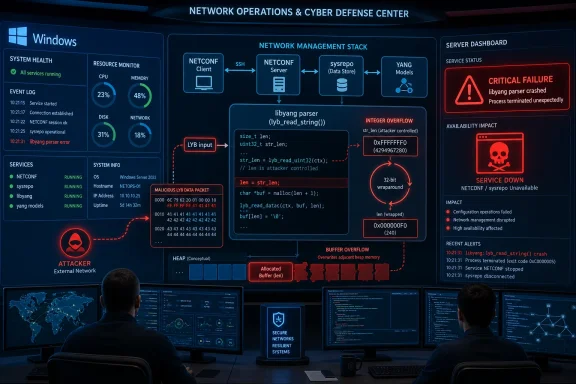
The flaw starts with an attacker-controlled string length. If a parser accepts a very large value and then performs arithmetic such as “length plus one” for a null terminator, the calculation can wrap around. In the public advisory’s example, an extreme 32-bit value can cause an allocation calculation to collapse into a tiny allocation, even zero bytes, while later operations still behave as if the original giant length were valid.
That is the ugly elegance of integer overflow bugs. The program’s mental model says “I allocated enough room for the string.” The CPU says “you asked for arithmetic in a fixed-width integer, and the result wrapped.” The allocator and the later copy routine then operate under different assumptions, and the heap becomes the scene of the crash.
In this case, the chain can involve an allocation that is too small, a read or copy based on a wrapped length calculation, and an out-of-bounds null terminator write. Any one of those would be enough to make a parser engineer wince. Together, they turn a string-length field into a denial-of-service primitive and a potential heap-corruption primitive.
Some administrators instinctively downgrade bugs that “only” crash things. That is a dangerous habit in network management software. If the affected process is a NETCONF server, configuration daemon, management plane service, or automation endpoint, a reliable crash can be more than an inconvenience.
Availability is not a secondary property in infrastructure. A management service that repeatedly dies can block changes, prevent recovery actions, interrupt provisioning, or leave operators blind during an incident. A vulnerability that does not read a secret or modify a route can still become operationally severe if it knocks out the component that lets humans and automation control the environment.
The supplied impact language captures this well: total loss of availability can be sustained while an attacker keeps delivering input, or persistent if the condition remains after the attack. Even partial availability loss can be serious if it prevents new sessions, starves memory, or forces repeated restarts. In infrastructure, “just a DoS” is often another way of saying “the control plane is now unreliable.”
A consumer might be a NETCONF server. It might be sysrepo. It might be a custom application that uses libyang to ingest configuration data. It might be an appliance component, a lab tool, a test harness, a container image, or a vendor daemon that quietly accepts LYB for performance reasons.
That indirection is what makes open-source parser vulnerabilities irritating to triage. The affected library may be easy to name, but the exposed attack surface depends on how it is compiled, linked, configured, and reachable. Some environments may have libyang installed but never parse untrusted LYB. Others may expose a parsing path to authenticated automation users. A smaller number may expose it before authentication or across a network boundary that defenders did not realize mattered.
The right response is therefore not a blanket panic and not a shrug. It is dependency-aware triage: find libyang, identify the consumers, determine whether LYB parsing is reachable by untrusted input, and patch or isolate accordingly.
NETCONF is widely associated with network automation and configuration management. Sysrepo is a datastore implementation commonly used with YANG-modeled configuration. Libyang sits underneath as the parser and data-modeling library. When that layer mishandles a binary blob, the blast radius depends on the management stack built above it.
For WindowsForum readers, the relevance may seem indirect until you look at how mixed estates actually run. Windows administrators increasingly manage Linux-based appliances, virtual network functions, Kubernetes workloads, WSL-based tooling, Azure-connected services, and vendor controllers from the same operational universe. A Windows shop can be exposed through the network gear it manages, the container images it deploys, or the automation services it trusts.
The lesson is not that NETCONF is uniquely dangerous. It is that management-plane protocols and their supporting libraries deserve the same scrutiny as internet-facing web servers. They often sit behind administrative ACLs, but they also sit close to the levers that keep the business running.
Security teams should resist both exaggeration and underreaction. If an environment does not accept LYB from unauthenticated network clients, that reduces exposure. If the only users who can reach the parser are trusted administrators on a segmented management network, the practical risk is different from a public-facing service.
But “authenticated” does not mean “safe.” Credentials are phished, automation tokens sprawl, contractors get access, and management networks are often less pristine than diagrams imply. A low-complexity crash reachable by any account or compromised tool in the management plane can still be a serious incident enabler.
The right question is not merely whether authentication exists. It is whether an attacker who compromises one automation identity, jump host, CI job, or vendor account can repeatedly feed hostile LYB to a process whose availability matters.
Modern allocators, compiler hardening, address-space layout randomization, control-flow protections, and process sandboxing can turn many heap bugs into reliable crashes rather than practical code execution. But defenders should not treat “RCE not confirmed” as the same thing as “RCE impossible.” The history of memory corruption is a history of exploitability moving as researchers learn the target.
The specific mechanics here are unattractive from a defensive standpoint because they involve attacker-controlled length, undersized allocation, large copy behavior in at least some input paths, and an out-of-bounds write. Those are ingredients exploit developers like to examine. Whether they can be assembled into reliable code execution depends on the consumer, platform, allocator, surrounding heap state, and available mitigations.
For most administrators, this distinction should shape priority rather than produce speculation. Patch the library because the DoS is real enough. Do not wait for a polished exploit chain proving code execution in a product you happen to run.
Source-built systems may be straightforward. Package-managed Linux servers can be queried. Containers can be scanned. But appliances, vendor controllers, statically linked binaries, and custom network automation tools can obscure the vulnerable dependency. The affected code may not appear as a standalone package at all.
This is the recurring frustration of open-source dependency response. The fix exists upstream before downstream consumers have all shipped updates. Security teams then sit in the gap between “the library is patched” and “the thing we actually run has integrated the patch.” That gap can last days, weeks, or longer depending on vendor responsiveness.
The operational response should therefore include both patching and compensating controls. If a vulnerable consumer cannot be updated immediately, restrict who can reach it, disable LYB ingestion where possible, monitor crash loops, and treat unexpected parser failures in management-plane services as security-relevant events.
This is especially true in enterprises that have embraced automation. A Windows-heavy organization may use PowerShell at the edge, GitHub or Azure DevOps in the pipeline, Linux containers in the middle, and NETCONF or RESTCONF southbound into network devices. The weak link may not be the workstation or the domain controller; it may be the parser in a service that converts modeled configuration into device state.
That is why Microsoft tracking a vulnerability like CVE-2026-44673 is useful even if the component is not a household Windows name. It puts the issue into the workflow where many defenders already watch for action items. It also reinforces a broader point: modern Windows security is not limited to Windows binaries.
The perimeter has become a bill of materials. If your business process depends on a component, that component’s memory safety bugs are your problem whether or not you installed them consciously.
The “scope unchanged” and “confidentiality none, integrity none” fields keep the score from becoming apocalyptic. This is not being presented as a credential-theft bug or direct configuration-tampering flaw. But for management-plane software, a crash can still produce second-order consequences. Systems that cannot be queried or configured at the right moment can fail in ways that are hard to explain to leadership with a neat CVSS label.
This is where defenders have to translate scoring into business impact. A lab sysrepo crash is a nuisance. A production configuration service crash during a network incident is a problem. A repeatedly triggered management-plane crash during a maintenance window can turn normal change into outage.
The same CVE can therefore deserve different urgency in different environments. The task is to classify exposure quickly enough that the decision is intentional rather than accidental.
Software bills of materials were supposed to help here, and sometimes they do. But SBOM usefulness still varies wildly. A vendor-provided SBOM that lists libyang and version information is valuable. A PDF data sheet that says “industry-standard open-source components” is not.
Container scanning can help if the vulnerable library is dynamically packaged. Endpoint detection may help if crashes generate signatures or core dumps. Vulnerability scanners may eventually flag affected packages. But statically linked binaries and appliance firmware remain difficult. The most exposed component may be the least transparent one.
This is why administrators should maintain not just asset inventories but dependency relationships for critical services. Knowing that a network automation controller uses sysrepo or libnetconf2 can shorten the response cycle dramatically. You do not need perfect knowledge of every transitive dependency to improve your odds; you need enough architectural knowledge to ask the right vendor the right question on day one.
The challenge is presentation. A CVE in the Security Update Guide can look equally urgent whether it affects a default Windows service, an optional library, or a downstream dependency that only matters in specific deployments. Administrators must read past the logo and into the affected component, attack vector, and exposure conditions.
That is not a criticism of Microsoft so much as a description of modern vulnerability management. Vendor advisory portals have become aggregation points for ecosystem risk. They are necessary, but they are not substitutes for environment-specific analysis.
For WindowsForum readers, the rule is simple: treat Microsoft’s listing as a prompt to investigate, not as proof that every Windows machine is exposed. Then follow the dependency chain until you reach something you actually run.
If you build from source, the path is direct. If you rely on a Linux distribution package, you wait for the distro or use a supported backport. If you rely on a vendor appliance, you wait for firmware or a hotfix. If you rely on a container image, you rebuild or pull a refreshed image. If you rely on a commercial controller, you need the vendor’s advisory, not just the upstream one.
This is the patch-management reality behind many “library vulnerabilities.” A single upstream CVE fans out into dozens of downstream remediation clocks. Some move fast. Some move quietly. Some do not move until customers ask loudly.
Administrators should therefore document vendor responses as part of the incident record. “Not affected because LYB parsing is disabled” is useful. “Affected, fix pending” is useful. Silence is itself a risk indicator. If a vendor ships infrastructure management software and cannot say whether it bundles libyang before SO 5.2.15, that is information worth retaining for renewal season.
Where possible, disable unneeded binary-format ingestion. If LYB is not required, do not expose it out of convenience. If the product supports multiple formats and only one path is vulnerable, narrowing accepted input formats may reduce risk, though administrators should verify this with vendor guidance rather than assume.
Monitoring is also important. Repeated crashes in NETCONF, sysrepo, or YANG-related services should not be filed merely as instability. A crafted input crash often looks like a reliability problem until someone correlates timing, source, and payload. Crash loops, abrupt daemon restarts, and unusual management-plane connection patterns deserve attention while remediation is pending.
Backups and recovery procedures matter too. Availability bugs are easier to tolerate when services restart cleanly and state is recoverable. They are much more serious when a crash corrupts state, blocks configuration deployment, or requires manual intervention at scale.
This does not mean every C library should be rewritten overnight. Libyang and similar projects exist because performance, portability, and ecosystem integration matter. Rewriting foundational parsers is expensive and risky. But the vulnerability class is not mysterious. Integer overflow feeding heap overflow is one of the oldest failure patterns in systems programming.
Better bounds checks, saturating arithmetic, hardened allocation helpers, fuzzing, and defensive parser design can reduce these bugs. Memory-safe languages can eliminate some classes entirely. In practice, most infrastructure will need a hybrid approach for years: harden the C and C++ we have, write new components more safely where possible, and put dangerous parsers behind narrow trust boundaries.
The policy debate often happens at lofty altitude. CVE-2026-44673 is the ground-level version: one length field, one parser, one heap, one management service that may or may not stay up when fed hostile bytes.
That does not mean advisories should be vague. Vague advisories help nobody except vendors hoping to minimize attention. But it does mean remediation timelines need to account for the fact that detailed parser bugs can become test cases quickly. If a proof-of-concept is essentially “put an extreme length field in the right place,” defenders should assume curious people will try.
The best answer is not secrecy; it is speed. Upstream fixes, downstream rebuilds, and accurate exposure guidance are the only sustainable response. Security teams should be wary of the comforting interval between disclosure and exploitation, because that interval keeps shrinking.
Network teams may know NETCONF. Linux teams may know libyang packages. Security teams may know the CVE. Windows teams may know the business impact when the management plane goes down. The organization is safest when those views meet quickly.
The worst-case internal response is fragmented ownership: Microsoft advisory goes to Windows admins, libyang advisory goes to Linux maintainers, network controller ownership sits with infrastructure, and nobody connects the dots. The bug then remains unpatched not because it was hard to fix, but because it was easy to misroute.
A mature response treats dependency vulnerabilities as cross-functional events. The question is not whose logo is on the advisory. The question is whose service can be crashed.
lyb_read_string() that can become a heap buffer overflow when malicious LYB data is parsed. The bug is not a Windows kernel flaw, and it is not a classic Microsoft-authored component story. But it is exactly the sort of open-source supply-chain vulnerability that now lands on Windows administrators’ desks because modern infrastructure is a mesh of vendor platforms, Linux-adjacent tooling, network automation stacks, containers, and third-party libraries.The short version is simple: libyang versions before SO 5.2.15 can be crashed by hostile LYB input in affected consumers, with heap corruption also in scope. The longer version is more interesting, because it shows how a small arithmetic mistake in a parser can graduate from “library bug” to “availability risk” when that parser sits behind NETCONF servers, sysrepo daemons, orchestration platforms, and appliance management interfaces.
 Microsoft’s Advisory Is a Supply-Chain Signal, Not a Windows Panic Button
CVE-2026-44673 is easy to misread if you encounter it through Microsoft’s Security Update Guide. The Microsoft page gives it the familiar shape of a Windows security item: a CVE number, severity language, impact framing, and the sober vocabulary of availability loss. That presentation can make every advisory look like Patch Tuesday, even when the vulnerable code originates elsewhere.Here, the vulnerable component is libyang, an open-source C library used to process YANG-modeled data. YANG is common in network configuration and management ecosystems, particularly where NETCONF, sysrepo, and related tooling are involved. The danger is therefore not that every Windows desktop suddenly has a new exposed parser waiting on the network; it is that administrators may have libyang embedded inside products, services, containers, appliances, or management stacks they do not inventory as “libyang.”
That is why Microsoft’s presence matters. The advisory is less a declaration that Windows itself is broken and more a reminder that Microsoft’s security perimeter now includes open-source dependencies, cloud images, network management workflows, and third-party components that may be consumed by Microsoft customers. In 2026, a vulnerability can be operationally relevant to Windows shops even when the vulnerable code was born in a Unix-shaped world.
The practical question is not “Do I run libyang on my laptop?” It is “Which product in my estate accepts LYB data, parses YANG-modeled content, or bundles libyang without making that dependency obvious?”
The Bug Is Arithmetic First, Memory Corruption Second
The vulnerable function,lyb_read_string(), lives in libyang’s LYB parser. LYB is libyang’s binary data format, designed for compact representation and efficient parsing. Binary formats tend to concentrate trust in length fields, and length fields are where integer bugs like to hide.The flaw starts with an attacker-controlled string length. If a parser accepts a very large value and then performs arithmetic such as “length plus one” for a null terminator, the calculation can wrap around. In the public advisory’s example, an extreme 32-bit value can cause an allocation calculation to collapse into a tiny allocation, even zero bytes, while later operations still behave as if the original giant length were valid.
That is the ugly elegance of integer overflow bugs. The program’s mental model says “I allocated enough room for the string.” The CPU says “you asked for arithmetic in a fixed-width integer, and the result wrapped.” The allocator and the later copy routine then operate under different assumptions, and the heap becomes the scene of the crash.
In this case, the chain can involve an allocation that is too small, a read or copy based on a wrapped length calculation, and an out-of-bounds null terminator write. Any one of those would be enough to make a parser engineer wince. Together, they turn a string-length field into a denial-of-service primitive and a potential heap-corruption primitive.
“Availability High” Is Not Security Theater
The CVSS framing for CVE-2026-44673 puts the emphasis on availability: network attack vector, low attack complexity, no privileges required, no user interaction, unchanged scope, no confidentiality impact, no integrity impact, and high availability impact. That combination produces a high-severity score without claiming data theft or privilege escalation.Some administrators instinctively downgrade bugs that “only” crash things. That is a dangerous habit in network management software. If the affected process is a NETCONF server, configuration daemon, management plane service, or automation endpoint, a reliable crash can be more than an inconvenience.
Availability is not a secondary property in infrastructure. A management service that repeatedly dies can block changes, prevent recovery actions, interrupt provisioning, or leave operators blind during an incident. A vulnerability that does not read a secret or modify a route can still become operationally severe if it knocks out the component that lets humans and automation control the environment.
The supplied impact language captures this well: total loss of availability can be sustained while an attacker keeps delivering input, or persistent if the condition remains after the attack. Even partial availability loss can be serious if it prevents new sessions, starves memory, or forces repeated restarts. In infrastructure, “just a DoS” is often another way of saying “the control plane is now unreliable.”
The Interesting Word Is “Consumer”
The public description says an attacker who can supply LYB data to any libyang consumer can trigger a crash or potential heap corruption. That word, consumer, is doing a lot of work. Libyang is not usually the product name printed on the box, the Windows service name in a console, or the line item in a procurement system.A consumer might be a NETCONF server. It might be sysrepo. It might be a custom application that uses libyang to ingest configuration data. It might be an appliance component, a lab tool, a test harness, a container image, or a vendor daemon that quietly accepts LYB for performance reasons.
That indirection is what makes open-source parser vulnerabilities irritating to triage. The affected library may be easy to name, but the exposed attack surface depends on how it is compiled, linked, configured, and reachable. Some environments may have libyang installed but never parse untrusted LYB. Others may expose a parsing path to authenticated automation users. A smaller number may expose it before authentication or across a network boundary that defenders did not realize mattered.
The right response is therefore not a blanket panic and not a shrug. It is dependency-aware triage: find libyang, identify the consumers, determine whether LYB parsing is reachable by untrusted input, and patch or isolate accordingly.
NETCONF and Sysrepo Make This a Management-Plane Story
The advisory explicitly calls out NETCONF servers using libnetconf2 and the sysrepo daemon as examples of affected consumers. That matters because these are not random desktop applications. They live in the operational layer where devices, services, and configurations are modeled, queried, and changed.NETCONF is widely associated with network automation and configuration management. Sysrepo is a datastore implementation commonly used with YANG-modeled configuration. Libyang sits underneath as the parser and data-modeling library. When that layer mishandles a binary blob, the blast radius depends on the management stack built above it.
For WindowsForum readers, the relevance may seem indirect until you look at how mixed estates actually run. Windows administrators increasingly manage Linux-based appliances, virtual network functions, Kubernetes workloads, WSL-based tooling, Azure-connected services, and vendor controllers from the same operational universe. A Windows shop can be exposed through the network gear it manages, the container images it deploys, or the automation services it trusts.
The lesson is not that NETCONF is uniquely dangerous. It is that management-plane protocols and their supporting libraries deserve the same scrutiny as internet-facing web servers. They often sit behind administrative ACLs, but they also sit close to the levers that keep the business running.
The Pre-Auth Caveat Deserves Careful Reading
The public advisory notes that NETCONF servers using libnetconf2 could be affected pre-auth if LYB is accepted on the wire. That is an important qualifier, not a throwaway aside. The difference between “remote unauthenticated crash” and “authenticated management user can crash a service” is operationally significant.Security teams should resist both exaggeration and underreaction. If an environment does not accept LYB from unauthenticated network clients, that reduces exposure. If the only users who can reach the parser are trusted administrators on a segmented management network, the practical risk is different from a public-facing service.
But “authenticated” does not mean “safe.” Credentials are phished, automation tokens sprawl, contractors get access, and management networks are often less pristine than diagrams imply. A low-complexity crash reachable by any account or compromised tool in the management plane can still be a serious incident enabler.
The right question is not merely whether authentication exists. It is whether an attacker who compromises one automation identity, jump host, CI job, or vendor account can repeatedly feed hostile LYB to a process whose availability matters.
Heap Corruption Keeps the Door Ajar
The confirmed impact is denial of service by crash. The advisory also leaves room for potential remote code execution if heap layout is controllable. That phrasing is appropriately cautious. Heap corruption is a category, not a guaranteed exploit.Modern allocators, compiler hardening, address-space layout randomization, control-flow protections, and process sandboxing can turn many heap bugs into reliable crashes rather than practical code execution. But defenders should not treat “RCE not confirmed” as the same thing as “RCE impossible.” The history of memory corruption is a history of exploitability moving as researchers learn the target.
The specific mechanics here are unattractive from a defensive standpoint because they involve attacker-controlled length, undersized allocation, large copy behavior in at least some input paths, and an out-of-bounds write. Those are ingredients exploit developers like to examine. Whether they can be assembled into reliable code execution depends on the consumer, platform, allocator, surrounding heap state, and available mitigations.
For most administrators, this distinction should shape priority rather than produce speculation. Patch the library because the DoS is real enough. Do not wait for a polished exploit chain proving code execution in a product you happen to run.
The Fix Is Simple; Finding Every Copy Is Not
The patched version is SO 5.2.15. In a clean world, that would end the story: upgrade libyang and move on. In the world administrators actually inhabit, the more difficult task is discovering where libyang is present and whether the product owner has shipped a rebuild.Source-built systems may be straightforward. Package-managed Linux servers can be queried. Containers can be scanned. But appliances, vendor controllers, statically linked binaries, and custom network automation tools can obscure the vulnerable dependency. The affected code may not appear as a standalone package at all.
This is the recurring frustration of open-source dependency response. The fix exists upstream before downstream consumers have all shipped updates. Security teams then sit in the gap between “the library is patched” and “the thing we actually run has integrated the patch.” That gap can last days, weeks, or longer depending on vendor responsiveness.
The operational response should therefore include both patching and compensating controls. If a vulnerable consumer cannot be updated immediately, restrict who can reach it, disable LYB ingestion where possible, monitor crash loops, and treat unexpected parser failures in management-plane services as security-relevant events.
Windows Administrators Are in the Blast Radius by Architecture
There was a time when a libyang bug would be filed mentally under “Linux networking people will handle it.” That boundary no longer holds. Windows environments now routinely depend on Linux-based control planes, open-source network daemons, containerized services, and vendor appliances that are administered from Windows consoles but secured through non-Windows components.This is especially true in enterprises that have embraced automation. A Windows-heavy organization may use PowerShell at the edge, GitHub or Azure DevOps in the pipeline, Linux containers in the middle, and NETCONF or RESTCONF southbound into network devices. The weak link may not be the workstation or the domain controller; it may be the parser in a service that converts modeled configuration into device state.
That is why Microsoft tracking a vulnerability like CVE-2026-44673 is useful even if the component is not a household Windows name. It puts the issue into the workflow where many defenders already watch for action items. It also reinforces a broader point: modern Windows security is not limited to Windows binaries.
The perimeter has become a bill of materials. If your business process depends on a component, that component’s memory safety bugs are your problem whether or not you installed them consciously.
The CVSS Vector Tells a Story About Operational Friction
The CVSS vector is stark: network reachable, low complexity, no privileges, no user interaction, availability high. Those fields are not a complete risk assessment, but they are a useful compression of why this bug is uncomfortable. An attacker does not need a local shell, a victim click, or an elaborate race condition if the vulnerable parse path is reachable.The “scope unchanged” and “confidentiality none, integrity none” fields keep the score from becoming apocalyptic. This is not being presented as a credential-theft bug or direct configuration-tampering flaw. But for management-plane software, a crash can still produce second-order consequences. Systems that cannot be queried or configured at the right moment can fail in ways that are hard to explain to leadership with a neat CVSS label.
This is where defenders have to translate scoring into business impact. A lab sysrepo crash is a nuisance. A production configuration service crash during a network incident is a problem. A repeatedly triggered management-plane crash during a maintenance window can turn normal change into outage.
The same CVE can therefore deserve different urgency in different environments. The task is to classify exposure quickly enough that the decision is intentional rather than accidental.
The Parser Bug That Becomes an Inventory Test
CVE-2026-44673 is also a test of software inventory maturity. Organizations that can answer “where is libyang?” within an hour are in a different class from organizations that need to open tickets with every vendor and hope someone knows. The difference is not merely bureaucratic; it changes the speed at which risk can be reduced.Software bills of materials were supposed to help here, and sometimes they do. But SBOM usefulness still varies wildly. A vendor-provided SBOM that lists libyang and version information is valuable. A PDF data sheet that says “industry-standard open-source components” is not.
Container scanning can help if the vulnerable library is dynamically packaged. Endpoint detection may help if crashes generate signatures or core dumps. Vulnerability scanners may eventually flag affected packages. But statically linked binaries and appliance firmware remain difficult. The most exposed component may be the least transparent one.
This is why administrators should maintain not just asset inventories but dependency relationships for critical services. Knowing that a network automation controller uses sysrepo or libnetconf2 can shorten the response cycle dramatically. You do not need perfect knowledge of every transitive dependency to improve your odds; you need enough architectural knowledge to ask the right vendor the right question on day one.
Microsoft’s Guide Reflects the New Normal of Shared Vulnerability Space
Microsoft’s security ecosystem increasingly surfaces issues that are not traditional Windows flaws. That can be annoying for administrators who want clean product boundaries, but it is healthier than pretending dependencies stop at corporate logos. Microsoft customers consume open-source code through cloud services, developer tools, Linux workloads, Windows Subsystem for Linux, container platforms, and third-party integrations.The challenge is presentation. A CVE in the Security Update Guide can look equally urgent whether it affects a default Windows service, an optional library, or a downstream dependency that only matters in specific deployments. Administrators must read past the logo and into the affected component, attack vector, and exposure conditions.
That is not a criticism of Microsoft so much as a description of modern vulnerability management. Vendor advisory portals have become aggregation points for ecosystem risk. They are necessary, but they are not substitutes for environment-specific analysis.
For WindowsForum readers, the rule is simple: treat Microsoft’s listing as a prompt to investigate, not as proof that every Windows machine is exposed. Then follow the dependency chain until you reach something you actually run.
The Patch Window Belongs to the Products That Bundle It
Upstream libyang has a fixed version. Downstream products need to absorb it. That is where many security programs stall, because the owner of the vulnerable library and the owner of the deployed product are often not the same entity.If you build from source, the path is direct. If you rely on a Linux distribution package, you wait for the distro or use a supported backport. If you rely on a vendor appliance, you wait for firmware or a hotfix. If you rely on a container image, you rebuild or pull a refreshed image. If you rely on a commercial controller, you need the vendor’s advisory, not just the upstream one.
This is the patch-management reality behind many “library vulnerabilities.” A single upstream CVE fans out into dozens of downstream remediation clocks. Some move fast. Some move quietly. Some do not move until customers ask loudly.
Administrators should therefore document vendor responses as part of the incident record. “Not affected because LYB parsing is disabled” is useful. “Affected, fix pending” is useful. Silence is itself a risk indicator. If a vendor ships infrastructure management software and cannot say whether it bundles libyang before SO 5.2.15, that is information worth retaining for renewal season.
Mitigation Starts With Reachability
If patching is delayed, exposure reduction should focus on who can feed LYB data to the parser. That means network segmentation, management-plane ACLs, authentication boundaries, and protocol configuration matter. A vulnerable parser behind a well-controlled administrative network is not equivalent to one reachable from a broad internal subnet.Where possible, disable unneeded binary-format ingestion. If LYB is not required, do not expose it out of convenience. If the product supports multiple formats and only one path is vulnerable, narrowing accepted input formats may reduce risk, though administrators should verify this with vendor guidance rather than assume.
Monitoring is also important. Repeated crashes in NETCONF, sysrepo, or YANG-related services should not be filed merely as instability. A crafted input crash often looks like a reliability problem until someone correlates timing, source, and payload. Crash loops, abrupt daemon restarts, and unusual management-plane connection patterns deserve attention while remediation is pending.
Backups and recovery procedures matter too. Availability bugs are easier to tolerate when services restart cleanly and state is recoverable. They are much more serious when a crash corrupts state, blocks configuration deployment, or requires manual intervention at scale.
This Is the Kind of Bug Memory-Safe Advocates Point To
CVE-2026-44673 is a small case study in why the industry keeps talking about memory safety. The vulnerable logic combines integer arithmetic, allocation sizing, binary parsing, and manual memory management. That is C’s danger zone. It is also where decades of infrastructure code still lives.This does not mean every C library should be rewritten overnight. Libyang and similar projects exist because performance, portability, and ecosystem integration matter. Rewriting foundational parsers is expensive and risky. But the vulnerability class is not mysterious. Integer overflow feeding heap overflow is one of the oldest failure patterns in systems programming.
Better bounds checks, saturating arithmetic, hardened allocation helpers, fuzzing, and defensive parser design can reduce these bugs. Memory-safe languages can eliminate some classes entirely. In practice, most infrastructure will need a hybrid approach for years: harden the C and C++ we have, write new components more safely where possible, and put dangerous parsers behind narrow trust boundaries.
The policy debate often happens at lofty altitude. CVE-2026-44673 is the ground-level version: one length field, one parser, one heap, one management service that may or may not stay up when fed hostile bytes.
The AI-Era Disclosure Footnote Is Worth Noticing
The GitHub advisory credits a reporter handle and gives detailed technical notes, including pseudocode and an explanation of the integer wraparound path. That level of disclosure is useful for defenders and maintainers, but it also shortens the distance between advisory and working reproducer. In 2026, vulnerability details are absorbed by automated scanners, code assistants, exploit developers, and defensive tools almost simultaneously.That does not mean advisories should be vague. Vague advisories help nobody except vendors hoping to minimize attention. But it does mean remediation timelines need to account for the fact that detailed parser bugs can become test cases quickly. If a proof-of-concept is essentially “put an extreme length field in the right place,” defenders should assume curious people will try.
The best answer is not secrecy; it is speed. Upstream fixes, downstream rebuilds, and accurate exposure guidance are the only sustainable response. Security teams should be wary of the comforting interval between disclosure and exploitation, because that interval keeps shrinking.
The Real Risk Is Hidden in Management Dependencies
CVE-2026-44673 is not the biggest vulnerability of the year, and it is not the kind of bug that should send every desktop administrator racing to reimage machines. Its importance lies elsewhere. It shows how infrastructure risk hides in dependencies that only a subset of teams can see.Network teams may know NETCONF. Linux teams may know libyang packages. Security teams may know the CVE. Windows teams may know the business impact when the management plane goes down. The organization is safest when those views meet quickly.
The worst-case internal response is fragmented ownership: Microsoft advisory goes to Windows admins, libyang advisory goes to Linux maintainers, network controller ownership sits with infrastructure, and nobody connects the dots. The bug then remains unpatched not because it was hard to fix, but because it was easy to misroute.
A mature response treats dependency vulnerabilities as cross-functional events. The question is not whose logo is on the advisory. The question is whose service can be crashed.
The libyang Fix Is a Small Patch With a Large Operational Lesson
The concrete actions here are not exotic, but they are easy to miss if the vulnerability is filed under the wrong mental category.- Organizations should identify systems, containers, appliances, and applications that use libyang before SO 5.2.15, especially NETCONF, sysrepo, libnetconf2, and custom YANG-processing software.
- Administrators should update to a fixed libyang build or apply vendor patches that incorporate the upstream correction, rather than assuming the operating system alone will remediate every bundled copy.
- Security teams should verify whether LYB parsing is reachable from untrusted, unauthenticated, or broadly authenticated network paths before assigning urgency.
- Operators should restrict access to management-plane services and disable unnecessary LYB input paths where supported while waiting for downstream fixes.
- Monitoring teams should treat repeated crashes in YANG, NETCONF, sysrepo, or related services as potentially hostile activity until logs and payload paths prove otherwise.
- Procurement and platform teams should ask vendors for dependency and remediation status when products bundle libyang, because silence around embedded open-source components is now an operational risk.
References
- Primary source: MSRC
Published: 2026-05-23T01:44:35-07:00
Security Update Guide - Microsoft Security Response Center
 msrc.microsoft.com
- Official source: microsoft.com
MSRC - Microsoft Security Response Center
The Microsoft Security Response Center is part of the defender community and on the front line of security response evolution. For over twenty years, we have been engaged with security researchers working to protect customers and the broader ecosystem.www.microsoft.com - Related coverage: talosintelligence.com
TALOS-2026-2359 || Cisco Talos Intelligence Group - Comprehensive Threat Intelligence
talosintelligence.com
- Related coverage: datacomm.com
- Related coverage: sentinelone.com
CVE-2026-24660: LibRaw Heap Buffer Overflow Vulnerability
CVE-2026-24660 is a heap buffer overflow vulnerability in LibRaw. Learn about its impact, affected versions, and mitigation methods.www.sentinelone.com
- Related coverage: deepaegis.io
- Related coverage: db.gcve.eu
Vulnerability-Lookup
Vulnerability-Lookup - Fast vulnerability lookup correlation from different sources.db.gcve.eu
