

CVE-2026-40034 is a high-severity command-injection vulnerability disclosed in 2026 in gitoxide’s
The headline risk is simple enough. A project that uses gitoxide libraries to inspect or update submodules may trust a submodule configuration value that should have been rejected, allowing attacker-controlled shell commands to cross the line from repository metadata into execution. The deeper lesson is more important: modern development machines are now part workstation, part build server, part package manager, and part automation endpoint, and bugs in “plumbing” libraries can become execution paths long before anyone thinks to call them exposed services.
Git submodules have always lived in a tense corner of the developer workflow. They are convenient when a project needs to pin another repository at a specific revision, but they also introduce a second trust decision inside the first one. You are not merely cloning a project; you are accepting instructions about where else to fetch code, how to arrange it, and, in some cases, how tooling should update it.
CVE-2026-40034 sits in that uncomfortable space. The affected component,
The vulnerable versions were described as
The Microsoft Security Response Center entry gives this issue visibility in the Windows security orbit, even though the weakness itself is in an open-source Git implementation rather than a Windows OS component. That distinction matters. It is not something Windows Update will necessarily solve for every affected environment, especially if the vulnerable code is vendored, statically linked, compiled into a developer tool, or packaged inside an internal application.
The bug was that the guard checked the wrong thing. It could see that a trusted local section existed for a submodule in
That mismatch creates the exploit path. A repository can first present a benign submodule configuration, leading the victim or automation to initialize the submodule and create partial local configuration. Later, the attacker changes
Git itself has long taken a harder line against this class of behavior. After earlier submodule-related command execution concerns, mainstream Git rejects dangerous update commands from
The difference between “Git would reject this” and “a Git library may accept this” is where enterprise risk often lives. Security teams routinely approve workflows based on the behavior of a familiar tool, only to discover that a scanner, package resolver, IDE extension, or build accelerator uses a different implementation underneath. The command line may be safe while the ecosystem around it is not.
A malicious repository does not need to scan the internet if it can wait for a developer, bot, CI worker, dependency updater, or code intelligence service to touch it. The attacker’s distribution mechanism is the software development workflow itself. A pull request, dependency update, fork, internal mirror, or third-party integration can all become plausible delivery routes if the vulnerable tool evaluates submodules in the wrong state.
That is especially relevant on Windows workstations, where Git is rarely just Git. Developers may interact with repositories through Visual Studio, VS Code extensions, GUI Git clients, security scanners, package managers, language servers, build scripts, WSL-mounted directories, PowerShell automation, and enterprise endpoint tooling. Each layer may parse repository metadata, inspect submodules, or run helper logic differently.
The “partial override” condition also makes the bug more realistic than a one-shot malicious repository that screams danger from the first clone. A benign initial state followed by a later malicious
The user-supplied availability language is not wrong, but it undersells the shape of the risk if read too narrowly. Availability can be destroyed by arbitrary commands, but the same primitive can threaten confidentiality and integrity as well. A command that deletes build artifacts is noisy; a command that modifies generated output, drops a credential harvester, or changes a build environment may be more damaging and less visible.
A command injection vulnerability triggered through repository state can therefore matter even when the immediate process has ordinary user privileges. The compromised process may inherit developer environment variables, access local credential stores, read project secrets, or modify files that later become part of a build. In a modern DevOps chain, the first machine touched is rarely the final target.
CI runners deserve the same scrutiny. Windows-based build agents often keep warm workspaces to save time, preserve tool caches, or support incremental builds. That is operationally sensible, but it also means repository state can persist across steps in ways that match the partial-initialization scenario. If a submodule was initialized in one stage and
The same goes for automated code review and dependency analysis. Tools that “only inspect” repositories often perform enough Git operations to matter. If an internal service fetches untrusted contributions, indexes branches, resolves submodules, or computes dependency graphs using gitoxide, it may be closer to the vulnerable path than its owners expect.
The Windows-specific response should therefore include endpoint and pipeline inventory, not just patch status on developer machines. Security teams should ask which products or internal services depend on
But Rust cannot make an unsafe trust decision safe. If code reads attacker-controlled configuration and treats it as permission to invoke a shell command, the language’s borrow checker is not the line of defense that matters. The bug lives at the semantic boundary between data and authority.
That is why command injection remains such a stubborn class of vulnerability. The dangerous operation is often legitimate in some contexts. Build systems, version-control tools, package managers, and deployment scripts all need to execute commands. The security problem is deciding who gets to supply those commands, when, and under which provenance rules.
CVE-2026-40034 is a provenance bug. The code did not merely forget to sanitize a string; it confused the presence of a trusted configuration section with proof that a particular value came from that trusted section. That kind of mistake is easy to miss in tests unless the tests model layered configuration, historical state, and hostile updates over time.
This is also why the fix matters beyond one crate. Defensive code should not ask vague questions like “does trusted configuration exist nearby?” It should ask precise questions such as “which source supplied this value, and is that source authorized to supply this kind of value?” That distinction sounds academic until it becomes an RCE advisory.
That matters for patch management. If an organization runs a tool that embeds gitoxide, the remediation path may be a crate update, a vendor update, a container rebuild, a CI runner image refresh, or a developer-tool upgrade. Traditional Windows patch dashboards may show green while the vulnerable library remains in a bundled executable.
The open-source dependency chain complicates accountability. A Rust crate may be pulled in indirectly by a tool that does not advertise gitoxide in its product name. A package may have been compiled months ago and deployed into an internal binary cache. A container image may include an old helper tool that no one thinks of as part of the attack surface because it only runs during builds.
This is where software bills of materials become more than compliance theater. An SBOM that can answer whether
Microsoft’s involvement also raises a practical point for Windows-heavy shops: development security is now platform security. The operating system, IDE, source-control stack, package ecosystem, cloud identity layer, and CI pipeline form one operational surface. Treating them as separate worlds produces blind spots attackers are happy to inhabit.
That sounds easy until you account for how developer tooling spreads. A single organization may have global developer images, self-hosted CI runners, GitHub Actions or Azure DevOps agents, local admin-installed utilities, containerized build environments, WSL distributions, and experimental tools maintained by individual teams. The vulnerable component may be in any of them.
The safest temporary mitigation is to avoid processing untrusted repositories or untrusted submodule changes with vulnerable gitoxide-based tooling. That is not always realistic, especially for organizations whose business is receiving code from customers, contractors, students, open-source contributors, or automated dependency feeds. But it is a useful policy line while inventory and updates catch up.
Security teams should also audit repository workflows that reuse working directories after submodule initialization. Fresh clones do not eliminate every problem, but state reuse is central to this particular attack shape. If a build pipeline initializes submodules once and then repeatedly pulls new commits into the same workspace, it deserves a closer look.
Detection is more difficult. The obvious artifact is suspicious
Many organizations treat
The uncomfortable part is that submodule state exists in multiple places. There is
The lesson for tool authors is direct. If a library implements Git behavior, matching Git’s security posture is not optional compatibility work. It is part of the feature. Users often rely on Git’s accumulated refusal cases without knowing them by name, and alternative implementations inherit that trust whether they ask for it or not.
For administrators, the policy response should be equally direct. Do not allow untrusted repositories to be processed by privileged automation simply because the workflow is “just Git.” Git metadata can influence execution paths through hooks, filters, submodules, build systems, package managers, and custom tooling. CVE-2026-40034 is one example in a larger pattern.
That concentration still covers valuable territory. Developer endpoints and CI runners are among the highest-leverage machines in an enterprise because they sit upstream of software delivery. An attacker who can influence what those machines execute may not need to break production directly.
Security teams should keep the response concrete:
gix-submodule Rust component, where a crafted .gitmodules update setting can be accepted after partial submodule initialization and later executed by vulnerable gitoxide-based consumers. The bug is not a Windows kernel emergency, and it is not a classic wormable network flaw. But it is exactly the kind of supply-chain weakness that should make Windows developers, CI operators, and security teams uncomfortable: a repository can become dangerous after it already looked safe.The headline risk is simple enough. A project that uses gitoxide libraries to inspect or update submodules may trust a submodule configuration value that should have been rejected, allowing attacker-controlled shell commands to cross the line from repository metadata into execution. The deeper lesson is more important: modern development machines are now part workstation, part build server, part package manager, and part automation endpoint, and bugs in “plumbing” libraries can become execution paths long before anyone thinks to call them exposed services.
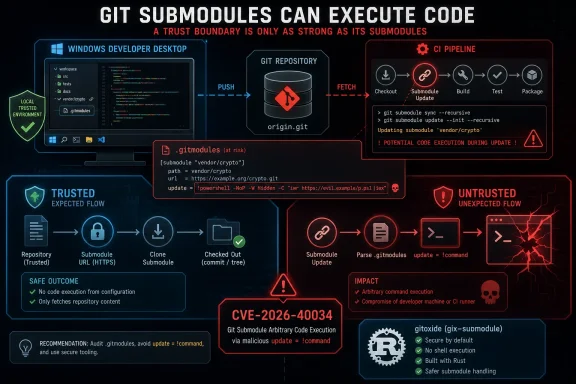 A Submodule Bug Lands Where Developers Least Want Ambiguity
Git submodules have always lived in a tense corner of the developer workflow. They are convenient when a project needs to pin another repository at a specific revision, but they also introduce a second trust decision inside the first one. You are not merely cloning a project; you are accepting instructions about where else to fetch code, how to arrange it, and, in some cases, how tooling should update it.CVE-2026-40034 sits in that uncomfortable space. The affected component,
gix-submodule, is part of the broader gitoxide project, a Rust implementation of Git functionality intended to be fast, modular, and embeddable. That means the exposure is not limited to a single command-line habit. The more relevant question is which developer tools, CI systems, scanners, indexers, package workflows, or internal platforms have adopted gitoxide crates and call the vulnerable submodule update path.The vulnerable versions were described as
gix-submodule before 0.29.0, gitoxide before 0.5.21, and gix before 0.84.0, with patched versions available in the relevant Rust package line. That version spread is not unusual in Rust ecosystems, where a project may be known by the workspace, crate, command, or library interface depending on who is looking. For administrators, the practical task is not to debate naming; it is to find dependencies that include the affected submodule handling code.The Microsoft Security Response Center entry gives this issue visibility in the Windows security orbit, even though the weakness itself is in an open-source Git implementation rather than a Windows OS component. That distinction matters. It is not something Windows Update will necessarily solve for every affected environment, especially if the vulnerable code is vendored, statically linked, compiled into a developer tool, or packaged inside an internal application.
The Exploit Hides in the Difference Between “A Trusted Section Exists” and “This Value Is Trusted”
The technical failure is subtle in exactly the way security bugs in configuration systems tend to be subtle. Gitoxide’s submodule code was supposed to block dangerousupdate = !command values from attacker-controlled .gitmodules files unless the value came from trusted local configuration. That guard exists because allowing a repository to define shell commands for update behavior is an obvious route to arbitrary execution.The bug was that the guard checked the wrong thing. It could see that a trusted local section existed for a submodule in
.git/config, and that existence was enough to satisfy the safety check. But the actual update value could still be read from .gitmodules, which is part of the repository content and therefore potentially attacker-controlled.That mismatch creates the exploit path. A repository can first present a benign submodule configuration, leading the victim or automation to initialize the submodule and create partial local configuration. Later, the attacker changes
.gitmodules to add a command-style update value. Because the local configuration section already exists but does not necessarily contain its own safe update value, vulnerable gitoxide logic can treat the submodule as trusted while still consuming the attacker’s command.Git itself has long taken a harder line against this class of behavior. After earlier submodule-related command execution concerns, mainstream Git rejects dangerous update commands from
.gitmodules rather than letting repository content silently define shell execution. CVE-2026-40034 is therefore not an indictment of every submodule workflow equally; it is a reminder that compatible implementations must reproduce not just Git’s features, but also its defensive scars.The difference between “Git would reject this” and “a Git library may accept this” is where enterprise risk often lives. Security teams routinely approve workflows based on the behavior of a familiar tool, only to discover that a scanner, package resolver, IDE extension, or build accelerator uses a different implementation underneath. The command line may be safe while the ecosystem around it is not.
The Attack Is Local, but the Delivery Vehicle Is Social and Distributed
The advisory data marks the issue as not remotely exploitable in the narrow CVSS sense, with user interaction required in the CVSS 3.1 view. That can make the vulnerability look less urgent than a network-facing RCE in a VPN appliance or web service. But for source-code supply-chain attacks, “local” often means “triggered by a repository your process willingly opened,” which is a different and increasingly important threat model.A malicious repository does not need to scan the internet if it can wait for a developer, bot, CI worker, dependency updater, or code intelligence service to touch it. The attacker’s distribution mechanism is the software development workflow itself. A pull request, dependency update, fork, internal mirror, or third-party integration can all become plausible delivery routes if the vulnerable tool evaluates submodules in the wrong state.
That is especially relevant on Windows workstations, where Git is rarely just Git. Developers may interact with repositories through Visual Studio, VS Code extensions, GUI Git clients, security scanners, package managers, language servers, build scripts, WSL-mounted directories, PowerShell automation, and enterprise endpoint tooling. Each layer may parse repository metadata, inspect submodules, or run helper logic differently.
The “partial override” condition also makes the bug more realistic than a one-shot malicious repository that screams danger from the first clone. A benign initial state followed by a later malicious
.gitmodules change fits normal collaboration patterns. Repositories evolve. Developers pull updates. Automation reuses working directories. That persistence is what turns a configuration bug into a workflow trap.The user-supplied availability language is not wrong, but it undersells the shape of the risk if read too narrowly. Availability can be destroyed by arbitrary commands, but the same primitive can threaten confidentiality and integrity as well. A command that deletes build artifacts is noisy; a command that modifies generated output, drops a credential harvester, or changes a build environment may be more damaging and less visible.
Windows Shops Should Read This as a Developer-Endpoint Problem
For WindowsForum readers, the most useful framing is not “does this affect Windows?” but “where does Windows execute developer automation that trusts Git metadata?” In many organizations, Windows developer laptops are privileged environments in everything but name. They hold source code, cloud tokens, package registry credentials, SSH keys, browser sessions, VPN access, and access to internal build systems.A command injection vulnerability triggered through repository state can therefore matter even when the immediate process has ordinary user privileges. The compromised process may inherit developer environment variables, access local credential stores, read project secrets, or modify files that later become part of a build. In a modern DevOps chain, the first machine touched is rarely the final target.
CI runners deserve the same scrutiny. Windows-based build agents often keep warm workspaces to save time, preserve tool caches, or support incremental builds. That is operationally sensible, but it also means repository state can persist across steps in ways that match the partial-initialization scenario. If a submodule was initialized in one stage and
.gitmodules changes later, a vulnerable consumer may encounter exactly the inconsistent trust boundary the bug requires.The same goes for automated code review and dependency analysis. Tools that “only inspect” repositories often perform enough Git operations to matter. If an internal service fetches untrusted contributions, indexes branches, resolves submodules, or computes dependency graphs using gitoxide, it may be closer to the vulnerable path than its owners expect.
The Windows-specific response should therefore include endpoint and pipeline inventory, not just patch status on developer machines. Security teams should ask which products or internal services depend on
gix, gitoxide, or gix-submodule, and whether those products are updated independently of the OS. If a vendor bundles the library, the version installed by Cargo on a developer’s machine may not tell the whole story.Rust’s Safety Story Still Ends at the Shell Boundary
There is a tempting but wrong lesson to draw from a Rust project having a command-injection vulnerability. This is not evidence that memory safety does not matter. Rust still helps eliminate large categories of memory corruption bugs that have haunted C and C++ software for decades.But Rust cannot make an unsafe trust decision safe. If code reads attacker-controlled configuration and treats it as permission to invoke a shell command, the language’s borrow checker is not the line of defense that matters. The bug lives at the semantic boundary between data and authority.
That is why command injection remains such a stubborn class of vulnerability. The dangerous operation is often legitimate in some contexts. Build systems, version-control tools, package managers, and deployment scripts all need to execute commands. The security problem is deciding who gets to supply those commands, when, and under which provenance rules.
CVE-2026-40034 is a provenance bug. The code did not merely forget to sanitize a string; it confused the presence of a trusted configuration section with proof that a particular value came from that trusted section. That kind of mistake is easy to miss in tests unless the tests model layered configuration, historical state, and hostile updates over time.
This is also why the fix matters beyond one crate. Defensive code should not ask vague questions like “does trusted configuration exist nearby?” It should ask precise questions such as “which source supplied this value, and is that source authorized to supply this kind of value?” That distinction sounds academic until it becomes an RCE advisory.
The MSRC Appearance Is a Signal, Not a Windows Patch Promise
Microsoft’s publication of a CVE entry can create an understandable assumption that the issue maps cleanly to Microsoft products or monthly Windows servicing. That is not necessarily the case here. MSRC tracks vulnerabilities that may affect Microsoft products, ecosystems, cloud services, dependencies, or customers, and its advisory presence is best read as a signal to investigate exposure rather than a guarantee that one Windows update closes every door.That matters for patch management. If an organization runs a tool that embeds gitoxide, the remediation path may be a crate update, a vendor update, a container rebuild, a CI runner image refresh, or a developer-tool upgrade. Traditional Windows patch dashboards may show green while the vulnerable library remains in a bundled executable.
The open-source dependency chain complicates accountability. A Rust crate may be pulled in indirectly by a tool that does not advertise gitoxide in its product name. A package may have been compiled months ago and deployed into an internal binary cache. A container image may include an old helper tool that no one thinks of as part of the attack surface because it only runs during builds.
This is where software bills of materials become more than compliance theater. An SBOM that can answer whether
gix-submodule or affected gix versions are present is immediately useful. One that lists only top-level products and omits transitive compiled dependencies will leave security teams guessing.Microsoft’s involvement also raises a practical point for Windows-heavy shops: development security is now platform security. The operating system, IDE, source-control stack, package ecosystem, cloud identity layer, and CI pipeline form one operational surface. Treating them as separate worlds produces blind spots attackers are happy to inhabit.
The Fix Is Straightforward; Proving You Are Fixed Is Not
The immediate remediation is to upgrade to patched versions of the affected gitoxide components. For Rust projects, that means updating dependency constraints, regenerating lockfiles where appropriate, rebuilding binaries, and redeploying tools that include the vulnerable crates. For consumers of packaged tools, it means tracking vendor advisories and confirming which gitoxide version is inside the build you actually run.That sounds easy until you account for how developer tooling spreads. A single organization may have global developer images, self-hosted CI runners, GitHub Actions or Azure DevOps agents, local admin-installed utilities, containerized build environments, WSL distributions, and experimental tools maintained by individual teams. The vulnerable component may be in any of them.
The safest temporary mitigation is to avoid processing untrusted repositories or untrusted submodule changes with vulnerable gitoxide-based tooling. That is not always realistic, especially for organizations whose business is receiving code from customers, contractors, students, open-source contributors, or automated dependency feeds. But it is a useful policy line while inventory and updates catch up.
Security teams should also audit repository workflows that reuse working directories after submodule initialization. Fresh clones do not eliminate every problem, but state reuse is central to this particular attack shape. If a build pipeline initializes submodules once and then repeatedly pulls new commits into the same workspace, it deserves a closer look.
Detection is more difficult. The obvious artifact is suspicious
update = !... content in .gitmodules, but a mature attacker will not necessarily leave a cartoonish payload behind. Reviewing changes to .gitmodules should become part of code review hygiene, particularly in repositories that feed privileged automation.Submodules Are a Policy Boundary, Not Just a Git Feature
The recurring security problem with submodules is that they blur ownership. A top-level repository can point to other code, other hosts, other credentials, and other update behavior. That is powerful, but it means repository metadata becomes policy.Many organizations treat
.gitmodules as low-risk project plumbing. It should be treated more like a dependency manifest with execution implications. Changes to submodule URLs, paths, branches, and update behavior should be reviewed with the same suspicion applied to build scripts and CI configuration.The uncomfortable part is that submodule state exists in multiple places. There is
.gitmodules in the repository, local .git/config, Git’s internal modules directory, and whatever abstractions a library builds on top. A safety check that works for a clean clone may fail after initialization, migration, or repeated pulls. That is exactly the kind of temporal complexity attackers exploit.The lesson for tool authors is direct. If a library implements Git behavior, matching Git’s security posture is not optional compatibility work. It is part of the feature. Users often rely on Git’s accumulated refusal cases without knowing them by name, and alternative implementations inherit that trust whether they ask for it or not.
For administrators, the policy response should be equally direct. Do not allow untrusted repositories to be processed by privileged automation simply because the workflow is “just Git.” Git metadata can influence execution paths through hooks, filters, submodules, build systems, package managers, and custom tooling. CVE-2026-40034 is one example in a larger pattern.
The Practical Message for Windows Build Rooms Is Narrow but Urgent
This is not the sort of vulnerability that should trigger panic across every Windows desktop. It does not mean every repository with submodules is hostile, nor does it mean the built-in Git tooling most users run will behave like the vulnerable gitoxide path. The risk concentrates where affected gitoxide libraries are used to process repositories that an attacker can influence.That concentration still covers valuable territory. Developer endpoints and CI runners are among the highest-leverage machines in an enterprise because they sit upstream of software delivery. An attacker who can influence what those machines execute may not need to break production directly.
Security teams should keep the response concrete:
- Organizations should identify tools and internal services that depend on
gix, gitoxide, orgix-submodule, including statically linked binaries and container images. - Developers and CI maintainers should upgrade affected gitoxide components to patched releases and rebuild anything that embeds them.
- Teams should treat changes to
.gitmodulesas security-relevant code review events, especially when submodules have already been initialized in persistent workspaces. - Build systems should avoid running vulnerable Git-compatible tooling against untrusted repositories, forks, or pull requests until dependency exposure is confirmed.
- Windows shops should remember that OS patch compliance does not prove open-source developer tooling is patched.
- Security monitoring should flag suspicious
update = !patterns in repository metadata, while recognizing that prevention through patching is the more reliable control.
References
- Primary source: MSRC
Published: 2026-06-13T01:43:07-07:00
Security Update Guide - Microsoft Security Response Center
 msrc.microsoft.com
- Related coverage: datacomm.com
- Related coverage: radar.offseq.com
gitoxide - Command Injection via Partial .gitmodules Override in gix-submodule - Live Threat Intelligence - Threat Radar | OffSeq.com
Detailed information about gitoxide - Command Injection via Partial .gitmodules Override in gix-submodule affecting Microsoft Security Response Center Microsoftradar.offseq.com - Related coverage: mondoo.com
CVE-2026-40034 | Mondoo Vulnerability Intelligence
CVE-2026-40034 - HIGH severity: gitoxide - Command Injection via Partial .gitmodules Override in gix-submodulemondoo.com - Related coverage: thehackerwire.com
CVE-2026-40034 - High Vulnerability - TheHackerWire
TheHackerWire - Your daily source for cybersecurity news, CVE alerts, hacking tutorials, and security tool reviews. Stay ahead of cyber threats.www.thehackerwire.com
- Related coverage: security.snyk.io
- Related coverage: synscan.net
gitoxide: CommandForbiddenInModulesConfiguration Bypass in gix_submodule::File::update() Enables Arbitrary Command Execution via .gitmodules | SynScan
gitoxide: CommandForbiddenInModulesConfiguration Bypass in gix_submodule::File::update() Enables Arbitrary Command Execution via .gitmodules is a high-severity vulnerability affecting gix (2026). Check if your assets are exposed with SynScan.synscan.net - Related coverage: dbugs.ptsecurity.com
CVE-2026-40034 — Remote Code Execution in Gix+2 Gix+2 | dbugs
Details on CVE-2026-40034: Remote Code Execution in Gix+2 Gix+2. Exploited in the wild. Includes CVSS score, affected versions, and references.dbugs.ptsecurity.com - Related coverage: labs.cloudsecurityalliance.org
MCP STDIO Design Flaw Enables Systemic AI Supply Chain RCE
PDF documentlabs.cloudsecurityalliance.org
- Related coverage: indusface.com
- Related coverage: uvcyber.com
