

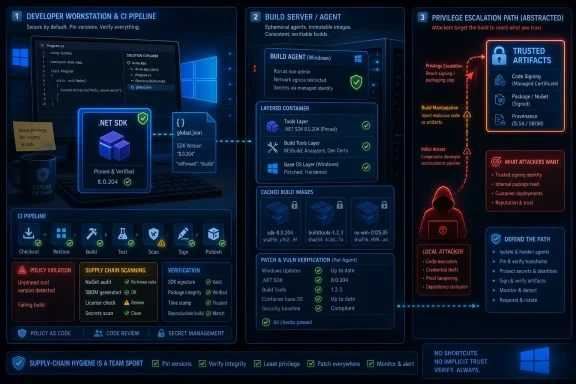
The SDK Is Not Just a Developer Convenience
The phrase “.NET SDK vulnerability” can sound narrow, almost academic, compared with a kernel bug or a remote-code-execution flaw in Exchange. That is the wrong instinct. The SDK is not a passive download that sits beside Visual Studio; it is the executable machinery behind builds, restores, templates, analyzers, workload installation, and command-line project operations.
That matters because developer machines are often privileged in ways ordinary endpoints are not. They may hold package-feed credentials, code-signing access, cloud deployment tokens, internal repository access, and cached secrets that are supposed to be invisible to the finished application. A flaw that lets an already-authorized local attacker elevate privileges is not the opening move in an intrusion, but it can be the move that turns a foothold into control.
Elevation-of-privilege vulnerabilities are often treated as second-tier Patch Tuesday fare because they usually require prior access. In enterprise reality, prior access is exactly what modern intrusions are designed to obtain. Phishing, malicious packages, exposed credentials, rogue browser extensions, and poisoned internal tools all aim to land on a machine first; privilege escalation is what makes the landing durable.
The SDK angle sharpens the concern. If an attacker can move from a low-privilege account to a higher-privilege context on a build host, the next question is not simply “what files can they read?” It is “what software can they influence before it becomes trusted by everyone else?”
Microsoft’s Sparse Advisory Is Itself Part of the Story
Microsoft’s advisory labels CVE-2026-45490 as a .NET SDK elevation-of-privilege vulnerability, but the publicly visible information appears limited. That is normal for many Patch Tuesday disclosures, especially when the vendor is trying to give defenders enough to act without handing attackers a recipe. It is also frustrating for administrators who must rank risk under time pressure.
The user-supplied excerpt points to the report confidence concept: a metric concerned with how certain the vulnerability is and how credible the known technical details are. In plain English, defenders want to know whether a CVE is a rumor, a plausible but underexplained weakness, or a vendor-confirmed flaw with enough specifics that exploit developers can work from it. For Microsoft-listed CVEs, the vendor acknowledgment typically removes the first kind of ambiguity: the bug is real enough to patch.
But confidence in existence is not the same as clarity about exploitation. A terse advisory can confirm that the flaw exists while leaving open important operational questions: whether exploitation requires a malicious project file, a local account, a build step, a specific workload, or a particular SDK feature band. Those distinctions matter, but they should not become excuses for inaction.
Security teams often overfit their patch priorities to disclosure detail. A vulnerability with a vivid exploit narrative feels urgent, while a dry SDK advisory feels administrative. That bias is backward. Lack of public detail may mean lower immediate attacker knowledge, but it also means defenders have less basis for crafting compensating controls.
Local Bugs Become Strategic on Shared Build Infrastructure
The “local attacker” requirement is the most misunderstood phrase in vulnerability management. On a single-user laptop, it may imply that the attacker already has enough access to cause trouble. On a shared build server, a virtual desktop pool, a lab machine, or a multi-tenant development workstation, local access is a starting condition, not a conclusion.
Many organizations run CI agents under service accounts with broad permissions. Others allow developers to queue builds that execute project-controlled scripts, restore packages from multiple feeds, or run custom MSBuild targets. In those environments, the boundary between “developer input” and “local code execution” is thinner than policy documents suggest.
That does not mean CVE-2026-45490 should be treated as a catastrophic supply-chain compromise by default. The public advisory does not establish that. The more sober conclusion is that SDK vulnerabilities deserve a different mental model from app-runtime vulnerabilities. They sit at the intersection of endpoint security, developer productivity, and release integrity.
A compromised build agent is not merely another infected server. It is a machine that may produce artifacts other systems are trained to trust. That is why the safest patching posture is to prioritize systems where the SDK participates in automated builds, package creation, signing, deployment, or privileged developer workflows.
Version Pinning Can Quietly Preserve the Vulnerability
The .NET ecosystem gives teams good reasons to pin SDK versions. A global.json file can keep builds reproducible, avoid surprise compiler behavior, and prevent a developer on a newer machine from accidentally changing project output. In mature environments, pinning is not laziness; it is engineering discipline.
The problem is that pinned toolchains can outlive their security assumptions. If a repository selects an older SDK feature band and the organization installs a patched SDK side-by-side, the vulnerable version may still be the one the build uses. The machine can look “updated” in inventory while the project remains tied to a risky executable path.
This is where .NET’s side-by-side design cuts both ways. It is excellent for compatibility, because multiple SDKs can coexist. It is awkward for security, because “we installed the update” does not necessarily mean “our builds stopped invoking the vulnerable SDK.” Administrators need to verify the SDK actually selected by real builds, not just the newest version present on disk.
The practical check is simple in concept: inspect installed SDKs, inspect repository pinning, and confirm the selected SDK during CI runs. The operational work is messier, especially in large estates where self-hosted agents, hosted pools, developer laptops, containers, and ephemeral runners all have different update paths.
Visual Studio Makes the Patch Path Easier, and More Opaque
For many Windows developers, the .NET SDK arrives through Visual Studio rather than as a standalone installation. That is convenient, but it can also obscure responsibility. A developer may believe Windows Update covers the risk, while the actual patch path runs through Visual Studio Installer, a refreshed SDK download, a build image update, or a container base image rebuild.
Microsoft’s own documentation has increasingly treated SDK currency as a first-class security concern. Recent .NET tooling includes warnings for SDKs with known vulnerabilities, end-of-life SDKs, and discontinued feature bands when the relevant checks are enabled. That is a welcome shift because it moves security feedback closer to the moment of build.
The catch is that warnings are not universal policy. They can depend on build properties, metadata cache freshness, network access, and whether organizations choose to enable or suppress them. A build that says nothing is not necessarily a build that is safe.
This is where security and developer experience often collide. Developers hate surprise build failures, and security teams hate silent toolchain drift. The better compromise is not to break every build on first detection, but to make SDK vulnerability checks visible in CI, track exceptions explicitly, and move from warning to enforcement after a short remediation window.
The Real Patch Boundary Is the Build Graph
Traditional endpoint patching asks whether a machine has received an update. Toolchain patching asks a harder question: what did this repository, on this agent, at this time, actually use to produce this binary? That question is closer to software supply-chain assurance than desktop administration.
The build graph includes more than the dotnet executable. It includes SDK feature bands, workloads, NuGet package sources, MSBuild targets, project templates, analyzers, source generators, and scripts invoked before and after compilation. A vulnerability in the SDK may involve only one of those surfaces, but administrators rarely know which one at disclosure time.
That is why build environments need the same asset discipline that production servers have slowly acquired. Organizations should know where .NET SDKs are installed, which versions are allowed, which repositories pin versions, and which agents can produce release artifacts. Without that map, every SDK CVE becomes a scavenger hunt.
Containers do not eliminate the problem. They make it easier to reproduce. If a build image contains a vulnerable SDK, every pipeline that uses that image inherits the issue consistently and efficiently. The fix is likewise image-centric: rebuild base images, update references, and ensure old layers are not silently reused by caches.
Exploitability Is Not the Same as Exposure
CVE scoring language can tempt readers into treating vulnerabilities as abstract math. Attack vector, privileges required, user interaction, and confidence metrics are useful, but they are not a substitute for understanding exposure. A local elevation bug on a locked-down kiosk and the same bug on a release-signing workstation are not equal risks.
For CVE-2026-45490, the exposed population likely centers on systems with the .NET SDK installed. That includes developer workstations, self-hosted build agents, educational labs, test servers, and some production machines that should probably not have an SDK installed at all. Runtime-only servers may be in a different category, depending on whether the affected component is present.
That distinction is important for WindowsForum readers because .NET often appears in multiple forms on the same estate. There is the runtime used to run applications, the ASP.NET Core runtime used by web workloads, the desktop runtime used by GUI apps, and the SDK used to build software. A CVE in the SDK should trigger inventory that separates those roles instead of treating “.NET installed” as one bucket.
The healthiest response is measured urgency. Do not assume every machine with .NET is exploitable. Do not assume developer machines are low-risk because they are “internal.” The right answer is to identify where the SDK exists, determine whether Microsoft has shipped a fixed version for the relevant supported branches, and update the places where the SDK can affect privilege or build integrity.
The Disclosure Gap Favors Teams With Boring Inventory
When advisories are terse, mature operations teams gain an advantage. They do not need a blog post with proof-of-concept screenshots to begin work. They already know which machines run which toolchains, how SDK versions enter their environment, and how to roll a new build image through CI.
Less mature teams get stuck asking basic questions under pressure. Do we install the SDK through Visual Studio or standalone installers? Do our hosted agents update automatically? Do we pin SDKs in repositories? Do container builds use Microsoft base images, internal mirrors, or stale private copies? Are old SDKs still present because one legacy project needs them?
Those questions are not glamorous, but they are the difference between patching and hoping. Toolchain vulnerabilities punish environments where development infrastructure has grown informally. The longer a company has allowed build agents to become pets, the harder a CVE like this is to close cleanly.
The irony is that developers usually understand dependency management better than anyone. They live with lock files, semantic versioning, transitive dependencies, and reproducibility. The missing step is applying that same rigor to the SDK itself. The compiler and build system are dependencies too.
Security Teams Should Resist the Urge to Treat This as Just Another Patch
A conventional patch ticket might say: deploy the latest .NET SDK and close when complete. That is tidy, auditable, and insufficient. The better ticket asks for evidence that vulnerable SDK versions are no longer selected by supported builds, especially on release-producing infrastructure.
There is also a policy opportunity here. Organizations should decide how long an SDK version may remain pinned after a security update supersedes it. They should decide whether CI merely warns on a vulnerable SDK or blocks release builds. They should decide who owns exceptions when a legacy project cannot move.
The answer will differ by environment. A hobbyist workstation can patch opportunistically. A regulated enterprise should have a defined service-level agreement for build toolchain CVEs. A software vendor should treat release pipelines as high-value assets and patch them with the urgency normally reserved for internet-facing systems.
The common thread is that the SDK cannot be invisible. If it can compile, sign, package, or deploy code, it is part of the security boundary. CVE-2026-45490 is a reminder that the tools used to make software require the same scrutiny as the software they make.
The Patch Tuesday Lesson Is Hiding in the Toolchain
The immediate operational message is straightforward, but the broader lesson is more durable. CVE-2026-45490 should push Windows and .NET shops to look beyond the presence of a patch and toward the lifecycle of the SDK across their development estate.
- Teams should identify every developer workstation, CI runner, container image, and build server where the .NET SDK is installed, not merely where .NET applications run.
- Administrators should verify the SDK version selected during actual builds, because side-by-side installation and
global.jsonpinning can keep older SDKs active. - Build images and self-hosted agents should be rebuilt or refreshed after SDK servicing updates, with cache behavior reviewed so stale layers do not survive the patch.
- Organizations should enable or monitor SDK vulnerability warnings in build workflows where practical, then define when warnings become release-blocking policy.
- Legacy projects that require old SDK feature bands should be treated as explicit exceptions with owners, timelines, and compensating controls.
- Production servers should be checked for unnecessary SDK installations, because machines that only run applications generally should not need the full build toolchain.
The most important takeaway is that Microsoft’s advisory should not be read as a narrow developer footnote. It is a prompt to ask whether the organization understands its build environment well enough to patch it with confidence.
CVE-2026-45490 may ultimately prove to be a routine SDK servicing item rather than a headline-grabbing exploit chain, but routine is exactly where security programs win or lose. The future of Windows security will not be defined only by kernel hardening, Defender detections, or splashy zero-days; it will also be defined by whether organizations can keep their developer toolchains current, observable, and boring.