

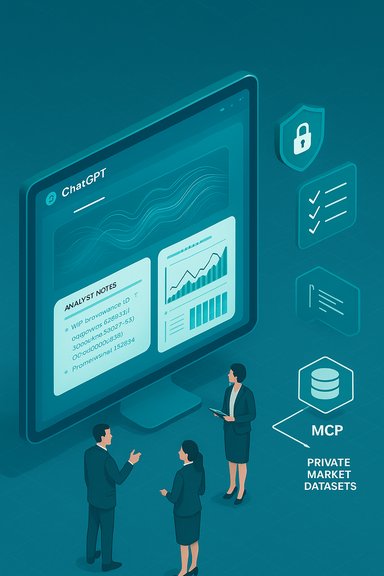
Morningstar and PitchBook have taken a decisive step into the agentic AI era by launching Model Context Protocol (MCP)–based apps inside ChatGPT, enabling licensed users to query proprietary public- and private-market data and analyst research through natural-language prompts without leaving the ChatGPT environment. The integration—announced in mid‑December 2025—promises faster, conversational access to analyst‑backed ratings, research, and private-capital intelligence, while also raising immediate questions about security, data governance, licensing, and regulatory compliance for financial institutions that adopt these new workflows.
Background
Who, what, and why it matters
Morningstar is a global provider of investment research and data, and PitchBook (a Morningstar company) is a leading source for private capital market intelligence. Together they maintain large collections of proprietary datasets—public company fundamentals and ratings, and detailed private-market records including deals, valuations, investors, funds, and people. In mid‑December 2025 the firms released MCP-powered apps for ChatGPT that allow entitled users (that is, licensed or licensed-and-authenticated customers) to access those datasets and analyst insights by typing plain-English questions into ChatGPT.This move is part of a broader trend: data vendors and enterprise software vendors are embedding their intellectual property directly into LLM-powered assistants so professionals can retrieve, synthesize, and act on data inside conversational interfaces. For investment teams, the upside is clear—much faster access to curated, analyst‑vetted knowledge; for IT, security teams, and compliance functions, the move introduces new integration and oversight responsibilities.
What is the Model Context Protocol (MCP)?
The Model Context Protocol is a standardized mechanism that lets language models and agentic AI systems securely request and receive structured context, documents, and tool access from third‑party services. MCP creates a predictable interface for AI agents to call into external data sources and enterprise systems, similar in spirit to how APIs standardized the first wave of web integration. The protocol underpins many modern “apps” inside LLM platforms and supports features like fine-grained entitlement, session tracking, and provenance metadata—capabilities that are central to applying LLMs in regulated industries such as finance.What Morningstar and PitchBook put into ChatGPT
Core features announced
- Natural‑language Q&A: Users can ask conversational questions and receive instant, sourced answers drawn from Morningstar’s and PitchBook’s authoritative datasets and analyst content.
- In‑chat access to ratings and research: Analyst‑backed ratings, research notes, company profiles, and private‑market intelligence become available inside the ChatGPT session.
- Enterprise‑grade security and data governance: The integration is designed around licensed entitlements, with claims of governance, logging, and secure access patterns suited for financial services workflows.
- Seamless workflow: The aim is to remove the context-switch between a web portal and a conversational assistant—users can prototype ideas, summarize research, and gather data inside ChatGPT before moving to their downstream tools.
How it differs from simple web scraping or public knowledge
These integrations are not merely scraping public web pages or summarizing freely available content. They expose proprietary data—private company records, licensable ratings, and curated analytics—that require authentication and usage controls. That distinction matters: the value proposition is not convenience alone, it’s delivering licensed content with provenance and analyst context that subscribers pay for.Technical and operational anatomy
How MCP enables a secure integration
MCP standardizes the contract between the LLM platform and the data provider. Typical components include:- Entitlement checks and tokenized access: The client authenticates to ChatGPT and explicitly authorizes access to a vendor’s connector. The connector then enforces entitlements based on the user’s subscription level.
- Provenance metadata: Returned results include references to the underlying dataset and analyst note IDs, allowing traceability and citation inside generated responses.
- Scoped access: MCP-based endpoints can expose only specific tables, query endpoints, or document types—minimizing blast radius.
- Audit logging and telemetry: Calls are logged for governance, showing who accessed what, when, and under which license.
Typical architecture pattern (high level)
- User authenticates to ChatGPT (platform SSO).
- User installs or enables the Morningstar/PitchBook app in ChatGPT and consents to data access.
- ChatGPT issues MCP calls to the vendor connector with the user’s identity and session tokens.
- The connector validates entitlements, queries the vendor backend, and returns structured results with provenance tags.
- ChatGPT composes a natural‑language response that includes sourced data snippets and citations to the vendor’s content.
Use cases and practical value
For investment teams and advisors
- Rapid answers to due-diligence questions: “What were the last three funding rounds for Company X, and who led them?”
- Quick portfolio analysis and summarization: Natural‑language summaries of a fund’s exposure, major holdings, and flagged risks.
- Conversation-driven research: Generate meeting-ready talking points and cite analyst conclusions without manual copying.
- Deal sourcing and screening: Use conversational prompts to scan private-market opportunity sets and shortlist targets.
For enterprise IT and platform teams
- Embedding trusted data into workflows used by traders, analysts, and advisors accelerates decision cycles and reduces friction between discovery and execution.
- The MCP connector approach keeps the heavy lifting inside the vendor’s controlled environment, which simplifies integration for enterprise architects.
Strengths: Where this approach delivers real value
- Speed to insight: Conversational retrieval significantly reduces the time needed to gather background and analyst context, enabling shorter research cycles.
- Sourced outputs: When configured correctly, responses include provenance and allow users to trace assertions back to analyst notes—critical for auditability and compliance.
- Improved accessibility: Non-technical users benefit from natural‑language access to complex datasets that previously required specialized queries or portal navigation.
- Enterprise integration patterns: MCP encourages a standardized, auditable integration model that vendors and platforms can reuse across ecosystems.
- Vendor control and IP protection: By exposing data through controlled MCP connectors, vendors can better manage who sees licensed content and how it’s used.
Risks and limits: What enterprises must consider
1. Model hallucination and over‑trust
LLMs can invent facts or misattribute insights. Even when drawing from vendor datasets, hallucinations remain possible if the model synthesizes beyond the supplied context. Organizations must avoid treating generated text as definitive advice without human verification.2. Licensing and contractual ambiguity
The apps claim “entitled” access, but specifics—what counts as a permitted use, whether derivative LLM outputs can be redistributed, and how usage fees are applied—are often defined in vendor contracts and platform policies. These commercial and IP boundaries are not fully standardized; procurement and legal teams must review terms carefully.3. Data leakage and exfiltration risk
Conversational agents that can call external connectors still run on hosted LLM infrastructure. A misconfiguration, inadequate scoping, or a flawed connector implementation could expose sensitive query patterns, proprietary datasets, or customer lists. Strong data classification, least‑privilege access, and network isolation are essential.4. Regulatory and compliance constraints
Regulated entities must ensure audit trails, record retention, and supervisory oversight of algorithmic outputs. For use cases tied to client advice, firms must document whether recommendations were human‑supervised, the provenance of the underlying data, and the process for validation.5. Operational reliability and latency
Private-market datasets are large and change frequently. Ensuring low-latency responses to conversational queries requires robust backend design, caching strategies, and clear SLAs—areas where vendor and platform terms should be scrutinized.6. Vendor lock‑in and interoperability
While MCP aims to be a standard, differences in mapping, metadata conventions, and entitlement models across vendors can complicate multi‑vendor workflows. Firms should plan for vendor-agnostic data pipelines and exportability where possible.Governance and security checklist for IT and compliance teams
- Identity and access
- Enforce enterprise SSO for ChatGPT and require multi‑factor authentication for administrative tasks.
- Map entitlements to existing license objects in your vendor contracts.
- Least privilege and scoping
- Limit connector scope to only the datasets and operations necessary for the role.
- Avoid giving broad data or write permissions to conversational agents.
- Auditability and logging
- Ensure the connector produces immutable logs with user identity, query payload, returned results, and timestamps.
- Route logs to centralized SIEM/archival systems for long‑term retention and supervisory review.
- Data loss prevention (DLP)
- Apply DLP policies to intercept any attempts to export sensitive strings (e.g., client PII, account numbers, or proprietary investment memos).
- Block or flag transcript exports, file downloads, and third‑party forwarding as needed.
- Model output controls
- Require that all produced investment recommendations include provenance metadata and a human‑review checkbox before client communication.
- Maintain a human-in-the-loop policy for any investment decisions or formal advice.
- Contract and licensing review
- Validate permitted uses with vendor legal teams (internal redistribution, training LLMs on proprietary outputs, archival of generated text).
- Clarify overage charges, data egress fees, and audit rights ahead of production use.
- Employee training and policy
- Train analysts and advisors on the limitations and appropriate uses of LLM-generated content.
- Build internal policies that define acceptable prompts, prohibited data, and escalation paths for uncertain outputs.
How to evaluate vendor claims and assurances
- Request demonstrable security artifacts: third‑party audits, SOC 2 / ISO 27001 attestations, and penetration test summaries.
- Insist on technical documentation of the connector: how entitlements are enforced, what metadata is returned, and what guarantees exist around data retention.
- Perform a proof-of-concept with realistic datasets and failure scenarios: measure latency, provenance quality, and the behavior of the system when the connector returns partial or contradictory data.
- Validate dispute and takedown procedures: who is responsible if an analyst note is updated after being cited in a generated response, and how will that correction propagate?
The broader strategic picture
Morningstar’s stated ambition: the “intelligence layer” for investing
Morningstar positions itself as an “investing intelligence layer,” marrying proprietary datasets with AI to become the canonical source of analyst-backed insights. Embedding those insights in conversational platforms expands their reach: analysts may now be asked for a “one‑sentence view” inside ChatGPT before an advisor finishes a client call.PitchBook’s private-market focus
PitchBook’s private-capital data uniquely benefits from conversational search: sourcing deal histories, LP relationships, and exit scenarios are fertile ground for agentic workflows. PitchBook has also been rolling out in‑platform generative tools; exposing that data into ChatGPT represents a strategic channel expansion.Competitive and ecosystem implications
- Data vendors that secure standardized MCP connectors will gain distribution across LLM platforms.
- Platform operators (OpenAI, Anthropic, Microsoft) benefit from richer, trusted content that supports enterprise adoption.
- Financial firms may consolidate on vendors that provide the strongest combination of data quality, licensing clarity, and secure integration.
Practical scenarios: sample prompts and expectations
- “Summarize the last five rounds for [Company X] and list lead investors, amounts, and implied valuations.”
Expectation: A sourced bullet list with explicit links/IDs to the records supporting each round and a confidence note if any rounds are estimates. - “Provide three analyst talking points for a client meeting about [Ticker Y], including the top three risks identified by Morningstar.”
Expectation: Concise talking points that cite the analyst report and include exact phrasing or paraphrase flags where relevant. - “What are the top metrics indicating stress in Fund Z’s portfolio versus its vintage peers?”
Expectation: Comparative statistics drawn from vendor-curated fund data; the app should provide a provenance tag for each metric.
Policy and legal considerations financial organizations should not ignore
- Recordkeeping obligations: Supervisory and regulatory rules often require firms to retain communications and the basis of client recommendations. Ensure generated content and conversation transcripts are archived according to regulatory retention schedules.
- Advice liability: Determine whether the firm or the vendor bears responsibility for AI-generated advice that leads to client losses. Insurance and contractual indemnities must be reviewed.
- Data residency and cross-border transfer: Private‑market intelligence often includes cross‑border data. Confirm how connector calls and data storage comply with local data residency laws.
- Model risk management: Integrate LLM‑driven outputs into existing model‑risk frameworks, including validation, monitoring, and change management processes.
What remains unclear or requires verification
- Pricing and usage tiers for ChatGPT‑based access to Morningstar/PitchBook content are vendor‑specific and require contractual confirmation; public releases highlight entitlement models but do not disclose detailed commercial terms.
- The precise scope of auditability and log retention (length, format, or exportability) depends on both the vendor’s connector implementation and the platform’s capabilities.
- Whether generated outputs can be used as training material by the underlying LLM provider is a contract term that must be confirmed separately; organizations should treat such claims as conditional until written assurances are provided.
Final analysis: opportunity, caution, and recommended next steps
The arrival of Morningstar and PitchBook MCP apps inside ChatGPT marks an important inflection in how professional investors and advisors will interact with financial data. There is real operational value: faster idea generation, conversational diligence, and improved accessibility to proprietary insights. The shift also formalizes a new distribution channel for vendors and tightens the integration between human analysts and AI assistants.At the same time, firms—especially those in regulated spaces—must move cautiously. The conversation interface is seductive, and without robust controls it can encourage overreliance on model outputs, create compliance gaps, and introduce contractual surprises. Enterprises should treat these integrations as they would any strategic infrastructure change: plan pilot projects, involve legal/compliance and security early, insist on demonstrable auditability, and codify human oversight where decisions matter.
Recommended immediate actions for enterprise leaders:
- Convene a cross‑functional review with Legal, Compliance, IT Security, and the business to map target use cases and regulatory constraints.
- Run a limited pilot with clearly defined success criteria that test provenance, latency, governance, and logging.
- Negotiate contractual terms that explicitly address permitted uses, data retention, audit rights, and training exclusions.
- Implement technical protections: SSO, DLP, SIEM integration, and role‑based entitlements.
- Train end users on limitations, required validation steps, and escalation paths for ambiguous outputs.
Source: 01net Morningstar and PitchBook Bring Trusted Investing Intelligence to Apps in ChatGPT
