

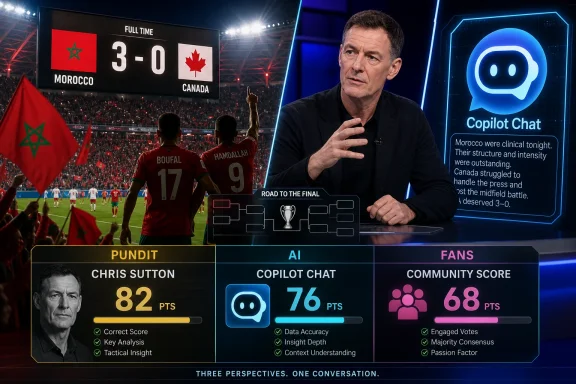
Chris Sutton predicted Morocco would beat Canada in the 2026 World Cup last 16 during BBC Sport’s rolling knockout-stage prediction coverage, saying before the July 4 match in Houston that Morocco would “definitely win this game” and could plausibly win the tournament. The prediction landed because Morocco did, in fact, beat Canada 3-0, ending the co-host’s historic run and pushing the Atlas Lions into a quarter-final against France. But the more interesting story is not that a pundit called a favorite correctly. It is that the World Cup prediction game has quietly become a referendum on expertise, crowd judgment, and the odd new habit of putting Microsoft Copilot Chat next to former professionals as if football intuition were just another benchmark.
Sutton’s phrasing was pure pundit theatre: definitive, quotable, and just arrogant enough to irritate anyone backing Canada. “I actually think Morocco can win this World Cup but, first things first, they will definitely win this game,” he said, according to BBC Sport’s prediction feature, which was also republished and summarized by outlets including AOL and regional sports sites.
Strip away the bravado, though, and the pick was not especially wild. Morocco reached the semi-finals in 2022, had already eliminated the Netherlands in the round of 32, and entered the Canada match with the profile of a side that knew how to survive tournament football. Canada’s story was more romantic, but Morocco’s was more complete.
That is the tension prediction columns live on. They sell certainty in a sport that punishes certainty, then quietly rely on structural advantages that make the certainty look braver than it is. Sutton was not picking a miracle. He was backing the better tournament side and dressing the obvious in a leather jacket.
Canada, meanwhile, had already won its World Cup before Morocco arrived. Jesse Marsch’s team earned the country’s first men’s World Cup point, then its first men’s World Cup win, then its first knockout appearance. By the time Morocco ended the run, the argument had shifted from “can Canada compete?” to “how far ahead are the established contenders still?”
Before this round, Sutton had reportedly picked 13 of 16 last-32 matches correctly, while the AI had 12 of 16. Across 88 of the tournament’s 104 matches, the running totals were close enough to be meaningful: Sutton on 54 correct predictions, Copilot on 55, and users on 62. It is a small scoreboard, but it says something larger about the way modern sports coverage now works.
Readers are no longer just being asked to consume punditry. They are being invited to compete with it. And now the machine has been added to the table, not as a tool behind the scenes, but as a visible participant.
That matters because the AI’s presence changes the emotional texture of the game. A former striker getting a score wrong is part of the ritual. A chatbot getting one wrong becomes evidence in a broader argument about whether generative AI is useful, overhyped, or merely good at rephrasing consensus.
Microsoft Copilot Chat is not “watching” football in the human sense. It is not feeling tournament momentum, reading body language in the tunnel, or sensing when a team has lost its nerve. It is ingesting patterns, probabilities, prior results, public narratives, and whatever context the prompt allows. Putting it beside Sutton is entertaining precisely because the comparison is unfair in both directions.
Sportsnet and other Canadian outlets described the Morocco defeat as the end of a historic run, and that is the right frame. Canada had entered this tournament still carrying the weight of an old World Cup absence and a short, painful 2022 experience. In 2026, as co-host, it needed credibility as much as results.
It got both. A first point and a first win are not decorative milestones for a country trying to grow a football culture; they are foundations. They give the next generation memories that are not borrowed from European club football or CONCACAF qualifying nights. They make the national team less of an event and more of an institution.
Marsch’s role in that cannot be separated from the noise around him. Sutton alluded to the Canadian manager annoying people with his touchline behaviour, which is another way of saying Marsch made himself impossible to ignore. That has always been part of his managerial persona: intensity as message, volume as identity, belief as tactical fuel.
Against Morocco, belief was not enough. But belief got Canada into the game that Morocco won, and that distinction matters.
Four years ago, that sentence would have sounded like romantic overreach. After Morocco’s 2022 semi-final run and its 2026 progress, it now sounds aggressive but not absurd. Tournament football has a way of reclassifying teams faster than club football does, and Morocco has moved from “dangerous outsider” to “do not be surprised if they are still here next week.”
That shift is uncomfortable for older football hierarchies. European and South American powers are accustomed to being discussed as default contenders, while everyone else is given a narrative role: surprise package, dark horse, plucky underdog, technical curiosity. Morocco has been refusing those assignments.
The win over Canada reinforced that refusal. It was not framed as a smash-and-grab upset; it was a professional knockout win by a team with tournament memory. Morocco did not merely survive Canada’s energy. It ended Canada’s run with the coldness of a side that expects to be judged by later rounds.
That is why Eilidh Barbour’s caution about France being too strong in a potential quarter-final was sensible but also revealing. Sutton joked that she would not win bravery awards for saying France could beat Morocco. He was right in the narrow punditry sense. Picking France is usually the safety rail.
But the fact that Morocco versus France now feels like a heavyweight judgment rather than a novelty fixture tells us how far Morocco’s status has moved.
This is the same cultural move happening across offices, schools, search engines, and operating systems. AI is being inserted into existing workflows, then personified just enough to make its outputs feel competitive. In this case, Copilot is not automating a business process or summarizing email. It is standing next to Chris Sutton in a prediction contest and accumulating a record.
That makes for a useful public demonstration of what generative AI can and cannot do. It can synthesize available context quickly. It can produce plausible picks. It can remain competitive over a large enough sample when the task rewards consensus and punishes overthinking. But it does not possess judgment in the human sense, and it does not become brave when it predicts an upset.
The user vote may be the more interesting comparator. More than 60,000 users reportedly submitted predictions for Paraguay’s win over Germany, and only 2 percent backed Paraguay. That is not just a failed prediction. It is a snapshot of mass expectation colliding with knockout volatility.
Crowds are powerful when they aggregate broad information. They are vulnerable when reputation overwhelms evidence. Germany’s name did work that Germany’s match did not.
That explains why Sutton’s certainty on Morocco cut through. “Morocco should beat Canada” is analysis. “Morocco will definitely win” is content. The second version travels because it creates a future receipt.
The same applies to AI. A model’s prediction is interesting partly because it can be audited afterward. If Copilot beats Sutton, it becomes a story about machines matching experts. If Sutton beats Copilot, it becomes a story about lived football knowledge defeating synthetic pattern recognition. If users beat both, the crowd gets to declare itself wiser than the panel.
Everyone wins except the person who says, accurately, that single-match football is unstable and that any prediction should be held lightly. That person is correct. That person is also terrible television.
This is where the language around Morocco has to mature. If Morocco loses to France, that should not retroactively turn the Canada prediction into hype. If Morocco beats France, it should not be treated as proof that the old football order has collapsed overnight. International football changes through accumulation, not one bracket line.
Morocco has already done enough across two World Cups to demand a more serious category. The Atlas Lions are not merely carrying continental hopes or providing narrative texture. They are building a tournament identity that opponents must plan for rather than admire.
That is the difference between a story and a threat. Canada was a story in 2026. Morocco is now a threat.
That is both clever and risky. Clever, because sports predictions are low-stakes, legible, and easy to compare. Risky, because every public AI output teaches users how to interpret the brand. If Copilot looks sensible, people may trust it more broadly. If it looks foolish, the joke sticks.
The deeper issue is calibration. AI tools are often at their best when they make uncertainty visible, but media formats reward confidence. A model that says “Morocco are favored, but Canada’s transition threat and home-continent energy create upset risk” is more useful than a model that mimics pundit certainty. It is also less clickable.
That tension will follow AI into more serious domains. In IT, the cost of false certainty is not a wrong quarter-final pick. It is a bad migration plan, a misread security alert, or an administrator trusting a generated PowerShell command without understanding its blast radius.
The football bracket is fun. The habit it encourages is worth watching.
Here is what the last-16 prediction drama actually leaves behind:
 Sutton’s Morocco Call Was Less Reckless Than It Sounded
Sutton’s phrasing was pure pundit theatre: definitive, quotable, and just arrogant enough to irritate anyone backing Canada. “I actually think Morocco can win this World Cup but, first things first, they will definitely win this game,” he said, according to BBC Sport’s prediction feature, which was also republished and summarized by outlets including AOL and regional sports sites.Strip away the bravado, though, and the pick was not especially wild. Morocco reached the semi-finals in 2022, had already eliminated the Netherlands in the round of 32, and entered the Canada match with the profile of a side that knew how to survive tournament football. Canada’s story was more romantic, but Morocco’s was more complete.
That is the tension prediction columns live on. They sell certainty in a sport that punishes certainty, then quietly rely on structural advantages that make the certainty look braver than it is. Sutton was not picking a miracle. He was backing the better tournament side and dressing the obvious in a leather jacket.
Canada, meanwhile, had already won its World Cup before Morocco arrived. Jesse Marsch’s team earned the country’s first men’s World Cup point, then its first men’s World Cup win, then its first knockout appearance. By the time Morocco ended the run, the argument had shifted from “can Canada compete?” to “how far ahead are the established contenders still?”
The Prediction Game Has Become Its Own Tournament
BBC Sport’s format has given the World Cup a parallel bracket: Sutton versus Microsoft Copilot Chat versus readers. That framing is clever because it turns each match into two events. There is the football, and then there is the accounting exercise afterward, where everyone learns whether intuition, algorithmic pattern matching, or mass opinion had the better day.Before this round, Sutton had reportedly picked 13 of 16 last-32 matches correctly, while the AI had 12 of 16. Across 88 of the tournament’s 104 matches, the running totals were close enough to be meaningful: Sutton on 54 correct predictions, Copilot on 55, and users on 62. It is a small scoreboard, but it says something larger about the way modern sports coverage now works.
Readers are no longer just being asked to consume punditry. They are being invited to compete with it. And now the machine has been added to the table, not as a tool behind the scenes, but as a visible participant.
That matters because the AI’s presence changes the emotional texture of the game. A former striker getting a score wrong is part of the ritual. A chatbot getting one wrong becomes evidence in a broader argument about whether generative AI is useful, overhyped, or merely good at rephrasing consensus.
Microsoft Copilot Chat is not “watching” football in the human sense. It is not feeling tournament momentum, reading body language in the tunnel, or sensing when a team has lost its nerve. It is ingesting patterns, probabilities, prior results, public narratives, and whatever context the prompt allows. Putting it beside Sutton is entertaining precisely because the comparison is unfair in both directions.
Canada’s Exit Was Historic, Not Humiliating
The danger with knockout coverage is that it compresses achievement into elimination. Canada lost 3-0 to Morocco, and that scoreline is severe enough to flatten the story if treated carelessly. But Canada’s 2026 campaign should not be judged only by its final act.Sportsnet and other Canadian outlets described the Morocco defeat as the end of a historic run, and that is the right frame. Canada had entered this tournament still carrying the weight of an old World Cup absence and a short, painful 2022 experience. In 2026, as co-host, it needed credibility as much as results.
It got both. A first point and a first win are not decorative milestones for a country trying to grow a football culture; they are foundations. They give the next generation memories that are not borrowed from European club football or CONCACAF qualifying nights. They make the national team less of an event and more of an institution.
Marsch’s role in that cannot be separated from the noise around him. Sutton alluded to the Canadian manager annoying people with his touchline behaviour, which is another way of saying Marsch made himself impossible to ignore. That has always been part of his managerial persona: intensity as message, volume as identity, belief as tactical fuel.
Against Morocco, belief was not enough. But belief got Canada into the game that Morocco won, and that distinction matters.
Morocco Is No Longer a Cinderella Story
The most important part of Sutton’s prediction was not the Canada result. It was the claim that Morocco could win the World Cup.Four years ago, that sentence would have sounded like romantic overreach. After Morocco’s 2022 semi-final run and its 2026 progress, it now sounds aggressive but not absurd. Tournament football has a way of reclassifying teams faster than club football does, and Morocco has moved from “dangerous outsider” to “do not be surprised if they are still here next week.”
That shift is uncomfortable for older football hierarchies. European and South American powers are accustomed to being discussed as default contenders, while everyone else is given a narrative role: surprise package, dark horse, plucky underdog, technical curiosity. Morocco has been refusing those assignments.
The win over Canada reinforced that refusal. It was not framed as a smash-and-grab upset; it was a professional knockout win by a team with tournament memory. Morocco did not merely survive Canada’s energy. It ended Canada’s run with the coldness of a side that expects to be judged by later rounds.
That is why Eilidh Barbour’s caution about France being too strong in a potential quarter-final was sensible but also revealing. Sutton joked that she would not win bravery awards for saying France could beat Morocco. He was right in the narrow punditry sense. Picking France is usually the safety rail.
But the fact that Morocco versus France now feels like a heavyweight judgment rather than a novelty fixture tells us how far Morocco’s status has moved.
AI Picks Are Good Television, But Bad Oracles
The Microsoft Copilot Chat angle is the most WindowsForum-relevant part of this otherwise football-shaped story. Not because Copilot predicted a score, but because mainstream sports coverage is now comfortable treating an AI assistant as a character.This is the same cultural move happening across offices, schools, search engines, and operating systems. AI is being inserted into existing workflows, then personified just enough to make its outputs feel competitive. In this case, Copilot is not automating a business process or summarizing email. It is standing next to Chris Sutton in a prediction contest and accumulating a record.
That makes for a useful public demonstration of what generative AI can and cannot do. It can synthesize available context quickly. It can produce plausible picks. It can remain competitive over a large enough sample when the task rewards consensus and punishes overthinking. But it does not possess judgment in the human sense, and it does not become brave when it predicts an upset.
The user vote may be the more interesting comparator. More than 60,000 users reportedly submitted predictions for Paraguay’s win over Germany, and only 2 percent backed Paraguay. That is not just a failed prediction. It is a snapshot of mass expectation colliding with knockout volatility.
Crowds are powerful when they aggregate broad information. They are vulnerable when reputation overwhelms evidence. Germany’s name did work that Germany’s match did not.
The Upset Economy Rewards Everyone Except the Cautious
Modern sports media feeds on prediction because prediction turns uncertainty into inventory. Every bracket, poll, AI pick, pundit scoreline, and fan vote becomes another reason to refresh. Accuracy matters, but not as much as engagement.That explains why Sutton’s certainty on Morocco cut through. “Morocco should beat Canada” is analysis. “Morocco will definitely win” is content. The second version travels because it creates a future receipt.
The same applies to AI. A model’s prediction is interesting partly because it can be audited afterward. If Copilot beats Sutton, it becomes a story about machines matching experts. If Sutton beats Copilot, it becomes a story about lived football knowledge defeating synthetic pattern recognition. If users beat both, the crowd gets to declare itself wiser than the panel.
Everyone wins except the person who says, accurately, that single-match football is unstable and that any prediction should be held lightly. That person is correct. That person is also terrible television.
France Now Tests Whether Morocco Is a Contender or a Moment
The quarter-final with France is where the Morocco argument becomes harder. Beating Canada confirmed Morocco’s seriousness, but it did not prove Sutton’s larger claim. France is a different examination: deeper squad, bigger tournament muscle, and less likely to be startled by Morocco’s confidence.This is where the language around Morocco has to mature. If Morocco loses to France, that should not retroactively turn the Canada prediction into hype. If Morocco beats France, it should not be treated as proof that the old football order has collapsed overnight. International football changes through accumulation, not one bracket line.
Morocco has already done enough across two World Cups to demand a more serious category. The Atlas Lions are not merely carrying continental hopes or providing narrative texture. They are building a tournament identity that opponents must plan for rather than admire.
That is the difference between a story and a threat. Canada was a story in 2026. Morocco is now a threat.
The Copilot Scoreboard Says More About Us Than About AI
For Windows users and IT professionals watching the Copilot brand spread across Microsoft’s ecosystem, the football prediction game is a lightweight but revealing case study. Microsoft’s AI assistant is no longer confined to productivity demos, code suggestions, or Windows search experiments. It is becoming a general-purpose public participant in culture.That is both clever and risky. Clever, because sports predictions are low-stakes, legible, and easy to compare. Risky, because every public AI output teaches users how to interpret the brand. If Copilot looks sensible, people may trust it more broadly. If it looks foolish, the joke sticks.
The deeper issue is calibration. AI tools are often at their best when they make uncertainty visible, but media formats reward confidence. A model that says “Morocco are favored, but Canada’s transition threat and home-continent energy create upset risk” is more useful than a model that mimics pundit certainty. It is also less clickable.
That tension will follow AI into more serious domains. In IT, the cost of false certainty is not a wrong quarter-final pick. It is a bad migration plan, a misread security alert, or an administrator trusting a generated PowerShell command without understanding its blast radius.
The football bracket is fun. The habit it encourages is worth watching.
The Real Lesson Is Hidden in the Scorekeeping
Sutton’s Morocco call will be remembered because it matched the result and contained a bigger claim. Canada’s run will be remembered because it reset expectations for a co-host still growing into the global game. Copilot’s presence will be remembered, if at all, as one more small sign that AI is being normalized through entertainment before it is fully understood in practice.Here is what the last-16 prediction drama actually leaves behind:
- Morocco’s 3-0 win over Canada made Sutton’s emphatic prediction look bold after the fact, even though the underlying pick was grounded in Morocco’s established tournament pedigree.
- Canada’s elimination should not obscure the significance of its first men’s World Cup point, first win, and first knockout-stage appearance.
- The BBC Sport prediction game has turned punditry, reader voting, and Microsoft Copilot Chat into a public contest over who reads football best.
- The close running totals between Sutton, Copilot, and users show that prediction accuracy in a chaotic tournament is less about mystique than sample size, consensus, and timing.
- Morocco’s next test against France is the point at which the “can win the World Cup” argument either gathers force or becomes a respectable overreach.
- Copilot’s role in the coverage is a reminder that AI systems are increasingly being judged in public, playful settings that shape user trust far beyond the original use case.
References
- Primary source: el-balad.com
Published: 2026-07-06T06:50:12.510135
Loading…
www.el-balad.com - Related coverage: aljazeera.com
Loading…
www.aljazeera.com - Related coverage: footballexpressnews.com
Loading…
www.footballexpressnews.com - Related coverage: olympic.ca
Loading…
olympic.ca - Related coverage: sportsnet.ca
Loading…
www.sportsnet.ca - Related coverage: aol.com
Loading…
www.aol.com
