

If you run a Microsoft-heavy security stack—Azure Sentinel, Microsoft Defender (for Endpoint and Office 365), Microsoft Entra ID, and Intune—you already have one of the broadest detection fabrics available to enterprise SOCs; the remaining, stubborn problem is not detection but consistent, rapid, and trustworthy investigation and resolution at scale.
Microsoft’s security portfolio delivers rich telemetry across identity, email, endpoint, cloud workloads, and device management. That deep visibility—when combined with a cloud-native SIEM like Microsoft Sentinel and Microsoft’s XDR signals—gives security teams incredibly high‑fidelity detection capabilities. At the same time, modern SOCs still suffer from a structural bottleneck: the time, skill, and staff required to turn alerts into verified incidents and remediate them. Microsoft’s native automation primitives (Logic Apps playbooks attached to Sentinel alerts) and new AI assistants such as Microsoft Security Copilot help analysts work faster, but they are augmentations, not full autonomous investigation engines.
D3 Security’s Morpheus positions itself precisely to fill that gap: an “Autonomous SOC” platform that claims to ingest alerts from Sentinel and the broader Microsoft stack and then autonomously run L2‑depth investigations and suggested containment actions for every alert, automatically. Those claims, if accurate and repeatable, change the operational economics of Microsoft-centric SOCs—but they also raise technical, governance, and trust questions that any SOC leader should validate before production rollout.
Key distinctions:
Why this matters:
Practical TCO evaluation steps:
However, the platform’s most consequential claims—self‑healing integrations that generate corrective code, sub‑two‑minute autonomous investigations across multi‑stage attacks, and a one‑engineer operational model—are vendor claims that require guarded validation. Run a tight, data‑driven PoC using your own Sentinel and Defender telemetry, insist on transparent audit trails for generated code and automated actions, and phase enablement of containment actions (advisory → semi‑automated → fully automated) as trust and measurements grow.
For Microsoft‑first SOC leaders, the most immediate next step is simple: schedule a proof‑of‑concept that runs Morpheus on a representative set of real Sentinel alerts from your tenant, with your Defender telemetry and your estate’s policy guardrails in place. Measure the precision, recall, time to investigation, and the governance artifacts produced. If the platform performs as claimed in your environment, the gains can be transformational—but the decision should be governed by data, not marketing alone.
Source: Security Boulevard D3 Morpheus for Your Microsoft Security Environment
 Background
Microsoft’s security portfolio delivers rich telemetry across identity, email, endpoint, cloud workloads, and device management. That deep visibility—when combined with a cloud-native SIEM like Microsoft Sentinel and Microsoft’s XDR signals—gives security teams incredibly high‑fidelity detection capabilities. At the same time, modern SOCs still suffer from a structural bottleneck: the time, skill, and staff required to turn alerts into verified incidents and remediate them. Microsoft’s native automation primitives (Logic Apps playbooks attached to Sentinel alerts) and new AI assistants such as Microsoft Security Copilot help analysts work faster, but they are augmentations, not full autonomous investigation engines.D3 Security’s Morpheus positions itself precisely to fill that gap: an “Autonomous SOC” platform that claims to ingest alerts from Sentinel and the broader Microsoft stack and then autonomously run L2‑depth investigations and suggested containment actions for every alert, automatically. Those claims, if accurate and repeatable, change the operational economics of Microsoft-centric SOCs—but they also raise technical, governance, and trust questions that any SOC leader should validate before production rollout.
How Morpheus is positioned for Microsoft environments
Native, bidirectional Microsoft integrations
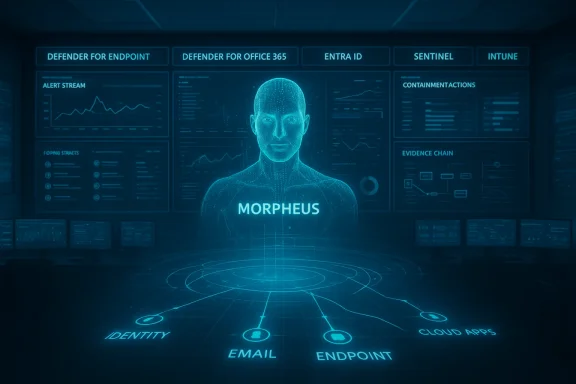
D3 advertises deep integrations across the Microsoft security ecosystem—Sentinel alert ingestion and case sync, Defender for Endpoint telemetry and containment actions, Defender for Office 365 mail analysis, Microsoft Entra ID sign-in and risk signals, Defender for Identity lateral movement telemetry, Defender for Cloud Apps (cloud app telemetry), and Intune device compliance. These are presented as bidirectional integrations that both pull telemetry in for investigation and write actions back into the same consoles where analysts work.- Benefits stressed by D3:
- Single investigation timeline stitched across email, identity, endpoint, and cloud.
- Evidence-backed recommendations and an auditable reasoning chain.
- Containment options executed where appropriate (e.g., disable Entra account, isolate an endpoint via Defender for Endpoint).
Marketplace and procurement angle
For procurement teams, one practical advantage D3 highlights is that Morpheus (Smart SOAR / Morpheus listing) is available through the Microsoft Azure Marketplace and can be purchased via existing Microsoft Azure Consumption Commitment (MACC) spend in many cases—reducing procurement friction for organizations that already have committed Azure budgets. Microsoft’s Marketplace and MACC rules allow many Marketplace purchases to count toward committed spend, making that claim plausible for buyers that confirm the exact offer’s MACC eligibility.What Morpheus says it does (a distilled summary)
- Automatically ingest every Sentinel alert and start a full investigation at scale.
- Pull evidence across Defender for Office 365, Entra ID, Defender for Endpoint, DLP and cloud app telemetry, and—if present—third‑party telemetry (CrowdStrike, Palo Alto, Splunk, etc.) to build a unified attack timeline.
- Generate and execute containment actions (isolate host, disable account) when pre‑configured and/or recommended.
- Provide a full forensic timeline and an explainable AI reasoning chain that shows which enrichments, correlations, and links produced the root‑cause finding.
- Detect integration drift (API / schema changes) and automatically generate corrective code to restore broken connectors—what D3 describes as self‑healing integrations.
Morpheus vs. Microsoft Security Copilot vs. Logic Apps: practical roles
Microsoft Security Copilot — an analyst assistant, not an autonomous investigator
Microsoft positions Security Copilot as a domain‑specific assistant that helps analysts query telemetry, summarize events, and draft recommended next steps. It excels at analyst‑initiated exploration and synthesis of telemetry available to it, and it can accelerate investigations when an experienced analyst is driving the inquiry. But Security Copilot is not presented as a fully autonomous L2 investigation engine that continuously ingests every alert and completes the entire investigative chain without human direction. That difference is central to D3’s positioning of Morpheus as complementary rather than redundant to Copilot.Key distinctions:
- Security Copilot: analyst‑initiated, conversational investigation and summarization.
- Logic Apps (Sentinel playbooks): deterministic workflow automation triggered by alerts.
- Morpheus: vendor‑positioned as alert‑native autonomous investigations that create bespoke investigation playbooks automatically and execute to produce an L2‑depth finding.
Logic Apps (Sentinel playbooks) — deterministic automation, not investigative judgment
Azure Logic Apps is Microsoft’s workflow/automation engine and it powers Sentinel playbooks. Logic Apps can orchestrate actions at scale—create tickets, call APIs, run enrichment lookups—but it runs deterministic, prebuilt workflows. When a playbook needs human judgment (assess blast radius, determine whether an alert is a true positive), Logic Apps cannot make that judgment without explicit, pre‑scripted rules. Sentinel playbooks are essential for deterministic automation; they are not a replacement for an engine that decides whether and how to investigate across dozens of telemetry sources.- Logic Apps are excellent at: notifications, ticket creation, reflex actions on high‑confidence alerts, and chainable automation across cloud services.
- Logic Apps are limited at: making context‑rich investigative judgments that require correlation across identity, email, endpoint, and DLP telemetry when the correlation rules are not pre‑scripted.
What to make of the D3 benchmark and the “under two minutes” claim
D3 has published claims that Morpheus completes investigative work in under two minutes for common phishing compromise scenarios and that, in their head‑to‑head benchmark, Morpheus identified root cause across three real‑world phishing scenarios while Microsoft Security Copilot did not. Those are striking claims and, if reproducible in your environment, materially change SOC throughput and mean time to respond. However:- These are vendor‑provided benchmark claims and marketing descriptions; independent, third‑party benchmarking published in peer‑reviewed or community‑audited form is not publicly available at the same level of detail. Buyers should treat these as vendor claims until validated in a controlled proof‑of‑concept using their own telemetry and threat scenarios.
- Reproducibility depends on environment: log retention, connector completeness, tenant permissions, E5 licensing and Security Copilot provisioning, third‑party tool telemetry, and the presence of correlated data (e.g., DLP evidence) materially affect whether any automated engine can trace a full attack path.
- The proper evaluation path is a representative PoC using your own Sentinel alerts and Defender telemetry, executed across a realistic sample of false positives and multi‑stage attacks.
Self‑healing integrations and “single‑engineer” operation: opportunity and caution
D3’s literature highlights two operational benefits every SOC engineering manager wants to hear: (1) Morpheus continuously monitors and repairs integration drift—auto‑generating corrective code when an upstream API or schema changes—and (2) the platform can be deployed and maintained by a single engineer because Morpheus removes the ongoing integration maintenance burden.Why this matters:
- Traditional SOAR programs (multiple Logic Apps, custom connectors, playbook engineering) impose ongoing engineering tax as vendor APIs and telemetry formats change.
- If a platform actually tolerates API drift and automatically regenerates safe connector code, that reduces the maintenance overhead and operational risk of ‘silent failures’ where integrations silently stop feeding telemetry.
- “Self‑healing” is a high‑value capability but also a complex one: generating, testing, and deploying corrective code against production connectors raises questions about code provenance, testing discipline, security review, and change control.
- Buyers should insist on clear technical exposure: how Morpheus tests generated code before deploying, how rollbacks are handled, whether generated code is pushed as a black‑box binary or reviewable source, and who signs off on the changes in production.
- Ask for a technical runbook showing a real API drift incident, the corrective code produced, the test matrix executed, and the time to full remediation. Vendor claims are only operationally useful when accompanied by verifiable telemetry and audit logs.
Risks, governance, and security considerations
Autonomous investigation and automated containment changes both the risk calculus and the governance surface of a SOC. Evaluate these areas explicitly.Privilege and lateral impact
- Morpheus needs elevated access to perform rich investigations (read sign‑in logs, query Defender telemetry, search mailboxes, and execute containment). That access must be tightly governed with least privilege, auditable service principals, and credential lifecycle controls.
- Automated containment actions (account disablement, endpoint isolation) can disrupt production systems. Ensure policy‑based guardrails, multi‑party approvals for high‑impact actions, and simulated testing of containment playbooks in staging.
Explainability and auditability
- The platform must provide clear, human‑readable evidence chains and a verifiable audit trail for every automated decision. D3 emphasizes explainable AI reasoning chains; buyers should validate that the reasoning is granular and maps directly to the telemetry artifacts that would satisfy forensic or compliance needs.
False positives and analyst trust
- Autonomous systems magnify both wins and mistakes. A single bad correlation or over‑zealous containment rule can erode analyst trust rapidly. Start by scoping Morpheus to triage and enrichment (no automatic containment) during pilots and measure precision and recall before enabling automatic remediation.
Compliance and legal
- Automated access to mailboxes, native deletion of artifacts, or automated data movement interacts with data protection rules. Ensure legal and compliance review for any automated investigative actions that access or move sensitive content.
Procurement, TCO, and operational economics
D3 frames the TCO argument around two levers: (a) reducing analyst hours spent in Tier‑1/2 investigation, and (b) reducing engineering maintenance for integrations and playbooks. The availability of Morpheus on the Azure Marketplace—and the potential to count purchases against MACC—makes procurement simpler for Azure‑committed organizations. Confirm MACC eligibility for the specific Marketplace offer and the billing model (metered vs. subscription) during contract discussions.Practical TCO evaluation steps:
- Baseline current SOC costs: analyst time per investigated alert, average number of alerts/day, engineering hours for playbook and connector maintenance.
- Run a time‑bound PoC that mirrors your alert mix and measures end‑to‑end time to triage and containment under Morpheus.
- Compare license and hosting costs (Marketplace/subscription) against labor savings and reduced incident dwell.
How to evaluate Morpheus in a Microsoft‑first SOC — an actionable PoC playbook
- Define realistic test cases
- Pull 10–15 high‑volume alert types from your Sentinel workspace (phishing forwarding rule, suspicious sign‑in, Lateral Movement indicators, suspicious DLP exfil, endpoint execution).
- Prepare data slices
- Ensure Defender for Endpoint, Defender for Office 365, Entra sign‑ins, Defender for Identity, and DLP telemetry are present and available to the PoC tenant.
- Test stages
- Ingestion and enrichment: Confirm Morpheus ingests alerts in real time, enriches with telemetry, and presents a coherent timeline.
- Root cause identification: For multi‑stage phishing scenarios, validate whether the platform consistently identifies credential theft → fraudulent login → mailbox forwarding chain.
- Containment safety: Start with advisory mode (recommendations only); test automated containment in a fenced test group.
- Validate explainability
- For each automated finding, ask for the exact telemetry objects (timestamped logs, event IDs) that the platform used to reach the conclusion.
- Integration drift test
- Simulate a connector change (rotate a credential or change a schema in a sandbox) and document whether and how the platform repairs the connector and how much human oversight is required.
- Measure outcomes
- Time saved per alert, false positives avoided, number of alerts fully investigated by the platform without human intervention, and the engineering hours saved on connector maintenance.
Where Morpheus fits—and where it does not
- Fit: Microsoft‑centric or hybrid SOCs with high alert volume and sufficient telemetry (Defender suite + Sentinel). Organizations that have strong cloud budgets and MACC commitments may find procurement smooth via Marketplace. Morpheus is positioned to reduce analyst time on repetitive L2 investigation and to reduce integration maintenance effort.
- Not a fit (without careful evaluation):
- Environments with sparse telemetry or fragmented logging where automatic correlation is impossible.
- Organizations that require human approval for every investigative step and cannot accept any autonomous triage before detailed legal/compliance review.
- Teams that cannot provision the necessary read/write privileges in a controlled way.
Conclusion: adopt cautiously, measure rigorously
The practical gap between detection and fully‑supported resolution is real in Microsoft‑centric SOCs: Sentinel and Defender produce excellent detections, but scaling the downstream investigation labor is the hard, expensive part. D3 Morpheus offers a clear narrative and product architecture that targets exactly that gap—autonomous L2 investigations, cross‑tool attack path discovery, and a procurement model that can fit in existing Azure spend. Those are substantial promises and, if validated in your environment, can materially improve MTTR and reduce analyst toil.However, the platform’s most consequential claims—self‑healing integrations that generate corrective code, sub‑two‑minute autonomous investigations across multi‑stage attacks, and a one‑engineer operational model—are vendor claims that require guarded validation. Run a tight, data‑driven PoC using your own Sentinel and Defender telemetry, insist on transparent audit trails for generated code and automated actions, and phase enablement of containment actions (advisory → semi‑automated → fully automated) as trust and measurements grow.
For Microsoft‑first SOC leaders, the most immediate next step is simple: schedule a proof‑of‑concept that runs Morpheus on a representative set of real Sentinel alerts from your tenant, with your Defender telemetry and your estate’s policy guardrails in place. Measure the precision, recall, time to investigation, and the governance artifacts produced. If the platform performs as claimed in your environment, the gains can be transformational—but the decision should be governed by data, not marketing alone.
Source: Security Boulevard D3 Morpheus for Your Microsoft Security Environment
