

Motorola has told GSMArena that the Motorola Edge 70 Max will receive up to three Android OS upgrades and up to five years of security maintenance releases, but the July 17 clarification still does not give buyers the firm, market-specific guarantee expected of a premium 2026 Android phone. The problem is not that Motorola chose the lower number previously published in its own fine print. It confirmed the higher figure. The problem is that it confirmed it with wording that remains conditional, while leaving contradictory regional listings and an apparent conflict with EU regulatory information unresolved.
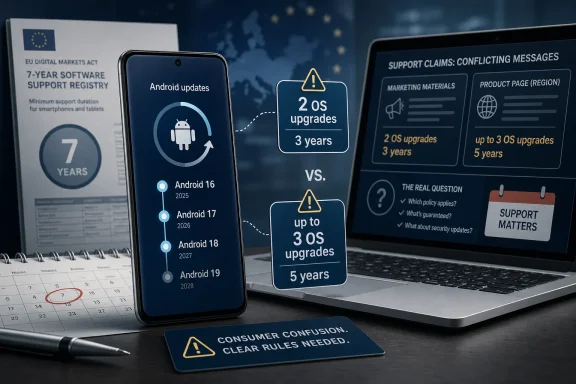
For a phone that launches with Android 16, the best-case reading is Android 17, Android 18, and Android 19, plus security patches for as long as five years. That is materially better than the two OS upgrades and three years of security coverage listed in a footnote on several Motorola product pages. But “up to” describes a maximum, not a clear guaranteed entitlement. A buyer still cannot point to Motorola’s statement and say the Edge 70 Max is definitely getting three major Android releases.
That distinction matters more now than it did even a few product cycles ago. Software support is no longer a vague goodwill promise reserved for enthusiasts tracking beta builds. It affects device resale value, security exposure, app compatibility, fleet planning, and whether a handset remains practical alongside a Windows PC for years rather than months.
Motorola’s latest answer improves the headline number. It has not yet repaired the trust problem.
The Edge 70 Max arrived on July 15 with specifications designed to make it one of Motorola’s more compelling high-end Android devices: Qualcomm’s Snapdragon 8 Gen 5, a 7,100mAh silicon-carbon battery, 90W wired charging, Qi2 magnetic wireless charging, a 6.8-inch Quad HD+ AMOLED display, and a 50MP Sony LYTIA 710 main camera. Motorola’s own launch material is clear and expansive on all of that hardware.
Its software support language was not.
As Android Authority first documented, the UK product page’s main copy advertised “up to 3 Android OS upgrades and 5 years of security updates.” A footnote on the same page said something markedly different: “Includes 2 OS upgrades and up to 3 years of security updates starting from the global launch date.” The footnote also said the terms could vary by market, carrier, or model.
That was not a minor discrepancy in phrasing. It gave a prospective buyer two incompatible answers to the same purchase question. On one reading, the phone could receive Android 19 and patches into 2031. On the other, it was only assured of Android 18 and three years of security coverage.
9to5Google subsequently found further variation. Its reporting noted that Sweden’s Motorola listing appeared to promise three years of OS updates and three years of security updates, while the UK page referred to security support through 2031 before its own lower footnote complicated the claim. The Indian listing reportedly carried similarly conflicting language.
Motorola’s response to GSMArena settled only part of that dispute. The company said the Edge 70 Max “arrives with up to 3 OS upgrades and up to 5 years of SMR,” using its term for Security Maintenance Releases. That is the more favorable policy, but it does not explain why two upgrades and three years appeared in the first place, whether those lower figures still apply anywhere, or why support varies by country.
Samsung and Google have set a much clearer baseline in the premium Android market: their current flagship policies are stated as firm, multi-year commitments. There is no need to parse whether a Galaxy S or Pixel buyer has been promised a maximum number of updates rather than a minimum. The customer knows the support window before purchasing.
Motorola’s latest wording may ultimately be intended as a three-upgrade, five-year commitment. But intent is not the same thing as the published policy. A buyer should not have to infer the real guarantee from a comment provided to a technology outlet after launch-day criticism.
The uncertainty is particularly awkward because Motorola has already shown it can make direct promises. According to Android Authority and 9to5Google, Motorola’s 2026 Signature and Razr Fold models carry seven years of Android OS and security updates. The Edge 70 Max therefore is not exposing an industry-wide technical constraint or a company incapable of longer support. It is exposing inconsistent policy choices across Motorola’s own premium lineup.
That makes the Edge 70 Max look like a hardware-first product being sold into a software-support market that has moved on.
There are potential explanations. A regulatory field may use a different measurement point, such as years from the end of market placement rather than from launch. It may combine operating-system security, corrective, and functionality updates in a way that does not map neatly to Motorola’s consumer-facing language. Or an entry may simply need correction.
But none of those possibilities eliminates the immediate issue: Motorola has not publicly explained which number buyers should rely on in Europe, India, the UK, or any other market. Until it does, the safest conclusion is that support terms may differ by model variant and geography, and that the public documentation has not been maintained to a standard befitting a flagship-priced phone.
For IT buyers, that is more than a consumer-service complaint. Organizations enrolling Android devices into Microsoft Intune, using Conditional Access, or relying on Android Enterprise need a reliable patch horizon. “Up to” support, differing by region, is difficult to turn into a defensible procurement standard. It complicates replacement cycles and makes a mixed-device deployment harder to manage.
The hardware case is persuasive. The unusually large battery, high-end Snapdragon platform, Qi2 support, and 2K display could make this a strong option for users who keep a phone connected to Windows through Phone Link, work across Microsoft 365 apps, or want a capable personal device that can stay in service for years.
But a long-lived hardware platform makes a short or uncertain support policy look worse, not better. A 7,100mAh battery and Snapdragon 8 Gen 5 are investments in longevity. A policy that may stop after Android 18, Android 19, or an unspecified regional variation undermines that investment.
Motorola now needs to publish a single, unambiguous matrix for the Edge 70 Max: every model number, every region, the exact count of guaranteed Android upgrades, the final security-patch date, and the security-update cadence. Until that happens, the phone’s most important specification remains not its battery capacity or benchmark potential, but the fact that buyers still cannot tell exactly how long Motorola intends to support it.
For a phone that launches with Android 16, the best-case reading is Android 17, Android 18, and Android 19, plus security patches for as long as five years. That is materially better than the two OS upgrades and three years of security coverage listed in a footnote on several Motorola product pages. But “up to” describes a maximum, not a clear guaranteed entitlement. A buyer still cannot point to Motorola’s statement and say the Edge 70 Max is definitely getting three major Android releases.
That distinction matters more now than it did even a few product cycles ago. Software support is no longer a vague goodwill promise reserved for enthusiasts tracking beta builds. It affects device resale value, security exposure, app compatibility, fleet planning, and whether a handset remains practical alongside a Windows PC for years rather than months.
Motorola’s latest answer improves the headline number. It has not yet repaired the trust problem.
 The Fine Print Created the Story
The Edge 70 Max arrived on July 15 with specifications designed to make it one of Motorola’s more compelling high-end Android devices: Qualcomm’s Snapdragon 8 Gen 5, a 7,100mAh silicon-carbon battery, 90W wired charging, Qi2 magnetic wireless charging, a 6.8-inch Quad HD+ AMOLED display, and a 50MP Sony LYTIA 710 main camera. Motorola’s own launch material is clear and expansive on all of that hardware.Its software support language was not.
As Android Authority first documented, the UK product page’s main copy advertised “up to 3 Android OS upgrades and 5 years of security updates.” A footnote on the same page said something markedly different: “Includes 2 OS upgrades and up to 3 years of security updates starting from the global launch date.” The footnote also said the terms could vary by market, carrier, or model.
That was not a minor discrepancy in phrasing. It gave a prospective buyer two incompatible answers to the same purchase question. On one reading, the phone could receive Android 19 and patches into 2031. On the other, it was only assured of Android 18 and three years of security coverage.
9to5Google subsequently found further variation. Its reporting noted that Sweden’s Motorola listing appeared to promise three years of OS updates and three years of security updates, while the UK page referred to security support through 2031 before its own lower footnote complicated the claim. The Indian listing reportedly carried similarly conflicting language.
Motorola’s response to GSMArena settled only part of that dispute. The company said the Edge 70 Max “arrives with up to 3 OS upgrades and up to 5 years of SMR,” using its term for Security Maintenance Releases. That is the more favorable policy, but it does not explain why two upgrades and three years appeared in the first place, whether those lower figures still apply anywhere, or why support varies by country.
“Up To” Is Not the Same as a Guarantee
Consumers are accustomed to marketing qualifiers, but software policy is an area where precision is essential. A company can realistically use “up to” for charging speed, screen brightness, or battery life because those outcomes depend on conditions. An OS-update commitment is different. It is a deliverable controlled by the manufacturer.Samsung and Google have set a much clearer baseline in the premium Android market: their current flagship policies are stated as firm, multi-year commitments. There is no need to parse whether a Galaxy S or Pixel buyer has been promised a maximum number of updates rather than a minimum. The customer knows the support window before purchasing.
Motorola’s latest wording may ultimately be intended as a three-upgrade, five-year commitment. But intent is not the same thing as the published policy. A buyer should not have to infer the real guarantee from a comment provided to a technology outlet after launch-day criticism.
The uncertainty is particularly awkward because Motorola has already shown it can make direct promises. According to Android Authority and 9to5Google, Motorola’s 2026 Signature and Razr Fold models carry seven years of Android OS and security updates. The Edge 70 Max therefore is not exposing an industry-wide technical constraint or a company incapable of longer support. It is exposing inconsistent policy choices across Motorola’s own premium lineup.
That makes the Edge 70 Max look like a hardware-first product being sold into a software-support market that has moved on.
The EPREL Listing Raises a Second Problem
The most troublesome loose end is Europe’s EPREL database, the EU’s product-registry system. 9to5Google reported that the Edge 70 Max’s EPREL label lists updates as being provided for seven years. That reported figure is not easily reconciled with Motorola’s “up to five years” security-maintenance statement, much less with the earlier product-page footnote suggesting three years.There are potential explanations. A regulatory field may use a different measurement point, such as years from the end of market placement rather than from launch. It may combine operating-system security, corrective, and functionality updates in a way that does not map neatly to Motorola’s consumer-facing language. Or an entry may simply need correction.
But none of those possibilities eliminates the immediate issue: Motorola has not publicly explained which number buyers should rely on in Europe, India, the UK, or any other market. Until it does, the safest conclusion is that support terms may differ by model variant and geography, and that the public documentation has not been maintained to a standard befitting a flagship-priced phone.
For IT buyers, that is more than a consumer-service complaint. Organizations enrolling Android devices into Microsoft Intune, using Conditional Access, or relying on Android Enterprise need a reliable patch horizon. “Up to” support, differing by region, is difficult to turn into a defensible procurement standard. It complicates replacement cycles and makes a mixed-device deployment harder to manage.
Strong Hardware Does Not Offset an Undefined Lifecycle
The Edge 70 Max is not priced like a disposable midrange device. In India, it is due to go on sale on July 20, 2026, with pricing starting at ₹54,999 for the 8GB/256GB model and rising to ₹59,999 for 12GB/256GB. UK pricing is approximately £700. At that level, a buyer is reasonably purchasing a multi-year device, not merely a large battery and fast charging for the next two Android releases.The hardware case is persuasive. The unusually large battery, high-end Snapdragon platform, Qi2 support, and 2K display could make this a strong option for users who keep a phone connected to Windows through Phone Link, work across Microsoft 365 apps, or want a capable personal device that can stay in service for years.
But a long-lived hardware platform makes a short or uncertain support policy look worse, not better. A 7,100mAh battery and Snapdragon 8 Gen 5 are investments in longevity. A policy that may stop after Android 18, Android 19, or an unspecified regional variation undermines that investment.
Motorola now needs to publish a single, unambiguous matrix for the Edge 70 Max: every model number, every region, the exact count of guaranteed Android upgrades, the final security-patch date, and the security-update cadence. Until that happens, the phone’s most important specification remains not its battery capacity or benchmark potential, but the fact that buyers still cannot tell exactly how long Motorola intends to support it.
References
- Primary source: AndroidPure
Published: 2026-07-18T06:53:16+00:00
Motorola Edge 70 Max Update Policy: Still Vaguer Than Samsung and Google – AndroidPure
Motorola's Edge 70 Max update policy clarification confirms only up to 3 OS upgrades and 5 years of security patches, still vaguer than its rivals.www.androidpure.com - Related coverage: androidcentral.com
Motorola's Edge 70 Max has a huge battery and Qi2.2—I'm more interested than I thought I'd be | Android Central
The phone is delivering more power than I anticipated.www.androidcentral.com - Related coverage: androidauthority.com
Why Motorola’s 7-year update promise matters — and why it might not be enough
The Motorola Signature is the first Moto phone with seven years of updates. It's a good change, but it might not be enough.www.androidauthority.com - Related coverage: smartworld.it
Motorola Edge 70 Max, quanti aggiornamenti: la risposta ufficiale | SmartWorld
Motorola chiarisce gli aggiornamenti software del Edge 70 Max: 3 OS upgrade e 5 anni di patch, ma il "fino a" lascia ancora dubbi.www.smartworld.it - Related coverage: phonearena.com
The Motorola Edge 70 Max just committed the biggest Android sin of 2026 - PhoneArena
The software support of the Edge 70 Max looks terrible considering it's Motorola's top-tier product.www.phonearena.com - Related coverage: mobilissimo.ro
Motorola clarifică politica de actualizări pentru Edge 70 Max: până la 3 versiuni Android și 5 ani de update-uri de securitate
Cel mai fresh smartphone lansat de Motorola edge Edge 70 Max, un model orientat spre gameri, cu display plat și procesor capabil sub capotă. El are chiar magneți...www.mobilissimo.ro