

Motorola’s Razr 70, sold in the United States as the Motorola Razr 2026, is an €800/$800 clamshell foldable that improves brightness, battery life, hinge materials, software polish, and camera flexibility while struggling to justify its launch price against discounted Razr predecessors and Samsung’s Galaxy Z Flip7. That is the central tension of this phone: it is not bad, not unfinished, and not hard to recommend in isolation. It is simply arriving in a market where good enough is no longer enough to win the foldable argument. Motorola has made one of the friendliest flip phones around, but it has also priced it as if friendliness alone can defeat raw value.
The Razr 70 is the kind of phone that explains why Motorola remains credible in foldables despite not having Samsung’s scale. The company understands the emotional part of a clamshell: the compactness, the glanceable outside screen, the pocketable nostalgia, the sense that a phone can still be a little playful. On those terms, the Razr 70 is easy to like.
The problem is that the market has moved faster than the product. A few years ago, any foldable that felt durable, usable, and relatively normal was a win. In 2026, buyers can compare multiple generations of Razrs, Samsung’s Flip line, and discounted flagship foldables before they ever walk into a carrier store.
That makes the Razr 70’s €800/$800 positioning difficult. It is not a cheap experiment, and it is not quite a flagship. It sits in the uncomfortable middle: expensive enough to invite scrutiny, conservative enough to make scrutiny hurt.
Motorola’s own back catalog is the most damaging comparison. The previous Razr 60/Razr 2025 can now be found at much lower street prices, while the older Ultra models have drifted into the same budget range as the new standard Razr. When last year’s better phone starts costing today’s regular phone money, the new device needs a sharper argument than “slightly better in several places.”
That matters more than a spec sheet suggests. A flip phone is only meaningfully different from a slab phone if the folded state changes behavior. If users still open the device for every message, timer, payment, song, or quick glance, the hinge becomes a novelty rather than a workflow.
Motorola’s cover-screen philosophy is closer to a tiny phone than a widget board. Broader app support makes the Razr feel less constrained, even when the ergonomics remain inherently cramped. It encourages short interactions, which is exactly where a clamshell should excel.
For WindowsForum readers who live between PCs, tablets, and phones, this is the sort of design decision that matters. The best mobile companion device is not always the one with the fastest benchmark score. Sometimes it is the one that lets you handle a two-factor prompt, a Teams notification, a podcast control, or a camera preview without unfolding into the full distraction rectangle.
Motorola’s improvements here do not redefine the category, but they strengthen the daily experience. The internal foldable display remains large enough to behave like a conventional smartphone when opened, while the cover screen continues to serve as the device’s signature feature. Brightness gains make both more usable outdoors and reduce the sense that the external screen is a secondary compromise.
The hinge upgrade also matters, even if most buyers will never describe their phone in terms of titanium. Foldables are still judged by feel. A clamshell can have excellent software and still lose trust if the opening action feels fragile, loose, or cheap.
That said, the Razr 70 does not escape the fundamental trade-off. It is still a foldable, still more mechanically complex than a slab phone, and still dependent on long-term durability that reviewers can only partly assess. Motorola has made the phone feel more mature, but maturity is not the same as invulnerability.
But “fine” becomes an awkward word at €800/$800. At that price, buyers are not unreasonable for expecting performance headroom. A foldable’s premium should not be spent entirely on the hinge while the rest of the phone quietly settles for midrange silicon.
The issue is not that the Razr 70 feels unusable. It is that the processor choice narrows the phone’s appeal just as competitors widen theirs. Samsung’s Galaxy Z Flip7 brings stronger performance and 12GB of RAM even in its base storage configuration, while older Razr Ultra models can offer more flagship-grade hardware for similar money once discounts enter the picture.
The 8GB RAM ceiling compounds the problem. In isolation, 8GB is still workable for Android. In a premium foldable sold in 2026, it looks like a cost-control decision the buyer is being asked to excuse.
The Moto AI features also fit the broader 2026 smartphone mood, where vendors are trying to make AI feel less like a demo and more like a utility. The risk, as ever, is that phone AI becomes a branding layer rather than a durable reason to buy. Motorola’s advantage is that its software additions tend to feel less suffocating than some competitors’ ecosystem pushes.
Still, Samsung has changed the software-support conversation. A seven-year update promise on the Galaxy Z Flip7 is not just a line in a comparison table; it alters the economics of buying an expensive phone. The longer a device is supported, the easier it is to justify paying premium money upfront.
Motorola’s software experience may be cleaner, but Samsung’s support policy is more reassuring to cautious buyers. That matters to enthusiasts and IT pros alike. A foldable already carries hardware uncertainty; software longevity should not be another open question.
This is also where Motorola’s less aggressive chipset may help. A phone does not need the fastest silicon to be satisfying if it is tuned well and lasts through the day. For many buyers, predictable battery life will matter more than peak performance they rarely touch.
That said, charging remains conservative. The unchanged 30W wired charging limit is not catastrophic, but it feels underwhelming in a device competing for premium dollars. Faster charging would have helped Motorola frame the Razr 70 as practical rather than merely polished.
Wireless charging support helps, but it does not fully erase the perception that Motorola is holding back. In 2026, charging is part of the value story. When a phone asks for flagship-ish money, every ordinary number becomes evidence for the prosecution.
The cover-screen camera workflow is especially important. It turns the rear cameras into selfie cameras without guesswork, and that can produce better results than relying on a small internal front camera. For creators and casual users alike, this is one of the few foldable features that feels immediately useful.
But the camera system is not strong enough to carry the price. The lack of autofocus on the ultrawide camera is the sort of omission that enthusiasts notice, even if casual users do not. It also weakens the phone’s flexibility for close-up shots and creative framing.
Motorola does not need to beat the best camera phones to justify the Razr 70. It does, however, need to avoid giving buyers obvious reasons to say the money went into the hinge rather than the imaging stack. Here again, the phone is competent but not compelling.
Motorola’s counterargument is usability and personality. The Razr’s external display experience remains one of the best in the business, and the company’s lighter software touch is genuinely appealing. Some users will prefer Motorola precisely because it does not feel like buying into Samsung’s entire services stack.
But Samsung’s advantage is cumulative. One specification does not decide this fight; the stack does. More RAM, stronger performance, longer support, and better speaker performance make the Flip7 feel like a more complete premium device.
The Galaxy Z Flip7 FE complicates matters further. It gives buyers a cheaper route into Samsung’s foldable world, even if it resembles last year’s hardware in spirit. For shoppers who care about updates and brand reliability more than Motorola’s cover-screen freedom, the FE may be enough.
The older Ultra models are even more dangerous. Once a previous-generation Ultra falls into the Razr 70’s price band, the standard model has to defend itself against a device that was originally built to sit higher in the lineup. That is rarely a fair fight for the newer mid-tier product.
This is the classic problem with iterative hardware in a discount-heavy market. Launch MSRP tells one story; retail pricing tells another. Motorola can position the Razr 70 as the new mainstream foldable, but Amazon promotions, carrier deals, renewed units, and leftover stock rewrite that positioning in real time.
For enthusiasts, this is good news. It means patience has value. For Motorola, it means the Razr 70 may become a better recommendation only after the market does what the spec sheet could not: lower the price.
That change is healthy. It forces manufacturers to stop treating the hinge as a universal excuse. A foldable can cost more than a slab phone, but it cannot use that cost to wave away every shortfall in performance, cameras, charging, memory, and updates.
Motorola is closer than most to making the friendly foldable. The Razr 70 has charm, polish, and a genuinely useful outside screen. It feels like a product built by a company that understands why people want flip phones in the first place.
But the value phase is unforgiving. A phone can be lovely and still be overpriced. A device can be one discount away from excellent and still be hard to recommend at launch.
If Motorola’s launch pricing falls quickly, the conversation changes. At a meaningful discount, the Razr 70’s strengths become easier to appreciate and its compromises become easier to forgive. The same chipset that feels uninspiring at €800/$800 becomes acceptable at a lower price, especially with strong battery life and an excellent cover-screen experience.
At full price, though, the buyer has too many alternatives. Samsung offers a more powerful and longer-supported premium flip. Motorola’s own previous models offer much of the same personality for less. Older Ultra variants may offer the hardware headroom the Razr 70 lacks.
That leaves the Razr 70 as a phone for a specific buyer: someone who values Motorola’s cover-screen implementation, wants the newest regular Razr, prefers clean Android, and is not deeply concerned with peak performance or maximum long-term support. That buyer exists. The question is whether there are enough of them at $800.
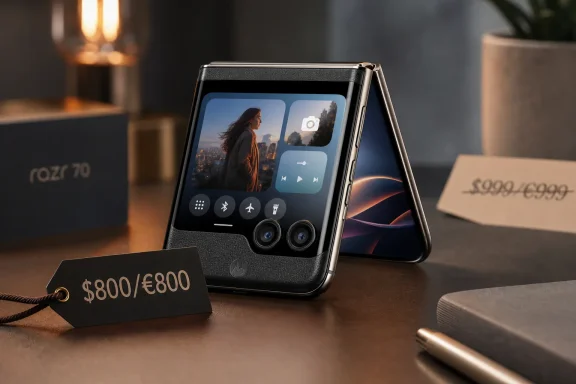 Motorola Made the Right Foldable for the Wrong Price Moment
The Razr 70 is the kind of phone that explains why Motorola remains credible in foldables despite not having Samsung’s scale. The company understands the emotional part of a clamshell: the compactness, the glanceable outside screen, the pocketable nostalgia, the sense that a phone can still be a little playful. On those terms, the Razr 70 is easy to like.The problem is that the market has moved faster than the product. A few years ago, any foldable that felt durable, usable, and relatively normal was a win. In 2026, buyers can compare multiple generations of Razrs, Samsung’s Flip line, and discounted flagship foldables before they ever walk into a carrier store.
That makes the Razr 70’s €800/$800 positioning difficult. It is not a cheap experiment, and it is not quite a flagship. It sits in the uncomfortable middle: expensive enough to invite scrutiny, conservative enough to make scrutiny hurt.
Motorola’s own back catalog is the most damaging comparison. The previous Razr 60/Razr 2025 can now be found at much lower street prices, while the older Ultra models have drifted into the same budget range as the new standard Razr. When last year’s better phone starts costing today’s regular phone money, the new device needs a sharper argument than “slightly better in several places.”
The Cover Screen Remains Motorola’s Best Argument
The strongest case for the Razr 70 is still the external display. Motorola has spent years treating the cover screen as a real interface rather than a notification window, and that decision continues to pay off. The result is a clamshell that can be used while closed without constantly feeling like the software is wagging a finger at you.That matters more than a spec sheet suggests. A flip phone is only meaningfully different from a slab phone if the folded state changes behavior. If users still open the device for every message, timer, payment, song, or quick glance, the hinge becomes a novelty rather than a workflow.
Motorola’s cover-screen philosophy is closer to a tiny phone than a widget board. Broader app support makes the Razr feel less constrained, even when the ergonomics remain inherently cramped. It encourages short interactions, which is exactly where a clamshell should excel.
For WindowsForum readers who live between PCs, tablets, and phones, this is the sort of design decision that matters. The best mobile companion device is not always the one with the fastest benchmark score. Sometimes it is the one that lets you handle a two-factor prompt, a Teams notification, a podcast control, or a camera preview without unfolding into the full distraction rectangle.
The Display Upgrades Are Real, Even If They Are Not Transformative
The Razr 70’s brighter displays are welcome. Foldables live and die by screen experience, and clamshells ask even more from their panels because they split attention between the inside and outside. A dim cover display undermines the entire concept.Motorola’s improvements here do not redefine the category, but they strengthen the daily experience. The internal foldable display remains large enough to behave like a conventional smartphone when opened, while the cover screen continues to serve as the device’s signature feature. Brightness gains make both more usable outdoors and reduce the sense that the external screen is a secondary compromise.
The hinge upgrade also matters, even if most buyers will never describe their phone in terms of titanium. Foldables are still judged by feel. A clamshell can have excellent software and still lose trust if the opening action feels fragile, loose, or cheap.
That said, the Razr 70 does not escape the fundamental trade-off. It is still a foldable, still more mechanically complex than a slab phone, and still dependent on long-term durability that reviewers can only partly assess. Motorola has made the phone feel more mature, but maturity is not the same as invulnerability.
The Chipset Is Adequate, Which Is the Problem
The MediaTek Dimensity 7450X is not a disaster. For ordinary use, it should be fine: messaging, browsing, social apps, streaming, maps, payments, camera use, and the usual churn of Android tasks. Most people do not need a flagship processor to read mail or post photos.But “fine” becomes an awkward word at €800/$800. At that price, buyers are not unreasonable for expecting performance headroom. A foldable’s premium should not be spent entirely on the hinge while the rest of the phone quietly settles for midrange silicon.
The issue is not that the Razr 70 feels unusable. It is that the processor choice narrows the phone’s appeal just as competitors widen theirs. Samsung’s Galaxy Z Flip7 brings stronger performance and 12GB of RAM even in its base storage configuration, while older Razr Ultra models can offer more flagship-grade hardware for similar money once discounts enter the picture.
The 8GB RAM ceiling compounds the problem. In isolation, 8GB is still workable for Android. In a premium foldable sold in 2026, it looks like a cost-control decision the buyer is being asked to excuse.
Motorola’s Software Is Clean, but Samsung Sells the Longer Promise
Motorola deserves credit for keeping Android relatively clean while adding thoughtful extras. The Razr 70’s software is one of the reasons the phone feels approachable. It avoids the sense that every feature has been designed by committee and then duplicated by three separate app stores.The Moto AI features also fit the broader 2026 smartphone mood, where vendors are trying to make AI feel less like a demo and more like a utility. The risk, as ever, is that phone AI becomes a branding layer rather than a durable reason to buy. Motorola’s advantage is that its software additions tend to feel less suffocating than some competitors’ ecosystem pushes.
Still, Samsung has changed the software-support conversation. A seven-year update promise on the Galaxy Z Flip7 is not just a line in a comparison table; it alters the economics of buying an expensive phone. The longer a device is supported, the easier it is to justify paying premium money upfront.
Motorola’s software experience may be cleaner, but Samsung’s support policy is more reassuring to cautious buyers. That matters to enthusiasts and IT pros alike. A foldable already carries hardware uncertainty; software longevity should not be another open question.
Battery Life Is the Razr 70’s Quiet Win
Battery endurance is one of the Razr 70’s most persuasive improvements. Clamshell foldables have historically had to work around tight internal space, split displays, and design priorities that leave less room for battery capacity. When a compact foldable can deliver strong endurance, it removes one of the category’s most practical objections.This is also where Motorola’s less aggressive chipset may help. A phone does not need the fastest silicon to be satisfying if it is tuned well and lasts through the day. For many buyers, predictable battery life will matter more than peak performance they rarely touch.
That said, charging remains conservative. The unchanged 30W wired charging limit is not catastrophic, but it feels underwhelming in a device competing for premium dollars. Faster charging would have helped Motorola frame the Razr 70 as practical rather than merely polished.
Wireless charging support helps, but it does not fully erase the perception that Motorola is holding back. In 2026, charging is part of the value story. When a phone asks for flagship-ish money, every ordinary number becomes evidence for the prosecution.
The Cameras Are Good Enough to Use, Not Good Enough to Win
The Razr 70’s camera setup is broadly competent. The main camera is good, the upgraded ultrawide is welcome, and the ability to use the cover screen for high-quality selfies remains one of the clamshell form factor’s best real-world tricks. This is a phone that makes more sense if you actually take photos of yourself, your family, your pets, your desk setup, or your travel moments.The cover-screen camera workflow is especially important. It turns the rear cameras into selfie cameras without guesswork, and that can produce better results than relying on a small internal front camera. For creators and casual users alike, this is one of the few foldable features that feels immediately useful.
But the camera system is not strong enough to carry the price. The lack of autofocus on the ultrawide camera is the sort of omission that enthusiasts notice, even if casual users do not. It also weakens the phone’s flexibility for close-up shots and creative framing.
Motorola does not need to beat the best camera phones to justify the Razr 70. It does, however, need to avoid giving buyers obvious reasons to say the money went into the hinge rather than the imaging stack. Here again, the phone is competent but not compelling.
Samsung Is No Longer Just the Default Rival
The Galaxy Z Flip7 is the obvious competitor, but the comparison is not merely about brand dominance. Samsung’s flip phone now represents the more conventional premium argument: stronger chipset, more RAM, better long-term software support, and a mature ecosystem. It is the safer buy for people who want foldable design without feeling like they are compromising too much on the rest of the phone.Motorola’s counterargument is usability and personality. The Razr’s external display experience remains one of the best in the business, and the company’s lighter software touch is genuinely appealing. Some users will prefer Motorola precisely because it does not feel like buying into Samsung’s entire services stack.
But Samsung’s advantage is cumulative. One specification does not decide this fight; the stack does. More RAM, stronger performance, longer support, and better speaker performance make the Flip7 feel like a more complete premium device.
The Galaxy Z Flip7 FE complicates matters further. It gives buyers a cheaper route into Samsung’s foldable world, even if it resembles last year’s hardware in spirit. For shoppers who care about updates and brand reliability more than Motorola’s cover-screen freedom, the FE may be enough.
The Older Razrs Are the New Razr’s Toughest Enemies
The most brutal competition comes from inside Motorola’s own house. The Razr 60/Razr 2025 remains close enough in experience that its discounts are hard to ignore. If the display and chipset are broadly similar in practice, many buyers will ask why they should pay hundreds more for the new model.The older Ultra models are even more dangerous. Once a previous-generation Ultra falls into the Razr 70’s price band, the standard model has to defend itself against a device that was originally built to sit higher in the lineup. That is rarely a fair fight for the newer mid-tier product.
This is the classic problem with iterative hardware in a discount-heavy market. Launch MSRP tells one story; retail pricing tells another. Motorola can position the Razr 70 as the new mainstream foldable, but Amazon promotions, carrier deals, renewed units, and leftover stock rewrite that positioning in real time.
For enthusiasts, this is good news. It means patience has value. For Motorola, it means the Razr 70 may become a better recommendation only after the market does what the spec sheet could not: lower the price.
The Foldable Market Has Entered Its Value Phase
The Razr 70’s awkwardness is not unique. It is a sign that foldables are leaving the novelty phase and entering the value phase. Early adopters once paid for the privilege of the form factor. Mainstream buyers now expect the form factor and the rest of the phone to make sense together.That change is healthy. It forces manufacturers to stop treating the hinge as a universal excuse. A foldable can cost more than a slab phone, but it cannot use that cost to wave away every shortfall in performance, cameras, charging, memory, and updates.
Motorola is closer than most to making the friendly foldable. The Razr 70 has charm, polish, and a genuinely useful outside screen. It feels like a product built by a company that understands why people want flip phones in the first place.
But the value phase is unforgiving. A phone can be lovely and still be overpriced. A device can be one discount away from excellent and still be hard to recommend at launch.
The Real Verdict Is Written on the Price Tag
The Razr 70 is a solid foldable held back less by flaws than by timing and price. That distinction matters. This is not a warning to avoid the phone; it is a warning not to overpay for it.If Motorola’s launch pricing falls quickly, the conversation changes. At a meaningful discount, the Razr 70’s strengths become easier to appreciate and its compromises become easier to forgive. The same chipset that feels uninspiring at €800/$800 becomes acceptable at a lower price, especially with strong battery life and an excellent cover-screen experience.
At full price, though, the buyer has too many alternatives. Samsung offers a more powerful and longer-supported premium flip. Motorola’s own previous models offer much of the same personality for less. Older Ultra variants may offer the hardware headroom the Razr 70 lacks.
That leaves the Razr 70 as a phone for a specific buyer: someone who values Motorola’s cover-screen implementation, wants the newest regular Razr, prefers clean Android, and is not deeply concerned with peak performance or maximum long-term support. That buyer exists. The question is whether there are enough of them at $800.
The Razr 70 Is a Discount Away From Being the Easy Flip Phone Pick
The practical advice is not complicated, but it is more conditional than Motorola would like.- The Razr 70 is one of the most user-friendly clamshell foldables available, largely because Motorola continues to treat the cover screen as a real interface.
- The brighter displays, improved battery life, upgraded ultrawide camera, and titanium hinge make the phone better, but not dramatically different from its predecessors.
- The Dimensity 7450X and 8GB RAM ceiling are acceptable for everyday use, yet underwhelming at the launch price.
- Samsung’s Galaxy Z Flip7 has the stronger premium argument thanks to better performance, more RAM, and a much longer software-support promise.
- Discounted Razr 60/Razr 2025 units and older Razr Ultra models may be the smarter buys unless the Razr 70’s price drops.
- The Razr 70 is easiest to recommend to buyers who care more about cover-screen usability, compact design, and clean software than benchmark performance.
References
- Primary source: gsmarena.com
Published: 2026-06-20T03:00:17.762476
Motorola Razr 70/Razr 2026 review: Final words, our verdict, pros and cons
As mentioned already, the Razr 70 is not a cheap device by any means. The official MSRP in Europe is €800, though that appears to be for the...www.gsmarena.com
- Related coverage: androidcentral.com
Best Motorola phones | Android Central
Here are the best Motorola phones you should consider if you're planning to buy a new phone. From budget options to foldables, there are many choices.www.androidcentral.com - Related coverage: motorola.com
Latest Flip Phone with AI Features | motorola US | motorola razr 2026 | motorola
Meet the latest flip phone, motorola razr 2026. It is an 3.6' external display flip phone with the latest AI features.www.motorola.com
- Related coverage: androidauthority.com
Motorola's 2026 Razr series is better and more expensive than ever
Motorola has unveiled the 2026 Razr series with bigger batteries, brighter cameras, more AI, and higher price tags than ever.www.androidauthority.com - Related coverage: phonearena.com
Motorola Razr 60 Full Specifications - PhoneArena
Motorola Razr 60 specifications. Released Apr 25, 2025. Features 6.9-inch display, Dual camera, 4500 mAh battery, 8GB RAM, 256GB storage, MediaTek Dimensity 7400X, Android 15.www.phonearena.com - Related coverage: techadvisor.com
Motorola Razr 60 Review: Stick, Twist, or Fold? - Tech Advisor
Motorola launches another (slightly) more affordable foldable with a bigger battery and IP48 certification. Is it worth your money?www.techadvisor.com
- Related coverage: notebookcheck.org
Motorola Razr 70 serie - Notebookcheck.org
Ésta es una lista de análises y otras informaciones sobre la serie Motorola Razr 70. www.notebookcheck.org
- Related coverage: notebookcheck.net
Motorola Razr 70: Specs and US pricing for upcoming foldable surface in new leak - Notebookcheck News
Motorola's 2026 Razr lineup will reportedly start at $799.99 and launch in North America on May 21. Leaked specifications reveal a transition to MediaTek for the base model and updated battery capacities. www.notebookcheck.net
- Related coverage: tomsguide.com
Samsung Galaxy Z Flip 7 FE review: Not like this | Tom's Guide
Combining the Galaxy Z Flip 6 with Galaxy Z Flip 7 features sounds like a good idea, but Samsung's charging a bit too much and offers too little upgrades to justify the price of this lower-cost (though still pricey) flip phone.www.tomsguide.com - Related coverage: oficinadanet.com.br
Motorola Razr 70: Ficha Técnica, Preço
Confira ficha técnica completa do Motorola Razr 70, preço a partir de R$ 5.399,00. O Motorola Razr 70, da Motorola, lançado em 29/04/2026. Ele traz tela Foldable LTPO AMOLED de 6.9 polegadas com resolução 1080 x 2640 pixels, 120Hz. O dese www.oficinadanet.com.br
- Related coverage: help.motorola.com
