

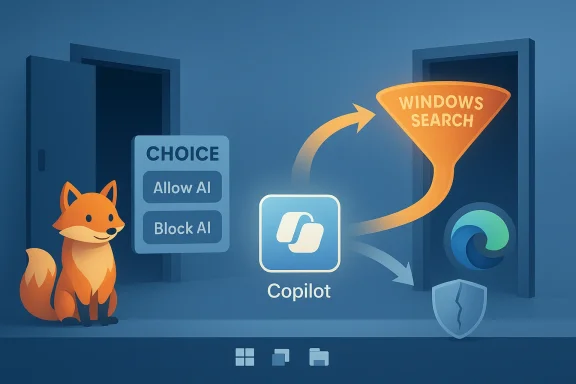
Mozilla’s latest criticism of Microsoft is about more than a browser rivalry. It is about whether Windows is still a neutral platform or whether it has become a distribution engine for Microsoft’s own Edge browser and Copilot AI services. The complaint lands at a moment when Microsoft is pushing its AI assistant deeper into the operating system, while Mozilla says users are still being steered back toward Microsoft products even after they try to choose something else. For Firefox, the issue is existential: if Windows keeps funneling people into Microsoft’s ecosystem, competing browsers lose traffic, revenue, and relevance.
For years, browser competition on Windows has revolved around defaults, prompts, and subtle interface choices. Microsoft has long argued that its browser and search integrations are part of a more cohesive user experience, while critics have said those same choices can become a kind of soft lock-in. Mozilla’s renewed challenge sits squarely in that older debate, but the arrival of AI gives it new urgency.
The company’s public position is that user choice should remain meaningful even when the operating system itself tries to be helpful. That sounds simple, but in practice it is messy. When Windows Search, taskbar behavior, Outlook, Teams, and other Microsoft apps can still route users into Edge, a “default browser” setting starts to look more symbolic than practical. Mozilla has been making that case for years, and its recent statement shows it believes the problem has not gone away.
Microsoft’s Copilot rollout has made the discussion even broader. Copilot is now installed by default on new Windows 11 PCs and is pinned to the taskbar on many systems, with Microsoft also documenting Copilot key support and additional Windows integration points. That means the same company that controls the desktop shell also controls an increasingly prominent AI layer, and that is precisely what Mozilla says should worry regulators and users alike.
What makes the situation especially sensitive is the scale of Windows itself. On a platform with billions of installed devices, even small behavioral nudges can create large market effects. If Edge becomes the path of least resistance for search, links, and AI assistance, then Firefox and other alternatives must compete not just on features, but against the operating system’s gravity.
Microsoft, meanwhile, has steadily woven Edge into Windows in ways that go beyond a standalone browser launch. Microsoft documents that Windows Search can send web queries to Bing and open links in Edge, and that some widgets and apps depend on Edge’s web engine to function. The company also says Edge is an “essential part” of Windows 10/11 in support material. That may be technically accurate, but it also reinforces the sense that Edge is not simply a browser you can swap out for another one.
Copilot has followed a similar path. Microsoft’s support pages state that on new Windows 11 PCs, Copilot is installed by default and pinned to the taskbar or Start menu. Microsoft also notes Copilot key support, voice access, and Windows Settings integration. On some hardware, the dedicated Copilot key can even fall back to Windows Search if Copilot is unavailable, which shows how deeply the AI experience is being tied to the system shell itself.
Mozilla’s counterpoint is that this is not just a product design preference. It is a competition issue. The company has commissioned research arguing that changing defaults on Windows can still be unnecessarily difficult, and that users can be routed back to Microsoft services even after they attempt to switch. Mozilla also says its own browser is now offering an AI Controls panel to let users block or allow features in a more explicit way. That contrast is part of the company’s broader narrative: choice should be real, not ceremonial.
Mozilla’s statement is also likely designed to influence the policy conversation before the market normalizes these integrations. In competition debates, the first company to define the narrative often gets an advantage. By framing Copilot and Edge as part of a single control strategy, Mozilla is urging regulators and the press to view them as one ecosystem play rather than separate features. That framing is important, because the policy remedy for a browser dispute can differ from the remedy for an AI platform dispute.
There is also a practical business reason for Mozilla to speak so loudly. Firefox’s usage is tied to search activity and browser engagement, so anything that channels users away from independent browsing can have a compounding effect. Smaller platform players do not just lose one interaction; they can lose the user’s habitual starting point. Once that happens, the economic cost can be hard to reverse.
This is not a trivial inconvenience. Search is a high-frequency behavior, which means even a small bias has a large cumulative effect. A user may not think much about one redirected click, but dozens of redirected clicks over weeks create real habit formation. Over time, that habit can become default behavior that no settings screen can easily undo.
Mozilla’s complaint is especially pointed because Windows Search sits at the center of the user experience. It is embedded in the taskbar and Start menu, which makes it more than an app. When an operating system’s own search surface routes users toward one browser, rival browsers are competing at a structural disadvantage. That is exactly the kind of asymmetry antitrust lawyers notice.
That matters because an AI assistant is not just a feature; it is a distribution layer. If a user asks Copilot questions, completes tasks through Copilot, and receives file or system help from Copilot, Microsoft has another channel through which it can steer people deeper into its own stack. Mozilla’s concern is that this could reduce the practical role of independent browsers by keeping users inside Microsoft-owned experiences for longer periods.
Microsoft may argue that integrated AI is what users want. That argument is not implausible. Consumers often prefer convenience, especially when a feature is preinstalled and visibly available. But convenience can also hide lock-in, particularly when the easiest path is built to favor the platform owner’s services. The line between helpful and self-preferencing is thin.
That creates a feedback loop. Less browser usage can mean weaker monetization, which can mean fewer resources for product improvements, which can then make the browser less competitive. Large platform owners can absorb that cycle more easily because they have adjacent revenue streams and control over the OS layer. Open-source and independent browser makers do not enjoy that cushion.
Mozilla’s own answer is to emphasize transparency and opt-in control. The company says Firefox now offers centralized AI controls so users can turn off AI-enhanced features in one place or manage them individually. That is not just a feature announcement; it is a philosophical rebuttal to Microsoft’s approach. Mozilla is saying that if AI is going to exist in the browser, users should be able to disable it cleanly and confidently.
There is real product logic in that position. Consumers like consistency, and Microsoft can argue that keeping the browser engine, search results, and assistant in one ecosystem reduces friction. It also simplifies security updates, telemetry, and feature delivery. From a platform engineering standpoint, integration can look like elegance rather than coercion.
But that defense only goes so far. The issue is not whether Microsoft can connect its products; it is whether the company should be able to use Windows as a distribution moat for those products. The more a platform owner controls the route from intent to action, the harder it becomes for competitors to earn a fair shot. That is why the debate keeps returning even after each default-setting tweak.
The European Union’s Digital Markets Act and related competition frameworks have already pushed the industry to think more carefully about defaults, user choice, and platform conduct. Mozilla’s recent research argues that even when regulations say users must be able to change defaults easily, the implementation can still be clumsy enough to blunt the intended effect. That is a crucial point: compliance on paper does not guarantee competition in practice.
For policymakers, the Copilot and Edge discussion may become a test case for whether AI integrations are being treated as neutral features or as strategic leverage. If regulators only examine traditional browser bundling, they may miss the role of AI assistants as the next major control point. The market is moving faster than many rulebooks.
The company also has an opportunity to differentiate Firefox as the browser for users who want explicit control over AI features. In a market where many products are racing to add more AI by default, a clearer opt-in philosophy can be compelling. Firefox’s AI controls give Mozilla a practical example it can point to rather than a purely rhetorical stance.
There is also a risk that Microsoft’s integration strategy keeps evolving faster than criticism can keep up. Even if one route into Edge is improved, another one may emerge through Copilot, widgets, or future Windows surfaces. Meanwhile, consumers can become numb to the issue if the convenience is high enough. That is the danger of platform power: people adapt to it before they fully notice it.
The other major variable is whether the market begins to treat AI assistants the way it once treated browsers: as a default gateway that every platform owner wants to own. If that happens, the competitive stakes could become larger than the browser wars ever were. The browser controlled where users went on the web; the assistant may control what they do next, which is a far more powerful position.
Source: TechSpot https://www.techspot.com/news/112033-mozilla-microsoft-using-copilot-edge-tighten-grip-windows.html
 Overview
For years, browser competition on Windows has revolved around defaults, prompts, and subtle interface choices. Microsoft has long argued that its browser and search integrations are part of a more cohesive user experience, while critics have said those same choices can become a kind of soft lock-in. Mozilla’s renewed challenge sits squarely in that older debate, but the arrival of AI gives it new urgency.The company’s public position is that user choice should remain meaningful even when the operating system itself tries to be helpful. That sounds simple, but in practice it is messy. When Windows Search, taskbar behavior, Outlook, Teams, and other Microsoft apps can still route users into Edge, a “default browser” setting starts to look more symbolic than practical. Mozilla has been making that case for years, and its recent statement shows it believes the problem has not gone away.
Microsoft’s Copilot rollout has made the discussion even broader. Copilot is now installed by default on new Windows 11 PCs and is pinned to the taskbar on many systems, with Microsoft also documenting Copilot key support and additional Windows integration points. That means the same company that controls the desktop shell also controls an increasingly prominent AI layer, and that is precisely what Mozilla says should worry regulators and users alike.
What makes the situation especially sensitive is the scale of Windows itself. On a platform with billions of installed devices, even small behavioral nudges can create large market effects. If Edge becomes the path of least resistance for search, links, and AI assistance, then Firefox and other alternatives must compete not just on features, but against the operating system’s gravity.
Background
Mozilla’s current argument did not appear out of nowhere. The company has a long history of fighting what it sees as platform-level browser favoritism, going back to the days when Internet Explorer dominated Windows. Its view has remained consistent: if a company controls the OS, it has a duty to avoid design choices that distort competition rather than merely serve users.Microsoft, meanwhile, has steadily woven Edge into Windows in ways that go beyond a standalone browser launch. Microsoft documents that Windows Search can send web queries to Bing and open links in Edge, and that some widgets and apps depend on Edge’s web engine to function. The company also says Edge is an “essential part” of Windows 10/11 in support material. That may be technically accurate, but it also reinforces the sense that Edge is not simply a browser you can swap out for another one.
Copilot has followed a similar path. Microsoft’s support pages state that on new Windows 11 PCs, Copilot is installed by default and pinned to the taskbar or Start menu. Microsoft also notes Copilot key support, voice access, and Windows Settings integration. On some hardware, the dedicated Copilot key can even fall back to Windows Search if Copilot is unavailable, which shows how deeply the AI experience is being tied to the system shell itself.
Mozilla’s counterpoint is that this is not just a product design preference. It is a competition issue. The company has commissioned research arguing that changing defaults on Windows can still be unnecessarily difficult, and that users can be routed back to Microsoft services even after they attempt to switch. Mozilla also says its own browser is now offering an AI Controls panel to let users block or allow features in a more explicit way. That contrast is part of the company’s broader narrative: choice should be real, not ceremonial.
Why Mozilla Is Escalating Now
The timing matters. Copilot has moved from a novelty feature to a system-level capability Microsoft wants users to encounter constantly. That changes the competitive stakes because AI is increasingly becoming the front door to computing, not just a feature inside an app. If the operating system’s assistant, search, and browser all point inward to the same vendor, rival products may struggle to find a natural entry point.Mozilla’s statement is also likely designed to influence the policy conversation before the market normalizes these integrations. In competition debates, the first company to define the narrative often gets an advantage. By framing Copilot and Edge as part of a single control strategy, Mozilla is urging regulators and the press to view them as one ecosystem play rather than separate features. That framing is important, because the policy remedy for a browser dispute can differ from the remedy for an AI platform dispute.
There is also a practical business reason for Mozilla to speak so loudly. Firefox’s usage is tied to search activity and browser engagement, so anything that channels users away from independent browsing can have a compounding effect. Smaller platform players do not just lose one interaction; they can lose the user’s habitual starting point. Once that happens, the economic cost can be hard to reverse.
The competitive logic
Mozilla’s argument is not that Microsoft should not build good products. It is that the company should not be allowed to bundle those products so tightly into Windows that rivals are effectively sidelined. That is a classic competition complaint, but the AI era gives it a fresh twist. If the assistant becomes the interface, then whoever controls the assistant controls discovery.- Edge gains an advantage when taskbar and Windows Search flows favor it.
- Copilot gains an advantage when it is pinned, preinstalled, and embedded in system surfaces.
- Firefox loses opportunities whenever the user is steered away before making a choice.
- Search partners and browser-driven monetization become less effective when usage shifts.
The Windows Search Problem
Windows Search is one of the clearest examples Mozilla points to. Microsoft’s own support documentation says that if users choose to search work and web from Windows Search, the results will be powered by Bing and links will open in Microsoft Edge. That means the operating system’s own search entry point can become a traffic funnel into Microsoft’s browser, regardless of what browser the user prefers for everyday web use.This is not a trivial inconvenience. Search is a high-frequency behavior, which means even a small bias has a large cumulative effect. A user may not think much about one redirected click, but dozens of redirected clicks over weeks create real habit formation. Over time, that habit can become default behavior that no settings screen can easily undo.
Mozilla’s complaint is especially pointed because Windows Search sits at the center of the user experience. It is embedded in the taskbar and Start menu, which makes it more than an app. When an operating system’s own search surface routes users toward one browser, rival browsers are competing at a structural disadvantage. That is exactly the kind of asymmetry antitrust lawyers notice.
Why this matters more than a browser tab
The important distinction is that Windows Search is not merely one app opening another. It is an OS-level gateway deciding where a user’s attention goes next. That means the browser choice problem is no longer about “which browser do you install?” but rather “which software gets the system’s first invitation?”- Search is the first stop for many everyday actions.
- Redirects can shape user habits quickly.
- OS-level search surfaces carry more weight than app-level defaults.
- Users often do not realize the redirection is happening.
Copilot as a Distribution Layer
Copilot is where Microsoft’s strategy becomes more ambitious. According to Microsoft support and product materials, Copilot is installed by default on new Windows 11 PCs, appears pinned to the taskbar or Start menu, and can be invoked through a dedicated key on supported devices. Microsoft has also described Copilot-related Windows experiences in system surfaces such as Settings and File Explorer.That matters because an AI assistant is not just a feature; it is a distribution layer. If a user asks Copilot questions, completes tasks through Copilot, and receives file or system help from Copilot, Microsoft has another channel through which it can steer people deeper into its own stack. Mozilla’s concern is that this could reduce the practical role of independent browsers by keeping users inside Microsoft-owned experiences for longer periods.
Microsoft may argue that integrated AI is what users want. That argument is not implausible. Consumers often prefer convenience, especially when a feature is preinstalled and visibly available. But convenience can also hide lock-in, particularly when the easiest path is built to favor the platform owner’s services. The line between helpful and self-preferencing is thin.
A new front door for the operating system
Historically, the browser was the front door to the internet. Copilot could become the front door to the computer itself. If that happens, the company controlling the assistant may shape not just what people browse, but what they search for, open, and act on. That is a deeper kind of power than browser market share alone.- Copilot is now part of the Windows identity, not an optional add-on.
- Dedicated hardware keys strengthen usage by habit.
- AI answers can reduce the need to browse elsewhere.
- Integrated assistants can steer users toward first-party services.
Firefox, Choice, and the Economics of Attention
Mozilla’s business model helps explain why this fight is so personal. Firefox is not just a product; it is part of an ecosystem where browser activity supports search revenue and product development. When users are redirected to Edge or kept inside Microsoft’s flow, Firefox loses usage, and with it some of the leverage that keeps its independent model viable.That creates a feedback loop. Less browser usage can mean weaker monetization, which can mean fewer resources for product improvements, which can then make the browser less competitive. Large platform owners can absorb that cycle more easily because they have adjacent revenue streams and control over the OS layer. Open-source and independent browser makers do not enjoy that cushion.
Mozilla’s own answer is to emphasize transparency and opt-in control. The company says Firefox now offers centralized AI controls so users can turn off AI-enhanced features in one place or manage them individually. That is not just a feature announcement; it is a philosophical rebuttal to Microsoft’s approach. Mozilla is saying that if AI is going to exist in the browser, users should be able to disable it cleanly and confidently.
Consumer impact versus enterprise impact
Consumers are affected by the inconvenience of defaults that keep drifting back toward Microsoft services. Enterprises, however, face a different problem: standardization and policy control. In corporate environments, Windows and Microsoft 365 are already deeply embedded, so Edge and Copilot can become the path of least resistance for IT admins as well as end users.- Consumers may feel trapped by unwanted redirections.
- Enterprises may see reduced flexibility in browser governance.
- Support teams may inherit more complexity when defaults are inconsistent.
- Procurement decisions may reinforce Microsoft’s ecosystem power.
Microsoft’s Defense and the Product Logic Behind It
Microsoft’s point of view is easy to infer even when it is not stated in Mozilla’s criticism: it believes deeply integrated experiences make Windows more useful. The company’s support materials regularly highlight features that depend on Edge, Bing, or Copilot, and it frames those components as part of a modern, connected system. In Microsoft’s worldview, a browser is not just a browser if the OS can use the same engine to power widgets, search, and web-backed system features.There is real product logic in that position. Consumers like consistency, and Microsoft can argue that keeping the browser engine, search results, and assistant in one ecosystem reduces friction. It also simplifies security updates, telemetry, and feature delivery. From a platform engineering standpoint, integration can look like elegance rather than coercion.
But that defense only goes so far. The issue is not whether Microsoft can connect its products; it is whether the company should be able to use Windows as a distribution moat for those products. The more a platform owner controls the route from intent to action, the harder it becomes for competitors to earn a fair shot. That is why the debate keeps returning even after each default-setting tweak.
The user-experience argument
Microsoft can sincerely believe it is reducing friction. Users click, search, and get an answer with fewer steps. Yet the same design can reduce meaningful choice if the system quietly invalidates the user’s earlier preference. A “better experience” for the platform owner is not always a better experience for the market.- Integration can improve convenience.
- Integration can also suppress choice.
- Defaults matter more when they are repeated across surfaces.
- Users often do not inspect the mechanics behind the result.
The Regulatory and Competitive Angle
This debate is not happening in a vacuum. Mozilla has repeatedly pointed to browser-choice concerns in the context of regulation and operating system design, and it has argued that platform gatekeepers can make competitive entry harder without overtly banning rivals. That is why browser defaults have long been a policy flashpoint in both the U.S. and Europe.The European Union’s Digital Markets Act and related competition frameworks have already pushed the industry to think more carefully about defaults, user choice, and platform conduct. Mozilla’s recent research argues that even when regulations say users must be able to change defaults easily, the implementation can still be clumsy enough to blunt the intended effect. That is a crucial point: compliance on paper does not guarantee competition in practice.
For policymakers, the Copilot and Edge discussion may become a test case for whether AI integrations are being treated as neutral features or as strategic leverage. If regulators only examine traditional browser bundling, they may miss the role of AI assistants as the next major control point. The market is moving faster than many rulebooks.
What a stronger remedy might look like
If regulators decide this is a competition problem, the remedy may need to be broader than “allow browser choice.” It could require clear routing rules, easier default changes, or limits on system surfaces that auto-open first-party services. Those ideas are not simple, but the current behavior is not simple either.- Default browser changes should be straightforward and persistent.
- Search surfaces should respect user-selected preferences.
- OS-level AI tools should not disadvantage rivals by design.
- Link-handling rules should be consistent across Windows and Microsoft apps.
Strengths and Opportunities
Mozilla has one major advantage here: it is telling a story that connects directly to a widely understood concern, namely choice. Even users who do not care about browser market share usually understand the annoyance of settings that do not stick. That gives Mozilla a broad, relatable argument, and it aligns with its newer message that AI should be something people control rather than something imposed on them.The company also has an opportunity to differentiate Firefox as the browser for users who want explicit control over AI features. In a market where many products are racing to add more AI by default, a clearer opt-in philosophy can be compelling. Firefox’s AI controls give Mozilla a practical example it can point to rather than a purely rhetorical stance.
- User choice remains Mozilla’s strongest message.
- Firefox AI controls provide a concrete product counterexample.
- Competition concerns resonate with regulators and privacy-conscious users.
- Windows scale makes the issue commercially meaningful.
- Transparency can become a brand differentiator.
- Open-source credibility helps Mozilla frame the debate as pro-user rather than anti-innovation.
Risks and Concerns
The biggest risk for Mozilla is that the public may view this as a familiar browser grievance rather than a serious platform issue. If the argument sounds like a company defending its own traffic share, it may not break through. Mozilla therefore has to keep tying the problem to user autonomy, not just browser usage metrics. That distinction is critical if it wants regulators and users to take the claim seriously.There is also a risk that Microsoft’s integration strategy keeps evolving faster than criticism can keep up. Even if one route into Edge is improved, another one may emerge through Copilot, widgets, or future Windows surfaces. Meanwhile, consumers can become numb to the issue if the convenience is high enough. That is the danger of platform power: people adapt to it before they fully notice it.
- The issue may be dismissed as ordinary product integration.
- Microsoft can keep shifting the control point to new surfaces.
- Consumers may prioritize convenience over abstraction.
- Regulators may move too slowly to matter.
- Firefox’s smaller scale leaves less room for error.
- AI features may normalize first-party preference even further.
Looking Ahead
The next phase of this story will likely be shaped less by one blog post and more by how Microsoft and Mozilla behave over the next several Windows and Firefox releases. If Copilot becomes more deeply embedded in Windows Settings, File Explorer, and other shell surfaces, Mozilla’s warning will gain credibility. If Microsoft makes browser-choice flows clearer and more persistent, the controversy could soften, at least at the edges. For now, the company has not done enough to settle the question.The other major variable is whether the market begins to treat AI assistants the way it once treated browsers: as a default gateway that every platform owner wants to own. If that happens, the competitive stakes could become larger than the browser wars ever were. The browser controlled where users went on the web; the assistant may control what they do next, which is a far more powerful position.
- Watch for Copilot integration in more Windows system surfaces.
- Watch for default browser policy changes in Windows and Microsoft 365 apps.
- Watch for Firefox AI controls adoption as a differentiator.
- Watch for regulatory reactions in the U.S. and Europe.
- Watch for whether Microsoft offers clearer user-choice prompts.
- Watch for whether independent browsers can reclaim attention in an AI-first workflow.
Source: TechSpot https://www.techspot.com/news/112033-mozilla-microsoft-using-copilot-edge-tighten-grip-windows.html
Last edited:
