

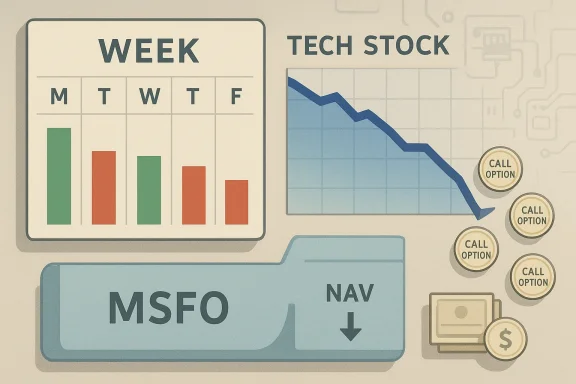
The latest blow to YieldMax MSFT Option Income Strategy ETF (MSFO) is not really about option income at all. It is about the uncomfortable reality that a weekly covered-call ETF can look resilient right up until the underlying stock starts trending lower and the premium environment cools at the same time. Microsoft’s pullback has pressured MSFO’s net asset value, while collapsing volatility has shrunk the weekly distributions that once made the product look deceptively durable. The result is a textbook reminder that income-focused wrappers do not erase single-name risk.
MSFO sits inside a fast-growing corner of the ETF market: single-stock option-income funds built to monetize volatility rather than chase traditional total return. YieldMax’s approach is simple on paper and complicated in practice. The fund seeks current income by selling call options or call spreads tied to Microsoft, while still maintaining secondary exposure to the stock’s price action. YieldMax describes the strategy as one designed to generate weekly income, with distributions that are explicitly not guaranteed and can vary over time.
That structure matters because these funds are often marketed as a way to get “paid while you wait.” In reality, they are better understood as a way to turn a volatile equity into a cash-flow machine, with the tradeoff that upside is capped and downside remains very real. MSFO’s own fund materials make clear that the secondary objective is exposure to Microsoft’s share price, subject to a limit on potential gains. That phrase is doing a lot of work. It means investors may receive periodic cash distributions, but they are not insulated from a sustained decline in MSFT.
Microsoft itself has become the market’s most important AI infrastructure story. The company has continued to post strong revenue growth, particularly in Azure, but investors have increasingly focused on the cost of maintaining that growth. In its fiscal Q2 2026 earnings materials, Microsoft reported revenue up 17% year over year, with Azure and other cloud services revenue up 39%, yet it also said the Microsoft Cloud gross margin percentage declined because of continued investments in AI infrastructure and growing AI product usage.
That combination—strong operating momentum plus heavy capital intensity—is exactly what can unsettle a stock even after a clean earnings beat. Microsoft guided Azure growth for the next quarter to 37% to 38% in constant currency, a very strong figure by ordinary standards but one that still invited debate about whether the company’s spending pace was outrunning near-term monetization. The market’s reaction has therefore been less about whether Microsoft is growing and more about how expensive that growth has become.
For MSFO holders, the timing is brutal. The ETF’s design rewards range-bound stocks with enough volatility to keep premiums elevated. It struggles when the underlying stock falls decisively, and it struggles again when volatility falls away and the option income engine becomes thin. That is why the fund can deliver weeks of appealing payouts and still underperform in a broader, quieter downtrend. The danger is not one bad week; it is a long sequence of small disappointments.
The investor temptation is to compare the distribution rate to a dividend yield and stop there. That is the wrong comparison. A dividend is paid by a company with operating cash flows; an option premium is compensation for taking on market risk. They are economically different, and the distinction becomes critical when the underlying asset is under pressure.
Key takeaways:
But that same frequency can obscure the real picture. A weekly payment that shrinks from a few cents to a few pennies can still feel “active,” even when the underlying net asset value is slowly leaking away. The investor sees cash arriving and assumes the product is working; meanwhile, the capital base is doing the opposite. That is the hidden dividend trap in many income products.
This is the essential market tension. Microsoft is being valued not just as a software giant, but as a capital-intensive AI platform builder. That means the market wants proof that each new dollar of infrastructure spend translates into durable revenue and margin expansion. Until that proof becomes obvious, the stock can remain under pressure even if earnings growth stays strong.
For MSFO investors, this matters because a covered-call strategy can survive volatility better than a one-way slide. It can harvest premiums while the stock bounces around. What it cannot do is fully offset a steady de-rating of the underlying. That is where capital loss overwhelms income.
That is especially important for a product like MSFO because the ETF does not own a portfolio of unrelated businesses. It owns a single story. If the Microsoft story is weak, there is no diversification layer to soften the blow. The income is real, but so is the concentration risk.
Microsoft’s volatility environment has clearly changed over time. The broader market saw a major VIX spike in 2025 and a much calmer backdrop later in the year, which helped explain why distributions fell into 2026. A lower-volatility market can be friendlier to ordinary equity investors, but it is often bad news for option-income products.
That is not a defect; it is the product functioning as designed. But it does raise a broader question: if the income stream depends on a favorable option-pricing environment, how much of the investor’s return is truly repeatable? The answer is probably less than many first-time buyers assume.
So even if the fund is still doing exactly what it was built to do, the optics can shift sharply. Investors who anchored to the $0.55 peak may now perceive the fund as failing, when in reality the market backdrop has simply changed. The problem is that perception and economic reality can both hurt returns.
The reason is structural, not accidental. YieldMax’s own materials note that the fund seeks exposure to Microsoft’s share price but with limited potential gains. That implies an asymmetry: the upside is constrained, while the downside remains significant. In a flat market, that tradeoff may be acceptable. In a downtrend, it becomes painful.
The paradox is that Microsoft’s strength may actually increase valuation sensitivity. When a stock is priced as a premium compounder, any hint that future growth is becoming more expensive can compress the multiple quickly. That is the kind of move that hurts MSFO holders twice: once through the underlying stock decline and again through weaker premium generation if volatility later fades.
This shift matters because software investors once expected software-like margins and software-like scalability. AI infrastructure is more expensive and more physical. It requires data centers, GPUs, power, and lease commitments. That makes the business more durable in some ways, but also more capital hungry in the near term.
For MSFO, the issue is amplified because the ETF’s exposure is one-to-one in spirit, if not in exact replication. It does not get the benefit of multiple different corporate cycles. It rides on Microsoft alone, which means every AI debate gets concentrated into one portfolio. That is not diversification; it is a wager on one narrative holding together.
Neither perspective is wrong, but the language differs. The retail framing is emotionally powerful; the institutional framing is economically precise. MSFO lives at the intersection of those two audiences, which is why the product can be popular even when its long-term total-return profile is unimpressive.
This is not unique to MSFO, but the issue is especially visible in option-income products because the payments are frequent and variable. That makes it easy to focus on the cash and ignore the source of the cash. The product can be working exactly as designed while still being unsuitable for a particular risk profile.
Investors should think in terms of sources and uses:
If the stock remains volatile but range-bound, MSFO can keep doing what it was built to do. If Microsoft continues to drift lower while volatility fades, the ETF’s weekly income will look increasingly like a consolation prize. In that case, the check arrives on time, but the portfolio still loses the argument.
Source: AOL.com When Microsoft Falters, MSFO Takes It On The Chin
 Background
MSFO sits inside a fast-growing corner of the ETF market: single-stock option-income funds built to monetize volatility rather than chase traditional total return. YieldMax’s approach is simple on paper and complicated in practice. The fund seeks current income by selling call options or call spreads tied to Microsoft, while still maintaining secondary exposure to the stock’s price action. YieldMax describes the strategy as one designed to generate weekly income, with distributions that are explicitly not guaranteed and can vary over time.That structure matters because these funds are often marketed as a way to get “paid while you wait.” In reality, they are better understood as a way to turn a volatile equity into a cash-flow machine, with the tradeoff that upside is capped and downside remains very real. MSFO’s own fund materials make clear that the secondary objective is exposure to Microsoft’s share price, subject to a limit on potential gains. That phrase is doing a lot of work. It means investors may receive periodic cash distributions, but they are not insulated from a sustained decline in MSFT.
Microsoft itself has become the market’s most important AI infrastructure story. The company has continued to post strong revenue growth, particularly in Azure, but investors have increasingly focused on the cost of maintaining that growth. In its fiscal Q2 2026 earnings materials, Microsoft reported revenue up 17% year over year, with Azure and other cloud services revenue up 39%, yet it also said the Microsoft Cloud gross margin percentage declined because of continued investments in AI infrastructure and growing AI product usage.
That combination—strong operating momentum plus heavy capital intensity—is exactly what can unsettle a stock even after a clean earnings beat. Microsoft guided Azure growth for the next quarter to 37% to 38% in constant currency, a very strong figure by ordinary standards but one that still invited debate about whether the company’s spending pace was outrunning near-term monetization. The market’s reaction has therefore been less about whether Microsoft is growing and more about how expensive that growth has become.
For MSFO holders, the timing is brutal. The ETF’s design rewards range-bound stocks with enough volatility to keep premiums elevated. It struggles when the underlying stock falls decisively, and it struggles again when volatility falls away and the option income engine becomes thin. That is why the fund can deliver weeks of appealing payouts and still underperform in a broader, quieter downtrend. The danger is not one bad week; it is a long sequence of small disappointments.
Why This Fund Exists
The popularity of single-stock covered-call ETFs reflects a wider shift in investor behavior. Many buyers no longer want pure exposure to equities; they want cash flow first, even if that means giving up some upside and accepting structural downside. YieldMax has built a family of products around that preference, and MSFO is one of the clearest examples because Microsoft is widely perceived as a high-quality, institutionally owned, “safe” mega-cap name. That perceived safety can make the income wrapper look more conservative than it really is.How the Strategy Works
The mechanics are straightforward. MSFO collects option premium by writing calls on Microsoft-linked exposure, then distributes those premiums to shareholders. If Microsoft rises sharply, the fund tends to lag because the short call position limits participation. If Microsoft falls, the fund still loses value with the stock, though the premiums may cushion part of the decline. In other words, the product monetizes volatility, not direction.The investor temptation is to compare the distribution rate to a dividend yield and stop there. That is the wrong comparison. A dividend is paid by a company with operating cash flows; an option premium is compensation for taking on market risk. They are economically different, and the distinction becomes critical when the underlying asset is under pressure.
Key takeaways:
- MSFO is built for income generation, not capital preservation.
- Its weekly payouts depend heavily on option premium levels.
- The fund’s upside is capped, while downside remains largely uncapped.
- A stable or choppy Microsoft is better than a trending decline.
- Low volatility usually means weaker distributions.
Why Investors Buy It Anyway
The appeal is obvious. Many retirees and income seekers want a stock-linked payout without having to build a derivative strategy themselves. Weekly distributions also create a psychological effect that monthly funds do not; the cash arrives often enough to feel tangible and therefore reassuring. That is part of why single-stock option funds have gathered so much attention even among investors who understand the tradeoffs.But that same frequency can obscure the real picture. A weekly payment that shrinks from a few cents to a few pennies can still feel “active,” even when the underlying net asset value is slowly leaking away. The investor sees cash arriving and assumes the product is working; meanwhile, the capital base is doing the opposite. That is the hidden dividend trap in many income products.
Microsoft’s Stock Is Doing the Heavy Lifting
MSFO’s fate is tightly bound to Microsoft’s share price, and the stock has not been cooperating. According to the premise of the piece, Microsoft has fallen about 17% year to date, and that drawdown alone can do more damage to MSFO than several weeks of collected option premiums can repair. In a covered-call wrapper, the underlying direction is still the anchor. If the anchor drifts lower, the whole structure follows.The Market’s CapEx Anxiety
Microsoft’s core business remains robust, but investors have become increasingly sensitive to the scale of AI-related capital spending. In the fiscal Q2 2026 materials, Microsoft said it was continuing to invest in AI infrastructure, and its cloud gross margin was pressured by those investments. The company also guided Azure growth at 37% to 38% for the coming quarter, which is excellent but not enough to end the debate over whether the spending curve is too steep.This is the essential market tension. Microsoft is being valued not just as a software giant, but as a capital-intensive AI platform builder. That means the market wants proof that each new dollar of infrastructure spend translates into durable revenue and margin expansion. Until that proof becomes obvious, the stock can remain under pressure even if earnings growth stays strong.
Why a Strong Quarter Can Still Hurt the Stock
The strange part is that strong earnings may no longer be enough. Microsoft reported revenue growth of 17% and Azure growth of 39%, yet the company’s stock still sold off on concerns about infrastructure spending and future margin pressure. That tells you the market is repricing the narrative, not merely the numbers. The company is being judged on capital efficiency as much as on growth.For MSFO investors, this matters because a covered-call strategy can survive volatility better than a one-way slide. It can harvest premiums while the stock bounces around. What it cannot do is fully offset a steady de-rating of the underlying. That is where capital loss overwhelms income.
- Strong earnings do not automatically mean a stronger stock.
- The market is focused on AI return on capital.
- Microsoft’s spending is now a valuation issue, not just an operating one.
- MSFO inherits that sentiment directly.
- A persistent markdown in MSFT can overwhelm option income.
The Danger of Narratives Repricing
A stock like Microsoft can be punished for reasons that never show up in the income statement right away. Investors may decide that the company is paying too much to stay ahead in AI, or that the payoff horizon is too long relative to expectations. Once that narrative takes hold, valuation compression can persist even as revenue and earnings remain strong.That is especially important for a product like MSFO because the ETF does not own a portfolio of unrelated businesses. It owns a single story. If the Microsoft story is weak, there is no diversification layer to soften the blow. The income is real, but so is the concentration risk.
The Income Stream Has Already Changed
The distribution profile is the second half of the story, and it is easy to miss because weekly payments create the impression of continuity. MSFO’s payouts peaked at $0.55 per share in May 2025, then fell into the $0.05 to $0.08 range by early 2026. That is a dramatic compression, and it is exactly what you would expect when option premiums normalize after a volatility spike.Volatility Is the Fuel
Option income funds live and die on implied volatility. When investors expect bigger price swings, option premiums rise because there is more uncertainty to insure against. When fear subsides, premiums shrink, and the cash available for distribution declines along with them. That means MSFO’s payout pattern is less a sign of management skill than a reflection of market conditions.Microsoft’s volatility environment has clearly changed over time. The broader market saw a major VIX spike in 2025 and a much calmer backdrop later in the year, which helped explain why distributions fell into 2026. A lower-volatility market can be friendlier to ordinary equity investors, but it is often bad news for option-income products.
What the Fund’s Current Data Suggests
YieldMax’s own MSFO page shows a 30-day SEC yield and a recent distribution history that is materially lower than the product’s more eye-catching moments in 2025. The fund’s publicly listed distributions in early 2026 show weekly payouts in the mid-single-digit cents range, not the headline-grabbing levels seen during volatility spikes.That is not a defect; it is the product functioning as designed. But it does raise a broader question: if the income stream depends on a favorable option-pricing environment, how much of the investor’s return is truly repeatable? The answer is probably less than many first-time buyers assume.
- Higher volatility usually means higher premiums.
- Lower volatility usually means lower distributions.
- The payout stream is therefore cyclical, not fixed.
- Weekly income can shrink fast when fear recedes.
- The “yield” should never be confused with a bond coupon.
Why This Feels Worse Than It Is
There is a behavioral element here too. A monthly product can hide a lot of variability because investors only see twelve payments a year. A weekly product makes every change visible. That transparency is useful, but it also amplifies disappointment when the distribution drops.So even if the fund is still doing exactly what it was built to do, the optics can shift sharply. Investors who anchored to the $0.55 peak may now perceive the fund as failing, when in reality the market backdrop has simply changed. The problem is that perception and economic reality can both hurt returns.
The NAV Problem Investors Underestimate
The most important issue for MSFO may be the one least discussed in marketing language: net asset value erosion. A covered-call fund can pay out consistently and still lose ground if the underlying asset falls faster than the premiums can compensate. That is why “income” and “total return” are not the same thing, even when monthly or weekly checks look attractive.Downside Comes Through Fully
When Microsoft drops, the ETF generally drops too. The call premium offers partial offset, but it does not create a floor. That means the fund can still post a negative total return during periods when distributions are coming in like clockwork. This is the part of the strategy many investors only appreciate after the first sustained decline.The reason is structural, not accidental. YieldMax’s own materials note that the fund seeks exposure to Microsoft’s share price but with limited potential gains. That implies an asymmetry: the upside is constrained, while the downside remains significant. In a flat market, that tradeoff may be acceptable. In a downtrend, it becomes painful.
Why Microsoft’s Size Does Not Save the Fund
Some investors assume that because Microsoft is large and profitable, the downside must be manageable. That is a dangerous assumption. Mega-cap quality can reduce bankruptcy risk, but it does not eliminate price risk, and price risk is what matters most inside a traded fund. Even world-class businesses can have bad stretches in the market if expectations reset.The paradox is that Microsoft’s strength may actually increase valuation sensitivity. When a stock is priced as a premium compounder, any hint that future growth is becoming more expensive can compress the multiple quickly. That is the kind of move that hurts MSFO holders twice: once through the underlying stock decline and again through weaker premium generation if volatility later fades.
NAV Versus Cash Flow
This distinction is worth stating plainly:- NAV decline hurts the principal base.
- Distribution income is the cash you receive along the way.
- A fund can have one without rescuing the other.
- The market prices both simultaneously.
- Long-term investors need to care about the total package.
The Microsoft Story Is Bigger Than One ETF
Microsoft’s current valuation debate has implications well beyond MSFO. The company is one of the central pillars of the AI trade, and the market’s treatment of Microsoft can influence sentiment across software, cloud, semiconductors, and infrastructure names. If investors decide the AI build-out is becoming too capital intensive, the repricing can spread far beyond one mega-cap ticker.AI Capex Is Changing the Rules
Microsoft’s earnings materials show a company that is still growing strongly but doing so with rising AI infrastructure intensity. The Microsoft Cloud gross margin percentage declined because of continued investments in AI infrastructure, even as Azure growth remained strong. That is the essence of the new debate: the market is no longer asking whether AI demand exists. It is asking whether the economics of supply are attractive enough.This shift matters because software investors once expected software-like margins and software-like scalability. AI infrastructure is more expensive and more physical. It requires data centers, GPUs, power, and lease commitments. That makes the business more durable in some ways, but also more capital hungry in the near term.
Competitive Pressure Still Matters
Microsoft is not alone in this. Every major cloud player is facing the same tension between AI demand and infrastructure cost. That means valuation multiples across the group can be sensitive to any sign that growth is slowing or capital intensity is rising too quickly. In such an environment, even strong companies can see their stocks trade like cyclical assets.For MSFO, the issue is amplified because the ETF’s exposure is one-to-one in spirit, if not in exact replication. It does not get the benefit of multiple different corporate cycles. It rides on Microsoft alone, which means every AI debate gets concentrated into one portfolio. That is not diversification; it is a wager on one narrative holding together.
The Consumer Versus Institutional Angle
Retail investors often buy funds like MSFO for monthly or weekly cash flow. Institutions, by contrast, tend to evaluate them more mechanically, focusing on factor exposure, implied volatility, and tax treatment. That difference in perspective matters because the retail buyer may see “income,” while the institutional buyer sees a derivative overlay with embedded convexity risk.Neither perspective is wrong, but the language differs. The retail framing is emotionally powerful; the institutional framing is economically precise. MSFO lives at the intersection of those two audiences, which is why the product can be popular even when its long-term total-return profile is unimpressive.
Distribution Quality Matters, Not Just Distribution Size
Many income investors ask the wrong question first. They ask how much the fund paid this week, not how much of that payment is economic return versus return of capital. YieldMax funds often have complex tax characteristics, and their cash distributions can include significant return-of-capital components. That does not automatically make them bad products, but it does mean headline yield can mislead.Why Tax Character Is Part of the Story
A distribution that feels generous can still be partly funded by reducing the investor’s cost basis. Over time, that changes the economics of the holding. It also means an investor can receive recurring payments while the underlying position quietly loses ground in a tax-advantaged or taxable account depending on structure and context.This is not unique to MSFO, but the issue is especially visible in option-income products because the payments are frequent and variable. That makes it easy to focus on the cash and ignore the source of the cash. The product can be working exactly as designed while still being unsuitable for a particular risk profile.
Why Weekly Payouts Are Not a Free Lunch
Weekly distributions create a strong sense of progress. That is useful if your goal is cash flow matching, but less useful if you are trying to preserve capital over a long horizon. A fund that pays every week may feel more productive than one that pays quarterly, even if the underlying economics are worse. That is behavioral alpha in reverse.Investors should think in terms of sources and uses:
- Option premiums are collected from market participants willing to buy upside exposure.
- Those premiums are passed through as distributions.
- The fund still remains exposed to Microsoft-linked price risk.
- If MSFT falls, the NAV can decline faster than income arrives.
- If volatility falls, future premiums can shrink rapidly.
The Real Comparison
MSFO should not be compared with a savings account or bond ladder. It should be compared with direct MSFT ownership, alternative covered-call structures, and other income strategies that expose the investor to market risk. Once you compare it correctly, the question is not whether the fund pays well in a good week. The question is whether the tradeoff is worth it over a full market cycle.Strengths and Opportunities
MSFO still has a real place for a certain type of investor. The fund offers a way to turn Microsoft exposure into a cash-flow stream, and it does so through a well-understood options framework. In the right market environment—range-bound shares, moderate volatility, and no major de-rating—it can be a useful tactical income sleeve rather than a core holding.- Weekly income can help investors with cash-flow needs.
- The strategy is easy to understand compared with many derivatives products.
- Microsoft remains a high-quality underlying company with durable cash generation.
- Periods of elevated volatility can boost distributions.
- The fund may appeal to investors seeking exposure without full upside dependence.
- A sideways Microsoft market can make the tradeoff more attractive.
- Short-duration option income can add flexibility relative to slow-paying funds.
Risks and Concerns
The risks are more serious than the promotional language often suggests. MSFO is exposed to a single stock, and that stock has already entered a drawdown. At the same time, the option-income engine has weakened as volatility has normalized, leaving the fund with less income support precisely when it needs it most. That is a difficult combination.- Single-stock concentration creates uncompensated idiosyncratic risk.
- A sustained MSFT decline can overwhelm option income.
- Lower volatility reduces the weekly payout stream.
- Distribution cuts can damage investor expectations quickly.
- NAV erosion can continue even when checks are still arriving.
- Tax complexity may reduce after-tax appeal.
- The strategy can lag badly in strong rallies because upside is capped.
What to Watch Next
The next phase of the MSFO story depends on two things: Microsoft’s ability to prove that AI spending is translating into efficient growth, and the market’s willingness to keep paying for option premium. If Microsoft can re-accelerate confidence around Azure and margins, the stock may stabilize enough to support the ETF. If not, the fund may remain stuck in a pattern of shrinking payouts and slow capital erosion.Key indicators to monitor
- Microsoft’s next earnings report and Azure growth guidance.
- Any change in AI capital expenditure commentary.
- The path of implied volatility across the mega-cap technology group.
- MSFO’s weekly distribution trend and whether it stabilizes.
- The stock’s technical behavior around prior support levels.
- Evidence that market sentiment is shifting from AI enthusiasm to AI skepticism.
If the stock remains volatile but range-bound, MSFO can keep doing what it was built to do. If Microsoft continues to drift lower while volatility fades, the ETF’s weekly income will look increasingly like a consolation prize. In that case, the check arrives on time, but the portfolio still loses the argument.
Source: AOL.com When Microsoft Falters, MSFO Takes It On The Chin
