

Microsoft’s work to bring Hyper‑V semantics into the Linux virtualization stack has taken a major step forward with the inclusion of a new MSHV accelerator in QEMU 10.2, a development that promises to reshape how Hyper‑V guests and Azure instances host nested and sibling virtual machines without the performance and manageability penalties of traditional nested virtualization.
Virtualization stacks have long been split between type‑1 hypervisors (like Hyper‑V) and widely used emulators and managers (like QEMU and KVM) on Linux. Each model makes tradeoffs between performance, isolation, and manageability; bridging them cleanly has been a recurring engineering challenge. Microsoft’s MSHV project, and now QEMU’s built‑in support for an MSHV accelerator, represent a practical effort to bring Hyper‑V’s capabilities to non‑Windows tooling and to let Linux‑based hosts and VMMs call into the Microsoft Hypervisor in a structured way.
The announcement was highlighted at FOSDEM 2026, where Microsoft engineer Magnus Kulke presented the MSHV accelerator and walked through the design goals, current status, and roadmap. The FOSDEM materials (slides, video, and subtitle files) make clear that QEMU 10.2 ships with a first‑class option for
However, cloud operators must treat MSHV as a platform capability that influences pricing, SLA guarantees, and security boundaries. If an L1 can carve GPUs into multiple L2 guests, the resource accounting and billing model needs to be explicit. Operators should also consider how this interacts with confidential computing and hardware‑backed trust models.
Technically, the approach is sensible: provide a minimal, well‑documented kernel ioctl API (
Operationally, however, the rollout must be measured. The most valuable features—live migration, robust device passthrough, and complete CPU model integration—are still in progress and will determine whether MSHV moves from an exciting capability to a production staple. Security hardening, upstream testing, and comprehensive tooling support are essential prerequisites before you should consider production adoption.
For administrators and platform architects, this is an opportunity: start planning labs now, validate your workload behavior, and engage with the upstream projects (QEMU, libvirt, and kernel maintainers). For cloud vendors, MSHV offers a technically elegant path to new product capabilities—provided the ecosystem converges on APIs, billing semantics, and hardened implementations.
The MSHV story is still being written, but QEMU 10.2’s inclusion of a first‑class
Source: FilmoGaz Microsoft Embraces QEMU 10.2 with New MSHV Accelerator for Hyper-V Guests
 Background
Virtualization stacks have long been split between type‑1 hypervisors (like Hyper‑V) and widely used emulators and managers (like QEMU and KVM) on Linux. Each model makes tradeoffs between performance, isolation, and manageability; bridging them cleanly has been a recurring engineering challenge. Microsoft’s MSHV project, and now QEMU’s built‑in support for an MSHV accelerator, represent a practical effort to bring Hyper‑V’s capabilities to non‑Windows tooling and to let Linux‑based hosts and VMMs call into the Microsoft Hypervisor in a structured way. The announcement was highlighted at FOSDEM 2026, where Microsoft engineer Magnus Kulke presented the MSHV accelerator and walked through the design goals, current status, and roadmap. The FOSDEM materials (slides, video, and subtitle files) make clear that QEMU 10.2 ships with a first‑class option for
-accel mshv and integration points that let existing management tooling discover and consume MSHV capabilities. What is the MSHV accelerator?
The technical idea in one line
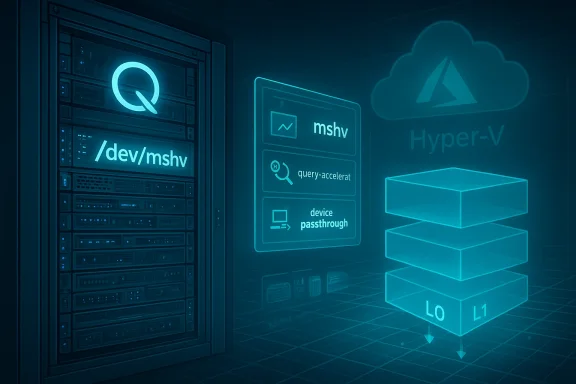
MSHV provides a kernel‑level interface that exposes the Microsoft Hypervisor to user‑mode VMMs via a device API (conceptually similar to /dev/kvm), and the QEMU MSHV accelerator is the glue that lets QEMU use that interface as a drop‑in accelerator backend.MSHV, /dev/mshv, and Direct Virtualization
At the kernel level Microsoft has contributed a/dev/mshv ioctl‑based driver that VMMs can open to manage partitions, map guest memory, create virtual processors, and handle hypervisor events. That driver implements the primitives needed to run guests using the Microsoft Hypervisor from Linux userspace. On top of this, Microsoft has been pushing a model called Direct Virtualization: instead of true nested virtualization where an L1 guest must be granted the raw CPU virtualization extensions and then itself run a hypervisor, Direct Virtualization lets an L1 owner allocate parts of its assigned resources (CPUs, RAM, and devices) to L2 guests while keeping the original isolation boundaries intact. The net result: L1‑hosted L2 guests get near‑native access to hardware and hypervisor features without the fragile complexity of exposing host virtualization extensions into guest mode. How QEMU fits in
QEMU’s accelerator framework was extended to recognizemshv as an accelerator type; QMP can list mshv via query-accelerators, and QEMU can be invoked with -accel mshv where supported. That means mainstream VMM tooling (QEMU, libvirt, orchestration stacks) can treat MSHV as just another accelerator option and gain access to Hyper‑V semantics from Linux hosts or VMs that have a /dev/mshv device. Why this matters: breaking the nested virtualization tradeoff
Nested virtualization has been useful for labs and testing, but production usage has been limited by performance quirks, weakened isolation, and configuration fragility. Microsoft’s Direct Virtualization and the MSHV accelerator aim to replace many nested scenarios with a cleaner model that preserves isolation while enabling richer device access and performance.- Performance: By avoiding the overhead of exposing raw virtualization extensions into guests, MSHV/direct virtualization allows guests to run with lower trap rates and better I/O efficiency. That’s especially important for I/O‑heavy workloads requiring GPU or NVMe access.
- Isolation: L2 guests can be managed as logical children of the hypervisor without granting L1 the ability to run its own full hypervisor. This reduces the attack surface compared to full nested setups.
- Manageability: Operators can provision L2 VMs from within L1 without complex kernel flag toggles or precarious host configuration changes that nested virtualization often requires.
What QEMU 10.2 brings: features and integration
QEMU 10.2’s release notes and documentation add the accelerator into the mainstream release stream and provide the management hooks for discoverability and capability negotiation. Major immediate features and integrations include:mshvaccelerator recognized by QEMU: QEMU now listsmshvas a present accelerator and can enable it at launch time when the host provides/dev/mshv. The QMPquery-acceleratorsAPI showsmshvas an available option.- Libvirt and management support in flight: Patch sets submitted to libvirt (and discussed on Fedora/libvirt mailing lists) add XML and domain type support so libvirt can launch
hyperv‑typed domains backed by-accel mshv. This work shortens the path from experimental to integrated management tooling. - Live migration and device passthrough on the roadmap: Kulke’s FOSDEM talk and the accompanying slides outline live migration support and plans for device passthrough (GPU, NVMe) and QEMU CPU model integration as priorities for next releases. Those are non‑trivial features that will determine real‑world adoption for cloud and edge use cases.
- Cross‑architecture intent: The project has explicit notes about x86_64 support with ARM compatibility in scope—reflecting Azure’s multi‑architecture platform and the need for MSHV to work across CPU families where Hyper‑V semantics exist.
Real‑world scenarios and early adoption paths
Azure-hosted Linux management VMs that run nested L2 guests
A common pattern Azure customers use today is to run a Linux VM as a management appliance inside an Azure instance and then run container runtimes or nested VMs inside that appliance. With MSHV available through/dev/mshv, those L1 management VMs can host L2 guests that receive committed CPU, RAM, and device access without exposing the L1 to the raw virtualization extensions that nested Hyper‑V traditionally required. This fits cloud workflows that need strong multi‑tenant separation while avoiding the overhead of full nested hypervisors. On‑premises Hyper‑V infrastructure bridging to Linux tools
Enterprises that standardize on Hyper‑V but also use Linux‑centric tooling can now combine the two more effectively. QEMU running on a Linux management partition (or even a Linux root partition running atop Hyper‑V) can use MSHV to manage VMs with Hyper‑V semantics while still integrating with Linux infrastructure for monitoring, backup, and orchestration. This reduces the friction of mixed environments.GPU and NVMe passthrough use cases
One of the most compelling promises is the ability to provide GPU and NVMe access to L2 guests while retaining Hyper‑V isolation. If device passthrough is implemented as planned, workloads like inference acceleration, virtualization of GPU‑heavy applications, and data‑intensive workloads could be moved into Direct Virtualization topologies with minimal penalties. The FOSDEM roadmap explicitly calls out GPU and NVMe access as high‑value targets.How to test it safely (lab guidance)
If you want to experiment with the MSHV accelerator today, treat this as a lab‑only feature until your organization validates stability, security, and operational behavior.- Ensure the kernel exposes
/dev/mshvon the host or L1 VM (this requires the kernel patches that add the MSHV driver). Confirm the presence of the device and the kernel module versions before progressing. - Use QEMU 10.2 or a later build that contains the MSHV accelerator. Query available accelerators via QMP (
query-accelerators) to verifymshvis present. - Launch a test guest with
-accel mshvon a non‑production host, then validate CPU performance, I/O latency, and device visibility inside the guest. Use controlled workloads and compare results with standard nested virtualization and native KVM/Hyper‑V runs. - Test resource delegation and isolation semantics: create L2 guests from L1 and ensure your policy controls (cgroups, namespaces, QoS) behave as expected. Monitor telemetry for traps, VM exits, and unexpected kernel messages.
- Do not enable this on production tenants until you’ve assessed migration, backup, and disaster recovery behaviors—particularly live migration paths—because these are highlighted as planned or experimental and will require validation for your environment.
Strengths: what MSHV gets right
- Bridges ecosystems: By exposing Hyper‑V primitives in a Linux‑friendly way, MSHV allows Linux‑native tooling to interact with Microsoft’s hypervisor without re‑implementing core hypervisor functionality. That’s a pragmatic approach to interoperability.
- Improved performance model: Direct Virtualization reduces the trap/exit churn of full nested virtualization and allows for more direct device access, which matters for both latency‑sensitive and throughput‑sensitive applications.
- Cloud operator benefits: For Azure and other providers that want to offer sandboxed compute inside tenant VMs, this model gives new ways to surface features like GPU acceleration to customers while preserving the cloud operator’s control plane.
- Upstream momentum: The contributions to the Linux kernel, the RFCs and patches on qemu-devel, and the libvirt patch sets show that MSHV is being developed in the open and integrated into the standard tooling stacks, which is crucial for long‑term sustainability.
Risks, open questions, and areas to watch
No major platform transition is risk‑free. MSHV introduces several technical and organizational questions that operators must monitor closely.- Security and attack surface: Exposing new ioctl surfaces like
/dev/mshvcreates new kernel API surfaces that need rigorous auditing. IOCTL interfaces historically have been a vector for privilege escalation and denial‑of‑service if not hardened. Operators should demand CVE reviews and hardened kernels before broad rollout. - Maturity of features: Live migration, device passthrough, and robust CPU model support are listed as planned features. Until those are fully implemented and battle‑tested, production scenarios that depend on migration, HA, or complex device lifecycles should remain cautious.
- Operational complexity: New topologies (L0 → L1 → L2 with direct virtualization or L1 siblings) complicate backup, monitoring, and incident response. Existing runbooks for nested virtualization will need updates to cover resource accounting, forensic collection, and performance debugging across hypervisor boundaries.
- Ecosystem alignment: While libvirt patches are in progress, each distro and orchestration tool must adopt the new accelerator semantics and test them. Divergence between QEMU, libvirt, cloud APIs, and vendor kernels could slow adoption or create fragmentation.
- Vendor lock‑in fears: Although MSHV is upstreamed, some organizations will weigh whether depending on Microsoft Hypervisor semantics reintroduces subtle vendor dependencies into otherwise cross‑platform stacks. Clear, open specifications and continued upstream maintenance are important mitigations.
Practical implications for Azure and cloud operators
For Microsoft, this feature is a logical extension of Azure’s scale and multi‑tenant needs: by enabling customers to run L2 guests with strong isolation and device access from L1, Azure can offer new managed sandboxing products and more flexible VM types without harming the operator’s control model. For other cloud operators and enterprises, the value proposition is similar: better performance for tenant‑managed VMs, richer device access, and simpler management compared with brittle nested‑Hyper‑V workflows.However, cloud operators must treat MSHV as a platform capability that influences pricing, SLA guarantees, and security boundaries. If an L1 can carve GPUs into multiple L2 guests, the resource accounting and billing model needs to be explicit. Operators should also consider how this interacts with confidential computing and hardware‑backed trust models.
Roadmap and what to expect next
Based on the FOSDEM talk, the QEMU RFCs, and the kernel patches, here’s a pragmatic short‑to‑medium‑term roadmap that operators and developers should watch for:- Stabilization of the MSHV accelerator in QEMU — further testing, bug fixes, and better QMP integration.
- Libvirt and orchestration support — merged patches to allow libvirt domain types and XML to declare
mshvusage without heavy custom plumbing. - Device passthrough and CPU model parity — support for VFIO‑style device isolation, GPU lifecycle handling, and CPU model compatibility across host/L2 layers.
- Live migration semantics — coordinated snapshot, device state transfer, and network continuity across Direct Virtualization topologies. This is likely the most complex and highest‑value item.
- Broader distro packaging and documentation — distribution kernels shipping
/dev/mshv, QEMU packages advertisingmshvsupport, and published operational guidance.
Final analysis: a careful opportunity for modernization
The inclusion of the MSHV accelerator in QEMU 10.2 isn’t merely a checkbox for interoperability; it represents a thoughtful rewrite of how cloud providers and mixed‑stack operators can bake isolation, performance, and flexible resource delegation into their platform designs.Technically, the approach is sensible: provide a minimal, well‑documented kernel ioctl API (
/dev/mshv) and a QEMU accelerator that mediates access, then let management tooling adopt the new model. This minimizes the need to re‑engineer existing hypervisors while enabling modern cloud scenarios like tenant‑side L2 guests with vendor‑managed safety nets. Operationally, however, the rollout must be measured. The most valuable features—live migration, robust device passthrough, and complete CPU model integration—are still in progress and will determine whether MSHV moves from an exciting capability to a production staple. Security hardening, upstream testing, and comprehensive tooling support are essential prerequisites before you should consider production adoption.
For administrators and platform architects, this is an opportunity: start planning labs now, validate your workload behavior, and engage with the upstream projects (QEMU, libvirt, and kernel maintainers). For cloud vendors, MSHV offers a technically elegant path to new product capabilities—provided the ecosystem converges on APIs, billing semantics, and hardened implementations.
The MSHV story is still being written, but QEMU 10.2’s inclusion of a first‑class
mshv accelerator makes the next chapter far more compelling for anyone building or operating virtualized infrastructure that spans Hyper‑V and Linux ecosystems. Source: FilmoGaz Microsoft Embraces QEMU 10.2 with New MSHV Accelerator for Hyper-V Guests
