

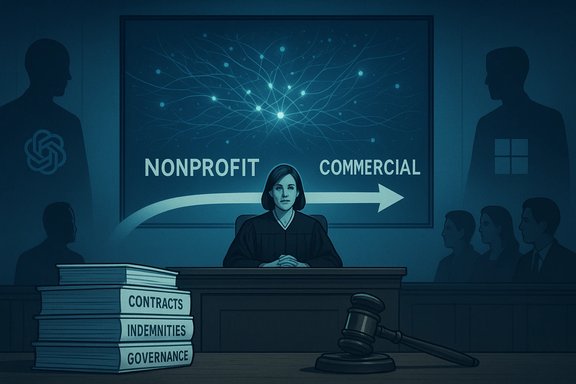
A federal judge in Oakland has signalled that Elon Musk’s long‑running lawsuit challenging OpenAI’s evolution from a nonprofit research lab into a commercial enterprise will move forward to jury trial — a development that dramatically amplifies legal and commercial uncertainty for enterprise customers, cloud partners and the broader AI ecosystem. The judge, U.S. District Judge Yvonne Gonzalez Rogers, told the courtroom there was “plenty of evidence” for a jury to weigh and that “this case is going to trial,” remarks reflected in contemporaneous reporting.
Background
The core dispute in brief
Elon Musk — a co‑founder of OpenAI who left the organization in 2018 and now runs a competitor, xAI — alleges that OpenAI’s transition from its founding nonprofit mission to a commercially focused structure breached representations made to early supporters and donors. Musk’s complaint says he contributed tens of millions of dollars and put strategic credibility behind the lab under an expectation of nonprofit governance, and now seeks unspecified damages tied to what he describes as “ill‑gotten gains” after multibillion‑dollar commercial deals. Reuters reported the judge found enough disputed facts to let a jury consider those claims at trial in March, though some factual and timing issues remain for the court to resolve.Why Microsoft is in the spotlight
Microsoft — by virtue of its massive investments in OpenAI, deep commercial integration (Azure, Bing, Microsoft 365 Copilot, GitHub Copilot) and its status as a defendant in Musk’s amended complaint — is uniquely exposed. The complaint alleges that OpenAI’s restructuring and the lucrative deals tied to it enriched OpenAI’s executives and benefitted investors, including Microsoft; Microsoft has denied wrongdoing and urged the court to dismiss claims against it. The presence of Microsoft as a named defendant means that the trial will likely probe contractual arrangements, information exchanges and board relationships that sit at the intersection of cloud infrastructure, exclusive commercialization rights, and strategic investment.What Musk is alleging — unpacking the legal theory
Fraud, breach and unjust enrichment claims
Musk’s complaint advances multiple legal theories, including fraud, breach of fiduciary duty (as to how commitments were made), and unjust enrichment. At the heart of the matter are assertions that OpenAI’s founders and managers made concrete assurances — orally and in writing — that the lab would remain nonprofit and mission‑driven, assurances that Musk says induced his financial and reputational backing. The legal question is not simply whether OpenAI became commercial — that is undisputed — but whether the representations and the process by which that conversion occurred give rise to civil liability.The statute‑of‑limitations and timing challenge
A central procedural battleground is when the alleged deception (if any) occurred. U.S. fraud claims typically carry a three‑year statute of limitations, so the jury (or judge at certain phases) will have to decide whether relevant misrepresentations were recent enough to remain actionable. Judge Gonzalez Rogers signalled the jury may need to determine when the alleged fraud took place before deciding which claims can proceed to damages — a sequencing that could shape the trial’s scope.The “charitable‑trust” question
Another technical legal vector concerns whether OpenAI’s earlier incorporation documents and operating language created enforceable charitable‑trust obligations — an arcane but potent theory that Musk’s lawyers have emphasized. If the court or a jury finds the lab was bound by charitable obligations that were breached through the conversion, the remedies available could be broader and more disruptive.The Microsoft angle — commercial exposure and reputational risk
Why Microsoft matters beyond an investor role
Microsoft is not a passive bystander. Its investment, integration of OpenAI models into flagship products, and contractual arrangements mean any adverse verdict that links Microsoft’s conduct to the alleged conversion could have outsized effects: litigation costs, damages exposure, disruption of commercial licenses, and a fresh regulatory spotlight on strategic partnerships between hyperscalers and AI labs. Microsoft has urged dismissal of claims against it and denies aiding or abetting any alleged misconduct.Financial figures and public narratives
Reporting indicates Microsoft’s stake and financial ties to OpenAI have been substantial and widely reported in the press — numbers cited in different outlets include a reported $135 billion headline valuation tied to Microsoft’s involvement; those figures are contextually important for jurors and markets even if they are not dispositive legal facts. The precise valuation, the sequencing of investments, and any preferential commercial terms will all be scrutinized in discovery and at trial.Practical exposure for enterprise customers
Corporations that have baked OpenAI tech into their products and workflows — especially through Azure or Microsoft‑delivered services — face short‑term and structural risks:- Short‑term: contractual disruption if licensing terms or exclusivity commitments are enjoined or reinterpreted.
- Medium‑term: uncertainty about who holds commercial rights to model outputs, derivative IP and distribution channels.
- Long‑term: shifts in vendor lock‑in calculus, compliance regimes and enterprise procurement decisions.
Broader legal and regulatory context
Antitrust and exclusivity allegations
A related but distinct class of concerns in Musk’s filings and subsequent litigation filings alleges a “fund‑no‑competitors” posture and potentially exclusionary behavior toward investors. Those are antitrust‑adjacent theories: did OpenAI, in partnership with investors, erect restraints that chilled investment in competitors? Such theories are notoriously fact‑intensive and difficult to prove, but they are serious and would draw regulatory attention if they gain traction.Corporate governance and fiduciary scrutiny
The litigation will also probe board minutes, governance structures and the communications among founders and early directors. The widely reported 2023 episodes around OpenAI’s temporary management shakeup (the so‑called firing and reinstatement of Sam Altman) added fuel to the public narrative, and judges and juries will ask whether internal governance choices comported with asserted charitable or nonprofit commitments. Those governance documents are a primary battleground and will shape whether conversion was lawful and performed with appropriate oversight.Technical and operational implications for enterprise AI strategies
Contracts, SLAs and the cloud delivery chain
Enterprises must treat this as a material vendor risk event. The trial puts into play potentially dispositive facts about who owns model IP, which contractual clauses survive a contested conversion, and whether preferred commercial lanes (for example, preferential Azure distribution of certain models) were legitimately contracted or improperly created.- Companies with mission‑critical dependencies should inventory all contracts referencing OpenAI model access, exclusivity clauses, data‑use restrictions, and indemnities.
- Risk teams must assess whether indemnities cover disputes arising from partner litigation or governance disputes.
- IT procurement teams should review exit clauses and portability commitments; tough renegotiations may be necessary.
Data residency, compliance and audit trails
Legal uncertainty magnifies compliance risks. Enterprises using OpenAI models via Microsoft Azure or directly should:- Validate data‑provenance and retention policies.
- Ensure contractual clarity on who controls model updates, fine‑tuning derivatives and endpoint governance.
- Demand auditable logs so that, if access or IP disputes arise, enterprises can demonstrate lawful use and data stewardship.
Security and operational stability
Beyond contracts, the litigation intersects with prior incidents and security concerns: high‑profile reports of misuse of Azure OpenAI resources (credential theft, API‑key abuse and tools to bypass moderation controls) have already heightened sensitivity around how platform access is controlled and monitored. Enterprises should treat the legal event as a prompt to harden identity and access management and to insist on stronger shared responsibility protocols with hyperscalers.What the trial could look like — scenarios and implications
Scenario 1: Limited liability outcome
The court or jury could find limited or no liability on the most consequential claims. That outcome would preserve the status quo commercially but would still extract discovery and public testimony that could influence market behavior and regulatory views. Microsoft and OpenAI would likely continue business largely uninterrupted, though reputational noise and checklists for enterprise risk management would spike.Scenario 2: Partial victory for Musk (timing or procedural win)
If the jury finds that Musk’s claims are timely and that portions of the conversion violated contractual or trust obligations, remedies could be injunctive: blocking certain contract terms, forcing unwind or remediation steps, or awarding damages for limited periods. Such outcomes would introduce complex commercial unwinds and renegotiations — especially for enterprise customers who depend on predictable licensing.Scenario 3: Broad judgment for Musk
A broad verdict in Musk’s favor could destabilize the current commercialization architecture of OpenAI and its investor relationships, potentially triggering renegotiations of licenses, a reorganization of governance, and immediate market reactions. This is the highest‑impact but least likely scenario given legal hurdles; nevertheless, enterprises must model for supply‑chain disruption and contingency migration plans.Practical guidance for enterprise IT leaders
1. Conduct an immediate contractual audit
Inventory all agreements involving OpenAI models, Microsoft‑delivered services, indemnities and IP clauses. Prioritize clauses covering:- Termination and portability
- Indemnities and liability caps
- Data‑use and model‑output ownership
2. Harden identity and API key hygiene
Many real risks — technical misuse, credential theft and API abuse — are independent of the legal fight and are higher probability near‑term operational failures. Rotate keys, apply least privilege, move to hashed and ephemeral credentials, and require MFA and hardware tokens where possible.3. Build vendor contingency playbooks
Map alternative suppliers, test portability of fine‑tunes and prompt‑workflows across model vendors, and document rollback plans for production copilots and agent frameworks.4. Engage legal and compliance now
The litigation’s discovery process can compel production of sensitive materials and may implicate confidentiality obligations. Legal teams should model discovery exposures, place litigation holds where appropriate, and pre‑emptively negotiate protective orders with vendors.5. Communicate to stakeholders
Be clear with downstream business units and regulators (where appropriate) about whether this litigation affects SLAs, roadmaps or security postures. Transparency builds trust and reduces panic during market rumblings.Strengths and weaknesses of the key actors’ positions
Strengths in Musk’s case
- Narrative clarity: Musk’s claim is intuitively compelling — donors expect mission fidelity, and a conversion to massive commercial valuation is an easy story to tell.
- Documentary hooks: Journal entries, emails and contemporaneous communications are reportedly part of the evidentiary picture the judge referenced as “plenty of evidence.” Those documents, if authenticated, can be persuasive to a jury.
Weaknesses in Musk’s case
- Legal standards: Proving actionable fraud or the enforcement of alleged charitable‑trust obligations is challenging in civil court and typically requires a high evidentiary bar.
- Timing issues: The statute of limitations could narrow the claims Musks can pursue, limiting the damages window even if liability is found.
Strengths in OpenAI and Microsoft’s defenses
- Commercial reality: OpenAI’s transition has been public and well‑documented; defenders argue the conversion was lawful and that no binding charitable trust prevented later commercial arrangements.
- Contractual shields: Investors, contracting parties and corporate counsel typically draft agreements to limit third‑party exposure and to anticipate governance shifts.
Weaknesses for OpenAI and Microsoft
- Reputational and governance exposure: Public testimony, board minutes and private communications can produce damaging narratives even if they fall short of legal liability.
- Discovery risk: The pretrial discovery process could force the disclosure of sensitive commercial details, licensing terms, and board deliberations that create market and regulatory headaches.
Risks that deserve particular attention
- Contractual uncertainty for AI outputs: Without clear contractual guarantees, enterprises could face disputes about who owns derivative IP, especially where fine‑tuning and proprietary data are involved.
- Regulatory knock‑on effects: A high‑profile trial focused on governance and exclusivity could spur regulators to open inquiries into strategic ties between cloud providers and AI labs.
- Operational disruption risk: Even short supply‑chain interruptions — model access outages, revocations or temporary injunctions — could be costly for companies running production AI services.
- Precedent for donor‑driven disputes: The case could create a template for donors to bring legal challenges when labs pivot to commercialization, complicating future funding mechanisms.
Cross‑checks, open questions and cautionary notes
- Discrepant dollar figures: News outlets have reported slightly different totals for Musk’s early contributions (reported as about $38 million in some accounts, $40 million in others). These differences arise from varying accounting for donor‑advised funds and in‑kind donations; the exact number will matter legally only to the extent it is pleaded and proven in court and should be treated cautiously until confirmed by court filings.
- Unverified allegations and hearsay: Some factual assertions (including characterizations of private conversations and intent) are contested and will hinge on testimony and admissible documentary evidence. Statements in news coverage or social posts that are not grounded in court filings or authenticated documents should be treated as provisional.
- Discovery will reshape narratives: The litigation’s discovery phase will likely reveal additional, potentially dispositive facts. Many public assertions are preview evidence or excerpts; they are not final adjudications.
What enterprises and IT strategists should do right now
- Assume volatility and plan for resilience. Map mission‑critical AI dependencies and build alternate execution pathways.
- Demand contractual clarity about IP, indemnities and portability from AI vendors and integrators.
- Treat security and identity hygiene as high‑priority operational controls independent of litigation outcomes.
- Coordinate legal, procurement and engineering teams to assess exposure, negotiate protective clauses and test fallbacks.
- Monitor the case closely: key milestones (written rulings on motions to dismiss, the judge’s scheduling order, discovery productions and witness lists) will materially affect how companies must respond.
Conclusion
The judge’s decision to let Elon Musk’s challenge move toward a jury trial elevates a dispute that was already a headline issue into a concrete legal event with material implications for Microsoft, OpenAI, enterprise customers and the wider AI market. The case will force disclosure and adjudication of thorny questions about donor expectations, governance, partnership economies and where control over foundational AI technology ultimately lies. For enterprises that have built product and business strategies atop OpenAI models — especially through Microsoft’s commercial channels — the message is clear: treat your AI vendor relationships as strategic‑risk exposures, not merely technological choices. The coming weeks and the trial itself will likely reshape commercial assumptions and may prompt contracts, architectures and compliance programs to adapt to an era where legal contestation is a core part of the technology risk landscape.Source: Computerworld Musk’s OpenAI lawsuit clears path to trial, putting Microsoft in the spotlight
