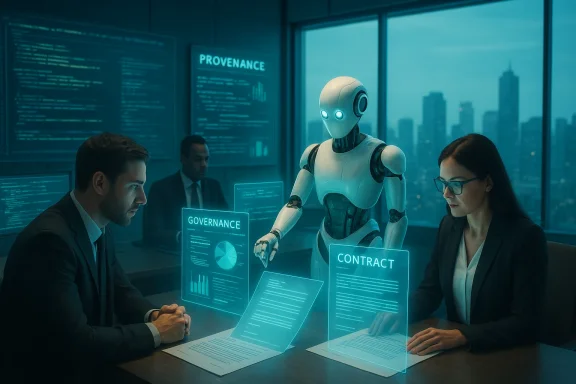
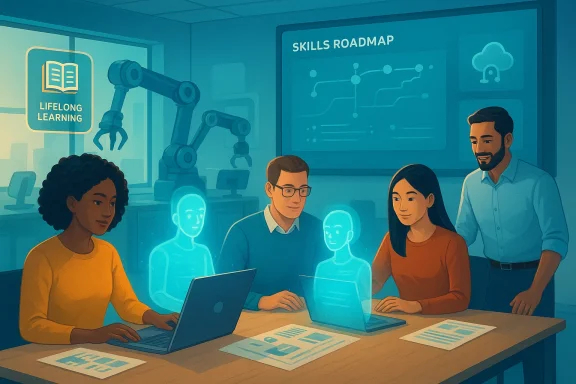
Mustafa Suleyman’s blunt timeline — that most white‑collar tasks could be “fully automated” within the next 12–18 months — has jolted boardrooms, policy tables, and workforces because it compresses a decades‑long debate about AI’s impact into an acute, actionable window.
The comments that prompted the headlines came during an interview with the Financial Times in which Microsoft’s AI chief argued that AI models are now approaching “human‑level performance” across the bulk of office‑based cognitive work — from drafting contracts to preparing tax returns and running marketing campaigns. Industry coverage and contemporaneous reports framed the remarks as part of a broader Microsoft pivot: while the company remains heavily invested in OpenAI, it is also accelerating investments in its own in‑house foundation modelsnt, enterprise‑grade AI requires vertically integrated compute, data and model stacks.
Those structural moves are not abstract. Microsoft’s strategy — articulated over the last 18 months and reiterated by senior executives — emphls → systems” capabilities: reliable orchestration layers, memory and provenance, entitlements, and human‑in‑the‑loop guardrails that turn raw model outputs into enterprise‑safe products. At the same time, Microsoft has retained long‑term commercial and IP arrangements with OpenAI while hedging toward self‑sufficiency through internal foundation models trained on gigawatt‑scale compute.
First, it collapses a widely expected multi‑year transition into a near terr enterprises and governments. Procurement cycles, training budgets, union negotiations, and regulatory design all operate on annual or multi‑year cadences; a near‑term acceleration forces immediate choices.
Second, it shifts the debate from if high‑level automation will happen to how organisations manage the transition: which tasks are automated, who owns the outputs, what traceability is required, and how legal and compliance responsibilities are allocated. The “models → systems” playbook Microsoft emphasizes is precisely about operationalizing those answers.
Third, the statement is also a recruiting and investment signal. Bold public timelines justify the enormous capital allocations required for training next‑generation models and buying hyperscale GPUs and networking capacity. Microsoft has signaled readiness to spend heavily to avoid vendor lock‑in and to own the stack end‑to‑end.
But capability is not the same as adoption. Enterprise customers require SLAs, auditability, data‑governance, and the ability to integrate models into regulated workflows. Those operational requirements slow down and sometimes halt wholesale automation even when model outputs are strong. Microsoft’s emphasis on building orchestration, entitlements, and audit trailsmpt to bridge capability to enterprise trust.
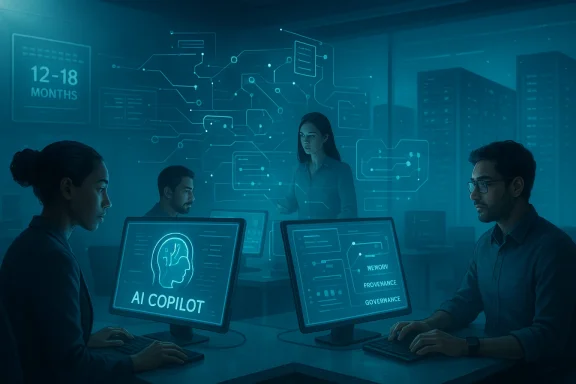
Microsoft and other vendors are now building embedded copilots across productivity stacks to deliver this approach: AI handles first drafts and structured tasks while humans retain final responsibility and creative judgment. The enterprise playbook focuses on making copilots auditable, anchored in corporate data, and constrained by permissioned access — engineering tradecraft that converts model outputs into reliable workflows.
Key governance gaps include:
The saorward combines three pillars: measured deployment (task‑level pilots and human‑in‑the‑loop), robust governance (incident reporting, SLAs, provenance and certification), and social transition mechanisms (paid apprenticeships, portable credentials, and targeted reskilling). If industry and policymakers act with discipline and urgency, the next two years can be a period of accelerated productivity that preserves human dignity and career mobility. If they treat the horizon as a fait accompli, the result will likely be disorderly displacement and avoidable harm.
Either way, the 12–24 month window that Suleyman highlights is now a planning horizon — not just a prediction. The question for leaders is not whether AI will change work; it is how quickly they will build the institutions, contracts, and safeguards needed to steer that change toward broadly shared gains.
Source: Decrypt Microsoft AI Chief Sets Two-Year Timeline for AI to Automate Most White Collar Jobs - Decrypt
 Background
The comments that prompted the headlines came during an interview with the Financial Times in which Microsoft’s AI chief argued that AI models are now approaching “human‑level performance” across the bulk of office‑based cognitive work — from drafting contracts to preparing tax returns and running marketing campaigns. Industry coverage and contemporaneous reports framed the remarks as part of a broader Microsoft pivot: while the company remains heavily invested in OpenAI, it is also accelerating investments in its own in‑house foundation modelsnt, enterprise‑grade AI requires vertically integrated compute, data and model stacks.Those structural moves are not abstract. Microsoft’s strategy — articulated over the last 18 months and reiterated by senior executives — emphls → systems” capabilities: reliable orchestration layers, memory and provenance, entitlements, and human‑in‑the‑loop guardrails that turn raw model outputs into enterprise‑safe products. At the same time, Microsoft has retained long‑term commercial and IP arrangements with OpenAI while hedging toward self‑sufficiency through internal foundation models trained on gigawatt‑scale compute.
What Suleyman actually said — and what he didn’t
- He predicted human‑level performance on most, if not all, professional tasks and estimated a 12–18 month horizon for many white‑collar roles to be “fully automated.”
- He cited software engineering as a live example where developers are already doing the majority of their coding with AI assistance, reframing the relationship between people and tools.
- He reiterated Microsoft’s plan to develop in‑house foundation models and stressed the need for “gigawatt‑scale” compute and top training teams to achieve “true self‑sufficiency.”
- He warned of safety risks and the likelihood of a “major AI safety incident” in the near term unless regulatory mechanisms and industry operating norms mature quickly.
Why this timeline matters — practical and symbolic impacts
Suleyman’s 12–18 month forecast is consequential for three reasons.First, it collapses a widely expected multi‑year transition into a near terr enterprises and governments. Procurement cycles, training budgets, union negotiations, and regulatory design all operate on annual or multi‑year cadences; a near‑term acceleration forces immediate choices.
Second, it shifts the debate from if high‑level automation will happen to how organisations manage the transition: which tasks are automated, who owns the outputs, what traceability is required, and how legal and compliance responsibilities are allocated. The “models → systems” playbook Microsoft emphasizes is precisely about operationalizing those answers.
Third, the statement is also a recruiting and investment signal. Bold public timelines justify the enormous capital allocations required for training next‑generation models and buying hyperscale GPUs and networking capacity. Microsoft has signaled readiness to spend heavily to avoid vendor lock‑in and to own the stack end‑to‑end.
How plaonth window?
Short answer: parts of it are plausible; the blanket claim that most white‑collar roles will be fully automated in that timeframe is optimistic and demands granular unpacking.1. Capability vs. adoption
AI capabilities—measured by benchmarks, pass rates on professional exams, and multi‑modal task performance—have improved rapidly. In narrow, well‑scoped tasks (e.g., document summarization, code generation, basiodern models already deliver outputs that are usable in production with human oversight. Real‑world usage at Microsoft and other companies shows rapid productivity gains.But capability is not the same as adoption. Enterprise customers require SLAs, auditability, data‑governance, and the ability to integrate models into regulated workflows. Those operational requirements slow down and sometimes halt wholesale automation even when model outputs are strong. Microsoft’s emphasis on building orchestration, entitlements, and audit trailsmpt to bridge capability to enterprise trust.
2. Task‑level granularity
Jobs are bundles of tasks, many of which are already highly automatable. But human roles also include judgment, nuanced negotiation, ethics, client relationships, and unpredictable exception handling. Mapping task‑level automation is the right unit of analysis: some tasks within a job may be automated in months; others may persist for years. OECD and other labor‑market analyses find that exposure to automation does not map directly to job loss, but it does reshape career pathways and training needs.3. Infrastructure and economics
Training and operating the largest models requires massive compute, specialized hardware, and energy. Microsoft’s strategy to own or tightly control that infrastructure reduces dependency risk but comes with heavy capital commitments. The economic case for replacing a salaried professional with automated workflows depends on reliability, error rates, and legal liability — not just raw cost per inference. In practice, enterprises will adopt hybrid models: AI as assistant first, automation only where safeguards are robust.4. Regulatory and liability frictions
Professional services (law, accounting, medicine) are heavily regulated. Certification, malpractice risk, and client confidentiality erect real barriers to replacing humans entirely. Even when models can pass bar‑exam style tests, regulators and professional bodies will likely force staged rollouts, mandatory human sign‑offs, and audit requirements. Those institutional frictions are a meaningful brake on instant replacement.Real‑world signals: coding, copilots, and the “superworker”
Suleyman’s mention of software engineering reflects a visible change: developers increasingly use AI assistants for scaffolding, test generation, and even complete modules. The result is a different relationship between human engineers and tools — one where humans supervise, integrate, and validate rather than author every line. Thve because software work is both technical and measurable: productivity metrics, bug rates, and deployment frequency can be tracked, helping organisations evaluate automation safely.Microsoft and other vendors are now building embedded copilots across productivity stacks to deliver this approach: AI handles first drafts and structured tasks while humans retain final responsibility and creative judgment. The enterprise playbook focuses on making copilots auditable, anchored in corporate data, and constrained by permissioned access — engineering tradecraft that converts model outputs into reliable workflows.
Economic and social consequences — who gains, who loses
Economic research and labor trackers are converging on a key insight: the jobs most exe higher‑paid, cognitive roles that rely on computer interfaces. That is a structural inversion from earlier waves of automation and has major distributional implications.- Short‑term winners: organizations, teams, and individuals who can adopt AI to multiply productivity gain value capture — particularly owners of capital, platform operators, and specialized AI engineers.
- Short‑term losers: mid‑level knowledge workers whose tasks are routine enough to automate but who lack mobility into newly created roles.
- Long‑run risks: erosion of apprenticeship paths and junior roles that historically train future leaders and managers, which could shrink talent pipelines and entrench inequality.
Safety, governance and the near‑term incident risk
Suleyman’s safety warning — that a major AI safety incident is plausible in the next two to three years — is not hyperbole. As models gain autonomy and agents act across systems, the attack surface increases: data leakage, hallucinations with operational impacts, automated fraud, or poorly constrained agents executing harmful sequences are real possibilities. The industry today lacks a mature, widely‑accepted incident reporting and third‑party audit system for large models.Key governance gaps include:
- No universal mechanism for mandatory incident reporting or cross‑firm learning when models cause harm.
- Weak standards for provenance, runbook‑driven human verification, and model certification across high‑risk domains.
- Limited liability frameworks that make it unclear who is accountable when AI errors cause financial, legal, or safety harms.
Competing narratives: displacement vs. creation
Not all leaders see only downside. Robinhood CEO Vlad Tenev and other entrepreneurs frame AI as a force for job creation — a “job singularity” that spawns new roles and micro‑enterprises by democratizing access to expert capabilities. ([decrypt.co](Robinhood CEO Says AI Could Spark a ‘Job Singularity’ - Decrypt can be true simultaneously: AI will eliminate specific tasks and whole roles even as it creates new tasks, hybrid job families, and business models. The meaningful policy question is how to manage the tail risk (rapid displacement and social harm) while amplifying the upside (entrepreneurship and productivity growth).Practical recommendations — what ets and workers should do now
The next 12–24 months are a period for disciplined experimentation, not panic. Below are pragmatic steps for each stakeholder group.For enterprises (IT, HR, procurement)
- Map work at the task level — classify tasks as automatable, augmentable, or human‑critical.
- Pilot with human‑in‑the‑loop controls — measure real error rates and downstream impact before scaling.
- Negotiate vendor contracts with exportable logs, SLAs, and incident response clauses.
- Invest in AgentOps: monitoring, rollback procedures, and continuous validation to manage model drift.
For policymakers and regulators
- Establish mandatory incident reporting and a cross‑firm learning mechanism for high‑impact AI failures.
- Create certification programs and domain‑specific validation regimes for healthcare, law, and finance.
- Fund transition programs: paid apprenticeships, portable microcredentials, and targeted reskilling subsidies.
For workers and labovocate for task protection and preserved training‑rich responsibilities to keep apprenticeship pathways intact.
- Push for transparency — visibility into how AI decisions are made and used in performance evaluations.
- Invest in complementary skills: judgment, cross‑domain integration, people management and domain expertise that are harder to automate.
Technical realism: what automation looks like in practice
Automation will rarely be an instant binary switch from human to machine. Expect staged patterns:- Phase 1: AI as co‑pilot — drafts, suggestions, data extraction, and ith mandatory human sign‑offs.
- Phase 2: Scoped automation — low‑risk, reversible tasks (e.g., templated communications, routine filings) move to autonomous execution with audit trails.
- Phase 3: End‑to‑end agentic workflows — multi‑step processes where agents operate across systems under strict governance and human oversight.
Risks and limits the industry must acknowledge
- Overconfidence bias: Capability demonstrations can create misleading impressions of readiness. Benchmarks and controlled tests do not guarantee safety or reliability in messy, real‑world environments.
- Concentration risk: Heavy reliance on a small set of hyperscalers and model providers increases systemic vulnerability to outages, supply constraints, or geopolitical disruptions.
- Loss of training pathways: Rapid automation at junior levels threatens the social mechanisms that produce mid‑career professionals.
- Regulatory lag: Without proactive policy, first movers may externalize costs and harms onto workers and the public.
Conclusion — plan for disruption, govern for resilience
Mustafa Suleyman’s timeline is intentionally provocative and strategically useful: it forces organizations to confront a near‑term, mission‑critical question about how to integrate and govern AI. Some of his predictions are already visible in product usage and enterprise pilots; others — wholesale automation of most white‑collar roles within 12–18 months — will require both technological and institutional shifts that are neither guaranteed nor evenly distributed.The saorward combines three pillars: measured deployment (task‑level pilots and human‑in‑the‑loop), robust governance (incident reporting, SLAs, provenance and certification), and social transition mechanisms (paid apprenticeships, portable credentials, and targeted reskilling). If industry and policymakers act with discipline and urgency, the next two years can be a period of accelerated productivity that preserves human dignity and career mobility. If they treat the horizon as a fait accompli, the result will likely be disorderly displacement and avoidable harm.
Either way, the 12–24 month window that Suleyman highlights is now a planning horizon — not just a prediction. The question for leaders is not whether AI will change work; it is how quickly they will build the institutions, contracts, and safeguards needed to steer that change toward broadly shared gains.
Source: Decrypt Microsoft AI Chief Sets Two-Year Timeline for AI to Automate Most White Collar Jobs - Decrypt