

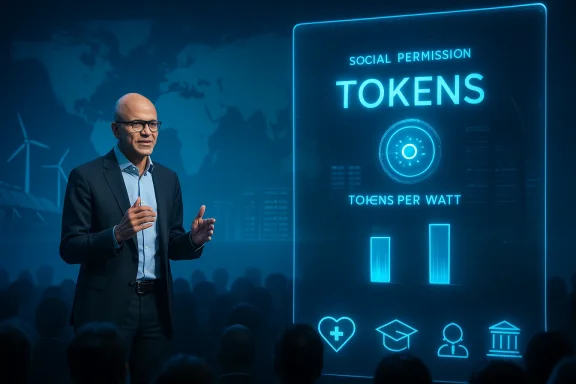
Microsoft’s chief executive did not mince words in Davos: the AI industry is running an energy experiment and the public’s patience will not be an unlimited resource. Satya Nadella used the World Economic Forum stage to crystallize a blunt thesis — generative AI is only socially legitimate if it demonstrably improves health, education, public services and productivity — and warned that otherwise we risk losing the “social permission” to burn scarce electricity creating digital “tokens” that power large language models and other generative systems.
Satya Nadella’s remarks at the World Economic Forum are part of a larger shift in the language senior executives now use to justify AI investment. Gone are the purely technical promises; in their place are new economic frameworks and moral claims designed to persuade regulators, customers and the wider public that AI is worth the environmental and fiscal cost.
Nadella framed AI as a new kind of infrastructure commodity: tokens — the units that represent compute and model usage — will be the medium through which economic value is created. He paired that framing with a stark energy argument: if tokens do not translate into better outcomes for people and societies, society will withdraw its tolerance for the resource demands of AI. He also described AI as a “cognitive amplifier” that gives users access to “infinite minds,” and urged companies to accelerate adoption so that the benefits of AI diffuse broadly across firms and labour markets.
Those comments arrived against a backdrop of extraordinary corporate capital spending, supply-chain stress in memory and storage markets, and a growing public conversation about the environmental and social trade-offs of large-scale AI. Microsoft’s announced fiscal plans — hundreds of billions in infrastructure and capital expenditure over recent years — and industry-wide demand for high-bandwidth memory have reshaped how chips, RAM, GPUs, and datacenter power are allocated across sectors.
Nadella’s “tokens” framing is also consequential. Treating AI compute as a tradable, measurable unit invites new economic thinking — tokens-per-watt, tokens-per-dollar — and opens the door to metrics and accountability. But it also commoditizes access to generative intelligence, which raises questions about who controls token supply and what it costs.
This outcome-focused approach can drive:
Microsoft’s capital plans underscore this reality: the company flagged multi‑billion-dollar investments in AI-capable data centres in recent fiscal cycles. Those investments shape where compute — and therefore AI capability — will be located, which in turn affects national competitiveness, jobs, and industrial policy.
Potential consequences:
Key questions left open:
Risks include:
What’s happening in market terms:
Policy priorities:
Key issues:
The next two years will be decisive. If firms and policymakers can convert Nadella’s rhetoric into:
The AI era pivots on whether tokens become a tool for shared prosperity or a resource that amplifies existing inequalities. Nadella’s challenge is clear: make AI materially useful to people’s lives, not merely exciting to investors. The industry, regulators, and civil society must now build the measurement, governance, and distribution mechanisms that will turn that admonition into practice.
Source: Stevivor Microsoft CEO Satya Nadella wants our "social permission" continue our mindless march to AI
 Background
Satya Nadella’s remarks at the World Economic Forum are part of a larger shift in the language senior executives now use to justify AI investment. Gone are the purely technical promises; in their place are new economic frameworks and moral claims designed to persuade regulators, customers and the wider public that AI is worth the environmental and fiscal cost.Nadella framed AI as a new kind of infrastructure commodity: tokens — the units that represent compute and model usage — will be the medium through which economic value is created. He paired that framing with a stark energy argument: if tokens do not translate into better outcomes for people and societies, society will withdraw its tolerance for the resource demands of AI. He also described AI as a “cognitive amplifier” that gives users access to “infinite minds,” and urged companies to accelerate adoption so that the benefits of AI diffuse broadly across firms and labour markets.
Those comments arrived against a backdrop of extraordinary corporate capital spending, supply-chain stress in memory and storage markets, and a growing public conversation about the environmental and social trade-offs of large-scale AI. Microsoft’s announced fiscal plans — hundreds of billions in infrastructure and capital expenditure over recent years — and industry-wide demand for high-bandwidth memory have reshaped how chips, RAM, GPUs, and datacenter power are allocated across sectors.
Overview: what Nadella actually argued
The core claims
- AI must deliver measurable social and economic outcomes — in healthcare, education, public services, and private-sector productivity — or it risks losing public support.
- Energy is a scarce resource, and its use to generate tokens must be justified by improved outcomes.
- The industry must build a “ubiquitous grid of energy and tokens” (a shorthand for global compute and power infrastructure) if AI is to diffuse widely and equitably.
- Adoption on the demand side matters: every firm must start using AI to create the social and economic momentum that justifies investment on the supply side.
- AI functions as a cognitive amplifier, expanding human capability by giving workers access to many more information sources and synthetic reasoning at scale.
Why those words matter
Language like “social permission” reframes controversial trade-offs as a negotiation between technology companies and the public. It signals that corporate legitimacy will be contingent on measurable benefits, not merely the fact of innovation. That’s an important rhetorical and strategic shift: companies now acknowledge that technical progress alone is not enough.Nadella’s “tokens” framing is also consequential. Treating AI compute as a tradable, measurable unit invites new economic thinking — tokens-per-watt, tokens-per-dollar — and opens the door to metrics and accountability. But it also commoditizes access to generative intelligence, which raises questions about who controls token supply and what it costs.
The good: constructive realism in a heated debate
1) Making outcomes the primary metric
Putting outcomes front and centre — health, education, public-sector efficiency — is a welcome corrective to a debate that has too often been dazzled by flashy demos. Demand for demonstrable utility puts pressure on product teams and researchers to optimize for measurable improvements, not just benchmark scores or viral outputs.This outcome-focused approach can drive:
- Better product design that aligns with public priorities.
- More rigorous evaluation frameworks that assess real-world impact.
- Stronger business cases for AI in areas like clinical documentation, learning personalization, or public-service automation.
2) Energy and infrastructure are real constraints
Nadella’s insistence that energy is scarce is not rhetoric; it’s a practical observation. The build-out of AI-optimised datacentres, procurement of HBM and DRAM, and mass deployment of GPUs have created real constraints in supply chains and put upward pressure on component prices.Microsoft’s capital plans underscore this reality: the company flagged multi‑billion-dollar investments in AI-capable data centres in recent fiscal cycles. Those investments shape where compute — and therefore AI capability — will be located, which in turn affects national competitiveness, jobs, and industrial policy.
3) A pragmatic nudge toward diffusion and skills
By saying “every firm has to start by using it,” Nadella highlights diffusion as a political and economic stabilizer. Broader adoption across firms and geographies could:- Distribute AI benefits beyond a handful of hyperscalers.
- Create new opportunities for worker skilling and productivity gains.
- Reduce concentration risks by making AI-driven productivity gains a feature of everyday businesses.
The risks and blind spots
1) “Social permission” as corporate leverage
Framing public acceptance as “permission” risks sounding transactional: corporations want consent to consume public resources (energy, data, attention) in exchange for promised benefits. That dynamic obscures power imbalances. Companies with capital and control of compute can shape which tokens are valuable and how benefits are measured.Potential consequences:
- Regulatory capture: corporations could lobby for token-friendly frameworks that privilege proprietary platforms.
- Measurement bias: benefits might be defined in ways that favour commercial outcomes over civic ones.
- Unequal bargaining: countries or communities with less leverage could become compute hosts without receiving proportional economic value.
2) Environmental and grid stresses are under-specified
Saying energy is scarce is not the same as specifying limits or pathways. The magnitude of AI’s power draw depends on design choices: model architecture, training frequency, caching strategies, and datacentre location. Without binding commitments to efficiency, renewable procurement, and grid investment, the “tokens” economy can exacerbate energy inequality.Key questions left open:
- What constitutes an acceptable token-per-watt threshold?
- How will emissions be accounted for across model lifecycle (training, fine-tuning, inference)?
- Who pays when local grids are strained by hyperscaler demand?
3) Labor and skills framing can feel like shifting responsibility
Nadella’s comparison to mastering Excel frames skill adoption as a worker responsibility. That’s partly true: workers who learn AI tools can become more productive. But this framing obscures employer obligations — to invest in retraining, to redesign jobs, and to share the productivity gains.Risks include:
- Employers substituting training rhetoric for investments.
- Wage pressure as AI reshapes job tasks.
- Uneven skilling access that deepens inequalities between regions and firms.
4) Commoditization of compute and potential geopolitical fallout
Positioning “tokens” as a new commodity invites geopolitics. Countries with abundant cheap energy and favourable infrastructure will attract datacentres, potentially concentrating AI capability. That dynamic can entrench global digital divides and create leverage over data, services, and economic growth.Supply-chain and consumer impacts: RAM, SSDs, and GPUs
Nadella’s comments about tokens and infrastructure map directly onto observable market effects. The AI-driven appetite for memory and storage has tightened supply and pushed pricing for DRAM and NAND upward. This has real consequences for PC builders, OEMs, gamers, and SMBs.What’s happening in market terms:
- Memory and HBM allocation is prioritised for AI and datacentre use, constraining consumer availability.
- Contract and spot prices for DRAM and NAND rose substantially during AI infrastructure buildouts, squeezing margins and increasing BOM costs.
- Some vendors have signalled inventory prioritization, and a handful of GPU makers have considered reviving older SKUs to keep consumer channels supplied.
Practical implications for IT buyers, developers, and consumers
For enterprise IT leaders
- Re-evaluate capacity planning: procurement timelines should factor in memory supply volatility and longer lead times for AI-optimised hardware.
- Insist on outcome KPIs: vendor contracts for AI services or copilot integrations should include measurable business outcomes — not just usage metrics.
- Build energy-aware budgets: model inference and training should be costed jointly with power and sustainability KPIs.
For developers and product teams
- Optimize for inference efficiency: design models and pipelines that minimise energy per token and capitalize on caching, distillation, and on-device compute where feasible.
- Measure user and social outcomes: embed impact assessment early — track whether AI outputs change real-world metrics, not just internal engagement.
- Design for transparency: users and auditors must be able to see how energy and compute translate into outcomes.
For consumers and gamers
- Expect component intermittency: shortages can make DIY upgrades pricier and slower. Consider prebuilt systems or delayed upgrades where bargains are unlikely.
- Be sceptical of breathless claims: marketing will conflate “AI-enabled” with meaningful improvements. Look for evidence and opt-in controls.
- Protect privacy: Copilot-integrated workflows, including healthcare note-taking or transcription, must be evaluated for data protection and disclosure.
Policy and public-interest considerations
If Nadella’s core claim is accepted — that token creation should be justified by real outcomes — then governments need to set frameworks that translate that principle into enforceable rules.Policy priorities:
- Standardize measurement: define interoperable metrics for tokens-per-watt, tokens-per-outcome, and lifecycle CO2 per model.
- Tie permits to impact: datacentre siting and grid access approvals should include binding plans for local benefit and energy contributions.
- Public investment in diffusion: fund skilling and regional infrastructure so benefits are not captured by a few hyperscale hubs.
- Competition and access: monitor the token economy to prevent gatekeeping that locks platforms into market dominance.
Microsoft 365 Copilot and the consumer experience
On the product front, Microsoft has not been shy about bundling Copilot into everyday productivity workflows. The existing Microsoft 365 app has been rebranded and refocused to integrate Copilot capabilities across Word, Excel, PowerPoint, and Outlook. The move brings generative assistance to mainstream consumers, but it raises a set of practical concerns that mirror Nadella’s bigger point.Key issues:
- Default installs and discoverability: automatic delivery of Copilot components to devices amplifies adoption but can create friction for users who don’t want AI enabled by default.
- Transparency and control: users should be able to disable Copilot in contexts where AI-driven editing or summarization could be inappropriate (for instance, academic or certain professional settings).
- Pricing and subscription models: bundling Copilot into consumer tiers changes the value proposition of Microsoft 365 and shifts where costs and benefits are felt.
Conclusion: a conditional mandate
Satya Nadella’s Davos remarks amount to a conditional mandate: the AI industry may continue its current capital‑intensive trajectory — constructing datacentres, buying memory, scaling models — but this trajectory is only legitimate if it delivers measurable public value. That rhetoric is both a restraint and a strategic device. It signals willingness to be held accountable for outcomes, but it also motivates rapid adoption and supply expansion that are profitable for vendors.The next two years will be decisive. If firms and policymakers can convert Nadella’s rhetoric into:
- Transparent metrics for token efficiency and social impact,
- Concrete commitments to energy efficiency and renewable sourcing,
- Real funding for diffusion and worker reskilling,
The AI era pivots on whether tokens become a tool for shared prosperity or a resource that amplifies existing inequalities. Nadella’s challenge is clear: make AI materially useful to people’s lives, not merely exciting to investors. The industry, regulators, and civil society must now build the measurement, governance, and distribution mechanisms that will turn that admonition into practice.
Source: Stevivor Microsoft CEO Satya Nadella wants our "social permission" continue our mindless march to AI
