

Satya Nadella’s argument is simple and sweeping: we are not watching incremental UI upgrades — we are watching a structural transformation of knowledge work driven by agentic AI, new modes of delegation, and a tokenized economics of compute that could rewrite how public-sector efficiency and GDP grow in the Global South.
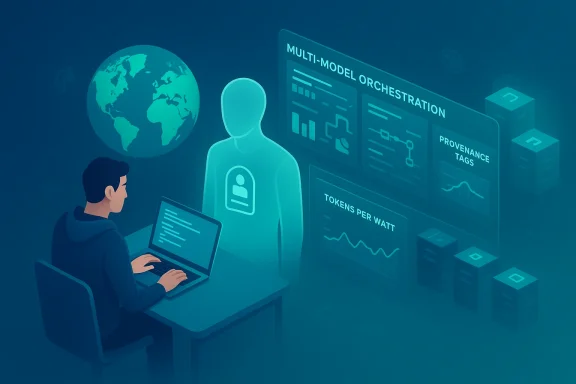
Satya Nadella, as Microsoft’s CEO and long-time architect of the company’s cloud-first pivot, has recast the debate about generative AI away from sensationalist capability races and toward practical economic outcomes: how AI is integrated as a productivity amplifier, how models will be orchestrated inside applications, and how compute and energy economics — “tokens per currency unit per watt” — will shape winners and losers. This framing, repeated in public forums from Davos to the All‑In podcast, is a roadmap for enterprise IT and national strategy alike.
Microsoft’s playbook binds together three elements: Azure as the infrastructure backbone, Copilot and agent APIs as the UI and orchestrator, and ecosystem distribution (LinkedIn, GitHub, Microsoft 365) as the channel to scale adoption. Nadella’s public statements and the company’s reported adoption metrics are being used to demonstrate that practical AI adoption is already becoming a business reality, not just a laboratory phenomenon.
This is not academic. The real-world impact shows up in onboarding speed, idea throughput, and the velocity of product experimentation: organizations that invest in “full-stack builders” and integrate copilots into daily workflows report measurable gains in output per developer and faster ramp times for new hires. Nadella’s emphasis on empowering current employees with better tools — rather than simply hiring more people — is a practical prescription for CIOs facing skills shortages.
For IT leaders this implies rethinking QA, code review, and IP controls: the review process must now verify not just correctness but provenance, entitlements, and compliance when AI-generated artifacts are incorporated into production code.
Identity-bound agents enable new workflows: automate recurring reporting for finance, manage employee queries in HR, or act as front-line negotiation assistants in sales. They are not “chatbots” in the old sense; they are compact services with identities, observable logs, entitlements, and lifecycle management — effectively digital coworkers.
This matters for CIOs deciding where to invest: tooling that increases idea throughput and shortens feedback loops offers asymmetric returns compared to marginal hiring, especially in mature teams where coordination, not headcount, is the bottleneck.
This composition-first view forces enterprises to invest in orchestration, retrieval-augmented generation, long-term memory, and governance systems rather than betting solely on a single model. Practical consequences include multi‑model routing per request, versioned model registries, and cost-aware model selection.
That framing matters because it connects technical efficiency to GDP outcomes: if tokens become the unit of delivered AI utility, then cheaper tokens (per watt and per local currency) translate into affordable, high-frequency AI services across health, education, and government — the very sectors Nadella says must demonstrate impact to justify AI’s resource footprint.
However, translating token economics into national GDP growth requires more than datacenter buildouts: it requires governance, interoperability standards, measurement of downstream outcomes, and attention to environmental externalities. Nadella’s prescription is engineering‑forward but dependent on political and institutional capacity to convert efficiency into measurable public value.
Caveat: some specific ecosystem multiplier claims have been repeated in public commentary but are context-sensitive and require granular financial audit to verify exact multipliers; readers should treat specific numeric multipliers (e.g., “7x” claims about particular product ecosystems) as illustrative and subject to verification with primary company disclosures. (I could not verify a single authoritative citation for the exact multiplier in the materials reviewed here.)
But converting deployments into GDP requires measurement systems, anti-corruption safeguards, and robust governance. Without those, AI projects risk being pilot silos or wasting scarce capital. The lesson: prioritize scalable workflows with clear KPIs (e.g., claim-to-service times, diagnostic accuracy, learning outcomes) that can be audited and tied to public budgets.
This is not an abstract manifesto. The bets Microsoft is making — on Copilot, Azure infrastructure, and regional skilling and datacenter commitments — are explicit moves to turn that theory into practice. The benefits will accrue where leaders demand measurable results and scale responsibly. The biggest winners in this shift will be those who treat AI not as a product checkbox, but as an integrated platform of models, agents, governance, and public-purpose measurement.
Source: Crypto Briefing Satya Nadella: AI is reshaping knowledge work, the rise of digital coworkers, and the global south's tech-driven GDP growth | All-In with Chamath, Jason, Sacks & Friedberg
 Background / Overview
Satya Nadella, as Microsoft’s CEO and long-time architect of the company’s cloud-first pivot, has recast the debate about generative AI away from sensationalist capability races and toward practical economic outcomes: how AI is integrated as a productivity amplifier, how models will be orchestrated inside applications, and how compute and energy economics — “tokens per currency unit per watt” — will shape winners and losers. This framing, repeated in public forums from Davos to the All‑In podcast, is a roadmap for enterprise IT and national strategy alike.Microsoft’s playbook binds together three elements: Azure as the infrastructure backbone, Copilot and agent APIs as the UI and orchestrator, and ecosystem distribution (LinkedIn, GitHub, Microsoft 365) as the channel to scale adoption. Nadella’s public statements and the company’s reported adoption metrics are being used to demonstrate that practical AI adoption is already becoming a business reality, not just a laboratory phenomenon.
The evolution of coding tools and knowledge work
From suggestions to autonomous agents
The progression in coding tools mirrors the larger trajectory of knowledge work. We moved from syntax-aware editors and autocomplete to AI-assistants that can draft functions and suggest refactors, and now toward agentic systems that can act on behalf of developers: run tests, open pull requests, triage issues, and even deploy under guardrails. Nadella outlined this evolution as part of a broader point: the technical stack is shifting from isolated models to systems — orchestration, memory, provenance, and entitlements matter more than raw model size.This is not academic. The real-world impact shows up in onboarding speed, idea throughput, and the velocity of product experimentation: organizations that invest in “full-stack builders” and integrate copilots into daily workflows report measurable gains in output per developer and faster ramp times for new hires. Nadella’s emphasis on empowering current employees with better tools — rather than simply hiring more people — is a practical prescription for CIOs facing skills shortages.
Macro delegation and micro stealing: new behaviors in code and cognition
Nadella used pithy phrases to capture two cognitive patterns emerging in engineering work: macro delegation (building systems that handle the broad strokes) and micro stealing (borrowing small code or ideas from shared agent outputs to accelerate progress). These behaviors reshape the mental model for collaboration: humans set goals, agents execute repeatable tasks, and teams shift toward higher‑level judgment, integration, and quality control.For IT leaders this implies rethinking QA, code review, and IP controls: the review process must now verify not just correctness but provenance, entitlements, and compliance when AI-generated artifacts are incorporated into production code.
Digital coworkers: identity, agents, and the “UI of AI”
Agents as identity-bound coworkers
One of the most consequential product shifts Nadella described is turning agents into identity-bound digital coworkers — persistent entities that carry identity, entitlements, audit trails, and context across sessions and systems. Microsoft’s Copilot family and internal agent initiatives demonstrate how an agent can be tied to a business identity, access approved datasets, and act under defined governance policies. This matters because the business value of agents hinges on trust, traceability, and safe delegation.Identity-bound agents enable new workflows: automate recurring reporting for finance, manage employee queries in HR, or act as front-line negotiation assistants in sales. They are not “chatbots” in the old sense; they are compact services with identities, observable logs, entitlements, and lifecycle management — effectively digital coworkers.
Full‑stack builders and idea throughput
Nadella highlighted organizational design changes — e.g., combining roles to create full‑stack builders — that increase the throughput of ideas into product outcomes. When developers, ML engineers, and product managers operate with shared copilots and instrumented workflows, the friction between an idea and a measurable experiment shrinks. That increases the rate of iteration, generates more validated learning per quarter, and ultimately raises the organization’s productivity ceiling.This matters for CIOs deciding where to invest: tooling that increases idea throughput and shortens feedback loops offers asymmetric returns compared to marginal hiring, especially in mature teams where coordination, not headcount, is the bottleneck.
Orchestration: many models, one application
Models as commoditized plumbing (with frontier edges)
Nadella posits a pragmatic model market: many commoditized models plus a smaller set of frontier models. In this view, commodity inference becomes part of the plumbing — akin to databases — while frontier models remain differentiated assets. Applications will orchestrate multiple models depending on task, cost, latency, and risk, and orchestration layers will manage which model runs when, with what context and safeguards.This composition-first view forces enterprises to invest in orchestration, retrieval-augmented generation, long-term memory, and governance systems rather than betting solely on a single model. Practical consequences include multi‑model routing per request, versioned model registries, and cost-aware model selection.
Token economics: tokens per currency unit per watt
Perhaps Nadella’s most operational coinage is the metric “tokens per rupee per watt” (or tokens per currency unit per watt), which ties model throughput (tokens) to local pricing and energy efficiency. This metric reframes AI deployment as an engineering and public-policy problem: it makes energy and local cost of compute explicit inputs for national competitiveness in AI-enabled services. Regions that can produce more useful tokens for less money and energy will be advantaged in scaling AI across economies.That framing matters because it connects technical efficiency to GDP outcomes: if tokens become the unit of delivered AI utility, then cheaper tokens (per watt and per local currency) translate into affordable, high-frequency AI services across health, education, and government — the very sectors Nadella says must demonstrate impact to justify AI’s resource footprint.
Economic and geopolitical implications
Tech diffusion, ecosystem multipliers, and GDP
Nadella argues the benefits of technology are realized through intense use and diffusion across sectors. For the Global South, that is an invitation: deploy local compute, train local talent, and embed AI into public services to capture productivity gains. Microsoft’s public commitments, skilling programs, and regionally localized infrastructure are practical moves aligned to this thesis, with targeted skilling and public‑sector projects explicitly called out as leverage points to boost GDP.However, translating token economics into national GDP growth requires more than datacenter buildouts: it requires governance, interoperability standards, measurement of downstream outcomes, and attention to environmental externalities. Nadella’s prescription is engineering‑forward but dependent on political and institutional capacity to convert efficiency into measurable public value.
Market share, ecosystems, and platform economics
Nadella framed success in the AI race as market share plus an ecosystem that multiplies platform revenue. Platform providers can capture core revenue while ecosystems — partners, ISVs, consulting services — generate several times the platform’s own revenue in aggregate. That dynamic has historical precedent in enterprise platforms and is central to Microsoft’s strategy to monetize both infrastructure and platform adjacencies.Caveat: some specific ecosystem multiplier claims have been repeated in public commentary but are context-sensitive and require granular financial audit to verify exact multipliers; readers should treat specific numeric multipliers (e.g., “7x” claims about particular product ecosystems) as illustrative and subject to verification with primary company disclosures. (I could not verify a single authoritative citation for the exact multiplier in the materials reviewed here.)
Competition, risk, and governance
Intense competition keeps firms fit — but raises risks
Nadella welcomed competition as a forcing mechanism that preserves agility and accelerates innovation, arguing that new competitors every decade keep incumbents honest. For enterprise IT, this is double‑edged: competition drives richer products and better prices, but it also fragments standards, multiplies integration points, and increases governance complexity. CIOs must balance speed-to-adoption with contractual clarity about model provenance, data use, and incident response.Energy, social permission, and measurable public value
Nadella warns that AI requires social permission to use scarce energy and water at scale; that permission will be granted only when AI delivers observable improvements in areas like health, education, and public-sector efficiency. Thus, environment and social outcomes are not peripheral — they are central to whether large-scale AI deployment is politically and socially sustainable. Enterprises and governments must measure outcomes and report them in auditable ways.Legal and accountability realities
Even as agents act autonomously, legal frameworks currently require human oversight and the capacity for indemnification. Nadella emphasized human‑in‑the‑loop responsibility as a practical boundary while governance frameworks catch up. That places a premium on audit trails, entitlements, and explainability interfaces in enterprise deployments.Opportunities (and pitfalls) for the Global South
A real chance to leapfrog with public-sector AI
Nadella’s most provocative economic claim is that the Global South stands to gain disproportionately by applying AI to public-sector workflows — easing service delivery, improving citizen outcomes, and generating measurable productivity gains that translate into GDP growth. Localized cloud regions, skilling initiatives, and public‑private partnerships could catalyze rapid adoption of AI in high-impact domains.But converting deployments into GDP requires measurement systems, anti-corruption safeguards, and robust governance. Without those, AI projects risk being pilot silos or wasting scarce capital. The lesson: prioritize scalable workflows with clear KPIs (e.g., claim-to-service times, diagnostic accuracy, learning outcomes) that can be audited and tied to public budgets.
National energy and infrastructure constraints
Token economics exposes a hard reality: countries with constrained grids, high energy costs, or limited access to specialized hardware face headwinds. That means infrastructure investments must include energy strategy (renewables, grid upgrades), efficient datacenter design, and policies to attract edge and hyperscaler investments while preserving data sovereignty and privacy standards.What IT leaders should do now: pragmatic playbook
- Audit where AI adds measurable value. Start with high-frequency, repeatable knowledge tasks that have clear KPIs (time-to-close, error rates, throughput).
- Invest in orchestration and governance before large-scale model procurement. Build model registries, observability, provenance tracking, and cost-aware routing.
- Treat agents as identity-bound services. Implement entitlements, audit trails, and lifecycle controls so agents can be revoked, inspected, or retrained safely.
- Prioritize upskilling and tool adoption over headcount expansion. Empower existing teams with copilots and experiment platforms to increase idea throughput and shorten onboarding times.
- Measure energy and unit economics. Use token-per-cost-per-watt thinking to evaluate deployment choices and procurement. If tokens are expensive in your region, consider hybrid orchestration strategies or selective on‑prem inference.
Strengths, weaknesses, and an honest verdict
Notable strengths
- Nadella’s framing ties engineering metrics to economics, which helps align incentives across product, operations, and policy teams. Making energy and token economics explicit is a constructive advancement for national and enterprise planning.
- The agentic approach — identity-bound digital coworkers — solves many practical enterprise problems around delegation, auditability, and ROI. Copilot-style integration lowers the barrier to adoption for knowledge workers.
- Emphasizing “empower existing employees” is a pragmatic productivity lever with immediate returns for organizations that can adopt tooling thoughtfully.
Material risks and open questions
- Energy and environmental externalities: large-scale token production consumes electricity and water; nations and firms must justify that consumption with measurable public benefits, or face social pushback.
- Governance and legal accountability: agentic systems introduce new liability surfaces; the industry’s current legal frameworks still place ultimate responsibility with humans, creating operational friction and insurance questions.
- Measurement and generalization risk: many vendor productivity claims are based on pilots. Scaling these results across diverse organizations requires data readiness, change management, and strict evaluation protocols.
The near-term horizon: what to expect in the next 18–36 months
- Widespread adoption of multi‑model orchestration in production applications, with enterprise platforms providing model routing, observability, and cost controls as standard features.
- Rapid expansion of Copilot-style experiences across vertical SaaS, with dozens of domain-specific copilots emerging for finance, HR, legal, and operations. Early adopters will internalize gains; laggards risk competitive disadvantage.
- National strategies in several emerging economies that pair datacenter investments with aggressive skilling programs — the aim: capture local AI value-add and measure public-service improvements as legitimacy for higher energy use. Execution will be uneven, but the strategic logic is clear.
Conclusion
Satya Nadella’s message is constructive and operational: treat AI as a systems engineering problem that must demonstrate measurable outcomes, be economical in energy and tokens, and amplify human judgment rather than simply chasing headline capabilities. For enterprise IT and national policymakers, the practical priorities are clear — orchestrate multiple models where required, bind agents to identity and governance, measure token economics against local energy and currency realities, and invest in tooling and skilling that raise the throughput of ideas.This is not an abstract manifesto. The bets Microsoft is making — on Copilot, Azure infrastructure, and regional skilling and datacenter commitments — are explicit moves to turn that theory into practice. The benefits will accrue where leaders demand measurable results and scale responsibly. The biggest winners in this shift will be those who treat AI not as a product checkbox, but as an integrated platform of models, agents, governance, and public-purpose measurement.
Source: Crypto Briefing Satya Nadella: AI is reshaping knowledge work, the rise of digital coworkers, and the global south's tech-driven GDP growth | All-In with Chamath, Jason, Sacks & Friedberg
