

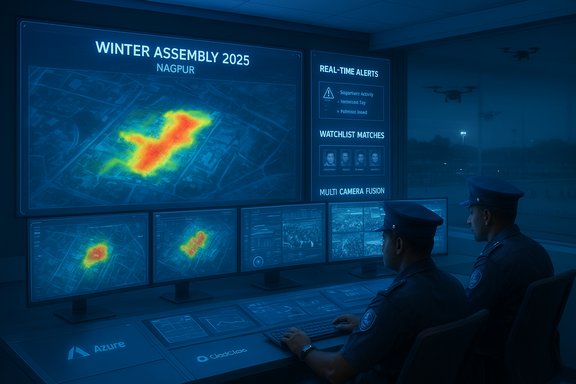
Nagpur’s police have begun piloting an AI-driven crowd management platform called AI Nirikshak during the Maharashtra Winter Assembly Session 2025 — a deployment that combines computer vision, real-time video analytics, heat‑mapping, drone feeds and integration with police databases under a partnership involving Nagpur City Police, Click2Cloud Technology Services and Microsoft Azure.
Nagpur functions as a high‑density event hub: it hosts the state’s Winter Assembly, major religious congregations such as Deekshabhoomi and Ganesh Visarjan, large sporting events, and frequent VIP movements. Those events present safety challenges that have pushed local authorities toward technology-assisted monitoring and predictive crowd control. The Nagpur City Police have a recent track record of experimenting with AI and drone surveillance at large gatherings — deployments that reportedly integrated CCTV networks with suspect‑watchlist lookups and live crowd‑density monitoring. The new pilot — billed as AI Nirikshak — is described by local reporting as Maharashtra’s first organized AI-based crowd intelligence platform. It promises to fuse multiple sensor inputs (fixed CCTVs, mobile surveillance vans, drones) and deliver event‑stage situational awareness, automated alerts for crowding and threats, and an AI assistant for rapid incident follow‑up. The stated implementing partner is Click2Cloud Technology Services India Pvt. Ltd., with underlying cloud services and tooling reportedly provided by Microsoft Azure.
Source: The Live Nagpur AI-Powered Crowd Management System Launched in Nagpur - The Live Nagpur
 Background / Overview
Nagpur functions as a high‑density event hub: it hosts the state’s Winter Assembly, major religious congregations such as Deekshabhoomi and Ganesh Visarjan, large sporting events, and frequent VIP movements. Those events present safety challenges that have pushed local authorities toward technology-assisted monitoring and predictive crowd control. The Nagpur City Police have a recent track record of experimenting with AI and drone surveillance at large gatherings — deployments that reportedly integrated CCTV networks with suspect‑watchlist lookups and live crowd‑density monitoring. The new pilot — billed as AI Nirikshak — is described by local reporting as Maharashtra’s first organized AI-based crowd intelligence platform. It promises to fuse multiple sensor inputs (fixed CCTVs, mobile surveillance vans, drones) and deliver event‑stage situational awareness, automated alerts for crowding and threats, and an AI assistant for rapid incident follow‑up. The stated implementing partner is Click2Cloud Technology Services India Pvt. Ltd., with underlying cloud services and tooling reportedly provided by Microsoft Azure. What the system claims to do
AI Nirikshak’s public feature list — as reported in the media briefings — includes these capabilities:- Heatmap-based crowd density detection, with predictions of potential congestion zones derived from multi‑camera fusion.
- Risk flag alerts for objects and behaviors, including automated detection of weapons (knives/guns/sharp objects), suspicious group formations, reverse movement against the flow, and unattended baggage.
- Object‑based and zone alerts, such as restricted‑zone violations, barricade breaches and vehicle detection along VIP routes.
- Facial recognition against a watchlist, for real‑time alerts when flagged individuals enter sensitive zones, plus auto‑tracking across cameras.
- Crowd footfall measurement and gate‑level ingress/egress counts to optimise manpower deployment.
- A police AI agent (chatbot) to retrieve case information (FIRs, vehicle histories), summarise incidents and support coordination under pressure.
Technology and partners — what’s verifiable
Click2Cloud is an established cloud services vendor that publicly promotes Azure‑based AI, enterprise governance and public‑sector solutions; its product and marketing materials describe AI adoption frameworks, Azure OpenAI integrations and a focus on secure deployments for government customers. Microsoft Azure is widely used across Indian public‑sector pilots for cloud and AI workloads. Local press coverage of Nagpur’s Winter Assembly security confirms the use of facial‑recognition devices and AI‑powered monitoring during the same session. Together, these independent sources corroborate that local police have introduced AI‑based surveillance capacities for the Assembly and that Click2Cloud and Microsoft technologies are plausible partners in such a deployment. Important technical claims that currently lack independent verification include the specific performance metric (“<1 second alert latency”) and the characterization of the architecture as “GDPR‑friendly.” These are plausible as engineering goals, but they appear only in partner/promotional messaging and have not been validated by third‑party audits or published testing results available in the public record at the time of reporting. These items should be treated as vendor claims until empirical measurement or independent evaluation is published.Why this matters for public safety and operations
AI‑assisted crowd intelligence can deliver several practical, measurable benefits when correctly implemented:- Faster situational awareness: real‑time heatmaps and automated alerts can reduce time to detection for emergent congestion or an evolving threat, enabling earlier, targeted interventions.
- Data‑driven resource allocation: gate‑level footfall counts and predicted hotspots let commanders redeploy officers and first responders more efficiently rather than relying solely on static rosters.
- Automated early warnings: unattended baggage or barricade breaches flagged automatically may prevent escalation and speed triage.
- Integrated workflows: a unified dashboard combining aerial drone views, CCTV feeds and database lookups reduces the friction of correlating disparate signals during high‑pressure events.
- Operational scale: a cloud‑orchestrated platform makes it practical to replicate the setup for other high‑risk venues across the state rather than bespoke point solutions.
Strengths: Where AI Nirikshak could deliver real value
- Sensor fusion across aerial and ground assets. Combining drone feeds with fixed CCTV and mobile cameras can provide complementary viewpoints, reducing blind spots and improving the fidelity of crowd estimation.
- Predictive capability for congestion. Heatmap analytics that project where a bottleneck will form can enable crowd‑flow management well before densities become critical.
- Operational analytics and after‑action review. Aggregated footfall and movement data create valuable records for post‑event planning, permitting evidence‑driven changes to venue layouts, barricade placement and ingress/egress routes.
- Rapid watchlist identification. When integrated lawfully and accurately, watchlist alerts can shorten suspect identification timeframes during incidents, assisting investigations and enabling proactive checks.
- Vendor and cloud backing. The involvement of a commercial cloud specialist (Click2Cloud) and Microsoft Azure suggests access to enterprise tooling (identity, auditing, encryption, role‑based access control) that, if correctly configured, supports resilient operations and governance.
Risks and trade‑offs — what to watch for
- Privacy and civil‑liberties exposure
- Facial recognition and pervasive surveillance raise well‑documented civil‑liberties concerns. Automated watchlist alerts can produce false positives, misidentifications and disproportionate interventions if thresholds are set too low or models are biased.
- India has been updating its data‑protection framework; the Digital Personal Data Protection (DPDP) Act, 2023 and its implementation rules are actively shaping legal expectations for personal data processing. Deployments that process biometric or identification data must be assessed for compliance with the DPDP obligations and any law enforcement exemptions that may apply. Treat vendor claims of “GDPR‑friendliness” as insufficient evidence of legal compliance in India; local regulatory tests and documented DPIAs (Data Protection Impact Assessments) are required.
- Accuracy and bias in detection
- Computer‑vision models vary in performance across lighting, viewpoint, occlusion and demographic groups. Weapon detection and unattended‑object classifiers can generate false positives, which in a crowded environment can cause panic if handled clumsily.
- High false alarm rates erode operator trust, leading to alert fatigue and ignored warnings — a safety failure mode particularly dangerous during mass gatherings.
- Operational dependency and vendor lock‑in
- Heavy reliance on a single commercial stack (cloud provider + integrator) can create single points of failure and procurement dependencies. Clear SLAs, data portability clauses and exit playbooks must be negotiated before scaling beyond a pilot.
- Security of sensitive data
- Aggregating CCTV footage, watchlists and case histories increases the asset value and attack surface. Misconfiguration or inadequate encryption could lead to large‑scale privacy breaches with legal and reputational consequences.
- Legal and oversight gaps
- Even where a law‑enforcement exemption exists, public trust demands transparent governance: who may query the system, for which purposes, retention timelines, and audit trails for automated decisions. Unclear oversight invites mission creep and misuse.
- Operational complexity under stress
- In live incidents, algorithmic alerts must be woven into clear SOPs (standard operating procedures) so that human decision‑makers can assess, verify and act without confusion. Poorly designed UIs or unclear escalation rules can nullify the benefits.
Mitigation and governance: a practical checklist
For police departments and civic administrators considering how to move from pilot to production, the following controls are critical:- Independent technical audit
- Commission an independent evaluation of model accuracy (weapon detection, facial matches, crowd‑counting) across representative conditions and demographic subsets before scaling.
- Data Protection Impact Assessment (DPIA)
- Publish a DPIA that describes data flows, retention, redaction, risk mitigation and lawful bases for processing under the DPDP Act and applicable rules. Make an executive summary public to build trust.
- Human‑in‑the‑loop policy
- Require human verification for all high‑impact automated alerts (facial matches, weapon detection) before taking coercive action. Log user overrides and decisions for audit.
- Transparency and public notice
- Post visible signage at monitored venues describing the presence of AI surveillance, the categories of processing and data‑subject rights under law.
- Retention and minimization
- Apply strict retention limits, anonymize or blur non‑relevant footage as soon as operational needs are met, and minimise storage of identifiable data unless justified.
- Access controls and cryptographic protections
- Use tenant keys or customer‑managed keys (CMKs) for sensitive data, implement least privilege access, and log all access to watchlists or stored CCTV material.
- Operational SLOs and false‑alarm KPIs
- Measure precision/recall for each alert type, set acceptable thresholds for false positives, and retrain/tune models with continuous ground‑truthing.
- Clear procurement terms
- Define exit and portability mechanics (export formats, timelines), SLAs for detection latency, and penalties for nondisclosure of incidents or security failures.
- Governance board
- Establish a multi‑stakeholder oversight board including police leadership, legal counsel, civil‑society representatives and technologists to review policies, audits and redress mechanisms.
Deployment roadmap and suggested KPIs
A measured rollout avoids the pitfalls of rushing from PoC to city‑wide production. A recommended staged approach:- Proof of Concept (30–60 days)
- Small footprint at one or two entry points during low‑risk events.
- KPIs: detection latency, precision/recall for object detection and footfall counts, false‑alarm rate < X% (baseline), operator response time.
- Controlled Pilot (90–180 days)
- Expand to a full‑venue deployment (legislative perimeter or religious site monitored for a sequence of events).
- KPIs: reduced response time to high‑risk alerts, accuracy of footfall estimates vs manual counts, officer redeployment efficiency metrics.
- Independent Audit (parallel to pilot)
- External technical and privacy audit with published findings.
- Conditional Scale (after audit)
- Rollout to additional venues with strict contractual governance.
- Average alert‑to‑action time (seconds/minutes).
- Precision and recall of watchlist matches and weapon detection.
- False positive rate and alerts per 1,000 attendees.
- Reduction in manual resource hours for routine crowd monitoring.
- Number of breaches of access control or data incidents (target: zero).
Legal and policy context in India
India’s national data‑protection architecture is evolving rapidly. The Digital Personal Data Protection Act, 2023 (DPDP Act) has introduced obligations on data fiduciaries and rules that affect how personal data — particularly biometric and identification data — may be processed. Implementation rules published in late 2025 strengthened compliance expectations for the private sector and public bodies, with penalties for non‑compliance. Any deployment that processes personal or biometric data must align with the DPDP framework, evaluate exemptions for law‑enforcement processing carefully, and ensure documented justification and oversight. In short: GDPR‑style design goals are helpful, but Indian legal compliance requires specific local analysis and formal DPIAs.Technical verification — what to ask vendors and integrators
When evaluating Click2Cloud, Microsoft or other integrators for an operational rollout, procurement teams should demand concrete evidence rather than marketing claims. Key verification items:- Measured end‑to‑end latency tests under representative network and camera loads showing 95th‑percentile alert latency numbers (not just averages).
- Precision/recall performance matrices for each detection class (weapon detection, unattended object, facial match) with the test dataset description and demographic breakdowns.
- Logs and audit trails format, retention, and how they are protected (CMKs, HSMs).
- Data residency options and which processing is performed on‑premises vs cloud.
- Details of model governance: retraining cadence, data used for training, procedures for addressing model drift and bias.
- Incident response and forensics playbooks in the event of false arrest, data leak, or exploitation of system vulnerabilities.
Ethical considerations and societal impact
Beyond compliance, there are ethical judgements to be made. Mass surveillance systems change the character of public spaces. The benefits of preventing stampedes and enabling rapid responses must be balanced against the risks of normalizing automated mass identification and the chilling effect on civic life.- Proportionality: Is the intrusion into privacy proportionate to the risk being managed for the specific venue or event?
- Necessity: Has the police demonstrated that existing methods are insufficient and that less invasive alternatives were considered?
- Redress: Are there accessible mechanisms for individuals to challenge a match or request deletion of personal data?
- Transparency: Are the algorithms, policies and audit findings open to independent scrutiny?
Conclusion — a balanced appraisal
AI Nirikshak represents a significant step toward modernizing crowd management in a city that handles regular mass events. The participation of Click2Cloud and Microsoft Azure aligns the pilot with current industry practice for cloud‑orchestrated AI surveillance solutions, and independent reporting confirms the Nagpur police are deploying AI tools during the Winter Assembly and other large gatherings. These capabilities have genuine potential to prevent overcrowding, reduce response times and provide commanders with richer situational awareness when paired with robust human oversight. However, a responsible path forward requires transparency, independent testing and strict governance. Several important technical and legal claims — including sub‑second latency guarantees and the “GDPR‑friendly” label — remain vendor‑centric statements that should be validated with measurements, independent audits and explicit compliance artefacts under India’s evolving DPDP framework. Without these, the technology risks becoming a surveillance imperative rather than a public‑safety tool. If Nagpur and the Maharashtra government are serious about scaling AI‑driven crowd intelligence across public venues, they should publish a clear governance roadmap: public DPIAs, independent performance audits, transparent retention policies, human‑in‑the‑loop safeguards and a redress mechanism for incorrect matches. Done right, AI Nirikshak can be a model for safer events and smarter deployment of limited policing resources; done poorly, it could erode trust and create new harms that negate the intended public‑safety benefits.Source: The Live Nagpur AI-Powered Crowd Management System Launched in Nagpur - The Live Nagpur
