
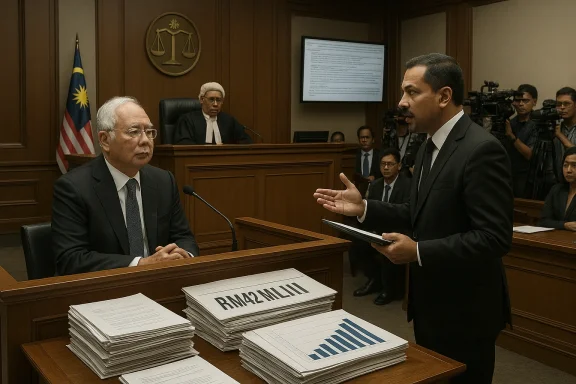
The Kuala Lumpur High Court on Thursday delivered a moment of crisp, plain-speaking testimony that risks reshaping the narrative around one of Malaysia’s longest-running political scandals: under cross‑examination by SRC International’s counsel, Najib Abdul Razak conceded that the RM42 million parked in his personal accounts was not connected to a Saudi donation, while his counsel immediately pushed back, saying the former prime minister still believes otherwise — a contradiction that narrows legal fault lines in the RM42 million civil recovery suit and sharpens political stakes.
The civil suit at the center of Thursday’s courtroom exchange is a demand by SRC International Sdn Bhd and its subsidiary Gandingan Mentari Sdn Bhd to recover RM42 million that SRC alleges was misapplied and diverted into Najib’s private accounts. The civil action runs alongside — and in the wake of — separate criminal proceedings that produced convictions relating to SRC and the broader 1MDB saga. The contested issue of whether the RM42 million was a donation from Saudi sources has been a central plank of Najib’s long-standing defence in multiple forums, making Thursday’s exchange pivotal for how the civil claim will be narrated and litigated.
Najib’s criminal cases have a well-documented procedural history: his SRC-related criminal conviction was upheld and he has been serving a custodial sentence, with subsequent litigation and appeals producing further sentences and fines tied to other 1MDB-related charges. Those prior criminal findings — and their treatment on appeal and review — are part of the legal background that informs both the civil claim and public interpretation of Thursday’s testimony.
Source: Newswav EXCLUSIVE | The courtroom bunkum -- Najib’s ‘Yes’, Shafee’s ‘No’
 Background
The civil suit at the center of Thursday’s courtroom exchange is a demand by SRC International Sdn Bhd and its subsidiary Gandingan Mentari Sdn Bhd to recover RM42 million that SRC alleges was misapplied and diverted into Najib’s private accounts. The civil action runs alongside — and in the wake of — separate criminal proceedings that produced convictions relating to SRC and the broader 1MDB saga. The contested issue of whether the RM42 million was a donation from Saudi sources has been a central plank of Najib’s long-standing defence in multiple forums, making Thursday’s exchange pivotal for how the civil claim will be narrated and litigated. Najib’s criminal cases have a well-documented procedural history: his SRC-related criminal conviction was upheld and he has been serving a custodial sentence, with subsequent litigation and appeals producing further sentences and fines tied to other 1MDB-related charges. Those prior criminal findings — and their treatment on appeal and review — are part of the legal background that informs both the civil claim and public interpretation of Thursday’s testimony.
What happened in court: the exchange in plain terms
- SRC’s counsel, Kwan Will Sen, asked Najib whether he still maintained that the RM42 million was a Saudi donation.
- Najib replied that “at that particular time, I thought it was a Saudi donation,” but when pressed whether he now accepted that the RM42 million had nothing to do with a Saudi donation, he answered: “Based on subsequent knowledge, yes.”
- Kwan then reminded Najib that Najib’s “Saudi donation” defence had been dismissed by the courts in the related criminal proceedings. Najib agreed with that statement but added a caveat that he had not had a chance to make a fuller explanation at the Federal Court level and referred to a claim that a senior judge agreed with parts of his review. That latter assertion is a matter Najib has raised in other contexts and is a factual point that merits verification against court records.
- Outside the witness box, Najib’s counsel, Tan Sri Muhammad Shafee Abdullah (Farhan Shafee / Shafee’s office), said Najib’s evidence had been misinterpreted by the media and reiterated that, in his own view and Najib’s stated belief, the monies originated as Saudi donations — a public disagreement that frames the testimony as contested rather than dispositive.
Legal significance: civil admissions vs criminal verdicts
Standards of proof and legal consequences
- Criminal findings require proof beyond reasonable doubt; civil claims are decided on the balance of probabilities. This matters because admissions or clarifications given under cross‑examination in a civil suit may carry different weight than criminal findings, but they can still be highly consequential in a recovery action.
- A sworn concession that the RM42 million was unrelated to a Saudi donation undermines the narrative Najib has historically relied upon to explain the transfers, and SRC will use the concession to reinforce its case for knowing receipt, dishonest assistance, and misfeasance in public office — causes of action SRC has signalled in previous filings.
Collateral estoppel and issue‑preclusion (practical note)
- While criminal convictions can be used as persuasive or estopping evidence in subsequent civil suits (depending on jurisdictional rules and precise factual overlaps), civil judges typically examine the total evidentiary picture, not just prior verdicts. A defendant’s concession in a civil hearing can be invoked to shorten issues, narrow cross‑examination of documentary evidence, and constrain factual narratives presented to the court. The immediate tactical effect is therefore tangible: evidence tranches become narrower and legal arguments more focused.
What the concession does — and does not — prove
- It is important to keep the legal and factual boundaries clear: Najib’s statement that, “based on subsequent knowledge, yes”, the RM42 million was not a Saudi donation, is a factual concession about the provenance issue at that time of testimony. It does not, on its face, equate to a judicial determination resolving the entire suite of SRC’s civil allegations. SRC still must prove the broader elements of its civil claims — including traceability, intention, and any knowing assistance by third parties.
- Conversely, Shafee’s rebuttal — that Najib continues to believe the monies were donations — is primarily a statement of belief and raises strategic questions about whether the defence will press a different evidentiary narrative (e.g., that Najib’s belief, reliance on counsel or officials, or other facts excuse him from restitution even if the funds were misapplied). The competing versions set up a classic courtroom contest: admissions in cross‑examination vs. defence narrative and context.
Documentary and forensic implications
The SRC civil suit is documentary at its core. The plaintiffs have previously signalled a paper‑heavy strategy emphasizing bank traces, instruction letters, company transfers, and cheque records. Thursday’s concession helps SRC in three practical ways:- It weakens a principal factual rebuttal (the Saudi‑donation narrative), narrowing the range of plausible explanations the defendant can legitimately advance.
- It increases the evidentiary leverage SRC can apply to trace where the RM42 million moved after it entered Najib’s accounts, potentially simplifying causation and quantification arguments in damages.
- It shifts media and public attention onto documentary proof and internal correspondence rather than contested lay narratives, forcing defenders to rely more on procedural argumentation and context than on headline defences.
Political and reputational fallout
The Najib saga is not only a legal story; it is a political lightning‑rod. The exchange has immediate public relations consequences:- For Najib and his supporters, a public courtroom concession is fodder for critics and opponents who point to long‑standing criminal findings and the political cost of governance failures. The optics are particularly stark because the RM42 million sum has been central to the 1MDB narrative that reshaped Malaysian politics.
- For Najib’s legal team and political allies, Shafee’s swift public statement framing the testimony as misinterpreted is an attempt to limit media momentum and preserve the longer‑range political narrative that prominent donations helped finance political activity. That split between witness testimony and counsel’s post‑court statements will be a recurring theme in media coverage and political spin.
Procedural timeline and what to watch next
- The civil hearing will continue with further witness testimony, documentary exhibits, and targeted cross‑examination. Expect SRC to call forensic accountants and present bank traces linking SRC disbursements to Najib’s accounts.
- Defence strategy options include (a) attempting to reframe the contested payments as lawful or donated funds (now complicated by the concession), (b) attacking SRC’s chain of custody and valuation of transfers, and (c) raising procedural or jurisdictional defences to limit recompense.
- Media and political scrutiny—heightened by the admission—means that court filings, transcripts, and any judicial observations will be publicly dissected. Watch for careful, judge‑authored summaries of testimony that can either embed or neutralize the rhetorical battle between Najib and his counsel.
- SRC presents its financial forensic evidence and seeks to solidify the trace from SRC accounts to Najib’s personal accounts.
- Defence leads counter‑evidence on context, intent, and belief, and may call rebuttal witnesses on donation provenance.
- Both parties commission independent expert accounting and valuation reports.
- Judgment on liability, followed (if liability is found) by quantification hearings to fix restitution or damages.
Strengths and weaknesses of the competing positions
SRC’s position (strengths)
- Clear documentary trail and prior criminal findings increase SRC’s leverage in a civil court; a concession about the donation claim undermines the single most prominent factual defence.
- The civil standard of proof lowers the evidentiary threshold compared with criminal cases, making SRC’s path to recovery more analytically feasible once key defences fade.
SRC’s position (weaknesses)
- SRC must convert documentary and transactional evidence into legal conclusions about knowing misuse, which involves complex inferences and will require coherent bridge evidence linking actions to culpability.
Najib’s defence (strengths)
- The combination of public statements by counsel and the possibility of explaining the testimony in fuller context can soften the practical bite of the cross‑examination concession. Counsel’s immediate public effort to reframe the testimony keeps the factual record contested.
- Political capital and public sympathy among some constituencies remain resources that can be mobilized outside courtrooms to influence public debate.
Najib’s defence (weaknesses)
- A courtroom admission, even if phrased carefully, is difficult to retrospectively recast in full legal terms. Once recorded in the transcript, the statement will be a fixed, citable fact that SRC can leverage in argument and in settlement bargaining.
Wider implications: rule of law, transparency, and public trust
The Najib‑SRC sequence has been a defining test of Malaysia’s institutional resilience. Thursday’s exchange underscores several broader themes:- Transparency and accountability: Civil recovery actions are an important complement to criminal enforcement; they seek restitution and create a public record that aids institutional learning. The visibility of documentary evidence and admitted facts supports long‑term norms of transparency.
- Media and legal interplay: Rapid media reporting and immediate post‑court commentary by counsel complicate how the public interprets testimony. This case demonstrates how counsel statements can attempt to reframe judicial testimony for political audiences.
- Legal closure vs political memory: Even if civil recovery yields restitution, public perceptions of corruption and institutional failure are slow to fade; the legal resolution may be only one stage in a broader struggle over historical narrative and political legitimacy.
Points that require cautious verification
- Najib’s assertion that a senior judge in a subsequent review agreed he did not receive a fair trial is reported as Najib’s observation in court and in media accounts; that factual claim should be verified against the Federal Court’s published orders and reasons to determine precisely what was said, by whom, and in what procedural context. Treat this as an alleged interpretive point rather than an established legal finding until checked against court transcripts.
- Reports that frame Najib’s admission as a total abandonment of the Saudi‑donation narrative overstate the point; read in context, the testimony concedes the RM42 million was not linked to a Saudi donation based on subsequent knowledge, while counsel continues to publicly assert a contrary belief — a factual tension that only the trial record can definitively reconcile. Readers should not conflate testimony snippets with final judicial findings.
Practical takeaways for readers and stakeholders
- For legal observers: expect a focus on documentary tracing, forensic bank records, and contemporaneous correspondence; the concession simplifies but does not end SRC’s work.
- For political actors: the courtroom record is now a sharper tool in the court of public opinion; both camps will contest interpretation aggressively in press releases and media commentary.
- For the public: court transcripts matter. What is said under oath in open court carries a different weight than out‑of‑court statements; public attention should follow the judicial record rather than media paraphrase.
Conclusion
Thursday’s exchange — short, direct, and politically explosive — advances the legal narrative in SRC’s favour by undercutting Najib’s most emblazoned line of defence about the RM42 million. Yet the moment is also a reminder of the gap between courtroom testimony and public spin: counsel’s immediate rebuttal keeps the dispute alive in the court of public perception. Legally, the concession strengthens SRC’s civil case by narrowing contested factual issues and sharpening documentary focus; politically, it hands opponents a new headline while giving defenders a window for context and mitigation. The next phases of the civil hearing will reveal whether the concession translates into restitution, or whether a broader evidentiary battle over tracing, timing and intent leaves the question more finely balanced than Thursday’s headlines suggest.Source: Newswav EXCLUSIVE | The courtroom bunkum -- Najib’s ‘Yes’, Shafee’s ‘No’
