

Wiresoft’s announced move into Saudi Arabia lands squarely at the intersection of two powerful trends: Middle East digital transformation and the global secondary market for perpetual software licenses. The Switzerland-based reseller promises Saudi businesses access to a broad catalogue of one-time-purchase Microsoft products — from Office 2024 and Microsoft 365 Enterprise variants to Windows Server 2025 and SQL Server 2025 — along with CALs, virtualization and design suites, and installation support. For IT teams hunting cost relief from subscription bills, that message is immediately attractive. But beneath the promotional language are real technical, legal, and procurement complexities that every Saudi CIO, procurement officer, and systems administrator needs to evaluate before clicking “buy.”
The last decade has compressed software buying models toward subscriptions and cloud services. Microsoft’s push to Microsoft 365, Azure, and recurring licensing has reduced options for organizations that prefer perpetual licensing for cost, control, or regulatory reasons. That shift boosted demand for secondary-market suppliers who sell legally acquired, pre-owned licenses at lower prices.
But market growth demands vendor accountability. Reliable secondary-market suppliers should:
Yet the promise of low prices must be balanced with careful due diligence:
Source: ipsnews.net https://ipsnews.net/business/2026/0...ia-as-the-premier-software-solutions-pioneer/
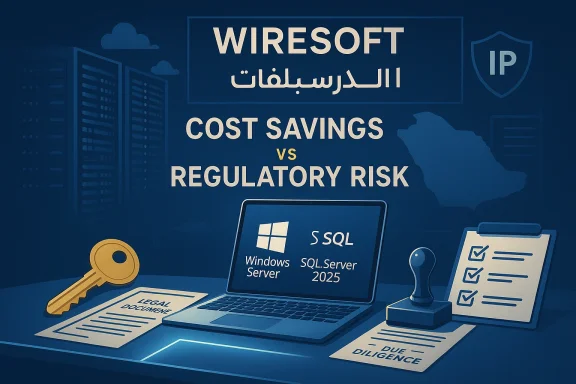 Background: why secondary licensing matters now
The last decade has compressed software buying models toward subscriptions and cloud services. Microsoft’s push to Microsoft 365, Azure, and recurring licensing has reduced options for organizations that prefer perpetual licensing for cost, control, or regulatory reasons. That shift boosted demand for secondary-market suppliers who sell legally acquired, pre-owned licenses at lower prices.- Secondary-market vendors claim two primary customer benefits: dramatic upfront cost savings over subscriptions, and the ability to run perpetual, offline, or locked-down environments without recurring fees.
- For countries undergoing aggressive digitalization — including Saudi Arabia under Vision 2030 — affordable software procurement can accelerate adoption across education, SMEs, and public projects.
What Wiresoft says it will offer in Saudi Arabia
Wiresoft’s announcement highlights a broad product mix aimed at enterprise and professional users:- Perpetual Office suites including Office 2024, Office 2021, and legacy Office versions.
- Microsoft subscription-class products referenced as Microsoft 365 Enterprise editions.
- Desktop and server operating systems including Windows 11, Windows 10, and server SKUs such as Windows Server 2025.
- Enterprise data platforms like SQL Server 2025 and Exchange Server.
- Client Access Licenses (CALs) and Remote Desktop CALs for finely tuned user/device licensing.
- Developer and productivity tools: Visual Studio, Microsoft Project, Visio.
- Third-party enterprise software: VMware, Autodesk, Oracle, and leading antivirus/security suites.
- Services touted in the release: SSL-secured digital delivery, free technical support for install/activation, internal testing of keys, and a 100% money-back guarantee.
The legal and compliance landscape — why “used software” is not a free pass
Wiresoft’s announcement emphasizes that “it is entirely legal and very safe to resell used software,” and that purchased licenses are “completely safe from audits.” That wording is optimistic and must be parsed carefully.- In the European Union, landmark court rulings have established that under certain conditions the resale of software licenses is permitted when the original copy was lawfully sold within the applicable market and the original licensee renders their copy unusable upon resale. That legal precedent underpins many European secondary licensing businesses.
- However, legal permissibility in Europe does not automatically translate into equivalence in other jurisdictions. Local IP rules, government procurement regulations, customs, and enforcement priorities matter — and Saudi Arabia has been actively strengthening IP protection and enforcement in recent years through the Saudi Authority for Intellectual Property (SAIP) and related agencies.
- “Safe from audits” is a claim that can mislead: audits examine provenance, contractual terms, activation records, and whether the original copy was decommissioned. A valid secondary-market sale typically requires documented proof that the license being sold originated from an eligible pool and that the prior instance was disabled. Even then, local regulators or rights-holders may challenge or investigate sales depending on facts and documentation.
Technical and activation realities: why license type matters
The devil is in the details. Microsoft licensing is highly granular: retail, OEM, volume, SPLA/CSP, and enterprise agreements all behave differently.- Retail (boxed or digital retail) licenses are generally the most transferrable for single-user perpetual editions, although binding to a Microsoft Account can complicate transfers in practice.
- OEM licenses (preinstalled on new hardware) are usually non-transferable and remain tied to the machine they shipped with.
- Volume licenses and volume-licensed product keys (such as those used by enterprises under Volume Licensing agreements) can sometimes be resold, but splitting or partially reselling multi-seat agreements is subject to restrictions and proof that the original environment no longer uses the seats sold.
- Activation and tenant-binding: Modern Microsoft activation systems increasingly tie licenses to accounts or tenants. Even legally transferable licenses can require manual intervention from Microsoft support to re-activate or to disentangle account-bound activations.
- Activation failures on newly purchased keys that require time-consuming support calls.
- Keys that have restrictions or are not valid for the intended region or edition.
- Licenses bundled with Software Assurance, upgrade rights, or maintenance that do not transfer.
- Incompatibility with management tools, or inability to enroll in Microsoft services that require an active CSP or EA relationship.
Saudi-specific risks and regulatory context
Saudi Arabia has ramped up IP enforcement and digital governance as part of broader economic modernization. Recent government actions demonstrate active enforcement against counterfeit or unlicensed software distribution and aggressive takedowns of infringing websites.- The Saudi Authority for Intellectual Property (SAIP) has issued guidance, partnered with other regulators, and carried out enforcement actions against software piracy and counterfeit goods.
- Penalties for IP violations can include fines, seizure of goods, website takedowns, and other administrative or criminal measures depending on the violation.
- Public-sector contracts and many private-sector vendors require strict proof of lawful licensing. Being unable to demonstrate provenance and valid transfer can imperil contracts or procurement compliance.
- Local legal frameworks and enforcement practices may differ from the EU’s “exhaustion” jurisprudence; what is defensible in one jurisdiction might still expose the buyer to enforcement risk or additional scrutiny in another.
- Organizations should factor the costs of potential audits, legal consultation, and re-license contingency into their total cost of ownership (TCO) calculations.
Practical due-diligence checklist for Saudi buyers
If your team is evaluating Wiresoft or any secondary-market supplier, adopt a documented procurement and validation process:- Request provenance documentation for each license: original seller details, proof the license was sold within the eligible market, and evidence that the prior installation(s) were decommissioned.
- Obtain a formal written statement from the reseller about activation steps, tenant-binding risks, and any limitations on updates or Software Assurance.
- Confirm edition/region compatibility: ensure the license keys are valid for Saudi Arabia and for your deployment edition (e.g., LTSC vs subscription, Server Datacenter vs Standard).
- Validate installation and activation in a quarantined test environment before wide deployment.
- Maintain an audit trail and signed purchase invoices to satisfy both internal compliance and potential regulatory inquiries.
- Preserve original delivery metadata: timestamps, digital receipts, and any signed declarations that the prior license-holder deleted or disabled their copies.
- Build a contingency budget for cases where Microsoft activation requires remedial steps or where re-licensing becomes necessary.
Cost calculus: short-term savings vs long-term risk
The headline value proposition of secondary-market resellers is price. One-time licenses reduce recurring operating expense and, for static environments, can produce clear savings. But total cost of ownership is broader:- Quantify the savings from lower upfront license cost.
- Add probable costs: support time for activations, legal review fees, contingency for alternate licensing if an audit fails, and administrative overhead for maintaining provenance records.
- Factor in security/patching: LTSC/perpetual editions can require manual patch management and may be less integrated with managed update channels, which can increase operational burden.
- Consider cloud advantages: Microsoft and many vendors bundle security, compliance, and management features into subscription models that reduce internal staffing needs.
Vendor claims to verify independently
Wiresoft’s release includes a number of statements companies should verify independently before acting:- “Every license bought by a business is completely safe from audits.” — This absolute phrasing is problematic. A license’s audit defensibility depends on provenance, license type, and local law. No reseller can guarantee audit immunity; they can only provide documentation and warranties.
- “All software keys come from verified European volumes and single licenses.” — Buyers should ask for concrete proof: origin documentation, invoices, and any notarized confirmations the vendor can provide.
- “Extensive internal testing ensures readiness for full deployment.” — Request written deployment test reports for critical server editions (e.g., Windows Server 2025, SQL Server 2025), and confirm whether updates and supportability are impacted.
- “100% money-back guarantee and free first-class technical support.” — Get the guarantee terms in writing: refund windows, dispute resolution jurisdiction, support SLAs, and any exceptions (e.g., non-refundable activation failures).
Operational recommendations for IT teams
If you decide to proceed with buying used or secondary-market licenses, follow these operational best practices:- Inventory and map license use tightly: which servers and devices run which SKU, who activated it, and which accounts are associated.
- Isolate new activations in a sandbox before production deployment.
- Require the reseller to provide documentation proving prior license deletion/decommissioning — and retain this as part of procurement records.
- Ensure your patch and update processes cover perpetual editions. LTSC versions may not receive feature updates in the same cadence as subscription-based services.
- Consider hybrid models where security-critical and collaboration workloads use supported subscription services while standalone appliances or test/dev instances use perpetual licenses.
- Train procurement, legal, and IT security teams on the vendor’s activation workflows so they can rapidly detect and remediate activation/compatibility issues.
The bigger picture: market opportunity and vendor accountability
Secondary-license vendors fulfill a market need. For many organizations — especially those with well-defined, stable systems — perpetual licensing remains the most practical and economical option. Wiresoft’s expansion into Saudi Arabia is an indicator that suppliers see strong demand in a region investing aggressively in digital infrastructure.But market growth demands vendor accountability. Reliable secondary-market suppliers should:
- Provide transparent provenance documentation.
- Explain technical activation steps and any risks associated with tenant/account binding.
- Offer contractual remedies that are realistic and enforceable within the buyer’s legal jurisdiction.
- Maintain clear support channels and escalation procedures if Microsoft activation or verification is problematic.
Conclusion: a measured approach for Saudi enterprise buyers
Wiresoft’s entry into the Saudi market adds an attractive procurement channel for organizations seeking perpetual licensing and short-term cost relief from subscription models. The offering — including Office 2024, Windows Server 2025, SQL Server 2025, CALs, and a range of enterprise applications — matches real-world needs for on-premises and regulated environments.Yet the promise of low prices must be balanced with careful due diligence:
- Confirm license provenance and decommissioning of original installations.
- Validate activation behavior in a test environment and get activation procedures in writing.
- Understand Saudi IP enforcement expectations and retain legal counsel for complex buys.
- Budget for potential remediation in worst-case scenarios (re-licensing, support escalation).
- Convert marketing claims into enforceable contractual warranties before large purchases.
Source: ipsnews.net https://ipsnews.net/business/2026/0...ia-as-the-premier-software-solutions-pioneer/
