

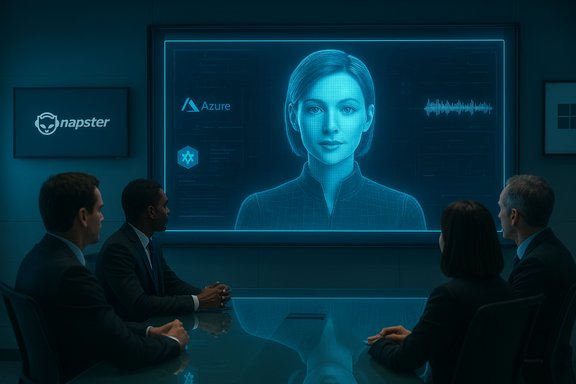
Napster’s announcement that it is among the first Microsoft partners to deploy Azure agentic AI for enterprises marks a pragmatic shift from experimental pilots to productized, low-latency conversational agents—an advance with clear promise for customer experience and equally clear operational and governance questions for any IT team planning a rollout.
Background / Overview
Since its rebrand from Infinite Reality, Napster has repositioned itself from immersive‑media playmaker to a vendor of embodied, agentic AI experiences—products such as Napster Spaces, Napster Companion, and Napster View are explicitly designed to convert static web presences into interactive, video‑enabled agent experiences. The company’s recent press activity frames the Microsoft partnership as the backbone that makes realtime voice and video agents commercially viable at scale. Microsoft’s Azure AI Foundry and the Azure OpenAI model catalogue are the technical pillars being cited in the partnership: Foundry supplies a model hosting and agent orchestration plane (including a Realtime API with WebRTC support for low‑latency speech in/speech out) while Azure provides the enterprise infrastructure and compliance tooling. Napster packages these capabilities into productized front‑end experiences and no‑code editors so business teams can deploy agents without heavy engineering lift. Microsoft’s own documentation confirms the Realtime API and the recommended WebRTC transport for low latency audio/video agent scenarios.What Napster announced — the essentials
- Napster says it has integrated Azure OpenAI models hosted via Azure AI Foundry, leveraging the Realtime API and model catalog to run embodied, video‑first agents for enterprise customers.
- The partnership explicitly mentions use of Azure Kubernetes Service (AKS) for scalable, containerized deployment and to handle production operational needs.
- A named pilot (a leadership/management consultancy and its client Cooper Parry) demonstrates an HR/leadership‑development use case: chat‑based AI “coaches” trained on company vision and culture to extend coaching access and reduce cost. Napster’s press release also references a separate pilot with a large paints‑and‑coatings manufacturer, though that particular deployment is referenced without independently verifiable technical metrics.
Technical anatomy: how this stack really fits together
Azure AI Foundry and the Realtime API
Azure AI Foundry provides a model catalog and runtime for enterprise models. The Realtime API in Foundry supports speech‑in / speech‑out models and low‑latency connections via WebRTC, SIP, or WebSocket. Microsoft’s documentation lists supported realtime models (gpt‑4o‑realtime family and realtime variants) and recommends WebRTC for client‑side audio connections because of its lower latency and built‑in media handling. That Realtime capability is the core enabler for Napster’s embodied, conversational video agents. Key technical takeaways:- Realtime models such as
gpt‑4o‑realtimeandgpt‑realtimeare available in specific Azure regions and are deployable from Foundry’s model catalog. - WebRTC is recommended for low‑latency, browser‑based audio/video sessions; SIP and WebSocket modes exist for telephony or server‑to‑server scenarios.
Azure Kubernetes Service (AKS) and scaling
AKS remains Microsoft’s managed Kubernetes service for running containerized applications at scale, and it’s a natural choice for packaging the non‑model parts of a real‑time agent stack: microservices for session orchestration, media proxies, telemetry pipelines, and adapter layers that call Foundry model endpoints. AKS offers autoscaling, monitoring integrations, node pools (including GPU‑enabled nodes), and enterprise governance controls—features that enterprise SI teams expect when moving prototypes into production.Data flows, keys, and residency
Enterprises must evaluate where the ephemeral audio/video streams and derived artifacts (transcripts, embeddings, memory stores) are stored and whether customer‑managed keys or region zoning are enforced. Microsoft documentation and Azure product pages document region restrictions for realtime models and guidance on resource creation in supported regions; Foundry and Azure OpenAI expose configuration options for deployment region and storage, but precise residency controls and CMK/BYOK support require validation at deployment time and in contract language.The pilot stories and human outcomes
Napster’s release highlights two pilots:- Leading Results used Napster’s technology to create on‑demand AI coaches for its client Cooper Parry, enabling bespoke coaching that matches Cooper Parry’s values and tone—an HR and leadership development scenario that reduces scheduling friction and cost. Napster gives quotes from Cooper Parry leadership about cultural fit and authenticity of the agents.
- A separate pilot with a paints and coatings manufacturer is described in other Napster public statements (integration across online and in‑store experiences), but that customer is unnamed in the press text and technical metrics (latency, retention lift, conversion uplift) have not been independently published. Treat this as a vendor‑provided pilot claim until a named, metrics‑driven case study is released.
- People augmentation: HR and training are low‑risk, high‑value initial targets because the domain is language‑rich, lower regulatory risk, and outcomes (engagement, access) are easy to measure.
- Commerce augmentation: Retail and in‑store experiences are attractive for video companions because they can blend product discovery with transactional flows, but they bring additional latency, privacy, and identity questions.
Responsible AI and governance — what the partners say versus what enterprises must ask
Napster and Microsoft both foreground responsible AI in the announcement: Microsoft highlights responsible AI principles—fairness, accountability, transparency, safety and privacy—and points to partnerships that embed those principles into enterprise deployments. IDC research commissioned by Microsoft also found more than 30% of respondents view the lack of governance and risk management solutions as the top barrier to scaling AI—this statistic is being used to justify the importance of enterprise controls. What the PR emphasizes:- Microsoft and partners will provide the platform controls—identity, regional deployments, content filtering, and auditing hooks—that enterprises need. Napster says it builds on those controls to deliver managed, productized experiences.
- Where exactly are transcripts, session recordings, and memory stores persisted? Are they subject to the same region and compliance commitments the organization requires?
- Are Bring‑Your‑Own‑Key (BYOK) or customer‑managed key options available to encrypt model logs and persistent stores?
- What human‑in‑the‑loop (HITL) escalation and audit trails are enforced for high‑impact outputs?
- How is agent identity, consent, and disclosure handled when synthetic voices or avatars are used (to avoid impersonation or deepfake risks)?
Strengths: why this approach is attractive to enterprise IT
- Faster time to market: Packaging realtime models into a no‑code front end and deploying on Azure reduces engineering cycles for marketing and product teams. Napster’s productization targets non‑engineering teams and shortens procurement → POC → production timelines.
- Low‑latency conversational experiences: WebRTC + Foundry realtime models are engineered for sub‑second interactions, enabling natural voice/video conversations that previously were impractical at scale. Microsoft docs explicitly recommend WebRTC for low latency and list realtime model SKUs available for deployment.
- Enterprise controls and distribution channels: Hosting the model layer on Azure and offering the solution through Azure Marketplace and the Microsoft partner ecosystem brings procurement, compliance, and SI channels that enterprises trust when moving to production.
- Clear productized UX: No‑code builders and agent templates reduce the dependency on bespoke integrator projects and make iteration accessible to business owners. This is a strategic change from the previous era of perpetual custom development.
Risks and blind spots IT leaders must manage
- Data residency and leakage: Real‑time audio and video sessions generate transcripts and derived metadata. Enterprises must confirm region, storage mechanics, and key management; assumptions in vendor marketing should be validated with technical proof. Microsoft’s Foundry lists supported regions for realtime models—customers must align their deployments with regulatory expectations.
- Model behavior and hallucinations: Agentic AI can produce plausible but incorrect or inappropriate responses. Implement confidence thresholds, strict escalation policies, and immutable logging—and do not place agents in roles that make safety‑critical decisions without human oversight. Napster and Microsoft provide safety tooling, but final liability sits with the deploying organization.
- Deepfake and impersonation risk: Synthetic avatars and voices can be misused or erode trust if not properly disclosed. Enforce consent flows, clear agent labeling, and opt‑out/consent capture where audio/video personas are used.
- Vendor lock and supply chain concentration: Napster’s product strategy intentionally couples its UX stack with Microsoft Foundry and Azure infrastructure. That yields operational simplicity but creates migration friction if a customer later seeks cross‑cloud portability. Architect modular connectors and insist on exportable artifacts to reduce lock‑in.
- Cost and observability: Realtime multimodal usage (video + TTS/STT + long memory) is computationally expensive. Model routing (small models for routine tasks, large models for complex reasoning) and quotas are necessary to control spend. Instrument telemetry into chargeback and budget planning.
Practical checklist for pilots and production readiness
Before wide rollout, IT and security teams should complete this checklist:- Validate data residency and encryption:
- Confirm region(s) for realtime model inference and storage.
- Confirm BYOK/CMK support for persistent storage and logs.
- Run a performance pilot:
- Simulate peak concurrent sessions (video + audio) to measure real‑world latency and error rates.
- Track per‑minute inference cost and operational overhead.
- Safety and governance:
- Define confidence thresholds and annotate where human handoff is mandatory.
- Enable immutable audit logging and versioning for models and agent prompts.
- Identity and disclosure:
- Ensure agents explicitly identify themselves as synthetic and capture consent for voice/video interactions.
- Protect against impersonation by linking agent personas to verifiable brand assets.
- Contractual and procurement:
- Negotiate SLAs that include compliance, data deletion semantics, and incident response rules.
- Insist on a migration plan and exportable data/agent configurations to avoid lock‑in.
- Monitoring and cost control:
- Set quotas and automated alerts for abnormal usage.
- Integrate telemetry with observability tools and finance reporting.
- Start small with a non‑critical, internal pilot (training/coaching or FAQ assistants).
- Validate latency, correctness, and privacy controls under production‑like load.
- Expand to a small subset of customers with human‑in‑the‑loop fallbacks and measurable KPIs (CSAT, conversion, handle time).
- Harden governance, add region‑specific deployments, and scale once ROI is proven.
How to evaluate vendor claims — three quick checks
- Ask for a named, metrics‑driven case study: conversion lift, session latency, and error rates. Vendor PRs often cite pilots without measurable data; require a verified case study.
- Review deployment diagrams that show where audio/video streams, transcripts, memories and backups are stored and encrypted. If diagrams are vague, they are likely incomplete.
- Confirm the rollback and model‑change plan: who controls model updates, and how quickly can an enterprise pin to a prior model version if a drift or safety issue emerges? Microsoft Foundry provides model cataloging and life‑cycle features, but process-level guarantees must be contractual.
Market context and what this means for Windows‑centric IT teams
Microsoft’s push to host a variety of frontier models in Azure AI Foundry—combined with a partner ecosystem that packages UX and orchestration—creates a commercially accessible path to agentic AI. For teams invested in Windows, Microsoft 365, and Azure, the appeal is straightforward: integrated identity (Entra), observability, and procurement channels make enterprise adoption less risky compared to piecing together open‑source stacks and third‑party hosting. Still, the market is maturing quickly and other cloud vendors and ISVs will ship competing patterns; IBV and partner specializations will matter for procurement decisions.Conclusion: measured optimism with operational discipline
Napster’s move to deploy Azure agentic AI is a credible, production‑oriented step that demonstrates how realtime model APIs, enterprise governance layers, and productized UX can converge into deployable services for commerce and people‑facing workflows. The technical enablers—Azure AI Foundry’s Realtime API with WebRTC and AKS for scalable microservices—are documented and available; what remains decisive is how organizations manage data residency, safety, cost and vendor dependency. For IT leaders, the opportunity is real: improve engagement, scale coaching and support, and prototype agentic automation quickly. But success will be less about the demo and more about the discipline: contractually enforceable governance, clear data residency and key management, robust human‑in‑the‑loop processes, and rigorous performance and safety testing before any public rollout. Napster and Microsoft provide a functioning stack; the responsibility for making it trustworthy and cost‑effective rests with the enterprise that chooses to deploy it.Source: GlobeNewswire Napster Among First Microsoft Partners to Deploy Azure Agentic AI for Enterprises
