

Napster’s new Napster Station promises to move conversational AI off screens and into crowded, noisy public spaces with a purpose-built kiosk that the company says can deliver persistent, video-enabled concierge service where ordinary voice assistants struggle.
Napster — the company that re-emerged this year after acquiring the Napster brand and pivoting into embodied AI experiences — announced Napster Station on December 30, 2025 as a hardened physical kiosk intended for high-traffic public spaces such as hotel lobbies, airport terminals, retail floors, and healthcare waiting rooms. The company frames Station as the first enterprise‑grade AI concierge engineered to operate reliably in environments with competing conversations and loud ambient noise, and to run on a stack that includes Microsoft Azure and Azure OpenAI Foundry technologies.
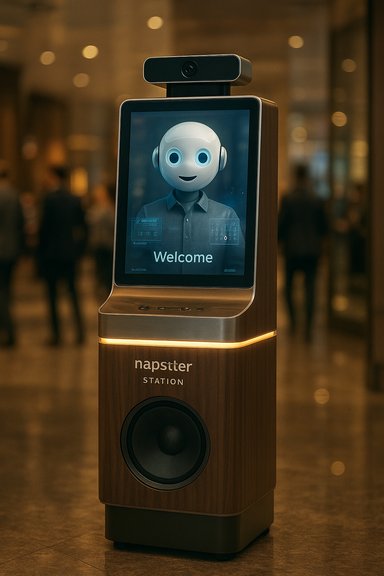
The press materials describe Station as a multimodal appliance that combines a proprietary near‑field microphone array (branded VoiceField™), integrated vision for presence sensing, studio‑quality audio playback, and a premium cabinet finish intended to look at home in luxury hospitality settings. Napster says the product is being shown at CES and will be available for enterprise deployment in Q1 2026. The company positions Station as dramatically cheaper to operate than human concierges — roughly “$1 per hour” in running cost, according to the announcement — and tightly integrated with Azure realtime models for low‑latency, voice‑first conversations.
This article summarizes the announcement, verifies technical claims where possible, and offers a critical analysis of the product’s strengths, likely operational challenges, and governance issues enterprises must address before rolling out voice/video concierges in public spaces.
Napster’s pitch is specific: purpose‑built hardware plus multimodal sensing enables reliable single‑user voice capture and context awareness even amid competing conversations. The vendor argues that this capability unlocks practical onsite concierge use cases that were previously impractical because of accuracy, privacy, and cost constraints.
The announcement also situates Station within Napster’s broader product strategy of embodied AI experiences — an ecosystem that already includes desktop holographic devices and agent companions — indicating the company sees a multi‑surface footprint for its agents (personal devices, kiosks, and glasses‑free displays). Independent tech coverage earlier this year showed Napster’s broader hardware ambitions, which lends context to Station as another piece in the company’s hardware + AI playbook.
Benefits organizations can reasonably expect if Station performs as advertised:
Independent coverage earlier in 2025 of Napster’s hardware experiments (Napster View holographic display) demonstrates the company’s appetite for physical devices and agent experiences — Station fits into that broader strategy to place agents into multiple real‑world surfaces. Those moves suggest Napster is betting the future of brand engagement will be multimodal and device‑diverse.
Enterprises that take a disciplined, staged approach to piloting — validating acoustic performance, privacy controls, HITL paths, and cost under realistic load — stand to gain a powerful new channel for customer engagement. Those that skip these checks risk reputational, privacy, and financial exposure if agents produce incorrect information, record or store data in noncompliant ways, or scale costs beyond expectations.
Napster’s booth demos at CES and the company’s Q1 2026 availability timeline will provide the first moments for independent testers and enterprise partners to validate the claims. The product is an important signal in the broader move to put agents into the physical world; successful, governed deployments could change how public spaces provide information and assistance — but success hinges on the operational rigor behind the marketing.
Conclusion
Napster Station packages ambitious hardware and enterprise realtime AI into a product that, if it performs as promised and if governance controls are implemented, could unlock a new class of on‑site, conversational services. For IT leaders and procurement teams, the path forward is clear: insist on empirical validation, contractual clarity on data handling and exportability, and phased pilots that prove both the user experience and the operational economics before scaling.
Source: GlobeNewswire Napster Launches Napster Station: The First AI Concierge Built to Provide Personalized Service in Crowded Spaces
 Background / Overview
Napster — the company that re-emerged this year after acquiring the Napster brand and pivoting into embodied AI experiences — announced Napster Station on December 30, 2025 as a hardened physical kiosk intended for high-traffic public spaces such as hotel lobbies, airport terminals, retail floors, and healthcare waiting rooms. The company frames Station as the first enterprise‑grade AI concierge engineered to operate reliably in environments with competing conversations and loud ambient noise, and to run on a stack that includes Microsoft Azure and Azure OpenAI Foundry technologies.The press materials describe Station as a multimodal appliance that combines a proprietary near‑field microphone array (branded VoiceField™), integrated vision for presence sensing, studio‑quality audio playback, and a premium cabinet finish intended to look at home in luxury hospitality settings. Napster says the product is being shown at CES and will be available for enterprise deployment in Q1 2026. The company positions Station as dramatically cheaper to operate than human concierges — roughly “$1 per hour” in running cost, according to the announcement — and tightly integrated with Azure realtime models for low‑latency, voice‑first conversations.
This article summarizes the announcement, verifies technical claims where possible, and offers a critical analysis of the product’s strengths, likely operational challenges, and governance issues enterprises must address before rolling out voice/video concierges in public spaces.
Why this matters: the problem Napster Station intends to solve
Traditional voice assistants and call‑center AI modules are designed and tested in controlled acoustic conditions. They routinely fail when placed in the real world: busy lobbies, noisy concourses, or crowded retail floors present multiple speakers, variable ambient noise, and complex turn‑taking — all hard problems for speech separation, speaker identification, and conversational context.Napster’s pitch is specific: purpose‑built hardware plus multimodal sensing enables reliable single‑user voice capture and context awareness even amid competing conversations. The vendor argues that this capability unlocks practical onsite concierge use cases that were previously impractical because of accuracy, privacy, and cost constraints.
The announcement also situates Station within Napster’s broader product strategy of embodied AI experiences — an ecosystem that already includes desktop holographic devices and agent companions — indicating the company sees a multi‑surface footprint for its agents (personal devices, kiosks, and glasses‑free displays). Independent tech coverage earlier this year showed Napster’s broader hardware ambitions, which lends context to Station as another piece in the company’s hardware + AI playbook.
Technical claims and verifications
What Napster says Station includes
Napster’s press text lists several headline features intended to distinguish Station from off‑the‑shelf voice assistants:- VoiceField™ Microphone Array: a proprietary near‑field array designed to isolate one speaker in a noisy environment.
- Multimodal Presence Sensing: integrated vision plus audio to determine the active speaker and focus the interaction.
- Audiophile‑Grade Sound: three precision tweeters and an integrated subwoofer for clear, authoritative TTS playback.
- Premium aesthetic: walnut wood and aluminum construction to serve as a high‑end physical fixture.
- Azure + Microsoft Foundry Realtime models: Napster states Station runs on Microsoft Azure OpenAI/Foundry realtime models to deliver low‑latency, conversational video agents.
Realtime voice + video on Azure: what is verifiable today
Napster’s reliance on Microsoft’s realtime model stack is technically plausible and consistent with publicly documented Azure capabilities. Microsoft’s Azure AI Foundry (Azure OpenAI / Foundry) includes a Realtime API designed for low‑latency audio and video interactions and explicitly recommends WebRTC for client‑side real‑time media because of its optimized handling of codecs, jitter, and error correction. Microsoft also publishes supported realtime model SKUs (realtime and realtime‑mini families) and region availability for low‑latency deployments. These platform capabilities align with Napster’s claims about low‑latency, multimodal agents running on Azure. Two practical takeaways from Microsoft documentation:- WebRTC is the recommended transport for live audio/video interactions to minimize latency and manage media streams.
- Realtime models and their region availability are published; deployments require a Foundry/Azure OpenAI resource in supported regions and typically use ephemeral tokens for secure sessions.
Verified vs. vendor‑only claims
- Verified by platform documentation: low‑latency voice/video models and WebRTC session flows on Azure are supported and documented.
- Vendor‑only / not independently verified yet: the specific performance of the VoiceField array in real airport ambient noise, the precise cost metric “~$1 per hour,” and the efficacy of presence sensing in mixed‑crowd contexts. These require independent measurements or replication by third‑party testers. Napster’s marketing materials and early demos are the primary source for these claims at the time of the announcement.
Use cases and where Station could add measurable value
Napster highlights four vertical use cases that match common enterprise patterns:- Hotels & Hospitality: contactless check‑in, local recommendations, and personalized guest service with remembered preferences.
- Healthcare: patient education in waiting rooms and multilingual, accessible explanations of procedures.
- Retail & Malls: hands‑free product configuration, wayfinding, and on‑floor engagement for shoppers.
- Airports: real‑time gate updates, terminal navigation, and passenger assistance in wayfinding and connections.
Benefits organizations can reasonably expect if Station performs as advertised:
- Reduced front‑desk load and faster service during peak periods.
- Consistent, 24/7 availability for basic inquiries (local maps, store hours, directions).
- Reduced labor costs for repetitive tasks, potentially improving margin on customer service operations.
- New digital touchpoints that can feed analytics and personalization while preserving brand voice at scale.
Operational and procurement considerations
Deploying an always‑on, video‑enabled AI kiosk in public environments is nontrivial. Enterprises should prepare a checklist before procurement and pilot phases:- Data residency and encryption: Where are audio/video streams, transcripts, and memory stores persisted? Are customer‑managed keys (CMK/BYOK) available for all persistent artifacts? Confirm region scoping with the vendor and cloud provider.
- Human‑in‑the‑loop (HITL) and escalation policies: What triggers an escalation to a human operator? How are ambiguous or high‑risk outputs detected and routed? Request details on thresholds, latency SLAs for HITL, and contact routing.
- Consent, signage, and identity: Public kiosks should disclose they are synthetic agents and capture consent for audio/video interactions where legally required. Implement clear signage and opt‑out controls; avoid any design that could be confused with human attendants.
- Auditability and exportability: Can conversation logs, agent configurations, and memory snapshots be exported for audits or migration? Require export formats and retention/deletion semantics in contracts.
- Fallbacks for connectivity and model outages: What degraded‑mode behavior exists if the cloud endpoint is unreachable? Local NLU or scripted fallbacks can maintain basic service during outages.
- Accessibility and inclusivity: Ensure TTS voices, visual displays, and interaction flows meet ADA/accessible design requirements. Validate language coverage and hearing/vision alternative modes.
- Cost modeling and observability: Realtime multimodal sessions (audio capture, STT, embeddings, TTS, video rendering, memory lookups) are resource‑intensive. Model routing and telemetry are essential to prevent runaway spend. Napster quotes an operational cost advantage in marketing materials, but buyers must model expected QPS (queries per second) and peak concurrency to validate the economics.
Governance, safety, and ethical risks
Deployments that blend speech, video, and persistent memory in public settings raise significant governance concerns that go beyond typical SaaS procurement.- Privacy and surveillance risk: Vision sensors imply a camera is present. Even with local presence sensing, enterprises must be explicit about what is recorded, what is transient, what is stored, and how third parties (including cloud providers) can access derived artifacts like transcripts and embeddings. Signage and consent mechanisms are necessary but not sufficient; contractual guarantees about deletion and access controls are essential.
- Impersonation and deepfake risk: High‑quality synthetic voices and avatars can be persuasive. Agents must be clearly identified as non‑human, and organizations must adopt safeguards to prevent impersonation of staff or misuse for fraud. Require agent identity markers and enforce strict content policies.
- Hallucination and liability: Generative models sometimes produce plausible-sounding but incorrect or harmful content. Public kiosk outputs could meaningfully affect decisions (medical advice, legal directions, financial guidance). Enterprises must restrict high‑risk recommendation domains and keep humans in the loop for consequential outputs.
- Vendor concentration and lock‑in: Napster’s product strategy packages UX on top of Microsoft Azure Foundry. That simplifies operations but increases migration friction; insist on exportable configurations and data to avoid vendor lock‑in.
Competitive and market context
Napster is not the only player pursuing embodied, in‑space agents. The market trend for 2025 has been a convergence: hyperscalers provide real‑time model runtimes and compliance tooling, while specialized ISVs productize the UX and hardware to deliver vertical‑specific experiences. The combination of a productized UX layer and a hyperscaler runtime speeds time‑to‑market for non‑engineering teams but creates strategic dependencies on the cloud provider’s model catalog and pricing.Independent coverage earlier in 2025 of Napster’s hardware experiments (Napster View holographic display) demonstrates the company’s appetite for physical devices and agent experiences — Station fits into that broader strategy to place agents into multiple real‑world surfaces. Those moves suggest Napster is betting the future of brand engagement will be multimodal and device‑diverse.
Practical pilot template: how to test Napster Station in your environment
A staged pilot reduces risk and surfaces operational unknowns. The following is a practical pilot sequence enterprises can use:- Define low‑risk, high‑value scope (e.g., wayfinding in a single concourse, hotel check‑in support for standard requests).
- Run an acoustic and privacy audit at the pilot site; capture signal‑to‑noise baselines during peak hours.
- Deploy a single Station with metrics collection (latency, STT accuracy, TTS clarity, fallbacks triggered, human escalations).
- Evaluate user experience with blind A/B testing versus human attendants for response time and CSAT.
- Validate data residency, retention, CMK/BYOK options, and export/import of memory snapshots for audits.
- Harden content filters and escalation rules based on observed misbehavior before broadening the rollout.
Strengths: where Napster Station could genuinely excel
- Purpose‑built hardware: If the VoiceField microphone array and presence sensing perform as claimed in noisy settings, this would be a meaningful engineering achievement that enables new on‑floor experiences not feasible with typical consumer voice assistants. The premium finish and speaker system also reduce friction for placements in hospitality and retail.
- Integration with Azure realtime stack: Using Microsoft Foundry and the Realtime API makes it straightforward to obtain sub‑second audio/video interactions with enterprise procurement and compliance channels, which is attractive to large customers. Microsoft docs confirm the platform’s intent and technical support for realtime audio/video models.
- Faster scaling and consistent UX: Productizing agent templates and memory semantics can allow companies to deploy consistent brand voice and knowledge across thousands of kiosk instances with centralized updates and analytics. This is an operational advantage over bespoke integrator projects.
Weaknesses and open questions
- Performance in the wild remains unproven: Vendor demos are a necessary first step, but independent acoustic lab results and live pilot metrics are needed to confirm the microphone array’s separation and presence sensing claims. Until third‑party testing appears, treat performance claims with cautious optimism.
- Unclear cost calculus: The “$1 per hour” operational cost claim is compelling, but the figure requires transparent cost modeling (model routing, peak concurrency, content moderation, and HITL costs). Buyers should request a cost breakdown tied to expected QPS and retention policies.
- Regulatory and privacy complexity: Deploying vision sensors in public spaces touches data protection laws in many jurisdictions. The vendor’s responsible‑AI claims are a start but do not replace contractual guarantees for residency, deletion, and access control.
Recommendations for IT leaders and procurement teams
- Require a hands‑on demo in a representative acoustic environment (not only at a trade show).
- Insist on deployment diagrams that show where transcripts, embeddings, and memory stores are created and stored; require CMK/BYOK where regional compliance matters.
- Contractually define SLAs for latency, uptime, and model update cadence, and demand exportable agent configurations for portability.
- Define HITL thresholds and test the escalation path under load.
- Start with non‑critical, low‑risk pilots (wayfinding, FAQ) and don’t escalate to clinical, legal, or transactional use cases until governance is proven.
Final assessment
Napster Station is an intriguing step into embodied AI: the product marries a bespoke hardware appliance with a hyperscaler realtime model stack to deliver agentic interactions in physical spaces where consumer voice assistants have historically failed. The technical underpinning — realtime Azure models and WebRTC media flows — is real and documented, and Napster’s broader product trajectory (holographic displays and agent companions) suggests depth beyond a one‑off kiosk. That said, much of Station’s value depends on two things that remain to be independently validated: the real‑world performance of the microphone and presence sensing in the types of noisy, multi‑speaker environments Napster claims to target, and transparent operational cost and governance details that satisfy enterprise procurement and compliance teams. Until independent pilots and lab tests are published, buyers should treat Napster’s performance and cost claims as promising but vendor‑asserted.Enterprises that take a disciplined, staged approach to piloting — validating acoustic performance, privacy controls, HITL paths, and cost under realistic load — stand to gain a powerful new channel for customer engagement. Those that skip these checks risk reputational, privacy, and financial exposure if agents produce incorrect information, record or store data in noncompliant ways, or scale costs beyond expectations.
Napster’s booth demos at CES and the company’s Q1 2026 availability timeline will provide the first moments for independent testers and enterprise partners to validate the claims. The product is an important signal in the broader move to put agents into the physical world; successful, governed deployments could change how public spaces provide information and assistance — but success hinges on the operational rigor behind the marketing.
Conclusion
Napster Station packages ambitious hardware and enterprise realtime AI into a product that, if it performs as promised and if governance controls are implemented, could unlock a new class of on‑site, conversational services. For IT leaders and procurement teams, the path forward is clear: insist on empirical validation, contractual clarity on data handling and exportability, and phased pilots that prove both the user experience and the operational economics before scaling.
Source: GlobeNewswire Napster Launches Napster Station: The First AI Concierge Built to Provide Personalized Service in Crowded Spaces
