

The era of “free AI certificates” has matured from headline bait into a practical scaffold students can use to build real skills—if they know which offers are genuinely useful, which are temporary promotions, and how to turn course completion into demonstrable work that employers value.
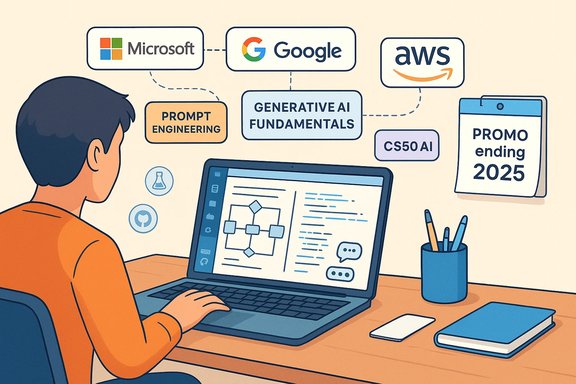
Over the last two years, major cloud vendors, university platforms, and specialist providers have expanded low‑ or no‑cost entry points into generative AI and prompt engineering. The result is a crowded, useful, and occasionally confusing landscape where “free” often means “audit access to materials” rather than a fully credentialed pathway. Recent roundups and platform announcements show consistent patterns: short vendor micro‑courses for productivity, compact developer primers with notebooks, and longer university‑level offerings for deep technical grounding. These options let students choose between quick productivity wins and multi‑week technical depth depending on their goals and time budgets. practice is important: vendors now publish free foundational micro‑courses with badges and hands‑on labs (often gated by lab credits), specialist providers offer 1–3 hour developer primers with code examples, and universities continue to provide project‑heavy classes that remain the gold standard for technical depth. Many roundups highlight the same core set of offerings—Microsoft/LinkedIn, Google Cloud Skills Boost, DeepLearning.AI/OpenAI, AWS Skill Builder, Coursera/edX university courses—so students have predictable options for mapping learning to roles.
Weeks 1–2: Orientation & productivity primers
However, the marketing language around “free” requires careful reading. Audit access is not the same as a verified credential, lab exercises can carry hidden costs, and vendor‑centric modules risk locking students into product patterns if they don’t also study vendor‑neutral principles. Treat vendor badges as stepping stones, not endpoints. Confirm promotional timelines—promises like “free through 2025” have expiration dates and must be verified before depending on them.
Source: Analytics Insight https://www.analyticsinsight.net/am...courses-for-students-get-certified-in-gen-ai]
 Background / Overview
Over the last two years, major cloud vendors, university platforms, and specialist providers have expanded low‑ or no‑cost entry points into generative AI and prompt engineering. The result is a crowded, useful, and occasionally confusing landscape where “free” often means “audit access to materials” rather than a fully credentialed pathway. Recent roundups and platform announcements show consistent patterns: short vendor micro‑courses for productivity, compact developer primers with notebooks, and longer university‑level offerings for deep technical grounding. These options let students choose between quick productivity wins and multi‑week technical depth depending on their goals and time budgets. practice is important: vendors now publish free foundational micro‑courses with badges and hands‑on labs (often gated by lab credits), specialist providers offer 1–3 hour developer primers with code examples, and universities continue to provide project‑heavy classes that remain the gold standard for technical depth. Many roundups highlight the same core set of offerings—Microsoft/LinkedIn, Google Cloud Skills Boost, DeepLearning.AI/OpenAI, AWS Skill Builder, Coursera/edX university courses—so students have predictable options for mapping learning to roles.The practical top picks — whow right now
Below are the recurring high‑value courses and learning paths across vendor and academic ecosystems, paired with the practical caveats every student needs before they enroll.1) Microsoft + LinkedIn: Career Essentials in Generative AI (Professional Certificate)
- What it is: A short multi‑module learning path produced by Microsoft and hosted on LinkedIn Learning that focuses on generative AI concepts, Copilot workflows, and responsible AI basics.
- Why it matters: It’s explicitly designed for workplace productivity (Copilot in Word/Excel/Outlook) and for non‑technical learners who need immediate tool fluency.
- Key verification: Microsoft announced the Career Essentiificate as part of its Skills for Jobs initiative and stated that the coursework would be free through 2025; that promotional period is time‑limited and requires confirmation before assuming free access in 2026.
- Caveat: The curriculum is intentionally Microsoft‑centric; excellent for Azure/Copilot environments, less useful if a student needs vendor‑neutral engineering principles.
2) DeepLearning.AI + OpenAI: ChatGPT Prompt Engineering for Developers
- What it is: A compact, hands‑on primer (roughly 1.5 hours) taught by contributors from OpenAI and DeepLearning.AI with Jupyter notebooks and API examples.
- Why it matters: It teaches practical prompt patterns and shows how to build a simple chatbot using the OpenAI API—high signal for developer roles building LLM apps.
- Caveat: Short duration means high density; students must complete notebooks and a tiny project to get hiring signal.
3) Google Cloud Skills Boost: Introduction to Generative AI + Generative AI Fundamentals badge
- What it is: A 45‑minute introductory micro‑course plus a short learning path that bundles LLM basics, safety, and small labs into a Generative AI Fundamentals badge.
- Why it matters: Easy wins and vendor badges that map to Google’s Vertex AI/Gemini ecosystem; labs can demonstrate competence quickly.
- Caveat: Labs frequently require cloud credits or Skill Boost subscriptions; badges are useful but not a substitute for a project in your portfolio.
4) AWS Skill Builder: Foundations of Prompt Engineering and related labs
- What it is: A vendor‑native learning path covering prompt engineering principles, model‑specific techniques (including Amazon Titan & Bedrock), and bias/mitigation practices.
- Why it matters: AWS is positioning Skill Builder as a bridge from conceptual literacy to Bedrock‑based apps; material covers advanced techniques like RAG and chain‑of‑thought at an introductory level.
- Caveat: Practical labs may still require a subscription or limited sandbox credits, and the training is tuned to AWS tooling and patterns.
5) University‑level: Harvard / CS50’s Introduction to AI with Python, fast.ai, and Elements of AI
- What it is: Project‑heavy courses that teach algorithms, Python implementations, and deep learning fundamentals (CS50 AI and fast.ai) and platform‑neutral conceptual foundations (Elements of AI).
- Why it matters: These courses force implementation and portfolio work—exactly what recruiters and technical interviewers prize. CS50’s ai course lists 7 weeks at 10–30 hours per week and provides a free audit route and paid verified certificates via edX.
- Caveat: High time cost. Not recommended as a “weekend sprint” unless you can commit serious hours.
How “free” actually breaks down (practical verification)
Students must treat the word free as three possible things:- Free access to lecture videos and reading (audit mode) — common on Coursera and edX.
- Free digital badges/micro‑course completion markers — common on vendor learning platforms, sometimes with labs gated by credits.
- Free, verified certificate — rare and usually time‑limited (promotions) or tied to scholarship programs.
Convert learning into hiring signal — an operational checklist
The clearest gap between course completion and real job value is the absence of demonstrable artifacts. Students who finish many micro‑courses but create no public projects often struggle to show impact. Use this checklist to convert courses into career assets:- Build one small, job‑adjacent artifact per learning path (chatbot, summarizer, prompt library).
- Publish a GitHub repo with a README, architecture diagram, test notebook, and a short 2–3 minute screencast demo.
- Document evaluation: show a simple metric (precision/recall, BLEU, or human evaluation), evidence of prompt testing, and a short disces (hallucinations, bias).
- If a course requires cloud sandboxes, use only synthetic or scrubbed data to avoid exposing proprietary information.
- If you want a credential, budget for verification: proctored exams (AI‑900, professional certs), paid Coursera/edX verified tracks, or vendor certification fees.
Time & cost reality: examples students should verify before enrolling
- Microsoft Learn / LinkedIn Career Essentials — historically free through 2025 as a promotion; verify availability in 2026 before assuming free certificate access.
- DeepLearning.AI ChatGPT Prompt Engineering — short, free during platform beta; notebooks included for hands‑on practice. Confirm current access model on DeepLearning.AI’s course page.
- Google Cloud Skills Boost micro‑courses — most video content is free; challenge labs or badges may require credits on Skill Boost.
- AWS Skill Builder promptBuilder lists free courses and labs; some advanced labs or builder labs may require an Individual subscription. Confirm before you assume zero cost.
- Microsoft AI‑900 (Azure AI Fundamentals) exam — fundamentals exam fees typically run about $99 USD and exam time is commonly 45–65 minutes; Microsoft Learn modules to prepare are free but the proctored exam is paid. This is a realistic example of audit-free content plus a paid assessment.
Strengths: why this moment matters for students
- Accessibility
 urses remove the initial cost barrier for students who only need conceptual fluency.
 - Speed: short vendor micro‑courses let students learn tool flows and ship a tiny demo in days, not months.
- Employer relevance: vendor badges and platform skills are useful in vendor‑aligned shops; many employers value the ability to demonstrate a working prototype over a list of badges.
- Path diversity: students can choose lightweight productivity primers, developer primers with API examples, or university project courses depending on time and career intent.
Risks and pitfalls: what to watch for
- Vendor lock‑in: many free tracks teach vendor‑specific tooling (Copilot, Vose skills are tactical and require re‑learning when switching stacks. Prioritize underlying principles (RAG design, evaluation, prompt patterns) where possible.
- “ verified credentials: audit modes let you learn, but the verified proof employers want usually costs money or requires proctored exams. Budget accordingly if you need a certificate.
- Hidden lab costs: hands‑on labs often require compute credits or subscriptions. Confirm sandbox policies before you start a project that needs heavy compute.
- Data privacy: never upload private or proprietary text into public LLM sandboxes without confirming vendor data policies; use synthetic data for demos and test cases. This is a recurring advisory across vendor documentation and course notes.
- Quality variance: marketplace platforms like Udemy have uneven updates and instructor variability; vet course update timestamps and user reviews before enrolling.
A recommended, time‑boxed roadmap for students (practical, 8‑week plan)
This template balances quick wins with a portfolio outcome that hiring managers can inspect.Weeks 1–2: Orientation & productivity primers
- Take Google’s Introduction to Generative AI (45 minutes) and Microsoft’s Career Essentials modules (if available) to build conceptual fluency and quick Copilot demos.
- Complete DeepLearning.AI’s ChatGPT Prompt Engineering for Developers and finish the Jupyter notebook. Build a small demo (e.g., summarizer or prompt‑driven Q&A) and publish it on GitHub.
- Pick one cloud stack (Google Vertex, AWS Bedrock, or Azure OpenAI). Use the vendor Skill Builder to run a simple RAG demo in a sandbox or with minimal cloud credits. Document costs.
- Create a 2‑page case study and 2–3 minute screencast. If you need a certificate for applications, consolidate and pay for a verified course or schedule a proctored fundamentals exam (AI‑900 for Azure, or a Coursera paid certificate).
Practical tips for academic budgets and scholarship options
- Student discounts and scholarship programs exist (AWS generative AI scholarships, vendor student offers, periodic Microsoft exam vouchers at training events). Check official vendor training pages and university partnerships; these programs change frequently.
- Use free audit tracks to preview content. If the verified certificate matters, directly compare the cost of upgrading vs. the expected hiring value of a completed portfolio project.
- Track and save proof of completion (screenshots of quizzes, exported badges) immediately—platform sessions and audit windows sometimes expire.
Final assessment: where free AI courses deliver and where they fall short
Free and low‑cost AI learning in 2026 delivers unprecedented access: students can reasonably learn generative AI concepts, prompt engineering patterns, and tool flows without paying up front. Vendor micro‑courses are excellent for immediate workplace productivity improvements; short developer primers supply the patterns needed to build small LLM apps; and university courses still offer the algorithmic rigor required for engineering roles.However, the marketing language around “free” requires careful reading. Audit access is not the same as a verified credential, lab exercises can carry hidden costs, and vendor‑centric modules risk locking students into product patterns if they don’t also study vendor‑neutral principles. Treat vendor badges as stepping stones, not endpoints. Confirm promotional timelines—promises like “free through 2025” have expiration dates and must be verified before depending on them.
Closing conclusion
For students, the current crop of free AI courses offers a pragmatic pathway: start with short vendor primers for conceptual fluency, take a focused developer primer and finish its notebooks, then convert that work into a public portfolio piece. Use audited university content to deepen technical understanding when you have the time. Most importantly, verify the exact enrollment, lab, and certificate terms on the provider page before you commit time or list a credential on your résumé. The combination of curated micro‑learning plus one or two demonstrable projects is the most reliable route from “completed course” to “hireable candidate.”Source: Analytics Insight https://www.analyticsinsight.net/am...courses-for-students-get-certified-in-gen-ai]
