

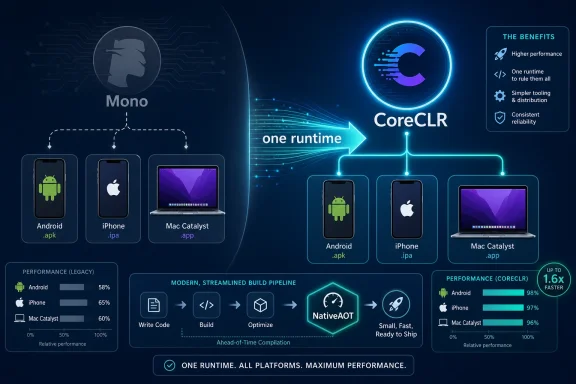
Microsoft said on May 13, 2026, that .NET MAUI apps targeting Android, iOS, and Mac Catalyst will run on CoreCLR by default starting with .NET 11 Preview 4, replacing Mono as the default mobile runtime after more than two decades of Xamarin-era lineage. The change is not just a runtime swap; it is Microsoft’s clearest signal yet that the modern .NET platform is finally becoming one platform in practice, not merely in branding. For MAUI developers, the promise is better performance, more consistent tooling, and a cleaner path to NativeAOT. For cautious teams, the subtext is just as important: another foundational piece of the Xamarin inheritance is being retired, and migration risk is now part of the .NET 11 story.
For years, .NET MAUI has lived with a split personality. Microsoft talked about “one .NET,” but mobile apps still carried the runtime DNA of Mono, the open-source project Miguel de Icaza began in 2001 to bring .NET beyond Windows. Mono was not a historical footnote; it was the reason C# became credible on iPhone and Android before Microsoft itself had a coherent cross-platform developer strategy.
That lineage matters because MAUI is Xamarin’s successor, not a clean-room invention. Xamarin.Forms became .NET MAUI, Xamarin.Android and Xamarin.iOS became .NET for Android and .NET for iOS, and the tooling was gradually folded into the broader .NET SDK. But underneath mobile and Mac Catalyst builds, Mono remained the runtime workhorse while CoreCLR powered the rest of the modern .NET world.
The .NET 11 change breaks that arrangement. Starting with Preview 4, Microsoft says CoreCLR becomes the default runtime for .NET MAUI applications on Android, iOS, and Mac Catalyst. Windows MAUI apps already used CoreCLR, so the move pulls mobile and Mac Catalyst into the same runtime family used by ASP.NET Core, desktop apps, cloud services, and much of Microsoft’s own production infrastructure.
That does not mean Mono disappears overnight. Developers can still opt back into Mono during the .NET 11 timeframe, and Blazor WebAssembly remains on Mono. But the default matters. Defaults are where ecosystems move, where bug reports concentrate, where templates point, and where Microsoft’s engineering attention becomes easiest to justify.
CoreCLR becoming the MAUI default is important because runtime differences are not cosmetic. A runtime controls garbage collection, diagnostics, JIT behavior where allowed, exception handling, reflection characteristics, assembly loading, and the low-level performance profile of an application. When different .NET workloads use different runtimes, developers may write one language and share libraries, but they still debug different beasts.
Microsoft’s argument is straightforward: the fewer runtime surfaces it has to support, the more consistent .NET becomes. A bug that reproduces across server, desktop, and mobile is easier to diagnose when it travels through the same runtime architecture. Performance work done for cloud services has a better chance of benefiting client apps. Tooling such as tracing and counters can become less platform-exception-heavy.
That is the strategic win. The practical win is that MAUI developers should be able to reason about mobile apps with fewer Xamarin-era caveats. The cost is that any app depending on Mono-specific behavior, undocumented runtime quirks, or delicate AOT/interpreter interactions may discover those dependencies the hard way.
Mono was the runtime that went where Microsoft would not. It ran .NET code on Linux when Microsoft’s official .NET story was still tied to Windows. It powered MonoTouch in 2009, MonoDroid after that, and eventually Xamarin’s commercial cross-platform mobile stack. Microsoft bought Xamarin in 2016 because the industry had already moved beyond Windows-first client development, and Xamarin had given C# developers a credible bridge to mobile.
That bridge was never purely technical. Mono carried a culture of portability, pragmatism, and survival under hostile platform constraints. Apple would not allow a conventional JIT on iOS devices. Android had its own runtime and packaging model. Mobile startup time, binary size, and platform binding layers imposed pressures that server-side .NET rarely faced in the same way.
CoreCLR on mobile is therefore not just CoreCLR dropped into a phone-shaped box. It is CoreCLR after years of absorbing mobile requirements that Mono had already learned through pain. When Microsoft says Mono’s DNA lives on in CoreCLR mobile support, that is not corporate nostalgia. It is a fair description of how platform engineering actually evolves.
CoreCLR brings the runtime machinery that modern .NET developers increasingly expect: tiered compilation where applicable, profile-guided optimization, ReadyToRun precompilation, and a mature diagnostics ecosystem. On Android, that should make release builds more competitive, particularly in startup-sensitive applications where users judge quality before the first screen has fully settled.
On iOS and Mac Catalyst, the story is more constrained because Apple’s platform rules limit dynamic code generation on devices. That means the runtime conversation inevitably intersects with ahead-of-time compilation, ReadyToRun images, interpreters, and NativeAOT. CoreCLR does not magically erase Apple’s restrictions, but it gives Microsoft a more unified place to invest in the compiler and runtime path.
For developers, this may be less about a single benchmark and more about fewer strange edges. MAUI’s reputation has suffered from the feeling that the stack can be powerful but fragile, especially when build tooling, platform SDKs, Visual Studio workloads, Xcode versions, and runtime behavior all collide. A unified runtime does not fix all of that. It does, however, remove one major axis of divergence.
NativeAOT changes the contract. Instead of shipping an app that relies on a full managed runtime with broad dynamic capabilities, developers compile code into a native binary with a smaller runtime footprint. That can improve startup and deployment characteristics, but it also exposes code patterns that depend heavily on reflection, dynamic loading, or late-bound behavior.
This is where MAUI’s future starts to look like the broader .NET future. Microsoft has been pushing trimming, AOT readiness, source generation, and reduced reflection across ASP.NET Core, libraries, and cloud-native workloads. Mobile apps are simply another place where the platform benefits from knowing more at build time and doing less at runtime.
The tradeoff is developer friction. Applications and third-party libraries that were written with a “the runtime will figure it out” mindset may need annotations, source generators, linker hints, or architectural changes. CoreCLR as the default runtime makes the path more consistent, but NativeAOT still asks developers to be more explicit about what their apps need.
The important phrase is for now. Platform defaults are rarely neutral. Once templates, documentation, samples, diagnostics, bug triage, and performance investments assume CoreCLR, Mono becomes the compatibility route rather than the forward route. That does not make it unsupported overnight, but it does change the social contract between Microsoft and MAUI developers.
For enterprise teams, the opt-out is valuable because mobile applications often sit in longer testing cycles than web services. A bank, retailer, logistics company, or medical-device-adjacent vendor may not be able to accept a runtime change simply because a new SDK says it is the default. The ability to stay on Mono while validating CoreCLR is the difference between a migration path and a forced march.
But the opt-out should not be mistaken for a reason to ignore the change. If CoreCLR is where Microsoft is going, teams should test it early, file bugs early, and identify Mono dependencies before the final .NET 11 release window closes. Waiting until the last servicing train is how runtime migrations become emergency projects.
The most immediate improvements should appear in release behavior, startup paths, and runtime compatibility with the rest of .NET. ReadyToRun and profile-guided optimization can help precompile hot code paths while avoiding a binary-size explosion. Dynamic PGO and tiered compilation, where available, give the runtime more ways to adapt code to actual execution.
There is a platform catch: .NET 11 raises the minimum supported Android API level for MAUI apps to Android 7.0, also known as API level 24. That is not shocking in 2026, but it is still a deployment consideration for organizations with old ruggedized devices, kiosks, scanners, or long-lived field hardware. Consumer developers may shrug; industrial developers may not.
The Android story, then, is a typical modernization bargain. Most apps should get a better runtime path and a more future-facing deployment model. A minority of apps tied to ancient devices or unusual runtime assumptions may need to stay on Mono temporarily while they plan hardware or OS upgrades.
CoreCLR becoming the default does not make Apple’s restrictions vanish. It means Microsoft is aligning the runtime architecture while continuing to use compilation strategies suited to the platform. On iOS and Mac Catalyst, that includes ReadyToRun and interpreter fallback in scenarios where not everything can be compiled the same way.
This is also where NativeAOT becomes especially attractive. If you already live in an AOT-heavy world because the platform demands it, a more unified and deliberate AOT story is a logical destination. The challenge is that Apple apps often depend on complex bindings, reflection-heavy frameworks, and platform-specific build chains, making every runtime transition feel more sensitive.
Mac Catalyst adds another layer of ambiguity. It gives developers a path to bring iPad-style apps to macOS, but it is not the same as building a fully native AppKit or SwiftUI Mac application. MAUI’s value proposition is shared C# and shared UI logic across platforms; CoreCLR may strengthen the runtime foundation, but it does not erase the product-design compromises inherent in cross-platform UI.
The community’s frustration has often centered less on the concept and more on the seams. Developers have complained about tooling reliability, platform-specific bugs, build breakage, workload installation issues, and delays between native SDK changes and smooth MAUI support. Some of that is inevitable in a cross-platform stack; some of it reflects Microsoft trying to rebuild Xamarin’s world inside the modern .NET SDK while the train is moving.
CoreCLR does not solve the UI abstraction problem. It does not decide whether a team should use MAUI instead of native SwiftUI and Kotlin. It does not make Mac Catalyst feel like a hand-crafted Mac app. It does not make every NuGet package trim-safe or AOT-friendly.
What it does is give MAUI a stronger platform story. If Microsoft can say that MAUI apps run on the same runtime foundation as the rest of .NET, use more of the same diagnostics, and share more performance engineering with server and desktop workloads, then MAUI looks less like a Xamarin compatibility island and more like a serious part of .NET’s future.
Teams should test serialization paths, reflection-heavy code, dependency injection startup, dynamic proxies, third-party controls, platform bindings, background services, push notification handlers, secure storage, database initialization, and crash reporting. Anything that touches startup, reflection, native interop, or linker behavior deserves special attention. The more an app leans on older Xamarin-era libraries, the more carefully it should be validated.
Build pipelines also matter. A runtime change is not just what happens on a device; it changes what the SDK produces, how packages are assembled, how symbols and diagnostics behave, and how release builds differ from debug builds. Continuous integration systems that build Android and iOS packages should be tested with .NET 11 previews before the final release pressure arrives.
The best migration posture is boring: create a branch, move to the preview SDK in a controlled environment, compare Mono and CoreCLR builds, test real devices, and record differences before deciding whether to opt out temporarily. The worst posture is assuming that because the app compiles, the runtime migration is complete.
Some incompatibilities may be mundane: different exception timing, different startup characteristics, different diagnostic output, or altered behavior in obscure reflection scenarios. Others may be more expensive, especially if a commercial control vendor or abandoned library has to adapt. A runtime transition is only as smooth as the dependency graph beneath the app.
There is also the question of app size. Microsoft’s own documentation has suggested that CoreCLR may bring a reasonable size increase in some scenarios, even as it improves compatibility and startup. For many apps, that will be an acceptable trade. For markets where download size, low-end devices, or constrained connectivity matter, it needs measurement rather than faith.
Still, these are the right problems for Microsoft to be solving. A cross-platform framework cannot remain healthy if its mobile runtime path is permanently separate from the rest of .NET. The pain of convergence is real, but the cost of never converging would be worse.
WebAssembly imposes its own constraints, just as iOS does. The browser sandbox, download size, startup time, and WebAssembly runtime model make the tradeoffs different from server, desktop, or mobile apps. Mono has historically been well suited to that environment because of its footprint and portability work.
So Microsoft’s “one runtime” story remains qualified. CoreCLR is becoming the default across nearly all .NET 11 workloads, but not literally all of them. That nuance matters because developers have heard sweeping unification claims before, only to discover platform-specific exceptions buried in the details.
The difference now is that the exception list is shrinking. MAUI moving to CoreCLR removes one of the biggest remaining divides in mainstream .NET application development. Blazor WebAssembly may remain a special case, but mobile no longer has to be.
For WindowsForum readers, the comparison to Windows itself is familiar. Microsoft has spent decades learning that compatibility layers are both a superpower and a tax. They let old software keep running, but they also preserve old assumptions long after the platform wants to move on. Xamarin-era Mono support in MAUI has been useful in exactly that way.
CoreCLR as the default is Microsoft choosing to pay down that tax. The move should help Microsoft focus runtime engineering around a smaller number of execution models, even if mobile platforms still require different compilation strategies. It also gives third-party library authors a clearer target: modern .NET behavior first, compatibility exceptions second.
That clarity is not glamorous, but it is what mature developer platforms need. The best runtime is the one developers do not have to think about until they are optimizing, diagnosing, or doing something unusual. MAUI has too often forced developers to think about the runtime for the wrong reasons.
Source: Thurrott.com Microsoft is Moving .NET MAUI to CoreCLR Runtime in .NET 11
 Microsoft Finally Takes the Xamarin Runtime Out of the Critical Path
For years, .NET MAUI has lived with a split personality. Microsoft talked about “one .NET,” but mobile apps still carried the runtime DNA of Mono, the open-source project Miguel de Icaza began in 2001 to bring .NET beyond Windows. Mono was not a historical footnote; it was the reason C# became credible on iPhone and Android before Microsoft itself had a coherent cross-platform developer strategy.That lineage matters because MAUI is Xamarin’s successor, not a clean-room invention. Xamarin.Forms became .NET MAUI, Xamarin.Android and Xamarin.iOS became .NET for Android and .NET for iOS, and the tooling was gradually folded into the broader .NET SDK. But underneath mobile and Mac Catalyst builds, Mono remained the runtime workhorse while CoreCLR powered the rest of the modern .NET world.
The .NET 11 change breaks that arrangement. Starting with Preview 4, Microsoft says CoreCLR becomes the default runtime for .NET MAUI applications on Android, iOS, and Mac Catalyst. Windows MAUI apps already used CoreCLR, so the move pulls mobile and Mac Catalyst into the same runtime family used by ASP.NET Core, desktop apps, cloud services, and much of Microsoft’s own production infrastructure.
That does not mean Mono disappears overnight. Developers can still opt back into Mono during the .NET 11 timeframe, and Blazor WebAssembly remains on Mono. But the default matters. Defaults are where ecosystems move, where bug reports concentrate, where templates point, and where Microsoft’s engineering attention becomes easiest to justify.
The “One .NET” Slogan Gets a Runtime Beneath It
Microsoft has spent the better part of a decade unifying .NET after the fragmentation of .NET Framework, .NET Core, Xamarin, Mono, UWP, and assorted platform-specific stacks. The branding got there first. The architecture has been catching up ever since.CoreCLR becoming the MAUI default is important because runtime differences are not cosmetic. A runtime controls garbage collection, diagnostics, JIT behavior where allowed, exception handling, reflection characteristics, assembly loading, and the low-level performance profile of an application. When different .NET workloads use different runtimes, developers may write one language and share libraries, but they still debug different beasts.
Microsoft’s argument is straightforward: the fewer runtime surfaces it has to support, the more consistent .NET becomes. A bug that reproduces across server, desktop, and mobile is easier to diagnose when it travels through the same runtime architecture. Performance work done for cloud services has a better chance of benefiting client apps. Tooling such as tracing and counters can become less platform-exception-heavy.
That is the strategic win. The practical win is that MAUI developers should be able to reason about mobile apps with fewer Xamarin-era caveats. The cost is that any app depending on Mono-specific behavior, undocumented runtime quirks, or delicate AOT/interpreter interactions may discover those dependencies the hard way.
Mono Won the War by Making Itself Replaceable
It is tempting to read this as a demotion for Mono, but that misses the historical irony. Mono succeeded so completely that Microsoft can now absorb its lessons into CoreCLR and make Mono less central to mainstream .NET application development.Mono was the runtime that went where Microsoft would not. It ran .NET code on Linux when Microsoft’s official .NET story was still tied to Windows. It powered MonoTouch in 2009, MonoDroid after that, and eventually Xamarin’s commercial cross-platform mobile stack. Microsoft bought Xamarin in 2016 because the industry had already moved beyond Windows-first client development, and Xamarin had given C# developers a credible bridge to mobile.
That bridge was never purely technical. Mono carried a culture of portability, pragmatism, and survival under hostile platform constraints. Apple would not allow a conventional JIT on iOS devices. Android had its own runtime and packaging model. Mobile startup time, binary size, and platform binding layers imposed pressures that server-side .NET rarely faced in the same way.
CoreCLR on mobile is therefore not just CoreCLR dropped into a phone-shaped box. It is CoreCLR after years of absorbing mobile requirements that Mono had already learned through pain. When Microsoft says Mono’s DNA lives on in CoreCLR mobile support, that is not corporate nostalgia. It is a fair description of how platform engineering actually evolves.
Performance Is the Selling Point, but Predictability May Be the Prize
Microsoft is pitching the move around three themes: a single runtime across most .NET 11 workloads, improved performance, and broader NativeAOT availability. Performance will get the headlines because it is easy to understand and easier to market. But predictability may be the bigger long-term payoff.CoreCLR brings the runtime machinery that modern .NET developers increasingly expect: tiered compilation where applicable, profile-guided optimization, ReadyToRun precompilation, and a mature diagnostics ecosystem. On Android, that should make release builds more competitive, particularly in startup-sensitive applications where users judge quality before the first screen has fully settled.
On iOS and Mac Catalyst, the story is more constrained because Apple’s platform rules limit dynamic code generation on devices. That means the runtime conversation inevitably intersects with ahead-of-time compilation, ReadyToRun images, interpreters, and NativeAOT. CoreCLR does not magically erase Apple’s restrictions, but it gives Microsoft a more unified place to invest in the compiler and runtime path.
For developers, this may be less about a single benchmark and more about fewer strange edges. MAUI’s reputation has suffered from the feeling that the stack can be powerful but fragile, especially when build tooling, platform SDKs, Visual Studio workloads, Xcode versions, and runtime behavior all collide. A unified runtime does not fix all of that. It does, however, remove one major axis of divergence.
NativeAOT Turns From Side Quest Into Strategy
NativeAOT is the other half of this announcement, and it may ultimately matter more than CoreCLR branding. In a world where app stores, mobile hardware, and cloud deployment all reward fast startup and smaller runtime overhead, compiling more of the application ahead of time is an obvious direction.NativeAOT changes the contract. Instead of shipping an app that relies on a full managed runtime with broad dynamic capabilities, developers compile code into a native binary with a smaller runtime footprint. That can improve startup and deployment characteristics, but it also exposes code patterns that depend heavily on reflection, dynamic loading, or late-bound behavior.
This is where MAUI’s future starts to look like the broader .NET future. Microsoft has been pushing trimming, AOT readiness, source generation, and reduced reflection across ASP.NET Core, libraries, and cloud-native workloads. Mobile apps are simply another place where the platform benefits from knowing more at build time and doing less at runtime.
The tradeoff is developer friction. Applications and third-party libraries that were written with a “the runtime will figure it out” mindset may need annotations, source generators, linker hints, or architectural changes. CoreCLR as the default runtime makes the path more consistent, but NativeAOT still asks developers to be more explicit about what their apps need.
The Opt-Out Is a Safety Valve, Not a Reversal
Microsoft is leaving an escape hatch. Developers who need Mono in .NET 11 can opt back in with a project property, at least for now. That is sensible engineering and careful ecosystem management.The important phrase is for now. Platform defaults are rarely neutral. Once templates, documentation, samples, diagnostics, bug triage, and performance investments assume CoreCLR, Mono becomes the compatibility route rather than the forward route. That does not make it unsupported overnight, but it does change the social contract between Microsoft and MAUI developers.
For enterprise teams, the opt-out is valuable because mobile applications often sit in longer testing cycles than web services. A bank, retailer, logistics company, or medical-device-adjacent vendor may not be able to accept a runtime change simply because a new SDK says it is the default. The ability to stay on Mono while validating CoreCLR is the difference between a migration path and a forced march.
But the opt-out should not be mistaken for a reason to ignore the change. If CoreCLR is where Microsoft is going, teams should test it early, file bugs early, and identify Mono dependencies before the final .NET 11 release window closes. Waiting until the last servicing train is how runtime migrations become emergency projects.
Android Gets the Cleanest Win
Android is likely to be the most straightforward beneficiary. Unlike iOS devices, Android allows JIT compilation, and the packaging model gives Microsoft more room to use CoreCLR’s strengths directly. .NET 10 already exposed CoreCLR on Android as an experimental option, so .NET 11 making it the default is a graduation rather than a surprise.The most immediate improvements should appear in release behavior, startup paths, and runtime compatibility with the rest of .NET. ReadyToRun and profile-guided optimization can help precompile hot code paths while avoiding a binary-size explosion. Dynamic PGO and tiered compilation, where available, give the runtime more ways to adapt code to actual execution.
There is a platform catch: .NET 11 raises the minimum supported Android API level for MAUI apps to Android 7.0, also known as API level 24. That is not shocking in 2026, but it is still a deployment consideration for organizations with old ruggedized devices, kiosks, scanners, or long-lived field hardware. Consumer developers may shrug; industrial developers may not.
The Android story, then, is a typical modernization bargain. Most apps should get a better runtime path and a more future-facing deployment model. A minority of apps tied to ancient devices or unusual runtime assumptions may need to stay on Mono temporarily while they plan hardware or OS upgrades.
Apple Platforms Remain the Hard Mode for Managed Code
iOS and Mac Catalyst are more complicated because Apple’s platform rules make managed runtimes live differently. On physical iOS devices, apps cannot depend on a normal JIT workflow. That has always forced Xamarin, Mono, and now .NET for iOS into ahead-of-time compilation strategies that look unlike desktop .NET.CoreCLR becoming the default does not make Apple’s restrictions vanish. It means Microsoft is aligning the runtime architecture while continuing to use compilation strategies suited to the platform. On iOS and Mac Catalyst, that includes ReadyToRun and interpreter fallback in scenarios where not everything can be compiled the same way.
This is also where NativeAOT becomes especially attractive. If you already live in an AOT-heavy world because the platform demands it, a more unified and deliberate AOT story is a logical destination. The challenge is that Apple apps often depend on complex bindings, reflection-heavy frameworks, and platform-specific build chains, making every runtime transition feel more sensitive.
Mac Catalyst adds another layer of ambiguity. It gives developers a path to bring iPad-style apps to macOS, but it is not the same as building a fully native AppKit or SwiftUI Mac application. MAUI’s value proposition is shared C# and shared UI logic across platforms; CoreCLR may strengthen the runtime foundation, but it does not erase the product-design compromises inherent in cross-platform UI.
MAUI Needed a Confidence Story as Much as a Runtime Story
.NET MAUI has always had a difficult job. It tries to be the successor to Xamarin.Forms, the cross-platform UI stack for C# developers, the Windows app story for some teams, and the mobile bridge for shops that do not want separate Swift, Kotlin, and Windows codebases. That is a lot of expectations for one framework.The community’s frustration has often centered less on the concept and more on the seams. Developers have complained about tooling reliability, platform-specific bugs, build breakage, workload installation issues, and delays between native SDK changes and smooth MAUI support. Some of that is inevitable in a cross-platform stack; some of it reflects Microsoft trying to rebuild Xamarin’s world inside the modern .NET SDK while the train is moving.
CoreCLR does not solve the UI abstraction problem. It does not decide whether a team should use MAUI instead of native SwiftUI and Kotlin. It does not make Mac Catalyst feel like a hand-crafted Mac app. It does not make every NuGet package trim-safe or AOT-friendly.
What it does is give MAUI a stronger platform story. If Microsoft can say that MAUI apps run on the same runtime foundation as the rest of .NET, use more of the same diagnostics, and share more performance engineering with server and desktop workloads, then MAUI looks less like a Xamarin compatibility island and more like a serious part of .NET’s future.
Developers Should Test Behavior, Not Just Benchmarks
The temptation after a runtime announcement is to run a sample app, measure startup, and declare victory or doom. That is useful but insufficient. Runtime changes can affect correctness in ways benchmarks never catch.Teams should test serialization paths, reflection-heavy code, dependency injection startup, dynamic proxies, third-party controls, platform bindings, background services, push notification handlers, secure storage, database initialization, and crash reporting. Anything that touches startup, reflection, native interop, or linker behavior deserves special attention. The more an app leans on older Xamarin-era libraries, the more carefully it should be validated.
Build pipelines also matter. A runtime change is not just what happens on a device; it changes what the SDK produces, how packages are assembled, how symbols and diagnostics behave, and how release builds differ from debug builds. Continuous integration systems that build Android and iOS packages should be tested with .NET 11 previews before the final release pressure arrives.
The best migration posture is boring: create a branch, move to the preview SDK in a controlled environment, compare Mono and CoreCLR builds, test real devices, and record differences before deciding whether to opt out temporarily. The worst posture is assuming that because the app compiles, the runtime migration is complete.
The Risk Is Concentrated in the Edges Microsoft Wants to Remove
The most fragile apps will be those that depend on the very differences Microsoft is trying to eliminate. That includes code that unknowingly relies on Mono-specific behavior, libraries that were never tested outside Xamarin assumptions, or mobile workflows that made peace with old runtime limitations rather than documenting them.Some incompatibilities may be mundane: different exception timing, different startup characteristics, different diagnostic output, or altered behavior in obscure reflection scenarios. Others may be more expensive, especially if a commercial control vendor or abandoned library has to adapt. A runtime transition is only as smooth as the dependency graph beneath the app.
There is also the question of app size. Microsoft’s own documentation has suggested that CoreCLR may bring a reasonable size increase in some scenarios, even as it improves compatibility and startup. For many apps, that will be an acceptable trade. For markets where download size, low-end devices, or constrained connectivity matter, it needs measurement rather than faith.
Still, these are the right problems for Microsoft to be solving. A cross-platform framework cannot remain healthy if its mobile runtime path is permanently separate from the rest of .NET. The pain of convergence is real, but the cost of never converging would be worse.
Blazor WebAssembly Shows the Unification Is Still Incomplete
There is one conspicuous holdout: Blazor WebAssembly continues to use Mono. That is not a small exception, because WebAssembly is one of .NET’s most important client-side bets. It also illustrates why runtime unification is a direction, not a completed state.WebAssembly imposes its own constraints, just as iOS does. The browser sandbox, download size, startup time, and WebAssembly runtime model make the tradeoffs different from server, desktop, or mobile apps. Mono has historically been well suited to that environment because of its footprint and portability work.
So Microsoft’s “one runtime” story remains qualified. CoreCLR is becoming the default across nearly all .NET 11 workloads, but not literally all of them. That nuance matters because developers have heard sweeping unification claims before, only to discover platform-specific exceptions buried in the details.
The difference now is that the exception list is shrinking. MAUI moving to CoreCLR removes one of the biggest remaining divides in mainstream .NET application development. Blazor WebAssembly may remain a special case, but mobile no longer has to be.
Microsoft’s Real Bet Is on Fewer Places for Bugs to Hide
The strongest argument for this change is not that CoreCLR is newer than Mono or that Microsoft prefers tidy diagrams. It is that runtime fragmentation creates places for bugs to hide. Every separate runtime path means separate assumptions, separate optimization work, separate diagnostics gaps, and separate issue queues.For WindowsForum readers, the comparison to Windows itself is familiar. Microsoft has spent decades learning that compatibility layers are both a superpower and a tax. They let old software keep running, but they also preserve old assumptions long after the platform wants to move on. Xamarin-era Mono support in MAUI has been useful in exactly that way.
CoreCLR as the default is Microsoft choosing to pay down that tax. The move should help Microsoft focus runtime engineering around a smaller number of execution models, even if mobile platforms still require different compilation strategies. It also gives third-party library authors a clearer target: modern .NET behavior first, compatibility exceptions second.
That clarity is not glamorous, but it is what mature developer platforms need. The best runtime is the one developers do not have to think about until they are optimizing, diagnosing, or doing something unusual. MAUI has too often forced developers to think about the runtime for the wrong reasons.
The .NET 11 MAUI Shift Leaves Developers With a Short Checklist
The big strategic arc is Microsoft moving MAUI out of Xamarin’s runtime shadow and into the CoreCLR mainstream. The immediate job for developers is more practical: test early, measure honestly, and decide whether the opt-out is a temporary bridge or an unnecessary delay.- Teams shipping .NET MAUI apps should validate .NET 11 Preview 4 or later on real Android, iOS, and Mac Catalyst targets before assuming CoreCLR is a drop-in change.
- Developers with older Android device fleets should confirm the Android 7.0 minimum requirement and identify whether any API 21-to-23 deployments still matter.
- Apps that rely on reflection, dynamic code paths, serializers, dependency injection containers, or older Xamarin-era libraries should receive extra compatibility testing under CoreCLR and NativeAOT scenarios.
- Build engineers should compare debug and release behavior because runtime and compilation strategy differences often appear only in publish-ready packages.
- Mono opt-out should be treated as a migration valve for .NET 11, not as a long-term strategy unless Microsoft later commits to keeping that path equally central.
Source: Thurrott.com Microsoft is Moving .NET MAUI to CoreCLR Runtime in .NET 11
