

 New Jersey’s S1677 Would Put Tesla’s Driverless Strategy Behind a Higher Gate
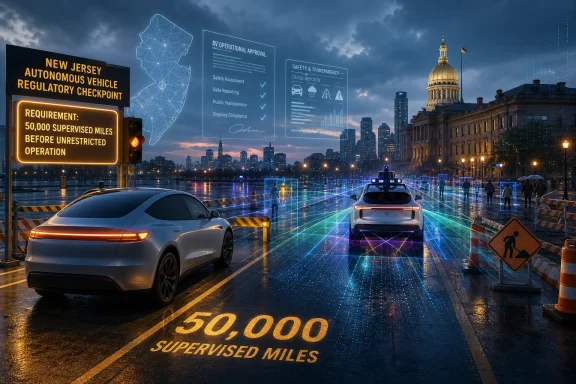
New Jersey’s S1677 would establish a three-year autonomous-vehicle pilot requiring fully driverless commercial vehicles to use cameras plus two additional sensing technologies, complete at least 50,000 miles of supervised in-state testing, report every crash, and obtain state authorization before carrying passengers without a driver. The proposal is company-neutral, but its reported practical effect would favor the multimodal sensor architectures used by Waymo and Zoox while requiring Tesla to change its camera-only approach before launching a qualifying driverless commercial service in New Jersey.The immediate takeaway: S1677 would not switch off Autopilot or FSD; it would make a fully driverless Tesla commercial service in New Jersey unlikely unless Tesla adds non-camera sensing, completes 50,000 supervised in-state miles, and gets approval.
New Jersey Is Regulating Architecture, Not Branding
Electrek framed S1677 as legislation that would effectively block Tesla’s current camera-only Robotaxi design while leaving Waymo’s architecture eligible for approval. That describes the bill’s reported practical effect, not its formal target: the legislation does not name Tesla, and satisfying its hardware requirements would not guarantee any company authorization to operate.The crucial provision requires fully autonomous commercial vehicles to carry a camera system and two distinct sensing modalities capable of detecting and tracking obstacles if the camera system fails.
The requirement does not necessarily mean that the additional modalities must be radar and lidar. In the current autonomous-vehicle market, however, radar and lidar are the most obvious practical interpretation, and they are the technologies identified in reporting about the proposal. Waymo and Zoox already combine cameras, radar, and lidar, while Tesla has made camera-based perception central to its autonomous-driving strategy.
That distinction matters because conventional vehicle regulation often specifies an outcome: a vehicle must stop within a certain distance, protect occupants in a crash, illuminate the roadway, or meet an emissions limit. S1677 goes further into the design stack by establishing that one class of sensor should not serve as the sole perception basis for an unmanned commercial driving system.
Tesla can reasonably describe that approach as technologically prescriptive. New Jersey can answer that a vehicle operating without a human fallback should have a way to perceive hazards when glare, contamination, damage, weather, or another optical problem degrades its cameras.
State Senator Andrew Zwicker, the bill’s sponsor, has offered a direct explanation of his position: “This is not anti-Tesla. I’m pro-New Jersey safety.” Zwicker is a physicist at the Princeton Plasma Physics Laboratory, and he reportedly sponsored the measure after riding in a Waymo in Phoenix.
The experience appears to have persuaded him that driverless deployment should proceed through extensively tested systems, redundant sensing, and a defined regulatory framework. Whether that framework is appropriately cautious or unnecessarily restrictive is the central policy dispute.
The Pilot Is a Gate, Not a Free Pass
The phrase pilot program can make S1677 sound like an open invitation to autonomous-vehicle developers. In practice, it would create an admission process with several gates intended to prevent a company from moving directly from limited demonstrations to an unsupervised commercial network.The program would run for three years. Before removing a human safety driver, an operator would have to complete at least 50,000 miles of supervised testing on New Jersey roads within the vehicle’s intended operating environment.
That local requirement is more significant than the raw mileage suggests. A company could not point only to testing conducted in Phoenix, California, Texas, or another market and argue that the accumulated experience transfers automatically to New Jersey. It would have to generate evidence in the state where it wants to operate, exposing its system to local roads, traffic patterns, construction practices, pedestrians, cyclists, emergency vehicles, and seasonal conditions.
The requirement also pushes operators to define what their vehicles are designed to handle. An autonomous-driving system may work within a limited operational domain—particular roads, speeds, weather conditions, or times of day—without being capable of driving everywhere under all circumstances. S1677 would make that boundary relevant to the authorization process instead of leaving it entirely to the developer.
After supervised testing, commercial service would still not be automatic. Operators would need official authorization before launching a driverless network, giving the state an opportunity to evaluate the safety case rather than treating a manufacturer’s declaration of readiness as the final word.
The legislation also requires every crash to be reported. That obligation could help regulators identify patterns that might remain hidden when incidents are evaluated individually, although the usefulness of the resulting record would depend on consistent reporting and meaningful state review.
The bill’s basic regulatory position is clear: fully driverless commercial operation would be permitted only after supervised in-state evidence, administrative review, and continuing compliance.
The Sensor Clause Converts a Technical Argument Into an Eligibility Rule
Tesla’s disagreement with radar and lidar is not a minor component decision. It is tied to the economics, training strategy, manufacturing model, and public narrative of the company’s autonomous-driving program.Cameras produce rich visual information. They can identify lane markings, traffic lights, signs, vehicle types, pedestrians, gestures, road debris, and the many semantic details that matter in driving. Tesla’s argument is that sufficiently capable software can extract the information needed to drive from camera feeds without requiring a more expensive suite of sensors.
The commercial attraction is obvious. Cameras are comparatively inexpensive, are already fitted to Tesla’s high-volume consumer fleet, and can collect enormous quantities of real-world driving data. A shared camera-based hardware platform also allows Tesla to pursue autonomy without building a completely separate sensor stack for a geographically limited robotaxi fleet.
Radar and lidar provide different kinds of information. Radar uses radio waves to measure distance and relative motion and can remain useful in some conditions that impair visible-light cameras. Lidar actively measures the surrounding environment to produce detailed spatial information rather than requiring software to infer all depth and structure from images.
No sensor is infallible. Cameras, radar, and lidar each have limitations, and combining them creates additional engineering work involving calibration, synchronization, maintenance, conflicting readings, computational demand, and cost.
That is the foundation of Tesla’s strongest objection. Sensor fusion is not automatically safe merely because more hardware is present. A poorly integrated three-sensor system could perform worse than a highly developed camera system, while a rigid mandate could lock today’s preferred architecture into law even if another technology eventually demonstrates comparable safety.
New Jersey’s counterargument concerns independent failure paths. If a visual condition degrades the primary camera system, additional cameras may encounter the same condition. A distinct sensing modality observes the environment through different physical principles, reducing the possibility that one type of interference compromises the entire perception stack.
| Operator or vehicle | Reported sensing approach | Reported practical fit with S1677’s sensor rule | Traditional-controls consideration | Reported deployment scale |
|---|---|---|---|---|
| Tesla Robotaxi strategy | Camera-based | Would likely require additional sensing modalities for a qualifying New Jersey service | Existing Tesla vehicles retain conventional controls | Unsupervised public-road test vehicles are mainly in Texas |
| Tesla Cybercab | Camera-based strategy | Would likely require additional sensing modalities for a qualifying New Jersey service | Designed without a steering wheel or pedals, creating a separate potential issue under a framework favoring traditional controls | Intended as a purpose-built autonomous vehicle |
| Waymo | Cameras, radar, and lidar | Its existing sensor architecture appears aligned with the proposed model, subject to testing and approval | Not identified as the central reported obstacle | More than 3,500 driverless vehicles across 11 US metro areas |
| Zoox | Cameras, radar, and lidar | Its existing sensor architecture appears aligned with the proposed model, subject to testing and approval | Not identified as the central reported obstacle | No fleet figure established in the cited reporting |
Redundancy Is Sensible, but It Is Not the Same as Proof
SAVE-US, the autonomous-vehicle safety nonprofit whose recommendations Electrek says are reflected in the framework, argues that robotaxis should use a mix of sensing technologies. Its case is particularly focused on taxis because they would operate repeatedly in public spaces where passengers, pedestrians, cyclists, emergency workers, and other drivers cannot choose whether to participate in the experiment.That argument has intuitive force. When a human is no longer responsible for driving, the automated system must manage degraded perception and other failures without depending on ordinary driver intervention.
Hardware redundancy should not, however, become a substitute for performance evidence. A vehicle can have cameras, radar, and lidar and still make an unsafe prediction, plan a bad path, misclassify an object, become immobilized in traffic, violate a rule, or respond poorly to an unusual scene. Perception is only one layer of autonomous driving; prediction, planning, control, maintenance, cybersecurity, and fleet operations also affect safety.
The strongest formulation of S1677 is therefore not that lidar or any other individual sensor makes a robotaxi safe. It is that a fully driverless commercial vehicle should not depend on a single sensing modality, and that multimodal perception should be combined with supervised local testing, crash reporting, authorization, and continuing oversight.
That distinction is important because otherwise the legislation risks creating a checklist that can be satisfied on paper without improving real-world operation. A company might install nominally distinct sensors without demonstrating that the automated-driving system uses them meaningfully, monitors their condition, reconciles contradictory data, and reacts safely when one modality becomes unavailable.
A serious implementation regime should examine complete system behavior rather than count devices on a specification sheet. Regulators should ask whether the vehicle can recognize degraded sensing, whether the remaining systems provide useful independent information, and whether the vehicle’s response avoids creating a new hazard.
The useful question is not simply how many sensors are present. It is whether the vehicle has credible, independently testable ways to recognize danger and respond safely when part of the system fails.
Tesla’s Cost Model Collides With New Jersey’s Redundancy Standard
Tesla’s camera-centered strategy promises significant economic leverage. If autonomous operation can be delivered through cameras, computing, and software designed for mass-produced vehicles, the company could avoid some of the expense and complexity associated with specialized robotaxi sensor suites.That approach is central to the Cybercab concept. Tesla is not proposing merely to operate a conventional car without a driver. It is attempting to build a purpose-designed vehicle whose hardware and operating costs could make autonomous transportation cheaper and easier to scale.
New Jersey is evaluating the same design choice from a different perspective. The absence of additional sensing modalities is treated not simply as elegant simplification but as a potentially concentrated source of failure. What Tesla presents as the removal of unnecessary components, the bill treats as the absence of independent environmental information.
This is the article’s essential technical-policy divide: Tesla wants camera-only autonomy judged by demonstrated performance, while S1677 would require a minimum level of sensor diversity before that performance can be considered for driverless commercial authorization.
The dispute cannot be resolved by analogy to human vision. Humans do not drive through a fixed set of external cameras feeding an automated-driving model, and human perception includes head movement, binocular vision, hearing, balance, context, experience, and reasoning about unfamiliar hazards. Humans also crash frequently, making ordinary human performance an unambitious final benchmark for technology promoted as a safer replacement.
Nor can the question be settled through a dramatic one-off demonstration. A staged example can expose a possible weakness, but it cannot establish that every implementation of one architecture is unsafe or that every vehicle using another architecture is safe.
The decisive evidence must come from repeatable testing, transparent crash information, validated failure cases, and sustained deployment. Tesla’s challenge is that its ambitions remain far ahead of its demonstrated unsupervised public-road footprint.
Scale Is Where Hidden Engineering Debt Comes Due
Philip Koopman, an engineering professor at Carnegie Mellon, has emphasized the difference between operating approximately 100 vehicles and operating 10,000. A system that appears workable in a relatively small deployment can reveal different engineering and operational problems after a dramatic increase in fleet size.Small fleets encounter fewer rare events. They cover fewer road configurations, weather combinations, unusual objects, hardware failures, emergency scenes, and interactions with confused human road users. They can also receive unusually intensive maintenance, monitoring, and operational attention.
Expansion changes the practical risk equation. A failure that is extremely rare on a per-mile basis may remain invisible during a restricted trial, then become a recurring fleet-management issue when thousands of vehicles operate throughout the day.
Waymo’s reported deployment of more than 3,500 driverless vehicles across 11 US metro areas does not prove that its system can operate on every New Jersey road or in every condition. It does provide a larger operational evidence base than a limited test program.
Tesla’s unsupervised public-road test vehicles are mainly in Texas, according to Electrek, while Elon Musk has stated a goal of putting hundreds of thousands of autonomous Teslas on the road by the end of 2026. The gap between the present footprint and that stated goal is not merely a question of geographic expansion. It is a gap between an industrial-scale promise and the evidence available to regulators deciding whether the system should operate without a responsible driver.
That makes S1677 more than an obstacle placed in front of an otherwise mature statewide network. Tesla would still have to demonstrate reliable operation and fleet-scale management in jurisdictions with fewer restrictions. Permissive regulation can create an opportunity to deploy, but it cannot by itself produce a safe, scalable service.
Regulation can slow expansion, increase costs, and advantage companies that have already invested in specialized fleets. It does not fully explain why a developer has yet to demonstrate large-scale unsupervised operation in markets where testing and deployment are already taking place.
The 50,000-Mile Rule Forces the Evidence to Become Local
The supervised-mileage requirement may prove as consequential as the sensor mandate. Tesla could theoretically add hardware to a New Jersey-specific fleet, but it could not bypass the obligation to accumulate at least 50,000 supervised miles on public roads in the state before removing the driver.For established operators, this would be a costly but understandable validation phase. For a company pursuing rapid mass deployment, it imposes a sequence: conduct supervised testing first, document performance, seek approval, and only then begin driverless commercial operations.
The rule also limits the value of broad national mileage totals. Autonomous developers often present large aggregate figures, but miles driven in one operational domain do not answer every question about another. A clear, dry, mapped route in a relatively predictable service area is not interchangeable with an unfamiliar road under different weather, traffic, and infrastructure conditions.
Local testing could reveal whether the system handles New Jersey road layouts, construction zones, traffic patterns, and seasonal conditions within its proposed service area. It would also give state officials and communities an opportunity to observe the fleet before passengers are carried without a driver.
Mileage remains an imperfect proxy for safety. Fifty thousand uneventful miles on easy roads can be less informative than a smaller set of carefully designed tests targeting known failure modes. An operator could theoretically accumulate mileage under favorable conditions while minimizing exposure to the scenarios most likely to reveal weaknesses.
The state should therefore treat 50,000 miles as an entry threshold, not conclusive proof. The distribution, difficulty, and relevance of those miles matter alongside the odometer total.
Cybercab Faces a Separate Traditional-Controls Question
Even if Tesla resolved the sensor dispute, the Cybercab’s physical design could encounter another obstacle. S1677 favors traditional controls such as steering wheels and pedals, while the Cybercab is designed without them.That absence is central to the vehicle’s purpose: it is intended as fully autonomous transportation, not as a conventional automobile waiting for its software to mature.
New Jersey’s proposal appears to favor a more gradual transition in which vehicles retain familiar physical controls while an operator establishes a safety record through supervised testing. The reported facts do not establish every operational requirement that regulators would apply to a control-free vehicle, so the precise effect would depend on the final bill text and implementation.
Still, the design conflict is apparent. A vehicle built around eliminating traditional controls does not naturally fit a pilot framework that favors retaining them.
The Cybercab therefore embodies a product bet that regulators will accept vehicles designed from the beginning without steering wheels or pedals. S1677 signals that New Jersey lawmakers are not yet prepared to make that assumption during the proposed pilot.
Tesla’s Owner Campaign Turned a Fleet Bill Into a Consumer Panic
Tesla responded to the legislation through direct-to-owner lobbying, warning New Jersey customers that the proposed framework could prevent driverless deployment. The campaign generated roughly 4,000 protest emails to Zwicker’s office in a single day.Mobilizing customers is not inherently improper. Tesla owners have an interest in transportation policy, and the company is entitled to argue that S1677 favors one engineering architecture and could suppress innovation.
The problem was confusion over what the bill would regulate. Many owners reportedly feared that New Jersey was preparing to disable or prohibit driver-assistance features in vehicles they already owned.
According to Zwicker, that fear was misplaced. The provisions at the center of the dispute concern fully driverless commercial fleets, not consumer features such as Autopilot and Full Self-Driving, which still require a licensed driver to monitor the vehicle.
That distinction should have been central to the public debate. A supervised driver-assistance feature and a commercial vehicle operating without a responsible driver create different safety, liability, reporting, and oversight questions.
By allowing those categories to blur, Tesla gained a larger protest response but weakened its substantive case. The campaign made it easier for supporters of S1677 to argue that consumer anxiety was being used against rules for a commercial service Tesla had not yet deployed at substantial scale.
It also exposed a persistent problem in autonomous-driving terminology. Product names and marketing language can suggest greater capability than a system’s legal and operational status. When owners cannot readily tell whether a robotaxi proposal applies to software in their personal vehicles, policymakers are likely to scrutinize the language surrounding that software more closely.
Autopilot and Full Self-Driving Are Not Being Switched Off
For current Tesla owners in New Jersey, the immediate practical point is straightforward: S1677 is not described as a ban on owning or driving a Tesla, and it does not target the continued use of Autopilot or Full Self-Driving as supervised consumer features.A licensed driver would remain responsible for monitoring the road and intervening when necessary. That human responsibility is why those products are distinct from the fully driverless commercial services at the center of the proposal.
Tesla’s long-term strategy relies on eventually crossing that boundary. The company wants technology developed through its consumer fleet to support unsupervised operation and commercial ride service. S1677 would make the crossing subject to a different regulatory regime involving additional sensing modalities, local testing, crash reporting, state authorization, and continuing oversight.
The proposal would therefore leave today’s supervised functionality outside its central robotaxi restrictions while making Tesla’s promised commercial autonomy more difficult to introduce in New Jersey. That is narrower than a “Tesla ban,” but it directly affects the company’s intended business model.
What Tesla Owners and Operators Should Watch Next
- Final sensor language: Watch whether the bill continues to require cameras plus two additional sensing technologies or moves toward a performance-based alternative.
- Definition of covered service: The clearest practical dividing line is whether the vehicle is operating commercially without a responsible human driver.
- Traditional-controls provisions: The final treatment of steering wheels and pedals could determine whether a purpose-built vehicle such as Cybercab can participate without redesign.
- Testing rules: Operators should watch how New Jersey defines supervised mileage, the intended operating environment, and acceptable documentation for the 50,000-mile requirement.
- Approval standards: Completing the mileage threshold would not itself guarantee authorization. The state’s review criteria may become as important as the statutory minimums.
- Crash-reporting implementation: Every crash would have to be reported, but the usefulness of that requirement will depend on reporting deadlines, consistent definitions, and public transparency.
- Tesla’s response: Tesla could add sensors for a New Jersey fleet, challenge the architecture mandate politically, propose an alternative safety case, or delay entry into the state.
- Changes affecting existing owners: Based on the reported scope of the proposal, owners should distinguish any future amendments affecting consumer driver assistance from the current dispute over fully driverless commercial service.
Washington’s Vacuum Has Turned State Lines Into Deployment Boundaries
The larger story is the absence of a comprehensive national framework governing commercial autonomous vehicles. Congress has debated federal legislation for years without producing a uniform system, leaving states to decide how driverless services should qualify for public-road access.That fragmentation creates predictable problems. A vehicle architecture may be eligible for testing in one state, face additional hardware requirements in another, and remain subject to a different approval process somewhere else. Developers must either build around the strictest important market, operate different fleets in different jurisdictions, or limit service to states whose rules match their existing technology.
For Tesla, state-by-state regulation is especially consequential because its autonomy strategy depends on standardization and scale. Adding non-camera sensors to a special New Jersey fleet would reduce the manufacturing simplicity that makes the camera-only model commercially attractive. Declining to make that change would leave a potentially important market to competitors whose vehicles already use multimodal perception.
Waymo and Zoox would still face testing, authorization, reporting, and operational obligations. S1677 should not be portrayed as automatic approval for either company. Its reported practical advantage for them is narrower: their existing sensing architectures appear to start on the permitted side of the proposed hardware threshold.
New Jersey must also avoid confusing prescriptive compliance with demonstrated safety. If the pilot proceeds, regulators should demand evidence that additional sensors contribute meaningfully to the driving system, that failures are detected, that degraded operation is handled safely, and that crash information informs continuing oversight.
Tesla, meanwhile, faces a strategic choice. It can argue that camera-only systems should be judged solely by measurable performance, but that case becomes more persuasive only when supported by substantial unsupervised operation, transparent safety evidence, and credible performance at fleet scale. Promises about future deployment cannot substitute for that record.
S1677 would not settle the national debate over the correct sensor architecture for autonomous vehicles. It would establish New Jersey’s entry conditions for a limited pilot and, in doing so, force developers to choose between adapting their vehicles and contesting the rules.
For current Tesla owners, the proposal is not a switch waiting to disable Autopilot or FSD. For Tesla’s robotaxi ambitions, however, it is a serious market-access barrier. Unless the legislation changes, a fully driverless Tesla commercial service in New Jersey would likely depend on three concrete steps: adding non-camera sensing, completing 50,000 supervised miles in the state, and persuading regulators that the resulting system is ready for authorization.
References
- Primary source: Electrek
Published: 2026-07-09T17:20:33.507894
New bill would ban Tesla's camera-only Robotaxi, not Waymo | Electrek
New Jersey's S1677 bill would require robotaxis to use cameras plus lidar and radar, effectively banning Tesla's camera-only Robotaxi in the state.electrek.co - Related coverage: njleg.state.nj.us

- Related coverage: njleg.gov

- Related coverage: fusioncollective.net
Tesla Calls It a Ban. The Bill Names No Company. — Fusion Collective
www.fusioncollective.net - Related coverage: driveteslacanada.ca
Tesla Warns New Jersey Bill Could Block Robotaxis - Drive Tesla
Tesla is warning New Jersey owners that proposed legislation could effectively prevent driverless vehicle deployments in the state and is urging them to contact lawmakers.driveteslacanada.ca - Related coverage: tesla.com
- Related coverage: teslarati.com
Tesla urges New Jersey owners to oppose new bill that could block Robotaxi
Tesla has launched a direct campaign targeting its customers in New Jersey, sending emails that warn of pending legislation that could effectively block true driverless technology in the state. The email focuses on Senate Bill S.1677 and Assembly Bill A.3968, measures intended to create a...www.teslarati.com - Related coverage: tesliens.com
Tesla mobilise ses clients contre le blocage du Robotaxi
Tesla mobilise ses propriétaires du New Jersey contre deux projets de loi qui menacent son Robotaxi. Conducteur imposé, 5 M$ d'assurance : on décrypte le bras de fer.tesliens.com - Related coverage: nerranetwork.com
New Jersey legislation could block true driverless cars, and Tesla is urging owners there to push ba… — Ep513 | Tesla Shorts Time Blog
New Jersey legislation could block true driverless cars, and Tesla is urging owners there to push back before it advances.nerranetwork.com - Related coverage: basenor.com
Tesla Urges NJ Owners to Fight Bills That Could Block FSD
📌 UPDATE — June 16, 2026 Tesla has now issued an official public statement escalating its opposition to the New Jersey legislation, going beyond owner emails to directly accuse the bill of singling out Tesla for a market ban. In its statement, Tesla said: "Rather than prioritizing real... www.basenor.com
- Related coverage: gearmusk.com
Tesla Warns NJ Owners: Proposed Laws Could Block Autonomous Vehicles Statewide - Gear Musk
Tesla is alerting New Jersey owners about legislation that could ban its autonomous vehicles tech, and to take action.gearmusk.com
- Related coverage: markey.senate.gov
- Related coverage: classaction.org