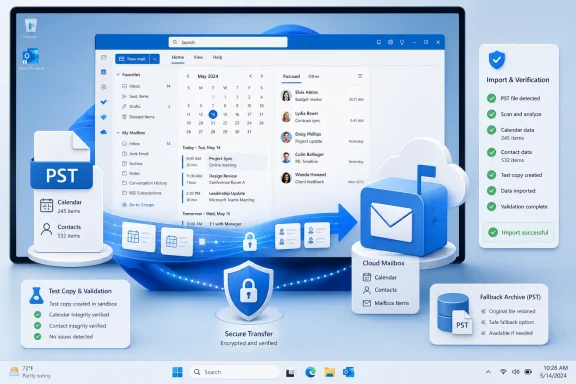
Microsoft’s roadmap says GCC users of new Outlook for Windows can import PST calendars and contacts into a mailbox, with General Availability listed for July 2026. It does not yet document the import steps, prerequisites, or duplicate handling.
That makes this a rollout-status and pilot guide, not a step-by-step how-to. Roadmap ID 486840 confirms the intended capability, platform, destination, and GCC scope, but it does not provide the exact navigation path in new Outlook, identify the required account type, explain how a user selects the
Until Microsoft publishes that workflow, or an organization verifies it directly in its managed GCC environment, administrators should not promise users a particular sequence of buttons or menus. The extractable answer to the user’s question is therefore:
Roadmap ID 486840 has a narrow but meaningful description: users of new Outlook for Windows can import calendars and contacts from an Outlook Data File, or
Each part of that description matters:
That distinction should shape support communications. Administrators can accurately say that Microsoft has placed PST calendar-and-contact import on the new Outlook for Windows roadmap for GCC and has assigned it a launched status with July 2026 General Availability. They should not improvise the menu path, required account configuration, destination-folder behavior, duplicate rules, file-size limits, or rollback process.
The roadmap also says future releases will expand PST capabilities. That wording is important because it prevents the July 2026 item from being mistaken for a declaration of complete PST compatibility. Roadmap ID 486840 names calendars and contacts. It does not state that every item type or every PST workflow is included.
Microsoft is not merely describing access to data inside a detached file. The stated outcome is an import from an Outlook Data File to a mailbox. This makes Roadmap ID 486840 a migration capability: calendar and contact information begins in a
Beyond that basic model, the roadmap leaves several practical questions unanswered. It does not explain whether the user can select among multiple configured mailboxes, whether the destination must be the mailbox associated with the current account, or whether calendar and contact folders can be mapped individually.
It also does not say whether imported data is placed into existing default folders, into user-selected folders, or into newly created folders. Administrators should treat all of those as validation questions rather than predicted product behavior.
The same restraint applies to conflicts. The roadmap does not say whether the importer will:
This smaller comparison is more useful than attempting a broad classic-versus-new Outlook feature matrix. Roadmap ID 486840 does not supply enough information to support detailed claims about older workflows, feature parity, or the treatment of every Outlook data type.
A GCC roadmap entry does not establish availability for other environments. It also does not establish a particular licensing rule, account requirement, client build, policy setting, or deployment state. Those details may eventually appear in procedural documentation, but they are not stated in the supplied roadmap facts.
Similarly, the roadmap’s Launched label should be read within its defined scope and timeline. It does not mean that every Outlook user can use the feature today, and it does not move the listed General Availability date earlier than July 2026.
For administrators, the correct message is deliberately narrow:
This framing also resolves the apparent tension between “Launched” and a forward-looking assignment. The roadmap status indicates Microsoft’s classification of the item, while the availability field provides the stated rollout month. The dates should be reported exactly rather than translated into a claim that the feature must already be present on a particular computer.
July 2026 — The roadmap lists General Availability for the GCC cloud instance on the Desktop platform.
July 10, 2026 — The supplied roadmap facts identify this as the item’s last update date. The status is listed as Launched.
The timeline should not be expanded with inferred preview dates, tenant deployment dates, client-version deadlines, or dates for other environments. The roadmap facts supplied for this feature do not establish them.
Accordingly, the article should not tell users to click a particular menu, choose a supposed duplicate option, or expect a named confirmation dialog. Microsoft must publish that workflow, or an administrator must observe and record it in the intended GCC environment, before those steps can be presented as fact.
Roadmap ID 486840 answers the first half for its stated scope. It says GCC users of new Outlook for Windows can import calendars and contacts from a
The second half remains undocumented in the supplied material. That is not a small editorial omission. Without an exact workflow, users cannot determine whether their account is eligible, whether the intended mailbox appears as a destination, how folder mapping works, or which duplicate rule is safe for an archive that may be the only surviving copy of its data.
This is why the feature should initially be handled as a pilot rather than a general self-service operation. The purpose of the pilot is not to guess how Microsoft implemented the importer. It is to capture the actual interface, verify the endpoint’s eligibility, observe the offered choices, and compare the result with the source file.
If the import command is not visible, that absence should be documented rather than worked around through speculation. Record the account and environment used, the new Outlook version shown by the application, the date of the test, and the menus examined. Those observations can then be compared with later Microsoft instructions or deployment communications.
For calendar data, validation should include representative recurring series and modified occurrences. The administrator is not assuming that reminders will fire, that meetings will merge into an existing calendar, or that every property will be retained. Those are questions to test.
Useful calendar validation questions include:
Contact validation should likewise focus on records that use more than a name and primary email address. The organization should select sample contacts containing the fields its users depend on and compare those records before and after the import.
Useful contact validation questions include:
The source file should not become the working copy for repeated experiments. Store the original in an approved location and test with a copy so that a failed attempt, accidental file operation, or later troubleshooting step does not endanger the only available source.
Preserving the original does not by itself create a rollback mechanism. If imported items are mixed into existing mailbox folders, removing them may still be difficult. The roadmap does not describe an undo function or recovery procedure.
That makes destination selection a critical part of the eventual workflow. If the released interface offers a way to isolate imported content in separate folders, administrators can evaluate whether that choice simplifies validation and cleanup. If it permits only direct import into existing folders, the pilot should determine how imported items can be identified afterward.
Neither outcome should be assumed before the interface is documented. The key is to establish the cleanup plan before importing a large or irreplaceable archive.
A suitable statement is:
Support teams should also resist broadening “calendars and contacts” into “everything in the PST.” The roadmap names two data classes. If a user’s archive contains other information, that information should be inventoried separately and should not be assumed to transfer through Roadmap ID 486840.
The same rule applies to the destination. The roadmap says “to a mailbox,” but it does not describe mailbox selection or folder mapping. Until the actual interface is documented, support scripts should not promise that users can import into a particular mailbox, create a separate calendar, or choose a specific contacts folder.
Microsoft still needs a dedicated new Outlook procedure that identifies:
What the roadmap does not provide is equally important. There is no documented navigation path, account prerequisite, file-selection procedure, destination-folder map, duplicate policy, limit, confirmation sequence, or recovery method in the supplied material.
For now, administrators should treat the release as a controlled migration capability awaiting a complete operating procedure. Preserve the original PST, test only with a copy, validate counts and representative recurring appointments and contact fields, and do not assume that item types outside calendars and contacts will transfer.
The forward path is clear even if the buttons are not: monitor Roadmap ID 486840, wait for Microsoft’s procedural documentation or validate the interface in an eligible GCC pilot, and publish an internal how-to only when every consequential step can be described from observed or documented behavior.
That makes this a rollout-status and pilot guide, not a step-by-step how-to. Roadmap ID 486840 confirms the intended capability, platform, destination, and GCC scope, but it does not provide the exact navigation path in new Outlook, identify the required account type, explain how a user selects the
.pst, show how the destination mailbox or calendar and contacts folders are chosen, list conflict or duplicate options, or describe the confirmation screen that completes the import.Until Microsoft publishes that workflow, or an organization verifies it directly in its managed GCC environment, administrators should not promise users a particular sequence of buttons or menus. The extractable answer to the user’s question is therefore:
- Can I import a PST calendar and contacts? Microsoft’s roadmap says the feature is for new Outlook for Windows in GCC and lists General Availability in July 2026.
- How do I do it? The roadmap does not document the procedure. A reliable how-to requires additional Microsoft instructions or a validated pilot on an eligible endpoint.
 Microsoft Has Addressed the Calendar-and-Contacts Portion of the PST Problem
Roadmap ID 486840 has a narrow but meaningful description: users of new Outlook for Windows can import calendars and contacts from an Outlook Data File, or .pst, to a mailbox.Each part of that description matters:
- Product: New Outlook for Windows
- Source: Outlook Data File (
.pst) - Named item types: Calendars and contacts
- Destination: A mailbox
- Cloud instance: GCC
- Platform: Desktop
- Release phase: General Availability
- Status: Launched
- Availability: July 2026
- Last update: July 10, 2026
- Roadmap identifier: 486840
That distinction should shape support communications. Administrators can accurately say that Microsoft has placed PST calendar-and-contact import on the new Outlook for Windows roadmap for GCC and has assigned it a launched status with July 2026 General Availability. They should not improvise the menu path, required account configuration, destination-folder behavior, duplicate rules, file-size limits, or rollback process.
The roadmap also says future releases will expand PST capabilities. That wording is important because it prevents the July 2026 item from being mistaken for a declaration of complete PST compatibility. Roadmap ID 486840 names calendars and contacts. It does not state that every item type or every PST workflow is included.
A Mailbox Import Is the Confirmed Outcome
The most important limiting word in the roadmap description is mailbox.Microsoft is not merely describing access to data inside a detached file. The stated outcome is an import from an Outlook Data File to a mailbox. This makes Roadmap ID 486840 a migration capability: calendar and contact information begins in a
.pst and is imported into a mailbox destination.Beyond that basic model, the roadmap leaves several practical questions unanswered. It does not explain whether the user can select among multiple configured mailboxes, whether the destination must be the mailbox associated with the current account, or whether calendar and contact folders can be mapped individually.
It also does not say whether imported data is placed into existing default folders, into user-selected folders, or into newly created folders. Administrators should treat all of those as validation questions rather than predicted product behavior.
The same restraint applies to conflicts. The roadmap does not say whether the importer will:
- Skip items that appear to be duplicates
- Create a second copy of each conflicting item
- Replace an existing item
- Merge selected fields
- Ask the user to choose a conflict rule
- Use different rules for calendars and contacts
What the roadmap confirms—and what it does not
| The roadmap confirms | The roadmap does not confirm |
|---|---|
| Roadmap ID 486840 | The exact navigation path in new Outlook |
| New Outlook for Windows | The required account type or other prerequisites |
| Desktop platform | How the user browses to and selects the .pst |
| Import of calendars and contacts | Support for item types not named in the roadmap |
Import from an Outlook Data File (.pst) | How source folders are selected |
| Import to a mailbox | How a destination mailbox is selected |
| GCC cloud instance | Whether destination calendar and contacts folders can be chosen |
| General Availability | File-size, item-count, or other limits |
| Launched status | Duplicate detection and conflict choices |
| July 2026 availability | The final confirmation and progress interface |
| July 10, 2026 last update | Error recovery, cancellation, undo, or rollback behavior |
| Future expansion of PST capabilities | Availability outside the roadmap’s stated GCC scope |
GCC Scope Must Remain Explicit
Roadmap ID 486840 identifies GCC as its cloud instance. The article’s availability claim should go no further than that.A GCC roadmap entry does not establish availability for other environments. It also does not establish a particular licensing rule, account requirement, client build, policy setting, or deployment state. Those details may eventually appear in procedural documentation, but they are not stated in the supplied roadmap facts.
Similarly, the roadmap’s Launched label should be read within its defined scope and timeline. It does not mean that every Outlook user can use the feature today, and it does not move the listed General Availability date earlier than July 2026.
For administrators, the correct message is deliberately narrow:
Everything beyond that statement requires documentation or local validation.Microsoft has marked Roadmap ID 486840 as Launched for new Outlook for Windows on Desktop in GCC, with General Availability listed for July 2026. The item says users can import calendars and contacts from a.pstto a mailbox.
This framing also resolves the apparent tension between “Launched” and a forward-looking assignment. The roadmap status indicates Microsoft’s classification of the item, while the availability field provides the stated rollout month. The dates should be reported exactly rather than translated into a claim that the feature must already be present on a particular computer.
Timeline
March 26, 2025 — Microsoft created Roadmap ID 486840, describing a new Outlook for Windows capability to import calendars and contacts from an Outlook Data File to a mailbox.July 2026 — The roadmap lists General Availability for the GCC cloud instance on the Desktop platform.
July 10, 2026 — The supplied roadmap facts identify this as the item’s last update date. The status is listed as Launched.
The timeline should not be expanded with inferred preview dates, tenant deployment dates, client-version deadlines, or dates for other environments. The roadmap facts supplied for this feature do not establish them.
Microsoft Has Not Published the Procedure Needed for a Safe How-To
A publishable procedure would need to answer more than “find the import command.” At minimum, it would need to document all of the following:- The exact navigation path
Users need the precise sequence of menus, settings pages, or account-management screens that opens the importer. - The required account type
The instructions must identify which account must be signed in, which mailbox can receive the data, and whether any additional eligibility condition applies. - How to select the PST
The procedure must show how to browse to the file, whether the file must be stored locally, and what happens if the file cannot be opened. - How to select source content
Users need to know whether they import the entire file, choose calendars and contacts separately, or select individual folders. - How to choose the destination
The interface must identify the destination mailbox and, if supported, the target calendar and contacts folders. - How conflicts and duplicates are handled
The procedure should state every available option and explain whether the same rules apply to appointments, recurring series, and contacts. - How to confirm the import
Users need to know what summary is presented before data is written, which button begins the import, and whether the operation can be cancelled. - How completion and errors are reported
A complete guide should show where successful, skipped, duplicate, and failed item counts appear. - How to recover from a bad import
The instructions must state whether an import can be undone, whether imported folders can be removed as a unit, or whether cleanup must be performed item by item.
Accordingly, the article should not tell users to click a particular menu, choose a supposed duplicate option, or expect a named confirmation dialog. Microsoft must publish that workflow, or an administrator must observe and record it in the intended GCC environment, before those steps can be presented as fact.
The User’s Question Is Only Half Answered
The practical question is: “Can I import my PST calendar and contacts, and how do I do it?”Roadmap ID 486840 answers the first half for its stated scope. It says GCC users of new Outlook for Windows can import calendars and contacts from a
.pst to a mailbox, with General Availability listed for July 2026.The second half remains undocumented in the supplied material. That is not a small editorial omission. Without an exact workflow, users cannot determine whether their account is eligible, whether the intended mailbox appears as a destination, how folder mapping works, or which duplicate rule is safe for an archive that may be the only surviving copy of its data.
This is why the feature should initially be handled as a pilot rather than a general self-service operation. The purpose of the pilot is not to guess how Microsoft implemented the importer. It is to capture the actual interface, verify the endpoint’s eligibility, observe the offered choices, and compare the result with the source file.
If the import command is not visible, that absence should be documented rather than worked around through speculation. Record the account and environment used, the new Outlook version shown by the application, the date of the test, and the menus examined. Those observations can then be compared with later Microsoft instructions or deployment communications.
Validation Matters More Than the Import Button
Calendar and contact records require more than a simple visual check. An import can finish while leaving important questions about completeness and fidelity unresolved.For calendar data, validation should include representative recurring series and modified occurrences. The administrator is not assuming that reminders will fire, that meetings will merge into an existing calendar, or that every property will be retained. Those are questions to test.
Useful calendar validation questions include:
- Did the destination receive the expected number of items?
- Did selected recurring series retain their expected dates?
- Did modified occurrences remain distinct from the original recurrence pattern?
- Did all-day events remain on the intended dates?
- Did a sample of historical and future appointments retain the fields the organization considers important?
- Did imported items appear in the expected calendar folder?
- Did the import create duplicates where similar items already existed?
- Did the interface report skipped or failed records?
- Did any imported items produce unexpected active behavior?
Contact validation should likewise focus on records that use more than a name and primary email address. The organization should select sample contacts containing the fields its users depend on and compare those records before and after the import.
Useful contact validation questions include:
- Does the imported item count match the expected source count?
- Were contacts placed in the intended destination folder?
- Were multiple email addresses retained where present?
- Were business and personal telephone fields kept distinct?
- Were notes and other important text fields preserved?
- How did the importer handle an existing contact with similar information?
- Were any contacts skipped, combined, replaced, or duplicated?
- Did the completion report identify conflicts or failures?
Keep the Original PST and Test a Copy
The safest initial control is also the simplest: preserve the original.pst.The source file should not become the working copy for repeated experiments. Store the original in an approved location and test with a copy so that a failed attempt, accidental file operation, or later troubleshooting step does not endanger the only available source.
Preserving the original does not by itself create a rollback mechanism. If imported items are mixed into existing mailbox folders, removing them may still be difficult. The roadmap does not describe an undo function or recovery procedure.
That makes destination selection a critical part of the eventual workflow. If the released interface offers a way to isolate imported content in separate folders, administrators can evaluate whether that choice simplifies validation and cleanup. If it permits only direct import into existing folders, the pilot should determine how imported items can be identified afterward.
Neither outcome should be assumed before the interface is documented. The key is to establish the cleanup plan before importing a large or irreplaceable archive.
Short Pilot Checklist for Administrators
Before the pilot
- Confirm that the test concerns new Outlook for Windows, not another Outlook client.
- Confirm that the environment being evaluated is within the roadmap’s stated GCC scope.
- Record the test date and the application information visible on the endpoint.
- Preserve the original
.pstin an approved location. - Create a separate copy for testing.
- Record the source file’s calendar and contact item counts where practical.
- Select representative recurring appointments and contacts with important fields for later comparison.
- Decide what evidence must be captured, including screenshots, offered destination choices, conflict options, progress messages, and error reports.
- Do not assume that item types not named in Roadmap ID 486840 will transfer.
During the pilot
- Record the exact navigation path that exposes the import command.
- Record the signed-in account and the destination choices actually presented.
- Record how the application asks the user to select the
.pst. - Record whether calendar and contact folders can be selected separately.
- Record every conflict or duplicate option exactly as displayed.
- Capture the pre-import summary and the action that confirms the operation.
- Note whether cancellation is offered before or during processing.
- Capture completion totals, skipped items, failures, and any error text.
- Avoid testing first against a mailbox containing irreplaceable production data.
After the pilot
- Compare source and destination item counts.
- Validate a sample of historical and future calendar items.
- Check recurring series and selected modified occurrences.
- Verify the contact fields important to the organization.
- Search for duplicates and determine how they were created or resolved.
- Confirm which mailbox and folders received the imported data.
- Document any item types that were ignored or unsupported.
- Determine whether imported records can be identified and removed without affecting existing data.
- Retain the original
.pstuntil the result has been reviewed and accepted. - Convert the observed process into internal guidance only after the test is reproducible.
What Support Teams Should Tell Users
Support teams need a concise response that separates roadmap confirmation from procedural availability.A suitable statement is:
That response is more useful than either extreme. It does not incorrectly say the capability is absent, and it does not send users searching for an undocumented button.Microsoft Roadmap ID 486840 says new Outlook for Windows can import calendars and contacts from a PST to a mailbox in GCC, with General Availability listed for July 2026. Microsoft’s roadmap does not provide the step-by-step import workflow, prerequisites, folder-mapping choices, duplicate rules, limits, or recovery process. We are therefore validating the feature before treating it as a supported self-service procedure.
Support teams should also resist broadening “calendars and contacts” into “everything in the PST.” The roadmap names two data classes. If a user’s archive contains other information, that information should be inventoried separately and should not be assumed to transfer through Roadmap ID 486840.
The same rule applies to the destination. The roadmap says “to a mailbox,” but it does not describe mailbox selection or folder mapping. Until the actual interface is documented, support scripts should not promise that users can import into a particular mailbox, create a separate calendar, or choose a specific contacts folder.
What Microsoft Still Needs to Publish
Roadmap ID 486840 is sufficient to announce direction and scope, but it is not sufficient to operate a migration program.Microsoft still needs a dedicated new Outlook procedure that identifies:
- The exact in-product navigation path
- Required accounts and prerequisites
- Supported
.pstselection methods - Supported source folders and item types
- Destination mailbox and folder selection
- Conflict and duplicate choices
- File-size or item-count limits, if any
- Progress, completion, and error reporting
- Cancellation and recovery behavior
- A clear method for validating or reversing an import
- The boundaries between the July 2026 capability and future PST expansion
A Meaningful Milestone, but Not Yet a Complete How-To
Roadmap ID 486840 removes an important uncertainty: Microsoft intends new Outlook for Windows in GCC to import calendars and contacts from an Outlook Data File to a mailbox. The roadmap lists the Desktop platform, General Availability, a Launched status, July 2026 availability, and a July 10, 2026 last update. It also points to future expansion of PST capabilities.What the roadmap does not provide is equally important. There is no documented navigation path, account prerequisite, file-selection procedure, destination-folder map, duplicate policy, limit, confirmation sequence, or recovery method in the supplied material.
For now, administrators should treat the release as a controlled migration capability awaiting a complete operating procedure. Preserve the original PST, test only with a copy, validate counts and representative recurring appointments and contact fields, and do not assume that item types outside calendars and contacts will transfer.
The forward path is clear even if the buttons are not: monitor Roadmap ID 486840, wait for Microsoft’s procedural documentation or validate the interface in an eligible GCC pilot, and publish an internal how-to only when every consequential step can be described from observed or documented behavior.
References
- Primary source: Microsoft 365 Roadmap
Published: 2026-07-10T21:58:35.1674832Z
Microsoft 365 Roadmap | Microsoft 365
The Microsoft 365 Roadmap lists updates that are currently planned for applicable subscribers. Check here for more information on the status of new features and updates.www.microsoft.com
- Official source: support.microsoft.com
Open and find items in an Outlook Data File (.pst) | Microsoft Support
Describes how to investigate items in an Outlook Data File (.pst) and troubleshoot search issues.support.microsoft.com - Official source: download.microsoft.com
- Official source: cdn-dynmedia-1.microsoft.com
- Related coverage: surfpac.navy.mil
- Related coverage: robert365.com
How to backup New Outlook Account Configuration and Mailbox Data - Robert 365
This is a full backup guide for New Outlook. Learn how to successfully backup and restore your Account Settings, Mailbox data, Calendar and Contacts. Additional preparations and workarounds are needed due to limitations in New Outlook, which could prevent you from being able to recover your...robert365.com
- Related coverage: windowslatest.com
Microsoft reveals all the features coming to New Outlook, but Outlook Classic still beats it
New Outlook is getting advanced Mail Merge, a new mini calendar, a single view for all your accounts, a reliable notifications experience. www.windowslatest.com
- Related coverage: windowsforum.com
- Related coverage: remosoftware.com
Quick and Easy Way to Import a PST File into Outlook.
In this article, find an effective method to import a PST file into Outlook versions 2021, 2019, 2019, and older versions like a pro.www.remosoftware.com - Related coverage: berrall.com
Microsoft’s new Outlook takes 10 seconds to do what Outlook Classic does instantly on Windows - Peer Networks UK
Wales & West leading provider of PC repairs & IT support for home & business. Peer Networks delivers prompt, no fuss, PC repair services to customers.www.berrall.com
- Official source: learn.microsoft.com
Outlook Calendar transfer... - Microsoft Q&A
Can't export "on my computer" calendar as an .ics file , onely as an .olm file - so can't import into Outlooklearn.microsoft.com - Official source: apps.apple.com
- Related coverage: geekchamp.com
How to Create PST File in Outlook 365: A Step-by-Step Guide - GeekChamp
A PST file, short for Personal Storage Table, is a local data file used by Microsoft Outlook to store email messages, calendar items, contacts,… geekchamp.com