

New Relic used Microsoft Build 2026 in San Francisco this week to promote deeper Azure, GitHub Copilot, Microsoft Foundry, and Marketplace integrations, framing its 14-year Microsoft partnership as an observability answer to the operational risks of agentic AI. The announcement is not just another partner-booth victory lap. It is a useful signal of where Microsoft’s developer platform is heading: toward AI systems that do not merely suggest code, but participate in production change, incident response, and remediation. In that world, observability stops being a dashboard discipline and becomes part of the control plane.
The most interesting part of New Relic’s Build 2026 message is not that it has new integrations with Microsoft services. Vendors integrate with Azure, GitHub, and Marketplace because that is where enterprise budgets, developers, and procurement shortcuts already live. The sharper point is that New Relic is trying to position observability as the missing trust layer for Microsoft’s agentic development story.
Microsoft’s Build narrative this year has leaned hard into agents: build them in GitHub, run them in Microsoft Foundry, connect them to enterprise context, and let them increasingly act across software delivery pipelines. New Relic’s pitch fits that arc almost too neatly. If agents are going to generate code, triage incidents, inspect telemetry, propose fixes, and validate changes, then the systems watching them need to move closer to the workflows where those agents operate.
That is why the phrase directly into the Azure and GitHub workflows where developers and SREs live matters. It is corporate language, yes, but it points to a real shift. The old model asked engineers to leave the incident, open an observability console, correlate signals by hand, then return to the deployment or pull request with a hypothesis. The new model tries to collapse that loop into the agent, the issue, the pull request, or the SRE workflow itself.
New Relic is calling this “Intelligent Observability,” and the branding is doing a lot of work. Underneath it is a more practical claim: telemetry must become machine-readable, context-rich, and actionable enough for AI agents to consume. That is the difference between observability as a record of what happened and observability as an input to what happens next.
Model Context Protocol, or MCP, has become one of the more important pieces of connective tissue in the AI tooling stack. Its premise is simple enough: give agents a standardized way to talk to tools, services, and data sources. In practice, it is a way to prevent every agent integration from becoming a bespoke connector with its own authentication model, permissions story, lifecycle, and failure mode.
For New Relic, an MCP server is a way to make its telemetry legible to Microsoft’s agent ecosystem. For Microsoft, partner MCP servers help make Azure’s agent platform feel less like a closed demo environment and more like an operational layer that can reach into the messy reality of enterprise infrastructure. That distinction matters because most serious Microsoft customers do not run a clean, Azure-only world. They run Windows, Linux, Kubernetes, SAP, SaaS sprawl, legacy databases, third-party monitoring, and homegrown deployment machinery held together by budget cycles and institutional memory.
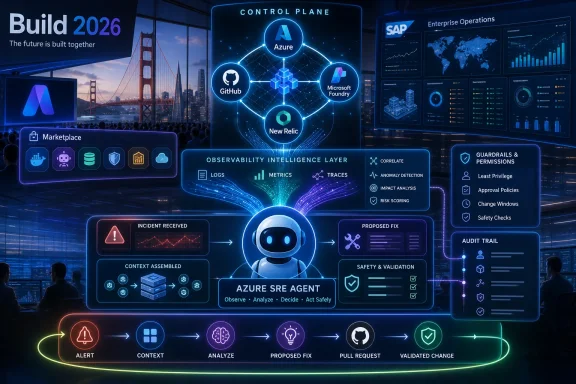
The Azure SRE Agent integration is designed to let Microsoft’s agent call into New Relic when an alert fires, retrieve context, and support incident detection, root-cause analysis, and remediation. The ambition is obvious: an SRE agent should not merely say, “Something is broken.” It should know what changed, what is affected, what telemetry is abnormal, and what remediation options have worked before.
That ambition also raises the stakes. If an agent has weak context, it can produce confident nonsense at operational speed. If it has accurate telemetry, bounded permissions, and a clean audit trail, it can compress the time between signal and action. New Relic’s bet is that observability vendors are not being displaced by AI agents; they are becoming the memory and sensory system those agents need.
Traditional application monitoring assumes relatively stable software behavior. A web service may scale up or down, but its logic is bounded by code humans wrote, reviewed, and deployed. AI agents complicate that model. Their behavior depends not only on code, but on prompts, model selection, retrieval sources, policy constraints, tool access, user intent, and runtime context.
That makes observability for agentic systems qualitatively different from observability for a REST API or a Windows service. It is not enough to know CPU, latency, error rate, and request volume. Teams need to understand whether an agent selected the wrong tool, retrieved stale context, looped through a task unnecessarily, escalated when it should not have, or attempted a remediation outside its intended boundary.
The industry has been using terms like AgentOps to describe this emerging discipline, and while the jargon is still settling, the operational need is not imaginary. If Microsoft wants Foundry to be the enterprise agent runtime, then observability vendors will compete to become the trusted instrumentation layer around that runtime. New Relic’s Foundry integration should be read in that light: not as a dashboard add-on, but as a claim on the operating model of AI-era software.
For WindowsForum readers, the practical implication is straightforward. If your organization is already moving Azure workloads into AI-assisted operations, the next procurement debate may not be whether to monitor those systems. It will be whether the telemetry stack can explain AI-mediated behavior well enough to satisfy engineering, security, compliance, and finance at the same time.
That trio maps directly onto the software delivery loop. Copilot helps write or modify code. GitHub Actions builds, tests, scans, and deploys it. Observability validates whether production behavior matches expectations. New Relic wants its telemetry to sit across the loop, not as an after-the-fact dashboard but as feedback that can influence the code and deployment process itself.
Security RX is especially telling because it uses runtime context to detect, evaluate, and suggest remediation for vulnerabilities. Static analysis can identify risky patterns, vulnerable dependencies, or suspicious code paths. Runtime context can tell teams whether a flaw is reachable, exposed, exploited, or attached to a critical service. The combination is powerful because it can help separate theoretical risk from operational urgency.
The GitHub Actions integration addresses a more mundane but persistent problem: missing instrumentation. Every platform team has seen this failure mode. A service ships, the pipeline is green, the customer experience degrades, and only then does the organization discover that logging, tracing, or metrics were incomplete. Detecting instrumentation gaps during deployment is not glamorous, but it is exactly the kind of practical guardrail that determines whether “AI-assisted DevOps” becomes useful or merely decorative.
The coding agent integration is the boldest claim. New Relic says its AI-strengthened technology can work with GitHub Copilot’s coding agent to transform manual change validation and incident response into an automated, AI-driven process. In plain English, that means an incident could generate telemetry-driven context, feed an issue or remediation path, trigger code changes or validation steps, and close the loop with production data.
That is the dream. The nightmare is an automated remediation loop that patches the symptom, hides the root cause, or creates a second-order failure in a neighboring system. The difference between the two will come down to boring things: permissions, approvals, test quality, rollback design, change windows, observability fidelity, and whether humans remain meaningfully in control.
Microsoft Marketplace is not merely a storefront. For many enterprises, it is a procurement shortcut that lets teams buy third-party software using existing Azure consumption commitments. That changes the sales motion. A monitoring platform that might once have required a separate vendor process can become part of a broader cloud-spend conversation.
That is good for Microsoft because Marketplace makes Azure stickier. It is good for New Relic because it lowers friction for Azure customers who already have committed cloud spend. It can also be good for customers, at least when Marketplace procurement reduces administrative delay without obscuring long-term cost.
But there is a strategic tradeoff. When more tooling is purchased through the hyperscaler marketplace, the hyperscaler becomes the commercial center of gravity even for third-party software. Observability vendors gain access to cloud budgets, but they also bind themselves more tightly to the cloud platform’s roadmap, incentives, and customer account structure.
New Relic appears comfortable with that trade. Its announcement emphasizes that it is a featured Microsoft Marketplace partner and that customers can use Azure consumption commitments to deploy observability across the organization. In an AI platform race where Microsoft is trying to make Azure, GitHub, and Foundry feel like one enterprise operating environment, New Relic is choosing to be close to the bundle rather than standing conspicuously outside it.
SAP on Azure is not a hobbyist workload. It is where large organizations put finance, supply chain, manufacturing, procurement, and other systems that executives actually notice when they fail. If New Relic can reduce performance interruptions and simplify monitoring for SAP environments on Azure, that is a very different kind of value proposition from a slick Copilot demo.
The agentless angle also matters. In heavily governed enterprise environments, installing agents across critical systems can trigger security reviews, compatibility concerns, and change-management friction. Agentless monitoring is not automatically better, but it can be easier to deploy in places where the tolerance for operational disturbance is low.
This is where New Relic’s Build message becomes more credible. AI agents and autonomous remediation make for the headline, but SAP observability is the anchor. It tells conservative IT buyers that the partnership is not only about future-facing developer workflows. It also touches the enterprise systems that still pay the bills.
For Microsoft, the SAP story reinforces Azure’s role as a platform for mission-critical workloads. For New Relic, it provides a wedge into accounts where observability is measured not by developer delight, but by uptime, auditability, and executive pain avoidance. That is less glamorous than agentic AI, but it is often where the renewal money lives.
Independent action is useful when systems are slow, noisy, and too complex for humans to manually correlate every signal. It is dangerous when the action path outruns the organization’s ability to understand, approve, or reverse it. In IT operations, speed without governance is not modernization. It is a new blast radius.
Observability can help, but it cannot magically solve the problem. Telemetry can show what happened, when it happened, and what changed. It can provide the evidence an agent needs to make better recommendations. It can also create the audit trail security teams will demand. But observability does not decide policy. It does not define acceptable risk. It does not determine whether an automated fix should be allowed to touch production on a Friday afternoon.
That means the real enterprise deployment pattern will likely be incremental. First, agents summarize incidents. Then they suggest likely causes. Then they propose remediations. Then they open pull requests, update runbooks, or prepare rollback plans. Only after trust accumulates will most organizations let them take direct production action, and even then only within narrow guardrails.
This is where Windows and Microsoft-heavy shops should be especially sober. Microsoft’s advantage is integration: identity, developer tools, Azure infrastructure, security, governance, and productivity surfaces under one umbrella. The risk is the same integration turning into a dense chain of delegated authority. If Copilot, Foundry, Azure SRE Agent, GitHub Actions, and third-party observability all participate in a remediation path, administrators need clarity about which component did what and under whose authority.
Datadog, Dynatrace, New Relic, Elastic, Grafana Labs, Splunk, and cloud-native monitoring stacks are all facing the same pressure. Customers want fewer panes of glass, but they also do not want to be trapped in a single vendor’s version of reality. AI agents intensify this tension because whichever system provides context to the agent may influence the diagnosis, the remediation, and the postmortem.
That makes neutrality a selling point, but proximity a necessity. New Relic wants to be close enough to Microsoft’s platform to be useful inside Azure and GitHub workflows. At the same time, it has to preserve enough cross-cloud and cross-stack credibility to appeal to customers whose operational world extends beyond Azure.
Microsoft benefits either way. The more partners build MCP servers, Marketplace listings, Foundry integrations, and Copilot extensions, the more Microsoft’s agent platform looks like the default coordination layer for enterprise software. Partners get distribution. Microsoft gets gravity.
The open question is whether customers get leverage. If MCP and related agent protocols remain interoperable and portable, customers may gain a more flexible operational architecture. If implementations become effectively tied to particular clouds, marketplaces, and commercial bundles, the new AI operations stack may reproduce the same lock-in patterns under a more futuristic vocabulary.
For administrators and SREs, the picture is more complicated. AI-assisted incident response can reduce toil, but it also introduces new surfaces to govern. Teams will need to define which agents can read telemetry, which can write issues, which can trigger deployments, which can modify code, and which can execute remediation steps against live infrastructure.
This is not just a permissions problem. It is an accountability problem. When an AI agent suggests a fix based on New Relic telemetry, Copilot prepares code, GitHub Actions deploys it, and Azure SRE Agent validates the remediation, the organization must still be able to answer a simple question: who owns the change?
The answer cannot be “the agent.” Enterprises may tolerate AI-assisted action, but regulators, auditors, customers, and executives will still expect human accountability. That means the best implementations will be the ones that make agent activity visible, reviewable, reversible, and tied to existing change-management practices.
There is a cultural issue, too. Developers may welcome observability inside GitHub if it helps them ship safer code. They may resist it if it feels like surveillance or automated blame assignment. The line between helpful runtime context and a productivity panopticon will be drawn by how organizations use the data.
Build 2026 is showing a platform strategy in which Microsoft wants agents to become part of the everyday software lifecycle. GitHub is the coding surface. Foundry is the agent and model platform. Azure is the infrastructure and governance base. Marketplace is the commercial channel. Observability partners like New Relic supply the operational context that makes the whole machine less blind.
That is a coherent strategy, and it is also an aggressive one. Microsoft is not merely adding AI features to developer tools. It is trying to reorganize the developer and operations stack around agents that can consume context, use tools, and act across environments. In that architecture, the winners will be the vendors whose data is trusted enough to guide automated decisions.
New Relic’s advantage is that observability already has a seat in incident rooms. Its challenge is that customers will demand proof that AI-enhanced integrations reduce noise rather than generate a more expensive kind of noise. Every vendor in this space can say it reduces mean time to resolution. The harder test is whether teams believe the recommendation at 2:00 a.m. when production is down.
The more mature customers will not ask whether the agent is impressive. They will ask whether it is bounded. They will ask what data it saw, what assumptions it made, what action it proposed, who approved it, and how quickly the system can roll back if the recommendation is wrong.
 New Relic Is Selling Confidence, Not Just Telemetry
The most interesting part of New Relic’s Build 2026 message is not that it has new integrations with Microsoft services. Vendors integrate with Azure, GitHub, and Marketplace because that is where enterprise budgets, developers, and procurement shortcuts already live. The sharper point is that New Relic is trying to position observability as the missing trust layer for Microsoft’s agentic development story.Microsoft’s Build narrative this year has leaned hard into agents: build them in GitHub, run them in Microsoft Foundry, connect them to enterprise context, and let them increasingly act across software delivery pipelines. New Relic’s pitch fits that arc almost too neatly. If agents are going to generate code, triage incidents, inspect telemetry, propose fixes, and validate changes, then the systems watching them need to move closer to the workflows where those agents operate.
That is why the phrase directly into the Azure and GitHub workflows where developers and SREs live matters. It is corporate language, yes, but it points to a real shift. The old model asked engineers to leave the incident, open an observability console, correlate signals by hand, then return to the deployment or pull request with a hypothesis. The new model tries to collapse that loop into the agent, the issue, the pull request, or the SRE workflow itself.
New Relic is calling this “Intelligent Observability,” and the branding is doing a lot of work. Underneath it is a more practical claim: telemetry must become machine-readable, context-rich, and actionable enough for AI agents to consume. That is the difference between observability as a record of what happened and observability as an input to what happens next.
The MCP Server Is the Real Center of Gravity
The cornerstone of the announcement is New Relic’s Model Context Protocol Server, which connects New Relic’s observability data to Microsoft’s Azure SRE Agent. That may sound like a plumbing detail, but plumbing is where platform power often hides.Model Context Protocol, or MCP, has become one of the more important pieces of connective tissue in the AI tooling stack. Its premise is simple enough: give agents a standardized way to talk to tools, services, and data sources. In practice, it is a way to prevent every agent integration from becoming a bespoke connector with its own authentication model, permissions story, lifecycle, and failure mode.
For New Relic, an MCP server is a way to make its telemetry legible to Microsoft’s agent ecosystem. For Microsoft, partner MCP servers help make Azure’s agent platform feel less like a closed demo environment and more like an operational layer that can reach into the messy reality of enterprise infrastructure. That distinction matters because most serious Microsoft customers do not run a clean, Azure-only world. They run Windows, Linux, Kubernetes, SAP, SaaS sprawl, legacy databases, third-party monitoring, and homegrown deployment machinery held together by budget cycles and institutional memory.
The Azure SRE Agent integration is designed to let Microsoft’s agent call into New Relic when an alert fires, retrieve context, and support incident detection, root-cause analysis, and remediation. The ambition is obvious: an SRE agent should not merely say, “Something is broken.” It should know what changed, what is affected, what telemetry is abnormal, and what remediation options have worked before.
That ambition also raises the stakes. If an agent has weak context, it can produce confident nonsense at operational speed. If it has accurate telemetry, bounded permissions, and a clean audit trail, it can compress the time between signal and action. New Relic’s bet is that observability vendors are not being displaced by AI agents; they are becoming the memory and sensory system those agents need.
Microsoft Foundry Turns Observability Into Agent Fuel
New Relic Monitoring for Microsoft Foundry is another piece of the same puzzle. It ingests logs and metrics from Azure into New Relic and presents dashboard views of application or agent performance. That sounds conventional until you consider what Microsoft Foundry is supposed to become: the place where enterprises build, deploy, govern, and optimize AI agents and applications.Traditional application monitoring assumes relatively stable software behavior. A web service may scale up or down, but its logic is bounded by code humans wrote, reviewed, and deployed. AI agents complicate that model. Their behavior depends not only on code, but on prompts, model selection, retrieval sources, policy constraints, tool access, user intent, and runtime context.
That makes observability for agentic systems qualitatively different from observability for a REST API or a Windows service. It is not enough to know CPU, latency, error rate, and request volume. Teams need to understand whether an agent selected the wrong tool, retrieved stale context, looped through a task unnecessarily, escalated when it should not have, or attempted a remediation outside its intended boundary.
The industry has been using terms like AgentOps to describe this emerging discipline, and while the jargon is still settling, the operational need is not imaginary. If Microsoft wants Foundry to be the enterprise agent runtime, then observability vendors will compete to become the trusted instrumentation layer around that runtime. New Relic’s Foundry integration should be read in that light: not as a dashboard add-on, but as a claim on the operating model of AI-era software.
For WindowsForum readers, the practical implication is straightforward. If your organization is already moving Azure workloads into AI-assisted operations, the next procurement debate may not be whether to monitor those systems. It will be whether the telemetry stack can explain AI-mediated behavior well enough to satisfy engineering, security, compliance, and finance at the same time.
GitHub Copilot Is No Longer Just a Developer Convenience
The GitHub side of New Relic’s announcement may prove more disruptive for day-to-day software teams. New Relic is highlighting Security RX integration for GitHub Copilot, GitHub Actions integration to detect missing instrumentation during deployment, and a coding agent integration designed to automate change validation and incident response.That trio maps directly onto the software delivery loop. Copilot helps write or modify code. GitHub Actions builds, tests, scans, and deploys it. Observability validates whether production behavior matches expectations. New Relic wants its telemetry to sit across the loop, not as an after-the-fact dashboard but as feedback that can influence the code and deployment process itself.
Security RX is especially telling because it uses runtime context to detect, evaluate, and suggest remediation for vulnerabilities. Static analysis can identify risky patterns, vulnerable dependencies, or suspicious code paths. Runtime context can tell teams whether a flaw is reachable, exposed, exploited, or attached to a critical service. The combination is powerful because it can help separate theoretical risk from operational urgency.
The GitHub Actions integration addresses a more mundane but persistent problem: missing instrumentation. Every platform team has seen this failure mode. A service ships, the pipeline is green, the customer experience degrades, and only then does the organization discover that logging, tracing, or metrics were incomplete. Detecting instrumentation gaps during deployment is not glamorous, but it is exactly the kind of practical guardrail that determines whether “AI-assisted DevOps” becomes useful or merely decorative.
The coding agent integration is the boldest claim. New Relic says its AI-strengthened technology can work with GitHub Copilot’s coding agent to transform manual change validation and incident response into an automated, AI-driven process. In plain English, that means an incident could generate telemetry-driven context, feed an issue or remediation path, trigger code changes or validation steps, and close the loop with production data.
That is the dream. The nightmare is an automated remediation loop that patches the symptom, hides the root cause, or creates a second-order failure in a neighboring system. The difference between the two will come down to boring things: permissions, approvals, test quality, rollback design, change windows, observability fidelity, and whether humans remain meaningfully in control.
Marketplace Momentum Shows Where the Budget Is Moving
New Relic also used Build to tout “strong double-digit year-over-year growth” in committed bookings through Microsoft Azure Marketplace for the period ending March 31, 2026. The company did not disclose the actual bookings figure in the announcement, so the statement is more directional than precise. Still, the Marketplace angle matters.Microsoft Marketplace is not merely a storefront. For many enterprises, it is a procurement shortcut that lets teams buy third-party software using existing Azure consumption commitments. That changes the sales motion. A monitoring platform that might once have required a separate vendor process can become part of a broader cloud-spend conversation.
That is good for Microsoft because Marketplace makes Azure stickier. It is good for New Relic because it lowers friction for Azure customers who already have committed cloud spend. It can also be good for customers, at least when Marketplace procurement reduces administrative delay without obscuring long-term cost.
But there is a strategic tradeoff. When more tooling is purchased through the hyperscaler marketplace, the hyperscaler becomes the commercial center of gravity even for third-party software. Observability vendors gain access to cloud budgets, but they also bind themselves more tightly to the cloud platform’s roadmap, incentives, and customer account structure.
New Relic appears comfortable with that trade. Its announcement emphasizes that it is a featured Microsoft Marketplace partner and that customers can use Azure consumption commitments to deploy observability across the organization. In an AI platform race where Microsoft is trying to make Azure, GitHub, and Foundry feel like one enterprise operating environment, New Relic is choosing to be close to the bundle rather than standing conspicuously outside it.
SAP Monitoring Is the Enterprise Proof Point
The mention of New Relic Monitoring for SAP Solutions could easily be overlooked amid the AI language, but it may be one of the more commercially grounded parts of the announcement. New Relic describes the product as an agentless, certified RISE with SAP observability solution available through Microsoft Marketplace.SAP on Azure is not a hobbyist workload. It is where large organizations put finance, supply chain, manufacturing, procurement, and other systems that executives actually notice when they fail. If New Relic can reduce performance interruptions and simplify monitoring for SAP environments on Azure, that is a very different kind of value proposition from a slick Copilot demo.
The agentless angle also matters. In heavily governed enterprise environments, installing agents across critical systems can trigger security reviews, compatibility concerns, and change-management friction. Agentless monitoring is not automatically better, but it can be easier to deploy in places where the tolerance for operational disturbance is low.
This is where New Relic’s Build message becomes more credible. AI agents and autonomous remediation make for the headline, but SAP observability is the anchor. It tells conservative IT buyers that the partnership is not only about future-facing developer workflows. It also touches the enterprise systems that still pay the bills.
For Microsoft, the SAP story reinforces Azure’s role as a platform for mission-critical workloads. For New Relic, it provides a wedge into accounts where observability is measured not by developer delight, but by uptime, auditability, and executive pain avoidance. That is less glamorous than agentic AI, but it is often where the renewal money lives.
The Agentic Future Still Has a Trust Problem
The most important unresolved issue in this announcement is trust. New Relic and Microsoft are promising a world in which AI agents can move beyond insight to “independent, real-time action.” That phrase captures both the opportunity and the anxiety.Independent action is useful when systems are slow, noisy, and too complex for humans to manually correlate every signal. It is dangerous when the action path outruns the organization’s ability to understand, approve, or reverse it. In IT operations, speed without governance is not modernization. It is a new blast radius.
Observability can help, but it cannot magically solve the problem. Telemetry can show what happened, when it happened, and what changed. It can provide the evidence an agent needs to make better recommendations. It can also create the audit trail security teams will demand. But observability does not decide policy. It does not define acceptable risk. It does not determine whether an automated fix should be allowed to touch production on a Friday afternoon.
That means the real enterprise deployment pattern will likely be incremental. First, agents summarize incidents. Then they suggest likely causes. Then they propose remediations. Then they open pull requests, update runbooks, or prepare rollback plans. Only after trust accumulates will most organizations let them take direct production action, and even then only within narrow guardrails.
This is where Windows and Microsoft-heavy shops should be especially sober. Microsoft’s advantage is integration: identity, developer tools, Azure infrastructure, security, governance, and productivity surfaces under one umbrella. The risk is the same integration turning into a dense chain of delegated authority. If Copilot, Foundry, Azure SRE Agent, GitHub Actions, and third-party observability all participate in a remediation path, administrators need clarity about which component did what and under whose authority.
Observability Vendors Are Being Pulled Into the Platform War
New Relic’s announcement also reflects a broader competitive reality. Observability vendors are no longer competing only on dashboards, data retention, query languages, or pricing models. They are competing to become embedded in the AI and cloud platforms where operational decisions will be made.Datadog, Dynatrace, New Relic, Elastic, Grafana Labs, Splunk, and cloud-native monitoring stacks are all facing the same pressure. Customers want fewer panes of glass, but they also do not want to be trapped in a single vendor’s version of reality. AI agents intensify this tension because whichever system provides context to the agent may influence the diagnosis, the remediation, and the postmortem.
That makes neutrality a selling point, but proximity a necessity. New Relic wants to be close enough to Microsoft’s platform to be useful inside Azure and GitHub workflows. At the same time, it has to preserve enough cross-cloud and cross-stack credibility to appeal to customers whose operational world extends beyond Azure.
Microsoft benefits either way. The more partners build MCP servers, Marketplace listings, Foundry integrations, and Copilot extensions, the more Microsoft’s agent platform looks like the default coordination layer for enterprise software. Partners get distribution. Microsoft gets gravity.
The open question is whether customers get leverage. If MCP and related agent protocols remain interoperable and portable, customers may gain a more flexible operational architecture. If implementations become effectively tied to particular clouds, marketplaces, and commercial bundles, the new AI operations stack may reproduce the same lock-in patterns under a more futuristic vocabulary.
Developers Get a Faster Loop, Administrators Get a Harder Job
For developers, the promise is attractive. Fewer context switches, faster feedback, vulnerability guidance informed by production reality, and deployment workflows that catch missing instrumentation before users do. If New Relic’s integrations work as advertised, they could turn observability from a specialist discipline into a continuous companion inside the developer workflow.For administrators and SREs, the picture is more complicated. AI-assisted incident response can reduce toil, but it also introduces new surfaces to govern. Teams will need to define which agents can read telemetry, which can write issues, which can trigger deployments, which can modify code, and which can execute remediation steps against live infrastructure.
This is not just a permissions problem. It is an accountability problem. When an AI agent suggests a fix based on New Relic telemetry, Copilot prepares code, GitHub Actions deploys it, and Azure SRE Agent validates the remediation, the organization must still be able to answer a simple question: who owns the change?
The answer cannot be “the agent.” Enterprises may tolerate AI-assisted action, but regulators, auditors, customers, and executives will still expect human accountability. That means the best implementations will be the ones that make agent activity visible, reviewable, reversible, and tied to existing change-management practices.
There is a cultural issue, too. Developers may welcome observability inside GitHub if it helps them ship safer code. They may resist it if it feels like surveillance or automated blame assignment. The line between helpful runtime context and a productivity panopticon will be drawn by how organizations use the data.
The Build 2026 Signal Is Bigger Than New Relic
It would be easy to dismiss the announcement as partner marketing. New Relic is at Build, Microsoft likes partners, Marketplace bookings are up, and everyone wants to attach themselves to AI. That reading is not wrong, but it is incomplete.Build 2026 is showing a platform strategy in which Microsoft wants agents to become part of the everyday software lifecycle. GitHub is the coding surface. Foundry is the agent and model platform. Azure is the infrastructure and governance base. Marketplace is the commercial channel. Observability partners like New Relic supply the operational context that makes the whole machine less blind.
That is a coherent strategy, and it is also an aggressive one. Microsoft is not merely adding AI features to developer tools. It is trying to reorganize the developer and operations stack around agents that can consume context, use tools, and act across environments. In that architecture, the winners will be the vendors whose data is trusted enough to guide automated decisions.
New Relic’s advantage is that observability already has a seat in incident rooms. Its challenge is that customers will demand proof that AI-enhanced integrations reduce noise rather than generate a more expensive kind of noise. Every vendor in this space can say it reduces mean time to resolution. The harder test is whether teams believe the recommendation at 2:00 a.m. when production is down.
The more mature customers will not ask whether the agent is impressive. They will ask whether it is bounded. They will ask what data it saw, what assumptions it made, what action it proposed, who approved it, and how quickly the system can roll back if the recommendation is wrong.
The Practical Reading for Microsoft Shops
The near-term lesson from New Relic’s Build push is not that every Azure customer should immediately wire AI agents into production remediation. The better reading is that observability, security, and developer productivity are converging inside Microsoft’s platform, and IT teams should prepare their governance models before the integrations become everyday defaults.- New Relic is using Build 2026 to place its observability data inside Azure SRE Agent, Microsoft Foundry, GitHub Copilot, and GitHub Actions workflows.
- The company’s MCP Server is the connective mechanism that lets Microsoft’s agent ecosystem consume New Relic telemetry as operational context.
- Marketplace growth matters because Azure consumption commitments can make third-party observability easier to buy and easier to standardize across Microsoft-heavy organizations.
- The GitHub integrations are aimed at closing the loop between code generation, deployment validation, vulnerability remediation, and production behavior.
- The SAP monitoring angle gives the announcement an enterprise workload story beyond the AI demo circuit.
- The biggest adoption barrier will be governance, because automated insight is useful only when permissions, audit trails, rollback paths, and human ownership are clearly defined.
References
- Primary source: businessnewsthisweek.com
Published: 2026-06-04T05:30:21.883586

New Relic Celebrates Strategic Partnership with Microsoft at Build 2026
Stay updated with Business News This Week – your source for the latest business news weekly, market updates, and top business storiesbusinessnewsthisweek.com - Related coverage: tomsguide.com
- Related coverage: techradar.com
From code-first to intent-first: Microsoft Build 2026 could be the end of programming as we know it
Redefining what it means to be a developer with agentic AIwww.techradar.com
- Official source: devblogs.microsoft.com

Build and run agents at scale with Microsoft Foundry at Build 2026 | Microsoft Foundry Blog
Learn how Microsoft Foundry helps developers build, deploy, and operate production-ready agents with Agent Framework, Toolboxes, hosted agents, Microsoft 365 distribution, observability, and agent optimization. devblogs.microsoft.com
- Related coverage: newrelic.com
- Official source: learn.microsoft.com
March 2026 announcements - Partner Center announcements
March 2026 announcements for Microsoft Partner Center including new capabilities, promotions, offers, markets, or changes to existing offers.learn.microsoft.com
- Official source: blogs.microsoft.com
The next phase of the Microsoft-OpenAI partnership - The Official Microsoft Blog
Amended Agreement Provides Long-Term Clarity The rapid pace of innovation requires us to continue to evolve our partnership to benefit our customers and both companies. Today, we are announcing an amended agreement to simplify our partnership and the way we work together, grounded in... blogs.microsoft.com
- Official source: news.microsoft.com
PHASE 2: with links/12:30 - Microsoft Build 2026
 news.microsoft.com
- Official source: techcommunity.microsoft.com
Azure SRE Agent: Expanding Observability and Multi-Cloud Resilience | Microsoft Community Hub
The Azure SRE Agent continues to evolve as a cornerstone for operational excellence and incident management. Over the past few months, we... techcommunity.microsoft.com
- Official source: cdn-dynmedia-1.microsoft.com
