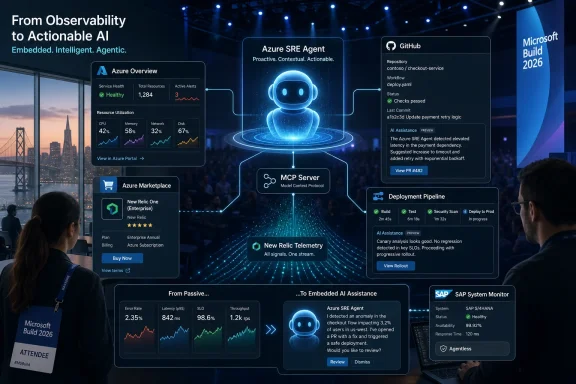
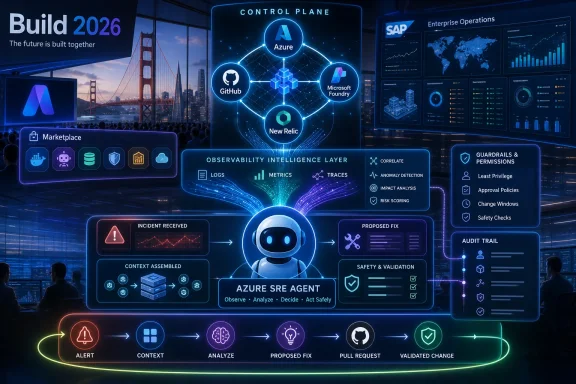
New Relic used Microsoft Build 2026 in San Francisco this week to highlight a 14-year Microsoft partnership, new Azure and GitHub integrations, and double-digit year-over-year growth in committed bookings through Microsoft Azure Marketplace for the 12 months ending March 31, 2026. The announcement is less about one observability vendor’s booth traffic than about a larger shift in enterprise software: telemetry is being pulled directly into the AI-assisted workflows where code is written, deployed, broken, and repaired. Microsoft wants Azure, GitHub Copilot, and its agent stack to become the operational cockpit. New Relic wants to make sure that cockpit cannot fly blind.
The old observability pitch was straightforward: instrument your applications, collect logs and metrics, draw dashboards, and page someone when production catches fire. That model is not dead, but it is plainly insufficient for the AI-era workflow Microsoft is building around Azure, GitHub, Copilot, and agentic operations. If code is increasingly generated, reviewed, deployed, and even remediated with AI assistance, the system watching production cannot remain a separate browser tab opened only after something goes wrong.
That is why New Relic’s Build 2026 message matters. The company is not merely saying that it supports Azure, or that it has a marketplace listing, or that GitHub developers can pipe more events into its platform. It is arguing that observability must become machine-actionable context for the agents Microsoft is pushing into developer and operations workflows.
The distinction is important. A dashboard helps a human infer that latency rose after a deployment. An agent-connected observability layer can, at least in theory, connect the deployment, the trace, the error spike, the vulnerable library, the affected business transaction, and the suggested remediation path without waiting for a senior engineer to assemble the narrative manually. That is the strategic center of the New Relic-Microsoft partnership.
Microsoft has been steadily recasting the software lifecycle around Copilot and agents. Build 2026 continued that direction, with Microsoft emphasizing agent development, governance, security, and operational readiness across its cloud and developer platforms. New Relic is attaching itself to that momentum by supplying the evidence layer those agents need if they are going to do more than autocomplete code and summarize incidents.
For enterprise buyers, Microsoft Marketplace is no longer just a catalog. It is procurement infrastructure. Many Azure customers can use existing Microsoft Azure Consumption Commitment agreements to buy third-party software, which makes marketplace listings especially powerful for vendors that already sit near cloud spend, security spend, and platform engineering budgets.
That is the practical genius of the partnership. Observability has long been a budget line that competes with cloud costs, security tools, incident management platforms, and developer productivity suites. By flowing New Relic purchases through Microsoft’s marketplace machinery, the company gets closer to the path of least resistance for customers already standardizing around Azure.
It also benefits Microsoft. Azure becomes stickier when the operational tooling around it can be bought, deployed, and justified through the same commercial motion. Microsoft does not need to own every best-of-breed tool if it can make Azure the place where those tools are discovered, billed, integrated, and increasingly orchestrated.
The result is a familiar cloud-platform bargain. Customers get faster procurement and tighter integration. Vendors get Microsoft’s distribution muscle. Microsoft gets more gravity around Azure. The open question is whether customers get genuine architectural flexibility or simply a smoother road into a more consolidated Microsoft-centered stack.
That matters because incident response is full of context gaps. The on-call engineer needs to know what changed, which services are affected, whether the problem is infrastructure, code, dependency, configuration, capacity, or a third-party failure, and whether a rollback would make things better or worse. The difference between a useful operations agent and a dangerous one is whether it can ground its recommendations in live, trustworthy telemetry.
New Relic’s MCP Server is designed to provide that grounding. When paired with Azure SRE Agent, New Relic says its observability insights can be surfaced directly inside Microsoft’s incident analysis and remediation flow. The pitch is that developers and SREs should not have to swivel between Azure Portal, GitHub, New Relic dashboards, logs, traces, runbooks, and chat threads to reconstruct an outage.
That is the right ambition. Mean time to resolution is often less about the raw time required to apply a fix than the time wasted figuring out what needs fixing. If an AI agent can shorten the diagnostic phase by correlating symptoms across telemetry sources, it becomes useful even before anyone trusts it to press the remediation button.
But MCP also raises the stakes. Once observability data becomes executable context for agents, the accuracy, freshness, permissions, and auditability of that context become security issues, not just usability issues. An agent with partial telemetry can make bad recommendations faster. An agent with excessive access can become a new blast radius. The next phase of observability will be judged not only by what it sees, but by how safely that visibility is exposed to automated systems.
This is a significant reframing of developer tooling. For years, the industry has told developers to “shift left,” meaning security, quality, and reliability checks should happen earlier in the software lifecycle. The phrase became so overused that it often meant little more than adding another noisy scanner to CI. New Relic’s argument is more specific: runtime context should inform coding and remediation decisions before, during, and after deployment.
That is particularly relevant for security. Static analysis can identify suspicious patterns, dependency risks, and insecure code paths, but it often lacks production context. Runtime observability can show whether a vulnerable component is actually exercised, whether it sits on a sensitive transaction path, and whether exploitation would matter to a specific customer-facing workflow. Combining that signal with Copilot is an attempt to move vulnerability handling from abstract backlog management to context-aware remediation.
The GitHub Actions integration is similarly pragmatic. Missing instrumentation is one of the quiet failures of observability programs. A team can standardize on a platform, publish golden paths, and still ship services whose traces are incomplete, logs are inconsistent, or critical deployment metadata never reaches the monitoring layer. Catching those gaps during deployment is less glamorous than an autonomous incident agent, but it may produce more immediate reliability gains.
The coding-agent integration is the more futuristic piece. New Relic describes a loop in which incidents and change validation can become part of an AI-driven process. The vision is seductive: production detects a problem, New Relic supplies context, GitHub Copilot proposes or prepares a fix, and the system learns from the outcome. The risk is equally obvious: enterprises will need strong review gates, policy enforcement, and rollback discipline before they allow that loop to close without human judgment.
That identity is valuable because the AI stack has a context problem. Large language models are fluent, but production systems are specific. They depend on service topology, release history, customer impact, cloud configuration, feature flags, dependency maps, cost signals, and years of institutional scars. Observability platforms have spent the last decade collecting exactly that messy operational reality.
The business implication is clear. If AI agents become a primary interface for development and operations, the platforms that feed them trustworthy operational context gain leverage. New Relic’s partnership with Microsoft is therefore not simply a distribution arrangement. It is a bid to become part of the nervous system for Azure-era software operations.
This also explains the company’s repeated use of “AI-strengthened” and “Intelligent Observability.” The language is marketing-heavy, but the underlying claim is coherent. Observability data becomes more valuable when it can trigger analysis, prioritization, and action. AI agents become more valuable when they can draw from real production telemetry rather than generic assumptions.
The winners in this space will not be the vendors with the loudest AI branding. They will be the ones that can connect telemetry, code, identity, deployment history, security posture, and business impact in a way that is reliable enough for enterprises to operationalize. That is a harder problem than putting a chatbot on top of logs.
That convenience is not trivial. Large organizations often lose months to procurement, security review, legal negotiation, and deployment friction. Marketplace availability can compress that timeline. For platform teams trying to standardize observability across dozens or hundreds of services, the difference between “approved path” and “custom vendor exception” is enormous.
There is also an architectural benefit. Observability works best when it is embedded into the platform engineering path. If a team can provision infrastructure, deploy code, instrument services, detect missing telemetry, monitor AI agents, and route incidents through a common workflow, reliability becomes part of the system rather than a heroic afterthought.
But the dependency tradeoff should be acknowledged. The more deeply New Relic integrates with Azure, GitHub, Marketplace, and Microsoft’s agent ecosystem, the more customers may design operational processes around that combined stack. That can be good engineering if the organization is already committed to Microsoft. It can be a constraint if the business later wants to rebalance across clouds, tools, or source-control ecosystems.
New Relic will argue that observability remains cross-platform, and that is central to its value. Microsoft will argue that Azure is becoming more open to partner tools and multi-cloud realities. Both claims can be true while the commercial center of gravity still pulls customers toward a Microsoft-shaped operating model.
SAP workloads are often mission-critical, expensive, and politically sensitive inside organizations. They also tend to sit at the intersection of cloud migration, modernization, compliance, and executive scrutiny. If observability can reduce interruptions and improve performance visibility for SAP on Azure, the value proposition becomes much easier for CIOs to understand.
This is where Microsoft’s enterprise strategy and New Relic’s observability strategy align neatly. Microsoft wants Azure to be a credible home for core enterprise workloads, not only cloud-native applications and AI experiments. New Relic wants to be seen as a platform for business-critical reliability, not just an application performance monitoring tool for web services.
The SAP angle also tempers the hype around agents. Enterprises may be excited about autonomous remediation, but they still need better visibility into the systems where downtime translates directly into missed shipments, broken financial processes, or angry customers. The path to agentic operations runs through boring, high-stakes plumbing.
That is why the announcement’s blend of AI agents, GitHub workflows, Azure Marketplace, and SAP monitoring is more coherent than it first appears. New Relic is trying to cover both ends of the enterprise reality: the new AI-generated code entering production faster than ever, and the old systems whose failure would still ruin the quarter.
Automated incident detection is useful when it reduces noise. Root-cause analysis is useful when it explains uncertainty rather than inventing certainty. Remediation is useful when it follows safe, reversible, policy-compliant paths. Productivity improves when engineers spend less time collecting context and more time making good decisions, not when they become supervisors of opaque automation.
The danger is that enterprises adopt agentic operations as a way to accelerate existing dysfunction. If service ownership is unclear, telemetry is inconsistent, runbooks are stale, and change management is chaotic, an AI agent will not magically produce operational maturity. It may simply make the chaos conversational.
That does not make the New Relic-Microsoft work unimportant. It makes it more important to implement carefully. Observability-powered agents should start with recommendation, summarization, correlation, and validation before moving into autonomous remediation. The audit trail should be as important as the answer. The ability to say “why did the agent recommend this?” will matter as much as whether the agent was right.
For WindowsForum’s IT pro audience, the lesson is familiar from every automation wave: the tool is only as good as the operational model around it. PowerShell did not eliminate the need for change control. Group Policy did not eliminate the need for design discipline. AI agents will not eliminate the need for ownership, permissions, and rollback planning.
That is a meaningful shift for Windows and Azure administrators. The next generation of operational tooling will be judged by how well it participates in automated workflows, not only by how well it displays information. Logs, metrics, traces, vulnerabilities, deployment events, and business indicators will increasingly be treated as inputs for agents that summarize, decide, and act.
It also means procurement decisions will have longer shadows. Buying an observability platform through Microsoft Marketplace is not just a billing choice if that platform becomes part of incident response, code remediation, SAP monitoring, and AI-agent governance. Tooling choices that once felt modular may become workflow architecture.
New Relic’s advantage is that it is positioning itself where Microsoft has momentum: Azure, GitHub, Copilot, Marketplace, and agents. Its challenge is that every observability and security vendor can see the same map. The race will be decided by integration depth, trust, and whether customers see measurable reductions in toil rather than another layer of AI-branded complexity.
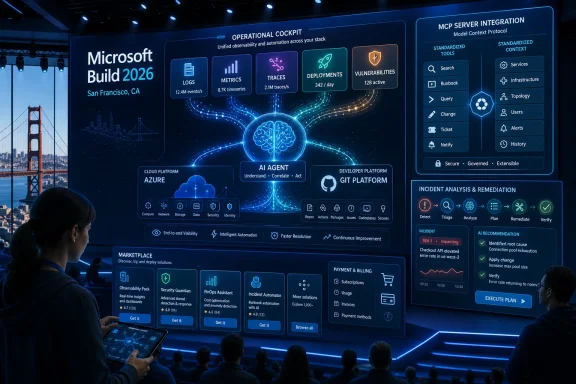 Microsoft’s AI Stack Needs Observability Where the Work Actually Happens
The old observability pitch was straightforward: instrument your applications, collect logs and metrics, draw dashboards, and page someone when production catches fire. That model is not dead, but it is plainly insufficient for the AI-era workflow Microsoft is building around Azure, GitHub, Copilot, and agentic operations. If code is increasingly generated, reviewed, deployed, and even remediated with AI assistance, the system watching production cannot remain a separate browser tab opened only after something goes wrong.That is why New Relic’s Build 2026 message matters. The company is not merely saying that it supports Azure, or that it has a marketplace listing, or that GitHub developers can pipe more events into its platform. It is arguing that observability must become machine-actionable context for the agents Microsoft is pushing into developer and operations workflows.
The distinction is important. A dashboard helps a human infer that latency rose after a deployment. An agent-connected observability layer can, at least in theory, connect the deployment, the trace, the error spike, the vulnerable library, the affected business transaction, and the suggested remediation path without waiting for a senior engineer to assemble the narrative manually. That is the strategic center of the New Relic-Microsoft partnership.
Microsoft has been steadily recasting the software lifecycle around Copilot and agents. Build 2026 continued that direction, with Microsoft emphasizing agent development, governance, security, and operational readiness across its cloud and developer platforms. New Relic is attaching itself to that momentum by supplying the evidence layer those agents need if they are going to do more than autocomplete code and summarize incidents.
The Marketplace Number Is a Sales Signal, Not Just a Press-Release Trophy
New Relic says it achieved strong double-digit year-over-year growth in committed bookings through Microsoft Azure Marketplace over the 12 months ending March 31, 2026. The company does not disclose the base number in the release, so the claim should be read as directional rather than definitive market-share proof. Still, the sales channel matters.For enterprise buyers, Microsoft Marketplace is no longer just a catalog. It is procurement infrastructure. Many Azure customers can use existing Microsoft Azure Consumption Commitment agreements to buy third-party software, which makes marketplace listings especially powerful for vendors that already sit near cloud spend, security spend, and platform engineering budgets.
That is the practical genius of the partnership. Observability has long been a budget line that competes with cloud costs, security tools, incident management platforms, and developer productivity suites. By flowing New Relic purchases through Microsoft’s marketplace machinery, the company gets closer to the path of least resistance for customers already standardizing around Azure.
It also benefits Microsoft. Azure becomes stickier when the operational tooling around it can be bought, deployed, and justified through the same commercial motion. Microsoft does not need to own every best-of-breed tool if it can make Azure the place where those tools are discovered, billed, integrated, and increasingly orchestrated.
The result is a familiar cloud-platform bargain. Customers get faster procurement and tighter integration. Vendors get Microsoft’s distribution muscle. Microsoft gets more gravity around Azure. The open question is whether customers get genuine architectural flexibility or simply a smoother road into a more consolidated Microsoft-centered stack.
The MCP Server Is the Most Important Detail in the Announcement
The most technically consequential part of New Relic’s announcement is its Model Context Protocol server integration with Microsoft’s Azure SRE Agent. MCP has become one of the key connective tissues of the agent ecosystem because it gives AI systems a standardized way to access external tools, data, and context. In plain English, it is one of the mechanisms that lets an agent ask a system such as New Relic what is happening in production rather than guessing from stale documentation or incomplete prompts.That matters because incident response is full of context gaps. The on-call engineer needs to know what changed, which services are affected, whether the problem is infrastructure, code, dependency, configuration, capacity, or a third-party failure, and whether a rollback would make things better or worse. The difference between a useful operations agent and a dangerous one is whether it can ground its recommendations in live, trustworthy telemetry.
New Relic’s MCP Server is designed to provide that grounding. When paired with Azure SRE Agent, New Relic says its observability insights can be surfaced directly inside Microsoft’s incident analysis and remediation flow. The pitch is that developers and SREs should not have to swivel between Azure Portal, GitHub, New Relic dashboards, logs, traces, runbooks, and chat threads to reconstruct an outage.
That is the right ambition. Mean time to resolution is often less about the raw time required to apply a fix than the time wasted figuring out what needs fixing. If an AI agent can shorten the diagnostic phase by correlating symptoms across telemetry sources, it becomes useful even before anyone trusts it to press the remediation button.
But MCP also raises the stakes. Once observability data becomes executable context for agents, the accuracy, freshness, permissions, and auditability of that context become security issues, not just usability issues. An agent with partial telemetry can make bad recommendations faster. An agent with excessive access can become a new blast radius. The next phase of observability will be judged not only by what it sees, but by how safely that visibility is exposed to automated systems.
GitHub Copilot Is Becoming the Front Door to Production Reality
New Relic’s GitHub-related integrations point to another shift: production feedback is moving closer to the developer’s editor and pull request workflow. The company is promoting Security RX integration for GitHub Copilot, GitHub Actions integration to identify missing instrumentation during deployment, and a connection to GitHub Copilot’s coding agent for change validation and incident response.This is a significant reframing of developer tooling. For years, the industry has told developers to “shift left,” meaning security, quality, and reliability checks should happen earlier in the software lifecycle. The phrase became so overused that it often meant little more than adding another noisy scanner to CI. New Relic’s argument is more specific: runtime context should inform coding and remediation decisions before, during, and after deployment.
That is particularly relevant for security. Static analysis can identify suspicious patterns, dependency risks, and insecure code paths, but it often lacks production context. Runtime observability can show whether a vulnerable component is actually exercised, whether it sits on a sensitive transaction path, and whether exploitation would matter to a specific customer-facing workflow. Combining that signal with Copilot is an attempt to move vulnerability handling from abstract backlog management to context-aware remediation.
The GitHub Actions integration is similarly pragmatic. Missing instrumentation is one of the quiet failures of observability programs. A team can standardize on a platform, publish golden paths, and still ship services whose traces are incomplete, logs are inconsistent, or critical deployment metadata never reaches the monitoring layer. Catching those gaps during deployment is less glamorous than an autonomous incident agent, but it may produce more immediate reliability gains.
The coding-agent integration is the more futuristic piece. New Relic describes a loop in which incidents and change validation can become part of an AI-driven process. The vision is seductive: production detects a problem, New Relic supplies context, GitHub Copilot proposes or prepares a fix, and the system learns from the outcome. The risk is equally obvious: enterprises will need strong review gates, policy enforcement, and rollback discipline before they allow that loop to close without human judgment.
Observability Vendors Are Racing to Become Agent Subsystems
New Relic is not alone in seeing this opening. The observability market has been converging with AI operations, security analytics, incident response, and developer platforms for years. What changed is that agentic workflows give observability vendors a new identity: not just dashboards for humans, but context providers for automated decision-making.That identity is valuable because the AI stack has a context problem. Large language models are fluent, but production systems are specific. They depend on service topology, release history, customer impact, cloud configuration, feature flags, dependency maps, cost signals, and years of institutional scars. Observability platforms have spent the last decade collecting exactly that messy operational reality.
The business implication is clear. If AI agents become a primary interface for development and operations, the platforms that feed them trustworthy operational context gain leverage. New Relic’s partnership with Microsoft is therefore not simply a distribution arrangement. It is a bid to become part of the nervous system for Azure-era software operations.
This also explains the company’s repeated use of “AI-strengthened” and “Intelligent Observability.” The language is marketing-heavy, but the underlying claim is coherent. Observability data becomes more valuable when it can trigger analysis, prioritization, and action. AI agents become more valuable when they can draw from real production telemetry rather than generic assumptions.
The winners in this space will not be the vendors with the loudest AI branding. They will be the ones that can connect telemetry, code, identity, deployment history, security posture, and business impact in a way that is reliable enough for enterprises to operationalize. That is a harder problem than putting a chatbot on top of logs.
Azure Customers Get Convenience, But Also Another Layer of Dependency
For Azure-heavy organizations, the appeal is obvious. New Relic is available through Microsoft Marketplace, integrates with Azure workflows, works with Microsoft Foundry monitoring scenarios, and plugs into Azure SRE Agent. If the enterprise already has Microsoft procurement, Azure governance, and GitHub-based development, New Relic can present itself as a natural extension rather than an external island.That convenience is not trivial. Large organizations often lose months to procurement, security review, legal negotiation, and deployment friction. Marketplace availability can compress that timeline. For platform teams trying to standardize observability across dozens or hundreds of services, the difference between “approved path” and “custom vendor exception” is enormous.
There is also an architectural benefit. Observability works best when it is embedded into the platform engineering path. If a team can provision infrastructure, deploy code, instrument services, detect missing telemetry, monitor AI agents, and route incidents through a common workflow, reliability becomes part of the system rather than a heroic afterthought.
But the dependency tradeoff should be acknowledged. The more deeply New Relic integrates with Azure, GitHub, Marketplace, and Microsoft’s agent ecosystem, the more customers may design operational processes around that combined stack. That can be good engineering if the organization is already committed to Microsoft. It can be a constraint if the business later wants to rebalance across clouds, tools, or source-control ecosystems.
New Relic will argue that observability remains cross-platform, and that is central to its value. Microsoft will argue that Azure is becoming more open to partner tools and multi-cloud realities. Both claims can be true while the commercial center of gravity still pulls customers toward a Microsoft-shaped operating model.
SAP Monitoring Shows the Partnership Is About Enterprise Plumbing, Not Just AI Demos
One of the less flashy parts of the announcement may be one of the most important for large customers: New Relic Monitoring for SAP Solutions is available in Microsoft Marketplace, and New Relic describes it as an agentless certified RISE with SAP observability solution. That detail moves the story beyond AI demos and into the world of enterprise systems that actually run companies.SAP workloads are often mission-critical, expensive, and politically sensitive inside organizations. They also tend to sit at the intersection of cloud migration, modernization, compliance, and executive scrutiny. If observability can reduce interruptions and improve performance visibility for SAP on Azure, the value proposition becomes much easier for CIOs to understand.
This is where Microsoft’s enterprise strategy and New Relic’s observability strategy align neatly. Microsoft wants Azure to be a credible home for core enterprise workloads, not only cloud-native applications and AI experiments. New Relic wants to be seen as a platform for business-critical reliability, not just an application performance monitoring tool for web services.
The SAP angle also tempers the hype around agents. Enterprises may be excited about autonomous remediation, but they still need better visibility into the systems where downtime translates directly into missed shipments, broken financial processes, or angry customers. The path to agentic operations runs through boring, high-stakes plumbing.
That is why the announcement’s blend of AI agents, GitHub workflows, Azure Marketplace, and SAP monitoring is more coherent than it first appears. New Relic is trying to cover both ends of the enterprise reality: the new AI-generated code entering production faster than ever, and the old systems whose failure would still ruin the quarter.
The Real Test Is Whether Automation Reduces Toil or Manufactures New Risk
New Relic’s release repeatedly returns to reducing mean time to resolution and boosting productivity. Those are the right metrics, but they are also the metrics every AIOps vendor has promised for years. The industry has learned to be cautious.Automated incident detection is useful when it reduces noise. Root-cause analysis is useful when it explains uncertainty rather than inventing certainty. Remediation is useful when it follows safe, reversible, policy-compliant paths. Productivity improves when engineers spend less time collecting context and more time making good decisions, not when they become supervisors of opaque automation.
The danger is that enterprises adopt agentic operations as a way to accelerate existing dysfunction. If service ownership is unclear, telemetry is inconsistent, runbooks are stale, and change management is chaotic, an AI agent will not magically produce operational maturity. It may simply make the chaos conversational.
That does not make the New Relic-Microsoft work unimportant. It makes it more important to implement carefully. Observability-powered agents should start with recommendation, summarization, correlation, and validation before moving into autonomous remediation. The audit trail should be as important as the answer. The ability to say “why did the agent recommend this?” will matter as much as whether the agent was right.
For WindowsForum’s IT pro audience, the lesson is familiar from every automation wave: the tool is only as good as the operational model around it. PowerShell did not eliminate the need for change control. Group Policy did not eliminate the need for design discipline. AI agents will not eliminate the need for ownership, permissions, and rollback planning.
The Build 2026 Message Hidden Behind the Partner Booth
The concrete news is that New Relic is using Build 2026 to showcase Microsoft integrations and marketplace momentum. The larger message is that Microsoft’s agent strategy is creating a new partner hierarchy. Vendors that can feed high-quality context into Copilot, Azure SRE Agent, Microsoft Foundry, and GitHub workflows become more strategic than vendors that merely export dashboards.That is a meaningful shift for Windows and Azure administrators. The next generation of operational tooling will be judged by how well it participates in automated workflows, not only by how well it displays information. Logs, metrics, traces, vulnerabilities, deployment events, and business indicators will increasingly be treated as inputs for agents that summarize, decide, and act.
It also means procurement decisions will have longer shadows. Buying an observability platform through Microsoft Marketplace is not just a billing choice if that platform becomes part of incident response, code remediation, SAP monitoring, and AI-agent governance. Tooling choices that once felt modular may become workflow architecture.
New Relic’s advantage is that it is positioning itself where Microsoft has momentum: Azure, GitHub, Copilot, Marketplace, and agents. Its challenge is that every observability and security vendor can see the same map. The race will be decided by integration depth, trust, and whether customers see measurable reductions in toil rather than another layer of AI-branded complexity.
What IT Teams Should Notice Before the Demo Becomes Default
The announcement is easiest to read as partner marketing, but administrators, SREs, and platform teams should treat it as a signal about where Microsoft-centered operations are heading. The practical consequences will show up not in keynote language but in procurement defaults, deployment templates, incident workflows, and developer expectations.- New Relic’s Microsoft partnership is increasingly about embedding observability into Azure and GitHub workflows rather than sending users back to a standalone monitoring console.
- The New Relic MCP Server is strategically important because it turns production telemetry into context that Microsoft agents can consume during incident analysis and remediation.
- Microsoft Marketplace growth matters because Azure consumption commitments can make third-party observability purchases easier for enterprises already committed to Microsoft cloud spending.
- GitHub Copilot integrations are pushing runtime context closer to code review, vulnerability remediation, deployment validation, and AI-assisted incident response.
- The strongest near-term value may come from practical guardrails, such as detecting missing instrumentation and improving triage, rather than fully autonomous remediation.
- Enterprises should evaluate these integrations through the lens of permissions, auditability, rollback, data exposure, and multi-cloud flexibility before allowing agents to take operational action.
References
- Primary source: 01net
Published: Tue, 02 Jun 2026 22:30:00 GMT
New Relic Celebrates Strategic Partnership with Microsoft at Build 2026
Observability leader grew customer committed bookings through Microsoft Marketplace transactions by double digits over recent 12 months Collaborative innovations empower development, ITOps, DevOps, SRE and platform engineering teams to automate incide... www.01net.it
- Official source: microsoft.com
Microsoft Build 2026: Securing code, agents, and models across the development lifecycle | Microsoft Security Blog
Discover how Microsoft enables fast, secure AI development with MDASH and new security capabilities.www.microsoft.com - Related coverage: newrelic.com
- Official source: devblogs.microsoft.com
Build and run agents at scale with Microsoft Foundry at Build 2026 | Microsoft Foundry Blog
Learn how Microsoft Foundry helps developers build, deploy, and operate production-ready agents with Agent Framework, Toolboxes, hosted agents, Microsoft 365 distribution, observability, and agent optimization.devblogs.microsoft.com - Official source: techcommunity.microsoft.com
Azure SRE Agent: Expanding Observability and Multi-Cloud Resilience | Microsoft Community Hub
The Azure SRE Agent continues to evolve as a cornerstone for operational excellence and incident management. Over the past few months, we... techcommunity.microsoft.com
- Official source: azure.microsoft.com
Many agents, one team: Scaling modernization on Azure | Microsoft Azure Blog
Announcing new agentic capabilities in Azure Copilot and GitHub Copilot for modernization that are built to scale and designed for control. azure.microsoft.com
- Related coverage: natlawreview.com
New Relic Celebrates Strategic Partnership with Microsoft at Build 2026
Observability leader grew customer committed bookings through Microsoft Marketplace transactions by double digits over recent 12 months Collaborative innovations empnatlawreview.com
- Official source: developer.microsoft.com
Bringing work context to your code in GitHub Copilot - Microsoft for Developers
This week we shipped the GitHub Copilot SDK which takes the agent loop from the Copilot CLI and makes it easy to embed in other applications. We’ve beendeveloper.microsoft.com - Official source: learn.microsoft.com
March 2026 announcements - Partner Center announcements | Microsoft Learn
March 2026 announcements for Microsoft Partner Center including new capabilities, promotions, offers, markets, or changes to existing offers.learn.microsoft.com - Official source: github.com
GitHub - microsoft/apm: Agent Package Manager · GitHub
Agent Package Manager. Contribute to microsoft/apm development by creating an account on GitHub. github.com