

Apple’s new AI-powered Siri is Apple’s 2026 attempt to turn the iPhone, Mac, iPad, Watch, and Vision Pro into a single personal assistant layer, competing less as a chatbot than as a system-level operator across apps, files, messages, photos, calendars, and device controls. That framing matters because the contest with ChatGPT and Claude is not a clean IQ test. It is a fight between ambient integration and frontier-model general intelligence. The uncomfortable answer for Apple fans is that integration can beat raw model power in daily computing — but only when the integration is reliable, broad, and trusted.
The mistake in many Siri-versus-ChatGPT comparisons is assuming that all assistants want to become the same product. ChatGPT and Claude are built around conversation as the primary interface. You open a window, describe a task, attach material, refine the answer, and continue iterating until the work is done.
Siri’s natural home is not that window. Siri lives in the lock screen, the side button, the AirPods stem, the watch face, CarPlay, Spotlight, Messages, Calendar, Photos, Shortcuts, and dozens of small moments where opening a chatbot feels like too much ceremony. Apple’s thesis is that the best assistant is not always the cleverest one; it is the one already standing where the user’s intent appears.
That is why Apple’s WWDC 2026 pitch, as described in Apple’s own newsroom material and echoed by outlets covering the launch, centers on personal context, on-screen awareness, and actions across apps. Those are not simply features. They are Apple’s answer to the fact that OpenAI and Anthropic can reason powerfully but do not own the operating system beneath the user’s work.
If Siri can understand “send this to Mom,” “make this photo look like the other one,” “move the meeting after my flight lands,” or “find the file Dave sent me last week and summarize it,” then it has an advantage that benchmark charts do not measure. The model does not need to be the smartest in the world if it can safely reach the most relevant part of your world.
OpenAI has spent the last several years turning ChatGPT from a text box into a general-purpose workbench: models for reasoning, coding, image generation, file analysis, voice interaction, and agent-like tasks. Anthropic has pushed Claude hard toward long-context analysis, careful writing, enterprise workflows, and coding assistance. Recent reporting from Axios and TechRadar around Anthropic’s Sonnet 5 release shows the industry’s center of gravity moving from simple chat toward agents that can complete multi-step work.
That is the frontier-model advantage. ChatGPT and Claude do not need to know where Apple hides every setting or how iOS routes a reminder. They need to be excellent at abstraction, synthesis, planning, critique, and generation. For many knowledge workers, that is the job.
Siri’s challenge is that “good enough reasoning plus perfect context” only beats “excellent reasoning plus partial context” when Siri’s execution layer actually works. If it misunderstands the user’s intent, cannot access the right app, fails to complete a multi-step task, or punts to a web result, the magic collapses quickly. The user does not forgive a system assistant the way they forgive a chatbot draft.
That matters because the most useful assistant is also the most invasive one. To become genuinely helpful, an assistant needs access to messages, calendars, location patterns, call history, photos, files, app content, purchases, contacts, health-adjacent signals, and workplace documents. Users may happily paste a document into ChatGPT for a one-off task, but they may be far more cautious about giving a third-party chatbot standing permission to roam their digital life.
Apple’s architecture gives it a story that OpenAI and Anthropic cannot easily copy. The company controls the hardware, operating system, app permission model, secure enclave, cloud sync story, and App Store rules. It can put boundaries around what the assistant sees and does, and it can present those boundaries in familiar Apple language.
But privacy is not a spell. It is an engineering and product discipline. If Siri’s local intelligence is too limited, it will need cloud help. If cloud help is too constrained, answers may be weak. If Apple leans on outside model partners, users will need clear disclosure about what leaves the device and under what terms. The winning privacy story is not “everything stays local,” because that is unlikely to be true for every advanced task. The winning story is that the user understands the tradeoff before the assistant acts.
This is the practical power of integration. ChatGPT can help you write a message. Siri can, in theory, understand the message thread, know the recipient, preserve the tone, attach the right file, and send it through the app you were already using. Claude can summarize a long document beautifully. Siri can, in theory, find the relevant document from a half-remembered clue, summarize it, attach it to a calendar event, and remind you before the meeting.
That “in theory” is doing heavy lifting. Apple has promised versions of this future before, and the delayed rollout of the most ambitious Siri features damaged confidence. MacRumors, Business Standard, Macworld, and others documented Apple’s earlier delays around personal context, on-screen awareness, and deeper app control after those features were first previewed during the Apple Intelligence push.
The delay history matters because system integration is brittle. Chatbots can improve invisibly on the server side. Siri must coordinate model behavior, OS frameworks, app developer adoption, permissions, localization, accessibility, latency, and privacy constraints. Apple’s advantage is also its burden: it is trying to make AI behave like part of the computer.
This is where Apple’s platform power cuts both ways. Developers have strong incentives to support system features that Apple highlights, especially if users begin expecting Siri compatibility as a mark of quality. But developers also have limited time, complex privacy obligations, and business reasons not to expose every valuable workflow to an assistant layer controlled by Apple.
The same problem applies on Windows and Android in different forms. AI agents become more useful when software exposes structured actions rather than forcing models to blindly click around a screen. Microsoft has been moving Copilot deeper into Windows and Microsoft 365 for the same reason: the assistant is only as useful as the tools it can safely operate.
Apple’s App Intents strategy could become the strongest foundation for consumer AI automation. It could also become another feature developers implement shallowly, with a handful of demo-friendly actions and little depth. The difference will decide whether Siri feels like a system brain or a voice-operated shortcut launcher.
That makes ChatGPT the more obvious general assistant for people who live across platforms. A Windows desktop at work, an Android phone, an iPad at home, and a browser everywhere else is not an edge case. It is normal computing. Apple’s integration is powerful inside the garden, but ChatGPT’s value follows the account rather than the device.
OpenAI has also moved aggressively into multimodal creation. Image generation and editing are no longer novelty features; they are part of the same creative workflow as copywriting, product mockups, social posts, presentation drafts, and design exploration. Siri can manipulate and find photos inside Apple’s ecosystem, but ChatGPT is better understood as a creative studio.
The weakness is that ChatGPT often requires the user to be a project manager. The user must formulate the prompt, supply the files, define the goal, verify the result, and decide what to do next. That is acceptable for complex work. It is overkill for “reply to this,” “file that,” “turn this into a reminder,” or “show me the photo from the restaurant last Friday.”
Anthropic’s enterprise positioning also matters. Claude’s appeal is strongest where trust, restraint, and document-heavy workflows matter: legal teams, analysts, engineers, researchers, compliance staff, and managers drowning in PDFs and meeting notes. It may not have Apple’s system hooks or OpenAI’s consumer momentum, but it has a clear identity.
Claude’s weakness in a Siri comparison is obvious: it is not a native operating-system assistant. It can be added to workflows, integrated through APIs, and used in coding tools, but it does not naturally know that your AirPods are connected, your meeting starts in eight minutes, your kid texted you from school, and your Mac has a file open that needs to become a PDF.
That does not make Claude less intelligent. It means intelligence and presence are different product virtues. Claude is the colleague you consult. Siri wants to become the assistant who is already in the room.
Those are not the same job. ChatGPT is the place to create a campaign visual, iterate on a product mockup, restyle an image, or generate a concept from scratch. Its value is imaginative and generative. The output is often something new.
Siri’s photo value is personal and operational. It can help find, organize, edit, share, or act on images already inside the user’s life. If Apple gets the integration right, “find the picture where Emma is wearing the red jacket at the beach and send it to Dad” is the kind of task where Siri should beat a generic chatbot, not because it is smarter, but because it is closer to the data.
Claude has historically been less associated with image generation and editing than OpenAI’s consumer products. That may change over time, and Anthropic has continued broadening Claude’s capabilities. But its center of gravity remains text, code, documents, and reasoning rather than consumer-facing image creation.
The coding race has become one of the clearest fronts in AI competition. OpenAI, Anthropic, Google, Microsoft, and others are all trying to turn models into software collaborators that can read repositories, understand terminals, generate patches, and operate inside IDEs. Anthropic’s Claude Code work and OpenAI’s Codex-related efforts show that the endpoint is not autocomplete; it is delegated engineering.
Siri could still matter to developers as an operating-system convenience. It might open projects, trigger shortcuts, summarize notifications, control Xcode-adjacent workflows, or coordinate between Apple devices. But that is not the same as being a coding brain. Apple would be foolish to market Siri as a replacement for Claude or ChatGPT in software development.
The better Apple strategy is to make the Mac a superb host for other models while keeping Siri focused on the system layer. If a developer wants Claude in the terminal, ChatGPT in the browser, Copilot in the editor, and Siri handling device context, that is not a failure of Siri. It is a realistic division of labor.
ChatGPT and Claude are optimized for a different rhythm. They can be fast, but their value often appears over multiple turns. The user asks, corrects, adds constraints, requests alternatives, and pushes the model toward a finished artifact. That process feels natural when the output is a document, a plan, or an analysis.
The new Siri has to bridge those worlds without becoming annoying. If every quick command turns into a conversational negotiation, Apple will have damaged one of Siri’s remaining strengths. If every complex request gets squeezed into the old voice-command pattern, Siri will feel underpowered.
The ideal assistant changes tempo. It should be instant for deterministic commands, conversational for ambiguous work, and cautious for actions with consequences. That is easy to describe and hard to ship.
ChatGPT had the opposite trajectory. It arrived with obvious flaws but also with moments of surprise. Users asked impossible-seeming questions and received useful answers. Even when it hallucinated, it felt like a new category of tool. Siri, by contrast, often felt like an old category that had failed to evolve.
Apple therefore needs more than a feature checklist. It needs repeated moments where Siri does something meaningfully useful that users did not expect it could do. The assistant must earn permission to be asked harder questions.
That trust will be built task by task. If Siri correctly understands personal context, cites the right message, chooses the right app action, confirms before sending, and completes the task, users will expand their expectations. If it fails in front of them during ordinary moments, they will retreat to ChatGPT, Claude, search, or manual tapping.
ChatGPT and Claude already sit inside enterprise procurement, identity, compliance, logging, data-retention, and model-access conversations. Organizations can license them, restrict them, integrate them, monitor usage, and train employees on acceptable workflows. The risks are obvious, but the management surface is also becoming familiar.
Siri’s system-level intimacy creates a different kind of question. If an assistant can read on-screen content, understand messages, search local files, and act across apps, administrators will need policy controls that are more granular than “AI on” or “AI off.” They will want to know what data is processed locally, what data can be sent to cloud models, how third-party model handoff works, and how actions are logged or confirmed.
Apple’s privacy posture helps, but enterprise buyers do not run on vibes. They need documentation, controls, auditability, and predictable behavior across fleets. If Apple wants Siri to matter beyond personal iPhones, it must speak the language of managed risk as fluently as it speaks the language of delight.
For everyday Apple-device control, Siri has the natural advantage. It can become the best assistant for actions that start in personal context and end in system execution. If Apple succeeds, users will not think of those moments as “using AI.” They will think of them as the computer finally understanding what they meant.
For creative and technical work, ChatGPT remains the more versatile tool. It is better suited to open-ended ideation, multimodal production, coding help, and tasks where the user wants to shape the result through conversation. Its weakness is not intelligence; it is distance from the operating system.
For dense professional reading and writing, Claude remains formidable. Its disciplined style and long-context strengths make it especially attractive for users who care less about flashy integrations and more about high-quality synthesis. Its weakness is that it is usually a destination, not an ambient layer.
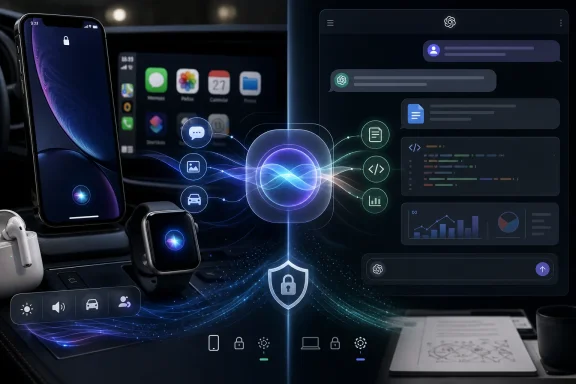 Apple Is Not Trying to Build a Better Chat Room
The mistake in many Siri-versus-ChatGPT comparisons is assuming that all assistants want to become the same product. ChatGPT and Claude are built around conversation as the primary interface. You open a window, describe a task, attach material, refine the answer, and continue iterating until the work is done.Siri’s natural home is not that window. Siri lives in the lock screen, the side button, the AirPods stem, the watch face, CarPlay, Spotlight, Messages, Calendar, Photos, Shortcuts, and dozens of small moments where opening a chatbot feels like too much ceremony. Apple’s thesis is that the best assistant is not always the cleverest one; it is the one already standing where the user’s intent appears.
That is why Apple’s WWDC 2026 pitch, as described in Apple’s own newsroom material and echoed by outlets covering the launch, centers on personal context, on-screen awareness, and actions across apps. Those are not simply features. They are Apple’s answer to the fact that OpenAI and Anthropic can reason powerfully but do not own the operating system beneath the user’s work.
If Siri can understand “send this to Mom,” “make this photo look like the other one,” “move the meeting after my flight lands,” or “find the file Dave sent me last week and summarize it,” then it has an advantage that benchmark charts do not measure. The model does not need to be the smartest in the world if it can safely reach the most relevant part of your world.
ChatGPT and Claude Still Own the Hard Thinking
None of this makes ChatGPT or Claude look weak. In fact, it clarifies why they became indispensable so quickly. When the task is writing a proposal, debugging a messy codebase, comparing arguments, drafting a legal-style memo, generating a marketing campaign, or exploring unfamiliar technical material, the chatbot interface is not a limitation. It is the workspace.OpenAI has spent the last several years turning ChatGPT from a text box into a general-purpose workbench: models for reasoning, coding, image generation, file analysis, voice interaction, and agent-like tasks. Anthropic has pushed Claude hard toward long-context analysis, careful writing, enterprise workflows, and coding assistance. Recent reporting from Axios and TechRadar around Anthropic’s Sonnet 5 release shows the industry’s center of gravity moving from simple chat toward agents that can complete multi-step work.
That is the frontier-model advantage. ChatGPT and Claude do not need to know where Apple hides every setting or how iOS routes a reminder. They need to be excellent at abstraction, synthesis, planning, critique, and generation. For many knowledge workers, that is the job.
Siri’s challenge is that “good enough reasoning plus perfect context” only beats “excellent reasoning plus partial context” when Siri’s execution layer actually works. If it misunderstands the user’s intent, cannot access the right app, fails to complete a multi-step task, or punts to a web result, the magic collapses quickly. The user does not forgive a system assistant the way they forgive a chatbot draft.
Apple’s Privacy Argument Is Stronger Than Its Intelligence Argument
Apple’s most credible advantage is not that Siri will outthink Claude or ChatGPT. It is that Siri can make a more persuasive privacy bargain. Apple can say, with a straight face, that intimate context belongs on the device or inside privacy-preserving infrastructure, not in a generic cloud chat log.That matters because the most useful assistant is also the most invasive one. To become genuinely helpful, an assistant needs access to messages, calendars, location patterns, call history, photos, files, app content, purchases, contacts, health-adjacent signals, and workplace documents. Users may happily paste a document into ChatGPT for a one-off task, but they may be far more cautious about giving a third-party chatbot standing permission to roam their digital life.
Apple’s architecture gives it a story that OpenAI and Anthropic cannot easily copy. The company controls the hardware, operating system, app permission model, secure enclave, cloud sync story, and App Store rules. It can put boundaries around what the assistant sees and does, and it can present those boundaries in familiar Apple language.
But privacy is not a spell. It is an engineering and product discipline. If Siri’s local intelligence is too limited, it will need cloud help. If cloud help is too constrained, answers may be weak. If Apple leans on outside model partners, users will need clear disclosure about what leaves the device and under what terms. The winning privacy story is not “everything stays local,” because that is unlikely to be true for every advanced task. The winning story is that the user understands the tradeoff before the assistant acts.
The System Layer Is Where Siri Can Actually Win
The best version of Siri does not compete with ChatGPT by writing a better essay. It wins by reducing friction in places where ChatGPT is structurally awkward. A system assistant can turn intelligence into action without making the user copy, paste, export, upload, download, rename, and reinsert the result.This is the practical power of integration. ChatGPT can help you write a message. Siri can, in theory, understand the message thread, know the recipient, preserve the tone, attach the right file, and send it through the app you were already using. Claude can summarize a long document beautifully. Siri can, in theory, find the relevant document from a half-remembered clue, summarize it, attach it to a calendar event, and remind you before the meeting.
That “in theory” is doing heavy lifting. Apple has promised versions of this future before, and the delayed rollout of the most ambitious Siri features damaged confidence. MacRumors, Business Standard, Macworld, and others documented Apple’s earlier delays around personal context, on-screen awareness, and deeper app control after those features were first previewed during the Apple Intelligence push.
The delay history matters because system integration is brittle. Chatbots can improve invisibly on the server side. Siri must coordinate model behavior, OS frameworks, app developer adoption, permissions, localization, accessibility, latency, and privacy constraints. Apple’s advantage is also its burden: it is trying to make AI behave like part of the computer.
The App Intents Problem Is Apple’s Hidden Bottleneck
For Siri to become more than a prettier voice assistant, apps need to expose meaningful actions. Apple can control its own apps, but the iPhone’s real value comes from the messy sprawl of banking apps, travel apps, productivity suites, messaging platforms, delivery services, enterprise tools, smart-home apps, and niche utilities. If those apps do not provide rich hooks for Siri, the assistant will hit walls.This is where Apple’s platform power cuts both ways. Developers have strong incentives to support system features that Apple highlights, especially if users begin expecting Siri compatibility as a mark of quality. But developers also have limited time, complex privacy obligations, and business reasons not to expose every valuable workflow to an assistant layer controlled by Apple.
The same problem applies on Windows and Android in different forms. AI agents become more useful when software exposes structured actions rather than forcing models to blindly click around a screen. Microsoft has been moving Copilot deeper into Windows and Microsoft 365 for the same reason: the assistant is only as useful as the tools it can safely operate.
Apple’s App Intents strategy could become the strongest foundation for consumer AI automation. It could also become another feature developers implement shallowly, with a handful of demo-friendly actions and little depth. The difference will decide whether Siri feels like a system brain or a voice-operated shortcut launcher.
ChatGPT’s Strength Is That It Does Not Need Permission to Be Useful
ChatGPT’s advantage is portability. It works across Windows, macOS, iOS, Android, browsers, APIs, developer tools, and enterprise environments. It does not need to own the operating system because its core use case is intellectual labor: drafting, explaining, coding, transforming, planning, translating, analyzing, and generating.That makes ChatGPT the more obvious general assistant for people who live across platforms. A Windows desktop at work, an Android phone, an iPad at home, and a browser everywhere else is not an edge case. It is normal computing. Apple’s integration is powerful inside the garden, but ChatGPT’s value follows the account rather than the device.
OpenAI has also moved aggressively into multimodal creation. Image generation and editing are no longer novelty features; they are part of the same creative workflow as copywriting, product mockups, social posts, presentation drafts, and design exploration. Siri can manipulate and find photos inside Apple’s ecosystem, but ChatGPT is better understood as a creative studio.
The weakness is that ChatGPT often requires the user to be a project manager. The user must formulate the prompt, supply the files, define the goal, verify the result, and decide what to do next. That is acceptable for complex work. It is overkill for “reply to this,” “file that,” “turn this into a reminder,” or “show me the photo from the restaurant last Friday.”
Claude’s Niche Is Becoming Less Niche
Claude’s reputation has been built around careful prose, long-document handling, coding help, and a tone that many professionals find less hyperactive than ChatGPT. That sounds like a niche until you realize how much white-collar work consists of reading, summarizing, rewriting, comparing, and deciding what matters. Claude is not merely a chatbot for essays; it is a machine for turning information overload into usable structure.Anthropic’s enterprise positioning also matters. Claude’s appeal is strongest where trust, restraint, and document-heavy workflows matter: legal teams, analysts, engineers, researchers, compliance staff, and managers drowning in PDFs and meeting notes. It may not have Apple’s system hooks or OpenAI’s consumer momentum, but it has a clear identity.
Claude’s weakness in a Siri comparison is obvious: it is not a native operating-system assistant. It can be added to workflows, integrated through APIs, and used in coding tools, but it does not naturally know that your AirPods are connected, your meeting starts in eight minutes, your kid texted you from school, and your Mac has a file open that needs to become a PDF.
That does not make Claude less intelligent. It means intelligence and presence are different product virtues. Claude is the colleague you consult. Siri wants to become the assistant who is already in the room.
Image Work Reveals the Difference Between Creation and Context
The original comparison from iPhoneIslam, drawing on Geeky Gadgets, argues that Siri and ChatGPT are stronger than Claude for image tasks. That is broadly fair, but the reason matters. ChatGPT is strong because it can generate and edit images as part of a creative conversation. Siri is strong because it can operate inside the user’s photo library and device context.Those are not the same job. ChatGPT is the place to create a campaign visual, iterate on a product mockup, restyle an image, or generate a concept from scratch. Its value is imaginative and generative. The output is often something new.
Siri’s photo value is personal and operational. It can help find, organize, edit, share, or act on images already inside the user’s life. If Apple gets the integration right, “find the picture where Emma is wearing the red jacket at the beach and send it to Dad” is the kind of task where Siri should beat a generic chatbot, not because it is smarter, but because it is closer to the data.
Claude has historically been less associated with image generation and editing than OpenAI’s consumer products. That may change over time, and Anthropic has continued broadening Claude’s capabilities. But its center of gravity remains text, code, documents, and reasoning rather than consumer-facing image creation.
Coding Is Where Siri Should Not Pretend to Compete
For programming, the comparison is brutally simple. ChatGPT and Claude are serious coding assistants. Siri is not. Apple can make Siri useful for developer-adjacent device tasks, but it is not the tool most developers will choose to reason through architecture, generate tests, inspect errors, refactor code, or explain a library.The coding race has become one of the clearest fronts in AI competition. OpenAI, Anthropic, Google, Microsoft, and others are all trying to turn models into software collaborators that can read repositories, understand terminals, generate patches, and operate inside IDEs. Anthropic’s Claude Code work and OpenAI’s Codex-related efforts show that the endpoint is not autocomplete; it is delegated engineering.
Siri could still matter to developers as an operating-system convenience. It might open projects, trigger shortcuts, summarize notifications, control Xcode-adjacent workflows, or coordinate between Apple devices. But that is not the same as being a coding brain. Apple would be foolish to market Siri as a replacement for Claude or ChatGPT in software development.
The better Apple strategy is to make the Mac a superb host for other models while keeping Siri focused on the system layer. If a developer wants Claude in the terminal, ChatGPT in the browser, Copilot in the editor, and Siri handling device context, that is not a failure of Siri. It is a realistic division of labor.
Speed Is Not the Same as Intelligence
Siri has always had a speed advantage in narrow tasks. Set a timer. Start a workout. Turn off the lights. Call someone. Add a reminder. Skip a track. For these jobs, latency matters more than eloquence. A brilliant paragraph after three seconds is worse than a completed action in half a second.ChatGPT and Claude are optimized for a different rhythm. They can be fast, but their value often appears over multiple turns. The user asks, corrects, adds constraints, requests alternatives, and pushes the model toward a finished artifact. That process feels natural when the output is a document, a plan, or an analysis.
The new Siri has to bridge those worlds without becoming annoying. If every quick command turns into a conversational negotiation, Apple will have damaged one of Siri’s remaining strengths. If every complex request gets squeezed into the old voice-command pattern, Siri will feel underpowered.
The ideal assistant changes tempo. It should be instant for deterministic commands, conversational for ambiguous work, and cautious for actions with consequences. That is easy to describe and hard to ship.
The Trust Gap Is Apple’s Real Opponent
Apple’s largest obstacle may not be OpenAI or Anthropic. It may be Siri’s reputation. For years, Siri has trained users to ask for less. People learned which commands worked, which phrases failed, and when it was faster to tap the screen. That learned caution is difficult to reverse.ChatGPT had the opposite trajectory. It arrived with obvious flaws but also with moments of surprise. Users asked impossible-seeming questions and received useful answers. Even when it hallucinated, it felt like a new category of tool. Siri, by contrast, often felt like an old category that had failed to evolve.
Apple therefore needs more than a feature checklist. It needs repeated moments where Siri does something meaningfully useful that users did not expect it could do. The assistant must earn permission to be asked harder questions.
That trust will be built task by task. If Siri correctly understands personal context, cites the right message, chooses the right app action, confirms before sending, and completes the task, users will expand their expectations. If it fails in front of them during ordinary moments, they will retreat to ChatGPT, Claude, search, or manual tapping.
Enterprise IT Will Not Treat Siri Like a Toy
For WindowsForum’s sysadmin and IT-pro readership, the most interesting question is not whether Siri can beat ChatGPT in a consumer comparison. It is how these assistants behave when they enter managed environments. Personal AI becomes a governance problem the moment it touches corporate data.ChatGPT and Claude already sit inside enterprise procurement, identity, compliance, logging, data-retention, and model-access conversations. Organizations can license them, restrict them, integrate them, monitor usage, and train employees on acceptable workflows. The risks are obvious, but the management surface is also becoming familiar.
Siri’s system-level intimacy creates a different kind of question. If an assistant can read on-screen content, understand messages, search local files, and act across apps, administrators will need policy controls that are more granular than “AI on” or “AI off.” They will want to know what data is processed locally, what data can be sent to cloud models, how third-party model handoff works, and how actions are logged or confirmed.
Apple’s privacy posture helps, but enterprise buyers do not run on vibes. They need documentation, controls, auditability, and predictable behavior across fleets. If Apple wants Siri to matter beyond personal iPhones, it must speak the language of managed risk as fluently as it speaks the language of delight.
The Winner Depends on the Job, Not the Benchmark
The most honest comparison is not a single winner’s podium. Siri, ChatGPT, and Claude are converging in some capabilities, but they still represent different theories of assistance. Siri is the integrated operator. ChatGPT is the flexible generalist and creator. Claude is the careful analyst and document thinker.For everyday Apple-device control, Siri has the natural advantage. It can become the best assistant for actions that start in personal context and end in system execution. If Apple succeeds, users will not think of those moments as “using AI.” They will think of them as the computer finally understanding what they meant.
For creative and technical work, ChatGPT remains the more versatile tool. It is better suited to open-ended ideation, multimodal production, coding help, and tasks where the user wants to shape the result through conversation. Its weakness is not intelligence; it is distance from the operating system.
For dense professional reading and writing, Claude remains formidable. Its disciplined style and long-context strengths make it especially attractive for users who care less about flashy integrations and more about high-quality synthesis. Its weakness is that it is usually a destination, not an ambient layer.
The Apple Assistant Wins Only If It Stops Acting Like Old Siri
The useful takeaway is not that one assistant is “best.” The useful takeaway is that the assistant market is splitting into roles, and Apple’s role is unusually demanding because Siri must be both smarter and more dependable than before.- Siri’s strongest path is system-level action across Apple devices, not out-arguing ChatGPT or Claude in a blank chat window.
- ChatGPT remains the more flexible choice for creative work, coding, image generation, brainstorming, and general-purpose problem solving.
- Claude remains especially strong for long documents, careful writing, structured analysis, and professional knowledge work.
- Apple’s privacy advantage is meaningful only if users and administrators receive clear controls over what is processed locally, what goes to the cloud, and when outside models are involved.
- Siri’s biggest risk is not weak branding but unreliable execution, because users will not trust a system assistant that fails at personal tasks.
- The practical future is multi-assistant computing, where Siri handles context and device action while ChatGPT and Claude handle deeper intellectual work.
References
- Primary source: آي-فون إسلام
Published: 2026-07-06T15:50:14.288315
Loading…
iphoneislam.com - Related coverage: techradar.com
Claude Sonnet 5 is here, and the 'most agentic Sonnet model yet' shows that the AI war is shifting from chat to agents | TechRadar
Let the agent wars beginwww.techradar.com - Official source: apple.com
Apple introduces Siri AI, a profoundly more capable and personal assistant - Apple
Apple introduces Siri AI, a profoundly more capable and personal assistant powered by Apple Intelligence, with personal context, world knowledge, and onscreen awareness.www.apple.com - Related coverage: allthings.how
Loading…
allthings.how - Related coverage: macrumors.com
Loading…
www.macrumors.com - Official source: help.openai.com
Loading…
help.openai.com
- Related coverage: business-standard.com
Loading…
www.business-standard.com - Related coverage: macworld.com
Loading…
www.macworld.com - Related coverage: moneycontrol.com
Loading…
www.moneycontrol.com - Related coverage: windowscentral.com
ChatGPT Images AI model promises precision and speed | Windows Central
ChatGPT images just got a massive upgrade and are now 4x faster, more precise, and more creative.www.windowscentral.com