

Newman’s Own has quietly weaponized generative AI to squeeze enterprise-grade productivity out of a 50-person operation — using Microsoft 365 Copilot to close the capability gap with multinational consumer packaged goods (CPG) rivals and, critically, direct more dollars to the Newman’s Own Foundation’s work for children in need.
Newman’s Own began as a simple idea: actor Paul Newman sold his homemade salad dressing and pledged that all profits would be donated to charity. That mission persists today through Newman’s Own and the Newman’s Own Foundation, which reports hundreds of millions of dollars donated to charitable causes since the company’s founding in 1982. The brand operates in the same crowded, margin-pressured CPG markets as multinational giants, but unlike those companies it channels 100% of profits to philanthropic work. In early 2025 Newman’s Own announced a measured but broad deployment of Microsoft 365 Copilot across marketing, logistics, legal and other functions — a practical, productivity-first application of generative AI (GenAI) that aims to free staff time for higher-value work and, by extension, increase the funds available for charitable giving. Microsoft’s customer story summarizing the program highlights quick wins and measurable time savings after Copilot was put into regular use.
Key dynamics that make this model attractive:
Examples in the broader CPG and food space — where companies such as Kellanova and Mondelēz are using data science and AI to optimize forecasting, inventory and sales execution — illustrate the competitive pressure to modernize. By adopting Copilot and similar productivity tools, smaller brands like Newman’s Own can move faster on content and insights without duplicating the large investments of a multinational. The result is a narrower gap in day-to-day execution even if absolute scale remains different.
That alignment introduces ethical obligations:
For other CPG brands — and small enterprises more broadly — the message is straightforward: GenAI can be a productivity multiplier when deployed with governance, contractual clarity and attention to real-world measurement. For Newman’s Own, those productivity gains translate directly back into the philanthropic mission, magnifying a legacy that began with a salad dressing and has become an enduring model of purpose-led business.
Source: PYMNTS.com Newman’s Own Uses GenAI to Compete With Consumer Products Giants | PYMNTS.com
 Background
Newman’s Own began as a simple idea: actor Paul Newman sold his homemade salad dressing and pledged that all profits would be donated to charity. That mission persists today through Newman’s Own and the Newman’s Own Foundation, which reports hundreds of millions of dollars donated to charitable causes since the company’s founding in 1982. The brand operates in the same crowded, margin-pressured CPG markets as multinational giants, but unlike those companies it channels 100% of profits to philanthropic work. In early 2025 Newman’s Own announced a measured but broad deployment of Microsoft 365 Copilot across marketing, logistics, legal and other functions — a practical, productivity-first application of generative AI (GenAI) that aims to free staff time for higher-value work and, by extension, increase the funds available for charitable giving. Microsoft’s customer story summarizing the program highlights quick wins and measurable time savings after Copilot was put into regular use. How a small CPG company is using Microsoft 365 Copilot
Newman’s Own’s deployment is deliberately workplace-centric: Copilot is embedded in Microsoft 365 apps employees already use, creating a low-friction path to adoption while also allowing the company to operate within an enterprise tenant and contractual protections rather than relying on consumer-grade chatbots.Day-to-day use cases
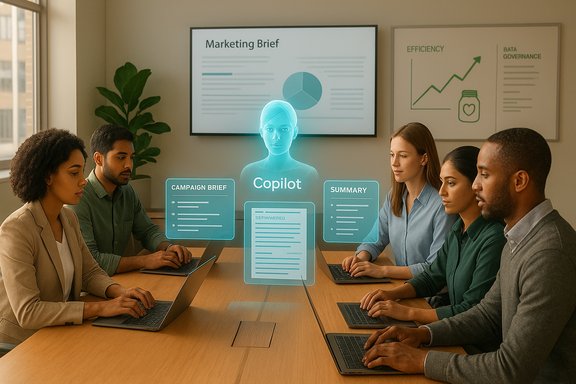
- Marketing: Copilot acts as a content co-creator for campaign briefs, social posts, and creative iterations. Newman’s Own reports the marketing team was able to triple the number of campaigns produced in a month after adopting GenAI-assisted workflows.
- Logistics and transportation: staff who previously spent half a day scanning daily industry publications now use Copilot to summarize and highlight actionable items in roughly 30 minutes, enabling faster cost-control and idea discovery.
- Research and knowledge work: tasks that once took two people two days now take a single person two hours by leveraging Copilot’s rapid synthesis and citation features.
- Legal support: with a compact legal team, the Chief Legal Officer uses GenAI as a junior associate for initial research, question triage and citation gathering — effectively enlarging legal capacity without adding headcount.
Overview: Why Copilot for a 50-person CPG makes sense
Most small-to-mid CPG brands lack the scale to maintain large in-house creative, legal and analytics teams. Generative AI, when integrated into the productivity stack, performs a multiplier role: it elevates each employee’s throughput, flattens routine work, and brings tasks that historically required specialized contractors into the core team.Key dynamics that make this model attractive:
- Low switching friction: embedding GenAI within Office apps means staff don’t leave familiar tools to gain AI benefits. This accelerates adoption and reduces training overhead.
- Cost-efficiency: automating repeatable creative and research work reduces reliance on external agencies for campaign drafts and background research, freeing budget for product and philanthropic priorities.
- Mission amplification: for a company that donates all profits, time saved directly translates to increased charitable capacity — a rare business model where productivity gains have immediate philanthropic upside.
A closer look: measurable wins and how they were achieved
The headlines — tripled marketing cadence, research compressed from days to hours, legal assistant-like support — are vivid, but the real story is in how those results were engineered.1) Process design, not magic
The improvements at Newman’s Own came from thoughtfully redesigning processes around the assistant:- Standardized prompts and templates: marketing and logistics teams used consistent prompt frameworks so outputs were repeatable and required minimal human editing.
- Human-in-the-loop review: for all externally facing content and legally sensitive outputs, a human reviewer validates and refines Copilot-generated drafts before publication.
- Role-based access and tenant governance: Copilot is used inside an enterprise tenant that provides administrative controls and integration with data loss prevention (DLP) policies, reducing the risk that sensitive data leaks to vendor training datasets.
2) Tactical use cases that scale
The company focused on practical, high-frequency tasks where small time savings compound:- Summaries and briefings: Copilot condenses long documents and daily publications into short, actionable summaries for logistics and procurement teams.
- Campaign ideation: rapid A/B creative drafts and variations let social and content teams iterate faster and run more experiments.
- Contract triage and clause research: legal uses Copilot to surface relevant clauses, case law snippets and sources, reducing initial research time significantly.
3) Measurement and baseline comparison
Newman’s Own tracked time-on-task before and after Copilot deployment, converting saved hours into equivalent salary cost reductions and incremental campaign throughput. Those time-savings were then presented internally as funds that could be redeployed to higher-impact activities or add to the pool of profit directed to the foundation. This measurement-first approach reduced the “shiny toy” risk and made outcomes defensible.The technical and vendor-side considerations
Deploying Copilot inside a small company still requires careful architecture and vendor negotiation.Grounding, data residency and contractual protections
Enterprise-grade Copilot deployments typically include contractual assurances around training data and telemetry, and enterprise customers can negotiate Data Processing Agreements (DPAs) that limit how prompts and outputs are used for model training. These elements are essential for organizations that handle sensitive documents or regulatory material. Newman’s Own adopted Copilot within Microsoft’s enterprise framework, where these protections are commonly part of the enterprise offering.Copilot Studio and agents (where applicable)
Microsoft’s wider Copilot platform includes tooling for building agents and automation (Copilot Studio) that let organizations scale multi-step workflows across systems. For an organization like Newman’s Own, connecting Copilot to internal data sources and automating routine workflows — while maintaining observability and logs — is an important next step for safely expanding AI-driven efficiency. Observability and governance features in agent tooling are important because they create the audit trail needed for compliance and trust.Operational security and governance
Practical technical controls that organizations should enforce include:- Sensitivity labels and DLP rules to prevent PII or financial records from being sent to external model endpoints without safeguards.
- Central logging of prompts and responses with retention policies to support audits and any external transparency requirements.
- Role-based licensing to prevent blanket access that could lead to ungoverned usage.
Competitive context: why GenAI matters for small CPG brands
Major CPG players have already invested heavily in digital and AI-driven capabilities — from demand forecasting to personalized commerce experiences. Smaller brands historically competed on niche positioning, branding and agility. GenAI presents a powerful equalizer: it reduces the cost of high-quality content production, speeds research and competitive analysis, and automates administrative drag.Examples in the broader CPG and food space — where companies such as Kellanova and Mondelēz are using data science and AI to optimize forecasting, inventory and sales execution — illustrate the competitive pressure to modernize. By adopting Copilot and similar productivity tools, smaller brands like Newman’s Own can move faster on content and insights without duplicating the large investments of a multinational. The result is a narrower gap in day-to-day execution even if absolute scale remains different.
Risks, trade-offs and red flags
Generative AI delivers measurable gains, but it brings real operational and reputational risks that must be managed.Hallucination and factual accuracy
AI-generated summaries and legal research can be prone to hallucination — confidently presented but incorrect assertions. The only reliable mitigation is human verification for decision-facing material and a strict rule that AI outputs are drafting aids, not final authority. Newman’s Own uses Copilot outputs as starting points with human sign-off required for all outward communications.Data privacy and training concerns
Enterprises should never assume vendor marketing equals contract. The important protections are contractual: explicit non-training clauses, data residency guarantees, deletion rights, and telemetry visibility. Public-sector and regulated organizations have already documented how these contract clauses should be treated as procurement essentials, and the same discipline applies to mission-driven private companies handling third-party data or sensitive contracts.Governance and auditability
If AI influences decisions that affect stakeholders, the organization must record what the AI did, who reviewed it, and how the decision was finalized. This includes logging prompts and outputs, storing run histories for agents, and creating a human-review trail. Without these controls, errors are harder to detect and remediate, and external scrutiny can quickly escalate.Vendor lock-in and platform risk
Relying on a single cloud or model ecosystem can lead to lock-in. Multi-model and orchestration strategies are emerging (where platforms route tasks to the best model for cost and performance), but they add complexity. Organizations should plan for portability, contractual exit rights, and clear SLAs for availability and performance.Practical checklist for CPG teams considering GenAI
Based on Newman’s Own’s experience and industry best practices, small brands should consider the following rollout checklist:- Define the problem set: identify 3–5 high-frequency tasks where time savings will compound (e.g., content drafts, document summaries, supplier research).
- Start with an enterprise tenant: pilot inside a controlled Microsoft 365 tenant (or equivalent enterprise environment) rather than public consumer chatbots.
- Negotiate contractual protections: require non-training clauses, data residency guarantees, deletion and export rights, and telemetry transparency.
- Implement DLP and sensitivity labels: block or gate PII and financial records from being sent to models unless explicitly allowed under contract.
- Build templates and prompts: standardize prompts and output formats so generated content is predictable and requires minimal editing.
- Require human sign-off for external outputs: establish clear rules for what AI can draft and what must be reviewed.
- Measure and report: track time saved, campaign throughput gains, and cost avoidance to validate ROI and philanthropic impact.
Ethical and mission considerations for purpose-driven brands
Newman’s Own’s use of GenAI is a compelling case study because the company’s purpose — donating all profits — creates an unusual alignment between operational efficiency and social impact. Productivity gains do not merely grow margins; they increase the finite pool of dollars that can be given away.That alignment introduces ethical obligations:
- Transparency about AI use in communications and fundraising materials so stakeholders understand how content is generated.
- Responsible messaging: ensuring that Copilot-generated marketing does not exaggerate product claims or the brand’s impact.
- Prioritizing jobs and skills transition: when automation changes workload, mission-driven organizations should consider reskilling and redeploying staff to higher-impact roles rather than immediate headcount reduction.
What Newman’s Own’s story means for the wider CPG sector
Newman’s Own demonstrates a pragmatic pattern that other small and medium CPG brands can emulate:- GenAI can compress routine tasks and expand a small team’s capability envelope.
- Embedding AI inside existing productivity tools reduces adoption friction and improves governance.
- Time saved is a convertible asset: for a for-purpose enterprise, it becomes increased charitable capital; for other brands, it can be reinvested in product innovation, customer experience, or growth.
Critical assessment: strengths and caveats
Newman’s Own’s program has notable strengths:- Focused deployment: by targeting high-frequency, high-friction tasks, the company realized visible ROI fast.
- Enterprise controls: using Microsoft’s enterprise Copilot offering allowed the company to retain contractual protections and administrative controls it would lack with consumer AI tools.
- Mission-aligned outcomes: time and cost savings feed directly into the organization’s philanthropic mission, creating immediate social return on investment.
- Accuracy risk: any factual or legal errors introduced by Copilot could produce reputational risk if not caught by reviewers. The experience shows human oversight remains essential.
- Governance burden: small organizations must still invest in procurement, legal and IT capability to negotiate DPAs, configure tenant-level protections and maintain logs — work that requires expertise and time.
- Dependency and costs: as usage scales, cloud consumption and per-seat Copilot licensing can increase operational costs; teams need to track consumption and optimize prompts and workflows to control spend.
Final thoughts
Newman’s Own’s adoption of Microsoft 365 Copilot is a clear, practical example of how generative AI can be operationalized by a small, mission-driven company to compete more effectively with much larger rivals. The real win is not novelty but disciplined execution: embedding Copilot in daily workflows, pairing AI drafts with human review, negotiating enterprise protections, and measuring the time and money savings that convert into charitable impact.For other CPG brands — and small enterprises more broadly — the message is straightforward: GenAI can be a productivity multiplier when deployed with governance, contractual clarity and attention to real-world measurement. For Newman’s Own, those productivity gains translate directly back into the philanthropic mission, magnifying a legacy that began with a salad dressing and has become an enduring model of purpose-led business.
Source: PYMNTS.com Newman’s Own Uses GenAI to Compete With Consumer Products Giants | PYMNTS.com
