

Microsoft's next Xbox hardware may be closer to reality than fans expected — but "closer" does not mean "certain," and the picture that is emerging is one of ambition tempered by supply-chain reality and deep software integration challenges.
In recent days AMD CEO Dr. Lisa Su signaled during AMD's Q4 2025 earnings call that the chipmaker's semi-custom system-on-chip (SoC) for Microsoft's next-generation Xbox is "progressing well to support a launch in 2027," an off‑hand line that reignited reporting and speculation across the industry. That comment from AMD is verifiable in the published earnings transcript and was repeated by multiple outlets as a direct quote from the call.
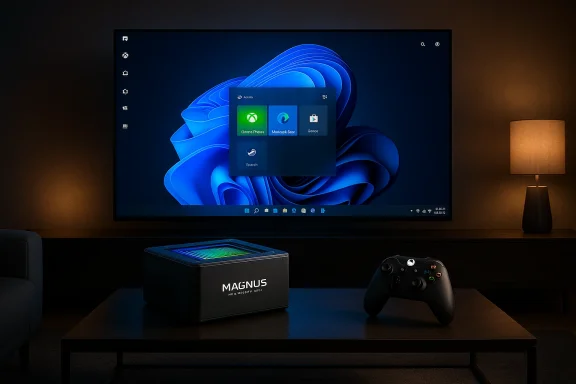
But the "2027" timeline appears to be a target from AMD's perspective — not a firm, companywide commitment from Microsoft. Reporting from Windows Central, which cites internal Xbox and Windows sources, portrays 2027 as a best case scenario that hinges on Microsoft delivering a polished operating system experience on that new hardware. In this vision the Gen‑10 Xbox would ship with a TV‑first, console-like interface that sits on top of full Windows 11, and users could "exit" from the Xbox mode to a full Windows 11 desktop and run any Windows programs — including third‑party PC storefronts like Steam or Epic. Windows Central also reports that AMD's internal SoC codename for the project is "Magnus," and that Microsoft may allow OEM partners to build alternative Xbox‑branded hardware with different price/performance points. (windowscentral.com)
Concurrently, Valve's Steam hardware program — the Steam Machine and Steam Frame announced last year — has publicly flagged memory and storage shortages as a reason to revisit shipping schedules and pricing. That same market pressure is influencing Microsoft’s calculations: component costs, especially DRAM and next‑generation memory types, and geopolitical factors such as tariffs are explicitly cited by reporting as complicating final pricing and launch economics for any new console.
This article synthesizes what is currently verifiable, highlights where reporting departs into reasonable inference or rumor, and assesses both the strategic strengths and the tangible risks in Microsoft’s apparent playbook: a Windows‑centric, OEM‑friendly next‑gen Xbox ecosystem powered by a high‑ambition AMD semi‑custom APU.
Why this matters:
Key reported pieces:
What remains highly speculative:
Practical implications:
What we have on firm ground is AMD’s confirmation that its semi‑custom SoC development is aligned to support a 2027 launch window, and Microsoft‑adjacent reporting that this is a "best case" for a product that ultimately depends on Windows 11 maturity and volatile hardware markets. The rest — detailed SoC specs, final pricing, OEM SKUs and exact launch timing — remains in the realm of evolving reporting and leaks. Readers should watch for direct announcements from Microsoft and AMD and treat leak‑level technical specifics cautiously until we see hardware or official product documentation.
Source: Wccftech Xbox Next Gen Might Launch in 2027, But It's a "Best Case Scenario"; Console Will Run Full Windows 11, OEM Can Make Their Own Hardware
 Background / Overview
In recent days AMD CEO Dr. Lisa Su signaled during AMD's Q4 2025 earnings call that the chipmaker's semi-custom system-on-chip (SoC) for Microsoft's next-generation Xbox is "progressing well to support a launch in 2027," an off‑hand line that reignited reporting and speculation across the industry. That comment from AMD is verifiable in the published earnings transcript and was repeated by multiple outlets as a direct quote from the call. But the "2027" timeline appears to be a target from AMD's perspective — not a firm, companywide commitment from Microsoft. Reporting from Windows Central, which cites internal Xbox and Windows sources, portrays 2027 as a best case scenario that hinges on Microsoft delivering a polished operating system experience on that new hardware. In this vision the Gen‑10 Xbox would ship with a TV‑first, console-like interface that sits on top of full Windows 11, and users could "exit" from the Xbox mode to a full Windows 11 desktop and run any Windows programs — including third‑party PC storefronts like Steam or Epic. Windows Central also reports that AMD's internal SoC codename for the project is "Magnus," and that Microsoft may allow OEM partners to build alternative Xbox‑branded hardware with different price/performance points. (windowscentral.com)
Concurrently, Valve's Steam hardware program — the Steam Machine and Steam Frame announced last year — has publicly flagged memory and storage shortages as a reason to revisit shipping schedules and pricing. That same market pressure is influencing Microsoft’s calculations: component costs, especially DRAM and next‑generation memory types, and geopolitical factors such as tariffs are explicitly cited by reporting as complicating final pricing and launch economics for any new console.
This article synthesizes what is currently verifiable, highlights where reporting departs into reasonable inference or rumor, and assesses both the strategic strengths and the tangible risks in Microsoft’s apparent playbook: a Windows‑centric, OEM‑friendly next‑gen Xbox ecosystem powered by a high‑ambition AMD semi‑custom APU.
What AMD actually said — and why it matters
AMD’s Q4 earnings call transcript contains the line that set this reporting round in motion: that the company’s semi‑custom SoC work for Microsoft is "progressing well to support a launch in 2027." That phrasing is important — it speaks to AMD readiness, not necessarily to Microsoft’s product launch decision. AMD, as a silicon supplier, can confirm engineering milestones and tapeout windows; Microsoft controls product timing, pricing, marketing and the software experience.Why this matters:
- Console launches depend on multiple disciplines: silicon readiness, OEM manufacturing, OS and UI polish, content roadmaps, licensing and retail economics.
- A chipset supplier saying it supports a given launch timeline is a necessary but not sufficient condition for a platform launch to actually occur on that schedule.
- The line helps explain why many outlets quickly repeated a 2027 horizon: AMD’s readiness reduces one large technical unknown.
The Windows‑centred console: what's being reported and what’s verified
Windows Central’s reporting is the clearest portrayal of Microsoft’s internal design vision: a console that defaults to a TV‑first Xbox interface but which runs full Windows 11 underneath, allowing an optional exit into a native Windows environment and support for PC storefronts, accessories, and applications. The site frames the approach as a deliberate attempt to merge the Xbox living‑room experience with Windows' general‑purpose PC capabilities. (windowscentral.com)Key reported pieces:
- The Gen‑10 Xbox will run Windows 11 as the base operating system, with an Xbox UI layered on top.
- Users will be able to "exit" to full Windows and run arbitrary Windows apps and other PC stores (e.g., Steam, Epic).
- Microsoft may build a premium flagship box while also enabling OEM partners (ASUS, Lenovo and others) to ship alternative Xbox‑branded hardware at different price/performance points.
- AMD's internal SoC codename for the program: "Magnus."
- The Windows Central piece is explicit, sourced to internal reporting from Jez Corden and his contacts; the quote and framing appear in the published article. (windowscentral.com)
- AMD’s chip‑readiness comment is verified in the earnings transcript.
- The full implementation details of the Windows experience on the console (exact APIs, driver model, kernel modifications, digital rights and content policies) are not public from Microsoft.
- The degree to which Microsoft will permit other PC storefronts to integrate or whether there will be exclusive incentives/taxonomies (for Game Pass, Microsoft Store) is unannounced; Windows Central reports expectations based on sources, but this is not an official Microsoft specification.
- Hardware SKUs, precise pricing targets, memory and storage configurations, and exact SoC die layout remain unannounced by either Microsoft or AMD. Several outlets have reported speculative "Magnus" specs, but those stem from leaks and analysis, not manufacturer confirmation.
Why Microsoft might want a Windows‑underpinned console
There is strategic logic in Microsoft’s reported direction.- Platform convergence: A Windows‑based Xbox lets Microsoft collapse engineering effort across PC and console assets — unified drivers, a shared application platform, and simplified multi‑platform development. That aligns with Microsoft's long‑standing aim to make "Xbox" a service across devices. (windowscentral.com)
- Ecosystem leverage: If Xbox ships as a full Windows device, Microsoft can position Game Pass alongside legacy PC ecosystems, cloud streaming, and Windows tools — making Game Pass a cross‑device subscription that natively serves both couch gaming and desktop use.
- OEM and hardware variety: Allowing OEM manufacturers to ship Xbox‑branded Windows machines creates flexible price points and form factors, and reduces Microsoft’s singular dependency on loss‑leader console economics. Windows Central’s reporting that OEMs like ASUS could build variants is consistent with the Ally handheld precedent. (windowscentral.com)
- Developer reach: Developers who already target Windows gain a straightforward path to the living‑room form factor without separate porting targets, potentially broadening the install base for PC‑native titles on a TV.
The technical and business risks — why "best case scenario" is a cautious phrase
- Software‑polish and QA risk
- Shipping a console reliant on full Windows 11 demands a TV‑first shell that must be reliably robust in a living‑room environment. Consoles are judged by immediate, consistent behavior across years; Windows is historically a general‑purpose OS, and slippage in system updates, driver stacks or background processes can degrade the console experience. Windows Central explicitly notes Microsoft’s caution in not committing to a hard 2027 deadline because of Windows polish requirements. (windowscentral.com)
- Supply‑chain and pricing volatility
- DRAM and NAND shortages — driven this cycle by AI datacenter procurement — have inflated prices and constrained supply. Valve’s public reconsideration of Steam Machine timing and pricing is a real‑world example: even deep-pocketed companies must rethink launch economics when memory moves rapidly. Those same pressures complicate Microsoft’s ability to lock a retail price, margins and partner subsidies for first‑party titles.
- Platform clarity and messaging risk
- If a new Xbox is "also a PC," Microsoft faces the messaging challenge of convincing console gamers they are getting a durable, curated, living‑room experience — not a desktop that requires maintenance. Ambiguity here can harm pre‑order confidence and developer commitment.
- Developer and exclusivity calculus
- A Windows‑based Xbox reduces the distinction between console exclusives and PC games. While that broadens availability, it may erode perceived console value if consumers view the hardware as "just another PC." Microsoft will need to balance first‑party incentives, marketing, and performance differentiation.
- Economic model for consoles
- Historically, console makers subsidize hardware to secure a large install base and monetize through software and services. A premium Xbox box with PC‑grade hardware and elevated BOM (bill of materials) could reduce subsidy ability. Microsoft may rely more on Game Pass, cloud and retail pricing to justify shifts — but that requires playbooks that still have open questions. Reporting indicates Microsoft isn't overly worried about a higher launch price because cross‑generation support will persist, but that’s a gamble on customer patience and Game Pass adoption. (windowscentral.com)
The "Magnus" APU: leak, rumor, and reality
Multiple outlets and leaks have associated the internal codename "Magnus" with AMD's in‑development semi‑custom APU for the next console. Reporting about internal codenames and silicon roadmaps is common in the hardware press, and "Magnus" has appeared repeatedly in analysis pieces and leak circles. Windows Central includes the name as AMD’s internal designation; other outlets referencing leaks and die shots have used the same name. That consistency across sources strengthens the inference that "Magnus" is an AMD internal label. (windowscentral.com)What remains highly speculative:
- Exact die configuration (chiplet sizes, compute unit counts), memory bus width and RAM type, and on‑die AI accelerators are all reported by leak analysts, but none of those specifics are officially confirmed by AMD or Microsoft. Treat those technical claims as interesting leads rather than verified facts.
- Semi‑custom APU choices determine how easily OEMs can create variants, how thermal and power envelopes constrain form factors, and what background services (e.g., hardware‑accelerated AI tasks) can run efficiently on the device.
Pricing: the single variable that can change everything
Multiple reports converge on the same trouble spot: pricing is in flux. The primary drivers are:- Memory shortages and price inflation (DRAM and NAND).
- Geopolitical tariffs and manufacturing costs.
- Elevated component demand from AI data centers, which has shifted supplier priorities away from mass‑market consumer parts.
Practical implications:
- A premium MSRP could push Microsoft into a non‑subsidized model, making the device expensive for mainstream consumers and increasing the importance of Game Pass and cloud features to justify the cost.
- Alternatively, OEM variants could spread the hardware across price brackets — but that dilutes the "console" story and shifts Microsoft’s role to platform steward rather than single‑box manufacturer.
Strategic scenarios Microsoft could be considering
- Conservative launch (software‑first)
- Delay hardware until Windows 11 and TV‑first shell are absolutely rock‑solid; release a premium Microsoft flagship alongside OEM devices. Advantages: reduced risk of consumer backlash; better long‑term trust. Disadvantage: slower time‑to‑market.
- OEM‑led plurality (platform as a service)
- Microsoft ships a reference box and incentivizes OEMs to produce multiple Xbox‑branded Windows machines. Advantages: price segmentation, reduced capital risk. Disadvantage: potential fragmentation of user experience.
- Aggressive launch (first‑to‑market premium)
- Ship in 2027 with high performance and premium price, leaning on cross‑generation support and Game Pass to preserve the install base. Advantages: PR and performance leadership. Disadvantages: high BOM, potential slow uptake if pricing is prohibitive.
What this means for gamers, developers, and the market
For gamers:- Expect more choice if OEMs are allowed to ship Xbox‑branded Windows hardware. Choice can be good, but a fragmented ecosystem risks confusing the core audience that values simple, turnkey consoles.
- Backward compatibility may continue for current Xbox Series S/X owners for many years; Microsoft reportedly plans a protracted cross‑generation window, meaning an immediate replacement is not strictly necessary for current owners. (windowscentral.com)
- A Windows‑based Xbox could reduce porting friction for PC titles, but it also reduces the marketing edge of console exclusivity. Developers must weigh reach versus differentiated platform funding and support.
- Microsoft’s approach would pressure Sony and Nintendo to clarify their own strategic responses; Sony has reportedly extended PS5 plans and may not accelerate PS6 imminently.
- Valve’s hardware delays underscore broader supply‑chain fragility that could raise price floors across the industry for 2026–2027.
What to watch next — key signals and dates
- Microsoft official confirmations
- Any statement from Microsoft about Windows 11 as the base OS for a next‑gen Xbox, official SoC codenames, or OEM programs will be decisive.
- AMD milestones
- Silicon tapeout announcements, public performance disclosures, and AMD roadmap updates that reference "semi‑custom" or "Magnus" will clarify the technical feasibility of a 2027 cadence. AMD’s Q4 transcript is a starting point, but follow‑up details from AMD are necessary.
- Valve and component markets
- Memory price movements and Valve’s future updates on Steam Hardware pricing and shipping windows are real indicators of supply‑side pressure. A sustained high DRAM price environment could delay or raise prices industry‑wide.
- Developer tooling and OS updates
- Evidence that Microsoft is shipping developer previews, a specialized Xbox‑on‑Windows SDK, or console certification documents that reference Windows desktop mode would move the story from rumor to roadmap.
- OEM announcements
- Partnerships and product announcements from ASUS, Lenovo, or other traditional PC OEMs carrying an "Xbox" brand would confirm the OEM plurality strategy.
Final assessment: plausible with caveats
Here’s a concise risk/reward verdict:- Probability of some Xbox next‑gen hardware launching within a 2027–2028 window: probable (based on AMD readiness, public partnerships and multiple independent reports).
- Probability that the launch occurs exactly in 2027 and exactly as currently described (full Windows 11 with seamless exit, broad OEM support, and specified "Magnus" APU specs): uncertain to speculative. Many of the specific claims (detailed SoC specs, pricing) remain unverified leaks or internal reports and should be treated cautiously.
Practical takeaways for readers
- If you're an Xbox Series owner today: there is no immediate need to buy new hardware; Microsoft reportedly expects to support current consoles for a prolonged cross‑generation window.
- If you're planning a high‑end purchase in 2026–2027: factor in the possibility of elevated pricing for next‑gen console hardware driven by memory and storage market conditions.
- If you are a developer or an indie studio: watch for Microsoft tooling and SDK updates — a Windows‑centric Xbox could simplify PC‑to‑living‑room porting, but business terms around storefronts and Game Pass will matter.
Conclusion
The latest reporting — anchored by AMD’s earnings call and expanded by Windows Central’s inside reporting — sketches an audacious, software‑first blueprint for Xbox’s next hardware chapter: a premium, Windows‑powered living‑room machine supported by OEM partners and designed to blur the line between PC and console. The idea is logical and consistent with Microsoft’s broader platform strategy, but it is far from a closed deal.What we have on firm ground is AMD’s confirmation that its semi‑custom SoC development is aligned to support a 2027 launch window, and Microsoft‑adjacent reporting that this is a "best case" for a product that ultimately depends on Windows 11 maturity and volatile hardware markets. The rest — detailed SoC specs, final pricing, OEM SKUs and exact launch timing — remains in the realm of evolving reporting and leaks. Readers should watch for direct announcements from Microsoft and AMD and treat leak‑level technical specifics cautiously until we see hardware or official product documentation.
Source: Wccftech Xbox Next Gen Might Launch in 2027, But It's a "Best Case Scenario"; Console Will Run Full Windows 11, OEM Can Make Their Own Hardware
