

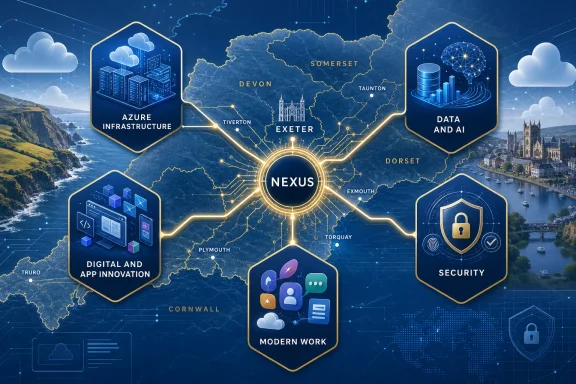
Exeter-based managed service provider Nexus has secured five Microsoft Solutions Partner designations across Azure infrastructure, Azure digital and app innovation, Azure data and AI, security, and modern work, positioning the company as one of the more broadly accredited Microsoft partners in South West England. The announcement is more than a local trophy cabinet update. It is a useful signal of how the Microsoft partner economy is being reshaped around measurable delivery, cloud consumption, security posture, and customer outcomes. For IT buyers in Devon, Cornwall, Somerset, and the wider region, the news narrows a familiar gap: enterprise-grade Microsoft expertise no longer has to mean a default call to London.
The headline number is five. Microsoft currently organizes Solutions Partner designations around six major solution areas: Infrastructure, Data and AI, Digital and App Innovation, Business Applications, Modern Work, and Security. Nexus has now claimed five of those six, leaving Business Applications as the only absent badge in the set described in the announcement.
That matters because the modern Microsoft estate is no longer cleanly divided into “Office,” “servers,” and “security.” A serious migration or modernization project now usually touches identity, endpoints, data governance, application architecture, compliance, automation, and cost management. A partner that can credibly operate across Azure, Microsoft 365, security, and AI is better aligned with the way real projects actually unfold.
The company’s own framing is unsurprisingly celebratory. John Brett, Nexus’s Operations Director, called the designations a significant achievement and pointed to the work of the firm’s technical teams. But the more interesting part is not the quote; it is the market logic underneath it. Microsoft’s partner badges have become a form of procurement shorthand at a time when technology decisions are becoming harder to explain, harder to reverse, and more expensive to get wrong.
For South West organizations, that shorthand has practical value. A housing association moving workloads to Azure, a law firm tightening Microsoft 365 security, or a construction company trying to make sense of AI-assisted workflows may not have the internal capacity to evaluate every supplier’s claims from first principles. Accreditation does not replace due diligence, but it gives buyers a place to start.
Microsoft’s current Solutions Partner model is designed to be harder to dismiss. The designations are tied to a partner capability score that includes performance, skilling, and customer success measures. In plain English, Microsoft wants the badge to reflect not only what a partner’s staff know, but whether the organization is actually delivering relevant customer work at scale.
That is the shift Nexus is benefiting from. The company is not merely saying it sells Microsoft services; it is saying Microsoft’s own framework recognizes its ability across five distinct parts of the cloud portfolio. In a market crowded with managed service providers, resellers, consultancies, and security specialists, that distinction is commercially useful.
It also reflects Microsoft’s broader strategy. The company has moved its partner ecosystem away from the older gold-and-silver competency language and toward designations that map directly to the Microsoft Cloud. The result is a program that mirrors Microsoft’s own sales motion: Azure infrastructure, Azure-native applications, data platforms, AI, Microsoft 365 productivity, and security.
This is good for Microsoft because it channels partners toward the areas where the company wants growth. It is good for partners because it gives them a clearer way to prove relevance. It is potentially good for customers because it makes supplier claims somewhat easier to compare, provided buyers understand what the badges do and do not prove.
Infrastructure points to Azure migration, modernization, and cloud operations. Digital and App Innovation suggests capability around application development and cloud-native services. Data and AI speaks to the platforms that increasingly sit behind analytics, automation, and generative AI projects. Security and Modern Work cover the Microsoft 365, identity, endpoint, and collaboration environments where many organizations now experience their most visible IT risks.
That breadth is valuable because the failure points in Microsoft projects often sit between disciplines. A cloud migration can fail because identity was underplanned. A Teams rollout can become a governance problem. An AI pilot can expose poor data hygiene. A security hardening project can stall because it disrupts users and no one has handled change management properly.
A multi-designation partner is not automatically immune to those problems. But the badges suggest that Nexus has invested in the kinds of skills required to see more of the map. In a region where many customers may be too small to maintain deep in-house specialisms across every Microsoft domain, that kind of external breadth is the product.
The danger, as ever, is assuming that breadth equals depth in every case. Buyers should still ask who will actually work on their project, what similar work the partner has completed, how support is escalated, and how success will be measured. A designation opens the door; it should not close the evaluation.
For customers in Devon, Cornwall, and Somerset, local presence can matter in ways that remote-first cloud rhetoric tends to underplay. Regulated organizations, professional services firms, public bodies, and charities often want a partner that understands the region’s business rhythms, skills constraints, budget cycles, and operational realities. They may not need someone down the road for every support ticket, but they often want accountability that feels closer than a hyperscale supplier relationship.
This is particularly important for Microsoft projects because they are rarely one-off technical events. Microsoft 365 security baselines, Azure cost optimization, endpoint management, backup strategy, compliance reporting, and AI governance all evolve over time. The partner relationship becomes less about implementation and more about stewardship.
That is where regional MSPs can make a persuasive case. They can translate Microsoft’s global platform agenda into the language of local boards, finance teams, and IT managers. They can also serve organizations that are too complex for commodity support but not large enough to justify the bench of a major systems integrator.
Nexus’s announcement should be read in that context. The company is not claiming to be the only route to Microsoft expertise in the UK. It is arguing that serious Microsoft capability is available from a South West-based provider with enough accreditation to compete for more ambitious work.
That convergence is creating demand for partners that can speak across domains. A customer asking about Copilot readiness, for example, may quickly discover that the real project is data classification, permissions cleanup, endpoint security, and user training. A customer asking about Azure may find that cost governance and security architecture matter as much as virtual machines and storage accounts.
This is why the combination of Nexus’s five designations is more compelling than any single badge in isolation. Modern Work without Security is incomplete. Data and AI without governance is risky. App Innovation without Infrastructure can become a deployment problem. Infrastructure without cost management and operational discipline can become a monthly surprise.
Microsoft knows this, and its partner program increasingly rewards alignment with these integrated solution areas. The market knows it too, even if customers do not always describe their needs in Microsoft’s terminology. They want secure systems, useful data, reliable cloud platforms, productive employees, and a path into AI that does not create more risk than value.
Nexus is effectively saying it has organized itself around that combined demand. For a company with more than 50 specialists supporting sectors including legal, housing, professional services, construction, and the public sector, that is a credible direction of travel.
That distinction matters because the MSP market is full of inflated language. Everyone is “trusted.” Everyone is “strategic.” Everyone is “customer-focused.” Microsoft designations help cut through some of that fog, but they do not eliminate the need for careful scoping, contractual clarity, and technical scrutiny.
Customers should still ask direct questions. Which certified staff are assigned to the account? What is the support model after go-live? How are security incidents handled? What assumptions underpin an Azure cost estimate? How are Microsoft 365 permissions audited before AI tools are introduced? How does the partner document decisions so the customer is not locked into tribal knowledge?
The best partners welcome those questions because they separate serious buyers from badge shoppers. A designation can get a partner onto a shortlist. Transparent delivery practice keeps it there.
For Nexus, the challenge will be maintaining the operational maturity implied by the badges as demand grows. Five designations create expectations. They tell the market that the company can handle projects that cross technical boundaries, and customers will judge the firm accordingly.
This is especially true in the UK mid-market. Many organizations run deeply on Microsoft but do not think of themselves as Microsoft-first in a strategic sense. They use Windows, Microsoft 365, Entra ID, Defender, SharePoint, Teams, Power Platform, and Azure in various combinations because that is how the modern business software landscape evolved around them.
The risk is that this estate becomes accidental architecture. Tools are added as needs arise, licensing changes, security defaults shift, departments create their own workflows, and suddenly the organization has a sprawling Microsoft environment that nobody fully understands. At that point, the right partner is not merely a supplier; it is an interpreter.
Nexus’s five designations suggest that it wants to occupy that interpreter role. The company’s message is not just “we can support your PCs” or “we can move you to the cloud.” It is “we can help you navigate the Microsoft platform as a connected operating environment.”
That is a more valuable proposition, but also a more demanding one. It requires ongoing investment in staff, process, and vendor alignment. It also requires the discipline to tell customers when a Microsoft-native answer is not automatically the best answer for a given problem.
Decision-makers know they need to modernize. They also know that modernization projects can disrupt operations, expose hidden technical debt, and commit the organization to years of platform dependency. A recognized partner can reduce perceived risk, especially when the work involves security and data.
That does not mean customers will blindly buy from the most decorated supplier. Procurement teams are increasingly alert to lock-in, service quality, and the difference between presales expertise and delivery capacity. But a local MSP with five Microsoft designations can enter those conversations with a stronger claim than most.
For Nexus, the opportunity is to convert accreditation into visible outcomes. That could mean more secure Microsoft 365 tenants, better Azure cost control, stronger identity governance, clearer AI readiness assessments, and application modernization projects that survive contact with production. The badges create permission to have those conversations; results create reputation.
There is also a recruitment angle. Technical staff often want to work for firms that invest in certification, partnerships, and meaningful projects. In a skills-constrained market, Microsoft designations can help an MSP attract and retain the people needed to keep the designations valuable in the first place.
The old MSP model was built around uptime, patching, procurement, and helpdesk responsiveness. Those still matter, but they are no longer enough. Customers now expect guidance on cloud architecture, identity security, ransomware resilience, compliance, endpoint management, collaboration, automation, and AI adoption.
That is a very different business from reselling licenses and responding to tickets. It requires a partner to understand both the technical substrate and the customer’s operating model. It also requires enough specialization to avoid dangerous simplifications.
Nexus’s five designations are therefore less a finish line than a public commitment. The company has declared that it wants to be judged as a serious Microsoft cloud, security, workplace, data, and application partner. The next test is whether customers experience that breadth as joined-up advice rather than a collection of practice areas.
 Nexus Turns a Regional Win Into a Microsoft Cloud Statement
The headline number is five. Microsoft currently organizes Solutions Partner designations around six major solution areas: Infrastructure, Data and AI, Digital and App Innovation, Business Applications, Modern Work, and Security. Nexus has now claimed five of those six, leaving Business Applications as the only absent badge in the set described in the announcement.That matters because the modern Microsoft estate is no longer cleanly divided into “Office,” “servers,” and “security.” A serious migration or modernization project now usually touches identity, endpoints, data governance, application architecture, compliance, automation, and cost management. A partner that can credibly operate across Azure, Microsoft 365, security, and AI is better aligned with the way real projects actually unfold.
The company’s own framing is unsurprisingly celebratory. John Brett, Nexus’s Operations Director, called the designations a significant achievement and pointed to the work of the firm’s technical teams. But the more interesting part is not the quote; it is the market logic underneath it. Microsoft’s partner badges have become a form of procurement shorthand at a time when technology decisions are becoming harder to explain, harder to reverse, and more expensive to get wrong.
For South West organizations, that shorthand has practical value. A housing association moving workloads to Azure, a law firm tightening Microsoft 365 security, or a construction company trying to make sense of AI-assisted workflows may not have the internal capacity to evaluate every supplier’s claims from first principles. Accreditation does not replace due diligence, but it gives buyers a place to start.
Microsoft’s Partner Badges Have Become Less Decorative
For years, vendor certifications had an image problem. They were useful, sometimes necessary, and often displayed prominently on websites, but many buyers learned to treat them as marketing furniture. A badge could mean deep experience, or it could mean that someone had passed an exam and the company had paid its dues.Microsoft’s current Solutions Partner model is designed to be harder to dismiss. The designations are tied to a partner capability score that includes performance, skilling, and customer success measures. In plain English, Microsoft wants the badge to reflect not only what a partner’s staff know, but whether the organization is actually delivering relevant customer work at scale.
That is the shift Nexus is benefiting from. The company is not merely saying it sells Microsoft services; it is saying Microsoft’s own framework recognizes its ability across five distinct parts of the cloud portfolio. In a market crowded with managed service providers, resellers, consultancies, and security specialists, that distinction is commercially useful.
It also reflects Microsoft’s broader strategy. The company has moved its partner ecosystem away from the older gold-and-silver competency language and toward designations that map directly to the Microsoft Cloud. The result is a program that mirrors Microsoft’s own sales motion: Azure infrastructure, Azure-native applications, data platforms, AI, Microsoft 365 productivity, and security.
This is good for Microsoft because it channels partners toward the areas where the company wants growth. It is good for partners because it gives them a clearer way to prove relevance. It is potentially good for customers because it makes supplier claims somewhat easier to compare, provided buyers understand what the badges do and do not prove.
Five Designations Say Breadth, Not Magic
The strongest interpretation of Nexus’s achievement is breadth. Infrastructure, Digital and App Innovation, Data and AI, Security, and Modern Work collectively cover much of the Microsoft estate that mid-market and public-sector organizations touch daily. This is the operating layer for modern Windows-centric IT.Infrastructure points to Azure migration, modernization, and cloud operations. Digital and App Innovation suggests capability around application development and cloud-native services. Data and AI speaks to the platforms that increasingly sit behind analytics, automation, and generative AI projects. Security and Modern Work cover the Microsoft 365, identity, endpoint, and collaboration environments where many organizations now experience their most visible IT risks.
That breadth is valuable because the failure points in Microsoft projects often sit between disciplines. A cloud migration can fail because identity was underplanned. A Teams rollout can become a governance problem. An AI pilot can expose poor data hygiene. A security hardening project can stall because it disrupts users and no one has handled change management properly.
A multi-designation partner is not automatically immune to those problems. But the badges suggest that Nexus has invested in the kinds of skills required to see more of the map. In a region where many customers may be too small to maintain deep in-house specialisms across every Microsoft domain, that kind of external breadth is the product.
The danger, as ever, is assuming that breadth equals depth in every case. Buyers should still ask who will actually work on their project, what similar work the partner has completed, how support is escalated, and how success will be measured. A designation opens the door; it should not close the evaluation.
The South West Angle Is More Than Local Pride
The announcement leans heavily into geography, and rightly so. Nexus is headquartered in Exeter and also lists offices in Bristol, Cardiff, and Birmingham. That footprint gives the company a regional story with a national reach, which is precisely the position many UK managed service providers want to occupy.For customers in Devon, Cornwall, and Somerset, local presence can matter in ways that remote-first cloud rhetoric tends to underplay. Regulated organizations, professional services firms, public bodies, and charities often want a partner that understands the region’s business rhythms, skills constraints, budget cycles, and operational realities. They may not need someone down the road for every support ticket, but they often want accountability that feels closer than a hyperscale supplier relationship.
This is particularly important for Microsoft projects because they are rarely one-off technical events. Microsoft 365 security baselines, Azure cost optimization, endpoint management, backup strategy, compliance reporting, and AI governance all evolve over time. The partner relationship becomes less about implementation and more about stewardship.
That is where regional MSPs can make a persuasive case. They can translate Microsoft’s global platform agenda into the language of local boards, finance teams, and IT managers. They can also serve organizations that are too complex for commodity support but not large enough to justify the bench of a major systems integrator.
Nexus’s announcement should be read in that context. The company is not claiming to be the only route to Microsoft expertise in the UK. It is arguing that serious Microsoft capability is available from a South West-based provider with enough accreditation to compete for more ambitious work.
The Timing Favors Partners That Can Join Cloud, Security, and AI
The designations arrive at a moment when the Microsoft stack is expanding in both power and complexity. Azure remains a core platform for infrastructure modernization, but the center of gravity has shifted toward security, data, and AI-enabled workflows. Microsoft 365 is no longer just email, Office apps, and Teams; it is an identity plane, a compliance surface, a collaboration hub, and increasingly an AI interface.That convergence is creating demand for partners that can speak across domains. A customer asking about Copilot readiness, for example, may quickly discover that the real project is data classification, permissions cleanup, endpoint security, and user training. A customer asking about Azure may find that cost governance and security architecture matter as much as virtual machines and storage accounts.
This is why the combination of Nexus’s five designations is more compelling than any single badge in isolation. Modern Work without Security is incomplete. Data and AI without governance is risky. App Innovation without Infrastructure can become a deployment problem. Infrastructure without cost management and operational discipline can become a monthly surprise.
Microsoft knows this, and its partner program increasingly rewards alignment with these integrated solution areas. The market knows it too, even if customers do not always describe their needs in Microsoft’s terminology. They want secure systems, useful data, reliable cloud platforms, productive employees, and a path into AI that does not create more risk than value.
Nexus is effectively saying it has organized itself around that combined demand. For a company with more than 50 specialists supporting sectors including legal, housing, professional services, construction, and the public sector, that is a credible direction of travel.
Accreditation Is a Signal, but Delivery Remains the Test
The sober reading of this announcement is that Microsoft has vouched for Nexus against Microsoft’s own criteria, not that every Nexus project will automatically succeed. Certifications are inputs into trust, not substitutes for execution. Any IT professional who has lived through a troubled migration knows the difference.That distinction matters because the MSP market is full of inflated language. Everyone is “trusted.” Everyone is “strategic.” Everyone is “customer-focused.” Microsoft designations help cut through some of that fog, but they do not eliminate the need for careful scoping, contractual clarity, and technical scrutiny.
Customers should still ask direct questions. Which certified staff are assigned to the account? What is the support model after go-live? How are security incidents handled? What assumptions underpin an Azure cost estimate? How are Microsoft 365 permissions audited before AI tools are introduced? How does the partner document decisions so the customer is not locked into tribal knowledge?
The best partners welcome those questions because they separate serious buyers from badge shoppers. A designation can get a partner onto a shortlist. Transparent delivery practice keeps it there.
For Nexus, the challenge will be maintaining the operational maturity implied by the badges as demand grows. Five designations create expectations. They tell the market that the company can handle projects that cross technical boundaries, and customers will judge the firm accordingly.
Microsoft’s Ecosystem Is Becoming the New IT Supply Chain
The wider story is that Microsoft’s partner ecosystem is now a critical layer of the IT supply chain. Microsoft builds and packages the platforms, but partners translate them into working environments for the organizations that lack massive internal IT departments. That translation layer is where strategy becomes configuration, governance, migration plans, support queues, and user adoption.This is especially true in the UK mid-market. Many organizations run deeply on Microsoft but do not think of themselves as Microsoft-first in a strategic sense. They use Windows, Microsoft 365, Entra ID, Defender, SharePoint, Teams, Power Platform, and Azure in various combinations because that is how the modern business software landscape evolved around them.
The risk is that this estate becomes accidental architecture. Tools are added as needs arise, licensing changes, security defaults shift, departments create their own workflows, and suddenly the organization has a sprawling Microsoft environment that nobody fully understands. At that point, the right partner is not merely a supplier; it is an interpreter.
Nexus’s five designations suggest that it wants to occupy that interpreter role. The company’s message is not just “we can support your PCs” or “we can move you to the cloud.” It is “we can help you navigate the Microsoft platform as a connected operating environment.”
That is a more valuable proposition, but also a more demanding one. It requires ongoing investment in staff, process, and vendor alignment. It also requires the discipline to tell customers when a Microsoft-native answer is not automatically the best answer for a given problem.
The Real Prize Is Customer Confidence, Not the Badge Wall
The practical value of this announcement will be measured in customer confidence. For organizations looking at cybersecurity hardening, Azure modernization, AI adoption, or Microsoft 365 improvement, the biggest blocker is often not awareness. It is trust.Decision-makers know they need to modernize. They also know that modernization projects can disrupt operations, expose hidden technical debt, and commit the organization to years of platform dependency. A recognized partner can reduce perceived risk, especially when the work involves security and data.
That does not mean customers will blindly buy from the most decorated supplier. Procurement teams are increasingly alert to lock-in, service quality, and the difference between presales expertise and delivery capacity. But a local MSP with five Microsoft designations can enter those conversations with a stronger claim than most.
For Nexus, the opportunity is to convert accreditation into visible outcomes. That could mean more secure Microsoft 365 tenants, better Azure cost control, stronger identity governance, clearer AI readiness assessments, and application modernization projects that survive contact with production. The badges create permission to have those conversations; results create reputation.
There is also a recruitment angle. Technical staff often want to work for firms that invest in certification, partnerships, and meaningful projects. In a skills-constrained market, Microsoft designations can help an MSP attract and retain the people needed to keep the designations valuable in the first place.
The Nexus News Compresses a Bigger Microsoft Story
Nexus’s announcement looks local, but it reflects several broader shifts that WindowsForum readers will recognize immediately. Microsoft has become the default enterprise platform for many organizations, but the platform itself has become too broad for casual administration. The result is a growing premium on partners that can connect the dots.The old MSP model was built around uptime, patching, procurement, and helpdesk responsiveness. Those still matter, but they are no longer enough. Customers now expect guidance on cloud architecture, identity security, ransomware resilience, compliance, endpoint management, collaboration, automation, and AI adoption.
That is a very different business from reselling licenses and responding to tickets. It requires a partner to understand both the technical substrate and the customer’s operating model. It also requires enough specialization to avoid dangerous simplifications.
Nexus’s five designations are therefore less a finish line than a public commitment. The company has declared that it wants to be judged as a serious Microsoft cloud, security, workplace, data, and application partner. The next test is whether customers experience that breadth as joined-up advice rather than a collection of practice areas.
Five Badges Later, the Buyer Still Has Work to Do
The concrete lesson for IT leaders is not that they should automatically choose Nexus, or any other partner, because Microsoft has issued a badge. The lesson is that designations should change the starting point of the conversation. They provide evidence that a partner has met Microsoft’s standards, while leaving room for customers to test fit, depth, and delivery discipline.- Nexus has secured five Microsoft Solutions Partner designations: Infrastructure, Digital and App Innovation, Data and AI, Security, and Modern Work.
- The achievement places the Exeter-headquartered MSP in a stronger position for Microsoft cloud, security, AI, and workplace modernization work across the South West and beyond.
- Microsoft’s designation model is based on capability signals including performance, skilling, and customer success, rather than simple membership language.
- Customers should treat the badges as useful evidence, not as a replacement for project references, named delivery teams, security processes, and clear commercial terms.
- The strongest implication is that regional MSPs can now credibly compete for complex Microsoft transformation projects once associated mainly with larger national integrators.
References
- Primary source: RS Web Solutions
Published: 2026-07-03T04:30:25.349857
Nexus Earns Five Prestigious Microsoft Partner Certifications
Nexus secures five top Microsoft Partner certifications, boosting expertise and credibility. Discover how this achievement sets new industry standards today.www.rswebsols.com - Official source: partner.microsoft.com
Solutions Partner designations FAQ
Review frequently asked questions (FAQ) about Solutions Partner designations, how to attain them, and the value they bring to partners.partner.microsoft.com
- Official source: microsoft.com
Your request has been blocked. This could be due to several reasons.
www.microsoft.com
- Official source: learn.microsoft.com
Solutions Partner program Partner Capability Score - Partner Center | Microsoft Learn
Learn about the Solutions Partner program partner capability score.learn.microsoft.com - Related coverage: epcgroup.net
Microsoft Solutions Partner Directory 2026 | EPC Group
Microsoft Solutions Partner directory & selection guide for 2026. How to find a Microsoft partner, what the 6 designations mean, and 6 named firms compared.www.epcgroup.net - Official source: devicepartner.microsoft.com
Introducing the SMB path to Azure Solutions Partner designations
devicepartner.microsoft.com
- Related coverage: itpro.com
Triple Microsoft designation defines serious, competitive, high-performing modern MSPs | ChannelPro
Triple Microsoft designation signals serious MSP capability through rigorous, performance-based accreditation standardswww.itpro.com - Related coverage: virtuoso.tech
- Related coverage: nexusinno.com
Nexus Innovations kicks off 2026 with a bang: Microsoft Solutions Partner – Business Applications! - Nexus Innovations
We are so proud to be designated by Microsoft as a Microsoft Solutions Partner - Business Applications!nexusinno.com - Official source: cdn-dynmedia-1.microsoft.com
- Related coverage: academy.tdsynnex.com
TD SYNNEX Secondary Logo - Sample (CMYK)
Young business man working at home with laptop and papers on deskacademy.tdsynnex.com
- Related coverage: experteach.eu
