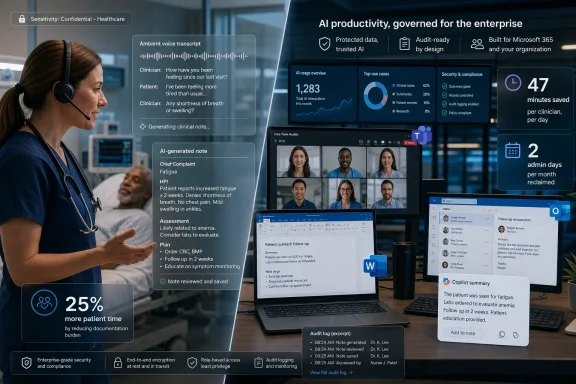
The NHS in England is preparing a new 10-year workforce plan in 2026 while expanding Microsoft 365 Copilot access to 505,000 staff, amid reporting and union warnings that ministers may scale back the 2023 recruitment ambitions and lean harder on AI-led productivity gains. The bet is not irrational: the NHS is drowning in administration, rota gaps, duplicated records, and brittle workflows that software really can improve. But the danger is that a technology programme designed to help clinicians will be used politically as a substitute for employing, retaining, and respecting them. A Copilot licence may save minutes; it cannot rebuild a workforce model that has been losing trust for years.
The central mistake in the current debate is not that AI is being taken too seriously. It is that it is being asked to solve the wrong layer of the problem.
As LBC’s opinion piece by Dr Anas Nader of Patchwork Health argues, the NHS staffing crisis is not merely a paperwork crisis with a chatbot-shaped hole in the middle. It is a retention crisis, a morale crisis, a scheduling crisis, a training-capacity crisis, and a credibility crisis. The people who keep wards running do not simply need faster email summaries; they need working systems that acknowledge the way clinical work is actually organised.
Microsoft 365 Copilot can plausibly reduce some administrative drag. NHS England has said the rollout follows a large trial and is intended to free up time for patients, with the government framing the move as part of a broader productivity drive. That is a reasonable use of enterprise software in a public service that spends too many hours translating human care into forms, notes, meeting actions, and inbox archaeology.
But there is a wide gap between using AI to support clinicians and invoking AI to justify a materially smaller workforce than previously planned. The former is modernisation. The latter is an accounting manoeuvre dressed in the language of transformation.
The NHS has seen this movie before. Central government announces a large digital ambition, the vendor ecosystem promises scale, the productivity assumptions arrive early, and the operational detail arrives late. Frontline staff then inherit the gap between ministerial optimism and ward reality.
The plan’s scale was also its political vulnerability. The Institute for Fiscal Studies warned that the implied staffing growth would require sustained funding increases, and that the workforce could account for an extraordinary share of total employment if the ambitions were realised. In other words, the 2023 plan forced the Treasury-facing question into the open: if the public wants the NHS to do more for an older, sicker population, who exactly is going to do the work?
That is the part of the 2023 settlement now under pressure. The current government’s 10 Year Health Plan has already signalled that the NHS of 2035 may have fewer staff than the 2023 model projected, with a heavier emphasis on better training, better roles, prevention, community care, and digital tools. The direction is politically understandable. Any government inheriting NHS finances in the mid-2020s would look for productivity before promising hundreds of thousands of additional posts.
But productivity is not magic. It is a relationship between tools, processes, incentives, skills, estate, management, data quality, and trust. If any one of those pieces is missing, the savings tend to become notional — visible in PowerPoint, invisible on the ward.
The problem with using AI as the balancing item in a workforce plan is that it makes the hardest assumption the most convenient one. Recruitment targets require training places, supervisors, pay settlements, universities, placement capacity, immigration policy, and budgets. AI productivity requires a forecast.
The NHS has no shortage of tasks that are simultaneously essential and demoralising. Staff write and rewrite referral letters. They compile handover notes. They chase information across systems. They sit in meetings where half the useful content is buried in follow-up actions. They duplicate documentation because different systems do not talk to each other. If Copilot can shave time from those tasks, the NHS should take the win.
But the phrase “500,000 licences” has a way of making a software deployment sound like a health policy. It is not. Giving half a million people access to an AI assistant says little about whether the tool will be embedded safely into clinical pathways, whether staff will be trained well enough to use it, whether local information governance teams will permit meaningful use, or whether saved time will be captured as better care rather than absorbed by the next unfunded demand.
The distinction matters because healthcare is not generic office work with more acronyms. A ward round, an outpatient clinic, a district nursing route, a theatre list, and an emergency department shift each generate different kinds of cognitive load. The administrative work around them is not merely “admin”; it is often the connective tissue of patient safety.
That is why Dr Nader’s critique lands. The NHS does not need fewer tools; it needs tools that fit the grain of clinical work. A chatbot layered across email and documents may help some staff work faster, but it will not by itself fix rota fairness, bank staffing, training bottlenecks, burnout, or the loss of experienced clinicians who are tired of being treated as an elastic resource.
A junior doctor who cannot predict their rota, a nurse who cannot easily pick up flexible shifts without being punished by opaque systems, a consultant drowning in clinic letters, and a manager manually reconciling staffing gaps are all living inside different versions of the same failure. The NHS often asks highly trained people to compensate for systems that are less intelligent than the workforce they control.
That is where targeted workforce technology can matter. Better rostering, smarter staff banks, real-time vacancy management, skills-based deployment, credential tracking, and flexible scheduling can improve both efficiency and morale. These are not glamorous AI stories, but they are closer to the operational problem than a generic assistant that writes meeting notes.
The NHS has talked for years about retention, flexible working, and staff experience. Yet many staff still experience workforce management as something done to them rather than with them. The promise of digital reform should be to make the institution more responsive to the people inside it.
Automation becomes dangerous when it is framed as extraction: the machine will take friction out, and the organisation will harvest the savings. Autonomy is different. It asks whether technology lets staff work at the top of their skills, avoid unnecessary drudgery, control more of their working lives, and spend more time on the parts of care that only humans can perform.
That distinction is not sentimental. It is practical. A workforce that feels empowered is more likely to stay; a workforce that feels optimised is more likely to leave.
The BMJ made this point during debate over the 2023 workforce plan: ambitions around AI and digital healthcare are much easier to state nationally than to deliver locally, especially when trusts vary so widely in infrastructure and digital capability. That remains the essential warning for 2026. AI does not float above the stack; it depends on the stack.
A Copilot rollout inside Microsoft 365 may avoid some of the worst integration problems because many NHS organisations already depend on Microsoft’s productivity suite. That is part of the appeal. It is easier to deploy an assistant into familiar office software than to rebuild fractured clinical systems from the ground up.
But ease of deployment should not be confused with depth of transformation. The NHS’s hardest problems often sit where clinical systems, workforce systems, finance systems, and operational pressures intersect. An AI assistant can summarise what it can see. It cannot fix what the architecture keeps apart.
There is also a governance issue that deserves more attention than it usually receives in ministerial announcements. Healthcare AI needs clear boundaries around data access, clinical accountability, auditability, bias, hallucination risk, and patient confidentiality. These are manageable risks, but they are not decorative. They determine whether staff trust the tool enough to use it and whether patients can trust the system using it.
The trouble is that productivity in healthcare behaves differently from productivity in a factory or a call centre. If AI saves a clinician 43 minutes on a given day, that time does not automatically convert into 43 minutes of extra patient care. It may be consumed by overrunning clinics, complex cases, mandatory training, safeguarding work, delayed discharges, or simply the backlog of tasks that had already been displaced by the previous crisis.
This does not make the saving worthless. It means the saving must be designed into workflow, staffing models, and service planning. Otherwise, the benefit is real at the individual level but invisible at the system level.
There is also a measurement trap. Governments love average time-saving figures because they travel well. But the average can conceal enormous variation. A manager who spends most of the day in meetings may benefit quickly from AI-generated summaries. A community nurse juggling travel, patient interaction, documentation, and unreliable connectivity may see much less value. A consultant using AI to draft correspondence may save time, while another clinician may spend extra time checking machine-generated text for subtle errors.
The NHS should measure these differences ruthlessly. Not because AI should be resisted, but because it should be deployed where it actually works. A credible workforce plan would distinguish between proven productivity gains, plausible future gains, and speculative gains being used to make the numbers add up.
That does not make the deal bad. Large public organisations often need large vendors because they need security commitments, procurement frameworks, support, compliance tooling, and the ability to deploy at national scale. The NHS cannot run its productivity infrastructure like a weekend hackathon.
But vendor scale has a gravitational pull. Once a platform becomes the default answer, local nuance can be flattened. Problems that require specialised clinical workflow tools may be reframed as prompts, templates, and productivity features. The procurement system may prefer the convenience of a single major supplier over the messy pluralism of smaller tools built around specific operational pain points.
That is where the Patchwork Health argument intersects with a broader technology-market concern. The NHS needs both horizontal tools and vertical tools. It needs general-purpose AI for everyday work, but it also needs specialised systems for staffing, scheduling, clinical documentation, diagnostics, patient flow, and workforce planning.
A successful digital NHS will not be built from one Copilot-shaped layer. It will be built from a disciplined ecosystem in which the generic assistant handles generic friction and specialist tools handle specialist work.
Does the rota arrive earlier? Are shifts distributed fairly? Can a clinician work flexibly without falling out of career progression? Are vacancies filled without endless begging messages? Does technology reduce duplicate documentation, or merely add another interface? Does AI help staff finish on time, or does it create new checking work? Do managers use productivity tools to support teams, or to squeeze them harder?
These questions matter because the NHS staffing crisis is also a story of accumulated disappointments. Staff have heard promises about transformation before. They have been told that new systems will release time, only to find that the old system still exists beside the new one. They have been praised as heroes and then asked to absorb more pressure.
The 2023 workforce plan at least acknowledged the scale of the human requirement. If the 2026 plan retreats from that scale, it must offer more than technological confidence. It must show the mechanism by which fewer-than-expected staff can meet rising demand without making working life worse.
That is a high bar. The NHS is dealing with an ageing population, growing complexity, mental health demand, backlogs, and public expectations that have not shrunk to match workforce supply. AI can help with parts of this. It cannot repeal demography.
Healthcare unions and professional bodies have watched efficiency drives become workload transfers. They know that “doing more with less” often means staff doing more with less support. They also know that if a workforce plan bakes in optimistic productivity assumptions, the consequences are not abstract. They appear as unsafe staffing, cancelled training, missed breaks, moral injury, and avoidable departures.
Still, the NHS cannot let legitimate scepticism harden into blanket resistance. There are tasks that machines should take away from clinicians. There are administrative burdens that exist only because institutions tolerate bad process. There are uses of AI that staff will welcome if they are safe, practical, and locally relevant.
The right dividing line is not AI versus staff. It is staff-led AI versus headcount-led AI.
Staff-led AI starts with the worker’s pain point and asks which tool, if any, reduces it. Headcount-led AI starts with a financial gap and asks how much productivity can be assumed. The first approach may produce durable gains. The second risks producing a spreadsheet fantasy that collapses into worse morale.
The NHS should be especially careful with language about substitution. Some roles will change. Some tasks will be automated. Some administrative functions may shrink. But when ministers or executives imply that AI can replace large numbers of clinicians or clinical support staff, they invite exactly the backlash they claim to be trying to avoid.
But it would be a category error to respond by treating recruitment as yesterday’s obsession and AI as tomorrow’s correction. The NHS needs recruitment, retention, redesign, and technology together. Remove one leg and the table tilts.
Retention is the hinge. If staff leave because working conditions are poor, no AI programme can compensate indefinitely. If experienced clinicians retire early, reduce hours, move abroad, or switch sectors, the NHS loses not just capacity but supervision, judgement, and institutional knowledge. That loss then damages training, which damages future supply.
This is why autonomy matters more than the word usually suggests. Control over working patterns, access to career development, fair deployment, good management, and tools that respect clinical realities are retention interventions. They are not perks.
A workforce plan that treats technology as a retention tool could be powerful. A workforce plan that treats technology as permission to recruit fewer people will be received as a threat.
A nurse who can swap a shift safely and transparently has experienced useful technology. A doctor whose appraisal, rota, and training records are not scattered across hostile systems has experienced useful technology. A ward manager who can see staffing risk in real time has experienced useful technology. A clinician who logs into one system instead of six has experienced useful technology.
These improvements rarely generate the same headlines as AI diagnosing rare disease. Yet they are the reforms that change whether staff experience the NHS as a place they can survive, grow, and recommend to others.
The phrase “everyday AI” is therefore both promising and insufficient. Everyday work is where the burden lives, but everyday tools must still be shaped for the environment. A hospital is not a law firm. A GP practice is not a marketing department. An ambulance service is not a consultancy. A generic tool can be useful in all of them, but it cannot understand all of them by default.
The NHS should resist the temptation to confuse procurement simplicity with operational sophistication. The better path is harder: deploy broad tools where they fit, fund specialist tools where they are needed, evaluate both honestly, and let staff experience determine what scales.
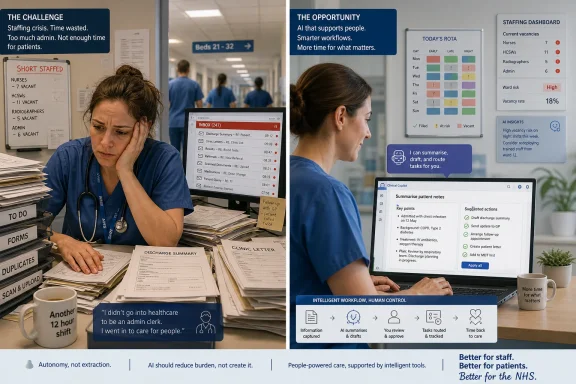 The NHS Is Trying to Automate Its Way Out of a Human Problem
The central mistake in the current debate is not that AI is being taken too seriously. It is that it is being asked to solve the wrong layer of the problem.As LBC’s opinion piece by Dr Anas Nader of Patchwork Health argues, the NHS staffing crisis is not merely a paperwork crisis with a chatbot-shaped hole in the middle. It is a retention crisis, a morale crisis, a scheduling crisis, a training-capacity crisis, and a credibility crisis. The people who keep wards running do not simply need faster email summaries; they need working systems that acknowledge the way clinical work is actually organised.
Microsoft 365 Copilot can plausibly reduce some administrative drag. NHS England has said the rollout follows a large trial and is intended to free up time for patients, with the government framing the move as part of a broader productivity drive. That is a reasonable use of enterprise software in a public service that spends too many hours translating human care into forms, notes, meeting actions, and inbox archaeology.
But there is a wide gap between using AI to support clinicians and invoking AI to justify a materially smaller workforce than previously planned. The former is modernisation. The latter is an accounting manoeuvre dressed in the language of transformation.
The NHS has seen this movie before. Central government announces a large digital ambition, the vendor ecosystem promises scale, the productivity assumptions arrive early, and the operational detail arrives late. Frontline staff then inherit the gap between ministerial optimism and ward reality.
The 2023 Plan Was Expensive Because Reality Was Expensive
The 2023 NHS Long Term Workforce Plan was not modest. Published under the previous government, it projected a substantial increase in NHS staffing by 2036/37 and argued that England faced a possible shortfall of hundreds of thousands of staff without long-term action. The King’s Fund, NHS Employers, the British Medical Association, and the Institute for Fiscal Studies all treated it as a major intervention because it was the first serious attempt to attach numbers to a workforce problem everyone had spent years describing in generalities.The plan’s scale was also its political vulnerability. The Institute for Fiscal Studies warned that the implied staffing growth would require sustained funding increases, and that the workforce could account for an extraordinary share of total employment if the ambitions were realised. In other words, the 2023 plan forced the Treasury-facing question into the open: if the public wants the NHS to do more for an older, sicker population, who exactly is going to do the work?
That is the part of the 2023 settlement now under pressure. The current government’s 10 Year Health Plan has already signalled that the NHS of 2035 may have fewer staff than the 2023 model projected, with a heavier emphasis on better training, better roles, prevention, community care, and digital tools. The direction is politically understandable. Any government inheriting NHS finances in the mid-2020s would look for productivity before promising hundreds of thousands of additional posts.
But productivity is not magic. It is a relationship between tools, processes, incentives, skills, estate, management, data quality, and trust. If any one of those pieces is missing, the savings tend to become notional — visible in PowerPoint, invisible on the ward.
The problem with using AI as the balancing item in a workforce plan is that it makes the hardest assumption the most convenient one. Recruitment targets require training places, supervisors, pay settlements, universities, placement capacity, immigration policy, and budgets. AI productivity requires a forecast.
Copilot Is Useful Software, Not Workforce Strategy
Microsoft 365 Copilot is fundamentally an office productivity tool. It can summarise documents, draft text, help with meetings, retrieve information across Microsoft 365, and automate some routine knowledge-work tasks. For NHS administrators, managers, analysts, and some clinicians, that could be genuinely helpful.The NHS has no shortage of tasks that are simultaneously essential and demoralising. Staff write and rewrite referral letters. They compile handover notes. They chase information across systems. They sit in meetings where half the useful content is buried in follow-up actions. They duplicate documentation because different systems do not talk to each other. If Copilot can shave time from those tasks, the NHS should take the win.
But the phrase “500,000 licences” has a way of making a software deployment sound like a health policy. It is not. Giving half a million people access to an AI assistant says little about whether the tool will be embedded safely into clinical pathways, whether staff will be trained well enough to use it, whether local information governance teams will permit meaningful use, or whether saved time will be captured as better care rather than absorbed by the next unfunded demand.
The distinction matters because healthcare is not generic office work with more acronyms. A ward round, an outpatient clinic, a district nursing route, a theatre list, and an emergency department shift each generate different kinds of cognitive load. The administrative work around them is not merely “admin”; it is often the connective tissue of patient safety.
That is why Dr Nader’s critique lands. The NHS does not need fewer tools; it needs tools that fit the grain of clinical work. A chatbot layered across email and documents may help some staff work faster, but it will not by itself fix rota fairness, bank staffing, training bottlenecks, burnout, or the loss of experienced clinicians who are tired of being treated as an elastic resource.
The Real Prize Is Autonomy, Not Automation
The strongest case for technology in the NHS workforce is not that it can replace people. It is that it can return agency to people who have spent years being managed by scarcity.A junior doctor who cannot predict their rota, a nurse who cannot easily pick up flexible shifts without being punished by opaque systems, a consultant drowning in clinic letters, and a manager manually reconciling staffing gaps are all living inside different versions of the same failure. The NHS often asks highly trained people to compensate for systems that are less intelligent than the workforce they control.
That is where targeted workforce technology can matter. Better rostering, smarter staff banks, real-time vacancy management, skills-based deployment, credential tracking, and flexible scheduling can improve both efficiency and morale. These are not glamorous AI stories, but they are closer to the operational problem than a generic assistant that writes meeting notes.
The NHS has talked for years about retention, flexible working, and staff experience. Yet many staff still experience workforce management as something done to them rather than with them. The promise of digital reform should be to make the institution more responsive to the people inside it.
Automation becomes dangerous when it is framed as extraction: the machine will take friction out, and the organisation will harvest the savings. Autonomy is different. It asks whether technology lets staff work at the top of their skills, avoid unnecessary drudgery, control more of their working lives, and spend more time on the parts of care that only humans can perform.
That distinction is not sentimental. It is practical. A workforce that feels empowered is more likely to stay; a workforce that feels optimised is more likely to leave.
The NHS Has a Digital Maturity Problem Before It Has an AI Problem
The most awkward fact in any NHS AI strategy is that much of the service is still trying to complete the previous digital revolution. Electronic patient record maturity remains uneven. Interoperability is patchy. Data quality varies. Single sign-on is still not universal enough. Staff often work across old and new systems simultaneously, turning digital transformation into digital duplication.The BMJ made this point during debate over the 2023 workforce plan: ambitions around AI and digital healthcare are much easier to state nationally than to deliver locally, especially when trusts vary so widely in infrastructure and digital capability. That remains the essential warning for 2026. AI does not float above the stack; it depends on the stack.
A Copilot rollout inside Microsoft 365 may avoid some of the worst integration problems because many NHS organisations already depend on Microsoft’s productivity suite. That is part of the appeal. It is easier to deploy an assistant into familiar office software than to rebuild fractured clinical systems from the ground up.
But ease of deployment should not be confused with depth of transformation. The NHS’s hardest problems often sit where clinical systems, workforce systems, finance systems, and operational pressures intersect. An AI assistant can summarise what it can see. It cannot fix what the architecture keeps apart.
There is also a governance issue that deserves more attention than it usually receives in ministerial announcements. Healthcare AI needs clear boundaries around data access, clinical accountability, auditability, bias, hallucination risk, and patient confidentiality. These are manageable risks, but they are not decorative. They determine whether staff trust the tool enough to use it and whether patients can trust the system using it.
The Productivity Dividend Will Not Arrive Automatically
The political appeal of AI in the NHS is obvious. It promises a rare combination: better care, lower administrative burden, and reduced cost growth. For a government facing waiting lists, fiscal limits, and a workforce exhausted by crisis management, that combination is almost irresistible.The trouble is that productivity in healthcare behaves differently from productivity in a factory or a call centre. If AI saves a clinician 43 minutes on a given day, that time does not automatically convert into 43 minutes of extra patient care. It may be consumed by overrunning clinics, complex cases, mandatory training, safeguarding work, delayed discharges, or simply the backlog of tasks that had already been displaced by the previous crisis.
This does not make the saving worthless. It means the saving must be designed into workflow, staffing models, and service planning. Otherwise, the benefit is real at the individual level but invisible at the system level.
There is also a measurement trap. Governments love average time-saving figures because they travel well. But the average can conceal enormous variation. A manager who spends most of the day in meetings may benefit quickly from AI-generated summaries. A community nurse juggling travel, patient interaction, documentation, and unreliable connectivity may see much less value. A consultant using AI to draft correspondence may save time, while another clinician may spend extra time checking machine-generated text for subtle errors.
The NHS should measure these differences ruthlessly. Not because AI should be resisted, but because it should be deployed where it actually works. A credible workforce plan would distinguish between proven productivity gains, plausible future gains, and speculative gains being used to make the numbers add up.
Vendor Scale Is Not the Same as Clinical Fit
Microsoft’s role in this story is not incidental. The company has spent years positioning Copilot as the default AI layer for enterprise work, and the NHS is one of the most visible enterprise environments in Europe. A 505,000-seat deployment is a major validation of Microsoft’s strategy, especially in a sector where trust, compliance, and institutional inertia matter.That does not make the deal bad. Large public organisations often need large vendors because they need security commitments, procurement frameworks, support, compliance tooling, and the ability to deploy at national scale. The NHS cannot run its productivity infrastructure like a weekend hackathon.
But vendor scale has a gravitational pull. Once a platform becomes the default answer, local nuance can be flattened. Problems that require specialised clinical workflow tools may be reframed as prompts, templates, and productivity features. The procurement system may prefer the convenience of a single major supplier over the messy pluralism of smaller tools built around specific operational pain points.
That is where the Patchwork Health argument intersects with a broader technology-market concern. The NHS needs both horizontal tools and vertical tools. It needs general-purpose AI for everyday work, but it also needs specialised systems for staffing, scheduling, clinical documentation, diagnostics, patient flow, and workforce planning.
A successful digital NHS will not be built from one Copilot-shaped layer. It will be built from a disciplined ecosystem in which the generic assistant handles generic friction and specialist tools handle specialist work.
Staff Will Judge the Plan by Whether Their Week Gets Better
The workforce plan will not be evaluated on launch-day rhetoric by the people most affected by it. It will be judged on ordinary weeks.Does the rota arrive earlier? Are shifts distributed fairly? Can a clinician work flexibly without falling out of career progression? Are vacancies filled without endless begging messages? Does technology reduce duplicate documentation, or merely add another interface? Does AI help staff finish on time, or does it create new checking work? Do managers use productivity tools to support teams, or to squeeze them harder?
These questions matter because the NHS staffing crisis is also a story of accumulated disappointments. Staff have heard promises about transformation before. They have been told that new systems will release time, only to find that the old system still exists beside the new one. They have been praised as heroes and then asked to absorb more pressure.
The 2023 workforce plan at least acknowledged the scale of the human requirement. If the 2026 plan retreats from that scale, it must offer more than technological confidence. It must show the mechanism by which fewer-than-expected staff can meet rising demand without making working life worse.
That is a high bar. The NHS is dealing with an ageing population, growing complexity, mental health demand, backlogs, and public expectations that have not shrunk to match workforce supply. AI can help with parts of this. It cannot repeal demography.
The Unions Are Right to Demand Evidence, Even If They Are Wrong to Fear Every Tool
The Royal College of Nursing, the British Medical Association, the Royal College of Emergency Medicine, Unite, and other organisations have warned that the emerging workforce plan may overstate near-term gains from AI and digital technology. Their concern is not Luddism. It is institutional memory.Healthcare unions and professional bodies have watched efficiency drives become workload transfers. They know that “doing more with less” often means staff doing more with less support. They also know that if a workforce plan bakes in optimistic productivity assumptions, the consequences are not abstract. They appear as unsafe staffing, cancelled training, missed breaks, moral injury, and avoidable departures.
Still, the NHS cannot let legitimate scepticism harden into blanket resistance. There are tasks that machines should take away from clinicians. There are administrative burdens that exist only because institutions tolerate bad process. There are uses of AI that staff will welcome if they are safe, practical, and locally relevant.
The right dividing line is not AI versus staff. It is staff-led AI versus headcount-led AI.
Staff-led AI starts with the worker’s pain point and asks which tool, if any, reduces it. Headcount-led AI starts with a financial gap and asks how much productivity can be assumed. The first approach may produce durable gains. The second risks producing a spreadsheet fantasy that collapses into worse morale.
The NHS should be especially careful with language about substitution. Some roles will change. Some tasks will be automated. Some administrative functions may shrink. But when ministers or executives imply that AI can replace large numbers of clinicians or clinical support staff, they invite exactly the backlash they claim to be trying to avoid.
Recruitment Targets Failed Because Retention Was Treated as Secondary
The government is not wrong to question arbitrary recruitment targets. A target can create the appearance of seriousness while ignoring whether staff stay, whether training quality holds up, whether placements exist, and whether new recruits enter teams capable of supporting them. A bigger pipeline is not a workforce strategy if the system leaks faster than it fills.But it would be a category error to respond by treating recruitment as yesterday’s obsession and AI as tomorrow’s correction. The NHS needs recruitment, retention, redesign, and technology together. Remove one leg and the table tilts.
Retention is the hinge. If staff leave because working conditions are poor, no AI programme can compensate indefinitely. If experienced clinicians retire early, reduce hours, move abroad, or switch sectors, the NHS loses not just capacity but supervision, judgement, and institutional knowledge. That loss then damages training, which damages future supply.
This is why autonomy matters more than the word usually suggests. Control over working patterns, access to career development, fair deployment, good management, and tools that respect clinical realities are retention interventions. They are not perks.
A workforce plan that treats technology as a retention tool could be powerful. A workforce plan that treats technology as permission to recruit fewer people will be received as a threat.
The NHS Needs Boring Technology More Than It Needs Dazzling AI
The public conversation about healthcare AI is dominated by spectacular examples: diagnostic models, image analysis, personalised medicine, robotic surgery, genomics, and predictive tools. These are important, and some will reshape care. But the NHS staffing crisis may be eased more quickly by less glamorous systems.A nurse who can swap a shift safely and transparently has experienced useful technology. A doctor whose appraisal, rota, and training records are not scattered across hostile systems has experienced useful technology. A ward manager who can see staffing risk in real time has experienced useful technology. A clinician who logs into one system instead of six has experienced useful technology.
These improvements rarely generate the same headlines as AI diagnosing rare disease. Yet they are the reforms that change whether staff experience the NHS as a place they can survive, grow, and recommend to others.
The phrase “everyday AI” is therefore both promising and insufficient. Everyday work is where the burden lives, but everyday tools must still be shaped for the environment. A hospital is not a law firm. A GP practice is not a marketing department. An ambulance service is not a consultancy. A generic tool can be useful in all of them, but it cannot understand all of them by default.
The NHS should resist the temptation to confuse procurement simplicity with operational sophistication. The better path is harder: deploy broad tools where they fit, fund specialist tools where they are needed, evaluate both honestly, and let staff experience determine what scales.
A Workforce Plan Built on Copilot Will Be Judged by the Rota
The emerging NHS workforce settlement will succeed or fail on concrete operational outcomes, not on whether the government can point to a large AI deployment. The question is whether technology changes the felt reality of working in the health service.- The Copilot rollout may reduce some administrative work, but it should be treated as an enabling tool rather than proof that the NHS can safely employ far fewer staff than previously projected.
- The 2023 workforce plan exposed the true scale and cost of the staffing challenge, and abandoning its numbers does not make the underlying demand disappear.
- The NHS needs targeted workforce technology for rostering, flexibility, staffing banks, career planning, and skills deployment as much as it needs general-purpose AI assistants.
- Any productivity assumptions in the new workforce plan should be tested against real clinical workflows, not averaged across staff groups as if all NHS work were the same.
- Staff trust will depend on whether AI gives them more control and less administrative drag, not whether it gives national leaders a more convenient financial model.
- The safest version of NHS AI is one that empowers clinicians and support staff; the riskiest version is one that turns uncertain future efficiencies into present-day headcount restraint.
References
- Primary source: lbc.co.uk
Published: 2026-07-03T07:50:24.136118
It will take more than a Copilot to turn the NHS staffing crisis around | LBC
Suggesting that a blanket rollout of an ‘everyday AI’ tool will be enough to support the UK’s largest and most complex workforce feels, at best, unrealistic writes Dr Anas Nader.www.lbc.co.uk - Related coverage: england.nhs.uk
NHS England » 500,000 NHS staff to get new artificial intelligence tools to help free up more time for patients
NHS England » 500,000 NHS staff to get new artificial intelligence tools to help free up more time for patientswww.england.nhs.uk - Related coverage: resultsense.com
505,000 NHS staff to get Microsoft Copilot to cut admin
NHS England will roll out Microsoft 365 Copilot to 505,000 staff after a trial saved 43 minutes a day, freeing clinicians for patient care by October 2026.www.resultsense.com
- Related coverage: techradar.com
Microsoft rolls out Copilot AI tools to over half a million NHS England staff, promises 'to improve service delivery, reduce costs and create more time for care' | TechRadar
NHS England to deploy Copilot to half a million staffwww.techradar.com - Related coverage: ifs.org.uk
NHS workforce plan implies one in eleven workers will be employed by the health service by 2036 | Institute for Fiscal Studies
One in two public sector workers could be employed by the NHS by 2036.ifs.org.uk - Related coverage: cxm.world
NHS Microsoft Copilot Rollout: What the 500,000 Licences Mean
NHS England is rolling out Microsoft 365 Copilot to 505,000 staff after a pilot saved 43 minutes a day thanks to the AI solution. cxm.world