

The Nintendo DS era produced more than just a few household-name blockbusters; it also gave us a cluster of commercially successful oddballs that have slipped badly from public memory. A recent AOL roundup singled out five such titles—Sonic Rush, Pokémon Ranger, Mario Hoops 3-on-3, Rhythm Heaven, and Tomodachi Collection—as examples of DS hits that sold well, spawned sequels, and still somehow faded into the background of gaming conversation. That combination of strong sales and weak long-term visibility is exactly what makes the DS library so fascinating: it was broad enough to nurture experiments, but crowded enough to bury them.
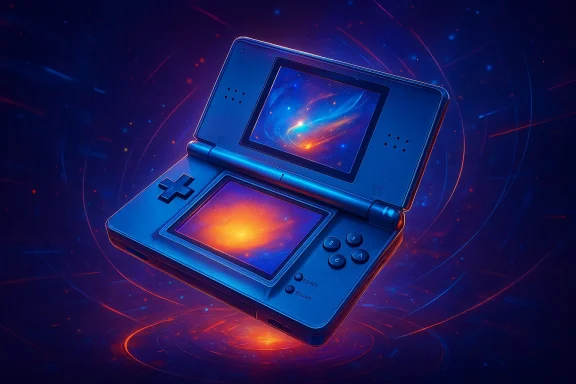
The Nintendo DS sits at a unique point in handheld history. It was not merely successful in the conventional sense; it helped define an entire era of portable gaming, with a library that balanced Nintendo’s first-party muscle, ambitious spin-offs, and unusually healthy third-party support. The system’s dual screens, resistive touchscreen, microphone input, and sleep-friendly form factor made it an ideal test bed for games that wanted to do something different without abandoning mainstream appeal. The result was a machine that could host ultra-traditional sequels one minute and genre-bending curiosities the next.
That breadth is also why the DS has become a kind of memory filter. A handful of giant franchises—Mario, Pokémon, Zelda, Animal Crossing, and the platform’s “must-own” lineup—continue to dominate retro discussions, while many smaller successes have drifted out of the cultural spotlight. In hindsight, this is less about quality than about recency bias: games that did well on a system with an enormous audience still needed a post-launch identity to survive in the public imagination. Without modern remasters, active sequels, or recurring characters in new entries, even million-selling releases can feel oddly erased.
The AOL piece captures that phenomenon neatly by focusing not on commercial failures, but on successful titles that never quite became permanent fixtures in the broader gaming canon. That distinction matters. A forgotten cult favorite is one thing; a once-prominent hit that has faded from the discourse is another. The latter tells us more about how franchises evolve, how platform legacies are curated, and how Nintendo’s own software strategy can either preserve or sideline a concept over time.
What makes these five games especially revealing is that they each represent a different kind of DS success. Sonic Rush was a revival of classic-style platforming with real momentum behind it. Pokémon Ranger experimented with a side branch of the Pokémon formula and became a mini-franchise. Mario Hoops 3-on-3 crossed over into weird territory with Square Enix characters. Rhythm Heaven translated a niche Japanese rhythm concept into a worldwide hit. Tomodachi Collection built a social simulation around Miis and turned that idea into a phenomenon in Japan. In other words, these were not filler titles. They were commercially meaningful bets that proved the DS could support more than the obvious tentpoles.
The game’s success was substantial, reportedly reaching three million copies sold, and it even generated a direct sequel in Sonic Rush Adventure. Those numbers matter because they show that this was not some overlooked side project; it was a meaningful commercial validation of a specific design philosophy. Yet the title’s visibility has diminished because later Sonic discourse became dominated by very different conversations: 3D experimentation, quality-control debates, and the recurring tension between boost-speed spectacle and platforming precision.
Another reason for the game’s relative obscurity is character continuity. Blaze the Cat, introduced here as a co-lead, did not become a true recurring pillar in the same way Sonic, Tails, Knuckles, or even Shadow did. That makes Sonic Rush feel like a self-contained achievement rather than a foundation stone for future branding. It is a fan-favorite memory more than a living franchise component, and that difference explains a lot about how games age in public consciousness.
The piece emphasizes that the game kept some core Pokémon ideas intact while pushing a clearer narrative front and center. That made it feel distinct from the mainline series without losing its identity, which is precisely why it worked commercially. It sold nearly three million copies worldwide and spawned two DS sequels, Shadows of Almia and Guardian Signs, confirming that the experiment had enough traction to become a real branch of the brand.
And yet, despite all of that, Ranger largely disappeared after the DS era. That absence is telling. Nintendo and The Pokémon Company have historically preferred to preserve the commercial center of Pokémon rather than proliferate too many offshoots that might dilute the brand. The consequence is a franchise that is always visible but not always expansive, and Pokémon Ranger became a casualty of that strategic conservatism.
The article notes that the game sold 1.5 million copies by 2007, which is a strong performance for an oddball crossover with a sports shell. It also notes that Nintendo and Square Enix returned to the idea with Mario Sports Mix on Wii, extending the cross-franchise experiment into a broader format. That continuity suggests the concept worked well enough to become a reusable template, even if the original DS entry never became a major cultural reference point.
The game’s obscurity is also a product of how sports spin-offs age. Unless a title becomes a perennial party classic or lands on a system with an enduring online scene, it tends to disappear once the novelty wears off. Mario Hoops 3-on-3 had the right ingredients for conversation and the wrong ones for permanence. It was weird enough to be interesting, but not weird enough to become mythology.
The game sold over three million copies worldwide, which is remarkable for a title built around short rhythm minigames rather than a single continuous progression loop. It also spawned follow-ups on Wii and 3DS, proving that Nintendo saw the formula as more than a one-off experiment. And yet the series always occupied a peculiar space between mass-market success and niche cultural identity.
Still, its broader reputation suffered because rhythm games were themselves living through a very specific cultural boom. The article points out that titles like Guitar Hero and Rock Band dominated the public imagination around the same period, which likely made Rhythm Heaven feel less like the leader of a movement and more like a clever cousin at the party. In hindsight, that may have helped the franchise survive; by avoiding overexposure, it retained its charm.
The article notes that by 2010, the game had sold well over three million copies despite remaining Japan-exclusive. That fact alone makes it one of the stranger successes in Nintendo’s handheld history. A culturally specific simulation built on a highly Nintendo-specific avatar system became a major hit, then remained almost invisible to most of the global audience.
Its obscurity outside Japan also highlights how platform hits can be regionally transformative without becoming globally canonical. Nintendo’s later Tomodachi Life for 3DS brought the concept westward, but the original DS title still functions almost like a missing chapter in the series’ mythology. That missing chapter is important, because it shows how localization decisions can rewrite a franchise’s long-term memory.
The DS generation was also unusually crowded with standout software. That sheer abundance is both a blessing and a curse: it gave players extraordinary variety, but it also diluted memory. In an ecosystem where major franchises were producing multiple entries, spinoffs, and experiments almost every year, many excellent games were destined to become deep-cut references rather than evergreen classics.
It is also worth noting how modern franchise management works against archival diversity. Nintendo, Sega, and The Pokémon Company each preserve their brands carefully, but they tend to revive the most commercially legible pieces first. That can leave a game like Pokémon Ranger or Tomodachi Collection stranded in a historical blind spot even when the core ideas behind them are still viable.
That matters because handhelds often get treated as second-tier ecosystems in retrospective game history, even when they are central to the survival of major franchises. The DS is a perfect counterexample. It was not just where Nintendo parked side projects; it was where it tested future possibilities. Some of those possibilities led nowhere, but others shaped how later games were framed, designed, or localized.
At the same time, the DS’s success created a backlog problem of its own. Games had to compete not only with rivals from other publishers, but with Nintendo’s own relentless output. The handheld became a place where innovation could thrive and disappear quickly, which is part of why it remains such a rich source of forgotten gems.
There is also a preservation lesson here. When games do not return through remasters, collections, or continuing sequels, they depend on memory transfers between fans. That works for a while, but not indefinitely. The result is a slow cultural fade in which once-successful titles become harder to explain to new players unless someone actively keeps telling their story.
That is why lists like this matter. They remind us that the gaming canon is curated, not inevitable. A title may sell millions, launch sequels, and still wind up in the archive drawer if it does not keep producing reasons to be remembered.
The larger lesson is that the DS library deserves more than nostalgia. It deserves active preservation, discussion, and contextualization, because the system’s most interesting stories are often not the most famous ones. The games in this list remind us that success and memory are different currencies, and the gaming industry is still deciding which one matters most.
Source: AOL.com https://www.aol.com/lifestyle/5-hit-nintendo-ds-video-000000463.html
 Overview
The Nintendo DS sits at a unique point in handheld history. It was not merely successful in the conventional sense; it helped define an entire era of portable gaming, with a library that balanced Nintendo’s first-party muscle, ambitious spin-offs, and unusually healthy third-party support. The system’s dual screens, resistive touchscreen, microphone input, and sleep-friendly form factor made it an ideal test bed for games that wanted to do something different without abandoning mainstream appeal. The result was a machine that could host ultra-traditional sequels one minute and genre-bending curiosities the next.That breadth is also why the DS has become a kind of memory filter. A handful of giant franchises—Mario, Pokémon, Zelda, Animal Crossing, and the platform’s “must-own” lineup—continue to dominate retro discussions, while many smaller successes have drifted out of the cultural spotlight. In hindsight, this is less about quality than about recency bias: games that did well on a system with an enormous audience still needed a post-launch identity to survive in the public imagination. Without modern remasters, active sequels, or recurring characters in new entries, even million-selling releases can feel oddly erased.
The AOL piece captures that phenomenon neatly by focusing not on commercial failures, but on successful titles that never quite became permanent fixtures in the broader gaming canon. That distinction matters. A forgotten cult favorite is one thing; a once-prominent hit that has faded from the discourse is another. The latter tells us more about how franchises evolve, how platform legacies are curated, and how Nintendo’s own software strategy can either preserve or sideline a concept over time.
What makes these five games especially revealing is that they each represent a different kind of DS success. Sonic Rush was a revival of classic-style platforming with real momentum behind it. Pokémon Ranger experimented with a side branch of the Pokémon formula and became a mini-franchise. Mario Hoops 3-on-3 crossed over into weird territory with Square Enix characters. Rhythm Heaven translated a niche Japanese rhythm concept into a worldwide hit. Tomodachi Collection built a social simulation around Miis and turned that idea into a phenomenon in Japan. In other words, these were not filler titles. They were commercially meaningful bets that proved the DS could support more than the obvious tentpoles.
Sonic Rush: The DS Game That Kept 2D Sonic Relevant
Sonic Rush arrived at a moment when the Sonic brand was looking for stability, and the DS gave Sega exactly the kind of hardware that could support a fast, side-scrolling answer to the question of what Sonic should be. The article describes it as a 2.5D platformer that blended 3D environments with side-scrolling gameplay, and that hybrid identity is key to its legacy. It preserved the classic feel while still looking modern enough to signal that Sonic could work on handheld hardware without becoming a relic.The game’s success was substantial, reportedly reaching three million copies sold, and it even generated a direct sequel in Sonic Rush Adventure. Those numbers matter because they show that this was not some overlooked side project; it was a meaningful commercial validation of a specific design philosophy. Yet the title’s visibility has diminished because later Sonic discourse became dominated by very different conversations: 3D experimentation, quality-control debates, and the recurring tension between boost-speed spectacle and platforming precision.
Why It Faded
The irony is that Sonic Rush may have been better at preserving “classic Sonic” than many of the franchise’s later attempts to modernize it. The AOL piece explicitly contrasts its status with the infamous 2006 Sonic the Hedgehog, which is a sharp reminder that a well-received portable spin-off can still be overshadowed by a high-profile mainline misfire. In a franchise as culturally noisy as Sonic, good ideas can disappear not because they fail, but because the conversation moves elsewhere.Another reason for the game’s relative obscurity is character continuity. Blaze the Cat, introduced here as a co-lead, did not become a true recurring pillar in the same way Sonic, Tails, Knuckles, or even Shadow did. That makes Sonic Rush feel like a self-contained achievement rather than a foundation stone for future branding. It is a fan-favorite memory more than a living franchise component, and that difference explains a lot about how games age in public consciousness.
- It restored confidence in 2D Sonic on portable hardware.
- It sold strongly enough to justify a sequel.
- It introduced Blaze in a major role, even if her long-term use was limited.
- It is remembered by fans more than by the mainstream audience.
- It benefited from being good at a moment when Sonic needed good news.
Pokémon Ranger: A Spin-Off That Proved Pokémon Could Be More Than Battles
Pokémon Ranger is one of the most interesting examples of Nintendo spin-off logic working at full strength. Instead of the standard Gym Leader structure, the game cast players as a wildlife ranger in Fiore, using Pokémon to solve objectives rather than simply collecting badges and climbing the ladder of competitive status. That shift is more than thematic dressing; it reorients the entire franchise around service, stewardship, and task-based storytelling.The piece emphasizes that the game kept some core Pokémon ideas intact while pushing a clearer narrative front and center. That made it feel distinct from the mainline series without losing its identity, which is precisely why it worked commercially. It sold nearly three million copies worldwide and spawned two DS sequels, Shadows of Almia and Guardian Signs, confirming that the experiment had enough traction to become a real branch of the brand.
A Different Kind of Pokémon Fantasy
The appeal of Pokémon Ranger lies in its inversion of the traditional fantasy. Instead of becoming the best trainer in the region, players become a helper, mediator, and protector. That is a clever fit for a handheld device, because it lends itself to mission-based progression and shorter play sessions while still feeling narratively coherent. It also gives the Pokémon world a civic layer that mainline games rarely explore in such direct terms.And yet, despite all of that, Ranger largely disappeared after the DS era. That absence is telling. Nintendo and The Pokémon Company have historically preferred to preserve the commercial center of Pokémon rather than proliferate too many offshoots that might dilute the brand. The consequence is a franchise that is always visible but not always expansive, and Pokémon Ranger became a casualty of that strategic conservatism.
- It gave Pokémon a mission-based structure instead of a gym-chasing one.
- It sold almost three million copies worldwide.
- It generated two DS sequels.
- It expanded the world-building of the franchise in a meaningful way.
- It vanished because the mainline Pokémon machine is often too dominant for spin-offs to persist.
Mario Hoops 3-on-3: The Strange Crossover Almost Everyone Missed
At first glance, Mario Hoops 3-on-3 looks like one of Nintendo’s many safe sports spin-offs. In reality, it is much stranger: a basketball game that quietly folds in Final Fantasy characters from Square Enix, including White Mage, Black Mage, Moogle, Cactuar, and Ninja. That alone makes it one of the most conceptually unusual Nintendo sports titles of the era, especially because it arrived on a platform known for accessible family-friendly software.The article notes that the game sold 1.5 million copies by 2007, which is a strong performance for an oddball crossover with a sports shell. It also notes that Nintendo and Square Enix returned to the idea with Mario Sports Mix on Wii, extending the cross-franchise experiment into a broader format. That continuity suggests the concept worked well enough to become a reusable template, even if the original DS entry never became a major cultural reference point.
Why the Crossover Matters
What makes Mario Hoops 3-on-3 so memorable in retrospect is not just the roster but the quiet collapse of genre boundaries it represents. Nintendo had long understood that Mario could function as a sports mascot, but pairing him with Final Fantasy iconography pushed the crossover into almost surreal territory. It was playful corporate diplomacy, and it predated the current era in which crossovers are often marketed as the entire point.The game’s obscurity is also a product of how sports spin-offs age. Unless a title becomes a perennial party classic or lands on a system with an enduring online scene, it tends to disappear once the novelty wears off. Mario Hoops 3-on-3 had the right ingredients for conversation and the wrong ones for permanence. It was weird enough to be interesting, but not weird enough to become mythology.
- It was a Nintendo sports game with a stealth crossover structure.
- It featured several recognizable Final Fantasy archetypes.
- It sold enough to rank among Nintendo’s stronger DS titles.
- It led to a spiritual follow-up on Wii.
- It remains one of the strangest polished examples of brand collaboration on handheld.
Rhythm Heaven: A Quiet Blockbuster in a Loud Era
Rhythm Heaven may be the best example on the list of a game that was both a success and a category unto itself. The article traces it back to the Japanese Game Boy Advance title Rhythm Tengoku, but the DS sequel expanded the concept and released globally, taking advantage of the dual screens, touchscreen input, and stylus control in ways the original could not. That hardware fit matters because it turned rhythm interaction into something tactile rather than merely auditory.The game sold over three million copies worldwide, which is remarkable for a title built around short rhythm minigames rather than a single continuous progression loop. It also spawned follow-ups on Wii and 3DS, proving that Nintendo saw the formula as more than a one-off experiment. And yet the series always occupied a peculiar space between mass-market success and niche cultural identity.
A Game Built for the DS Hardware
The DS was unusually well suited to Rhythm Heaven because rhythm games reward precision and immediate feedback. The stylus and touchscreen made timing feel more physical, while the system’s portability encouraged quick sessions and repeat attempts. That design made the game feel like a product of its platform rather than a game merely ported onto it.Still, its broader reputation suffered because rhythm games were themselves living through a very specific cultural boom. The article points out that titles like Guitar Hero and Rock Band dominated the public imagination around the same period, which likely made Rhythm Heaven feel less like the leader of a movement and more like a clever cousin at the party. In hindsight, that may have helped the franchise survive; by avoiding overexposure, it retained its charm.
- It translated a Japanese concept into a global release.
- It used DS hardware in a highly natural way.
- It sold over three million copies.
- It produced sequels across two later Nintendo platforms.
- It remained distinctive even during the height of the rhythm-game boom.
Tomodachi Collection: Japan’s Social-Sim Surprise Hit
Tomodachi Collection is perhaps the most obscure title on the list outside Japan, which makes its inclusion both obvious and revealing. The game built a social-simulation experience around Miis, letting players manage an apartment complex populated by avatars that could be created in-game, transferred via Wi-Fi, or imported from a Wii. That linkage turned Nintendo’s avatar concept into something more emotionally elastic and more absurdly personal.The article notes that by 2010, the game had sold well over three million copies despite remaining Japan-exclusive. That fact alone makes it one of the stranger successes in Nintendo’s handheld history. A culturally specific simulation built on a highly Nintendo-specific avatar system became a major hit, then remained almost invisible to most of the global audience.
Miis as a Social Engine
What Tomodachi Collection really did was transform Miis from a novelty into a simulation medium. Rather than using avatars simply as cute stand-ins for players, it let them form relationships, require attention, and occupy a shared domestic space. That made the concept feel closer to a digital community than a menu-based customization feature.Its obscurity outside Japan also highlights how platform hits can be regionally transformative without becoming globally canonical. Nintendo’s later Tomodachi Life for 3DS brought the concept westward, but the original DS title still functions almost like a missing chapter in the series’ mythology. That missing chapter is important, because it shows how localization decisions can rewrite a franchise’s long-term memory.
- It turned Miis into a living social ecosystem.
- It sold over three million copies in Japan.
- It was influential enough to spawn later sequels.
- It remained largely hidden from Western players.
- It demonstrated that Nintendo’s most eccentric ideas can still be mass-market hits.
Why These DS Hits Slipped Away
The biggest takeaway from the article is not that these games were obscure failures, but that they were successful enough to be culturally noticeable once and then lost momentum. That is a very different kind of forgetting. When a game sells millions and still disappears from the broader conversation, it tells us that commercial success alone does not guarantee endurance.The DS generation was also unusually crowded with standout software. That sheer abundance is both a blessing and a curse: it gave players extraordinary variety, but it also diluted memory. In an ecosystem where major franchises were producing multiple entries, spinoffs, and experiments almost every year, many excellent games were destined to become deep-cut references rather than evergreen classics.
The Role of Sequels and Remasters
One reason some DS titles remain visible is that they were continually refreshed through ports, collections, or later references. The five games in the AOL roundup do not all share that fate. Some have sequels but no modern home, others have characters that escaped the original title but not the game itself, and some survived only as memories in niche fan circles. That uneven afterlife is often what separates “classic” from “forgotten.”It is also worth noting how modern franchise management works against archival diversity. Nintendo, Sega, and The Pokémon Company each preserve their brands carefully, but they tend to revive the most commercially legible pieces first. That can leave a game like Pokémon Ranger or Tomodachi Collection stranded in a historical blind spot even when the core ideas behind them are still viable.
- Success does not guarantee cultural permanence.
- The DS library was so deep that many hits were eclipsed by bigger names.
- Sequels help, but only if the franchise keeps evolving publicly.
- Regional exclusivity can erase a game from global memory.
- Brand managers often prioritize safe revival candidates over quirky legacy titles.
The DS as a Laboratory for Franchises
What ties these five games together is not genre, but function. Each one served as a laboratory for a larger brand: Sonic testing classic platform identity, Pokémon exploring an alternate career path, Mario dabbling in crossover sports, Rhythm Heaven proving that stylus-based rhythm design could travel globally, and Tomodachi Collection turning avatar culture into a social sandbox. The DS made this sort of experimentation commercially practical because its install base was enormous and its audience was unusually broad.That matters because handhelds often get treated as second-tier ecosystems in retrospective game history, even when they are central to the survival of major franchises. The DS is a perfect counterexample. It was not just where Nintendo parked side projects; it was where it tested future possibilities. Some of those possibilities led nowhere, but others shaped how later games were framed, designed, or localized.
What the DS Got Right
The DS could support games that were short, weird, stylus-driven, or narrowly focused without demanding the kind of overhead that a home console release required. That made it ideal for designs that might have struggled elsewhere. It is no accident that so many concepts in this roundup feel like experiments in user interface, pacing, or genre blending rather than straightforward sequels.At the same time, the DS’s success created a backlog problem of its own. Games had to compete not only with rivals from other publishers, but with Nintendo’s own relentless output. The handheld became a place where innovation could thrive and disappear quickly, which is part of why it remains such a rich source of forgotten gems.
- The DS encouraged genre experimentation.
- Its hardware made unconventional gameplay feel natural.
- Its massive audience gave odd ideas a commercial shot.
- The platform’s own abundance made memory competitive.
- It functioned as a proving ground for franchise extensions.
Why Forgotten Does Not Mean Unimportant
A game being forgotten by the general public does not make it culturally irrelevant. If anything, titles like these are often more instructive than the obvious classics, because they reveal what publishers were willing to try when they had confidence in their audiences. That is especially true for Nintendo, whose DS-era output shows a company willing to use its most recognizable characters to test new ideas rather than merely recycle old ones.There is also a preservation lesson here. When games do not return through remasters, collections, or continuing sequels, they depend on memory transfers between fans. That works for a while, but not indefinitely. The result is a slow cultural fade in which once-successful titles become harder to explain to new players unless someone actively keeps telling their story.
The Long Tail of Obscurity
In practical terms, obscurity is not always a sign of failure. Sometimes it is a sign that a game was so specific to its hardware, era, or design trend that it no longer maps neatly onto today’s market expectations. Rhythm Heaven and Tomodachi Collection both feel like products of a broader moment in interface design and social play. Their fading visibility says as much about changing taste as it does about the games themselves.That is why lists like this matter. They remind us that the gaming canon is curated, not inevitable. A title may sell millions, launch sequels, and still wind up in the archive drawer if it does not keep producing reasons to be remembered.
- Obscurity can coexist with quality.
- Cultural memory is shaped by repetition, not just success.
- Platform-specific design can age out of the mainstream quickly.
- Archival neglect creates false impressions of significance.
- Retrospectives help restore context that fan memory alone cannot preserve.
Strengths and Opportunities
This roundup works because it does not chase the obvious DS heavyweights. Instead, it spotlights commercially successful curiosities that reveal just how inventive the handheld library could be, and that gives readers a more textured picture of the system’s legacy. The strongest opportunity here is for Nintendo, Sega, and The Pokémon Company to revisit these brands in ways that respect their original ideas rather than flattening them into nostalgia bait. If handled carefully, even the most forgotten DS successes could find a second life.- Sonic Rush still has a strong case as a model for portable Sonic design.
- Pokémon Ranger could inspire a more narrative-driven spin-off.
- Mario Hoops 3-on-3 shows that crossover sports can be genuinely inventive.
- Rhythm Heaven remains one of Nintendo’s best examples of touch-based design.
- Tomodachi Collection demonstrates the long-term value of Mii-based social simulation.
- The DS library still has room for reappraisal, especially from younger players discovering it later.
- These games could all benefit from modern preservation efforts or compilation releases.
Risks and Concerns
The biggest risk is that forgotten titles become curiosity artifacts instead of living pieces of game history. When that happens, their mechanics, intentions, and influence are flattened into trivia, and the industry loses a chance to learn from them. There is also the danger that revival efforts will overcorrect by polishing away the very quirks that made these games stand out in the first place.- Regional exclusivity can keep a game culturally invisible outside its home market.
- Spin-offs are often the first titles cut when franchise strategy tightens.
- Sequels do not guarantee remembrance if the brand stops iterating publicly.
- Modern audiences may not connect with DS-era interface assumptions.
- Overreliance on nostalgia can lead publishers to ignore more interesting legacy options.
- A title’s absence from current platforms can create a self-reinforcing cycle of obscurity.
Looking Ahead
If there is a future for these games beyond retrospective lists, it will likely come through selective revival rather than full-scale reinvention. Nintendo in particular has become more willing to revisit older ideas when the business case aligns, but it remains cautious about reviving brands that do not neatly fit current platform strategy. That means the most likely path forward is a slow one: remasters, collection appearances, cameo references, and maybe a surprise reboot or two.The larger lesson is that the DS library deserves more than nostalgia. It deserves active preservation, discussion, and contextualization, because the system’s most interesting stories are often not the most famous ones. The games in this list remind us that success and memory are different currencies, and the gaming industry is still deciding which one matters most.
- Watch for ports or legacy collections that surface lesser-known DS titles.
- Pay attention to whether Nintendo revisits Mii-based concepts in new forms.
- Track whether Rhythm Heaven and related rhythm properties receive renewed attention.
- Look for modern reinterpretations of spin-off structures in Pokémon and Sonic.
- Expect more retro coverage to focus on under-discussed hits rather than only the obvious classics.
Source: AOL.com https://www.aol.com/lifestyle/5-hit-nintendo-ds-video-000000463.html
Last edited:
