

Nisshin Flour Milling’s push toward a real-time data platform is a useful case study in a much larger manufacturing trend: the move from isolated plant dashboards to shared, enterprise-wide operational intelligence. The company had already modernized its mills with MES-based visualization in the early 2000s, but those insights were still largely trapped on site until it began stitching together Azure services in 2021 and completed a cross-mill, head-office-connected platform in March 2023. The latest shift to Microsoft Fabric is important because it addresses the next problem after connectivity: making real-time data easier for frontline mill workers and less dependent on advanced technical expertise. That distinction matters in a process where millers still make micron-level adjustments based on wheat moisture, hardness, and other variables. n Flour Milling is not just digitizing for the sake of digitizing. It is trying to convert a deeply experience-driven craft into a more repeatable, data-informed operating model. The company’s digital strategy sits inside a broader medium-term business plan that places digital technology at the center of growth, and Japan’s Digital Technology Accreditation System recognition in 2023 suggests that regulators saw that effort as credible rather than cosmetic. In other words, this is not a pilot project wearing a press-release badge; it is an industrial transformation program with institutional backing.
The challenge is fahas followed industrial analytics closely. Factories can generate huge amounts of telemetry, but turning that telemetry into decisions is another matter entirely. Many manufacturers succeed at collecting data and fail at distributing it in a form that operators can trust and use. That appears to have been the exact bottleneck Nisshin Flour Milling encountered after it expanded beyond local MES dashboards into a broader Azure-based real-time platform. The data was available, but the barrier was usability.
Microsoft Fabric matters here because Misitioning the platform around simplified real-time analytics, with Real-Time Intelligence, Real-time hub, and tighter integration between streaming data, querying, and actioning. Microsoft’s own messaging emphasizes that Fabric is meant to reduce the need to manually stitch services together, which is especially relevant for manufacturers trying to push insights to non-technical users. In practical terms, that means the same raw event can be ingested, transformed, queried, and operationalized with less friction than a bespoke architecture built from separate Azure components. (microsoft.com)
For Nisshin, the shift is strategic as much as technical. The company is not simply trying to see more data faster. It is trying to reduce the dependence on a shrinking pool of expert millers, standardize operations across locations, and make the knowledge locked in one site reusable in others. That is the kind of business problem that data platforms can actually solve when they are desie who use them, not just the engineers who build them.
The flour milling industry is an unexpectedly demanding setting for digital transformation. Unlike clean, repeatable transactions in office software, milling involves physical inputs that vary by harvest, region, moisture content, and the condition of the machinery itself. Nisshin’s own description underscores that skilled millers have historically adjusted rollers and sieves in tiny increments, often relying on judgment built through years of practice. That means the knowledge problem is not just “how do we collect more data?” but “how do we pse before it walks out the door?”
That is why the company’s smartification agenda is more interesting than a generic factory modernization story. Smart mills are not only about automation. They are about converting data into knowledge and knowledge into repeatable processes. This is especially relevant in food production, where consistency, quality, and throughput matter, but product variability can never be eliminated completely. A system that helps operators make better decisions without removing human oversight is often more valuable than one that tries to remoop entirely.
The evolution from MES to Azure to Fabric mirrors a broader enterprise pattern. Many companies start with local visualization tools, then move to cloud-based data integration, and finally reach the stage where they need a simpler consumption layer for business users. Microsoft Fabric’s pitch is that the platform can unify data engineering, analytics, and real-time operations in a way that reduces the number of tools and specialist skills required. Microsoft has made this argument repeatedly, especially around Real-Time Intelligence and the idea of handling streaming data without “landing” it first. (microsoft.com)
Nisshin’s experience also exposes a less glamorous truth about industrial AI: the hardest part is often not model quality, but adoption. The company already had a technically advanced Azure stack built from IoT Hub, Stream Analytics, Synapse Analytics, and Data Factory, but that still required expertise that many mill workers did not have. In that sense, the move to Fabric is as mucion as it is a platform upgrade. That is a very different kind of digital transformation from the one vendors tend to advertise.
The operational payoff is not just “faster alerts.” It is better calibration of human judgment. If a miller sees a change in the right context, that insight can be turned into a repeatable pattern for future shifts or other plants. That creates an organizational memory that extends beyond the individual ophere expertise is hard to hire and even harder to scale, that is a material advantage.
That gap is common in industrial IT. Engineers can build a powerful pipeline, but frontline teams often need low-friction interfaces, predictable workflows, and clear explanations of what the data means. If the system requires advanced query skills or specialist support to interpret an alert, adoption stalls. Microsoft Fabric is trying to close that gap by putting more of the ingestion-to-action pipeline inside one SaaS experience. Microsoft’s Real-Time Intelligence messaging explicitly talks about low-code and no-code interfaces alongside code-rich ones, which is a strong clue about where the company believes the market is heading. (microsoft.com)
Fabric’s promise is that it can make real-time data feel more like an operational product and less like infrastructure. Microsoft has positioned Real-time hub as a central place to discover, manage, and use streaming data, and that is significant for manufacturers because discovery and governance are often the hidden barriers to scale. When data is easy to find and easy to act on, the organization is more likely to reuse it rather than build one-off dashboards for every plant. (microsoft.com)
The deeper lesson is that democratization is not a slogan; it is a design constraint. If a system is supposed to reduce skill dependence, then its interface must reflect the cognitive reality of the users. That often means simpler visuals, clearer alerts, and less need to hop between tools. Fabric’s integrated model may help here, but only if it translates into something that feels native to plant operations rather than abstractly “cloud modern.” (microsoft.com)
The real-time story is especially compelling. Microsoft says Real-Time Intelligence brings together the ability to ingest streaming data, dynamically transform it, query it instantly, and trigger actions from the same environment. That maps neatly onto a mill environment where the response to a production deviation can involve alerts, rerouting, recalibration, or escalation. If the workflow is short enough, the signal survives contact with the factory floor. (microsoft.com)
That is exactly what manufacturers like Nisshin need. The value of a platform rises when it can reduce the gap between detection and response. A dashboard that merely displays a deviation is useful; a system that helps decide what to do next is much more powerful. The more that decision support can be standardized, the more the company can scale expertise across facilities.
This matters because manufacturing often gets discussed as if the end state is zero human intervention. In reality, the best systems usually preserve human oversight while improving the quality of the decisions humans make. That is particularly true when qhigh and process variation is unavoidable. The goal is not to eliminate judgment; it is to distribute it better.
There is also a training dividend. Newer employees can ramp faster if they are learning from codified patterns rather than relying solely on apprenticeship. That can reduce the time it takes to become productive while also making erable to labor shortages. In a sector where precision matters, that is a real strategic hedge.
Microsoft Fabric can support that model if it makes expertise legible at the right level of abstraction. Mill workers do not need the entire data pipeline. They need the right indication, at the right time, with enough context to act. The closer the interface gets to that ideal, the more likely the platform will move from pilot value to daily operational value. (microsoft.com)
That pitch matters because manufacturers have options. They can assemble best-of-breed point tools, stick with hyperscaler-native services, or move toward more unified analytics platforms. Fabric’s advantage is not that it is the only capable option. It is that it compresses complexity at a time when complexity is becoming the main barrier to adoption. Microsoft clearly believes that simplification is a competitive weapon. (microsoft.com)
For Microsoft rivals, the challenge is not just feature parity. It is packagir can get from sensor event to action more easily in Fabric than in a competing stack, then Microsoft has won something more durable than a benchmark comparison. It has won mindshare around operational simplicity. That is hard to dislodge. (microsoft.com)
What makes this particularly interesting is that the company’s own earlier Azure setup already proved the appetite for real-time data. The new question isn make the experience sufficiently accessible to drive adoption beyond a specialist team. If it can, it strengthens the company’s claim that Fabric is more than a rebrand of existing analytics tooling. It becomes a genuine operational platform.
Enterprise buyers will care most about governance, interoperability, and workforce enablement. Consumer impact, by contrast, is about outcome quality rather than software architecture. That is a useful distinction because it reminds us why manufacturing analytics matters in the firs not to produce prettier dashboards. The point is to produce better physical goods more consistently.
The most interesting part is that the platform also helps bridge operational silos. When head office and mills share the same live picture, the company can coordinate more effectively and reduce the risk that local optimization undermines broader performance. That cross-site visibility is often where the biggest enterprise value appears.
There is also a broader sustainability angle. More accurate processing can reduce waste, improve yield, and make production more efficient. Those outcomes matter to manufacturers, retailers, and consumers alike. The consumer never sees the dashboard, but they do see the consequences of better execution. That is where industrial software quietly becomes everyday value.
Another concern is overreliance on platform abstraction. When systems become easier to use, they can also become easier to trust too much. That makes governance, validation, and training even more important. In manufacturing, a bad recommendation can be worse than no recommendation at all if it is acted on too quickly. Ease of use should never become a substitute for process discipline.
It will also be worth watching whether Microsoft turns this into a broader manufacturing pattern. Fabric’s real-time story is strongest when it can be framed around frontline utility, not just cloud modernization. If Microsoft can show that Real-Time Intelligence helps actual operators in actual plants, the platform gets a much stronger industrial narrative. That would matter well beyond milling. (microsoft.com)
Source: Microsoft Nisshin Flour Milling promotes real-time data use with Microsoft Fabric | Microsoft Customer Stories
The challenge is fahas followed industrial analytics closely. Factories can generate huge amounts of telemetry, but turning that telemetry into decisions is another matter entirely. Many manufacturers succeed at collecting data and fail at distributing it in a form that operators can trust and use. That appears to have been the exact bottleneck Nisshin Flour Milling encountered after it expanded beyond local MES dashboards into a broader Azure-based real-time platform. The data was available, but the barrier was usability.
Microsoft Fabric matters here because Misitioning the platform around simplified real-time analytics, with Real-Time Intelligence, Real-time hub, and tighter integration between streaming data, querying, and actioning. Microsoft’s own messaging emphasizes that Fabric is meant to reduce the need to manually stitch services together, which is especially relevant for manufacturers trying to push insights to non-technical users. In practical terms, that means the same raw event can be ingested, transformed, queried, and operationalized with less friction than a bespoke architecture built from separate Azure components. (microsoft.com)
For Nisshin, the shift is strategic as much as technical. The company is not simply trying to see more data faster. It is trying to reduce the dependence on a shrinking pool of expert millers, standardize operations across locations, and make the knowledge locked in one site reusable in others. That is the kind of business problem that data platforms can actually solve when they are desie who use them, not just the engineers who build them.
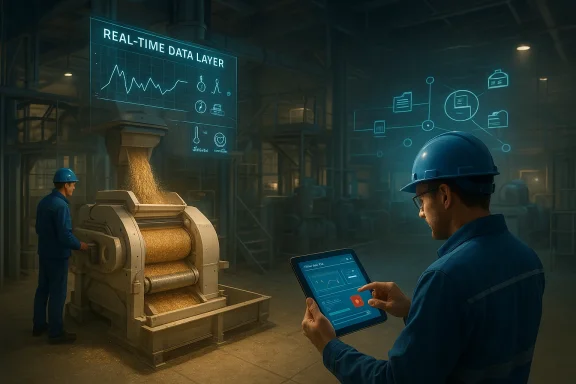 Background
The flour milling industry is an unexpectedly demanding setting for digital transformation. Unlike clean, repeatable transactions in office software, milling involves physical inputs that vary by harvest, region, moisture content, and the condition of the machinery itself. Nisshin’s own description underscores that skilled millers have historically adjusted rollers and sieves in tiny increments, often relying on judgment built through years of practice. That means the knowledge problem is not just “how do we collect more data?” but “how do we pse before it walks out the door?”That is why the company’s smartification agenda is more interesting than a generic factory modernization story. Smart mills are not only about automation. They are about converting data into knowledge and knowledge into repeatable processes. This is especially relevant in food production, where consistency, quality, and throughput matter, but product variability can never be eliminated completely. A system that helps operators make better decisions without removing human oversight is often more valuable than one that tries to remoop entirely.
The evolution from MES to Azure to Fabric mirrors a broader enterprise pattern. Many companies start with local visualization tools, then move to cloud-based data integration, and finally reach the stage where they need a simpler consumption layer for business users. Microsoft Fabric’s pitch is that the platform can unify data engineering, analytics, and real-time operations in a way that reduces the number of tools and specialist skills required. Microsoft has made this argument repeatedly, especially around Real-Time Intelligence and the idea of handling streaming data without “landing” it first. (microsoft.com)
Nisshin’s experience also exposes a less glamorous truth about industrial AI: the hardest part is often not model quality, but adoption. The company already had a technically advanced Azure stack built from IoT Hub, Stream Analytics, Synapse Analytics, and Data Factory, but that still required expertise that many mill workers did not have. In that sense, the move to Fabric is as mucion as it is a platform upgrade. That is a very different kind of digital transformation from the one vendors tend to advertise.
Why real-time matters in milling
Real-time data is especially valuable in milling because conditions can change quickly, and small changes can ripple through quality and yield. A slight shift in moisture or hardness can alter how the mill should operate, which means delayed visibility canput or inconsistent product. When the production line is tightly tuned, the value of immediacy rises sharply.The operational payoff is not just “faster alerts.” It is better calibration of human judgment. If a miller sees a change in the right context, that insight can be turned into a repeatable pattern for future shifts or other plants. That creates an organizational memory that extends beyond the individual ophere expertise is hard to hire and even harder to scale, that is a material advantage.
- Real-time visibility reduces the gap between event and response.
- Shared data creates common operating language across mills.
- Better context can support quality consistency.
- Faster feedback can improve yield and reduce waste.
- Operational knowledge becomes easier to preserve and transfer.
From Azure Plumbing to Platform Usability
The Microsoft stack that Nisshin assembled in 2021 was already technically sophisticated. Azure IoT Hub, Stream Analytics, Synapse Analytics, and Data Factory can do a lot when combined correctly, and Microsoft has long positioned Azure as a strong environment for streaming telemetry and manufacturing workloads. The problem, as Nisshin describes it, was not whether the stack could process the data. It was whest to the process could use it without becoming cloud specialists.That gap is common in industrial IT. Engineers can build a powerful pipeline, but frontline teams often need low-friction interfaces, predictable workflows, and clear explanations of what the data means. If the system requires advanced query skills or specialist support to interpret an alert, adoption stalls. Microsoft Fabric is trying to close that gap by putting more of the ingestion-to-action pipeline inside one SaaS experience. Microsoft’s Real-Time Intelligence messaging explicitly talks about low-code and no-code interfaces alongside code-rich ones, which is a strong clue about where the company believes the market is heading. (microsoft.com)
Why existing Azure architecture was not enough
The original Azure-based real-time platform was a legitimate step forward, but it still left Nisshin with a familiar enterprise problem: too much power in the hands of too few expertsy be used effectively by a technical team, then its value stops at the boundary between IT and operations. That creates a bottleneck precisely where the company wanted broader adoption.Fabric’s promise is that it can make real-time data feel more like an operational product and less like infrastructure. Microsoft has positioned Real-time hub as a central place to discover, manage, and use streaming data, and that is significant for manufacturers because discovery and governance are often the hidden barriers to scale. When data is easy to find and easy to act on, the organization is more likely to reuse it rather than build one-off dashboards for every plant. (microsoft.com)
- Legacy cloud architecture often favors specialists.
- Frontline users need context, not raw telemetry.
- Shared interfaces reduce training overhead.
- One platform can be easier to govern than many tools.
- Simpler access can drive wider adoption across mills.
The usability problem in industrial AI
Industrial AI has a tendency to fail in the handoff from pilot to production. A model may be aorkflow is clumsy or the interface is intimidating, operators revert to old habits. Nisshin’s story is a textbook example: the data existed, the platform worked, but the workers who needed it most did not have an easy way to apply it. That is a product design issue as much as a data architecture issue.The deeper lesson is that democratization is not a slogan; it is a design constraint. If a system is supposed to reduce skill dependence, then its interface must reflect the cognitive reality of the users. That often means simpler visuals, clearer alerts, and less need to hop between tools. Fabric’s integrated model may help here, but only if it translates into something that feels native to plant operations rather than abstractly “cloud modern.” (microsoft.com)
Why Fabric Fits This Use Case
Fabric is a natural fit for Nisshin because it is designed around the idea that analytics should not live in disconnected silos. Microsoft has been pushing Fabric as a complete data platform that unifies transformation, analytics, and AI-ready experiences within one SaaS layer. For a manufacturing company trying to get real-time insights into the hands of non-technical users, that simplification is not merely convenient. It is the difference between a platform that is admired and a platform that is actually used. (microsoft.com)The real-time story is especially compelling. Microsoft says Real-Time Intelligence brings together the ability to ingest streaming data, dynamically transform it, query it instantly, and trigger actions from the same environment. That maps neatly onto a mill environment where the response to a production deviation can involve alerts, rerouting, recalibration, or escalation. If the workflow is short enough, the signal survives contact with the factory floor. (microsoft.com)
Real-Time Intelligence as an operational layer
One of the more important changes Microsoft has made is to reframe streaming analytics as an operational layer rather than a backend service. Thles talk about alerting a production manager when equipment overheats or rerunning jobs when pipelines fail. Those examples may sound obvious, but they highlight a larger shift: real-time analytics is no longer being marketed as a specialist engineer’s toy. It is being sold as a business action engine. (microsoft.com)That is exactly what manufacturers like Nisshin need. The value of a platform rises when it can reduce the gap between detection and response. A dashboard that merely displays a deviation is useful; a system that helps decide what to do next is much more powerful. The more that decision support can be standardized, the more the company can scale expertise across facilities.
- Real-time intelligence supports faster response cycles.
- Shared context can improve decision quality.
- One platform can combine visibility and action.
- Operational teams need less technical mediation.
- Manufacturing gains come from shortening the feedback loop.
SaaS simplicity versus he move from separate Azure services to Fabric also reflects a classic enterprise trade-off: control versus simplicity. Custom stacks offer more flexibility, but they also demand more engineering, more maintenance, and more specialized knowledge. Fabric offers a more opinionated environment, which can be a strength when the goal is widespread adoption rather than endless customization. (microsoft.com)
For Nisshin, that may be the crucial point. Its earlier Azure design likely delivered power and flexibility, but a more productized environment could reduce the friction between data generation and operational use. In plain English, less plumbing and more practice. That is often what separates a technically impressive platform from a truly valuabling theater, more plant-floor utility.*Human Skill, Data Knowledge, and Automation
One of the most compelling aspects of Nisshin’s strategy is that it does not frame automation as a replacement for skilled labor. Instead, it tries to capture the logic of expert millers and turn it into guidance that others can use. That is a much more realistic vision for industrial AI, especially in a domain where phatters and where blindly automated adjustments could create more problems than they solve.This matters because manufacturing often gets discussed as if the end state is zero human intervention. In reality, the best systems usually preserve human oversight while improving the quality of the decisions humans make. That is particularly true when qhigh and process variation is unavoidable. The goal is not to eliminate judgment; it is to distribute it better.
Converting tacit expertise into repeatable knowledge
Tacit knowledge is one of the hardest assets to digitalize. It lives in habits, intuition, and pattern recognition. Nisshin’s effort to convert milling experience into data-driven knowledge is therefore more ambitious than it may sound at first glance. If done well, it can help preserve quality control even as experienced workers retire or move on.There is also a training dividend. Newer employees can ramp faster if they are learning from codified patterns rather than relying solely on apprenticeship. That can reduce the time it takes to become productive while also making erable to labor shortages. In a sector where precision matters, that is a real strategic hedge.
- Tacit knowledge can be preserved before it disappears.
- Training becomes more consistent across sites.
- Expertise can be shared without overloading senior staff.
- Decision support improves confidence for newer operators.
- Standardization helps reduce variation in output.
Automation without de-skilling
There is a subtle but important distinction between automation and de-skilling. Automation that removes operators from the loop can sometimes create fragility, because the organization loses the ability to intervene intelligently when conditions change. Nisshin’s approach appears more balanced: it wants to ease dependence on rare expertise without erasing the expertise itself. That is far healthier than the usual automation fantasy.Microsoft Fabric can support that model if it makes expertise legible at the right level of abstraction. Mill workers do not need the entire data pipeline. They need the right indication, at the right time, with enough context to act. The closer the interface gets to that ideal, the more likely the platform will move from pilot value to daily operational value. (microsoft.com)
Competitive Implications
Nisshin’s adoption of Fabric also says something about the competitive position of Microsoft in industrial data. Microsoft is increasingly trying to sell not just cloud infrastructure, but a full stack that spans ingestion, analytics, AI, and operational action. In that sense, the company is making a broader manufacturing argument: if your data architecture is too fragmented, your real-time ambitions will stay stuck in prototype mode. (microsoft.com)That pitch matters because manufacturers have options. They can assemble best-of-breed point tools, stick with hyperscaler-native services, or move toward more unified analytics platforms. Fabric’s advantage is not that it is the only capable option. It is that it compresses complexity at a time when complexity is becoming the main barrier to adoption. Microsoft clearly believes that simplification is a competitive weapon. (microsoft.com)
What rivals have to answer
Competing platforms will need to answer two questions. First, can they deliver real-time analytics without forcing customers to glue together too many services? Second, can they make those insights consumable by frontline teams, not just data engineers? Those are different questions, and many platforms solve only one of them well. (microsoft.com)For Microsoft rivals, the challenge is not just feature parity. It is packagir can get from sensor event to action more easily in Fabric than in a competing stack, then Microsoft has won something more durable than a benchmark comparison. It has won mindshare around operational simplicity. That is hard to dislodge. (microsoft.com)
- Simplicity can be a stronger differentiator than raw capabibility is a competitive battleground.
- Integrated real-time workflows reduce platform sprawl.
- Manufacturing buyers value operational clarity.
- Vendor ecosystems matter as much as features.
The market is moving toward operational AI
The broader market context is straightforward: manufacturing buyers are increasingly looking for operational AI, not just analytics. That means systems that can detecact on changes in production conditions. Nisshin’s story fits squarely into that trend, and Microsoft is using Fabric to make the case that its platform is ready for that shift. (microsoft.com)What makes this particularly interesting is that the company’s own earlier Azure setup already proved the appetite for real-time data. The new question isn make the experience sufficiently accessible to drive adoption beyond a specialist team. If it can, it strengthens the company’s claim that Fabric is more than a rebrand of existing analytics tooling. It becomes a genuine operational platform.
Enterprise vs Consumer Impact
This story is overwhelmingly an enterprise story, but it stilations downstream. For the business, the immediate gains are about throughput, consistency, and the ability to scale expertise across production sites. For the consumer, those improvements show up indirectly as more stable flour quality, better supply reliability, and potentially less waste in the chain between wheat and finished product.Enterprise buyers will care most about governance, interoperability, and workforce enablement. Consumer impact, by contrast, is about outcome quality rather than software architecture. That is a useful distinction because it reminds us why manufacturing analytics matters in the firs not to produce prettier dashboards. The point is to produce better physical goods more consistently.
What enterprise stakeholders gain
For plant leaders, the value lies in improved decision speed and shared visibility. For IT, the attraction is a more manageable platform that can be standardized across mills. For business leadership, the prize is strategic continu preserved, reused, and governed in a way that supports expansion and resilience. Those are classic enterprise benefits, but they are especially important in a process-heavy industry like milling.The most interesting part is that the platform also helps bridge operational silos. When head office and mills share the same live picture, the company can coordinate more effectively and reduce the risk that local optimization undermines broader performance. That cross-site visibility is often where the biggest enterprise value appears.
- Better coordination between plants and headquarters.
- Faster decision-making across operations.
- Stronger standardization of process knowledge.
- Easier workforce training and support.
- Improved resilience against talent shortages.
Why consumers still benefit
Consumers rarely think about the data platform behind flour production, but they feel its effects in product consistency and supply stability. Better process control can translate into more reliable quality across batches. Over time, that can strengthen brand trust in a category where many customers assume flour is a commodity until quality wobbles.There is also a broader sustainability angle. More accurate processing can reduce waste, improve yield, and make production more efficient. Those outcomes matter to manufacturers, retailers, and consumers alike. The consumer never sees the dashboard, but they do see the consequences of better execution. That is where industrial software quietly becomes everyday value.
Strengths and Opportunities
Nisshin Flour Milling’s Fabric adoption has several strengths that make it a compelling example of practical industrial transformation. It combines a clear operational pain point, a strong technical foundation, and a credible reason to simplify the experience for the people actually using the data. The opportunity is noore information, but to make that information operationally useful at scale. That is what gives the project staying power.- Real-time visibility can tighten the loop between detection and action.
- Fabric simplification may lower the barrier for frontline adoption.
- Cross-mill sharing can spread best practices more quickly.
- Expertise preservation helps defend against labor attrition.
- Standardized workflows can reduce variation across sites.
- Enterprise governance becomes easier when fewer tools are in play.
- Operational resilience improves when more people can interpret live data.
Risks and Concerns
The upside is real, but so are the risks. The biggest one is the classic enterprise trap: a technically strong platform can still fail if it remains too complicated for daily use. If Fabric does not meaningfully reduce the cognitive load on mill workers, Nisshin could end up with a nicer dashboard but not a better operating model. That would be a disappointing outcome for a project with such clear promise.Another concern is overreliance on platform abstraction. When systems become easier to use, they can also become easier to trust too much. That makes governance, validation, and training even more important. In manufacturing, a bad recommendation can be worse than no recommendation at all if it is acted on too quickly. Ease of use should never become a substitute for process discipline.
- Adoption risk if workers still find the platform too technical.
- Governance risk if real-time alerts are not carefully validated.
- Integration risk if existing factory systems are hard to unify.
- Overautomation risk if human judgment is underweighted.
- Change-management risk if the workforce is not fully trained.
- Vendor dependency risk if the company becomes too tied to one stack.
- Scaling risk if results do not transfer cleanly across mills.
Looking Ahead
The most important thing to watch is whether Nisshin’s Fabric rollout changes how quickly mill workers can turn live data into decisions. If the answer is yes, this could become a persuasive model for other process industries that rely on tacit expertise but struggle to scale it across plants. If the answer is only “the dashboards are nicer,” then the story will be interesting but limited. The difference will be measured in workflow, not presentation.It will also be worth watching whether Microsoft turns this into a broader manufacturing pattern. Fabric’s real-time story is strongest when it can be framed around frontline utility, not just cloud modernization. If Microsoft can show that Real-Time Intelligence helps actual operators in actual plants, the platform gets a much stronger industrial narrative. That would matter well beyond milling. (microsoft.com)
- Whether the platform reduces the need for specialized technical support.
- Whether other mills adopt the same model after Nisshin’s example.
- Whether Microsoft expands manufacturing-specific guidance around Fabric.
- Whether worker training improves because data is easier to interpret.
- Whether real-time insights lead to measurable quality or yield gains.
Source: Microsoft Nisshin Flour Milling promotes real-time data use with Microsoft Fabric | Microsoft Customer Stories
Last edited:
