

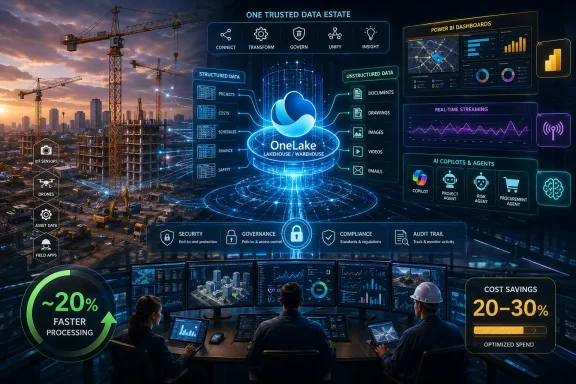
Microsoft published a March 6, 2026 customer story saying Tata Realty & Infrastructure Ltd. has moved enterprise analytics onto Microsoft Fabric, reducing data processing time by 20 percent and annual analytics costs by 20 to 30 percent while preparing its real estate operations for AI-driven decision-making. The announcement is not just another cloud migration victory lap. It is a case study in how Microsoft wants complex, asset-heavy enterprises to stop treating analytics as a reporting layer and start treating it as operating infrastructure. For Tata Realty, the wager is that growth across regions, property types, and construction lifecycles now depends less on bigger spreadsheets than on a unified data estate that can support decisions before risk becomes visible on a balance sheet.
Real estate is often described in stubbornly physical terms: land banks, lease rates, construction schedules, capital deployment, occupancy, safety, and regulatory paperwork. But the modern developer is also a data company, even if it never wanted to become one. Every project creates signals in finance, procurement, engineering, CRM, safety, legal, and customer service, and those signals lose value quickly when they sit in separate systems.
That is the problem Microsoft says Tata Realty faced as its portfolio expanded across residential, commercial, mixed-use, and infrastructure developments in Southeast Asia. The company needed consistent access to information across finance, operations, engineering, safety, and HR, but the useful data was increasingly split across structured and unstructured sources. Traditional reporting could show what had happened; leadership wanted earlier signals about pricing, demand, and operational performance.
The distinction matters. A dashboard that arrives after a project delay is an autopsy. A data platform that exposes weak demand, cost creep, or execution risk early enough to change behavior is a management system. Microsoft Fabric is being positioned precisely in that gap: not merely as a place to build reports, but as a shared foundation where operational data, analytics, business intelligence, and AI can converge.
Tata Realty’s stated need for “predictive and cognitive analytics” is also telling. Enterprises are no longer buying analytics modernization purely for faster monthly reporting. They are buying optionality: the ability to run copilots, agents, forecasting models, and automated workflows later without rebuilding the data estate first.
In real estate, that fragmentation is especially expensive because decisions are capital-intensive and time-sensitive. Pricing a unit, renegotiating a contract, reallocating resources, or escalating a safety concern all depend on signals that cross departmental boundaries. If sales data, construction progress, vendor performance, and cash-flow assumptions live in different analytical worlds, leadership is forced to govern by reconciliation.
Microsoft’s customer story says Tata Realty was dealing with siloed data, unstructured sources, and disparate analytics tools, which slowed decisions, increased costs, introduced risk, and blocked important insights. That framing is standard enterprise software language, but the underlying point is sharper: at scale, fragmented analytics becomes a business control problem. It is not just inconvenient for analysts; it can distort capital allocation.
Fabric’s promise is to reduce the number of seams. In Microsoft’s architecture, data engineering, warehousing, lakehouse storage, real-time analytics, Power BI, and AI-readiness are brought under a common software-as-a-service umbrella. That does not magically eliminate data governance work, but it changes the default from integration-by-project to integration-by-platform.
That is the core strategic move. Microsoft is trying to make OneLake for enterprise analytics what SharePoint and OneDrive became for business content: the assumed place where organizational information lives, is governed, and can be activated by higher-level tools. If the data is in OneLake, Power BI can report on it, Data Factory can move and transform it, Real-Time Intelligence can monitor it, and Copilot-style experiences can eventually reason over it.
For WindowsForum readers, the analogy is familiar. Microsoft’s most durable enterprise plays usually start as product consolidation and become control-plane consolidation. Active Directory did not win merely because it stored identities; it became the administrative backbone for Windows networks. Microsoft 365 did not win merely because it bundled Office apps; it became the collaboration and compliance surface for knowledge work. Fabric is Microsoft’s attempt to do something similar for data and analytics.
That ambition explains why Fabric is sold as more than a warehouse or BI refresh. A warehouse can answer known questions efficiently. A lakehouse can support broader data types and machine-learning workflows. A full Fabric estate is supposed to support both, while giving Microsoft a native path to embed AI features into the daily rhythm of business decision-making.
That approach is less glamorous than a sweeping transformation narrative, but it is usually how enterprise modernization survives contact with reality. Real estate firms cannot pause finance, CRM, project reporting, or safety workflows while an architecture team pursues platform purity. The winning migration path is the one that lets the business keep breathing.
The phased model also reflects a broader truth about Fabric adoption. Microsoft is not asking every customer to throw away Power BI, Azure investments, or existing analytics workflows overnight. It is offering a path that begins with familiar assets and gradually pulls more of the data lifecycle into Fabric. That lowers the psychological barrier for IT leaders who have already standardized around Microsoft tools.
In Tata Realty’s case, Power BI appears to have been a bridge rather than an endpoint. The company used standardized dashboards and KPIs as part of the preparation, then moved toward a broader Fabric foundation. That is exactly the customer journey Microsoft wants: Power BI users discovering that the report layer is easier to scale when the data engineering, lakehouse, warehouse, and governance layers are in the same ecosystem.
That is a subtle but important shift. Classic BI is observational. Users inspect charts, identify a problem, leave the dashboard, open another system, update a record, email someone, or create a task. Every handoff creates delay and error. If the analytics surface can trigger an action, update a field, or write information back into an operational system, it collapses part of the distance between insight and execution.
Microsoft says Tata Realty used this capability to reduce manual data entry across systems, lower human error, and save operational time. For a real estate business managing multiple concurrent developments, that kind of workflow compression can matter more than a prettier executive dashboard. The gains come from removing the small frictions that accumulate across hundreds of project reviews, approvals, updates, and reconciliations.
This is also where Fabric begins to look like a platform for business applications rather than simply analytics. Once reports can participate in workflows, once user data functions can route actions, and once semantic models become queryable by AI agents, the distinction between “BI” and “operations” starts to blur. Microsoft knows this, and it is one reason Fabric sits so comfortably beside Power Platform, Dynamics, Teams, and Copilot in the company’s enterprise story.
That is the right order of operations. AI projects fail when companies try to put natural-language interfaces on top of inconsistent, poorly governed, or incomplete data. A chatbot that confidently summarizes bad data is not digital transformation; it is risk acceleration. Before an organization can rely on copilots or agents, it needs stable definitions, access controls, lineage, data quality, and a clear understanding of which systems represent the business truth.
Fabric is designed to make that preparatory work feel like part of the platform rather than a separate consulting epic. Data Factory handles ingestion and transformation. Warehouses and lakehouses support different analytical patterns. Real-Time Intelligence can process streaming signals. Power BI remains the familiar visualization layer. OneLake and governance controls are meant to keep the sprawl from reappearing under a new brand.
For Tata Realty, the promise is not that AI will suddenly replace management judgment. It is that executives and frontline teams may be able to ask better questions of fresher data, with less manual preparation standing between the question and the answer. That is a more modest claim than the usual AI hype cycle, but it is also more valuable.
Fabric’s capacity model is central to this story. Instead of separately managing a patchwork of services, customers can consolidate workloads under shared Fabric capacity. That can simplify procurement and operations, but it also changes the governance problem. When multiple teams share the same analytical substrate, IT must become more disciplined about workload management, prioritization, performance tuning, and chargeback or showback.
The 20 percent reduction in data processing time is similarly meaningful but not revolutionary on its own. In enterprise analytics, the bigger win is often predictability. If teams know that data pipelines will complete reliably, reports will refresh on time, and operational signals will appear quickly enough to matter, they can build processes around the platform. Speed matters; dependable speed matters more.
Still, the cost result is strategically important for Microsoft. Fabric competes not only against rival data platforms, but against inertia. Many CIOs already know their data estates are fragmented, but modernization projects are hard to justify if they look like expensive replatforming exercises with vague AI benefits. Tata Realty gives Microsoft a cleaner argument: simplify the stack, reduce cost, accelerate processing, and prepare for AI on the same foundation.
The operational complexity is easy to underestimate. A developer may need to track construction milestones, contractor performance, budget variance, leasing velocity, customer sentiment, safety incidents, compliance documentation, and asset performance across multiple geographies. Each metric is useful alone, but the real value emerges when they can be correlated.
For example, pricing decisions may depend on demand signals, inventory movement, local market conditions, campaign performance, and project delivery confidence. Finance teams may need to understand how construction delays affect cash flow and revenue recognition. Operations leaders may need to see whether safety indicators correlate with vendor performance or schedule compression. These are not isolated BI questions; they are cross-functional operating questions.
Fabric’s appeal to a company like Tata Realty lies in this cross-functional layer. If the platform can unify enough of the relevant data and make it usable by both analysts and business teams, it can shorten the distance between local activity and executive action. That is why Microsoft’s customer story emphasizes sales, project, finance, CRM, and operations teams working with the right data at the right time.
This is the Microsoft enterprise flywheel. Power BI creates the user base. Azure provides the infrastructure trust. Microsoft partners handle implementation. Fabric offers consolidation. Copilot supplies the AI narrative. The result is a platform story that feels less like a leap into the unknown and more like the next logical step for organizations that have already standardized on Microsoft.
That familiarity can be a real advantage for IT departments. Skills transfer more easily, identity and access patterns are more consistent, and executives are less likely to resist tools that resemble what they already use. For organizations with heavy Microsoft footprints, Fabric’s selling point is not simply that it can do data engineering or warehousing. It is that those capabilities arrive inside an administrative and productivity universe the enterprise already understands.
The risk, of course, is lock-in. Consolidation reduces complexity, but it also concentrates dependency. A company that puts its data estate, reporting layer, governance approach, and AI roadmap into a single vendor’s platform must be confident about pricing, roadmap stability, interoperability, and exit options. Microsoft’s job is to make the operational benefits feel large enough that those concerns become manageable rather than decisive.
Microsoft’s customer story credits Prosys with helping Tata Realty simplify data, accelerate insights, and deliver a future-ready analytics ecosystem. That is partner language, but it reflects a real market pattern. Microsoft sells platforms; partners translate them into working enterprise systems. For customers, the quality of that translation often determines whether a modernization effort becomes a durable capability or another half-finished platform migration.
This also explains why Fabric adoption is likely to vary widely across organizations. The product can provide a unified architecture, but it cannot automatically resolve conflicting KPIs, poor data ownership, unclear business definitions, or political battles over whose numbers count. Those are organizational problems disguised as technical ones.
Tata Realty’s success metrics suggest that the implementation addressed enough of those issues to produce measurable gains. But other firms should resist copying the architecture without copying the discipline. The hard part of analytics modernization is rarely the diagram; it is getting the business to agree on what the diagram is for.
That tradeoff is not a reason to avoid modernization. It is a reason to treat analytics platforms as critical infrastructure. If sales, project, finance, CRM, and operations teams are all making decisions from Fabric-backed data, then data quality incidents become operational incidents. Capacity bottlenecks become business bottlenecks. Governance mistakes become compliance exposure.
The introduction of AI raises the stakes further. Copilot-style interfaces and data agents can make enterprise information more accessible, but they can also make weak data controls more visible and more dangerous. A natural-language answer feels authoritative even when it is built on incomplete context. The more approachable the interface becomes, the more rigorous the underlying permissions, definitions, and validation must be.
This is where Microsoft’s governance messaging is doing heavy work. For regulated and asset-intensive businesses, the promise of AI-readiness only matters if it comes with security, auditability, and continuity. Tata Realty’s case study repeatedly emphasizes governance and business continuity, which is exactly what cautious CIOs will look for beneath the AI gloss.
Microsoft says Tata Realty aims over the next six years to expand net operating income and scale its operational footprint three to four times. Whether Fabric directly enables that ambition will depend on execution, market conditions, capital availability, and management discipline. Still, the platform choice reflects a belief that scaling the business without scaling analytical complexity is now a competitive requirement.
That is the broader lesson for enterprise IT. Growth often breaks reporting systems before it breaks core transaction systems. The ERP may still run, the CRM may still accept updates, and the project systems may still track milestones, but leadership loses confidence when the combined picture arrives late or inconsistently. Fabric is Microsoft’s answer to that scaling problem.
For Tata Realty, the modernization appears to have moved analytics closer to the center of operations. For Microsoft, the story demonstrates how Fabric can be sold to industries far beyond software, retail, or financial services. For IT leaders watching from the sidelines, it is a reminder that data modernization is becoming less optional as AI expectations rise.
Source: Microsoft Tata Realty modernizes enterprise analytics to scale growth with Microsoft Fabric | Microsoft Customer Stories
 Microsoft’s Fabric Pitch Lands in a Very Physical Business
Real estate is often described in stubbornly physical terms: land banks, lease rates, construction schedules, capital deployment, occupancy, safety, and regulatory paperwork. But the modern developer is also a data company, even if it never wanted to become one. Every project creates signals in finance, procurement, engineering, CRM, safety, legal, and customer service, and those signals lose value quickly when they sit in separate systems.That is the problem Microsoft says Tata Realty faced as its portfolio expanded across residential, commercial, mixed-use, and infrastructure developments in Southeast Asia. The company needed consistent access to information across finance, operations, engineering, safety, and HR, but the useful data was increasingly split across structured and unstructured sources. Traditional reporting could show what had happened; leadership wanted earlier signals about pricing, demand, and operational performance.
The distinction matters. A dashboard that arrives after a project delay is an autopsy. A data platform that exposes weak demand, cost creep, or execution risk early enough to change behavior is a management system. Microsoft Fabric is being positioned precisely in that gap: not merely as a place to build reports, but as a shared foundation where operational data, analytics, business intelligence, and AI can converge.
Tata Realty’s stated need for “predictive and cognitive analytics” is also telling. Enterprises are no longer buying analytics modernization purely for faster monthly reporting. They are buying optionality: the ability to run copilots, agents, forecasting models, and automated workflows later without rebuilding the data estate first.
The Old Analytics Stack Was Built for Departments, Not Velocity
Most enterprise analytics estates did not fail suddenly. They became brittle slowly, through a thousand practical decisions that made sense at the time. A finance team adopted one reporting process, operations built another, project teams maintained their own trackers, and executives eventually discovered that “the truth” depended on which system produced the meeting deck.In real estate, that fragmentation is especially expensive because decisions are capital-intensive and time-sensitive. Pricing a unit, renegotiating a contract, reallocating resources, or escalating a safety concern all depend on signals that cross departmental boundaries. If sales data, construction progress, vendor performance, and cash-flow assumptions live in different analytical worlds, leadership is forced to govern by reconciliation.
Microsoft’s customer story says Tata Realty was dealing with siloed data, unstructured sources, and disparate analytics tools, which slowed decisions, increased costs, introduced risk, and blocked important insights. That framing is standard enterprise software language, but the underlying point is sharper: at scale, fragmented analytics becomes a business control problem. It is not just inconvenient for analysts; it can distort capital allocation.
Fabric’s promise is to reduce the number of seams. In Microsoft’s architecture, data engineering, warehousing, lakehouse storage, real-time analytics, Power BI, and AI-readiness are brought under a common software-as-a-service umbrella. That does not magically eliminate data governance work, but it changes the default from integration-by-project to integration-by-platform.
OneLake Is the Real Product Microsoft Wants IT to Buy
The most important name in this story may not be Fabric, Power BI, or Copilot. It is OneLake, Microsoft’s centralized logical data lake for Fabric workloads. In Tata Realty’s deployment, Microsoft says OneLake unified structured and unstructured data into a single environment while extending security and governance controls across analytics and AI workloads.That is the core strategic move. Microsoft is trying to make OneLake for enterprise analytics what SharePoint and OneDrive became for business content: the assumed place where organizational information lives, is governed, and can be activated by higher-level tools. If the data is in OneLake, Power BI can report on it, Data Factory can move and transform it, Real-Time Intelligence can monitor it, and Copilot-style experiences can eventually reason over it.
For WindowsForum readers, the analogy is familiar. Microsoft’s most durable enterprise plays usually start as product consolidation and become control-plane consolidation. Active Directory did not win merely because it stored identities; it became the administrative backbone for Windows networks. Microsoft 365 did not win merely because it bundled Office apps; it became the collaboration and compliance surface for knowledge work. Fabric is Microsoft’s attempt to do something similar for data and analytics.
That ambition explains why Fabric is sold as more than a warehouse or BI refresh. A warehouse can answer known questions efficiently. A lakehouse can support broader data types and machine-learning workflows. A full Fabric estate is supposed to support both, while giving Microsoft a native path to embed AI features into the daily rhythm of business decision-making.
Tata Realty Chose Modernization Without the Big-Bang Drama
One of the more practical details in the Tata Realty story is the phased rollout. Microsoft says Tata Realty worked with Prosys Infotech Private Limited and adopted Fabric workloads while maintaining business continuity. Existing workloads were used to validate outcomes early, which let the company reduce migration risk while keeping operations moving.That approach is less glamorous than a sweeping transformation narrative, but it is usually how enterprise modernization survives contact with reality. Real estate firms cannot pause finance, CRM, project reporting, or safety workflows while an architecture team pursues platform purity. The winning migration path is the one that lets the business keep breathing.
The phased model also reflects a broader truth about Fabric adoption. Microsoft is not asking every customer to throw away Power BI, Azure investments, or existing analytics workflows overnight. It is offering a path that begins with familiar assets and gradually pulls more of the data lifecycle into Fabric. That lowers the psychological barrier for IT leaders who have already standardized around Microsoft tools.
In Tata Realty’s case, Power BI appears to have been a bridge rather than an endpoint. The company used standardized dashboards and KPIs as part of the preparation, then moved toward a broader Fabric foundation. That is exactly the customer journey Microsoft wants: Power BI users discovering that the report layer is easier to scale when the data engineering, lakehouse, warehouse, and governance layers are in the same ecosystem.
Fabric Turns Reporting Into an Operational Surface
The most interesting technical detail in the case study is not the cost reduction, although that will get the procurement team’s attention. It is Tata Realty’s use of translytical capabilities to enable write-back from Power BI into other business applications. In plain English, the report is no longer just a place to look at information; it becomes a place to act.That is a subtle but important shift. Classic BI is observational. Users inspect charts, identify a problem, leave the dashboard, open another system, update a record, email someone, or create a task. Every handoff creates delay and error. If the analytics surface can trigger an action, update a field, or write information back into an operational system, it collapses part of the distance between insight and execution.
Microsoft says Tata Realty used this capability to reduce manual data entry across systems, lower human error, and save operational time. For a real estate business managing multiple concurrent developments, that kind of workflow compression can matter more than a prettier executive dashboard. The gains come from removing the small frictions that accumulate across hundreds of project reviews, approvals, updates, and reconciliations.
This is also where Fabric begins to look like a platform for business applications rather than simply analytics. Once reports can participate in workflows, once user data functions can route actions, and once semantic models become queryable by AI agents, the distinction between “BI” and “operations” starts to blur. Microsoft knows this, and it is one reason Fabric sits so comfortably beside Power Platform, Dynamics, Teams, and Copilot in the company’s enterprise story.
The AI Story Depends on the Boring Plumbing
Every enterprise software announcement now contains an AI paragraph, and many of them deserve skepticism. The Tata Realty story is more credible because the AI claim is grounded in data plumbing rather than magic. Microsoft says the company is building a unified data foundation for advanced analytics, AI-enabled Copilot experiences, and future growth.That is the right order of operations. AI projects fail when companies try to put natural-language interfaces on top of inconsistent, poorly governed, or incomplete data. A chatbot that confidently summarizes bad data is not digital transformation; it is risk acceleration. Before an organization can rely on copilots or agents, it needs stable definitions, access controls, lineage, data quality, and a clear understanding of which systems represent the business truth.
Fabric is designed to make that preparatory work feel like part of the platform rather than a separate consulting epic. Data Factory handles ingestion and transformation. Warehouses and lakehouses support different analytical patterns. Real-Time Intelligence can process streaming signals. Power BI remains the familiar visualization layer. OneLake and governance controls are meant to keep the sprawl from reappearing under a new brand.
For Tata Realty, the promise is not that AI will suddenly replace management judgment. It is that executives and frontline teams may be able to ask better questions of fresher data, with less manual preparation standing between the question and the answer. That is a more modest claim than the usual AI hype cycle, but it is also more valuable.
Cost Reduction Is the Headline, Capacity Discipline Is the Subtext
Microsoft says Tata Realty reduced annual analytics costs by 20 to 30 percent after consolidating tools and moving to a unified capacity model. That number will be useful in sales decks, but the underlying mechanism deserves scrutiny. Cloud analytics costs are often reduced not simply by moving to a new platform, but by rationalizing duplicated workloads, retiring overlapping tools, and making capacity more visible.Fabric’s capacity model is central to this story. Instead of separately managing a patchwork of services, customers can consolidate workloads under shared Fabric capacity. That can simplify procurement and operations, but it also changes the governance problem. When multiple teams share the same analytical substrate, IT must become more disciplined about workload management, prioritization, performance tuning, and chargeback or showback.
The 20 percent reduction in data processing time is similarly meaningful but not revolutionary on its own. In enterprise analytics, the bigger win is often predictability. If teams know that data pipelines will complete reliably, reports will refresh on time, and operational signals will appear quickly enough to matter, they can build processes around the platform. Speed matters; dependable speed matters more.
Still, the cost result is strategically important for Microsoft. Fabric competes not only against rival data platforms, but against inertia. Many CIOs already know their data estates are fragmented, but modernization projects are hard to justify if they look like expensive replatforming exercises with vague AI benefits. Tata Realty gives Microsoft a cleaner argument: simplify the stack, reduce cost, accelerate processing, and prepare for AI on the same foundation.
The Real Estate Industry Is Becoming an Analytics Industry
Tata Realty’s modernization should be read against a broader industry shift. Real estate firms are under pressure from higher capital costs, changing demand patterns, sustainability expectations, regulatory scrutiny, and customer expectations shaped by digital-first industries. The firms that can sense demand, model risk, and coordinate execution faster will have an advantage over those still waiting for end-of-month reports.The operational complexity is easy to underestimate. A developer may need to track construction milestones, contractor performance, budget variance, leasing velocity, customer sentiment, safety incidents, compliance documentation, and asset performance across multiple geographies. Each metric is useful alone, but the real value emerges when they can be correlated.
For example, pricing decisions may depend on demand signals, inventory movement, local market conditions, campaign performance, and project delivery confidence. Finance teams may need to understand how construction delays affect cash flow and revenue recognition. Operations leaders may need to see whether safety indicators correlate with vendor performance or schedule compression. These are not isolated BI questions; they are cross-functional operating questions.
Fabric’s appeal to a company like Tata Realty lies in this cross-functional layer. If the platform can unify enough of the relevant data and make it usable by both analysts and business teams, it can shorten the distance between local activity and executive action. That is why Microsoft’s customer story emphasizes sales, project, finance, CRM, and operations teams working with the right data at the right time.
Microsoft’s Advantage Is Familiarity, Not Just Features
Microsoft does not need Fabric to be the only technically capable analytics platform. It needs Fabric to be the most natural analytics platform for organizations already deep in Microsoft’s enterprise ecosystem. Tata Realty’s story shows that advantage clearly: Azure, Power BI, governance, partner implementation, and future Copilot experiences all reinforce one another.This is the Microsoft enterprise flywheel. Power BI creates the user base. Azure provides the infrastructure trust. Microsoft partners handle implementation. Fabric offers consolidation. Copilot supplies the AI narrative. The result is a platform story that feels less like a leap into the unknown and more like the next logical step for organizations that have already standardized on Microsoft.
That familiarity can be a real advantage for IT departments. Skills transfer more easily, identity and access patterns are more consistent, and executives are less likely to resist tools that resemble what they already use. For organizations with heavy Microsoft footprints, Fabric’s selling point is not simply that it can do data engineering or warehousing. It is that those capabilities arrive inside an administrative and productivity universe the enterprise already understands.
The risk, of course, is lock-in. Consolidation reduces complexity, but it also concentrates dependency. A company that puts its data estate, reporting layer, governance approach, and AI roadmap into a single vendor’s platform must be confident about pricing, roadmap stability, interoperability, and exit options. Microsoft’s job is to make the operational benefits feel large enough that those concerns become manageable rather than decisive.
Partner-Led Transformation Remains the Enterprise Default
The presence of Prosys Infotech in the Tata Realty deployment is not incidental. Large-scale analytics modernization usually requires more than product licensing. It requires data modeling, migration planning, report rationalization, governance design, stakeholder management, and a sober understanding of which business processes can change now versus later.Microsoft’s customer story credits Prosys with helping Tata Realty simplify data, accelerate insights, and deliver a future-ready analytics ecosystem. That is partner language, but it reflects a real market pattern. Microsoft sells platforms; partners translate them into working enterprise systems. For customers, the quality of that translation often determines whether a modernization effort becomes a durable capability or another half-finished platform migration.
This also explains why Fabric adoption is likely to vary widely across organizations. The product can provide a unified architecture, but it cannot automatically resolve conflicting KPIs, poor data ownership, unclear business definitions, or political battles over whose numbers count. Those are organizational problems disguised as technical ones.
Tata Realty’s success metrics suggest that the implementation addressed enough of those issues to produce measurable gains. But other firms should resist copying the architecture without copying the discipline. The hard part of analytics modernization is rarely the diagram; it is getting the business to agree on what the diagram is for.
The Risks Move Up the Stack
A unified analytics platform reduces some risks while creating new ones. Fragmented systems create inconsistent reporting, duplicated effort, and slow decision-making. Consolidated platforms create dependency, governance concentration, and the possibility that errors propagate faster because more teams trust the same foundation.That tradeoff is not a reason to avoid modernization. It is a reason to treat analytics platforms as critical infrastructure. If sales, project, finance, CRM, and operations teams are all making decisions from Fabric-backed data, then data quality incidents become operational incidents. Capacity bottlenecks become business bottlenecks. Governance mistakes become compliance exposure.
The introduction of AI raises the stakes further. Copilot-style interfaces and data agents can make enterprise information more accessible, but they can also make weak data controls more visible and more dangerous. A natural-language answer feels authoritative even when it is built on incomplete context. The more approachable the interface becomes, the more rigorous the underlying permissions, definitions, and validation must be.
This is where Microsoft’s governance messaging is doing heavy work. For regulated and asset-intensive businesses, the promise of AI-readiness only matters if it comes with security, auditability, and continuity. Tata Realty’s case study repeatedly emphasizes governance and business continuity, which is exactly what cautious CIOs will look for beneath the AI gloss.
The Numbers Are Strong, but the Strategic Signal Is Stronger
The headline outcomes are clear: 20 percent faster data processing, 20 to 30 percent lower annual analytics costs, accelerated reporting, and thousands of manual reporting hours saved annually. Those are meaningful results. But the strategic signal is that Tata Realty is positioning analytics as a growth platform, not a back-office function.Microsoft says Tata Realty aims over the next six years to expand net operating income and scale its operational footprint three to four times. Whether Fabric directly enables that ambition will depend on execution, market conditions, capital availability, and management discipline. Still, the platform choice reflects a belief that scaling the business without scaling analytical complexity is now a competitive requirement.
That is the broader lesson for enterprise IT. Growth often breaks reporting systems before it breaks core transaction systems. The ERP may still run, the CRM may still accept updates, and the project systems may still track milestones, but leadership loses confidence when the combined picture arrives late or inconsistently. Fabric is Microsoft’s answer to that scaling problem.
For Tata Realty, the modernization appears to have moved analytics closer to the center of operations. For Microsoft, the story demonstrates how Fabric can be sold to industries far beyond software, retail, or financial services. For IT leaders watching from the sidelines, it is a reminder that data modernization is becoming less optional as AI expectations rise.
Tata Realty’s Fabric Bet Narrows the Lesson for Everyone Else
The most concrete lessons from Tata Realty’s Fabric deployment are not about chasing AI fashion. They are about simplifying the data estate before scale turns complexity into risk.- Tata Realty moved to Microsoft Fabric after siloed data, unstructured sources, and disparate analytics tools began slowing decision-making across a growing real estate portfolio.
- The company reports a 20 percent reduction in data processing time and a 20 to 30 percent reduction in annual analytics costs after consolidating analytics workloads.
- OneLake is central to the architecture because it gives Tata Realty a unified environment for structured and unstructured data across analytics and AI workloads.
- Power BI remains important, but the story moves beyond dashboards by using Fabric capabilities such as Data Factory, Real-Time Intelligence, data agents, and translytical write-back.
- The phased rollout with Prosys Infotech matters because enterprise analytics modernization usually succeeds through controlled migration, not big-bang replacement.
- The AI opportunity depends on governance, data quality, and business continuity more than on the mere presence of Copilot-branded features.
Source: Microsoft Tata Realty modernizes enterprise analytics to scale growth with Microsoft Fabric | Microsoft Customer Stories
