

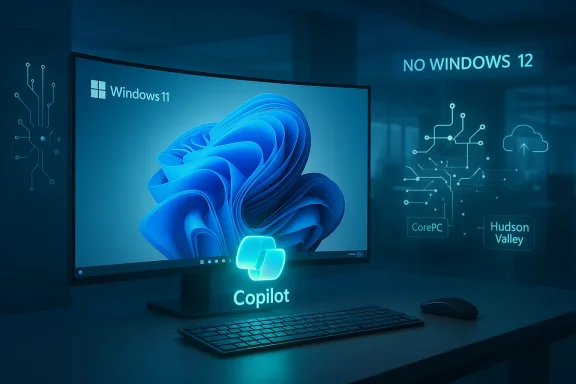
The viral claim that Microsoft is preparing a subscription‑only, AI‑first “Windows 12” for 2026 has been emphatically overstated: there is no public Microsoft announcement or verifiable product roadmap that supports a mandatory, subscription‑gated consumer OS shipping this year. Multiple independent outlets and community investigations have treated the original scoop as thinly sourced or amplified by automated content pipelines, and Microsoft’s observable activity points to incremental evolution of Windows 11 rather than a wholesale licensing and hardware reset.
In early March 2026 a cluster of articles and republished reports assembled internal codenames and engineering concepts—most commonly references to Hudson Valley, CorePC, and deeper Copilot integration—into a single narrative: that Microsoft would launch “Windows 12” as a modular, AI‑centric operating system, lock advanced features behind a monthly fee, and gate premium functionality to machines with dedicated neural accelerators (NPUs) measured in the tens of TOPS. That narrative spread qmedia, forums, and low‑quality aggregator sites, producing upgrade anxiety among consumers and procurement friction for IT teams.
But plausibility is not proof. The concepts cited in the rumor—modularity, on‑device inference, and subscription monetization—are all real trends within the industry and within Microsoft’s public product mix. Those facts made the rumor feel credible. Closer inspection, however, shows the leap from “engineering experiments and subscription offerings” to “mandatory subscription Windows 12 in 2026” lacks corroborating evidence from ofnels or well‑documented leaks. Independent fact‑checks and community analyses characterize the strongest versions of the story as speculative, misinterpreted, or the product of thin sourcing and amplification.
For Microsoft: the company should prioritize transparent communications—clearly label what is experimental, what is optional, and what will remain part of the base OS. For users and IT leaders: base decisions on official Microsoft documentation and measured technical validation, not on recycled headlines or AI‑amplified echoes.
The bigger lesson is systemic: in an era of rapid AI‑assisted publishing, both vendors and journalists must raise the bar on provenance and clarity. The fate of Windows does not hinge on a single year or a sensational headline; it hinges on choices that balance innovation with compatibility, revenue with trust, and hardware progress with fair access. Until the vendor says otherwise, treat Windows 11 as the platform to be managed—and regard “Windows 12 subscription OS” headlines as the product of an overactive rumor mill, not a confirmed plan.
Conclude with caution: watch official Microsoft channels for any future announcements, follow reputable beat reporters for confirmed leaks, and keep procurement and upgrade decisions grounded in documented requirements rather than headlines.
Source: thewincentral.com Microsoft Debunks Windows 12 Subscription OS Rumors
 Background / Overview
In early March 2026 a cluster of articles and republished reports assembled internal codenames and engineering concepts—most commonly references to Hudson Valley, CorePC, and deeper Copilot integration—into a single narrative: that Microsoft would launch “Windows 12” as a modular, AI‑centric operating system, lock advanced features behind a monthly fee, and gate premium functionality to machines with dedicated neural accelerators (NPUs) measured in the tens of TOPS. That narrative spread qmedia, forums, and low‑quality aggregator sites, producing upgrade anxiety among consumers and procurement friction for IT teams.But plausibility is not proof. The concepts cited in the rumor—modularity, on‑device inference, and subscription monetization—are all real trends within the industry and within Microsoft’s public product mix. Those facts made the rumor feel credible. Closer inspection, however, shows the leap from “engineering experiments and subscription offerings” to “mandatory subscription Windows 12 in 2026” lacks corroborating evidence from ofnels or well‑documented leaks. Independent fact‑checks and community analyses characterize the strongest versions of the story as speculative, misinterpreted, or the product of thin sourcing and amplification.
Where the rumor came from: CorePC, Hudson Valley and misread breadcrumbs
The kernel of truth
Three elements form the kernel that journalists and social posts repackaged into the Windows 12 story:- Internal codenames and long‑running engineering projects (for example, work that has appeared under names like Hudson Valley and concepts sometimes called CorePC).
- Microsoft’s public push to fold Copilot and AI features ws.
- Microsoft’s existing subscription portfolio (Microsoft 365, Windows 365/Cloud PC), which demonstrates the company’s comfort with recurring revenue models.
Where interpretation became exaggeration
The problem arose when those discrete facts were reassembled without the context that matters:- Internal codenames do not equal an imminent retail product. Historically, Microsoft experiments internally for years before labeling or launching consumer products.
- A modular architecture discussion (CorePC‑style ideas) could be integrated into future Windows updates without constituting a new, subscription‑only OS.
- Existing subscription services like Windows 365 are cloud‑delivered and targeted primarily at enterprises; conflating them with a mandatortion is a category error.
What Microsoft is actually doing (public signals)
Microsoft’s observed public posture in early 2026 emphasizes three, largely compatible priorities:- Continue iterating and stabilizing Windows 11 with incremental feature releases and quality improvements.
- Expand Copilot experiences across Windows (system integrations, better side‑pane experiences, opt‑in controls), while experimenting with how some AI features can run locally on devices with dedicated acceleration.
- Grow subscription offerings where they make commercial sense—primarily in productivity and cloud‑delivered experiences such as Microsoft 365 and Windows 365—but not to replace the traditional consumer retail license model overnight.
Technical claims examined: NPUs, “40 TOPS” and hard hardware gates
The most alarming technical assertion circulating in the rumor stack is the idea that a specific neural throughput figure (commonly reported as approximately 40 TOPS) would be required to access the full Windows experience.What TOPS means — and why numeric S (Trillions Of Operations Per Second) is a vendor metric describing peak inference throughput for accelerators. It’s a coarse performance indicator that fails to capture important real‑world factors such as memory bandwidth, model quantization, software runtimes, and system integration. Operating systems almost never base minimum system support on a single numeric accelerator throughput target; instead they define capabilities and feature tiers. Declaring a hard TOPS threshold as a prerequisite for boot or core OS functionality would be historically unprecedented and extremely disruptive.
A more likely engineering approach
If Microsoft ties AI experiences to hardware capabilities, the practical approach will probably look like this:- Tiered experiences where advanced, lower‑latency AI features are oith stronger NPUs.
- Graceful fallbacks that run smaller models in software or route heavier inference to the cloud, preserving baseline functionality on older hardware.
- OEM certification and marketing programs (akin to “Copilot+” device classes) that advertise enhanced local AI support without eliminating support for the broader installed base.
The subscription angle: business logic, incentives, and practical constraints
Why subscription makes sense (for some features)
From a business standpoint, subscriptions are attractive: recurring revenue funds ongoing R&D and offsets the variable cloud costs associated with large‑model inference. Charging for compute‑heavy features is an obvious way to allocate costs where usage and infrastructure demand are highest. Microsoft’s current product lineup already includes subscription services that monetize compute and continuity—Microsoft 365 for productivity and Windows 365 for cloud PCs are direct examples.Why a mandatory consumer subscription makes no short‑term sense
However, a mandatory, consumer‑facing subscription for core OS functionality faces serious headwinds:- Consumer backlash and brand damage: forcing a subscription for basic desktop use would provoke sustained negative reaction and drive some users toward alternatives.
- Hardware fragmentation and e‑waste: gating features to new NPUs risks leaving large swathes of hardware unsupported and would raise regulatory and environmental concerns.
- Legal and regulatory risk: such a move would invite scrutiny from competition authorities and consumer protection bodies across multiple jurisdictions.
- OEM and retail disruption: converting OEM licensing into a subscription model is a contractually and operationally complex change that would require years of partner negotiation.
Risks of the rumor itself: market noise, procurement chaos, and trust erosion
The rapid spread of the Windows 12 subscription narrative illustrates concrete harms caused by tech rumor cascades:- Buyers delaying purchases or making premature upgrade decisions based on imaginary hardware requirements.
- IT teams adjusting procurement cycles or pausing refran unverified OS timeline.
- Erosion of trust toward publishers and Microsoft alike, as users feel manipulated by hearsay about forced upgrades and subscription creep.
- Policy confusion that could trigger preemptive regulatory posturing before facts are established.
What users and IT admins should do now
Practical advice to avoid panic and make evidence‑based decisions:- Do not buy new hardware solely because of the Windows 12 rumor. Base refresh cycles on real needs and vendor compatibility lists.
- For administrators: maintain standard test rings and use official Microsoft release health dashboards and support documentation when planning rollouts. Don’t react to social headlines when it comes to mass deployments.
- Privacy and opt‑in controls: when new Copilot or AI features are released, review privacy settings and telemetry controls carefully before enabling them for large user populations.
- Inventory your estate against realistic hardware capability tiers—identify mission‑critical systems that may benefit from local inference accelerators, but avoid framing these capabilities as universally mandatory.
How journalists and publishers should avoid repeating the mistake
This episode highlights necessary improvements to technology reporting in an AI era:- Require at least two independent, named sources before publishing claims about product roadmaps or mandatory listinguish between internal research and formal product announcements; label speculative items clearly.
- Avoid “amplify then correct” cycles—corrections rarely reach the same audience as the sensational original.
- For aggregated content, demand editorial verification layers and human review for claims about roadmaps, hardware baselines, or pricing.
Critical analysis — strengths, weaknesses, and the most likely path forward
Strengths of Microsoft’s direction (the pieces that make sense)
- Modularity and state separation can reduce update complexity, improve security isolation, and enable lighter device images for constrained hardware.
- On‑device AI unlocks lower latency and better privacy in certain scenarios.
- Subscription revenue funds ongoing investment in AI infrastructure that would otherwise be economically impossible to sustain at scale.
Weaknesses and risks of pursuing an aggressive subscription‑first OS
- Poor communication breeds mistrust; even well‑intentioned segmentation looks like opportunism without clear messaging.
- Hardware gating risks fracturing the ecosystem and accelerating e‑waste.
- Subscription creep without clear boundaries could push a consumer backlash that outweighs incremental revenue gains.
The most credible near‑term scenario
Based on available evidence and expert reads of Microsoft’s public posture, the most credible path is:- Continued refinement of Windows 11 and platform stabilization work.
- Incremental addition of AI features with tiered hardware optimizations and optional subscription‑backed premium services (for compute‑heavy generation features, enterprise Copilot governance, or Cloud PC offerings).
- OEM and Microsoft device certification programs that advertise enhanced experiences without depriving older hardware of baseline functionality.
A practical checklist to evaluate future Windows rumors
When the next big headline about Windows drops, use this checklist before acting or amplifying:- Is there an official Microsoft blog post or support doc? If not, treat with caution.
- Do two independent, reputable outlets with named sources corroborate the claim? If the story’s corroboration is just co.
- Does the claim conflate a cloud subscription product (Windows 365) with the retail OS license? If so, question the inference.
- Are technical claims backed by published system requirements or SDK docs? Treat single numeric metrics (e.g., “40 TOPS”) as unverified until documented.
- Does the narrative require immediate buyer action? If yes, seek primary vendor guidance (OEMs, Microsoft support) before making decisions.
Final verdict and recommendations
The dramatic headline—“Microsoft will ship a subscription‑only Windows 12 in 2026 that bricks older PCs unless you pay monthly”—does not hold up to careful scrutiny. The technical ideas behind the rumor (modularity, on‑device acceleration, subscription monetization) are real and deserve attentive coverage. But the leap from engineering experiments and existing subscription services to a mandatory consumer OS subscription in 2026 is unsupported by public evidence and has been rejected or qualified by multiple independent outlets and community research. Until Microsoft issues a clear, verifiable announcement, readers should treat the claim as speculation.For Microsoft: the company should prioritize transparent communications—clearly label what is experimental, what is optional, and what will remain part of the base OS. For users and IT leaders: base decisions on official Microsoft documentation and measured technical validation, not on recycled headlines or AI‑amplified echoes.
The bigger lesson is systemic: in an era of rapid AI‑assisted publishing, both vendors and journalists must raise the bar on provenance and clarity. The fate of Windows does not hinge on a single year or a sensational headline; it hinges on choices that balance innovation with compatibility, revenue with trust, and hardware progress with fair access. Until the vendor says otherwise, treat Windows 11 as the platform to be managed—and regard “Windows 12 subscription OS” headlines as the product of an overactive rumor mill, not a confirmed plan.
Conclude with caution: watch official Microsoft channels for any future announcements, follow reputable beat reporters for confirmed leaks, and keep procurement and upgrade decisions grounded in documented requirements rather than headlines.
Source: thewincentral.com Microsoft Debunks Windows 12 Subscription OS Rumors
