

Microsoft will not ship a product called Windows 12 in 2026 — despite a fresh surge of stories, social posts and speculative leaks that presented the next Windows release as imminent — and the evidence is straightforward: Microsoft’s public release plan for the near term focuses on iterative Windows 11 updates (25H2, device-targeted 26H1 and the broader 26H2 later in the year), not a new numbered OS. This matters because the distinction between a serially updated Windows 11 and a brand-new Windows 12 is not just marketing — it affects upgrade paths, enterprise testing windows, hardware purchases and security planning for millions of devices worldwide.
Microsoft’s official communication and the broad technology press agree on two core facts: Microsoft released Windows 11, version 25H2 into the Windows Insider Release Preview Channel in late August 2025 and moved that update toward general availability in the autumn of 2025, and Microsoft’s engineering work that surfaced in early 2026 centers on platform branches (some targeted at new Arm hardware) rather than a global rebooted OS branded “Windows 12.” The Windows Insider Program post making 25H2 available to Release Preview testers is the clearest, authoritative record of that plan.
Independent outlets — from Tom’s Hardware to The Verge and major reporting on Windows update branches — have parsed Microsoft’s public posts and Insider builds the same way: 2025’s 25H2 and 2026’s device-specific 26H1/26H2 cadence constitute Microsoft’s roadmap in the near term, not an immediate Windows 12 launch.
Microsoft’s Windows strategy in 2026 looks less like an abrupt reboot and more like an intentional, staged evolution: targeted platform images for new silicon, enablement packages for smoother upgrades, and a continuing cadence of feature deliveries through Insider channels. That approach reduces the risk of a disruptive, rushed release — but it also creates a window where messaging, procurement and management complexity matter more than they did in a one‑size‑fits‑all release model. Users and IT teams who treat the next 12–18 months as a planning window rather than a cliff will be best positioned to avoid surprises.
Conclusion: the most responsible reading of the record is simple and verifiable — there is no official Windows 12 launch scheduled for 2026. Plan for Windows 11 updates, test for platform divergence where it applies to your devices, and treat any “Windows 12” feature lists that lack Microsoft confirmation as aspirational leaks rather than a shipping roadmap.
Source: Mezha Windows 12 won't be released in 2026, despite rumours – Windows Central
 Background / Overview
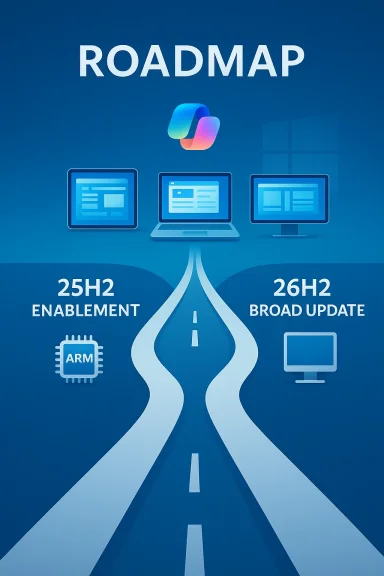
Microsoft’s official communication and the broad technology press agree on two core facts: Microsoft released Windows 11, version 25H2 into the Windows Insider Release Preview Channel in late August 2025 and moved that update toward general availability in the autumn of 2025, and Microsoft’s engineering work that surfaced in early 2026 centers on platform branches (some targeted at new Arm hardware) rather than a global rebooted OS branded “Windows 12.” The Windows Insider Program post making 25H2 available to Release Preview testers is the clearest, authoritative record of that plan.Independent outlets — from Tom’s Hardware to The Verge and major reporting on Windows update branches — have parsed Microsoft’s public posts and Insider builds the same way: 2025’s 25H2 and 2026’s device-specific 26H1/26H2 cadence constitute Microsoft’s roadmap in the near term, not an immediate Windows 12 launch.
What the r read
The rumor anatomy
- Early 2026 social posts and a handful of site stories claimed Microsoft planned to ship a new, AI‑first Windows “Windows 12” in 2026 — sometimes under leaked codenames like Hudson Valley or tied to “Copilot+” hardware narratives. Those stories pulled together Insider-channel artifacts, OEM whispers and alleged build strings into a single headline: a new OS is imminent.
- The direct result: heightened expectation among consumers and IT pros about a large, disruptive OS change arriving in the coming months. Forum conversations reflect the spike in speculation and concern.
Why the rumours took hold
Several factors made the rumor environment fertile:- Windows 10’s official end-of-support timeline and the general industry appetite for an “AI-first” desktop narrative created a story arc that made a major Windows successor feel plausible.
- Microsoft’s accelerating public messaging around Copilot and AI-enabled features — plus references to new device classes and silicon like Qualcomm’s Snapdragon X2 — meant that hardware + OS transitions were visible and could be misread as a new Windows version rather than incremental platform evolution.
The authoritative record: what Microsoft actually said and released
Windows 11, version 25H2 — the near-term reality
Microsoft announced that Windows 11 version 25H2 was available to the Windows Insider Release Preview Channel on August 29, 2025, and the company proceeded with a staged rollout into general availability thereafter. The official description frames 25H2 as an enablement package — not a full, replatforming OS release — sharing a servicing stack and base with 24H2. That language is important because an enablement package implies minimal platform differences and a quick install experience rather than the multi‑hour reinstallation associated with older big‑number OS jumps.- Key dates to note:
- Windows Insider Release Preview post: August 29, 2025.
- Public rollout and ISOs: broadly reported around September 2025.
26H1 and 26H2: divergence, not a “Windows 12” replacement
In late 2025 and into early 2026 Microsoft’s Insider branches and corporate messaging revealed a split in platform development:- Windows 11, version 26H1 — initially targeted and preinstalled only on a small class of new Arm-based devices built around Qualcomm’s Snapdragon X2. This OS image is built on a new internal platform variant (reported under internal names like “Bromine”), and Microsoft confirmed 26H1’s role as a hardware‑gated, factory-shipped image rather than a broad Windows Update for the installed base.
- Windows 11, version 26H2 — the update path and timing for the wider x86/x64 installed base. Insiders and reporters expect 26H2 to be the fall 2026 platform release that reaches more devices. Day-to-day Windows users and administrators should plan around 26H2 as the next universal feature update.
Why the distinction matters: technical, commercial and operational implications
Fragmentation risk vs. controlled specialization
Microsoft’s branching strategy introduces short-term platform fragmentation: OEMs shipping 26H1 on Copilot+ Arm PCs will carry a different servicing lane than the majority of x86 devices that will receive 26H2 later in 2026. That can create:- Device management complexity for enterprises that purchase mixed hardware fleets.
- Testing overhead for ISVs and driver vendors who must validate across Bromine‑ and Germanium‑based images.
- Potential user confusion when devices legitimately run different Windows versions in the same calendar year.
Enterprise planning and support timelines
Enterprises must remember these concrete lifecycle anchors:- Windows 25H2 is an enablement package that resets support timelines for some channels — administrators should verify support-lifetimes in their environment and plan updates accordingly.
- A device shipped with 26H1 may remain on that branch until Microsoft converges branches in a later unified release (public reporting suggests a unification target around 2027). That matters for patching, as 26H1 devices won’t receive 26H2 fall updates in the same way an x86 device would.
Assessing the sources: what’s confirmed, what’s inferred, and what’s pure speculation
Confirmed by Microsoft (high confidence)
- 25H2 was released to the Windows Insider Release Preview Channel on August 29, 2025.
- 25H2 is delivered as an enablement package sharing a servicing stack with 24H2. ([blogs.windowsndows.com/windows-insider/2025/08/29/releasing-windows-11-version-25h2-to-the-release-preview-channel/)
- Microsoft has indicated a device-targeted 26H1 path (Arm-first) and a separate, later 26H2 for the broader ecosystem; reporting and Insider artifacts corroborate that.
Supported by multiple independent technology reporters (strong corroboration)
- Outlets such as Tom’s Hardware and The Verge reported and explained Microsoft’s 25H2 rollout and that a broad Windows 12 launch was not announced for 2026. These independent analyses track Microsoft’s public posts and Insider builds.
Unconfirmed or unverifiable (treat with caution)
- Features and branding attributed to a hypothetical “Windows 12” (code‑names like Hudson Valley, feature lists including on‑device NPUs and a full AI-first UI) largely come from leaks, vendor whispers and interpretive reporting in chat and forums — these claims lack direct Microsoft confirmation and should be treated as speculative. Forum posts and community threads document this speculative discourse vividly, but they are not equivalent to official d# Risks and trade-offs: what to watch for in 2026
Consumer risks
- Confusion at retail: buyers of Copilot+ or Snapdragon X2 devices might expect a universal “next Windows” experience; instead they will find hardware‑gated images tailored to that device. Consumers should confirm the device’s shipped Windows image and ongoing update behavior before purchase. Reporting indicates 26H1 will ship preinstalled on select devices in spring 2026.
- Patch parity: if you own different hardware classes, you may see different update timing or feature exposure during 2026. Plan for staggered feature arrival.
Enterprise risks
- Testing burden: IT teams must validate Windows behavior across the distinct branches if they deploy mixed fleets. Driver and application compatibility testing needs to include Bromine-based images if you plan to buy or pilot Copilot+ Arm devices. Analyst coverage suggests unification may not occur until 2027, extending the period of divergence.
- Procurement misalignment: buying hardware on a mistaken assumption that it will run the same update cadence as the rest of your estate can cause patching and support headaches.
Ecosystem risks
- Third-party vendor fatigue: ISVs and driver developers must support multiple branches and ensure acceptable compatibility across the installed base, increasing QA costs and possibly slowing feature uptake.
- Messaging confusion: the rumor-driven demand for “Windows 12” pressurizes vendors to overpromise on timelines and features; reputable reporting is already pushing back against such narratives.
Practical guidance: what readers should do now
For consumers
- If you’re buying a new PC in early 2026, ask the seller or OEM whether the device ships with 26H1 (hardware-gated Arm image) or the mainstream Windows 11 image; understand what that means for updates this year. Reporting shows 26H1 will be limited to select Arm devices.
- If you’re happy with Windows 11 on your current PC, there’s no urgent need to chase rumor headlines. 25H2 and later 26H2 are incremental and Microsoft’s enablement-package approach reduces the friction of upgrading from 24H2.
For IT professionals and administrators
- Inventory your fleet: identify devices that may ship on alternate branches (e.g., Copilot+ Arm laptops).
- Test explicitly on the branch that matches devices you plan to deploy. If a pilot device ships with 26H1, validate on that image, not just on 25H2 or 24H2.
- Adjust procurement language to require clear update and servicing expectations from OEMs.
- Maintain conservative update policies for the bulk of your estate: staged deployments and ring testing remain the best defense against platform drift.
For developers and ISVs
- Prioritize automated test coverage across multiple Windows branches. Insider builds show where platform APIs are diverging; pay attention to Canary/Dev channel changes to spot future compatibility risks. Community discussion panels and Insider flight notes provide early warning for API shifts.
Why some reporting got this wrong — and why that’s instructive
Two headlines drove confusion: one that translated platform‑branching work into a monolithic “Windows 12” announcement, and another that misread device-specific images as the start of a universal roll-out. Both mistakes are instructive:- Leak aggregation vs. confirmation: credible journalism distinguishes between a collection of signals (leaks, internal strings, OEM conversations) and an official product announcement. Microsoft’s public record — the Windows Insider blog and its official release posts — remain the authoritative source for release names and distribution models.
- Platform vs. product: the emergence of new platform cores (Bromine, Germanium, Strontium in reporting) is an engineering detail that can be summarized poorly into consumer-facing messaging. It’s accurate to say Microsoft is evolving Windows under the hood; it’s not accurate to equate that evolution with a global Windows 12 release in 2026.
Strengths and potential benefits of Microsoft’s approach
- Risk-managed hardware enablement: shipping 26H1 as a factory image for specific Arm devices allows OEMs and Microsoft to safely validate new silicon without forcing an immediate global update.
- Safer rollout for enterprises: enablement packages like 25H2 make upgrades faster and less disruptive, reducing reboot cycles and installation overhead for broad upgrades.
- Modular evolution: by working in branches, Microsoft can iterate on AI and device integration features with less risk to the core user experience on established hardware.
Weaknesses and potential hazards
- Short-term fragmentation: mixed servicing lanes increase the administrative and testing burden.
- Messaging friction: a stream of speculative headlines undermines Microsoft’s control over upgrade expectations and can fuel poor purchasing decisions.
- Vendor coordination costs: ISVs, driver authors and OEM support teams must validate and maintain compatibility across branches, increasing QA timelines.
Final verdict: what’s likely and what to expect next
- Windows 12 as a mass-market, branded successor will not arrive for the general installed base in 2026. The near-term calendar is centered on Windows 11 increments (25H2 already released as an enablement package in late 2025) and a split 2026 path with hardware-targeted 26H1 followed by broader 26H2 later in the year. Microsoft’s official Insider posts and multiple independent outlets corroborate that timeline.
- Expect the conversation to shift from "When is Windows 12 coming?" to "How will Microsoft reconcile the platform branches and deliver a unified servicing model?" Industry reporting and Insider branch activity suggest a unification milestone is likely in a future update (reporters point to 2027 as a plausible unification target), but that is forward-looking and not yet a Microsoft announcement.
Quick recap and action checklist
- Microsoft officially moved Windows 11, version 25H2 through Insider Release Preview in August 2025 and toward GA in autumn 2025; this is an enablement package, not a new Windows 12.
- 26H1 in early 2026 is device-targeted (Arm, Snapdragon X2) and will ship on select new PCs as a factory image; 26H2 later in 2026 is the broader, cross‑device release.
- If you manage devices, inventory, test and align procurement with OEM update guarantees now; don’t assume a global Windows 12 migration in 2026.
- Inventory hardware and identify Copilot+ or Arm-targeted candidates.
- Prioritize testing on the exact images your planned devices ship with.
- Delay nonessential mass upgrades until after internal validation.
- Communicate clearly to stakeholders that “Windows 12 in 2026” is a rumor, not a roadmap.
Microsoft’s Windows strategy in 2026 looks less like an abrupt reboot and more like an intentional, staged evolution: targeted platform images for new silicon, enablement packages for smoother upgrades, and a continuing cadence of feature deliveries through Insider channels. That approach reduces the risk of a disruptive, rushed release — but it also creates a window where messaging, procurement and management complexity matter more than they did in a one‑size‑fits‑all release model. Users and IT teams who treat the next 12–18 months as a planning window rather than a cliff will be best positioned to avoid surprises.
Conclusion: the most responsible reading of the record is simple and verifiable — there is no official Windows 12 launch scheduled for 2026. Plan for Windows 11 updates, test for platform divergence where it applies to your devices, and treat any “Windows 12” feature lists that lack Microsoft confirmation as aspirational leaks rather than a shipping roadmap.
Source: Mezha Windows 12 won't be released in 2026, despite rumours – Windows Central
