

HMD Global has launched four new Nokia-branded 4G feature phones — the Nokia 200 4G, Nokia 210 4G, Nokia 215 4G Second Edition, and Nokia 235 4G Second Edition — adding a dedicated AI assistant button, video chat, USB-C charging, and familiar keypad hardware in select global markets in July 2026. The move is not merely a nostalgia play with a chatbot bolted on. It is an attempt to redefine the “dumbphone” as something more selective than primitive: less app-saturated than a smartphone, but no longer disconnected from the AI services now creeping into every tier of consumer electronics.
As SmartHouse reported, the Australian launch details remain absent for now, and HMD has not yet turned this into the kind of global keynote moment that would accompany a flagship Android phone. That low-key rollout matters. HMD is testing whether artificial intelligence can become a feature-phone utility before it becomes a feature-phone tax.
The central hardware change is almost comically small: an AI button placed on the directional pad. On a slab smartphone, that would be one more contested shortcut in a sea of gestures, widgets, and app icons. On a keypad phone, it is closer to a statement of intent.
HMD’s own product pages describe the Nokia 210 4G as a keypad phone with video calling, an AI assistant, and cloud phone services. Notebookcheck, Gadgets360, Gizmochina, and SmartHouse all report the same basic lineup: four Nokia-branded handsets running S30+, using 1,450mAh batteries, and carrying the old feature-phone promise of long life, physical keys, and limited complexity.
The assistant is powered by Sikey AI, and the pitch is practical rather than magical. Users can reportedly ask simple questions and use voice commands to trigger selected device functions such as opening the camera, turning on the torch, setting alarms or reminders, and making calls. That is not the full conversational AI experience sold by Microsoft, Google, OpenAI, or Apple; it is closer to voice control with a knowledge layer.
That distinction is important because feature-phone buyers are often not asking for a pocket computer. They may be older users, budget buyers, workers who need a cheap backup phone, parents buying for children, or people deliberately trying to escape the attention economy. If AI on these devices becomes a lightweight accessibility tool, it has a real use case. If it becomes another subscription funnel, it risks missing the very audience that still buys phones with number pads.
Modern feature phones are different because the networks around them have changed. 2G and 3G shutdowns in many markets have forced even basic handsets into the 4G era, while USB-C mandates and consumer expectations have pushed manufacturers toward more standardized charging and more modern radios. A 2026 feature phone is not a preserved 2003 device. It is a cheap, constrained computer pretending not to be one.
That makes HMD’s new AI button less surprising than it first appears. Once a phone has 4G, a camera, Bluetooth, cloud-linked services, and a modern charging port, the line between “basic” and “smart” is already porous. The question becomes where the manufacturer draws the boundary.
HMD appears to be drawing it around interface, not capability. These phones still have small QVGA displays, T9-style input, and the S30+ operating system rather than a full smartphone app ecosystem. The user is not being invited into an endless grid of apps. Instead, HMD is trying to add a few smartphone-like services while preserving the physical grammar of a feature phone.
That changes the emotional proposition of a basic phone. For years, the trade-off was clear: a feature phone gave you simplicity and battery life, but it cut you off from the richer communication habits that families and workplaces had normalized. Voice and SMS were enough for some users, but not for grandparents who wanted to see grandchildren, migrant workers who relied on video calls, or families coordinating across platforms.
By putting a VGA front camera across the range, HMD is acknowledging that “essential communication” no longer means only voice and text. The Nokia 210 4G and Nokia 235 4G also include rear-facing cameras, with the 235 4G carrying a 2-megapixel sensor. Nobody should mistake that for a serious photography system, but that is not the point. The point is proof-of-life communication: a face, a room, a document, a quick visual check-in.
In that sense, video calling is less of a gimmick than AI. It solves an obvious human problem. The AI assistant solves a more speculative one, though it could become valuable for users who struggle with menus, typing, or small-screen navigation.
That is a strange requirement for a product category often chosen specifically because the user does not want, cannot afford, or cannot comfortably operate a smartphone. It suggests that HMD and its partners are still thinking of the feature phone as part of a broader phone ecosystem rather than as an independent device. For some households, that may be fine: a caregiver, parent, or family member can manage the subscription. For others, it creates a dependency that weakens the entire promise.
The 180-day free period also reframes the AI button. For the first six months, it is a built-in convenience. After that, it becomes a reminder that even the simplest phone can now contain a metered service.
This is where HMD’s experiment becomes a test of trust. Feature phones have historically been attractive because they feel final: you buy the device, insert a SIM, charge it, and use it. Once an assistant sits behind a trial period, the product inherits some of the anxieties of the smartphone world — subscriptions, account management, service continuity, and the possibility that a headline feature may disappear if the user stops paying.
For WindowsForum readers, the analogy is not hard to see. Enterprise IT has spent years watching vendors describe every new managed layer as empowerment, even when users experience it as friction. A locked-down device can be a blessing or a cage depending on who controls the locks. In HMD’s case, S30+ keeps the phones simple, but cloud services and AI assistance introduce new dependencies that classic feature phones did not have.
The result is a hybrid strategy. HMD wants the reliability aura of old Nokia phones, the compliance with modern networks that 4G provides, and just enough cloud intelligence to make the device feel current. It does not want to compete with Android on apps, displays, cameras, or performance. It wants to sell the phone as a curated appliance.
That may be the only viable path left for mass-market feature phones. Competing with smartphones on smartphone terms is a losing game. Competing on restraint, durability, price, and battery life still gives HMD a lane — provided the added services do not make the devices feel like underpowered smartphones rather than improved basic phones.
A voice assistant that can place a call, set an alarm, open the camera, or turn on the torch could be genuinely useful on a small-screen keypad device. Physical buttons are excellent for muscle memory, but nested menus on tiny displays can be punishing. Voice shortcuts can reduce friction for older users, visually impaired users, or anyone who wants a basic device without memorizing every menu path.
This is where HMD’s implementation will have to prove itself. Basic voice commands are only as good as their reliability in noisy rooms, varied accents, weak connectivity, and low-cost microphones. If the assistant fails often, users will abandon it faster than they would abandon a flaky smartphone app because the fallback interface is slower.
The phrase “on-device virtual assistant,” used in some reports, should also be treated carefully. “On-device” can mean different things in consumer marketing, especially when cloud phone services are part of the same product pitch. Users and administrators will want clarity about what is processed locally, what is sent to remote servers, how voice data is handled, and whether the assistant remains useful without data coverage.
These are not glamorous specifications, but glamour would be a warning sign. A feature phone with a big display, advanced camera stack, and full app ecosystem is simply a cheap smartphone with worse software. HMD is instead preserving the low-power, low-expectation profile that keeps these devices relevant.
The Nokia 235 4G Second Edition’s 2-megapixel rear camera is enough for basic snapshots, but the more important camera is arguably the VGA module that enables video chat. A feature phone does not need to win Instagram. It needs to show a face clearly enough that a call feels personal.
That design logic is old Nokia thinking filtered through modern supply chains. The parts are modest. The features are carefully rationed. The question is whether AI belongs in that rationed set or whether it will look, in hindsight, like a marketing layer added because every product in 2026 is expected to say “AI” somewhere on the box.
That makes the AI addition philosophically risky. The market for feature phones includes people who buy them precisely because they are not portals into the modern software economy. If AI becomes another always-present service with account requirements and recurring fees, HMD may alienate the minimalists and “digital detox” buyers who have helped keep the category culturally visible.
But there is another audience for whom this could work: users who need simplicity, not ideological purity. A parent may want a child to have calls, texts, location-independent communication, and limited video contact without a full smartphone. An older user may want a familiar keypad plus voice help. A field worker may want a durable backup handset with modern charging and enough intelligence to reduce menu diving.
The difference between those audiences matters. The digital-detox buyer may resent AI. The accessibility buyer may welcome it. The budget buyer may tolerate it only if the subscription price is low or irrelevant. HMD’s challenge is that one product line is trying to speak to all three.
This is not a minor UX footnote. Account creation, payment management, renewal, cancellation, and support are part of the product experience. A user who can operate a keypad phone but not a smartphone may be locked out of managing one of the device’s advertised features. A caregiver may become the real administrator of the phone.
That may create a useful model for families and care settings, but it also raises questions about privacy and autonomy. Who controls the assistant subscription? Who has access to account information? What happens if the managing smartphone is replaced, lost, or owned by a different person?
For IT professionals, this is familiar territory. The endpoint is never just the endpoint. The management plane is part of the system, and sometimes it is the most important part.
Putting AI into a Nokia feature phone is not inherently a betrayal of the brand. Nokia’s best old phones were not anti-technology; they were technology made dependable. If Sikey AI makes basic tasks easier, if video calling works reliably, and if battery life remains strong, the new devices could feel like a sensible modernization.
The danger is overpromising. “AI assistant” now carries expectations shaped by far more capable devices and services. A small S30+ handset with limited input, modest hardware, and a trial-based assistant cannot meet those expectations. HMD’s marketing must keep the promise narrow: voice shortcuts, simple queries, and accessible controls.
That may sound unambitious, but unambitious technology often ages better. The original Nokia appeal was not that the phone could do everything. It was that it could do the important things without making itself the center of your life.
The same is true of Xpress Chat. Video calling on a feature phone sounds compelling only if the network of compatible users is broad enough and the setup is simple enough. HMD says smartphone users can also use the Xpress Chat app, which is essential; a video-calling feature that only works between a small number of new Nokia handsets would be too isolated to matter.
Pricing will be decisive. Not just handset pricing, which remains unannounced for Australia, but subscription pricing as well. A cheap phone with a surprisingly expensive assistant would be an own goal. A modest service fee for a genuinely useful accessibility layer could find a niche.
HMD also needs to explain availability with more precision. “Select global markets” is not enough for buyers who need network compatibility, warranty support, and local pricing. Feature phones are often bought pragmatically, and pragmatic buyers need specifics.
As SmartHouse reported, the Australian launch details remain absent for now, and HMD has not yet turned this into the kind of global keynote moment that would accompany a flagship Android phone. That low-key rollout matters. HMD is testing whether artificial intelligence can become a feature-phone utility before it becomes a feature-phone tax.
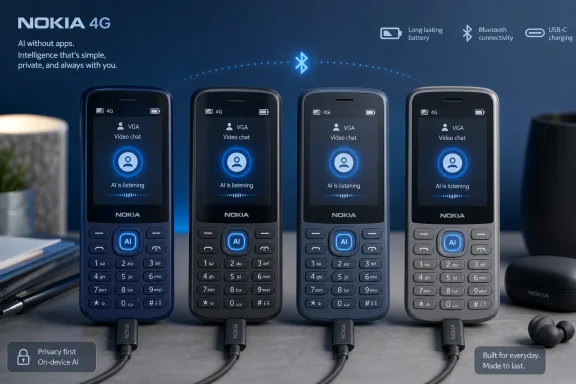 HMD Puts an AI Button Where the Menu Key Used to Live
The central hardware change is almost comically small: an AI button placed on the directional pad. On a slab smartphone, that would be one more contested shortcut in a sea of gestures, widgets, and app icons. On a keypad phone, it is closer to a statement of intent.HMD’s own product pages describe the Nokia 210 4G as a keypad phone with video calling, an AI assistant, and cloud phone services. Notebookcheck, Gadgets360, Gizmochina, and SmartHouse all report the same basic lineup: four Nokia-branded handsets running S30+, using 1,450mAh batteries, and carrying the old feature-phone promise of long life, physical keys, and limited complexity.
The assistant is powered by Sikey AI, and the pitch is practical rather than magical. Users can reportedly ask simple questions and use voice commands to trigger selected device functions such as opening the camera, turning on the torch, setting alarms or reminders, and making calls. That is not the full conversational AI experience sold by Microsoft, Google, OpenAI, or Apple; it is closer to voice control with a knowledge layer.
That distinction is important because feature-phone buyers are often not asking for a pocket computer. They may be older users, budget buyers, workers who need a cheap backup phone, parents buying for children, or people deliberately trying to escape the attention economy. If AI on these devices becomes a lightweight accessibility tool, it has a real use case. If it becomes another subscription funnel, it risks missing the very audience that still buys phones with number pads.
The Dumbphone Was Never Really Dumb
The phrase “dumbphone” has always been a little misleading. Classic Nokia handsets were not dumb; they were specialized. They made calls, sent messages, held contacts, ran a few utilities, survived pockets and drops, and lasted long enough that “battery anxiety” was not yet a lifestyle condition.Modern feature phones are different because the networks around them have changed. 2G and 3G shutdowns in many markets have forced even basic handsets into the 4G era, while USB-C mandates and consumer expectations have pushed manufacturers toward more standardized charging and more modern radios. A 2026 feature phone is not a preserved 2003 device. It is a cheap, constrained computer pretending not to be one.
That makes HMD’s new AI button less surprising than it first appears. Once a phone has 4G, a camera, Bluetooth, cloud-linked services, and a modern charging port, the line between “basic” and “smart” is already porous. The question becomes where the manufacturer draws the boundary.
HMD appears to be drawing it around interface, not capability. These phones still have small QVGA displays, T9-style input, and the S30+ operating system rather than a full smartphone app ecosystem. The user is not being invited into an endless grid of apps. Instead, HMD is trying to add a few smartphone-like services while preserving the physical grammar of a feature phone.
Video Calling Is the More Radical Upgrade
The AI button will get the headlines, but Xpress Chat video calling may be the more disruptive addition for the people most likely to buy these handsets. HMD’s product material for the Nokia 210 4G frames video calling as a core feature, with the Xpress Chat app allowing calls between supported Nokia feature phones and smartphones.That changes the emotional proposition of a basic phone. For years, the trade-off was clear: a feature phone gave you simplicity and battery life, but it cut you off from the richer communication habits that families and workplaces had normalized. Voice and SMS were enough for some users, but not for grandparents who wanted to see grandchildren, migrant workers who relied on video calls, or families coordinating across platforms.
By putting a VGA front camera across the range, HMD is acknowledging that “essential communication” no longer means only voice and text. The Nokia 210 4G and Nokia 235 4G also include rear-facing cameras, with the 235 4G carrying a 2-megapixel sensor. Nobody should mistake that for a serious photography system, but that is not the point. The point is proof-of-life communication: a face, a room, a document, a quick visual check-in.
In that sense, video calling is less of a gimmick than AI. It solves an obvious human problem. The AI assistant solves a more speculative one, though it could become valuable for users who struggle with menus, typing, or small-screen navigation.
The Subscription Catch Cuts Against the Simplicity Pitch
The most revealing detail in the launch is not the AI button itself but the business model behind it. SmartHouse and other outlets report that Sikey AI will be free for the first 180 days, after which continued use will require a paid subscription. More awkwardly, users will reportedly need a compatible smartphone to purchase or manage that subscription.That is a strange requirement for a product category often chosen specifically because the user does not want, cannot afford, or cannot comfortably operate a smartphone. It suggests that HMD and its partners are still thinking of the feature phone as part of a broader phone ecosystem rather than as an independent device. For some households, that may be fine: a caregiver, parent, or family member can manage the subscription. For others, it creates a dependency that weakens the entire promise.
The 180-day free period also reframes the AI button. For the first six months, it is a built-in convenience. After that, it becomes a reminder that even the simplest phone can now contain a metered service.
This is where HMD’s experiment becomes a test of trust. Feature phones have historically been attractive because they feel final: you buy the device, insert a SIM, charge it, and use it. Once an assistant sits behind a trial period, the product inherits some of the anxieties of the smartphone world — subscriptions, account management, service continuity, and the possibility that a headline feature may disappear if the user stops paying.
S30+ Becomes the Anti-App Store Strategy
The choice of S30+ is central to the story. HMD is not reviving KaiOS-style ambitions here, at least not in the form of a broad third-party app platform. S30+ is constrained, familiar, and limited. That limitation is the product.For WindowsForum readers, the analogy is not hard to see. Enterprise IT has spent years watching vendors describe every new managed layer as empowerment, even when users experience it as friction. A locked-down device can be a blessing or a cage depending on who controls the locks. In HMD’s case, S30+ keeps the phones simple, but cloud services and AI assistance introduce new dependencies that classic feature phones did not have.
The result is a hybrid strategy. HMD wants the reliability aura of old Nokia phones, the compliance with modern networks that 4G provides, and just enough cloud intelligence to make the device feel current. It does not want to compete with Android on apps, displays, cameras, or performance. It wants to sell the phone as a curated appliance.
That may be the only viable path left for mass-market feature phones. Competing with smartphones on smartphone terms is a losing game. Competing on restraint, durability, price, and battery life still gives HMD a lane — provided the added services do not make the devices feel like underpowered smartphones rather than improved basic phones.
AI on a Keypad Phone Is Really an Accessibility Story
The strongest argument for Sikey AI is not productivity. Nobody is buying a Nokia 200 4G to summarize PDFs, generate images, or manage a calendar across six cloud accounts. The compelling case is accessibility.A voice assistant that can place a call, set an alarm, open the camera, or turn on the torch could be genuinely useful on a small-screen keypad device. Physical buttons are excellent for muscle memory, but nested menus on tiny displays can be punishing. Voice shortcuts can reduce friction for older users, visually impaired users, or anyone who wants a basic device without memorizing every menu path.
This is where HMD’s implementation will have to prove itself. Basic voice commands are only as good as their reliability in noisy rooms, varied accents, weak connectivity, and low-cost microphones. If the assistant fails often, users will abandon it faster than they would abandon a flaky smartphone app because the fallback interface is slower.
The phrase “on-device virtual assistant,” used in some reports, should also be treated carefully. “On-device” can mean different things in consumer marketing, especially when cloud phone services are part of the same product pitch. Users and administrators will want clarity about what is processed locally, what is sent to remote servers, how voice data is handled, and whether the assistant remains useful without data coverage.
The Camera Specs Say HMD Knows the Market
The hardware tells a story of cost discipline. The Nokia 210 4G and Nokia 215 4G Second Edition reportedly use 2.4-inch QVGA displays, while the Nokia 200 4G and Nokia 235 4G Second Edition move to larger 2.8-inch IPS screens with the same resolution. All four use 1,450mAh batteries. Bluetooth 5.0, USB-C, 3.5mm audio, and FM radio round out the practical checklist.These are not glamorous specifications, but glamour would be a warning sign. A feature phone with a big display, advanced camera stack, and full app ecosystem is simply a cheap smartphone with worse software. HMD is instead preserving the low-power, low-expectation profile that keeps these devices relevant.
The Nokia 235 4G Second Edition’s 2-megapixel rear camera is enough for basic snapshots, but the more important camera is arguably the VGA module that enables video chat. A feature phone does not need to win Instagram. It needs to show a face clearly enough that a call feels personal.
That design logic is old Nokia thinking filtered through modern supply chains. The parts are modest. The features are carefully rationed. The question is whether AI belongs in that rationed set or whether it will look, in hindsight, like a marketing layer added because every product in 2026 is expected to say “AI” somewhere on the box.
HMD Is Selling Restraint in an Industry Addicted to More
The broader mobile industry has spent years pushing users toward ever-larger displays, more cameras, more background services, more notifications, and more subscriptions. HMD’s feature-phone business survives because not everyone wants that bargain. Some users want fewer choices, not more.That makes the AI addition philosophically risky. The market for feature phones includes people who buy them precisely because they are not portals into the modern software economy. If AI becomes another always-present service with account requirements and recurring fees, HMD may alienate the minimalists and “digital detox” buyers who have helped keep the category culturally visible.
But there is another audience for whom this could work: users who need simplicity, not ideological purity. A parent may want a child to have calls, texts, location-independent communication, and limited video contact without a full smartphone. An older user may want a familiar keypad plus voice help. A field worker may want a durable backup handset with modern charging and enough intelligence to reduce menu diving.
The difference between those audiences matters. The digital-detox buyer may resent AI. The accessibility buyer may welcome it. The budget buyer may tolerate it only if the subscription price is low or irrelevant. HMD’s challenge is that one product line is trying to speak to all three.
The Smartphone Requirement Is the Product’s Most Awkward Admission
Requiring a smartphone to manage the AI subscription exposes a structural problem. If the feature phone is meant to stand alone, the requirement is self-defeating. If it is meant to be a companion device managed by someone else, HMD should say so plainly.This is not a minor UX footnote. Account creation, payment management, renewal, cancellation, and support are part of the product experience. A user who can operate a keypad phone but not a smartphone may be locked out of managing one of the device’s advertised features. A caregiver may become the real administrator of the phone.
That may create a useful model for families and care settings, but it also raises questions about privacy and autonomy. Who controls the assistant subscription? Who has access to account information? What happens if the managing smartphone is replaced, lost, or owned by a different person?
For IT professionals, this is familiar territory. The endpoint is never just the endpoint. The management plane is part of the system, and sometimes it is the most important part.
The Nokia Brand Still Carries a Promise HMD Must Not Overdraw
Nokia’s name remains unusually powerful in the feature-phone market because it evokes durability, simplicity, and a kind of technological honesty. HMD, as the licensee and manufacturer of Nokia-branded phones, has benefited from that inherited trust. But inherited trust can be spent.Putting AI into a Nokia feature phone is not inherently a betrayal of the brand. Nokia’s best old phones were not anti-technology; they were technology made dependable. If Sikey AI makes basic tasks easier, if video calling works reliably, and if battery life remains strong, the new devices could feel like a sensible modernization.
The danger is overpromising. “AI assistant” now carries expectations shaped by far more capable devices and services. A small S30+ handset with limited input, modest hardware, and a trial-based assistant cannot meet those expectations. HMD’s marketing must keep the promise narrow: voice shortcuts, simple queries, and accessible controls.
That may sound unambitious, but unambitious technology often ages better. The original Nokia appeal was not that the phone could do everything. It was that it could do the important things without making itself the center of your life.
The First Six Months Will Decide Whether the Button Matters
The 180-day trial window gives HMD a useful but unforgiving test. During that period, users will learn whether the assistant is a daily habit or a novelty. If they use it to make calls, set alarms, start video chats, and navigate the phone, the subscription conversation becomes plausible. If they press it three times and forget it exists, the AI story evaporates.The same is true of Xpress Chat. Video calling on a feature phone sounds compelling only if the network of compatible users is broad enough and the setup is simple enough. HMD says smartphone users can also use the Xpress Chat app, which is essential; a video-calling feature that only works between a small number of new Nokia handsets would be too isolated to matter.
Pricing will be decisive. Not just handset pricing, which remains unannounced for Australia, but subscription pricing as well. A cheap phone with a surprisingly expensive assistant would be an own goal. A modest service fee for a genuinely useful accessibility layer could find a niche.
HMD also needs to explain availability with more precision. “Select global markets” is not enough for buyers who need network compatibility, warranty support, and local pricing. Feature phones are often bought pragmatically, and pragmatic buyers need specifics.
The Small Print Is Where This Nokia Experiment Gets Serious
The headline is easy: Nokia feature phones now have an AI button. The real story is how many modern technology assumptions have been compressed into devices that still look like old-school handsets.- HMD has introduced four Nokia-branded 4G feature phones with S30+, USB-C, Bluetooth 5.0, FM radio, and 1,450mAh batteries.
- The new AI button invokes Sikey AI for basic questions and selected voice-controlled phone functions.
- The assistant is reportedly free for 180 days, after which users will need a paid subscription.
- The requirement to manage that subscription through a compatible smartphone complicates the pitch for users who chose a feature phone to avoid smartphones.
- Xpress Chat video calling may prove more practically important than AI if setup is simple and smartphone interoperability works well.
- Australian pricing and availability remain unannounced, leaving buyers to wait for regional details before judging value.
References
- Primary source: smarthouse.com.au
Published: 2026-07-06T06:52:08.155989
Nokia Adds AI Assistant To New Generation Of Feature Phones - SmartHouse
HMD Global has refreshed its Nokia feature phone range, bringing artificial intelligence capabilities to a series of traditional handsets that continue to focus on simplicity, long battery life and essential communication. The new lineup includes the Nokia 200 4G, Nokia 210 4G, Nokia 215 4G...www.smarthouse.com.au - Related coverage: gizmochina.com
HMD launches four new feature phones with 4G and AI features - Gizmochina
The new lineup includes the Nokia 210 4G, 235 4G 2nd Edition, 215 4G 2nd Edition, and 200 4G. Each one has a dedicated AI assistant button on the directional pad. www.gizmochina.com
- Related coverage: notebookcheck.net
HMD silently launches four new Nokia feature phones with AI assistant buttons - Notebookcheck News
HMD Global has officially released four new Nokia feature phones, namely the Nokia 210 4G, the Nokia 235 4G 2nd Edition, the Nokia 215 4G 2nd Edition, and the Nokia 200 4G. All four phones feature an on-device AI assistant, the S30+ operating system, and a 1,450 mAh battery. www.notebookcheck.net
- Related coverage: hmd.com
HMD
 www.hmd.com
- Related coverage: gadgets360.com
- Related coverage: gizguide.com
HMD releases Nokia 4 bar phones w/ some sort of "AI"
GIZGUIDE is one of the leading and most trusted technology-based websites in the Philippines providing the latest news, gadget reviews, and tutorials.www.gizguide.com
- Related coverage: notebookcheck.info
A HMD lança discretamente quatro novos celulares básicos da Nokia com botões de assistente de IA - NotebookCheck.info News
A HMD Global lançou oficialmente quatro novos celulares básicos da Nokia, a saber: o Nokia 210 4G, o Nokia 235 4G 2ª Edição, o Nokia 215 4G 2ª Edição e o Nokia 200 4G. Todos os quatro aparelhos contam com um assistente de IA integrado, o sistema operacional S30+ e uma bateria de 1.450 mAh. www.notebookcheck.info
- Related coverage: ubergizmo.com
New Nokia 4G Feature Phones Bring USB-C And AI Assistant | Ubergizmo
If you are on the market for a basic phone, we have great news; HMD Global has expanded its classic mobile lineup with the announcement of four new...www.ubergizmo.com - Related coverage: gadgets.beebom.com
HMD Launches New Nokia Feature Phones with an AI Assistant but There's a Catch | Beebom Gadgets
HMD has launched four new Nokia feature phones with a dedicated AI button, Sikey AI assistant, USB-C charging and more.gadgets.beebom.com - Related coverage: smartworld.it
Nokia 200, 210, 215 e 235 4G: i feature phone con AI di HMD | SmartWorld
HMD lancia quattro nuovi Nokia con AI a bordo: assistente vocale gratis 180 giorni, poi si paga. Ma serve uno smartphone per abbonarsi.www.smartworld.it - Related coverage: ceppek.com
- Related coverage: telecomtalk.info
HMD Launches AI-Powered Nokia Feature Phones
HMD launches all-new Nokia feature phone with 200 series 4G phone with dedicated AI assistant called the Sikey AI - Here is all we know so far:telecomtalk.info - Related coverage: digital-assistant.nokia.com
- Related coverage: nokia.com
2162632123
Conceptual image with a speech bubble next to an interactive AI CPU. 3d renderingwww.nokia.com