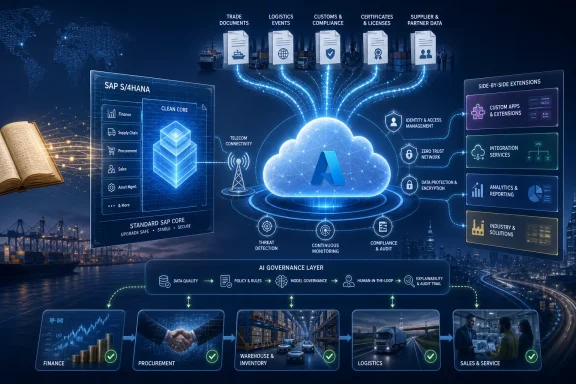
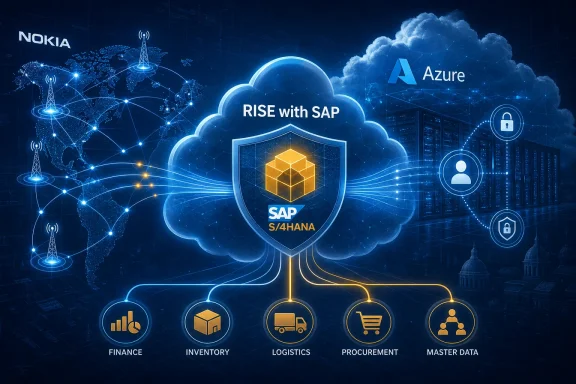
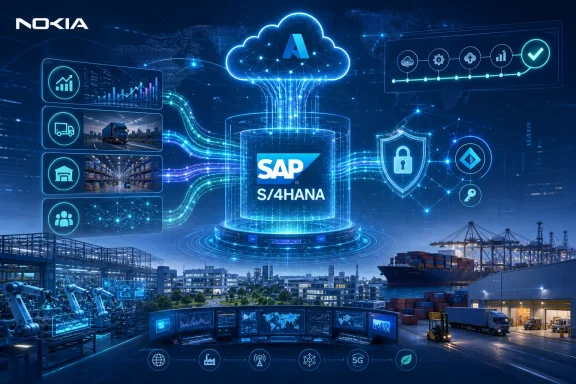
Nokia, SAP and Microsoft announced on June 30, 2026, that Nokia has signed a multi-year agreement to move its SAP S/4HANA environment into the RISE with SAP model, with the core ERP landscape hosted on Microsoft Azure. The deal is not a flashy product launch; it is a bet on where large-company computing is going. For WindowsForum readers, the interesting part is not that another global enterprise is “moving to cloud.” It is that the cloud, ERP, security, data, and AI stacks are being bundled into one operational architecture that will increasingly define how Microsoft’s largest customers run.
The press-release version is straightforward: Nokia will use RISE with SAP Methodology to continue modernizing its ERP estate, SAP will operate and manage the S/4HANA environment in the cloud, and Microsoft Azure will provide the hyperscale platform underneath it. That sounds like procurement language, but the strategic meaning is sharper. Nokia is moving one of the least forgiving parts of enterprise IT — finance, logistics, trade, warehouse operations, master data, and availability-to-promise processes — into a managed cloud model designed to feed continuous software updates and AI functions into the business core.
ERP migrations have always been the place where enterprise optimism goes to be audited. Companies promise simplification and process standardization, then encounter decades of customization, data exceptions, local operating habits, and integrations that were never documented because they were never supposed to live this long. Nokia’s move matters because it frames that old problem in the language of enterprise AI, not merely modernization.
The phrase “AI-driven business transformation” can mean almost anything in 2026, and vendors have not been shy about stretching it. In this case, however, there is a concrete technical foundation beneath the slogan. AI that acts on enterprise workflows needs clean master data, governed process semantics, consistent authorization, reliable telemetry, and real-time access to transactional systems. That is exactly the layer SAP and Microsoft are trying to industrialize.
For Nokia, this is also about control. A company that sells networking infrastructure into the AI era cannot afford a back office whose own data architecture is too fragmented to support automation. The company’s stated goal of simplifying its ERP landscape and supporting AI-driven processes is not just an internal IT upgrade; it is a credibility move for a vendor whose customers are themselves trying to build AI-ready infrastructure.
That distinction matters because traditional ERP transformation is full of false finish lines. A company completes a technical migration, celebrates a go-live, then spends years discovering that the system is still too customized, too brittle, or too disconnected from adjacent analytics and workflow tools. RISE is SAP’s attempt to wrap the transition in a standardized methodology, toolchain, service model, and commercial package that keeps customers moving toward a cleaner core.
The “clean core” idea is the part administrators should watch most closely. SAP is pushing customers away from deep customizations inside the transactional heart of ERP and toward extensions, integrations, and process changes that are more cloud-compatible. That can be healthy engineering discipline, but it also shifts power away from bespoke internal systems and toward vendor-defined patterns.
For Nokia, that means its ERP modernization is not simply a matter of running S/4HANA somewhere else. The SAP environment named in the announcement includes central finance, master data governance, extended warehouse management, global trade services, and advanced available-to-promise capabilities. These are not peripheral workloads. They are the connective tissue of how a multinational manufacturer and network technology company turns orders, inventory, compliance, suppliers, financial controls, and logistics into execution.
The managed model is attractive because it reduces infrastructure burden and gives the enterprise a more predictable route to new SAP capabilities. It is also uncomfortable because it forces a company to decide which old process quirks are strategic and which are just archaeology. In that sense, RISE is less a cloud subscription than a long negotiation with corporate memory.
That is why SAP on Azure has become more than a migration story. Microsoft has spent years making Azure hospitable to large SAP estates, while SAP and Microsoft have tightened integration around data, identity, Sentinel, Microsoft 365, Copilot, Fabric, and Joule. The target architecture is not “SAP runs on Microsoft servers.” It is “SAP business processes become available to the Microsoft cloud stack without losing governance.”
This is where the WindowsForum angle becomes clear. The modern Microsoft enterprise footprint is no longer just Windows endpoints, Active Directory descendants, Office, and server licensing. It is Entra identity, Defender telemetry, Sentinel monitoring, Teams workflows, Copilot interfaces, Fabric analytics, Azure infrastructure, and partner platforms like SAP sitting inside a managed operational envelope.
For admins, this raises the stakes of Azure architecture. When SAP runs inside a RISE model on Azure, the customer does not simply own and operate every layer as if it were a traditional VM estate. Microsoft’s own guidance makes clear that SAP manages the RISE landscape in SAP-controlled Azure subscriptions, while the customer’s Azure environment connects to it through defined interfaces and integration points. That separation is sensible, but it creates operational boundaries that must be understood before something breaks at quarter-end.
In practice, this means troubleshooting becomes a team sport. Network routes, identity flows, data pipelines, firewalls, private connectivity, monitoring scopes, and support responsibilities all need to be documented with more discipline than many enterprises historically applied to on-prem systems. The cloud makes infrastructure more programmable, but it does not make accountability automatic.
That is where IT strategy becomes organizational politics. Finance may have reporting practices embedded in legacy workflows. Logistics may have regional exceptions that were once vital and are now merely tolerated. Procurement may depend on data conventions that nobody wants to defend in a steering committee but everyone expects the system to preserve.
The clean-core model is an answer to that sprawl. Keep the transactional center closer to standard SAP. Move differentiation into approved extensions, cloud services, analytics layers, and surrounding applications. Accept that the price of continuous innovation is less freedom to modify the deepest part of the platform.
That trade-off is not unique to SAP. Microsoft has made similar arguments across Windows, Microsoft 365, Dynamics, and Azure: standardize the base, secure the identity layer, move customization to managed extension points, and let the cloud service evolve. The enterprise software industry has largely concluded that unlimited customer customization is incompatible with fast-moving security and AI delivery.
For Nokia, the promise is a more future-ready platform. For IT professionals, the warning is that modernization programs should not be judged only by go-live dates. The real test is whether the organization can retire customizations, rationalize master data, and keep extensions from recreating the same complexity in more fashionable places.
That is why SAP’s emphasis on embedded AI is more credible in ERP than in many consumer-facing AI pitches. An assistant that summarizes a meeting may save time, but an agent that can interpret an order constraint or flag a working-capital issue depends on structured business context. S/4HANA, master data governance, warehouse systems, global trade services, and ATP logic are exactly the kinds of systems that give AI something operationally meaningful to work with.
Microsoft’s parallel interest is just as strong. Copilot is much more valuable when it can connect user intent inside Microsoft 365 to business data and actions inside SAP. A finance manager working in Excel, Teams, or Word does not want an AI assistant that merely drafts prose. The more valuable assistant can reason over governed enterprise data, initiate workflows, explain exceptions, and respect authorization boundaries.
That last phrase is doing a lot of work. Enterprise AI cannot be allowed to become a charming new path around compliance. The appeal of SAP and Microsoft’s joint approach is that identity, security, workflow, and data governance are being built into the integration story from the start. Whether that works in production at global scale will depend on implementation discipline, but the architectural direction is clear.
For Nokia, progressively adopting AI-enabled functionality gives the company a way to modernize without pretending that every process should become autonomous overnight. The better reading is that Nokia is building the prerequisite layer. Before the AI agents come the unglamorous things: harmonized data, standardized process, clean interfaces, support boundaries, and reliable cloud operations.
That does not mean the ERP deal is a reciprocal favor, and there is no need to imply one. But it does show how deeply interdependent the AI cloud supply chain has become. Nokia sells networking gear into the hyperscale infrastructure boom, Microsoft operates the cloud platform underpinning that boom, and SAP provides the business software layer that many global firms still rely on to function.
The result is a triangulated relationship that reflects the structure of enterprise technology in 2026. No single vendor owns the whole stack. Instead, the winners are those that can make their layer indispensable while integrating tightly enough with the others to reduce customer friction.
Nokia’s public identity as “a global leader in connectivity for the AI era” also matters here. The company is selling into a world where AI demand is driving data center expansion, optical networking upgrades, routing capacity, private wireless, and edge connectivity. Running its own core business systems on a cloud-and-AI-ready ERP architecture gives Nokia a cleaner internal story to tell.
There is a practical risk in that symmetry as well. When major vendors become customers, suppliers, and ecosystem partners to one another, dependency maps get complicated. Procurement teams may like fewer strategic partners; risk teams often prefer fewer blast-radius assumptions. A Nokia-sized company will understand that tension, but smaller enterprises copying the pattern may not.
The security argument has substance, especially when Azure-native monitoring and identity tooling are integrated with SAP workloads. Microsoft Sentinel for SAP, Entra integration patterns, private networking, and cloud-scale telemetry can give enterprises visibility they often lacked in older on-prem ERP environments. The ability to correlate identity behavior, business activity, endpoint signals, and network events is genuinely powerful.
But security also becomes more contractual. In a RISE on Azure model, SAP operates the SAP landscape in its managed environment, Microsoft provides the cloud platform, and the customer remains responsible for its own surrounding systems, integrations, identities, data usage, and business controls. This is not worse than the old model, but it is different enough to catch complacent teams.
The most dangerous phrase in cloud security is “they manage that.” Sometimes they do. Sometimes they manage the infrastructure but not the configuration decision. Sometimes they manage the application environment but not the identity policy around who can trigger a workflow. Sometimes a support boundary is technically correct and operationally maddening.
For administrators, the lesson is plain: the architecture diagram is a security document. Every interface between Nokia’s customer-managed Azure environment, SAP’s managed RISE environment, and the remaining on-prem or third-party systems is a potential control point and a potential failure point. The more AI-driven workflows enter the picture, the more those boundaries matter.
Nokia’s agreement is therefore valuable for SAP because it shows the company’s preferred narrative in action. A longtime SAP customer continues moving toward a unified S/4HANA landscape, uses RISE as the structured path, hosts the environment on Azure, and adopts embedded AI capabilities over time. That is almost a reference architecture for SAP’s current strategy.
Yet the burden on SAP is heavy. If RISE is marketed as a methodology and operating model, customers will expect more than infrastructure hosting. They will expect SAP to help reduce complexity, accelerate transformation, provide meaningful innovation, and keep the core stable while new AI functions arrive.
This is not easy. ERP customers are conservative for good reasons. A failed productivity tool rollout is annoying; a failed ERP transformation can interrupt billing, procurement, shipments, reporting, compliance, and executive credibility. SAP must move fast enough to satisfy the AI moment while moving carefully enough not to frighten the people who close the books.
The Nokia agreement gives SAP a strong proof point. It also raises expectations. If RISE is going to be the highway for enterprise AI, it must be smooth enough for companies whose systems cannot simply be rebooted after lunch.
That is where Azure is comfortable. Microsoft’s advantage in deals like Nokia’s is not only GPU capacity or AI branding. It is the company’s long-standing position inside enterprise IT: Microsoft 365 on the desktop, Entra in identity, Windows on endpoints, Defender and Sentinel in security, Power Platform and Fabric in business workflows, and Azure as the platform where adjacent workloads can land.
SAP brings the business process layer Microsoft does not own. Nokia brings the scale and operational complexity that make the case meaningful. The agreement is therefore a neat example of Microsoft’s broader enterprise strategy: do not replace every system of record, but make Azure the control plane, integration layer, security fabric, and AI execution environment around them.
There is a reason Microsoft keeps talking about SAP data in Fabric, Joule and Copilot integration, and agent-to-agent workflows. The company knows that the next phase of Copilot value depends on access to business context beyond email and documents. ERP data is among the richest and most protected context in the enterprise.
If Microsoft can make that data available safely inside productivity and analytics workflows, it can turn Copilot from an assistant into an operational interface. That future is not guaranteed, and many organizations will move slowly. But deals like Nokia’s are the kind of groundwork that makes it plausible.
In a RISE on Azure world, the SAP team still matters enormously, but so do the teams responsible for Entra ID, conditional access, network connectivity, Azure policy, Sentinel, Defender, data integration, endpoint security, Power BI or Fabric, and Microsoft 365 governance. The Windows ecosystem is no longer merely where users launch the SAP GUI or open exported spreadsheets. It is part of the business process surface.
That shift creates opportunity for IT pros who understand both infrastructure and process. The valuable admin is not just the person who can configure a route table or reset a user’s MFA state. It is the person who understands how that identity decision affects a finance workflow, a warehouse exception, or an AI assistant’s ability to act on behalf of a user.
It also creates new failure modes. A conditional access change can become an ERP access incident. A network peering misconfiguration can become a logistics delay. A data-sharing policy can become an analytics outage. A poorly governed AI integration can become a compliance concern before anyone has agreed which team owns it.
The practical advice is not to become afraid of integration. It is to document it ruthlessly. Cloud ERP projects should produce living maps of identity flows, network dependencies, data movement, support ownership, logging coverage, and emergency escalation paths. The old runbook culture needs to evolve for multi-vendor managed cloud.
That is where SAP and Microsoft’s combined pitch becomes compelling. SAP knows the structure of the business process. Microsoft knows the productivity surface where employees spend much of their day. Azure provides the compute, integration, identity, and security platform. If those pieces work together, AI can move from “summarize this” to “explain why this order is constrained and draft the corrective workflow.”
Nokia’s adoption path appears cautious rather than reckless, which is a virtue. The announcement says AI-enabled functionality embedded in SAP’s cloud applications will be progressively adopted as part of the journey. That is the right tempo for systems where bad automation can create financial, operational, or compliance damage.
There is also a cultural dimension. AI adoption in ERP will require trust not only in model outputs, but in the underlying data and process design. If employees know the master data is inconsistent, they will not trust the AI interpretation. If approvals are messy, the assistant will amplify the mess. If exception handling lives in undocumented side channels, automation will expose the gap.
In other words, AI will not save a poor ERP transformation. It will reward a disciplined one.
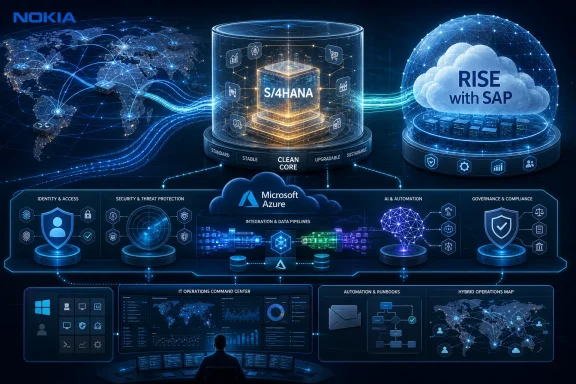 Nokia’s ERP Deal Is Really an AI Infrastructure Deal
The press-release version is straightforward: Nokia will use RISE with SAP Methodology to continue modernizing its ERP estate, SAP will operate and manage the S/4HANA environment in the cloud, and Microsoft Azure will provide the hyperscale platform underneath it. That sounds like procurement language, but the strategic meaning is sharper. Nokia is moving one of the least forgiving parts of enterprise IT — finance, logistics, trade, warehouse operations, master data, and availability-to-promise processes — into a managed cloud model designed to feed continuous software updates and AI functions into the business core.ERP migrations have always been the place where enterprise optimism goes to be audited. Companies promise simplification and process standardization, then encounter decades of customization, data exceptions, local operating habits, and integrations that were never documented because they were never supposed to live this long. Nokia’s move matters because it frames that old problem in the language of enterprise AI, not merely modernization.
The phrase “AI-driven business transformation” can mean almost anything in 2026, and vendors have not been shy about stretching it. In this case, however, there is a concrete technical foundation beneath the slogan. AI that acts on enterprise workflows needs clean master data, governed process semantics, consistent authorization, reliable telemetry, and real-time access to transactional systems. That is exactly the layer SAP and Microsoft are trying to industrialize.
For Nokia, this is also about control. A company that sells networking infrastructure into the AI era cannot afford a back office whose own data architecture is too fragmented to support automation. The company’s stated goal of simplifying its ERP landscape and supporting AI-driven processes is not just an internal IT upgrade; it is a credibility move for a vendor whose customers are themselves trying to build AI-ready infrastructure.
RISE With SAP Turns Migration Into a Managed Operating Model
RISE with SAP has often been described as a cloud migration program, but that undersells what SAP is trying to do. The important word is not migration; it is operating model. SAP wants customers to stop treating ERP as a one-off platform conversion and start treating it as a managed, continuously updated business system.That distinction matters because traditional ERP transformation is full of false finish lines. A company completes a technical migration, celebrates a go-live, then spends years discovering that the system is still too customized, too brittle, or too disconnected from adjacent analytics and workflow tools. RISE is SAP’s attempt to wrap the transition in a standardized methodology, toolchain, service model, and commercial package that keeps customers moving toward a cleaner core.
The “clean core” idea is the part administrators should watch most closely. SAP is pushing customers away from deep customizations inside the transactional heart of ERP and toward extensions, integrations, and process changes that are more cloud-compatible. That can be healthy engineering discipline, but it also shifts power away from bespoke internal systems and toward vendor-defined patterns.
For Nokia, that means its ERP modernization is not simply a matter of running S/4HANA somewhere else. The SAP environment named in the announcement includes central finance, master data governance, extended warehouse management, global trade services, and advanced available-to-promise capabilities. These are not peripheral workloads. They are the connective tissue of how a multinational manufacturer and network technology company turns orders, inventory, compliance, suppliers, financial controls, and logistics into execution.
The managed model is attractive because it reduces infrastructure burden and gives the enterprise a more predictable route to new SAP capabilities. It is also uncomfortable because it forces a company to decide which old process quirks are strategic and which are just archaeology. In that sense, RISE is less a cloud subscription than a long negotiation with corporate memory.
Azure Wins When the Back Office Becomes the AI Front Door
Microsoft’s role in this deal is both obvious and subtle. Obviously, Azure gets another large SAP-on-cloud reference customer. Less obviously, Microsoft is positioning Azure not merely as the compute substrate for SAP, but as the place where enterprise data, productivity workflows, identity, security monitoring, and AI orchestration converge.That is why SAP on Azure has become more than a migration story. Microsoft has spent years making Azure hospitable to large SAP estates, while SAP and Microsoft have tightened integration around data, identity, Sentinel, Microsoft 365, Copilot, Fabric, and Joule. The target architecture is not “SAP runs on Microsoft servers.” It is “SAP business processes become available to the Microsoft cloud stack without losing governance.”
This is where the WindowsForum angle becomes clear. The modern Microsoft enterprise footprint is no longer just Windows endpoints, Active Directory descendants, Office, and server licensing. It is Entra identity, Defender telemetry, Sentinel monitoring, Teams workflows, Copilot interfaces, Fabric analytics, Azure infrastructure, and partner platforms like SAP sitting inside a managed operational envelope.
For admins, this raises the stakes of Azure architecture. When SAP runs inside a RISE model on Azure, the customer does not simply own and operate every layer as if it were a traditional VM estate. Microsoft’s own guidance makes clear that SAP manages the RISE landscape in SAP-controlled Azure subscriptions, while the customer’s Azure environment connects to it through defined interfaces and integration points. That separation is sensible, but it creates operational boundaries that must be understood before something breaks at quarter-end.
In practice, this means troubleshooting becomes a team sport. Network routes, identity flows, data pipelines, firewalls, private connectivity, monitoring scopes, and support responsibilities all need to be documented with more discipline than many enterprises historically applied to on-prem systems. The cloud makes infrastructure more programmable, but it does not make accountability automatic.
The Old ERP Customization Habit Meets the Clean-Core Wall
Every ERP modernization program eventually collides with the same uncomfortable question: how much of the old system represents business advantage, and how much of it represents accumulated compromise? Nokia’s announcement avoids that drama, as corporate announcements usually do. But the move to RISE implies a serious attempt to reduce complexity by standardizing processes and limiting custom code in the core.That is where IT strategy becomes organizational politics. Finance may have reporting practices embedded in legacy workflows. Logistics may have regional exceptions that were once vital and are now merely tolerated. Procurement may depend on data conventions that nobody wants to defend in a steering committee but everyone expects the system to preserve.
The clean-core model is an answer to that sprawl. Keep the transactional center closer to standard SAP. Move differentiation into approved extensions, cloud services, analytics layers, and surrounding applications. Accept that the price of continuous innovation is less freedom to modify the deepest part of the platform.
That trade-off is not unique to SAP. Microsoft has made similar arguments across Windows, Microsoft 365, Dynamics, and Azure: standardize the base, secure the identity layer, move customization to managed extension points, and let the cloud service evolve. The enterprise software industry has largely concluded that unlimited customer customization is incompatible with fast-moving security and AI delivery.
For Nokia, the promise is a more future-ready platform. For IT professionals, the warning is that modernization programs should not be judged only by go-live dates. The real test is whether the organization can retire customizations, rationalize master data, and keep extensions from recreating the same complexity in more fashionable places.
AI Needs Transactional Truth, Not Another Dashboard
The AI framing around this agreement is easy to dismiss because nearly every enterprise announcement now arrives with AI varnish. But ERP is one of the few places where the AI story can be more than a demo. If an AI agent is going to help with supply allocation, financial close, inventory exceptions, trade compliance, or supplier risk, it must be grounded in systems that actually represent the business.That is why SAP’s emphasis on embedded AI is more credible in ERP than in many consumer-facing AI pitches. An assistant that summarizes a meeting may save time, but an agent that can interpret an order constraint or flag a working-capital issue depends on structured business context. S/4HANA, master data governance, warehouse systems, global trade services, and ATP logic are exactly the kinds of systems that give AI something operationally meaningful to work with.
Microsoft’s parallel interest is just as strong. Copilot is much more valuable when it can connect user intent inside Microsoft 365 to business data and actions inside SAP. A finance manager working in Excel, Teams, or Word does not want an AI assistant that merely drafts prose. The more valuable assistant can reason over governed enterprise data, initiate workflows, explain exceptions, and respect authorization boundaries.
That last phrase is doing a lot of work. Enterprise AI cannot be allowed to become a charming new path around compliance. The appeal of SAP and Microsoft’s joint approach is that identity, security, workflow, and data governance are being built into the integration story from the start. Whether that works in production at global scale will depend on implementation discipline, but the architectural direction is clear.
For Nokia, progressively adopting AI-enabled functionality gives the company a way to modernize without pretending that every process should become autonomous overnight. The better reading is that Nokia is building the prerequisite layer. Before the AI agents come the unglamorous things: harmonized data, standardized process, clean interfaces, support boundaries, and reliable cloud operations.
Microsoft and Nokia Are Already Entangled in the Cloud Supply Chain
There is another wrinkle here that makes the agreement more interesting than a standard customer win. Nokia is not just a Microsoft cloud customer. It is also a supplier to Microsoft Azure’s data center networking footprint, with Nokia announcing a five-year expansion to provide routers and switches for Azure infrastructure across more than 30 countries.That does not mean the ERP deal is a reciprocal favor, and there is no need to imply one. But it does show how deeply interdependent the AI cloud supply chain has become. Nokia sells networking gear into the hyperscale infrastructure boom, Microsoft operates the cloud platform underpinning that boom, and SAP provides the business software layer that many global firms still rely on to function.
The result is a triangulated relationship that reflects the structure of enterprise technology in 2026. No single vendor owns the whole stack. Instead, the winners are those that can make their layer indispensable while integrating tightly enough with the others to reduce customer friction.
Nokia’s public identity as “a global leader in connectivity for the AI era” also matters here. The company is selling into a world where AI demand is driving data center expansion, optical networking upgrades, routing capacity, private wireless, and edge connectivity. Running its own core business systems on a cloud-and-AI-ready ERP architecture gives Nokia a cleaner internal story to tell.
There is a practical risk in that symmetry as well. When major vendors become customers, suppliers, and ecosystem partners to one another, dependency maps get complicated. Procurement teams may like fewer strategic partners; risk teams often prefer fewer blast-radius assumptions. A Nokia-sized company will understand that tension, but smaller enterprises copying the pattern may not.
The Security Story Is Strongest Where the Responsibility Lines Are Clearest
SAP, Microsoft, and Nokia all use the language of security, resilience, and global scale in the announcement. That is expected. Mission-critical ERP on cloud must be sold as safer, not merely newer.The security argument has substance, especially when Azure-native monitoring and identity tooling are integrated with SAP workloads. Microsoft Sentinel for SAP, Entra integration patterns, private networking, and cloud-scale telemetry can give enterprises visibility they often lacked in older on-prem ERP environments. The ability to correlate identity behavior, business activity, endpoint signals, and network events is genuinely powerful.
But security also becomes more contractual. In a RISE on Azure model, SAP operates the SAP landscape in its managed environment, Microsoft provides the cloud platform, and the customer remains responsible for its own surrounding systems, integrations, identities, data usage, and business controls. This is not worse than the old model, but it is different enough to catch complacent teams.
The most dangerous phrase in cloud security is “they manage that.” Sometimes they do. Sometimes they manage the infrastructure but not the configuration decision. Sometimes they manage the application environment but not the identity policy around who can trigger a workflow. Sometimes a support boundary is technically correct and operationally maddening.
For administrators, the lesson is plain: the architecture diagram is a security document. Every interface between Nokia’s customer-managed Azure environment, SAP’s managed RISE environment, and the remaining on-prem or third-party systems is a potential control point and a potential failure point. The more AI-driven workflows enter the picture, the more those boundaries matter.
The Deal Validates SAP’s Cloud Pivot, But It Also Exposes SAP’s Burden
SAP has spent years urging customers toward S/4HANA and cloud-based transformation, but the company’s challenge has always been that its biggest customers are also its most complicated. A midmarket cloud ERP deployment can be opinionated and relatively clean. A global enterprise with decades of SAP history, acquisitions, localizations, and adjacent systems is another creature entirely.Nokia’s agreement is therefore valuable for SAP because it shows the company’s preferred narrative in action. A longtime SAP customer continues moving toward a unified S/4HANA landscape, uses RISE as the structured path, hosts the environment on Azure, and adopts embedded AI capabilities over time. That is almost a reference architecture for SAP’s current strategy.
Yet the burden on SAP is heavy. If RISE is marketed as a methodology and operating model, customers will expect more than infrastructure hosting. They will expect SAP to help reduce complexity, accelerate transformation, provide meaningful innovation, and keep the core stable while new AI functions arrive.
This is not easy. ERP customers are conservative for good reasons. A failed productivity tool rollout is annoying; a failed ERP transformation can interrupt billing, procurement, shipments, reporting, compliance, and executive credibility. SAP must move fast enough to satisfy the AI moment while moving carefully enough not to frighten the people who close the books.
The Nokia agreement gives SAP a strong proof point. It also raises expectations. If RISE is going to be the highway for enterprise AI, it must be smooth enough for companies whose systems cannot simply be rebooted after lunch.
Azure’s Enterprise Advantage Is Boring, Which Is Why It Works
The consumer AI conversation tends to revolve around model performance, chat interfaces, and splashy demos. Enterprise AI adoption is duller and more consequential. It depends on procurement, compliance, identity, service-level commitments, data residency, integration patterns, monitoring, migration tooling, and the ability to tell a board that the quarter will still close on schedule.That is where Azure is comfortable. Microsoft’s advantage in deals like Nokia’s is not only GPU capacity or AI branding. It is the company’s long-standing position inside enterprise IT: Microsoft 365 on the desktop, Entra in identity, Windows on endpoints, Defender and Sentinel in security, Power Platform and Fabric in business workflows, and Azure as the platform where adjacent workloads can land.
SAP brings the business process layer Microsoft does not own. Nokia brings the scale and operational complexity that make the case meaningful. The agreement is therefore a neat example of Microsoft’s broader enterprise strategy: do not replace every system of record, but make Azure the control plane, integration layer, security fabric, and AI execution environment around them.
There is a reason Microsoft keeps talking about SAP data in Fabric, Joule and Copilot integration, and agent-to-agent workflows. The company knows that the next phase of Copilot value depends on access to business context beyond email and documents. ERP data is among the richest and most protected context in the enterprise.
If Microsoft can make that data available safely inside productivity and analytics workflows, it can turn Copilot from an assistant into an operational interface. That future is not guaranteed, and many organizations will move slowly. But deals like Nokia’s are the kind of groundwork that makes it plausible.
The Windows Admin’s Role Moves Up the Stack
A decade ago, many Windows administrators could think of SAP as somebody else’s kingdom. It ran on specialized infrastructure, was administered by specialized Basis teams, and had its own change rhythms, tooling, and priesthood. Cloud integration is blurring those borders.In a RISE on Azure world, the SAP team still matters enormously, but so do the teams responsible for Entra ID, conditional access, network connectivity, Azure policy, Sentinel, Defender, data integration, endpoint security, Power BI or Fabric, and Microsoft 365 governance. The Windows ecosystem is no longer merely where users launch the SAP GUI or open exported spreadsheets. It is part of the business process surface.
That shift creates opportunity for IT pros who understand both infrastructure and process. The valuable admin is not just the person who can configure a route table or reset a user’s MFA state. It is the person who understands how that identity decision affects a finance workflow, a warehouse exception, or an AI assistant’s ability to act on behalf of a user.
It also creates new failure modes. A conditional access change can become an ERP access incident. A network peering misconfiguration can become a logistics delay. A data-sharing policy can become an analytics outage. A poorly governed AI integration can become a compliance concern before anyone has agreed which team owns it.
The practical advice is not to become afraid of integration. It is to document it ruthlessly. Cloud ERP projects should produce living maps of identity flows, network dependencies, data movement, support ownership, logging coverage, and emergency escalation paths. The old runbook culture needs to evolve for multi-vendor managed cloud.
The AI Promise Will Be Won or Lost in the Middle Office
The most overhyped AI visions imagine autonomous enterprises humming along with minimal human intervention. The more realistic near-term transformation will happen in the middle office: finance analysts, supply chain planners, procurement managers, compliance teams, service operations, and IT staff using AI to compress the distance between signal and action.That is where SAP and Microsoft’s combined pitch becomes compelling. SAP knows the structure of the business process. Microsoft knows the productivity surface where employees spend much of their day. Azure provides the compute, integration, identity, and security platform. If those pieces work together, AI can move from “summarize this” to “explain why this order is constrained and draft the corrective workflow.”
Nokia’s adoption path appears cautious rather than reckless, which is a virtue. The announcement says AI-enabled functionality embedded in SAP’s cloud applications will be progressively adopted as part of the journey. That is the right tempo for systems where bad automation can create financial, operational, or compliance damage.
There is also a cultural dimension. AI adoption in ERP will require trust not only in model outputs, but in the underlying data and process design. If employees know the master data is inconsistent, they will not trust the AI interpretation. If approvals are messy, the assistant will amplify the mess. If exception handling lives in undocumented side channels, automation will expose the gap.
In other words, AI will not save a poor ERP transformation. It will reward a disciplined one.
Nokia’s Cloud ERP Move Gives IT a More Concrete AI Checklist
The significance of the Nokia-SAP-Microsoft agreement is not that every enterprise should copy it exactly. It is that the deal shows what “AI-ready” looks like when stripped of keynote theatrics and translated into systems that actually run a global company. The architecture is cloud-based, but the work is organizational.- Nokia is using RISE with SAP Methodology to continue moving its ERP estate toward a managed S/4HANA cloud model on Microsoft Azure.
- SAP will operate and manage the cloud ERP environment, shifting more infrastructure responsibility away from Nokia while increasing the importance of clearly defined service and integration boundaries.
- Microsoft Azure is not just hosting capacity in this arrangement; it is the foundation for identity, security, data, integration, and AI-adjacent enterprise services around SAP.
- The agreement reinforces the clean-core direction of modern ERP, where companies are pushed to standardize core processes and move differentiation into governed extensions and integrations.
- The AI value depends less on chatbots than on transactional truth, master data quality, process discipline, and secure access to business context.
- For Windows and Azure administrators, SAP modernization increasingly intersects with Entra, Sentinel, networking, Microsoft 365, Fabric, and Copilot governance.
References
- Primary source: SAP News Center
Published: Tue, 30 Jun 2026 13:05:36 GMT
Nokia, SAP and Microsoft to Advance Business Transformation | SAP News Center
Nokia will accelerate its enterprise transformation using RISE with SAP Methodology, with SAP S/4HANA hosted on Microsoft Azure.news.sap.com - Official source: azure.microsoft.com
- Official source: learn.microsoft.com
Integrating Azure with SAP RISE | Microsoft Learn
Describes integrating SAP RISE managed virtual network with customer's own Azure environmentlearn.microsoft.com - Related coverage: nokia.com
Nokia expands multi-year agreement to supply Microsoft Azure datacenter networks | Nokia.com
Nokia has announced a five-year expansion of its multi-year agreement to supply Microsoft Azure with datacenter routers and switches. The partnership will grow Nokia's global footprint to over 30 countries and strengthen its role as a strategic supplier for Microsoft's worldwide cloud...www.nokia.com