

Centrica announced on May 27, 2026, in London that it will adopt RISE with SAP and SAP Business AI, with an initial finance implementation scheduled to go live in July 2026 as part of a wider cloud and data overhaul. The deal is framed as an energy-sector transformation story, but it is also a very familiar enterprise-IT story: a large incumbent with complicated operations is betting that cleaner data, cloud ERP, and AI-assisted workflows can make old systems behave like a modern platform. For WindowsForum readers, the interesting part is not simply that Centrica is buying more SAP. It is that SAP, Microsoft, and systems integrators are now being bundled into the same operational reset, with AI positioned not as a sidecar but as the new interface to business software.
The headline says AI, but the substance is plumbing. Centrica is moving deeper into RISE with SAP, extending what it calls a SAP-first strategy across corporate services and beginning with finance. That is a conservative place to start, but it is also the place where the consequences of messy data, brittle integrations, and slow reporting become impossible to hide.
This is the kind of transformation that sounds abstract until a month-end close drags on, a supply-chain issue gets buried in disconnected systems, or customer-facing teams cannot see the operational facts they need. Energy companies do not merely sell units of power anymore. They manage volatile wholesale markets, customer services, regulatory obligations, decarbonisation plans, distributed assets, and increasingly software-mediated customer relationships.
That is why Centrica’s programme matters beyond the SAP customer-win circuit. The company is trying to move from being a traditional energy supplier into a more service-led business by 2030. That ambition depends less on a chatbot demo than on whether finance, supply chain, operations, and customer systems can share a cleaner core of governed data.
SAP’s pitch is that RISE with SAP, SAP Business Data Cloud, SAP Business AI, and Joule can sit together as a platform for that change. The word platform does a lot of work in enterprise software, sometimes too much. In this case, though, the idea is straightforward: if AI is going to advise, automate, or orchestrate anything important, it needs trusted data and controlled processes underneath it.
Finance is also a telling starting point because it is both highly structured and highly exposed. It has repeatable workflows, formal controls, regulatory obligations, audit trails, and executive visibility. In other words, it is exactly the sort of environment where vendors like to argue that AI can reduce friction, but where customers cannot tolerate vague answers or untraceable automation.
For Centrica, a finance-first deployment lets the company test the new cloud foundation in a domain where value can be measured. Faster reporting, fewer reconciliations, lower maintenance overhead, cleaner data lineage, and reduced customisation are not glamorous promises, but they are the operating gains that boards understand. If those gains do not appear, it will be difficult to justify broader claims about agentic AI and service-led reinvention.
The date also matters. A July 2026 go-live gives Centrica a near-term execution milestone rather than a distant transformation slogan. In a sector full of long-range net-zero and digital-service targets, a concrete ERP cutover is one of the few points where strategy has to meet the calendar.
Enterprise AI fails most often not because the model cannot produce language, but because the business cannot trust the data being fed into it. A conversational system that retrieves the wrong supplier record, misunderstands financial context, or draws from stale operational data is not an efficiency tool. It is a liability wearing a productivity badge.
This is why SAP has been pushing a broader architecture around Business Data Cloud, Business AI, Joule, and the so-called autonomous enterprise. The message is that AI should be grounded in business context, data models, process knowledge, governance, and permissions. That is a more credible pitch than generic generative AI, though it also locks customers more tightly into SAP’s view of how enterprise intelligence should be assembled.
Centrica’s choice suggests that large customers are willing to accept that bargain, at least where the alternative is a patchwork of ageing ERP, reporting workarounds, and one-off analytics projects. AI becomes the commercial hook, but data governance remains the hard centre of the programme.
For Windows-heavy organisations, Microsoft Copilot is already a natural front door because it lives close to email, documents, Teams, identity, and the desktop experience. SAP’s Joule, by contrast, has a more specialised claim: it understands SAP processes, business objects, and workflows. The potential upside is that users can ask business-process questions in natural language rather than memorising transaction codes, report paths, or workflow conventions.
The risk is assistant sprawl. If Copilot can draft the meeting summary but Joule can explain a finance workflow, which system should a user ask about a budget variance? If the answer depends on permissions, data freshness, application context, and licensing boundaries, the user experience can become another layer of enterprise ambiguity.
Centrica’s programme will therefore test not only whether AI can make SAP easier to use, but whether multiple AI interfaces can coexist without confusing staff. The winners in enterprise AI may not be the tools with the flashiest demos. They may be the ones that route questions to the right system, preserve permissions, expose provenance, and avoid pretending that all business knowledge lives in one chat box.
A traditional energy supplier could once organise itself around billing, supply contracts, infrastructure relationships, and call-centre operations. A modern energy-services company may need to support smart tariffs, home energy management, electric vehicle charging, distributed generation, demand response, boiler services, insurance-like offerings, and data-rich customer engagement. That is a very different business architecture.
The operational challenge is that many large incumbents are not starting from a clean sheet. They have decades of systems, integrations, acquisitions, bespoke processes, and regulatory reporting obligations. Moving that estate toward a cleaner cloud platform is not simply an IT refresh. It is a way of deciding which processes are strategic, which customisations are dead weight, and which data objects become authoritative.
That is where the energy-sector story intersects with the WindowsForum audience. Whether the workload is ERP, identity, analytics, endpoint management, or security operations, the strategic pressure is the same: legacy systems are being asked to support real-time, AI-mediated, compliance-sensitive business models they were never designed for.
But simplification always has a governance cost. Moving more of the ERP estate into SAP’s cloud operating model changes who controls upgrades, technical architecture, extensibility patterns, and sometimes the pace of change. That may be exactly what some organisations need if years of customisation have made their landscapes expensive and fragile. It may also make others nervous, especially where deeply tailored processes have been treated as competitive advantage.
Centrica appears to be leaning into the SAP-first approach across corporate services. That is a strong statement. It suggests the company sees more value in standardisation and platform alignment than in maintaining a looser collection of best-of-breed or internally managed systems.
The phrase clean core often appears in SAP transformation discussions, and it captures the trade-off neatly. A cleaner core can reduce technical debt and make future upgrades easier, but it can also force painful conversations about business processes that have been customised for years. AI does not remove those conversations. If anything, it makes them more urgent because AI-assisted workflows depend on predictable, well-described process foundations.
For IT departments, this creates both opportunity and complexity. If SAP data and workflows can be surfaced through Microsoft environments, employees may spend less time jumping between applications. If identity, access controls, device management, and compliance policies are properly integrated, AI assistance could become part of the normal enterprise fabric rather than a separate portal.
But this is also where implementation details matter. Microsoft 365, Entra ID, Purview, Defender, Teams, Power Platform, Azure, SAP BTP, SAP cloud services, and third-party integration layers all have their own policy models and operational assumptions. A slick vendor diagram can make the stack look inevitable. A real IT estate can turn it into months of permission mapping, data classification, monitoring, and support-model negotiation.
Centrica’s adoption shows why AI in the enterprise is not just a model-selection exercise. The technical question is not simply “Which assistant is smarter?” It is “Which assistant can act safely within the organisation’s actual identity, data, workflow, and audit boundaries?”
In consumer AI, an agent that books the wrong restaurant or summarises a document poorly is annoying. In enterprise finance, procurement, or energy operations, an agent that acts on the wrong data can create financial, regulatory, or customer-impacting consequences. That does not make agentic AI useless, but it means autonomy must arrive in narrow, governed increments.
The first wave of useful enterprise agents will likely be constrained assistants: tools that prepare reconciliations, flag anomalies, draft process explanations, suggest next steps, or automate low-risk transactions under human supervision. The more ambitious version, in which agents initiate and complete complex workflows, will require far more confidence in data quality, authorisation, exception handling, and auditability.
Centrica’s programme is therefore best understood as foundation-building rather than instant autonomy. The cloud migration, data core, finance implementation, and assistant deployment create the conditions under which more ambitious AI could be tested. They do not guarantee that agentic AI will deliver meaningful autonomy at scale.
Cloud ERP can reduce infrastructure burden, eliminate some upgrade pain, and replace bespoke maintenance with standard services. It can also introduce subscription commitments, consumption-based surprises, integration costs, change-management costs, and partner dependency. The financial outcome depends heavily on how much complexity is retired rather than merely relocated.
This is especially important when AI enters the commercial model. AI features often arrive with new entitlements, usage metrics, premium tiers, or bundled incentives. Customers may initially see AI as part of the transformation package, only to discover that meaningful scale requires careful monitoring of consumption, licensing, and value realised.
For Centrica, the business case will be judged over years, not press-release cycles. If cloud ERP and AI reduce friction in finance, improve supply-chain visibility, and support new service revenue, the cost story becomes credible. If the programme mainly swaps old complexity for new platform dependence, the savings will be harder to defend.
That is attractive, but it changes job design. Finance analysts, procurement teams, operations staff, and managers may need to learn how to interrogate AI outputs, validate data sources, and understand when a recommendation is safe to act upon. The skill is not merely prompt-writing. It is business judgement applied to machine-assisted workflows.
This creates a training burden that vendors sometimes understate. Employees who do not trust the system will bypass it. Employees who overtrust it may create new risks. The useful middle ground requires transparency: users need to know what data an assistant used, what assumptions it made, what it is allowed to do, and when a human approval is required.
Centrica’s long partnership with SAP may help here because transformation is easier when the vendor relationship is mature and the business already understands the platform’s role. But longevity can cut both ways. A 20-year relationship may also mean 20 years of embedded habits, custom processes, and institutional shortcuts that do not disappear because the interface becomes conversational.
Systems integrators will shape how much of Centrica’s landscape is standardised, how legacy customisations are treated, how SAP and Microsoft tools are connected, and how AI use cases are prioritised. They will also influence whether the organisation builds internal capability or becomes dependent on external expertise for every significant change.
For IT leaders, this is a familiar tension. The right partner can accelerate transformation and bring hard-won migration knowledge. The wrong delivery model can create a costly dependency loop in which every process adjustment becomes a statement of work.
Centrica’s programme is large enough that integration governance will be central. If SAP is the strategic platform and Microsoft is a major work surface, someone still has to make the operating model coherent. That includes support ownership, incident response, access reviews, data stewardship, model governance, and the mundane but crucial question of who fixes things when an AI-assisted workflow breaks.
That convergence can benefit customers when it reduces fragmentation. A business that has spent years stitching together reporting tools, data warehouses, ERP customisations, and collaboration platforms may welcome a more coherent architecture. If AI agents are to work across processes, some degree of consolidation may be necessary.
But convergence also reduces optionality. Once data governance, workflow automation, AI assistants, and cloud ERP are aligned around a small set of strategic vendors, switching costs rise. That does not make the strategy wrong. It means the governance questions need to be asked before the architecture becomes irreversible.
Centrica’s SAP-first strategy is therefore both a technology decision and a power allocation. It gives SAP a central role in the company’s future operating model, while Microsoft remains deeply embedded in how employees experience digital work. That is the shape of modern enterprise IT: fewer clean boundaries, more overlapping platforms, and a constant negotiation over where the system of record ends and the system of action begins.
AI assistants are being layered onto business systems that already depend on Microsoft identity, Windows endpoints, Office documents, Teams conversations, security tooling, and compliance policies. That makes endpoint and identity hygiene more important, not less. If AI becomes a new way to access business data, then access control failures become more consequential.
Administrators should expect more pressure from business units to connect AI tools to operational systems. They should also expect vendors to argue that their platforms are safer because they are governed, contextual, and integrated. Those claims deserve scrutiny, especially around logging, retention, data residency, permission inheritance, and administrative visibility.
The key shift is that AI adoption is no longer confined to experimental sandboxes. It is moving into finance, supply chain, HR, procurement, customer service, and operations. That means the people who manage devices, identities, policies, integrations, and monitoring will be pulled into AI governance whether or not they asked for it.
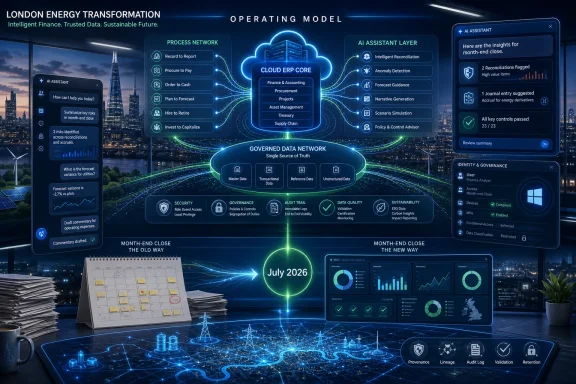 Centrica Is Not Buying AI So Much as Buying a New Operating Model
The headline says AI, but the substance is plumbing. Centrica is moving deeper into RISE with SAP, extending what it calls a SAP-first strategy across corporate services and beginning with finance. That is a conservative place to start, but it is also the place where the consequences of messy data, brittle integrations, and slow reporting become impossible to hide.This is the kind of transformation that sounds abstract until a month-end close drags on, a supply-chain issue gets buried in disconnected systems, or customer-facing teams cannot see the operational facts they need. Energy companies do not merely sell units of power anymore. They manage volatile wholesale markets, customer services, regulatory obligations, decarbonisation plans, distributed assets, and increasingly software-mediated customer relationships.
That is why Centrica’s programme matters beyond the SAP customer-win circuit. The company is trying to move from being a traditional energy supplier into a more service-led business by 2030. That ambition depends less on a chatbot demo than on whether finance, supply chain, operations, and customer systems can share a cleaner core of governed data.
SAP’s pitch is that RISE with SAP, SAP Business Data Cloud, SAP Business AI, and Joule can sit together as a platform for that change. The word platform does a lot of work in enterprise software, sometimes too much. In this case, though, the idea is straightforward: if AI is going to advise, automate, or orchestrate anything important, it needs trusted data and controlled processes underneath it.
The Finance Go-Live Is the Quiet Test That Matters
The first implementation is scheduled for July 2026, and it starts in finance. That may sound less dramatic than grid optimisation or AI-powered customer engagement, but finance is where enterprise software transformations earn or lose credibility. If the ledgers, controls, reporting cycles, and master data are not reliable, the rest of the AI story becomes theatre.Finance is also a telling starting point because it is both highly structured and highly exposed. It has repeatable workflows, formal controls, regulatory obligations, audit trails, and executive visibility. In other words, it is exactly the sort of environment where vendors like to argue that AI can reduce friction, but where customers cannot tolerate vague answers or untraceable automation.
For Centrica, a finance-first deployment lets the company test the new cloud foundation in a domain where value can be measured. Faster reporting, fewer reconciliations, lower maintenance overhead, cleaner data lineage, and reduced customisation are not glamorous promises, but they are the operating gains that boards understand. If those gains do not appear, it will be difficult to justify broader claims about agentic AI and service-led reinvention.
The date also matters. A July 2026 go-live gives Centrica a near-term execution milestone rather than a distant transformation slogan. In a sector full of long-range net-zero and digital-service targets, a concrete ERP cutover is one of the few points where strategy has to meet the calendar.
SAP’s AI Pitch Depends on the Boring Work of Data Governance
Centrica’s earlier go-live with SAP Business Data Cloud is the hinge in this story. SAP says that project unified SAP and non-SAP data across the organisation, giving Centrica a governed foundation for better decision-making. That is not a decorative prelude to the AI work; it is the condition that makes AI even remotely useful in a business this operationally complex.Enterprise AI fails most often not because the model cannot produce language, but because the business cannot trust the data being fed into it. A conversational system that retrieves the wrong supplier record, misunderstands financial context, or draws from stale operational data is not an efficiency tool. It is a liability wearing a productivity badge.
This is why SAP has been pushing a broader architecture around Business Data Cloud, Business AI, Joule, and the so-called autonomous enterprise. The message is that AI should be grounded in business context, data models, process knowledge, governance, and permissions. That is a more credible pitch than generic generative AI, though it also locks customers more tightly into SAP’s view of how enterprise intelligence should be assembled.
Centrica’s choice suggests that large customers are willing to accept that bargain, at least where the alternative is a patchwork of ageing ERP, reporting workarounds, and one-off analytics projects. AI becomes the commercial hook, but data governance remains the hard centre of the programme.
Joule and Copilot Put the Interface War Inside the Enterprise
One of the more interesting details is that SAP’s Joule is being enabled alongside Microsoft Copilot within Centrica. That pairing reflects the reality of enterprise AI in 2026: no single assistant owns the user. Employees will move between productivity suites, ERP screens, analytics tools, service systems, and workflow platforms, and each vendor wants its assistant to be the one that interprets intent.For Windows-heavy organisations, Microsoft Copilot is already a natural front door because it lives close to email, documents, Teams, identity, and the desktop experience. SAP’s Joule, by contrast, has a more specialised claim: it understands SAP processes, business objects, and workflows. The potential upside is that users can ask business-process questions in natural language rather than memorising transaction codes, report paths, or workflow conventions.
The risk is assistant sprawl. If Copilot can draft the meeting summary but Joule can explain a finance workflow, which system should a user ask about a budget variance? If the answer depends on permissions, data freshness, application context, and licensing boundaries, the user experience can become another layer of enterprise ambiguity.
Centrica’s programme will therefore test not only whether AI can make SAP easier to use, but whether multiple AI interfaces can coexist without confusing staff. The winners in enterprise AI may not be the tools with the flashiest demos. They may be the ones that route questions to the right system, preserve permissions, expose provenance, and avoid pretending that all business knowledge lives in one chat box.
Energy Companies Are Being Pushed Into Software Company Problems
SAP’s framing of the deal leans heavily on the pressures facing energy companies: renewables, regulation, geopolitics, customer demand, and climate targets. That framing is not just marketing. Energy suppliers are being forced to operate in a world where volatility is normal and where customer relationships are increasingly mediated by data, devices, and digital services.A traditional energy supplier could once organise itself around billing, supply contracts, infrastructure relationships, and call-centre operations. A modern energy-services company may need to support smart tariffs, home energy management, electric vehicle charging, distributed generation, demand response, boiler services, insurance-like offerings, and data-rich customer engagement. That is a very different business architecture.
The operational challenge is that many large incumbents are not starting from a clean sheet. They have decades of systems, integrations, acquisitions, bespoke processes, and regulatory reporting obligations. Moving that estate toward a cleaner cloud platform is not simply an IT refresh. It is a way of deciding which processes are strategic, which customisations are dead weight, and which data objects become authoritative.
That is where the energy-sector story intersects with the WindowsForum audience. Whether the workload is ERP, identity, analytics, endpoint management, or security operations, the strategic pressure is the same: legacy systems are being asked to support real-time, AI-mediated, compliance-sensitive business models they were never designed for.
RISE with SAP Is Also a Control Shift
RISE with SAP is usually sold as a pathway to cloud ERP transformation. It packages software, infrastructure, services, and migration under a more managed SAP umbrella. For customers, the appeal is simplification: fewer moving parts, a clearer migration route, and access to newer capabilities without running everything themselves.But simplification always has a governance cost. Moving more of the ERP estate into SAP’s cloud operating model changes who controls upgrades, technical architecture, extensibility patterns, and sometimes the pace of change. That may be exactly what some organisations need if years of customisation have made their landscapes expensive and fragile. It may also make others nervous, especially where deeply tailored processes have been treated as competitive advantage.
Centrica appears to be leaning into the SAP-first approach across corporate services. That is a strong statement. It suggests the company sees more value in standardisation and platform alignment than in maintaining a looser collection of best-of-breed or internally managed systems.
The phrase clean core often appears in SAP transformation discussions, and it captures the trade-off neatly. A cleaner core can reduce technical debt and make future upgrades easier, but it can also force painful conversations about business processes that have been customised for years. AI does not remove those conversations. If anything, it makes them more urgent because AI-assisted workflows depend on predictable, well-described process foundations.
The Microsoft Angle Is Bigger Than a Productivity Add-On
Microsoft’s presence in the programme should not be treated as incidental. Centrica is working with SAP, Microsoft, and systems integrators on the broader transformation, and Joule is being enabled alongside Microsoft Copilot. That reflects a broader enterprise pattern: SAP owns many systems of record, while Microsoft owns much of the day-to-day work surface.For IT departments, this creates both opportunity and complexity. If SAP data and workflows can be surfaced through Microsoft environments, employees may spend less time jumping between applications. If identity, access controls, device management, and compliance policies are properly integrated, AI assistance could become part of the normal enterprise fabric rather than a separate portal.
But this is also where implementation details matter. Microsoft 365, Entra ID, Purview, Defender, Teams, Power Platform, Azure, SAP BTP, SAP cloud services, and third-party integration layers all have their own policy models and operational assumptions. A slick vendor diagram can make the stack look inevitable. A real IT estate can turn it into months of permission mapping, data classification, monitoring, and support-model negotiation.
Centrica’s adoption shows why AI in the enterprise is not just a model-selection exercise. The technical question is not simply “Which assistant is smarter?” It is “Which assistant can act safely within the organisation’s actual identity, data, workflow, and audit boundaries?”
Agentic AI Sounds Radical Until It Meets Audit and Change Control
SAP has been talking more openly about agentic AI, where software agents can perform tasks across business processes rather than merely answer questions. Centrica is described as laying the foundation to explore those applications. The language is careful, and it should be.In consumer AI, an agent that books the wrong restaurant or summarises a document poorly is annoying. In enterprise finance, procurement, or energy operations, an agent that acts on the wrong data can create financial, regulatory, or customer-impacting consequences. That does not make agentic AI useless, but it means autonomy must arrive in narrow, governed increments.
The first wave of useful enterprise agents will likely be constrained assistants: tools that prepare reconciliations, flag anomalies, draft process explanations, suggest next steps, or automate low-risk transactions under human supervision. The more ambitious version, in which agents initiate and complete complex workflows, will require far more confidence in data quality, authorisation, exception handling, and auditability.
Centrica’s programme is therefore best understood as foundation-building rather than instant autonomy. The cloud migration, data core, finance implementation, and assistant deployment create the conditions under which more ambitious AI could be tested. They do not guarantee that agentic AI will deliver meaningful autonomy at scale.
The Cost Story Is Persuasive, but Never Automatic
SAP says the move to cloud is expected to reduce Centrica’s total cost of ownership, simplify the technology landscape, and establish a cleaner data core. Those are standard cloud-transformation claims, and they may be true. But any sysadmin or enterprise architect knows that cost reduction is not automatic simply because a workload moves to a vendor-managed platform.Cloud ERP can reduce infrastructure burden, eliminate some upgrade pain, and replace bespoke maintenance with standard services. It can also introduce subscription commitments, consumption-based surprises, integration costs, change-management costs, and partner dependency. The financial outcome depends heavily on how much complexity is retired rather than merely relocated.
This is especially important when AI enters the commercial model. AI features often arrive with new entitlements, usage metrics, premium tiers, or bundled incentives. Customers may initially see AI as part of the transformation package, only to discover that meaningful scale requires careful monitoring of consumption, licensing, and value realised.
For Centrica, the business case will be judged over years, not press-release cycles. If cloud ERP and AI reduce friction in finance, improve supply-chain visibility, and support new service revenue, the cost story becomes credible. If the programme mainly swaps old complexity for new platform dependence, the savings will be harder to defend.
The Human Change Programme Will Be Larger Than the Technical One
The emphasis on Joule and conversational interaction hints at a shift in how employees work with enterprise systems. SAP software has a reputation for power and complexity. A conversational layer promises to make that complexity less visible, allowing users to ask for outcomes rather than navigate the machinery.That is attractive, but it changes job design. Finance analysts, procurement teams, operations staff, and managers may need to learn how to interrogate AI outputs, validate data sources, and understand when a recommendation is safe to act upon. The skill is not merely prompt-writing. It is business judgement applied to machine-assisted workflows.
This creates a training burden that vendors sometimes understate. Employees who do not trust the system will bypass it. Employees who overtrust it may create new risks. The useful middle ground requires transparency: users need to know what data an assistant used, what assumptions it made, what it is allowed to do, and when a human approval is required.
Centrica’s long partnership with SAP may help here because transformation is easier when the vendor relationship is mature and the business already understands the platform’s role. But longevity can cut both ways. A 20-year relationship may also mean 20 years of embedded habits, custom processes, and institutional shortcuts that do not disappear because the interface becomes conversational.
The Systems Integrators Are the Unnamed Power Brokers
The announcement mentions systems integrators, as nearly every major enterprise transformation does. That small phrase hides a great deal of practical reality. Large SAP programmes do not succeed because software is switched on; they succeed because process design, data migration, testing, security, change management, and cutover planning are executed with discipline.Systems integrators will shape how much of Centrica’s landscape is standardised, how legacy customisations are treated, how SAP and Microsoft tools are connected, and how AI use cases are prioritised. They will also influence whether the organisation builds internal capability or becomes dependent on external expertise for every significant change.
For IT leaders, this is a familiar tension. The right partner can accelerate transformation and bring hard-won migration knowledge. The wrong delivery model can create a costly dependency loop in which every process adjustment becomes a statement of work.
Centrica’s programme is large enough that integration governance will be central. If SAP is the strategic platform and Microsoft is a major work surface, someone still has to make the operating model coherent. That includes support ownership, incident response, access reviews, data stewardship, model governance, and the mundane but crucial question of who fixes things when an AI-assisted workflow breaks.
This Is a Case Study in Vendor Convergence
The broader lesson is that enterprise AI is accelerating vendor convergence. SAP is not merely selling ERP. Microsoft is not merely selling productivity software. Systems integrators are not merely implementing workflows. Each participant wants a larger role in the customer’s operating model.That convergence can benefit customers when it reduces fragmentation. A business that has spent years stitching together reporting tools, data warehouses, ERP customisations, and collaboration platforms may welcome a more coherent architecture. If AI agents are to work across processes, some degree of consolidation may be necessary.
But convergence also reduces optionality. Once data governance, workflow automation, AI assistants, and cloud ERP are aligned around a small set of strategic vendors, switching costs rise. That does not make the strategy wrong. It means the governance questions need to be asked before the architecture becomes irreversible.
Centrica’s SAP-first strategy is therefore both a technology decision and a power allocation. It gives SAP a central role in the company’s future operating model, while Microsoft remains deeply embedded in how employees experience digital work. That is the shape of modern enterprise IT: fewer clean boundaries, more overlapping platforms, and a constant negotiation over where the system of record ends and the system of action begins.
Windows Shops Should Read This as an AI Governance Story
For WindowsForum’s core audience, the Centrica announcement may look distant at first glance. It is an energy company, a SAP programme, and a corporate transformation story. But the underlying pattern is likely to appear in many organisations over the next two years.AI assistants are being layered onto business systems that already depend on Microsoft identity, Windows endpoints, Office documents, Teams conversations, security tooling, and compliance policies. That makes endpoint and identity hygiene more important, not less. If AI becomes a new way to access business data, then access control failures become more consequential.
Administrators should expect more pressure from business units to connect AI tools to operational systems. They should also expect vendors to argue that their platforms are safer because they are governed, contextual, and integrated. Those claims deserve scrutiny, especially around logging, retention, data residency, permission inheritance, and administrative visibility.
The key shift is that AI adoption is no longer confined to experimental sandboxes. It is moving into finance, supply chain, HR, procurement, customer service, and operations. That means the people who manage devices, identities, policies, integrations, and monitoring will be pulled into AI governance whether or not they asked for it.
The Centrica Deal Reveals the Real Enterprise AI Checklist
Centrica’s move is easy to summarise as an AI adoption story, but the practical checklist is more grounded. The company is aligning cloud ERP, data governance, finance transformation, AI assistants, Microsoft integration, and partner delivery under one long-term programme. That is the point.- Centrica’s first RISE with SAP implementation is scheduled for July 2026 and will begin in finance, giving the transformation a near-term operational test.
- The earlier SAP Business Data Cloud go-live is central because AI tools need governed SAP and non-SAP data before they can be trusted in core workflows.
- Joule and Microsoft Copilot will coexist inside the programme, making interface design, permissions, and user training critical.
- The move may reduce total cost of ownership, but only if Centrica retires complexity rather than recreating it in the cloud.
- Agentic AI remains an aspiration that will depend on auditability, process discipline, and carefully bounded automation.
- For IT teams, the main lesson is that AI governance now belongs inside mainstream enterprise architecture, not off to the side as an innovation project.
References
- Primary source: IT Brief Asia
Published: 2026-06-01T08:00:05.996410

Centrica adopts SAP AI in long-term cloud overhaul
The cloud overhaul is meant to trim costs and modernise finance systems as Centrica adapts to tougher energy-market pressures.
itbrief.asia
- Related coverage: news.sap.com
Centrica Adopts RISE with SAP to Support AI-Driven Transformation
SAP SE (NYSE: SAP) and Centrica, a global energy and services company, today announced Centrica’s decision to adopt RISE with SAP and SAP Business AI.news.sap.com - Related coverage: help.sap.com
