
Norway said on June 19, 2026, that pupils in grades one through seven should generally not use generative AI learning tools during the school day, while older students will face tighter, age-based limits under national school recommendations beginning with the new academic year. The decision is less a panic button than a line in the sand: children must learn to read, write, calculate, argue, and persist before software is allowed to autocomplete the hard parts. For Windows users, school IT admins, and education vendors, Norway’s move is a warning that the next fight over AI will not be about whether it works, but about when it is allowed to work for a child.
The most important thing about Norway’s announcement is not that it treats generative AI as dangerous. It treats it as powerful enough to require a developmental schedule.
Prime Minister Jonas Gahr Støre framed the policy around a basic concern: uncritical AI use can let students skip important steps in learning. That phrasing matters. Norway is not saying that large language models are useless, or that children should grow up technologically illiterate. It is saying that a seven-year-old asking a chatbot to produce a sentence is not the same educational event as a seven-year-old struggling to write one.
That distinction has been blurred by the commercial language of AI adoption. Vendors sell generative AI as a universal assistant, a productivity layer, a tutor, a study buddy, and a creativity engine. Schools, meanwhile, are places where inefficiency is often the point. A child sounding out a word, revising a paragraph, or wrestling with arithmetic is not failing to optimize a workflow; the struggle is the workflow.
Norway’s policy lands at a moment when governments are trying to reconcile two slogans they have repeated for years. One says children need digital skills to compete in the future economy. The other says children are losing attention, reading stamina, and basic academic resilience in the present. Generative AI forces those slogans into conflict because it is not merely another screen. It is a screen that talks back, summarizes, drafts, explains, translates, solves, and flatters.
That makes the measure less like a technology embargo and more like a curriculum decision. Norway is effectively saying that generative AI belongs later in the learning sequence, after foundational skills have had time to form. The policy’s center of gravity is not cybersecurity, copyright, or cheating, although all three matter. It is cognitive development.
This is the part of the story that AI maximalists will find hardest to answer. If a tool can generate fluent prose, summarize a chapter, solve a math problem, and produce a polished presentation, then it can also conceal whether a student has acquired the underlying skill. That is not a side effect. It is the product’s core selling point.
Adults use AI to compress labor. Children need some forms of labor to become educated. The same feature that makes a model useful to a professional writer, programmer, analyst, or office worker can make it corrosive in a primary classroom. Norway has chosen to name that contradiction rather than pretend that “responsible use” solves it by magic.
That sequence reveals a governing theory. Norway is no longer treating each platform as a separate nuisance. Phones, social media, and generative AI are different technologies, but in schools they compete for the same scarce resources: attention, memory, motivation, and teacher authority. The policy agenda is an attempt to reclaim those resources.
The school-performance backdrop is also important. Norwegian officials have pointed to declining outcomes in international assessments and concerns over basic reading and writing skills. Whether AI is a cause of those declines is not the claim. The claim is more modest and more politically potent: when core skills are already under pressure, schools should not casually introduce tools that make it easier to bypass practicing them.
That is a defensible position. It also leaves open uncomfortable questions. If AI access outside school remains widespread, then a school-day restriction may protect classroom time while doing little to shape homework habits. If AI becomes embedded in productivity suites, browsers, search engines, learning platforms, and operating systems, then “no AI” becomes harder to administer than “no phones.”
A school district can block a chatbot website. It can restrict browser extensions. It can manage devices through Microsoft Intune, apply web filtering, lock down app installations, and separate student and teacher profiles. But generative AI is no longer a single destination on the web. It is increasingly a feature inside search, office suites, note-taking apps, coding tools, image editors, accessibility products, and classroom platforms.
That creates a familiar enterprise problem. Policy says one thing; defaults, integrations, and user behavior say another. The modern Windows endpoint is not a neutral terminal. It is a managed ecosystem of accounts, cloud services, telemetry, browser policies, identity controls, and subscription entitlements. If schools want age-based AI access, administrators will need controls that are equally granular.
This is where the debate leaves philosophy and enters procurement. A school cannot responsibly adopt “AI for education” unless it can answer basic administrative questions. Which students can access which model? Are prompts logged? Are teachers able to review interactions? Is student data used for training? Can AI features be disabled by grade level? Do browser and office policies align? What happens when a student signs into a personal account?
Norway’s guidance may be national education policy, but its success will depend on mundane IT work: device management, identity governance, filtering, contract language, audit trails, and teacher training. The classroom argument will become a console-setting argument very quickly.
But Norway’s move exposes a gap in the pitch. Most AI product messaging treats “education” as one market. Schools do not work that way. A six-year-old, a thirteen-year-old, a seventeen-year-old, and a teacher may all sit under the same institutional tenant, but they should not share the same AI affordances.
This is not just a moral distinction; it is a product requirement. If Copilot-style assistants, AI writing aids, summarizers, and generative tutoring systems are to be used in public education, they will need controls that reflect developmental stages. A blanket on/off switch is too crude. A free-for-all is politically doomed.
Microsoft in particular has reason to pay attention because Windows, Edge, Microsoft 365, Teams, and Entra-based identity sit deep inside many school environments. The company can argue that managed AI is safer than unmanaged AI. That argument gets stronger if schools can meaningfully restrict features for younger children while enabling supervised use for older students and staff.
The alternative is predictable. If platform vendors cannot provide convincing administrative boundaries, governments and districts will create their own through blunt prohibitions. Norway is showing what happens when public policy moves faster than product governance.
But cheating is not the deepest issue in elementary school. A child who uses AI to write a paragraph is not merely violating an assessment rule. The child may be avoiding the experience through which writing becomes possible. That is why the Norwegian framing is more serious than a disciplinary crackdown.
Schools can redesign exams. They can use oral assessments, in-class writing, supervised browsers, locked-down devices, handwritten work, and process portfolios. Those tactics may help with academic integrity. They do not fully address the developmental problem of outsourcing practice before competence exists.
The analogy with calculators is useful but limited. Calculators changed math instruction, but most systems still expect children to learn number sense before relying heavily on computation tools. Generative AI reaches into more domains at once: language, reasoning, research, coding, art, translation, and explanation. It is less like adding calculators to math class than adding a plausible adult co-author to every subject.
That breadth is why Norway’s policy will travel. Even governments that do not copy the near-ban will face the same question: which intellectual tasks should remain unassisted long enough for children to internalize them?
For years, education technology framed paper as backward and digital platforms as modern. The argument was not entirely wrong. Digital tools can improve access, support disabled students, update materials quickly, and make collaboration easier. But the edtech story often underestimated the value of friction.
A printed textbook does not ping, autocomplete, recommend, scrape, track, or branch into a hundred adjacent distractions. It also does not quietly change the task from reading to searching, from composing to prompting, or from remembering to retrieving. In an AI-saturated classroom, paper’s limitations become part of its appeal.
This does not mean schools should retreat into an analog fantasy. Students will live in a world shaped by AI systems, algorithmic feeds, automated decision-making, and software-mediated work. But the return of paper signals a shift in burden of proof. Digital tools no longer get automatic credit for being modern. They have to prove that they improve learning rather than merely increase activity.
That shift will unsettle the education technology industry. For two decades, “more devices” often passed as a plan. Norway is suggesting that the better question is not how many devices a classroom has, but what those devices are allowed to do to the learning process.
That is not sustainable. If Norway wants the policy to work, teachers need more than a slogan about responsible use. They need clear examples, enforceable defaults, training time, and institutional backing when they say no.
The teacher’s role is especially delicate for older students. A strict elementary limit is conceptually clean. Supervised use in secondary school is much harder. Teachers must decide when AI supports learning and when it replaces it. They must explain why one assignment permits AI brainstorming while another forbids AI drafting. They must evaluate process as well as product.
That requires professional judgment, but also shared norms. Without them, AI policy becomes classroom roulette. One teacher bans everything. Another encourages experimentation. A third lacks the technical confidence to know what students are doing. Students then learn the real lesson of many technology rollouts: rules are local, inconsistent, and negotiable.
Norway’s national approach can reduce that inconsistency, but only if it gives teachers practical authority. The policy cannot be enforced by moral exhortation alone. It has to be built into platforms, assessment design, teacher training, and parent communication.
That is the structural weakness in any classroom-only policy. A child may be blocked from using generative AI at school but still have access through a family laptop, phone, tablet, game console browser, search engine, or messaging app. Parents may not know when AI is being used. Some may actively encourage it as a competitive advantage.
This is not new. Homework has always reflected inequality in home support, private tutoring, quiet space, and parental involvement. Generative AI adds a new layer: unequal access to automated assistance. Some children will have paid AI tools, technically savvy parents, and permissive norms. Others will not. If schools ignore that reality, AI could widen the gap between students who appear fluent and students who actually had to do the work alone.
Norway’s policy partly avoids this by focusing on school-day access. The state has clearer authority over what happens in classrooms than what happens at kitchen tables. But the homework problem will return. If AI is restricted at school yet assignments remain easy to outsource at home, teachers will have to redesign work around evidence of process, in-person demonstration, and oral explanation.
For Windows households, the practical challenge is familiar. Parental controls can help, but AI is increasingly embedded across services. Blocking a single app will not be enough. Families will need norms, not just filters: when help is allowed, when it is not, and why the child’s own effort matters more than a polished answer.
But the school policy is not simply the EU AI Act translated into classroom practice. The AI Act is primarily a market and risk framework. It classifies systems, assigns obligations, and attempts to govern deployment. Norway’s school move is more culturally specific and more pedagogical. It asks what kind of childhood a public education system should protect.
That difference matters because education policy can move where general AI regulation cannot. A government may struggle to regulate every chatbot in the consumer market, but it can set rules for public schools. It can define procurement standards. It can restrict tools by age. It can tell municipalities which defaults are acceptable.
Other countries will watch this closely because school systems everywhere are facing similar pressure. Some will choose permissive experimentation. Some will issue vague guidance. Some will restrict AI only during exams. Norway has chosen a clearer developmental line, and that clarity may prove influential even among governments that stop short of a near-ban.
The policy also gives political cover to school leaders elsewhere. A principal or district IT director who wants to slow AI adoption can now point to a wealthy, digitally advanced country and say: caution is not anti-technology. It is a mainstream public policy option.
A model that produces a convincing explanation of fractions is not automatically welcome in a third-grade classroom. A writing assistant that improves grammar is not automatically appropriate for a child still learning sentence structure. A chatbot that can answer any question is not automatically a tutor. In education, the relevant question is not “Can the tool do the task?” It is “Should the learner still be doing this task unaided?”
That question threatens a lot of product roadmaps. Many AI education tools are built around acceleration: faster feedback, faster drafting, faster lesson generation, faster personalization. Schools may want some of that for teachers and older students. For younger pupils, however, acceleration can be a euphemism for skipping.
The companies that adapt will be the ones that stop treating restrictions as hostility. Age-gated design, transparent logging, curriculum-aligned modes, teacher-controlled scaffolding, and strong data protections will become selling points. The companies that insist on universal access will invite universal resistance.
This is a lesson the broader software industry should already know. Enterprise customers do not reject powerful tools because they hate productivity. They reject tools they cannot govern. Schools are enterprise customers with children at the center, which makes governance not a compliance afterthought but the product itself.
There are legitimate educational uses for AI-adjacent systems, especially in accessibility. Speech-to-text, text-to-speech, translation support, reading aids, and adaptive tools can help students with disabilities or language barriers participate more fully. The challenge is that generative AI blurs the line between accommodation and substitution.
A dyslexic student using assistive technology to access a text is not the same as a student asking a model to produce the answer. A language learner receiving vocabulary support is not the same as submitting machine-generated prose. But software does not always draw those lines cleanly, and neither do classroom workflows.
This is where absolutist rhetoric becomes dangerous. If the policy is implemented crudely, it could deny useful support to students who need it. If it is implemented loosely, the exception becomes the rule. The administrative burden will fall on schools to distinguish between tools that enable learning and tools that replace it.
That distinction should become the core test for AI in education. Does the system help the student engage with the task, or does it complete the task on the student’s behalf? The answer will not always be obvious, but asking the question is better than pretending that all “AI learning tools” belong in the same bucket.
Children need to experience the gap between not knowing and knowing. They need to sit with confusion long enough to form strategies. They need to produce bad first drafts, make arithmetic mistakes, misread a sentence, revise an answer, and discover that effort changes ability. These are not sentimental claims. They are the mechanics of learning.
Generative AI interferes with that process when introduced too early or too casually. It can make the student feel productive while reducing the student’s need to think. It can produce fluent language that masks weak comprehension. It can reward prompt manipulation over subject mastery. It can make the final artifact look better while the learner remains unchanged.
That does not mean AI has no place in school. It means placement matters. Older students can be taught to critique model outputs, compare sources, inspect hallucinations, use AI for feedback, and understand automated systems as objects of study. But those are advanced literacies. They depend on the very reading, writing, numeracy, and judgment that early AI use may weaken.
Norway is betting that sequence matters more than novelty. First build the learner. Then introduce the machine.
That will require coordination between people who do not always speak the same language. Teachers think in assignments and learning goals. IT teams think in policies, tenants, licenses, logs, and endpoints. Parents think in safety and opportunity. Vendors think in adoption. Governments think in public legitimacy. AI in schools sits at the collision point of all five.
A sensible school policy will therefore look less like a manifesto and more like a layered control model. Younger students get default denial except for approved assistive or teacher-led uses. Older students get supervised access tied to explicit learning objectives. Teachers get more flexibility, but also training and approved tools. Administrators get auditability and contractual assurances. Parents get plain-language explanations.
That is not glamorous, but it is the only version likely to survive contact with real classrooms. The alternative is a cycle of hype, misuse, backlash, and blanket bans.
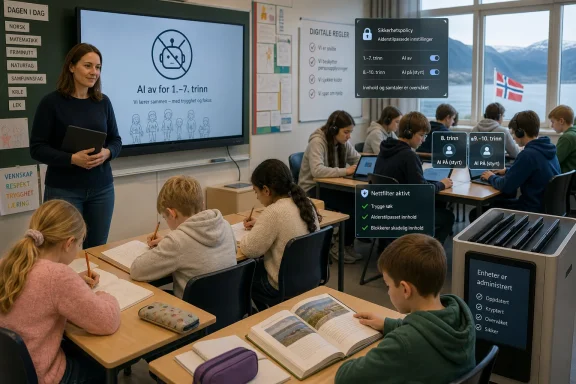 Norway Turns the Classroom Into the First AI Safety Zone
The most important thing about Norway’s announcement is not that it treats generative AI as dangerous. It treats it as powerful enough to require a developmental schedule.Prime Minister Jonas Gahr Støre framed the policy around a basic concern: uncritical AI use can let students skip important steps in learning. That phrasing matters. Norway is not saying that large language models are useless, or that children should grow up technologically illiterate. It is saying that a seven-year-old asking a chatbot to produce a sentence is not the same educational event as a seven-year-old struggling to write one.
That distinction has been blurred by the commercial language of AI adoption. Vendors sell generative AI as a universal assistant, a productivity layer, a tutor, a study buddy, and a creativity engine. Schools, meanwhile, are places where inefficiency is often the point. A child sounding out a word, revising a paragraph, or wrestling with arithmetic is not failing to optimize a workflow; the struggle is the workflow.
Norway’s policy lands at a moment when governments are trying to reconcile two slogans they have repeated for years. One says children need digital skills to compete in the future economy. The other says children are losing attention, reading stamina, and basic academic resilience in the present. Generative AI forces those slogans into conflict because it is not merely another screen. It is a screen that talks back, summarizes, drafts, explains, translates, solves, and flatters.
The Ban Is Really a Curriculum Decision
Calling the Norwegian move a “ban” is convenient, but incomplete. For elementary pupils, the rule is close to a near-prohibition during the school day. For lower secondary and upper secondary students, the picture is more graduated: use can happen, but with teacher supervision, stricter limits, and age-appropriate guidance.That makes the measure less like a technology embargo and more like a curriculum decision. Norway is effectively saying that generative AI belongs later in the learning sequence, after foundational skills have had time to form. The policy’s center of gravity is not cybersecurity, copyright, or cheating, although all three matter. It is cognitive development.
This is the part of the story that AI maximalists will find hardest to answer. If a tool can generate fluent prose, summarize a chapter, solve a math problem, and produce a polished presentation, then it can also conceal whether a student has acquired the underlying skill. That is not a side effect. It is the product’s core selling point.
Adults use AI to compress labor. Children need some forms of labor to become educated. The same feature that makes a model useful to a professional writer, programmer, analyst, or office worker can make it corrosive in a primary classroom. Norway has chosen to name that contradiction rather than pretend that “responsible use” solves it by magic.
The Timing Is No Accident
The Norwegian announcement follows a broader political campaign against the saturation of childhood by digital systems. The government has already moved against smartphone use in schools and has supported higher age limits for social media. The AI school guidance should be read in that sequence, not as an isolated reaction to ChatGPT-style tools.That sequence reveals a governing theory. Norway is no longer treating each platform as a separate nuisance. Phones, social media, and generative AI are different technologies, but in schools they compete for the same scarce resources: attention, memory, motivation, and teacher authority. The policy agenda is an attempt to reclaim those resources.
The school-performance backdrop is also important. Norwegian officials have pointed to declining outcomes in international assessments and concerns over basic reading and writing skills. Whether AI is a cause of those declines is not the claim. The claim is more modest and more politically potent: when core skills are already under pressure, schools should not casually introduce tools that make it easier to bypass practicing them.
That is a defensible position. It also leaves open uncomfortable questions. If AI access outside school remains widespread, then a school-day restriction may protect classroom time while doing little to shape homework habits. If AI becomes embedded in productivity suites, browsers, search engines, learning platforms, and operating systems, then “no AI” becomes harder to administer than “no phones.”
Windows Admins Will Recognize the Real Problem Immediately
For WindowsForum readers, the Norwegian policy has an obvious operational subtext: rules are easy to announce and hard to enforce when the software stack itself is becoming AI-saturated.A school district can block a chatbot website. It can restrict browser extensions. It can manage devices through Microsoft Intune, apply web filtering, lock down app installations, and separate student and teacher profiles. But generative AI is no longer a single destination on the web. It is increasingly a feature inside search, office suites, note-taking apps, coding tools, image editors, accessibility products, and classroom platforms.
That creates a familiar enterprise problem. Policy says one thing; defaults, integrations, and user behavior say another. The modern Windows endpoint is not a neutral terminal. It is a managed ecosystem of accounts, cloud services, telemetry, browser policies, identity controls, and subscription entitlements. If schools want age-based AI access, administrators will need controls that are equally granular.
This is where the debate leaves philosophy and enters procurement. A school cannot responsibly adopt “AI for education” unless it can answer basic administrative questions. Which students can access which model? Are prompts logged? Are teachers able to review interactions? Is student data used for training? Can AI features be disabled by grade level? Do browser and office policies align? What happens when a student signs into a personal account?
Norway’s guidance may be national education policy, but its success will depend on mundane IT work: device management, identity governance, filtering, contract language, audit trails, and teacher training. The classroom argument will become a console-setting argument very quickly.
Microsoft’s Education Pitch Now Has a Grade-Level Problem
Microsoft, Google, OpenAI, Anthropic, and education technology vendors all want to position AI as a natural layer in learning. The pitch is familiar: teachers get help with lesson planning, students get personalized explanations, administrators get efficiency, and accessibility improves for learners who need support. Much of that is plausible.But Norway’s move exposes a gap in the pitch. Most AI product messaging treats “education” as one market. Schools do not work that way. A six-year-old, a thirteen-year-old, a seventeen-year-old, and a teacher may all sit under the same institutional tenant, but they should not share the same AI affordances.
This is not just a moral distinction; it is a product requirement. If Copilot-style assistants, AI writing aids, summarizers, and generative tutoring systems are to be used in public education, they will need controls that reflect developmental stages. A blanket on/off switch is too crude. A free-for-all is politically doomed.
Microsoft in particular has reason to pay attention because Windows, Edge, Microsoft 365, Teams, and Entra-based identity sit deep inside many school environments. The company can argue that managed AI is safer than unmanaged AI. That argument gets stronger if schools can meaningfully restrict features for younger children while enabling supervised use for older students and staff.
The alternative is predictable. If platform vendors cannot provide convincing administrative boundaries, governments and districts will create their own through blunt prohibitions. Norway is showing what happens when public policy moves faster than product governance.
The Cheating Debate Was Always Too Small
Much of the early school conversation around generative AI focused on cheating. That was understandable. Teachers suddenly faced essays, summaries, code, and homework answers that could be generated in seconds. Detection tools proved unreliable, assessment design became harder, and students quickly learned that the boundary between “help” and “submission” was negotiable.But cheating is not the deepest issue in elementary school. A child who uses AI to write a paragraph is not merely violating an assessment rule. The child may be avoiding the experience through which writing becomes possible. That is why the Norwegian framing is more serious than a disciplinary crackdown.
Schools can redesign exams. They can use oral assessments, in-class writing, supervised browsers, locked-down devices, handwritten work, and process portfolios. Those tactics may help with academic integrity. They do not fully address the developmental problem of outsourcing practice before competence exists.
The analogy with calculators is useful but limited. Calculators changed math instruction, but most systems still expect children to learn number sense before relying heavily on computation tools. Generative AI reaches into more domains at once: language, reasoning, research, coding, art, translation, and explanation. It is less like adding calculators to math class than adding a plausible adult co-author to every subject.
That breadth is why Norway’s policy will travel. Even governments that do not copy the near-ban will face the same question: which intellectual tasks should remain unassisted long enough for children to internalize them?
The Printed Book Is Back Because the Screen Lost Trust
Reports around the Norwegian package also point to renewed support for printed books in classrooms. That detail may sound nostalgic, but it is politically revealing. The printed book has become a proxy for a slower, more bounded form of attention.For years, education technology framed paper as backward and digital platforms as modern. The argument was not entirely wrong. Digital tools can improve access, support disabled students, update materials quickly, and make collaboration easier. But the edtech story often underestimated the value of friction.
A printed textbook does not ping, autocomplete, recommend, scrape, track, or branch into a hundred adjacent distractions. It also does not quietly change the task from reading to searching, from composing to prompting, or from remembering to retrieving. In an AI-saturated classroom, paper’s limitations become part of its appeal.
This does not mean schools should retreat into an analog fantasy. Students will live in a world shaped by AI systems, algorithmic feeds, automated decision-making, and software-mediated work. But the return of paper signals a shift in burden of proof. Digital tools no longer get automatic credit for being modern. They have to prove that they improve learning rather than merely increase activity.
That shift will unsettle the education technology industry. For two decades, “more devices” often passed as a plan. Norway is suggesting that the better question is not how many devices a classroom has, but what those devices are allowed to do to the learning process.
Teachers Need Authority, Not Just Guidance
One risk in any national AI policy is that it pushes complexity downward. Ministers announce principles. Directorates produce recommendations. Municipalities interpret them. Vendors adjust contracts. Then the teacher is left in front of thirty students trying to decide whether a grammar suggestion, translation tool, reading aid, chatbot explanation, or AI-generated image crosses the line.That is not sustainable. If Norway wants the policy to work, teachers need more than a slogan about responsible use. They need clear examples, enforceable defaults, training time, and institutional backing when they say no.
The teacher’s role is especially delicate for older students. A strict elementary limit is conceptually clean. Supervised use in secondary school is much harder. Teachers must decide when AI supports learning and when it replaces it. They must explain why one assignment permits AI brainstorming while another forbids AI drafting. They must evaluate process as well as product.
That requires professional judgment, but also shared norms. Without them, AI policy becomes classroom roulette. One teacher bans everything. Another encourages experimentation. A third lacks the technical confidence to know what students are doing. Students then learn the real lesson of many technology rollouts: rules are local, inconsistent, and negotiable.
Norway’s national approach can reduce that inconsistency, but only if it gives teachers practical authority. The policy cannot be enforced by moral exhortation alone. It has to be built into platforms, assessment design, teacher training, and parent communication.
Parents Are the Unmanaged Endpoint
Schools can restrict AI during the school day. Homes are another matter.That is the structural weakness in any classroom-only policy. A child may be blocked from using generative AI at school but still have access through a family laptop, phone, tablet, game console browser, search engine, or messaging app. Parents may not know when AI is being used. Some may actively encourage it as a competitive advantage.
This is not new. Homework has always reflected inequality in home support, private tutoring, quiet space, and parental involvement. Generative AI adds a new layer: unequal access to automated assistance. Some children will have paid AI tools, technically savvy parents, and permissive norms. Others will not. If schools ignore that reality, AI could widen the gap between students who appear fluent and students who actually had to do the work alone.
Norway’s policy partly avoids this by focusing on school-day access. The state has clearer authority over what happens in classrooms than what happens at kitchen tables. But the homework problem will return. If AI is restricted at school yet assignments remain easy to outsource at home, teachers will have to redesign work around evidence of process, in-person demonstration, and oral explanation.
For Windows households, the practical challenge is familiar. Parental controls can help, but AI is increasingly embedded across services. Blocking a single app will not be enough. Families will need norms, not just filters: when help is allowed, when it is not, and why the child’s own effort matters more than a polished answer.
Europe’s AI Act Is Not the Whole Story
It is tempting to fold Norway’s move into the broader European regulatory mood. That is partly right. Europe has been more willing than the United States to regulate digital markets, privacy, platforms, and AI. Norway, while not an EU member, is closely tied to European regulatory structures through the European Economic Area.But the school policy is not simply the EU AI Act translated into classroom practice. The AI Act is primarily a market and risk framework. It classifies systems, assigns obligations, and attempts to govern deployment. Norway’s school move is more culturally specific and more pedagogical. It asks what kind of childhood a public education system should protect.
That difference matters because education policy can move where general AI regulation cannot. A government may struggle to regulate every chatbot in the consumer market, but it can set rules for public schools. It can define procurement standards. It can restrict tools by age. It can tell municipalities which defaults are acceptable.
Other countries will watch this closely because school systems everywhere are facing similar pressure. Some will choose permissive experimentation. Some will issue vague guidance. Some will restrict AI only during exams. Norway has chosen a clearer developmental line, and that clarity may prove influential even among governments that stop short of a near-ban.
The policy also gives political cover to school leaders elsewhere. A principal or district IT director who wants to slow AI adoption can now point to a wealthy, digitally advanced country and say: caution is not anti-technology. It is a mainstream public policy option.
The AI Industry Should Read This as a Market Signal
The education AI market has often assumed that adoption is inevitable because the tools are impressive. Norway is a reminder that public-sector adoption depends on legitimacy, not just capability.A model that produces a convincing explanation of fractions is not automatically welcome in a third-grade classroom. A writing assistant that improves grammar is not automatically appropriate for a child still learning sentence structure. A chatbot that can answer any question is not automatically a tutor. In education, the relevant question is not “Can the tool do the task?” It is “Should the learner still be doing this task unaided?”
That question threatens a lot of product roadmaps. Many AI education tools are built around acceleration: faster feedback, faster drafting, faster lesson generation, faster personalization. Schools may want some of that for teachers and older students. For younger pupils, however, acceleration can be a euphemism for skipping.
The companies that adapt will be the ones that stop treating restrictions as hostility. Age-gated design, transparent logging, curriculum-aligned modes, teacher-controlled scaffolding, and strong data protections will become selling points. The companies that insist on universal access will invite universal resistance.
This is a lesson the broader software industry should already know. Enterprise customers do not reject powerful tools because they hate productivity. They reject tools they cannot govern. Schools are enterprise customers with children at the center, which makes governance not a compliance afterthought but the product itself.
The Policy Will Be Judged by Its Exceptions
A near-ban always lives or dies in the exceptions. Norway’s elementary rule reportedly allows limited exceptions, and those exceptions will matter.There are legitimate educational uses for AI-adjacent systems, especially in accessibility. Speech-to-text, text-to-speech, translation support, reading aids, and adaptive tools can help students with disabilities or language barriers participate more fully. The challenge is that generative AI blurs the line between accommodation and substitution.
A dyslexic student using assistive technology to access a text is not the same as a student asking a model to produce the answer. A language learner receiving vocabulary support is not the same as submitting machine-generated prose. But software does not always draw those lines cleanly, and neither do classroom workflows.
This is where absolutist rhetoric becomes dangerous. If the policy is implemented crudely, it could deny useful support to students who need it. If it is implemented loosely, the exception becomes the rule. The administrative burden will fall on schools to distinguish between tools that enable learning and tools that replace it.
That distinction should become the core test for AI in education. Does the system help the student engage with the task, or does it complete the task on the student’s behalf? The answer will not always be obvious, but asking the question is better than pretending that all “AI learning tools” belong in the same bucket.
The Hard Lesson Norway Is Trying to Preserve
Norway’s argument is unfashionable because it defends difficulty. Modern software culture tends to treat friction as a defect. Education cannot.Children need to experience the gap between not knowing and knowing. They need to sit with confusion long enough to form strategies. They need to produce bad first drafts, make arithmetic mistakes, misread a sentence, revise an answer, and discover that effort changes ability. These are not sentimental claims. They are the mechanics of learning.
Generative AI interferes with that process when introduced too early or too casually. It can make the student feel productive while reducing the student’s need to think. It can produce fluent language that masks weak comprehension. It can reward prompt manipulation over subject mastery. It can make the final artifact look better while the learner remains unchanged.
That does not mean AI has no place in school. It means placement matters. Older students can be taught to critique model outputs, compare sources, inspect hallucinations, use AI for feedback, and understand automated systems as objects of study. But those are advanced literacies. They depend on the very reading, writing, numeracy, and judgment that early AI use may weaken.
Norway is betting that sequence matters more than novelty. First build the learner. Then introduce the machine.
For School IT, the New Default Is Defensible Friction
The operational takeaway for administrators is that AI access can no longer be treated as a casual feature setting. It is now part of safeguarding, curriculum, assessment integrity, procurement, and identity management.That will require coordination between people who do not always speak the same language. Teachers think in assignments and learning goals. IT teams think in policies, tenants, licenses, logs, and endpoints. Parents think in safety and opportunity. Vendors think in adoption. Governments think in public legitimacy. AI in schools sits at the collision point of all five.
A sensible school policy will therefore look less like a manifesto and more like a layered control model. Younger students get default denial except for approved assistive or teacher-led uses. Older students get supervised access tied to explicit learning objectives. Teachers get more flexibility, but also training and approved tools. Administrators get auditability and contractual assurances. Parents get plain-language explanations.
That is not glamorous, but it is the only version likely to survive contact with real classrooms. The alternative is a cycle of hype, misuse, backlash, and blanket bans.
Norway’s School AI Line Gives the Rest of Us a Checklist
Norway’s move is specific to its school system, but the pressure behind it is universal. Any district, municipality, academy trust, or education ministry considering generative AI now has to answer practical questions that cannot be waved away by saying “the future is AI.”- Generative AI should not be introduced to young children simply because it is available inside tools schools already buy.
- Age-based access rules are more credible than one-size-fits-all AI policies.
- School IT teams need grade-level controls, logging, and disablement options across browsers, office suites, learning platforms, and identity systems.
- Teachers need enforceable defaults and training, not vague instructions to encourage innovation while preventing misuse.
- Accessibility exceptions must be protected without turning accommodation into a loophole for automated completion.
- Assessment design has to move toward process, supervision, oral explanation, and demonstrated understanding where AI use is likely outside school.
References
- Primary source: harianbasis.co
Published: 2026-06-21T01:10:18.845060
Loading…
www.harianbasis.co - Independent coverage: world.infonasional.com
Published: 2026-06-21T00:10:18.844166
Loading…
world.infonasional.com - Related coverage: nord.no
Loading…
www.nord.no - Related coverage: startupfortune.com
Norway bans AI from primary classrooms and the rest of Europe may not be far behind - Startup Fortune
Norway's Prime Minister Jonas Gahr Stoere announced a near-total ban on generative AI in elementary schools on June 19, 2026, with tiered restrictionsstartupfortune.com - Related coverage: nhh.no
Loading…
www.nhh.no - Related coverage: levellers.ai
Loading…
www.levellers.ai
