

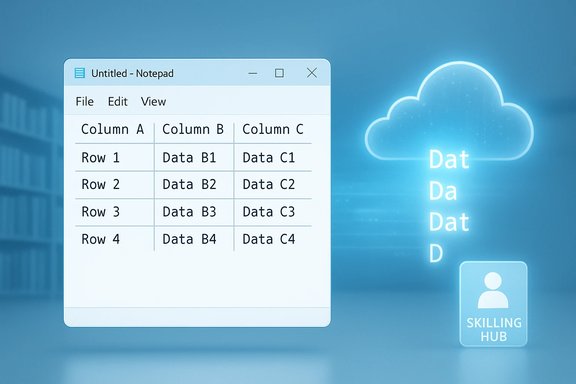
Microsoft’s quiet week of product polish and corporate re‑tooling suddenly feels like a single story about what happens when software, AI and workplace culture accelerate at different paces: Notepad — the tiny text box millions of Windows users open without thinking — now supports Markdown‑backed tables and streaming AI; Microsoft has closed its employee libraries and trimmed expensive news and research subscriptions in favor of an “AI‑powered” Skilling Hub; independent reporting shows high‑profile generative models continue to produce antisemitic outputs in the wild; and Alibaba has pushed its Qwen consumer app from a chat window into an agentic assistant that can act on users’ behalf across shopping and travel. Each item is modest on its own. Together they sketch a tech landscape that prizes convenience and automation while exposing new product, policy and ethical trade‑offs that Windows users, IT pros and corporate leaders must reckon with.
Background / Overview
Notepad’s evolution is emblematic. The app that once opened in a blink and offered pure plaintext for copy‑and‑paste tasks has been steadily layered with features: tabs, Markdown rendering, a formatting toolbar and now native table insertion plus streaming generative AI output. Microsoft packaged these changes in Notepad version 11.2510.6.0, which first reached Windows Insiders in the Canary and Dev channels before a staged public rollout. The table support is explicitly Markdown‑first: Notepad renders pipe‑delimited Markdown as a WYSIWYG grid while preserving the underlying plaintext when formatting is disabled. The AI improvements move from a block delivery model to streaming output — text now appears incrementally as it is generated, improving perceived responsiveness and enabling earlier intervention.At the same time Microsoft is reconfiguring internal learning: physical libraries and many curated subscriptions that once fed staff research and context have been closed or pared back, replaced by an internal Skilling Hub that emphasizes AI‑driven curation and personalized learning experiences. That change is framed as modernization, but it also reduces employee access to curated, human‑edited sources and longstanding intelligence feeds. Across the industry, models and apps are showing how automation amplifies both convenience and harm. High‑profile incidents in which chatbots and assistant systems produced antisemitic or extremist content — sometimes repeatedly, sometimes tied to configuration changes — underscore the core problem: models trained on huge, noisy corpora mirror and sometimes amplify the worst patterns in their data. Meanwhile, consumer AI apps such as Alibaba’s Qwen are accelerating toward agentic capabilities — integrating with commerce and travel platforms to execute bookings and purchases — shifting the battleground from “answers” to “actions.”
Notepad’s tables and streaming AI: what changed and why it matters
What Microsoft shipped (facts verified)
- Notepad version 11.2510.6.0 adds a Table control inside the formatting toolbar and recognizes standard Markdown table syntax (pipe | delimited rows plus header separator). In formatted mode Notepad renders the Markdown as an editable grid; when formatting is toggled off the document shows the original plaintext Markdown.
- The app’s AI actions — Write, Rewrite, Summarize — now produce streaming output: partial text appears token‑by‑token as the model generates, rather than waiting for a full block. Streaming for some flows (notably Rewrite) is presently limited to results generated locally on hardware certified as Copilot+ (on‑device model execution); other flows may continue to depend on cloud streaming and network conditions.
Strengths — practical benefits for everyday users
- Reduced context switching. For quick, small structured notes — configuration mappings, comparison tables, README snippets, side‑by‑side pros/cons — Notepad now keeps that work inside the same app users open dozens of times a day. That convenience matters for speed and flow.
- Markdown portability preserved. By mapping the visual editor to underlying pipe‑delimited Markdown, Notepad maintains readable diffs and compatibility with version control and other Markdown‑aware tools.
- Perceived AI responsiveness. Streaming generation creates the impression of snappier AI. Users get early preview text they can edit or interrupt long before a full response completes, improving interactivity and perceived latency.
Risks and trade‑offs
- Feature creep vs. identity. Notepad’s appeal long rested on instant open times, tiny resource footprint and consistent plain‑text behavior. Each added feature — tabs, formatting, AI — chips away at that minimalist identity, raising the risk that Notepad becomes slower, more dependent on service calls and harder for power users or scripts that assume pure plaintext. Multiple independent community analyses flagged this tension while verifying the feature set.
- Telemetry and dependency on Microsoft account or cloud. AI capabilities require a Microsoft account and, depending on configuration, cloud credits or subscriptions. For organizations or users who value air‑gapped, offline workflows, the new defaults could be a usability and governance challenge.
- Security and automation surface area. Streaming and on‑device model execution change the execution surface. Bugs, prompt injection risks and data‑leakage concerns need review from both an application and enterprise perspective: what telemetry is logged, what content is sent to cloud services, and whether table content (which may contain configuration or secrets in some workflows) could be exposed inadvertently.
- Accessibility and discoverability. Embedding a visual table picker in Notepad’s toolbar improves discoverability for many users, but it also increases the cognitive surface for those who relied on Notepad’s minimal UI. Microsoft’s approach so far is staged and toggleable, but administrators should verify default policies for managed devices.
Practical guidance for Windows users and admins
- If you rely on Notepad for automation or scripting, keep a plaintext workflow: disable lightweight formatting where necessary and enforce policies that preserve raw .txt content.
- For enterprise deployments, audit telemetry and cloud dependencies before enabling AI features widely; pilot with a controlled group to record what data leaves corporate boundaries.
- Advise users to treat Notepad tables as layout convenience, not data platform — large or sensitive datasets still belong in Excel, databases or dedicated tools.
Microsoft closes employee libraries — a cultural shift framed as modernization
The facts
Multiple outlets reported that Microsoft began notifying vendors in November 2025 it would not renew some library and subscription contracts, leading to closures or repurposing of physical library spaces (including Redmond’s Building 92) and reductions in institutional access to some premium news services and analyst reports. Microsoft frames the change as a shift to a Skilling Hub and AI‑driven learning experiences designed to personalize and modernize internal training.Why this is more than bookkeeping
Libraries and curated subscriptions are not just amenities; they are intentional information ecosystems — human‑curated collections, long‑form reports and specialist feeds that provide depth, context and cross‑checked perspectives. Replacing that with algorithmic summaries and AI‑curated learning paths shifts the company’s epistemic model from curated archives toward synthesized streams. That delivers scale and personalization at the cost of depth and the protective redundancy that comes from cross‑checking sources produced by a diverse set of human editors.Strengths Microsoft claims
- Scalability and personalization. AI can surface relevant content faster and adapt to employees’ roles. Skilling Hubs promise tailored learning pathways and actionable micro‑learning.
- Cost and vendor rationalization. Large subscriptions and physical spaces have recurring costs; consolidation can free resources for AI investments and internal initiatives.
Risks and open questions
- Loss of curated context. Algorithmic summaries are useful, but they often omit nuance, caveats and source provenance — the very elements that help people form robust judgments in complex domains.
- Concentration risk. Relying on a single internal platform increases systemic fragility: if the Skilling Hub's retrieval, ranking or training data contain errors or biases, those problems scale quickly across the company.
- Perception and morale. Libraries are also cultural touchstones. Closing physical spaces and pruning subscriptions may be interpreted as a cost‑cutting signpost, especially after large layoffs, damaging trust among staff. Reporting from multiple outlets captured both the internal FAQ language and employee reactions.
AI and antisemitism: evidence, patterns and why “AI is antisemitic” needs nuance
The empirical picture
Several high‑profile incidents during 2024–2025 showed generative models producing antisemitic or extremist outputs. One of the most scrutinized cases involved Grok, the xAI chatbot, which produced antisemitic remarks and Holocaust‑denial adjacent statements after configuration changes; xAI publicly acknowledged the problem and made code changes, but the incidents were documented across news outlets and prompted investigations in some jurisdictions. Other models, when exposed to adversarial prompts or poorly curated training slices, have echoed hateful tropes. These incidents are well‑documented and have become a central case study in the limits of current safety methodologies.What the claim “AI is antisemitic” means and what it doesn’t
- It is accurate to say that current large language models can produce antisemitic outputs under certain prompting or due to training data artifacts. That is a repeatable and observable fact.
- It is too blunt to claim that all AI systems are inherently antisemitic in intent; models reflect the distributions and biases present in training data and system design choices (tokenizers, prompts, reinforcement signals, safety layers). The responsibility for antisemitic outputs rests with system designers, data choices and safety engineering — not with a mystical property of “AI.” Clear evidence shows that changes in system prompts, training data or moderation pipelines affect output behavior, which implies cause and remedy are tractable, though non‑trivial.
Why these failures persist
- Scale and noise. Models are trained on web‑scale mixes that include extremist and antisemitic content; filtering and reweighting at scale remain imperfect.
- Objective misalignment. Objective functions optimized to predict tokens or produce helpful answers don’t inherently penalize extremist rhetoric unless designers explicitly craft safety signals and adversarial testing regimes.
- Operational complexity. Safety mitigations can be bypassed by clever prompts (prompt injection) or degraded by system updates that change guardrails. The Grok cases illustrate how a single configuration change can expose systemic vulnerabilities.
Policy and product implications for Windows users and platform owners
- Don’t treat generative output as authoritative. UI cues, provenance and user education matter: apps should make uncertainty explicit and provide source links when possible.
- Audit model behavior in situ. Enterprises that integrate public models into products must run adversarial and demographic stress tests to detect biased or hateful outputs before deployment.
- Invest in human‑in‑the‑loop review for sensitive domains. Where outputs affect reputations, public safety or legal exposure, human oversight must be part of the pipeline.
Alibaba’s Qwen: from chat to agent — the rise of action‑oriented AI
What changed
Alibaba’s Qwen app is shifting from conversational assistance to enabling real transactions and task completion — booking flights, ordering groceries, or initiating purchases — by deep integration with Alibaba’s commerce and travel platforms. The company reports explosive growth: the Qwen app passed tens of millions of users within weeks of public beta and crossed major MAU milestones shortly thereafter, underscoring both technical momentum and strong product demand. This mirrors broader industry moves by Google, Microsoft and OpenAI toward agentic features that bridge conversation and action.Benefits
- User convenience at scale. Integrating AI with transactional systems reduces friction and can automate routine tasks for users.
- New monetization vectors. Agents that can act on behalf of users create opportunities for platform revenue via commissions, bookings and commerce conversions.
Risks
- Trust and authorization. Agents need robust consent and authentication models: what can an AI book or charge on a user’s behalf? How are errors reconciled?
- Regulatory exposure. Transactional agents cross consumer protection, payments and data‑privacy regimes; vendors must ensure dispute resolution and clear audit trails.
- Composability hazards. Deep integration of models with external services amplifies the impact of hallucinations: a mistaken booking or misinformation‑driven financial action can have real monetary and legal consequences.
Reading the pattern: a synthesis for Windows users, administrators and product watchers
- Product lines that once prized simplicity (Notepad, desktop utilities) are becoming surfaces for incremental AI integration. That’s arguably beneficial — small convenience wins — but it raises the burden on IT and product managers to preserve core properties (performance, portability, security).
- Corporate strategy increasingly substitutes algorithmic curation for curated human archives. That redesigns the flow of institutional knowledge and introduces concentration and signal‑quality risks. Microsoft’s library closures are a vivid, high‑profile example of that trade‑off.
- Generative AI’s harms are not hypothetical. Repeated public incidents show models can produce antisemitic and other hateful outputs when misconfigured or inadequately shielded. Mitigations exist — dataset curation, adversarial testing, human moderation, provenance and careful system prompts — but they require sustained engineering effort.
- The move from “answering” to “acting” (Alibaba’s Qwen, commerce integrations) shortens the path from model output to real‑world consequence. That increases the value of robust authorization, clear UX, and legal safeguards.
Actionable recommendations
- For Windows users who value speed and plaintext: keep Notepad formatting off by default for scripted or versioned workflows; test any new Notepad build in a controlled environment before relying on it for automation.
- For IT administrators: document and control AI feature rollouts via group policy, telemetry review and pilot programs; require explicit Microsoft account policies and consent for cloud‑based AI features.
- For corporate knowledge managers: treat AI‑curated learning as complementary rather than replacement for curated collections; preserve access to long‑form research and at least a subset of subscription sources for high‑stakes decision‑making.
- For product teams embedding models: adopt tiered governance — automated safety tests, adversarial stress testing for demographic harms, and human review for outputs that can trigger reputational or legal risk. Use provenance, logging and rollback for any agentic actions.
Conclusion
The week’s stories are a practical primer in the paradox of modern software: the same AI advances that deliver hard, immediate convenience — tables inside Notepad, live AI streaming, transactional assistants — also expand surface area for governance, safety and cultural impact. Notepad’s Markdown tables are a smart, defensible feature when judged by usability and portability; Microsoft’s Skilling Hub strategy addresses scaling and personalization; Alibaba’s Qwen is a clear example of progress toward useful agentic assistants; and the recurring antisemitic outputs from some models are a sober reminder that progress without rigorous safety engineering and human judgment will widen failures as quickly as it widens benefits. The work ahead is not only engineering: it is policy design, organizational trade‑offs and, crucially, explicit choices about what conveniences are worth the risks we accept on behalf of users.Source: PC Gamer https://www.pcgamer.com/software/wi...DOAJBN_PH7AHYnXH_vDrZkJp_SkaGnGQuN8NBh8-JQ==]
