

Notion restored access to Anthropic’s Claude models in Notion AI on Sunday, June 7, 2026, after a roughly half-day service disruption tied to degraded performance and elevated errors on Anthropic’s Opus 4.7 and 4.8 models. The outage was brief, but the lesson is bigger than a weekend hiccup in a productivity app. AI features are now being sold as if they are native software, while their reliability increasingly depends on a chain of remote model providers, routing layers, status pages, and vendor judgment calls. For Windows users, admins, and enterprises standardizing on AI-assisted workflows, the incident is a reminder that the new desktop productivity stack is only as resilient as the cloud services hiding behind the button marked “Ask AI.”
The visible story is simple enough. Notion said Anthropic’s Opus 4.7 and 4.8 models were experiencing degraded performance, which increased failure rates for users who selected those models in Notion AI. Notion then disabled all Anthropic models in the product, before restoring access later the same day.
That sequence matters because Notion did not merely suffer a local application bug. It made an operational decision about a third-party dependency that users experience as part of Notion itself. To the person trying to summarize a meeting note, draft a project brief, or interrogate a knowledge base, the distinction between “Notion is broken” and “Anthropic is returning elevated errors through Notion’s integration” is not especially comforting.
This is the bargain modern software vendors are striking with customers. They present AI as a seamless extension of the workspace, yet many of the most impressive capabilities are brokered through external model providers. The user interface says Notion; the reasoning engine may be Anthropic; the fallback may be another model; the incident response may require coordination across companies that do not share the same customers, telemetry, or public messaging cadence.
The weekend disruption was therefore less a scandal than a useful x-ray. It showed the bones of a product category that increasingly depends on invisible subcontracting. Notion handled the event quickly, but the speed of recovery does not erase the structural dependency it exposed.
That reaction did not come from nowhere. Anthropic’s Claude models, especially the Opus line, are not generic autocomplete engines in the eyes of their heaviest users. Developers, researchers, analysts, and productivity-tool obsessives build habits around their behavior. When a model feels slower, less reliable, more verbose, less decisive, or worse at tool use, users often interpret the change as evidence that the provider has altered the product.
The AI industry has trained customers to think this way. Model versions appear and disappear. “Latest” often means “different,” not necessarily “better for my workflow.” Vendors tune systems, change defaults, alter rate limits, adjust safety behavior, and move users between model snapshots with limited visibility. In that environment, a spike in errors can look to users like a quality regression, even when the root cause is plain infrastructure trouble.
Notion product chief Max Schoening pushed back on that interpretation, reportedly emphasizing that the degraded performance was a temporary service disruption rather than a story about model quality. That distinction is important, but it also reveals a communications problem the AI industry has not solved. Users do not just want to know whether a service is “up”; they want to know whether the thing they rely on is the same thing they used yesterday.
A database outage is usually obvious. A login failure is easy to classify. A storage incident has visible boundaries. AI degradation is slipperier. The service may respond, but fail more often. It may complete requests, but with degraded tool use. It may select a fallback model whose answer is acceptable for drafting copy but unacceptable for a legal review, code migration plan, or executive analysis.
That ambiguity makes AI incidents harder to communicate. “Elevated errors” is precise enough for engineers and maddeningly vague for everyone else. It does not tell users whether their failed prompts were retried, whether their selected model was unavailable, whether the system silently changed models, or whether outputs produced during the incident should be treated with added skepticism.
Notion’s response — temporarily disabling Anthropic models rather than letting users continue to select a degraded option — was defensible. A visible switch can be better than a misleading promise. But it also raises a product-design question that will become more urgent: how much routing logic should users see?
Power users increasingly want model choice, not just “AI.” Enterprises want auditability. Admins want to know which provider processed which class of data, under what policy, and with what retention guarantees. A simple picker is no longer a cosmetic feature; it is part of the trust boundary.
That integration is valuable precisely because the AI is embedded. Users do not want to export notes into a separate chatbot, paste sensitive context into another tab, and copy the result back into a workspace. The productivity pitch is that the model comes to the work, not the other way around.
But embedded AI changes the reliability equation. A standalone chatbot outage is annoying. A model outage inside a work-management platform can interrupt a workflow that users no longer perceive as optional. If a team has started using AI-generated summaries as a routine part of sprint planning, sales handoffs, policy drafting, or support triage, then degraded model access becomes a process failure rather than a novelty failure.
That is the danger of successful AI adoption. The more natural these features feel, the more invisible the dependency becomes. And the more invisible the dependency becomes, the more disruptive it feels when it suddenly surfaces.
Microsoft has spent years moving Windows, Office, Teams, OneDrive, Defender, and Copilot-era services into a hybrid model where the local client is only one part of the experience. That shift has real benefits: faster feature delivery, cross-device continuity, centralized security controls, and cloud-scale intelligence. It also means the troubleshooting surface has exploded.
When Notion AI loses access to a model provider, the impact may not be Windows-specific, but the operational lesson absolutely is. Many Windows-heavy organizations now run a dense mesh of SaaS clients, browser apps, endpoint agents, identity brokers, EDR tools, cloud storage sync engines, and AI assistants. The endpoint may be healthy while the workflow is broken.
That is a difficult mental shift for support desks. The old question was, “Is the PC working?” The newer question is, “Which dependency in the chain is failing, and can the user continue safely through another route?” AI makes that question more complicated because the fallback may still produce an answer — just not the same answer.
But multi-model routing is not as simple as swapping one storage bucket for another. Different models have different strengths, costs, context limits, safety behaviors, tool-use habits, latency profiles, and output styles. A fallback model may be perfectly adequate for a meeting summary and meaningfully worse for a complex code review or legal-style comparison of contract language.
The central problem is that AI models are not interchangeable commodities, even when vendors and product interfaces imply that they are. In traditional infrastructure, an object store can often be abstracted behind an API with predictable semantics. In AI, the “same” prompt routed to a different model can produce a different interpretation, different confidence, different omissions, and different failure modes.
That does not mean routing is bad. It means routing needs policy. Enterprises will need to decide which tasks can fail over automatically, which tasks must ask for user consent, and which tasks should stop rather than proceed on a lower-confidence model. The future of AI reliability is not merely uptime; it is appropriate degradation.
If a user requested a summary during the degraded period, did it fail visibly? If the model was unavailable, was another model used? If another provider handled the request, was that consistent with the organization’s data policy? If output quality was lower, would the user know? If the request touched regulated or confidential material, can an admin later determine what happened?
Those are not theoretical compliance questions. They are the predictable consequence of putting AI into business workflows. Companies are no longer just buying software; they are buying inference paths. Every path has implications for privacy, security review, vendor risk, and operational continuity.
The incident reportedly did not involve a security breach or known data exposure. That is good, but it should not lull buyers into treating AI outages as harmless. Availability incidents can still create business risk when users make decisions based on incomplete output, when teams lose confidence in a tool, or when fallbacks violate assumptions documented during procurement.
The audit trail will become a selling point. Vendors that can show which model ran, why a fallback occurred, whether user data crossed a provider boundary, and how an incident affected specific requests will have an advantage with serious IT buyers. Vendors that hide everything behind a cheerful sparkle icon will eventually run into harder questions.
That uncertainty is combustible. A status post about degraded performance can become evidence in a larger narrative before the vendor has finished investigating. A temporary disablement can be interpreted as a retreat from a model. A failure spike can be reframed as proof that a new release is flawed. Social media does not wait for root-cause analysis.
The industry should not dismiss this as user hysteria. The suspicion exists because AI products often lack version transparency. In conventional software, release notes may be incomplete, but users at least understand the idea of a versioned binary, a patch level, and a reproducible bug. In hosted AI, the model name may stay the same while the surrounding system changes.
That opacity is a product choice. It may be necessary in some cases, especially where safety, abuse prevention, and infrastructure optimization are involved. But it carries a trust cost. If vendors want users to avoid reading every incident as a quality scandal, they need to give them better ways to distinguish outages, model updates, routing changes, and policy shifts.
Reliability is not just whether an API returns a 200 response. It is whether the right model is available for the right task at the expected latency and quality level. It is whether tool calls complete. It is whether the product fails clearly when it cannot meet the user’s selected preference. It is whether fallback behavior is predictable and documented.
For admins, this is where procurement questionnaires should become more specific. It is not enough to ask whether a vendor uses AI or which model provider it supports. Buyers should ask how the product handles provider outages, whether model routing is configurable, whether logs identify the model used, and whether certain data classes can be restricted to approved providers.
Consumer AI can get away with vibes for a while. Enterprise AI cannot. The closer these systems get to regulated work, operational decisions, and executive reporting, the more they will be judged like infrastructure rather than magic.
That is a real achievement. Many outages become worse because vendors hesitate, communicate poorly, or allow partial failures to cascade. Notion’s decision to remove Anthropic models rather than let users repeatedly hit a bad path likely reduced confusion inside the product, even if it increased speculation outside it.
But contained incidents are still instructive. They show where assumptions held and where they need reinforcement. In this case, the biggest assumption is that AI tools can be treated as ordinary SaaS features. They cannot, at least not entirely. They are probabilistic services with vendor-specific behavior, opaque tuning, and increasingly high expectations from users who build routines around them.
The future will bring more of these incidents, not fewer. That is not because AI vendors are uniquely careless. It is because demand is rising, model serving is expensive and complex, and the number of applications embedding frontier models is growing faster than the maturity of the operational playbook around them.
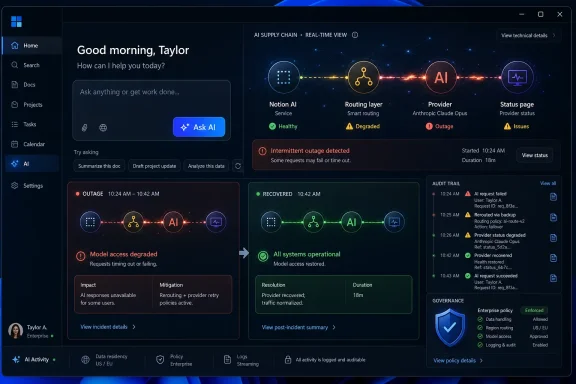 Notion’s AI Button Was Really a Supply Chain
The visible story is simple enough. Notion said Anthropic’s Opus 4.7 and 4.8 models were experiencing degraded performance, which increased failure rates for users who selected those models in Notion AI. Notion then disabled all Anthropic models in the product, before restoring access later the same day.That sequence matters because Notion did not merely suffer a local application bug. It made an operational decision about a third-party dependency that users experience as part of Notion itself. To the person trying to summarize a meeting note, draft a project brief, or interrogate a knowledge base, the distinction between “Notion is broken” and “Anthropic is returning elevated errors through Notion’s integration” is not especially comforting.
This is the bargain modern software vendors are striking with customers. They present AI as a seamless extension of the workspace, yet many of the most impressive capabilities are brokered through external model providers. The user interface says Notion; the reasoning engine may be Anthropic; the fallback may be another model; the incident response may require coordination across companies that do not share the same customers, telemetry, or public messaging cadence.
The weekend disruption was therefore less a scandal than a useful x-ray. It showed the bones of a product category that increasingly depends on invisible subcontracting. Notion handled the event quickly, but the speed of recovery does not erase the structural dependency it exposed.
A Half-Day Outage Became a Model-Quality Referendum
The oddity of the incident was not that a cloud AI model had a service problem. Cloud platforms fail, APIs degrade, queues back up, load balancers misbehave, and infrastructure incidents are part of life for anyone who has run production systems at scale. The oddity was how quickly a service disruption was pulled into a broader argument about model quality.That reaction did not come from nowhere. Anthropic’s Claude models, especially the Opus line, are not generic autocomplete engines in the eyes of their heaviest users. Developers, researchers, analysts, and productivity-tool obsessives build habits around their behavior. When a model feels slower, less reliable, more verbose, less decisive, or worse at tool use, users often interpret the change as evidence that the provider has altered the product.
The AI industry has trained customers to think this way. Model versions appear and disappear. “Latest” often means “different,” not necessarily “better for my workflow.” Vendors tune systems, change defaults, alter rate limits, adjust safety behavior, and move users between model snapshots with limited visibility. In that environment, a spike in errors can look to users like a quality regression, even when the root cause is plain infrastructure trouble.
Notion product chief Max Schoening pushed back on that interpretation, reportedly emphasizing that the degraded performance was a temporary service disruption rather than a story about model quality. That distinction is important, but it also reveals a communications problem the AI industry has not solved. Users do not just want to know whether a service is “up”; they want to know whether the thing they rely on is the same thing they used yesterday.
The Status Page Is Now Part of the Product
For years, status pages lived in the background. They were read by incident responders, support teams, and the occasional unlucky admin explaining to a department why a SaaS tool was misbehaving. AI has dragged the status page into the foreground because model behavior is both operational and experiential.A database outage is usually obvious. A login failure is easy to classify. A storage incident has visible boundaries. AI degradation is slipperier. The service may respond, but fail more often. It may complete requests, but with degraded tool use. It may select a fallback model whose answer is acceptable for drafting copy but unacceptable for a legal review, code migration plan, or executive analysis.
That ambiguity makes AI incidents harder to communicate. “Elevated errors” is precise enough for engineers and maddeningly vague for everyone else. It does not tell users whether their failed prompts were retried, whether their selected model was unavailable, whether the system silently changed models, or whether outputs produced during the incident should be treated with added skepticism.
Notion’s response — temporarily disabling Anthropic models rather than letting users continue to select a degraded option — was defensible. A visible switch can be better than a misleading promise. But it also raises a product-design question that will become more urgent: how much routing logic should users see?
Power users increasingly want model choice, not just “AI.” Enterprises want auditability. Admins want to know which provider processed which class of data, under what policy, and with what retention guarantees. A simple picker is no longer a cosmetic feature; it is part of the trust boundary.
The Claude Dependency Is a Feature Until It Is an Incident
Notion’s adoption of high-end Anthropic models made obvious product sense. Claude has been popular among users who want long-context reasoning, writing assistance, coding help, and document analysis. Notion’s workspace is a natural place for those capabilities because it already contains the raw material: meeting notes, project plans, research, customer notes, engineering specs, and internal knowledge bases.That integration is valuable precisely because the AI is embedded. Users do not want to export notes into a separate chatbot, paste sensitive context into another tab, and copy the result back into a workspace. The productivity pitch is that the model comes to the work, not the other way around.
But embedded AI changes the reliability equation. A standalone chatbot outage is annoying. A model outage inside a work-management platform can interrupt a workflow that users no longer perceive as optional. If a team has started using AI-generated summaries as a routine part of sprint planning, sales handoffs, policy drafting, or support triage, then degraded model access becomes a process failure rather than a novelty failure.
That is the danger of successful AI adoption. The more natural these features feel, the more invisible the dependency becomes. And the more invisible the dependency becomes, the more disruptive it feels when it suddenly surfaces.
Windows Users Already Know This Movie
WindowsForum readers have seen this pattern before, just with different logos. A desktop feature becomes cloud-backed. A local workflow gets a remote dependency. An update changes behavior that users thought was stable. A service degradation somewhere else makes a familiar interface feel unreliable.Microsoft has spent years moving Windows, Office, Teams, OneDrive, Defender, and Copilot-era services into a hybrid model where the local client is only one part of the experience. That shift has real benefits: faster feature delivery, cross-device continuity, centralized security controls, and cloud-scale intelligence. It also means the troubleshooting surface has exploded.
When Notion AI loses access to a model provider, the impact may not be Windows-specific, but the operational lesson absolutely is. Many Windows-heavy organizations now run a dense mesh of SaaS clients, browser apps, endpoint agents, identity brokers, EDR tools, cloud storage sync engines, and AI assistants. The endpoint may be healthy while the workflow is broken.
That is a difficult mental shift for support desks. The old question was, “Is the PC working?” The newer question is, “Which dependency in the chain is failing, and can the user continue safely through another route?” AI makes that question more complicated because the fallback may still produce an answer — just not the same answer.
Multi-Model Routing Is Not a Magic Escape Hatch
Some commentary around the incident framed Notion’s response as a win for multi-model routing. There is truth in that. If an application can disable a failing provider and continue serving users through other models, that is better than hard failure. Redundancy is one of the few practical defenses against the fragility of any single AI provider.But multi-model routing is not as simple as swapping one storage bucket for another. Different models have different strengths, costs, context limits, safety behaviors, tool-use habits, latency profiles, and output styles. A fallback model may be perfectly adequate for a meeting summary and meaningfully worse for a complex code review or legal-style comparison of contract language.
The central problem is that AI models are not interchangeable commodities, even when vendors and product interfaces imply that they are. In traditional infrastructure, an object store can often be abstracted behind an API with predictable semantics. In AI, the “same” prompt routed to a different model can produce a different interpretation, different confidence, different omissions, and different failure modes.
That does not mean routing is bad. It means routing needs policy. Enterprises will need to decide which tasks can fail over automatically, which tasks must ask for user consent, and which tasks should stop rather than proceed on a lower-confidence model. The future of AI reliability is not merely uptime; it is appropriate degradation.
The Enterprise Problem Is Not the Outage, It Is the Audit Trail
For individual users, the Notion-Anthropic disruption was probably a temporary annoyance. Retry later, pick another model, or do the work manually. For enterprises, the more important issue is what the incident says about observability and governance.If a user requested a summary during the degraded period, did it fail visibly? If the model was unavailable, was another model used? If another provider handled the request, was that consistent with the organization’s data policy? If output quality was lower, would the user know? If the request touched regulated or confidential material, can an admin later determine what happened?
Those are not theoretical compliance questions. They are the predictable consequence of putting AI into business workflows. Companies are no longer just buying software; they are buying inference paths. Every path has implications for privacy, security review, vendor risk, and operational continuity.
The incident reportedly did not involve a security breach or known data exposure. That is good, but it should not lull buyers into treating AI outages as harmless. Availability incidents can still create business risk when users make decisions based on incomplete output, when teams lose confidence in a tool, or when fallbacks violate assumptions documented during procurement.
The audit trail will become a selling point. Vendors that can show which model ran, why a fallback occurred, whether user data crossed a provider boundary, and how an incident affected specific requests will have an advantage with serious IT buyers. Vendors that hide everything behind a cheerful sparkle icon will eventually run into harder questions.
The Social-Media Outage Cycle Is Now Part of Incident Response
One reason this brief disruption attracted attention is that it landed in a market already primed for suspicion. AI users constantly debate whether models have been “nerfed,” whether new versions are worse than old ones, and whether providers silently change behavior to reduce cost or risk. Sometimes those complaints are overblown. Sometimes they are grounded in real product changes. Often, from the outside, users cannot tell.That uncertainty is combustible. A status post about degraded performance can become evidence in a larger narrative before the vendor has finished investigating. A temporary disablement can be interpreted as a retreat from a model. A failure spike can be reframed as proof that a new release is flawed. Social media does not wait for root-cause analysis.
The industry should not dismiss this as user hysteria. The suspicion exists because AI products often lack version transparency. In conventional software, release notes may be incomplete, but users at least understand the idea of a versioned binary, a patch level, and a reproducible bug. In hosted AI, the model name may stay the same while the surrounding system changes.
That opacity is a product choice. It may be necessary in some cases, especially where safety, abuse prevention, and infrastructure optimization are involved. But it carries a trust cost. If vendors want users to avoid reading every incident as a quality scandal, they need to give them better ways to distinguish outages, model updates, routing changes, and policy shifts.
Reliability Claims Need to Grow Up
The Notion incident also exposes a gap in how AI products are marketed. Vendors are comfortable making claims about capability: better reasoning, fewer tool errors, improved workflow handling, longer context, more natural writing. They are less comfortable explaining reliability in the practical language customers need.Reliability is not just whether an API returns a 200 response. It is whether the right model is available for the right task at the expected latency and quality level. It is whether tool calls complete. It is whether the product fails clearly when it cannot meet the user’s selected preference. It is whether fallback behavior is predictable and documented.
For admins, this is where procurement questionnaires should become more specific. It is not enough to ask whether a vendor uses AI or which model provider it supports. Buyers should ask how the product handles provider outages, whether model routing is configurable, whether logs identify the model used, and whether certain data classes can be restricted to approved providers.
Consumer AI can get away with vibes for a while. Enterprise AI cannot. The closer these systems get to regulated work, operational decisions, and executive reporting, the more they will be judged like infrastructure rather than magic.
The Weekend Incident Was Small Because the Blast Radius Was Contained
The most generous reading of Notion’s response is that the system worked as intended. Anthropic had a brief infrastructure issue. Notion saw degraded performance affecting users of specific models. It disabled the affected provider broadly, waited for recovery, and restored access. The public noise was louder than the operational damage.That is a real achievement. Many outages become worse because vendors hesitate, communicate poorly, or allow partial failures to cascade. Notion’s decision to remove Anthropic models rather than let users repeatedly hit a bad path likely reduced confusion inside the product, even if it increased speculation outside it.
But contained incidents are still instructive. They show where assumptions held and where they need reinforcement. In this case, the biggest assumption is that AI tools can be treated as ordinary SaaS features. They cannot, at least not entirely. They are probabilistic services with vendor-specific behavior, opaque tuning, and increasingly high expectations from users who build routines around them.
The future will bring more of these incidents, not fewer. That is not because AI vendors are uniquely careless. It is because demand is rising, model serving is expensive and complex, and the number of applications embedding frontier models is growing faster than the maturity of the operational playbook around them.
Notion’s Claude Hiccup Leaves a Checklist for the AI Desktop
The practical lesson from the weekend is not that Notion or Anthropic failed some extraordinary test. It is that AI-assisted work now needs the same sober continuity planning that IT already applies to identity, storage, endpoint protection, and collaboration platforms.- Organizations should assume that embedded AI features depend on external providers, even when the product interface makes them feel native.
- Admins should ask vendors whether model fallbacks are automatic, visible to users, configurable by policy, and recorded in logs.
- Teams using AI for business-critical work should define which tasks may continue on a fallback model and which should stop until the preferred model returns.
- Users should treat sudden AI failures or behavior changes as possible service degradation before assuming that a model has been intentionally weakened.
- Vendors should communicate AI incidents in terms users understand, including which models were affected, whether fallbacks were used, and when normal routing resumed.
References
- Primary source: Bitcoin World
Published: 2026-06-07T18:50:13.338349
Notion Restores Anthropic AI Models After Brief Service Disruption
Notion restored access to Anthropic's Claude models after a temporary service disruption caused degraded performance over the weekend.bitcoinworld.co.in - Related coverage: techcrunch.com
Notion restores access to Anthropic after service disruption | TechCrunch
Notion's head of product said he was "astonished" at “the amount of people RT-ing this."techcrunch.com - Related coverage: notion.com
April 16, 2026 – Opus 4.7, now in Notion
Claude Opus 4.7, Anthropic’s latest model, is now in Notion. It uses fewer tokens, makes 3x fewer tool errors, and handles complex workflows more reliably than ever.www.notion.com - Related coverage: fourweekmba.com
Anthropic Claude AI Outage: Notion's Multi-Model Switch 2026 - FourWeekMBA
Anthropic Opus 4.7/4.8 degraded performance causes Notion AI failures. Notion disables Claude, reroutes to alternatives. Why multi-model routing is infrastructure resilience.fourweekmba.com - Related coverage: tugatech.com.pt
Notion restaura acesso aos modelos da Anthropic após falha de serviço | TugaTech
A integração de ferramentas de IA na popular plataforma de produtividade sofreu um ligeiro contratempo no último fim de semana. Na madrugada de domingo, de acortugatech.com.pt - Related coverage: tipranks.com
Anthropic Resolves Brief Claude Service Disruption Affecting Notion Integration - TipRanks.com
New updates have been reported about Anthropic. Anthropic experienced a short-lived infrastructure issue over the weekend that temporarily degraded performance on s...www.tipranks.com
- Related coverage: checkupstream.com
CheckUpstream
Track Notion uptime, incidents, and community-reported error rates over the past 30 days. Real-time reliability data from CheckUpstream.checkupstream.com - Related coverage: inews.zoombangla.com
Claude Opus 4.8: Anthropic Restores Services After Outage Amid Growing Security Scrutiny
Anthropic restored Claude services after a multi-hour outage as the company faces heightened scrutiny over AI security and reliability.inews.zoombangla.com - Related coverage: eaglestatus.io
Notion Status. Check if Notion is down or having issues. | EagleStatus
Notion not working smoothly? Check if Notion is down right now. Start monitoring the services you depend on and get real-time alerts in your favorite channels when issues arise — EagleStatus monitors over 1,700 services to keep you updated!eaglestatus.io - Related coverage: techbuzz.ai
Notion Restores Anthropic AI Access After Brief Outage | The Tech Buzz
Productivity platform fixes Claude integration disruption as users voice concernswww.techbuzz.ai - Related coverage: incidenthub.cloud
Is Anthropic Down Right Now? Live Status and Outage Checker
Is Anthropic down? Check real-time Anthropic status, outages, and issues. Track all Anthropic service disruptions, outage history, and get instant alerts.incidenthub.cloud - Related coverage: stampr-ai.com
- Related coverage: cmr.berkeley.edu
- Official source: www-cdn.anthropic.com
