

NTT DATA said on May 15, 2026, from Plano, Texas, that it has signed a definitive agreement to acquire WinWire, a Santa Clara-based Microsoft partner focused on agentic AI, Azure, data engineering, and cloud-native application development. The deal is not just another services roll-up dressed in AI language. It is a bet that enterprise AI will be won less by model announcements than by the armies of engineers who can wire data, security, workflow, and cloud operations into something companies can actually run. For WindowsForum readers, the signal is clear: Microsoft’s AI ecosystem is becoming more services-heavy, more Azure-centric, and more dependent on partners that can turn Copilot-era ambition into production architecture.
The most important number in the announcement is not the market forecast or the expected size of the AI economy. It is the roughly 1,000 Azure engineers and Microsoft specialists WinWire is expected to bring into NTT DATA once the deal closes.
That tells us what this transaction is really about. Enterprises have spent the last two years being told that generative AI will transform knowledge work, software development, customer service, operations, and analytics. Many have tested pilots. Far fewer have reorganized their data estates, identity models, compliance processes, application portfolios, and workflow governance around AI systems that can safely act on behalf of employees.
NTT DATA is buying a company that lives in that gap. WinWire’s pitch is not that it owns a foundation model or a magical chatbot. It is that it knows how to build the scaffolding around Microsoft’s AI stack: Azure, Microsoft Fabric, Azure AI Foundry, cloud-native development, and modern data engineering.
That distinction matters. The current AI market rewards spectacle, but enterprise IT rewards repeatability. A demo can survive with synthetic data, generous permissions, and a forgiving audience. A production system has to survive procurement, security review, incident response, data residency, cost controls, service-level commitments, and the quiet wrath of business users who will abandon any tool that creates more work than it removes.
NTT DATA’s acquisition intent says the company believes the next phase of AI adoption will be brutally practical. The winner is not the integrator with the best slide deck on agentic AI. The winner is the one with enough specialists to land AI inside the messy, Microsoft-heavy estates where enterprises already live.
That strategy creates a huge opportunity for Microsoft partners, but also a huge dependency. Microsoft can ship the platforms, but it cannot personally refactor every legacy workflow, reconcile every data warehouse, secure every tenant, and train every business unit to trust agent-driven processes. The cloud vendor needs a delivery ecosystem large enough to make the platform real.
NTT DATA is positioning itself as one of those industrial delivery arms. The company already claims a large Microsoft practice, tens of thousands of Microsoft certifications, and operations across more than 50 countries. WinWire adds a more focused Microsoft-native bench with specific depth in Azure-based AI and data modernization.
The phrase “agentic AI” deserves skepticism, because it is currently being stretched across everything from simple workflow automation to genuinely autonomous multi-step systems. But underneath the marketing fog is a real architectural shift. Enterprises are moving from AI as a conversational interface toward AI as a decision-and-action layer embedded in business processes.
That move creates demand for consultants who understand more than prompts. An agent that can summarize a document is one problem. An agent that can inspect inventory, update a ticket, trigger a customer notification, query a regulated data set, and escalate an exception is another. The second system requires identity boundaries, audit trails, policy enforcement, transaction handling, rollback plans, human approval paths, and data quality discipline.
This is where services firms smell money. Every enterprise that wants agents will discover that its data is inconsistent, its permissions are too broad, its application interfaces are uneven, and its governance model was designed for human operators rather than semi-autonomous software. NTT DATA’s deal for WinWire is a wager that fixing those problems will be a durable business, not a temporary AI gold rush.
That kind of credentialing matters in the Microsoft channel. Large enterprise buyers rarely choose a systems integrator solely because of a partner badge, but badges become shorthand for trust, access, and relevance. They suggest that Microsoft sees the partner as capable of delivering the kinds of workloads Microsoft wants customers to adopt.
For NTT DATA, the acquisition strengthens a story it has already been telling. The company has emphasized Microsoft cloud, security, AI, and industry transformation as core growth areas. It has also promoted its status as Microsoft’s 2025 Global System Integrator Growth Champion Partner of the Year, a label that is as much about momentum as it is about size.
The WinWire deal gives that momentum more substance. Instead of simply saying it can help clients adopt Azure AI, NTT DATA can point to an expanded specialist base and a company that has been built around Microsoft-first delivery. That matters at a time when global consultancies are competing to convince CIOs that they can move AI from sandbox to operating model.
There is also a geographic and organizational logic. NTT DATA wants to strengthen its North American leadership position, and WinWire brings a U.S.-based front door with Indian delivery scale. That is a familiar services pattern, but the AI twist is important: organizations want local advisory, industry context, and compliance awareness, while still needing enough engineering capacity to modernize platforms at speed.
The acquisition also gives NTT DATA a more explicit industry-AI narrative. WinWire has emphasized healthcare and software and digital platforms as key sectors. Those are areas where Microsoft cloud adoption is already deep, but where AI deployment can be constrained by privacy, reliability, and integration demands. If NTT DATA can turn WinWire’s frameworks into repeatable offerings, it gets more than headcount; it gets packaged credibility.
This is why Microsoft Fabric appears in the announcement alongside Azure AI Foundry. Fabric represents Microsoft’s attempt to pull data integration, analytics, data science, real-time intelligence, and business intelligence into a more unified software-as-a-service environment. Azure AI Foundry, meanwhile, is aimed at building, evaluating, deploying, and managing AI applications and agents. Together, they form the backbone of Microsoft’s argument that enterprise AI is not a standalone feature but a platform architecture.
For IT pros, that means AI projects increasingly begin with unglamorous work. Data classification has to improve. Lineage has to be understandable. Permissions need to be mapped to actual business roles. APIs and event streams need to be reliable. Legacy applications need wrappers, migrations, or replacements. Observability has to expand from infrastructure metrics to model behavior, agent actions, and business outcomes.
This is where many AI pilots stall. The chatbot works in a conference room because it is pointed at a curated corpus and shielded from operational complexity. The enterprise rollout fails because the real world contains duplicate customer records, contradictory policy documents, regional compliance exceptions, custom ERP extensions, and data owners who do not agree on who is allowed to see what.
NTT DATA and WinWire are selling the antidote: build the data and application foundation first, then scale AI through controlled, industry-specific patterns. That is not as thrilling as claiming that agents will replace entire departments by next quarter. It is, however, much closer to how large organizations actually change.
The acquisition also reflects a maturing view of AI risk. Early AI adoption often focused on model selection, prompt engineering, and user experimentation. Enterprise-scale AI forces harder questions about process control. If an autonomous system recommends an action, who approves it? If it takes the action, who audits it? If it makes a costly mistake, which logs prove what happened?
Those questions are not solved by a model provider alone. They are solved through architecture, governance, and delivery discipline. That is why the services layer is becoming one of the most consequential parts of the AI market.
When a company says it wants agentic AI, it usually means it wants software that can move across that environment without breaking it. That is a tall order. The agent may need to read a document in SharePoint, respect sensitivity labels, call a business API, write to a database, notify a user in Teams, and create an audit record that satisfies internal compliance. The user may experience that as a simple Copilot-like interaction, but the backend is a maze.
This is why Microsoft-aligned systems integrators are suddenly more strategic. The value is not just knowing Azure services. It is knowing the operational reality of Microsoft-centric enterprises: hybrid identity, old Active Directory assumptions, endpoint management through Intune or Configuration Manager, PowerShell automation, Exchange and SharePoint inheritance, Teams sprawl, conditional access policies, and the peculiar persistence of Excel as a mission-critical interface.
NTT DATA’s acquisition intent should be read as a statement about where AI budgets are moving. The first wave of spending went to experimentation, subscriptions, and executive visibility. The next wave goes to modernization, integration, governance, and managed operations. That work is less flashy, but it is more durable.
For sysadmins and enterprise architects, the lesson is that AI will not remain a side project owned by innovation teams. It will push into identity, endpoint policy, data lifecycle management, network architecture, software delivery, and incident response. The people who manage Windows and Microsoft cloud environments will increasingly be asked to make AI systems safe enough to operate.
That does not mean every admin needs to become a machine-learning engineer. It does mean the boundary between traditional IT operations and AI operations is dissolving. Access policy, logging, privileged actions, data retention, and user training are now AI deployment issues.
Still, the magnitude tells us why NTT DATA is moving. Even if the eventual market is smaller than the most aggressive projections, enterprise AI is clearly becoming a central budget category. Cloud providers, chipmakers, software vendors, consultancies, and cybersecurity firms are all trying to claim a layer of the stack.
The problem is that enterprise AI spending is not a single market. It is a bundle of related investments: GPUs and cloud capacity, application modernization, data platforms, AI developer tooling, compliance systems, workforce training, security monitoring, and managed services. A company like NTT DATA wants to sit across as many of those layers as possible.
WinWire helps because it operates in the middle of the stack, where strategy meets implementation. It can help customers build AI-ready data foundations, modernize applications, and create agentic workflows using Microsoft technologies. That is a more defensible position than selling generic AI enthusiasm.
There is also a timing advantage. Enterprises are under pressure from boards and competitors to show AI progress, but many CIOs are wary of uncontrolled experimentation. They need partners who can provide acceleration without turning the IT estate into a governance nightmare. NTT DATA’s message is designed for that anxiety: scale AI, but do it securely, consistently, and with industry alignment.
The acquisition is subject to customary closing conditions and regulatory approvals, so it is not yet completed. The announcement did not disclose financial terms. That leaves open the usual integration questions: how WinWire will be folded into NTT DATA’s Microsoft business, whether its culture survives the scale-up, and how quickly its frameworks can be converted into repeatable global offerings.
Those questions matter because services acquisitions can look cleaner in press releases than they do in practice. Talent can leave. Sales motions can clash. Specialized firms can lose their edge inside larger organizations. NTT DATA is not just buying capability; it is taking on the challenge of preserving the very specialization that made WinWire attractive.
This is not new in enterprise technology. Cloud migration created a similar wave of acquisitions as major services firms bought boutique AWS, Azure, Salesforce, ServiceNow, and data engineering specialists. The AI cycle compresses that pattern because customers are moving from experimentation to production while the platforms themselves are still evolving.
Microsoft benefits from this consolidation in the short term. A bigger, more capable partner bench helps Azure AI, Fabric, Copilot, and related services land in complex enterprises. It also gives customers a familiar procurement path: rather than betting on a small specialist alone, they can buy through a global integrator with a Microsoft-aligned delivery model.
But consolidation has trade-offs. Smaller specialists often win because they are focused, fast, and technically opinionated. Large integrators win because they can operate globally, staff heavily, and absorb risk. The best acquisitions preserve the first set of virtues while adding the second. The worst turn a sharp firm into another slide in a global capability deck.
For Microsoft customers, the practical question is not whether NTT DATA becomes larger. It is whether the combined organization can deliver cleaner outcomes: faster data modernization, better-governed AI agents, more reliable cloud-native applications, and less ambiguity around security and operations. If the answer is yes, the acquisition strengthens Microsoft’s enterprise AI channel. If not, it becomes another example of AI-era scale chasing AI-era hype.
There is also a competitive backdrop. Accenture, Capgemini, Cognizant, Infosys, Tata Consultancy Services, Wipro, IBM, Deloitte, and other global firms are all telling versions of the same story: AI transformation requires industry expertise, cloud depth, data engineering, security, and managed operations. NTT DATA’s move gives it more ammunition in that crowded fight.
The difference will be execution. Everyone can say “agentic AI.” Fewer can show a regulated enterprise how to deploy agents that safely perform work across real systems, with measurable value and tolerable risk. That is the bar WinWire is now being asked to help NTT DATA clear.
That makes security a first-order concern, not a deployment afterthought. Enterprises will need to treat agents as actors inside their environments. They will need identities, permissions, scopes, logging, approvals, monitoring, and revocation paths. They will need to know which data an agent can access, which tools it can invoke, and which actions require human confirmation.
Microsoft has been pushing governance and control narratives around Copilot, Azure AI, and the broader agent ecosystem. But governance is not a switch. It has to be implemented across tenants, applications, data sources, and business processes. That is where integrators enter the picture.
WinWire’s claimed focus on secure enterprise-scale AI is therefore more than a marketing phrase. It speaks to the main obstacle between pilot success and production trust. If a customer cannot prove that an agent behaves within policy, the project will either be blocked by risk teams or quietly confined to low-impact use cases.
For Windows and Microsoft administrators, this means familiar disciplines become newly important. Least privilege, conditional access, device compliance, data loss prevention, sensitivity labeling, privileged identity management, and audit logging all become part of the AI operating model. The agent may be new, but the failure modes often look like old security problems at machine speed.
There is also a cost-management angle. Agentic systems can generate unpredictable consumption if they repeatedly call models, tools, data services, or workflows. Production AI requires financial observability as well as security observability. Cloud bills are not a side issue when AI workloads scale.
A mature AI deployment therefore looks less like a chatbot launch and more like a platform engineering program. It needs architecture standards, reusable components, deployment pipelines, testing harnesses, monitoring, incident response, and governance review. NTT DATA’s bet is that enterprises will pay heavily for partners that can package that complexity into deliverable programs.
Most enterprises are not short on AI ideas. They are short on confidence. Confidence that the data is good enough. Confidence that security will hold. Confidence that costs will not spiral. Confidence that employees will use the tools. Confidence that regulators, auditors, and customers will accept the resulting workflows. Confidence that the system will improve business outcomes rather than simply demonstrate technical novelty.
NTT DATA is trying to sell that confidence. WinWire gives it a more specialized Microsoft engine for doing so. Microsoft gets a stronger partner capable of pushing Azure AI and Fabric deeper into enterprise accounts. Customers get a larger vendor promising to unify consulting, engineering, cloud modernization, AI development, and managed services.
The risk is that confidence can be oversold. AI transformation projects can become expensive, sprawling, and hard to measure. Agentic AI in particular can tempt organizations into automating before they understand the process they are automating. A bad workflow does not become good because an AI agent moves it faster.
This is where buyers need discipline. The best AI projects begin with bounded processes, clear ownership, measurable outcomes, and strong data controls. They expand as trust is earned. The worst begin with executive urgency, vague transformation language, and insufficient attention to the operational plumbing.
NTT DATA’s acquisition of WinWire will be judged by which kind of project it enables. If the combined firm helps customers build practical, secure, measurable AI systems on Microsoft platforms, the deal will look prescient. If it merely expands the vocabulary of transformation without improving delivery, it will fade into the background noise of AI consolidation.
For IT professionals, the deal is another reminder that Microsoft’s AI future will not arrive as a single product update. It will arrive through a series of platform changes, partner engagements, modernization programs, and governance fights inside real organizations. The infrastructure people will be in the room because the infrastructure is the product surface.
The most concrete takeaways are less about corporate positioning and more about what this means for enterprise technology work:
Source: 01net NTT DATA Announces Intent to Acquire WinWire to Scale Enterprise AI Adoption and Accelerate Industry Transformation with Microsoft
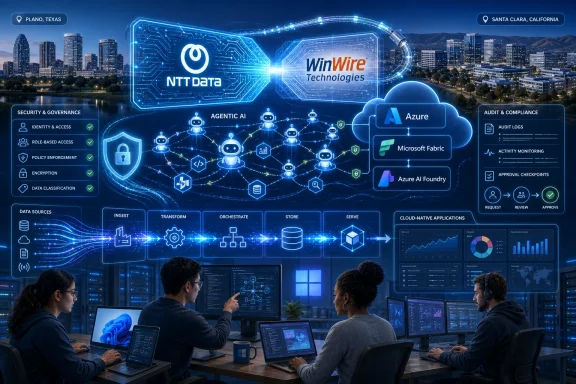 NTT DATA Is Buying Delivery Capacity, Not Just AI Vocabulary
The most important number in the announcement is not the market forecast or the expected size of the AI economy. It is the roughly 1,000 Azure engineers and Microsoft specialists WinWire is expected to bring into NTT DATA once the deal closes.That tells us what this transaction is really about. Enterprises have spent the last two years being told that generative AI will transform knowledge work, software development, customer service, operations, and analytics. Many have tested pilots. Far fewer have reorganized their data estates, identity models, compliance processes, application portfolios, and workflow governance around AI systems that can safely act on behalf of employees.
NTT DATA is buying a company that lives in that gap. WinWire’s pitch is not that it owns a foundation model or a magical chatbot. It is that it knows how to build the scaffolding around Microsoft’s AI stack: Azure, Microsoft Fabric, Azure AI Foundry, cloud-native development, and modern data engineering.
That distinction matters. The current AI market rewards spectacle, but enterprise IT rewards repeatability. A demo can survive with synthetic data, generous permissions, and a forgiving audience. A production system has to survive procurement, security review, incident response, data residency, cost controls, service-level commitments, and the quiet wrath of business users who will abandon any tool that creates more work than it removes.
NTT DATA’s acquisition intent says the company believes the next phase of AI adoption will be brutally practical. The winner is not the integrator with the best slide deck on agentic AI. The winner is the one with enough specialists to land AI inside the messy, Microsoft-heavy estates where enterprises already live.
Microsoft’s AI Stack Needs an Industrial Supply Chain
Microsoft has spent the Copilot era turning AI into a platform story. Azure supplies infrastructure and model access. Microsoft Fabric tries to unify analytics and data engineering. Azure AI Foundry gives developers and organizations a managed environment for building and operating AI applications and agents. Microsoft 365 and Dynamics provide the productivity and business-process surfaces where many of those agents are expected to show up.That strategy creates a huge opportunity for Microsoft partners, but also a huge dependency. Microsoft can ship the platforms, but it cannot personally refactor every legacy workflow, reconcile every data warehouse, secure every tenant, and train every business unit to trust agent-driven processes. The cloud vendor needs a delivery ecosystem large enough to make the platform real.
NTT DATA is positioning itself as one of those industrial delivery arms. The company already claims a large Microsoft practice, tens of thousands of Microsoft certifications, and operations across more than 50 countries. WinWire adds a more focused Microsoft-native bench with specific depth in Azure-based AI and data modernization.
The phrase “agentic AI” deserves skepticism, because it is currently being stretched across everything from simple workflow automation to genuinely autonomous multi-step systems. But underneath the marketing fog is a real architectural shift. Enterprises are moving from AI as a conversational interface toward AI as a decision-and-action layer embedded in business processes.
That move creates demand for consultants who understand more than prompts. An agent that can summarize a document is one problem. An agent that can inspect inventory, update a ticket, trigger a customer notification, query a regulated data set, and escalate an exception is another. The second system requires identity boundaries, audit trails, policy enforcement, transaction handling, rollback plans, human approval paths, and data quality discipline.
This is where services firms smell money. Every enterprise that wants agents will discover that its data is inconsistent, its permissions are too broad, its application interfaces are uneven, and its governance model was designed for human operators rather than semi-autonomous software. NTT DATA’s deal for WinWire is a wager that fixing those problems will be a durable business, not a temporary AI gold rush.
WinWire Gives NTT DATA a Sharper Microsoft Edge
WinWire is not a household name to most Windows users, but in the Microsoft partner ecosystem it has the profile NTT DATA wants. It is headquartered in Santa Clara, operates global delivery centers in India, and has positioned itself around Microsoft Azure, AI-led transformation, data platforms, and cloud-native engineering. The company also says it has been a six-time Microsoft Partner of the Year award winner or finalist.That kind of credentialing matters in the Microsoft channel. Large enterprise buyers rarely choose a systems integrator solely because of a partner badge, but badges become shorthand for trust, access, and relevance. They suggest that Microsoft sees the partner as capable of delivering the kinds of workloads Microsoft wants customers to adopt.
For NTT DATA, the acquisition strengthens a story it has already been telling. The company has emphasized Microsoft cloud, security, AI, and industry transformation as core growth areas. It has also promoted its status as Microsoft’s 2025 Global System Integrator Growth Champion Partner of the Year, a label that is as much about momentum as it is about size.
The WinWire deal gives that momentum more substance. Instead of simply saying it can help clients adopt Azure AI, NTT DATA can point to an expanded specialist base and a company that has been built around Microsoft-first delivery. That matters at a time when global consultancies are competing to convince CIOs that they can move AI from sandbox to operating model.
There is also a geographic and organizational logic. NTT DATA wants to strengthen its North American leadership position, and WinWire brings a U.S.-based front door with Indian delivery scale. That is a familiar services pattern, but the AI twist is important: organizations want local advisory, industry context, and compliance awareness, while still needing enough engineering capacity to modernize platforms at speed.
The acquisition also gives NTT DATA a more explicit industry-AI narrative. WinWire has emphasized healthcare and software and digital platforms as key sectors. Those are areas where Microsoft cloud adoption is already deep, but where AI deployment can be constrained by privacy, reliability, and integration demands. If NTT DATA can turn WinWire’s frameworks into repeatable offerings, it gets more than headcount; it gets packaged credibility.
The Agentic AI Pitch Is Really a Data Engineering Pitch
The announcement repeatedly invokes agentic AI, but the quieter phrase “data engineering” may be more important. Agents are only as useful as the systems they can reason over and act within. If the underlying data estate is fragmented, stale, poorly governed, or inaccessible, the agent becomes a charming interface to organizational confusion.This is why Microsoft Fabric appears in the announcement alongside Azure AI Foundry. Fabric represents Microsoft’s attempt to pull data integration, analytics, data science, real-time intelligence, and business intelligence into a more unified software-as-a-service environment. Azure AI Foundry, meanwhile, is aimed at building, evaluating, deploying, and managing AI applications and agents. Together, they form the backbone of Microsoft’s argument that enterprise AI is not a standalone feature but a platform architecture.
For IT pros, that means AI projects increasingly begin with unglamorous work. Data classification has to improve. Lineage has to be understandable. Permissions need to be mapped to actual business roles. APIs and event streams need to be reliable. Legacy applications need wrappers, migrations, or replacements. Observability has to expand from infrastructure metrics to model behavior, agent actions, and business outcomes.
This is where many AI pilots stall. The chatbot works in a conference room because it is pointed at a curated corpus and shielded from operational complexity. The enterprise rollout fails because the real world contains duplicate customer records, contradictory policy documents, regional compliance exceptions, custom ERP extensions, and data owners who do not agree on who is allowed to see what.
NTT DATA and WinWire are selling the antidote: build the data and application foundation first, then scale AI through controlled, industry-specific patterns. That is not as thrilling as claiming that agents will replace entire departments by next quarter. It is, however, much closer to how large organizations actually change.
The acquisition also reflects a maturing view of AI risk. Early AI adoption often focused on model selection, prompt engineering, and user experimentation. Enterprise-scale AI forces harder questions about process control. If an autonomous system recommends an action, who approves it? If it takes the action, who audits it? If it makes a costly mistake, which logs prove what happened?
Those questions are not solved by a model provider alone. They are solved through architecture, governance, and delivery discipline. That is why the services layer is becoming one of the most consequential parts of the AI market.
The Windows Enterprise Estate Is the Battlefield
This deal should interest WindowsForum readers because Microsoft’s enterprise footprint is the terrain on which much of this AI adoption will play out. Windows endpoints, Microsoft 365 identities, Entra-based access controls, Teams collaboration, SharePoint content, Power Platform workflows, Dynamics business applications, SQL estates, Azure infrastructure, and third-party line-of-business systems all collide inside the average enterprise.When a company says it wants agentic AI, it usually means it wants software that can move across that environment without breaking it. That is a tall order. The agent may need to read a document in SharePoint, respect sensitivity labels, call a business API, write to a database, notify a user in Teams, and create an audit record that satisfies internal compliance. The user may experience that as a simple Copilot-like interaction, but the backend is a maze.
This is why Microsoft-aligned systems integrators are suddenly more strategic. The value is not just knowing Azure services. It is knowing the operational reality of Microsoft-centric enterprises: hybrid identity, old Active Directory assumptions, endpoint management through Intune or Configuration Manager, PowerShell automation, Exchange and SharePoint inheritance, Teams sprawl, conditional access policies, and the peculiar persistence of Excel as a mission-critical interface.
NTT DATA’s acquisition intent should be read as a statement about where AI budgets are moving. The first wave of spending went to experimentation, subscriptions, and executive visibility. The next wave goes to modernization, integration, governance, and managed operations. That work is less flashy, but it is more durable.
For sysadmins and enterprise architects, the lesson is that AI will not remain a side project owned by innovation teams. It will push into identity, endpoint policy, data lifecycle management, network architecture, software delivery, and incident response. The people who manage Windows and Microsoft cloud environments will increasingly be asked to make AI systems safe enough to operate.
That does not mean every admin needs to become a machine-learning engineer. It does mean the boundary between traditional IT operations and AI operations is dissolving. Access policy, logging, privileged actions, data retention, and user training are now AI deployment issues.
The Market Forecast Is Huge, but the Integration Problem Is Bigger
The announcement cites analyst estimates that the global AI market could grow from $390 billion to nearly $3.5 trillion over the next decade. Numbers that large should always be handled carefully. Market forecasts often combine software, services, infrastructure, consulting, and indirect spending in ways that make them directionally useful but operationally vague.Still, the magnitude tells us why NTT DATA is moving. Even if the eventual market is smaller than the most aggressive projections, enterprise AI is clearly becoming a central budget category. Cloud providers, chipmakers, software vendors, consultancies, and cybersecurity firms are all trying to claim a layer of the stack.
The problem is that enterprise AI spending is not a single market. It is a bundle of related investments: GPUs and cloud capacity, application modernization, data platforms, AI developer tooling, compliance systems, workforce training, security monitoring, and managed services. A company like NTT DATA wants to sit across as many of those layers as possible.
WinWire helps because it operates in the middle of the stack, where strategy meets implementation. It can help customers build AI-ready data foundations, modernize applications, and create agentic workflows using Microsoft technologies. That is a more defensible position than selling generic AI enthusiasm.
There is also a timing advantage. Enterprises are under pressure from boards and competitors to show AI progress, but many CIOs are wary of uncontrolled experimentation. They need partners who can provide acceleration without turning the IT estate into a governance nightmare. NTT DATA’s message is designed for that anxiety: scale AI, but do it securely, consistently, and with industry alignment.
The acquisition is subject to customary closing conditions and regulatory approvals, so it is not yet completed. The announcement did not disclose financial terms. That leaves open the usual integration questions: how WinWire will be folded into NTT DATA’s Microsoft business, whether its culture survives the scale-up, and how quickly its frameworks can be converted into repeatable global offerings.
Those questions matter because services acquisitions can look cleaner in press releases than they do in practice. Talent can leave. Sales motions can clash. Specialized firms can lose their edge inside larger organizations. NTT DATA is not just buying capability; it is taking on the challenge of preserving the very specialization that made WinWire attractive.
Microsoft’s Partner Economy Is Consolidating Around AI Execution
The WinWire deal fits a broader pattern in the Microsoft ecosystem. As AI becomes a platform race, specialized partners become acquisition targets for larger global system integrators that need credibility, skills, and delivery assets quickly. The market is moving too fast for every large firm to build all capabilities organically.This is not new in enterprise technology. Cloud migration created a similar wave of acquisitions as major services firms bought boutique AWS, Azure, Salesforce, ServiceNow, and data engineering specialists. The AI cycle compresses that pattern because customers are moving from experimentation to production while the platforms themselves are still evolving.
Microsoft benefits from this consolidation in the short term. A bigger, more capable partner bench helps Azure AI, Fabric, Copilot, and related services land in complex enterprises. It also gives customers a familiar procurement path: rather than betting on a small specialist alone, they can buy through a global integrator with a Microsoft-aligned delivery model.
But consolidation has trade-offs. Smaller specialists often win because they are focused, fast, and technically opinionated. Large integrators win because they can operate globally, staff heavily, and absorb risk. The best acquisitions preserve the first set of virtues while adding the second. The worst turn a sharp firm into another slide in a global capability deck.
For Microsoft customers, the practical question is not whether NTT DATA becomes larger. It is whether the combined organization can deliver cleaner outcomes: faster data modernization, better-governed AI agents, more reliable cloud-native applications, and less ambiguity around security and operations. If the answer is yes, the acquisition strengthens Microsoft’s enterprise AI channel. If not, it becomes another example of AI-era scale chasing AI-era hype.
There is also a competitive backdrop. Accenture, Capgemini, Cognizant, Infosys, Tata Consultancy Services, Wipro, IBM, Deloitte, and other global firms are all telling versions of the same story: AI transformation requires industry expertise, cloud depth, data engineering, security, and managed operations. NTT DATA’s move gives it more ammunition in that crowded fight.
The difference will be execution. Everyone can say “agentic AI.” Fewer can show a regulated enterprise how to deploy agents that safely perform work across real systems, with measurable value and tolerable risk. That is the bar WinWire is now being asked to help NTT DATA clear.
Security Will Decide Whether Agentic AI Leaves the Pilot Lab
Agentic AI raises the stakes because it shifts AI from advice to action. A system that drafts an email can embarrass you. A system that modifies a customer record, approves a workflow, changes a configuration, or triggers a financial process can create operational and legal consequences.That makes security a first-order concern, not a deployment afterthought. Enterprises will need to treat agents as actors inside their environments. They will need identities, permissions, scopes, logging, approvals, monitoring, and revocation paths. They will need to know which data an agent can access, which tools it can invoke, and which actions require human confirmation.
Microsoft has been pushing governance and control narratives around Copilot, Azure AI, and the broader agent ecosystem. But governance is not a switch. It has to be implemented across tenants, applications, data sources, and business processes. That is where integrators enter the picture.
WinWire’s claimed focus on secure enterprise-scale AI is therefore more than a marketing phrase. It speaks to the main obstacle between pilot success and production trust. If a customer cannot prove that an agent behaves within policy, the project will either be blocked by risk teams or quietly confined to low-impact use cases.
For Windows and Microsoft administrators, this means familiar disciplines become newly important. Least privilege, conditional access, device compliance, data loss prevention, sensitivity labeling, privileged identity management, and audit logging all become part of the AI operating model. The agent may be new, but the failure modes often look like old security problems at machine speed.
There is also a cost-management angle. Agentic systems can generate unpredictable consumption if they repeatedly call models, tools, data services, or workflows. Production AI requires financial observability as well as security observability. Cloud bills are not a side issue when AI workloads scale.
A mature AI deployment therefore looks less like a chatbot launch and more like a platform engineering program. It needs architecture standards, reusable components, deployment pipelines, testing harnesses, monitoring, incident response, and governance review. NTT DATA’s bet is that enterprises will pay heavily for partners that can package that complexity into deliverable programs.
The Real Product Is Confidence
The acquisition announcement frames the deal around helping organizations move beyond experimentation to operationalize AI at scale. That phrase has become common, but it is still the right way to understand the market.Most enterprises are not short on AI ideas. They are short on confidence. Confidence that the data is good enough. Confidence that security will hold. Confidence that costs will not spiral. Confidence that employees will use the tools. Confidence that regulators, auditors, and customers will accept the resulting workflows. Confidence that the system will improve business outcomes rather than simply demonstrate technical novelty.
NTT DATA is trying to sell that confidence. WinWire gives it a more specialized Microsoft engine for doing so. Microsoft gets a stronger partner capable of pushing Azure AI and Fabric deeper into enterprise accounts. Customers get a larger vendor promising to unify consulting, engineering, cloud modernization, AI development, and managed services.
The risk is that confidence can be oversold. AI transformation projects can become expensive, sprawling, and hard to measure. Agentic AI in particular can tempt organizations into automating before they understand the process they are automating. A bad workflow does not become good because an AI agent moves it faster.
This is where buyers need discipline. The best AI projects begin with bounded processes, clear ownership, measurable outcomes, and strong data controls. They expand as trust is earned. The worst begin with executive urgency, vague transformation language, and insufficient attention to the operational plumbing.
NTT DATA’s acquisition of WinWire will be judged by which kind of project it enables. If the combined firm helps customers build practical, secure, measurable AI systems on Microsoft platforms, the deal will look prescient. If it merely expands the vocabulary of transformation without improving delivery, it will fade into the background noise of AI consolidation.
The Microsoft AI Services Race Just Got a Larger Contender
The immediate story is a proposed acquisition, but the longer story is the professionalization of enterprise AI. The market is shifting from experiments run by small teams to programs run by CIOs, CISOs, data leaders, architects, and business owners. That shift favors companies that can provide scale, governance, and delivery muscle.For IT professionals, the deal is another reminder that Microsoft’s AI future will not arrive as a single product update. It will arrive through a series of platform changes, partner engagements, modernization programs, and governance fights inside real organizations. The infrastructure people will be in the room because the infrastructure is the product surface.
The most concrete takeaways are less about corporate positioning and more about what this means for enterprise technology work:
- NTT DATA has signed a definitive agreement to acquire WinWire, but the transaction still depends on customary closing conditions and regulatory approvals.
- WinWire is expected to add more than 1,000 Azure engineers and Microsoft specialists to NTT DATA’s Microsoft-focused cloud and AI delivery capacity.
- The deal centers on agentic AI, Microsoft Azure, Microsoft Fabric, Azure AI Foundry, data engineering, and cloud-native application modernization.
- The acquisition strengthens NTT DATA’s attempt to move enterprise customers from AI pilots toward governed, production-scale deployments.
- Microsoft’s partner ecosystem is becoming more important as customers discover that AI adoption requires data modernization, security controls, workflow integration, and managed operations.
- Windows and Microsoft cloud administrators should expect AI projects to increasingly touch identity, endpoint management, compliance, logging, cost controls, and application architecture.
Source: 01net NTT DATA Announces Intent to Acquire WinWire to Scale Enterprise AI Adoption and Accelerate Industry Transformation with Microsoft
