

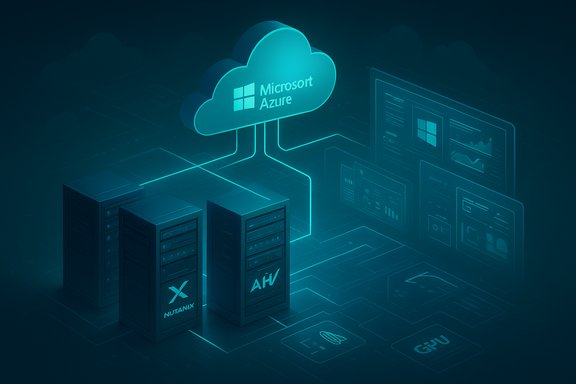
Nutanix’s recent headlines — widely circulated as the company “expanding Microsoft Azure Virtual Desktop flexibility across hybrid cloud” — are an important signal for enterprise desktop virtualization, but they must be read with care: the vendor’s public materials confirm a broad push to make Nutanix AHV a stronger platform for end‑user computing, yet independent verification that Microsoft has formally added AHV as a supported on‑prem host substrate for Azure Virtual Desktop (AVD) in the same way as Azure Stack HCI / Azure Local is not present in the public record at this time.
Virtual desktop infrastructure (VDI) and Desktop-as-a-Service (DaaS) remain a core element of hybrid work strategies for enterprises that need secure, centrally managed desktop experiences with low-latency local compute. Microsoft’s Azure Virtual Desktop (AVD) has evolved into a hybrid-capable platform where the service control plane runs in Azure while session hosts can be deployed either in Azure or in Microsoft’s supported on‑prem pathway (historically Azure Stack HCI, now often referenced as Azure Local). Microsoft’s documented on‑prem model is tightly coupled to a Windows‑centric stack — Hyper‑V, Azure Arc/Resource Bridge integration, and the Azure control plane — which handles identity, host registration, telemetry and licensing interactions. Nutanix has spent the last several years doubling down on hybrid multicloud consistency, making Nutanix Cloud Platform (NCI) and the AHV hypervisor a central vector for on‑prem EUC and hybrid workloads. Recent product moves (NC2 on Azure, expanded Citrix integration, and a new Omnissa Horizon integration) explicitly target the EUC market and give customers more on‑prem choices for delivering virtual desktops and apps from AHV. Those announcements are well documented in Nutanix’s blogs and vendor press, which describe integrations with Omnissa Horizon and improved Citrix multi‑cluster management on AHV. Taken together, the combination of Nutanix messaging and third‑party coverage has been reported (including by market wire services) as Nutanix enabling or supporting Azure Virtual Desktop on AHV. That’s the claim that demands technical and vendor-level verification before IT teams treat it as a supported, production‑grade option.
For customers that need immediate, supported hybrid AVD: adopt Azure Local / Azure Stack HCI (the Microsoft‑documented path), or run AVD in Azure and use Nutanix NC2 on Azure for hybrid consistency. If remaining on AHV is a priority and Microsoft support is not strictly required, validated AHV-native solutions like Citrix or Omnissa Horizon provide supported, production‑grade EUC today.
The Nutanix announcements expand the hybrid desktop conversation in useful ways; the prudent enterprise will convert that conversation into verified, documented steps before making irreversible infrastructure commitments.
Source: MarketScreener https://www.marketscreener.com/news...ibility-across-hybrid-cloud-ce7d5edbd080f42d/
 Background / Overview
Virtual desktop infrastructure (VDI) and Desktop-as-a-Service (DaaS) remain a core element of hybrid work strategies for enterprises that need secure, centrally managed desktop experiences with low-latency local compute. Microsoft’s Azure Virtual Desktop (AVD) has evolved into a hybrid-capable platform where the service control plane runs in Azure while session hosts can be deployed either in Azure or in Microsoft’s supported on‑prem pathway (historically Azure Stack HCI, now often referenced as Azure Local). Microsoft’s documented on‑prem model is tightly coupled to a Windows‑centric stack — Hyper‑V, Azure Arc/Resource Bridge integration, and the Azure control plane — which handles identity, host registration, telemetry and licensing interactions. Nutanix has spent the last several years doubling down on hybrid multicloud consistency, making Nutanix Cloud Platform (NCI) and the AHV hypervisor a central vector for on‑prem EUC and hybrid workloads. Recent product moves (NC2 on Azure, expanded Citrix integration, and a new Omnissa Horizon integration) explicitly target the EUC market and give customers more on‑prem choices for delivering virtual desktops and apps from AHV. Those announcements are well documented in Nutanix’s blogs and vendor press, which describe integrations with Omnissa Horizon and improved Citrix multi‑cluster management on AHV. Taken together, the combination of Nutanix messaging and third‑party coverage has been reported (including by market wire services) as Nutanix enabling or supporting Azure Virtual Desktop on AHV. That’s the claim that demands technical and vendor-level verification before IT teams treat it as a supported, production‑grade option.What Nutanix actually announced (and what the press reported)
- Nutanix’s public communications from its conferences and .NEXT event focus on:
- Native integrations to make AHV a stronger platform for EUC players (Citrix multi‑cluster management; Omnissa Horizon on AHV).
- Continued expansion of Nutanix Cloud Clusters (NC2) on public cloud providers, including Azure, which preserves a consistent operating model across on‑prem and cloud nodes.
- Market and wire stories summarized those vendor messages and reported that Nutanix would “support Microsoft Azure Virtual Desktop for hybrid environments,” phrasing that some outlets took to mean AVD session hosts could be run on Nutanix AHV on‑prem while still being managed from the Azure AVD control plane. That interpretation is attractive but technically consequential and, at the time of the reporting, not supported by a clear Microsoft‑backed technical document or joint GA announcement.
- Independent Nutanix materials and partner press (Omnissa, Citrix) substantiate Nutanix’s strategy to broaden EUC options on AHV — but they stop short of documenting Microsoft’s formal support for AVD session hosts on AHV. That gap is the core verification issue.
The technical reality: why “AVD on AHV” is not a trivial checkbox
Microsoft’s hybrid AVD path is not hypervisor‑agnostic by default. Key technical dependencies that must be satisfied for on‑prem AVD to behave as a first‑class, Azure‑managed service include:- Host registration and management hooks: AVD’s control plane expects session hosts to register and report health/telemetry via Azure Arc / Resource Bridge workflows. Those agents and management flows are built around Microsoft’s supported on‑prem solution set.
- Hypervisor compatibility and vendor validation: Historically, Microsoft’s on‑prem AVD implementations have been validated against Hyper‑V and the Azure Stack HCI (Azure Local) model. Other hypervisors (KVM‑based AHV included) are not documented as a supported host substrate for the Azure Local on‑prem pathway. Adding a new hypervisor as a supported AVD host requires explicit engineering, testing, and published Microsoft/Nutanix documentation.
- Licensing and entitlement nuances: Multi‑session Windows licensing (Windows 10/11 Enterprise multi‑session) and Microsoft 365 app behaviors can be tied to hosting models. Running session hosts on non‑Microsoft hypervisors may require clarification or license amendments. Enterprises must get written licensing guidance before deploying at scale.
- Operational support and SLAs: Even if a third‑party translation or “adapter” were developed to present AHV‑hosted VMs to Microsoft’s control plane, long‑term incident triage, cross‑vendor escalation paths and formal SLA commitments would be essential to avoid protracted “finger‑pointing” during production incidents.
What this would mean in practice — the potential upside
If Microsoft and Nutanix deliver a jointly supported offering that places AVD session hosts on AHV while preserving the AVD control plane, enterprises could realize meaningful operational and business benefits:- Hypervisor choice and vendor flexibility: Organizations that standardized on Nutanix AHV could add AVD to the same infrastructure without a wholesale hypervisor migration, preserving operational continuity and potentially lowering migration cost and complexity.
- Lower latency and data locality: Running session hosts close to users (on‑prem AHV) can reduce latency for graphics‑intensive and data‑sensitive workloads, satisfying sovereignty and compliance requirements where cloud egress is undesirable.
- Unified management for heterogeneous EUC stacks: If Nutanix’s Prism and Nutanix Cloud Clusters remain the operational fabric, IT could manage Citrix, Omnissa Horizon, and (if supported) AVD session hosts through a more consistent operational model, reducing toolchain fragmentation. Nutanix already documents native integrations for Citrix and partners with Omnissa to support VDI on AHV.
- Hybrid burst and mobility models with NC2 on Azure: Even without AVD on AHV, Nutanix Cloud Clusters (NC2) on Azure let customers keep operational consistency and move workloads into Azure for scale or proximity to Azure services. That route remains a proven alternative today.
The risks and caveats — why organizations must remain cautious
- No Microsoft‑published GA support for AHV as an AVD host substrate (yet): As of the latest vendor documents and Microsoft AVD guidance, the on‑prem AVD pathway is centered on Azure Local / Azure Stack HCI with Hyper‑V expectations. Public Nutanix materials do not contain a Microsoft‑backed, joint documentation page that confirms AHV as a first‑class AVD host. That absence elevates operational and licensing risk for production rollouts premised on the headlines.
- Potential licensing pitfalls: Microsoft’s licensing for multi‑session Windows and Microsoft 365 per‑user entitlements has historically been sensitive to the hosting model. Running session hosts on a non‑Microsoft hypervisor without explicit Microsoft guidance could create compliance exposure or unexpected costs. Ask for written licensing confirmation from Microsoft.
- Support fragmentation: Without a joint support matrix, incidents that involve the AVD broker and an AHV‑hosted session host could fall into a cross‑vendor escalation loop. Enterprises need a single, documented path for incident triage and joint root cause analysis.
- Feature parity and performance unknowns: Even if technical integration is possible, features such as GPU offload, multimedia redirection, USB redirection, and FSLogix profile behavior should be fully validated under representative workloads against Microsoft’s supported stack to ensure parity. NVIDIA and other ecosystem vendors publish support matrices that vary by platform; these dependencies must be tested.
Due‑diligence checklist for IT teams (practical, sequential steps)
- Obtain written product documentation from Nutanix and Microsoft that explicitly states the support model, GA date, and the exact list of supported configurations (host registration method, required agent versions, supported VM images, and management workflows).
- Secure written licensing guidance from Microsoft covering Windows multi‑session, Microsoft 365 Apps, and any other entitlement concerns for AVD session hosts running on AHV.
- Validate the support matrix and SLA: confirm who is the primary responder for specific categories (networking, host boot issues, AVD broker interactions, FSLogix profile corruption, GPU pass‑through). Demand a joint escalation and support contact list.
- Run a pilot with representative workloads and users that measure:
- Session boot and reprovision time
- FSLogix profile performance (IOPS and latency)
- GPU acceleration behavior for multimedia / CAD workloads (if required)
- RDP Shortpath and network‑latency characteristics
- Assess security and compliance posture: ensure telemetry, logging, and audit trails meet internal and regulatory controls; confirm data sovereignty behavior for profile storage and user data.
- Plan for rollback and migration: define an exit path that includes restoring users to Azure-hosted AVD or to validated on‑prem Citrix / Omnissa deployments if needed.
- Document FinOps impacts: model TCO across on‑prem capacity, licensing, Azure consumption (for control plane), and the cost of required professional services.
Alternatives and practical options available today
If organizations need a supported hybrid on‑prem AVD pathway immediately, consider these proven routes:- Azure Virtual Desktop on Azure Local (Azure Stack HCI): Microsoft’s documented hybrid on‑prem path for AVD remains the supported approach and offers published deployment steps, sizing guidance and vendor validation. Use this option when Microsoft support and SLA guarantees are non‑negotiable.
- Run AVD in Azure + Nutanix NC2 on Azure: For teams that want Nutanix operational consistency without waiting for new integrations, run session hosts in Azure while using NC2 on Azure for other Nutanix workloads to keep a consistent management plane and licensing portability.
- AHV‑native EUC stacks (Citrix, Omnissa Horizon): These are production‑grade, supported VDI/DaaS options on AHV today and can meet many enterprise hybrid desktop needs with clear vendor support and SLAs. Nutanix and partners have published integrations and beta programs (e.g., Omnissa Horizon on AHV) to provide alternatives.
- Third‑party management layers (e.g., Nerdio): Products like Nerdio Manager for Enterprise provide a single automation plane that can unify lifecycle management across cloud and on‑prem host pools; such automation can be valuable regardless of which hypervisor hosts session VMs. However, verify the exact host types Nerdio supports for AVD hybrid host pools in your required versions.
Ecosystem signals: partners, vGPU, backup and management
The broader ecosystem activity supports the narrative that Nutanix is pushing AHV as a viable EUC substrate:- vGPU and hardware support: Vendors such as NVIDIA publish explicit support guidance for AVD and Azure Local environments. GPU support matrices and driver compatibility differ across hypervisors and validated Azure Local releases, so GPU‑intensive AVD workloads must be validated against published vendor lists.
- Backup and data protection: Third‑party vendors (for example, Acronis) have added agentless backup support for Nutanix AHV, which strengthens operational protection options for AHV‑hosted VMs. Such ecosystem depth matters when you plan production desktop estates.
- Broader Nutanix partner momentum: Citrix’s native integration with Prism Central and Omnissa Horizon’s announced AHV support both indicate Nutanix’s EUC strategy is underway; those integrations are immediate, tangible steps — distinct from the separate question of Microsoft formally supporting AVD on AHV.
Analysis and recommendation
The headlines that Nutanix “expanded AVD flexibility across hybrid cloud” are a positive signal that Nutanix is focused on EUC parity and ecosystem choice. Nutanix’s investments in Omnissa, Citrix integrations and NC2 on Azure are real, verifiable moves that materially improve the options customers have for hybrid desktop strategies. However, the most consequential claim — that Microsoft now supports AVD session hosts running on Nutanix AHV in the same supported model used for Azure Local/Azure Stack HCI — is not yet corroborated by Microsoft’s published AVD documentation or by a joint Nutanix‑Microsoft technical document that lists AHV as a supported AVD host substrate. Until Microsoft publishes explicit support guidance and licensing clarifications, IT teams should treat the market reports as vendor intent rather than a drop‑in operational fact. Ask for joint GA statements, published integration guides, and written licensing confirmation before committing production AVD estates to AHV.For customers that need immediate, supported hybrid AVD: adopt Azure Local / Azure Stack HCI (the Microsoft‑documented path), or run AVD in Azure and use Nutanix NC2 on Azure for hybrid consistency. If remaining on AHV is a priority and Microsoft support is not strictly required, validated AHV-native solutions like Citrix or Omnissa Horizon provide supported, production‑grade EUC today.
Final thoughts
The enterprise desktop virtualization landscape is moving quickly: vendors are responding to customer demand for hypervisor choice, data locality, and hybrid operational consistency. Nutanix’s recent EUC investments strengthen AHV’s position as a viable on‑prem EUC platform and increase pressure on the broader ecosystem to offer interoperability and choice. However, when the stakes are high — licensing, compliance, and production SLAs — the difference between a promising vendor roadmap and a Microsoft‑supported, GA offering is material. Treat the current headlines as an important industry signal and pursue a measured path: require published joint documentation, pilot with representative workloads, demand written licensing clarity, and only then scale production deployments.The Nutanix announcements expand the hybrid desktop conversation in useful ways; the prudent enterprise will convert that conversation into verified, documented steps before making irreversible infrastructure commitments.
Source: MarketScreener https://www.marketscreener.com/news...ibility-across-hybrid-cloud-ce7d5edbd080f42d/
