

Nutanix says it will support Microsoft Azure Virtual Desktop (AVD) on-premises running on its AHV hypervisor — a claim first reported by market news outlets at Microsoft Ignite 2025 — but the announcement, as circulated, deserves careful parsing, verification, and a sober look at what it would actually mean for enterprise VDI strategies.
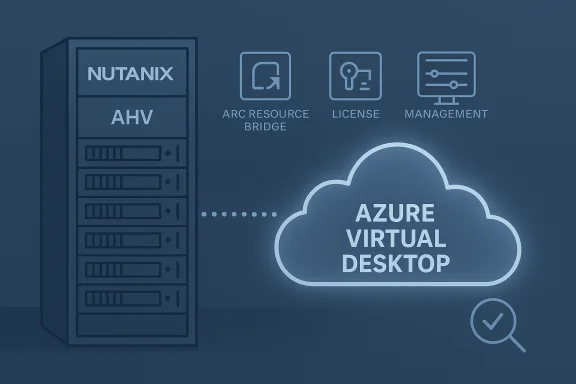
Virtual desktop infrastructure (VDI) and Desktop-as-a-Service (DaaS) remain central to hybrid-work strategies and secure remote access initiatives. Nutanix has long positioned its Nutanix Cloud Platform and AHV hypervisor as a foundation for on‑prem and hybrid EUC (End‑User Computing) deployments, with existing validated integrations for Citrix and new partnerships for on‑prem VDI stacks. At the same time, Microsoft has pushed toward an Azure‑centric on‑prem model for Azure Virtual Desktop through Azure Stack HCI (recently rebranded in documentation as Azure Local in some contexts), which embeds Hyper‑V as the supported hypervisor and relies on Azure control‑plane services such as Resource Bridge and Azure Arc for management. The result: headlines that Nutanix will “run AVD on AHV” are headline‑friendly, but the technical and commercial reality behind that phrasing is complex — and at the time of writing the publicly available primary sources from the vendor and Microsoft do not clearly present a finished, supported product that delivers AVD session hosts natively on AHV in the same way Microsoft supports AVD on Azure Stack HCI. Instead, Nutanix’s public announcements at recent events focus on broader EUC partnerships and expanded support for other VDI stacks on AHV.
In the evolving landscape of hybrid EUC, headline announcements matter — but the enterprise‑grade decisions that follow them demand proof points: published support documentation, licensing clarity, and joint support commitments. Until those items appear for AVD on AHV, organizations should plan around the proven, supported pathways while monitoring Nutanix and Microsoft for an official, jointly supported offering.
Source: TipRanks Nutanix to support Microsoft Azure Virtual Desktop for hybrid environments - TipRanks.com
 Background
Virtual desktop infrastructure (VDI) and Desktop-as-a-Service (DaaS) remain central to hybrid-work strategies and secure remote access initiatives. Nutanix has long positioned its Nutanix Cloud Platform and AHV hypervisor as a foundation for on‑prem and hybrid EUC (End‑User Computing) deployments, with existing validated integrations for Citrix and new partnerships for on‑prem VDI stacks. At the same time, Microsoft has pushed toward an Azure‑centric on‑prem model for Azure Virtual Desktop through Azure Stack HCI (recently rebranded in documentation as Azure Local in some contexts), which embeds Hyper‑V as the supported hypervisor and relies on Azure control‑plane services such as Resource Bridge and Azure Arc for management. The result: headlines that Nutanix will “run AVD on AHV” are headline‑friendly, but the technical and commercial reality behind that phrasing is complex — and at the time of writing the publicly available primary sources from the vendor and Microsoft do not clearly present a finished, supported product that delivers AVD session hosts natively on AHV in the same way Microsoft supports AVD on Azure Stack HCI. Instead, Nutanix’s public announcements at recent events focus on broader EUC partnerships and expanded support for other VDI stacks on AHV. What the announcement (as reported) actually says
- The market brief reported that Nutanix “announced at Microsoft Ignite 2025 that its Nutanix Cloud Platform solution will support Microsoft Azure Virtual Desktop for hybrid environments,” and quoted a Nutanix statement that this “will enable organizations to run Azure Virtual Desktop on premises on the Nutanix AHV hypervisor.”
- That wording, if taken literally, implies Microsoft’s AVD service could be deployed with session hosts running on Nutanix AHV inside customers’ datacenters, while still integrating with the AVD control plane. The promise is attractive: bring Azure‑managed desktops to the on‑prem infrastructure you already run, but keep the cloud‑managed operational model, security controls, and (presumably) licensing portability.
- Important caveat: Press summaries and wire copy can compress nuances. Publicly published Nutanix materials seen around the same timeframe highlight new AHV integrations with third‑party EUC vendors (for example, Omnissa Horizon) and improvements to multi‑cluster Citrix management on AHV rather than a formal, published Microsoft–Nutanix product page that documents AVD on AHV support at the time of reporting. That mismatch is why verification is needed.
Why the claim needs verification (technical realities)
AVD’s on‑prem model is tightly coupled to Microsoft’s HCI path
Microsoft’s on‑prem offering for Azure Virtual Desktop — historically labeled for Azure Stack HCI and now evolving under the Azure Local messaging — integrates deeply with Microsoft management stacks: Hyper‑V, Azure Arc, and the Resource Bridge or similar bridging technologies. Those components handle identity, telemetry, host registration, health reporting, and licensing interactions with the Azure control plane. Microsoft documentation and partner guidance consistently reference Azure Stack HCI / Azure Local and Hyper‑V as the supported on‑prem substrate for first‑class AVD deployments. That design limits one‑to‑one portability of AVD to arbitrary hypervisors without additional engineering or commercial arrangements.Key AVD on‑prem requirements that complicate AHV support
- Host registration and management via Azure Arc / Resource Bridge — host pools and session hosts must be registered in Azure and be manageable from Microsoft’s control plane. Microsoft’s existing on‑prem playbook relies on a Windows‑centric stack for those hooks.
- Hypervisor compatibility — AVD for Azure Local/Stack HCI presumes Hyper‑V; other hypervisors (KVM/AHV) are not documented as supported for the AVD for Azure Local pathway.
- Licensing and entitlement controls — Microsoft product licensing for multi‑session Windows and certain Microsoft 365 behaviors can be contingent on the hosting model; moving to an alternative hypervisor often requires explicit Microsoft product and licensing changes. This is an important commercial consideration that must be clarified between vendor partners.
- A formal Microsoft‑Nutanix engineering and support agreement that adds AHV to Microsoft’s supported on‑prem host models for AVD (with the necessary Resource Bridge/Arc integrations), or
- A third‑party translator or management layer that makes AHV‑hosted VMs appear as supported hosts in Microsoft’s control plane — a nontrivial engineering and support undertaking.
Nutanix’s recent EUC moves that form the likely context
Nutanix has actively expanded AHV’s EUC ecosystem. Recent, verifiable announcements include:- An integration with Omnissa Horizon (a remote desktop/app delivery solution) that runs on Nutanix AHV, explicitly aimed at giving customers more choice for on‑prem and hybrid VDI deployments. This partnership was presented as a way to run a Horizon‑style platform across on‑prem Nutanix and public clouds, managed through a unified control plane.
- Strengthened native support for Citrix multi‑cluster management on Prism Central with AHV, simplifying operations for enterprises that run Citrix Virtual Apps and Desktops on Nutanix. Nutanix’s messaging has pushed the narrative of “hypervisor choice” and interoperability for long‑standing EUC players in the ecosystem.
- Continued investment in hybrid extensions such as Nutanix Cloud Clusters (NC2) on Azure, which enables Nutanix environments to extend into Azure bare‑metal nodes. That hybrid capability provides another way to run Azure‑native services in proximity to Nutanix customers’ infrastructure by simply moving workloads into Azure while keeping a consistent Nutanix operating model.
What Nutanix supporting AVD on AHV would mean in practice
If a formal, supported offering exists or is forthcoming, enterprises could expect several potential benefits — assuming Microsoft backs the architecture:- Operational flexibility: run AVD‑managed desktops where you prefer — on Nutanix AHV on‑prem, in Nutanix‑managed clusters in public cloud, or in mixed topologies — while keeping the AVD management plane. This could reduce data egress, lower latency for local users, and align with sovereignty/compliance needs.
- Consolidated EUC operations: unify VDI, DaaS, and desktop delivery under Nutanix’s Prism management when AHV is a supported host, simplifying image management, scaling, and observability.
- Potential cost optimization: keep predictable on‑prem consumption and licensing while selectively bursting or shifting workloads to Azure. This is especially attractive to organizations with existing Nutanix investments.
- Clear Microsoft documentation showing AVD host pool lifecycle management and support for AHV‑hosted session hosts.
- Transparent licensing guidance from Microsoft about multi‑session Windows and Microsoft 365 app support on AHV‑hosted session hosts.
- Support and SLA commitments from both Microsoft and Nutanix for troubleshooting, patching, and lifecycle management across the dual‑vendor stack.
Technical and operational risks to evaluate now
- Supportability: Without explicit Microsoft support, running AVD components on an unsupported hypervisor can void vendor support and complicate problem resolution. Incident triage between Microsoft and Nutanix could become a protracted “finger‑pointing” exercise if errors fall across product boundaries.
- Identity and management linkage: AVD’s control plane interactions (session brokering, user profile management via FSLogix, and telemetry) assume specific host registration workflows that may not map neatly to KVM/AHV without engineered adaptors.
- Licensing pitfalls: Microsoft’s rules for multi‑session Windows and AVD licensing are nuanced and can be tied to hosting models; an unsupported host option may require unique licensing agreements or third‑party mediation. Enterprises must get written licensing clarity before large rollouts.
- Performance and feature parity: Even if a technical integration exists, performance characteristics and feature parity (e.g., GPU offload, multimedia redirection, USB redirection) must be validated under real workloads compared to Microsoft’s supported stack on Hyper‑V/Azure Stack HCI.
- Long‑term roadmap and product sustainment: Partners sometimes announce collaborations that lead to beta programs or limited technical previews. That’s valuable, but enterprises need clarity on GA timelines, roadmaps, and upgrade paths to commit mission‑critical EUC services.
Recommended questions and due diligence for IT teams and decision makers
When evaluating the Nutanix + AVD messaging, procurement teams should insist on written answers to a short checklist:- Is Microsoft formally supporting AVD host pools with session hosts running on AHV, or is this a Nutanix‑side integration tool that provides a comparable experience?
- What are the exact prerequisites for host registration, Resource Bridge/Arc integration, and identity management for on‑prem session hosts on AHV?
- How will Microsoft licensing for Windows multi‑session and Microsoft 365 Apps be handled for AHV‑hosted session hosts? Is there written guidance?
- What SLAs and support‑handoff procedures will be in place between Microsoft and Nutanix if customers encounter cross‑vendor issues?
- For production readiness, what benchmarking and compatibility tests have been performed for multimedia, GPU‑accelerated workloads, and FSLogix profile performance on AHV?
Alternatives and practical options today
Until a clear, supported AHV‑hosted AVD path is documented and widely available, organizations have practical alternative strategies to achieve hybrid AVD outcomes:- Use Azure Stack HCI / Azure Local for AVD on‑prem: This is Microsoft’s established, supported route for on‑prem AVD with documented management and licensing models. It remains the path for guaranteed Microsoft support.
- Run AVD in Azure and use Nutanix NC2 on Azure: For organizations that want to preserve Nutanix operational consistency, deploying Nutanix Cloud Clusters on Azure (NC2) and running AVD in Azure can deliver proximity, low latency, and hybrid management while leveraging Nutanix tooling for certain workloads.
- Adopt AHV‑native EUC stacks: If staying on AHV is a priority, established integrations with Citrix and Omnissa Horizon on AHV provide mature on‑prem EUC alternatives with clear support models. These solutions can offer feature parity for many use cases and are engineered to run on Nutanix AHV.
- Mixed topologies with brokering layers: Some organizations use brokering and management layers (e.g., third‑party control planes) to present a unified desktop experience across different hosting models, accepting increased management complexity in exchange for flexibility.
Strengths of the Nutanix promise — why it’s attractive
- Choice and vendor flexibility: If realized, running AVD on AHV would break a lock‑in vector and let customers choose the hypervisor they prefer while maintaining a cloud‑managed desktop experience. That’s a powerful negotiation lever for customers with heavy Nutanix investments.
- Performance and locality: Running desktops near users (on‑prem AHV) can reduce latency for graphics‑intensive workloads and satisfy data‑sovereignty or compliance constraints.
- Operational continuity: For organizations that standardized on Nutanix AHV for compute across many workloads, adding AVD to the same environment would simplify lifecycle and capacity planning — provided Microsoft supports that model operationally.
Where the public record stands today — a verification summary
- Market news outlets reported Nutanix said it would support Azure Virtual Desktop on AHV at Microsoft Ignite 2025. That coverage exists and is the origin of the current discussion.
- Nutanix’s official public announcements in the same timeframe demonstrate a concerted push into EUC partnerships (Omnissa Horizon, Citrix multi‑cluster management) and hybrid cloud capabilities (NC2 on Azure), but do not publish a Microsoft‑backed, GA statement or detailed technical documentation that shows Microsoft has added AHV as a supported host substrate for AVD in the same way as Azure Stack HCI. Thus, the claim, while plausible as a future roadmap or partnership intent, is not corroborated by Microsoft product documentation at this time. This gap makes the initial report partially verified at best and merits caution.
Bottom line and practical guidance
The business case for bringing cloud‑managed desktops to on‑prem Nutanix AHV is compelling — but the current public facts do not yet demonstrate a completed, Microsoft‑supported AVD on AHV solution at GA. The prudent approach for IT leaders is:- Treat the market report as an important signal of vendor intent rather than a drop‑in operational fact. Ask for vendor documentation and Microsoft confirmation in writing before planning migrations premised on AVD on AHV support.
- If immediate AVD on‑prem capabilities are required under Microsoft support, follow Microsoft’s current guidance for AVD on Azure Stack HCI / Azure Local or run AVD in Azure and use Nutanix NC2 on Azure for hybrid consistency.
- For customers committed to AHV, evaluate Omnissa Horizon and Citrix on AHV — both represent robust, supported EUC platforms that integrate with Nutanix’s operational model today and can meet many hybrid workplace needs while vendor clarity for AVD on AHV matures.
In the evolving landscape of hybrid EUC, headline announcements matter — but the enterprise‑grade decisions that follow them demand proof points: published support documentation, licensing clarity, and joint support commitments. Until those items appear for AVD on AHV, organizations should plan around the proven, supported pathways while monitoring Nutanix and Microsoft for an official, jointly supported offering.
Source: TipRanks Nutanix to support Microsoft Azure Virtual Desktop for hybrid environments - TipRanks.com
