Nutanix AVD on AHV: Hybrid Azure Virtual Desktop for On Prem VDI

  • Thread Author
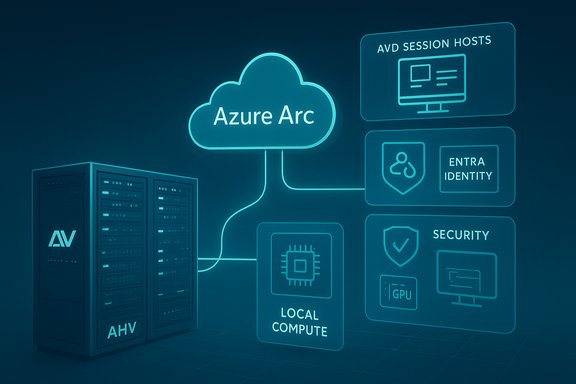
Server rack with Nutanix AHV branding beside a glowing cloud computing dashboard.
Nutanix and Microsoft have taken a significant step toward a more flexible, partner-driven VDI landscape by announcing that the Nutanix Cloud Platform will support Azure Virtual Desktop (AVD) for hybrid environments, enabling organizations to run AVD session hosts on-premises on Nutanix AHV while using Azure for brokering, management, and cloud-native integrations.

Background / Overview​

The announcement, revealed during Microsoft Ignite 2025, builds on two converging trends: enterprises’ desire to avoid lock‑in to a single deployment model, and Microsoft’s push to expand AVD beyond cloud‑native Azure deployments into hybrid topologies using Azure Arc. The new hybrid AVD capability lets customers use Arc‑Enabled Servers to register on‑premises VMs as AVD session hosts, which in turn allows partners such as Nutanix to provide lifecycle, provisioning, and session‑host operations for environments that must remain local for performance, sovereignty, or compliance reasons.
This move is positioned as a preview capability: Nutanix has confirmed support for AVD on Nutanix AHV is under development, while Microsoft has published the limited‑preview framework called Azure Virtual Desktop for hybrid environments, listing Nutanix among launch partners alongside other tooling vendors. The preview is explicitly designed to broaden customers’ options — enabling on‑prem AHV, VMware vSphere, Hyper‑V, or even physical Windows Server hosts to participate in the AVD control plane.

What Microsoft and Nutanix Actually Announced​

Microsoft: AVD for hybrid environments (Azure Arc + AVD)​

Microsoft’s AVD hybrid announcement introduces a model where Azure Arc‑enabled servers can act as AVD session hosts. The control plane (brokering, management, identity integration, and user access) remains in Azure, while session hosts live where organizations prefer — on‑premises or in alternate clouds. Microsoft positioned this as a limited preview with partner integrations to provide provisioning and lifecycle capabilities for non‑Azure hypervisors and infrastructure.
Key bullet points about Microsoft’s hybrid AVD model:
  • AVD control plane remains cloud‑hosted in Azure; session hosts can register via Azure Arc.
  • Hybrid host types include Hyper‑V, Nutanix AHV, VMware vSphere, physical Windows Servers, and other Arc‑compatible hosts.
  • VM lifecycle management on hybrid hosts can be delivered by partner tools rather than the Azure native provisioning pipeline.
  • The preview excludes some cloud‑only features (for example, Windows 11 Enterprise Multi‑Session is not supported in the hybrid preview).

Nutanix: AVD on AHV (under development)​

Nutanix announced that the Nutanix Cloud Platform will support AVD session hosts running on Nutanix AHV, integrating their hypervisor and management stack with Microsoft’s hybrid AVD framework. Nutanix frames the capability around hybrid flexibility, performance for latency‑sensitive workloads, and compliance concerns that drive on‑premises deployments in regulated industries.
What Nutanix is promising:
  • Ability to run AVD session hosts on‑premises on Nutanix AHV.
  • Use of Azure brokering and management (via Azure Arc) while preserving local control and performance.
  • Improved options for burst scaling and disaster recovery by combining AHV with Azure resources (including Nutanix Cloud Clusters on Azure for hybrid mobility).
  • Integration with Microsoft 365, Teams optimizations, and Microsoft Entra identity services through the AVD control plane.
Note: Nutanix’s capability remains in development and has no GA date announced at the time of the preview.

Why this matters: Strategic and technical implications​

1) Choice without vendor lock‑in — a practical breakthrough​

One of the clearest benefits is giving enterprises a real choice in where session hosts run. Organizations with large investments in Nutanix infrastructure (or with strict data‑residency rules) can keep session hosts local, while still using Microsoft’s cloud‑native management, policy, and security integrations. That lowers migration friction and makes hybrid AVD attractive for phased cloud transformations.

2) Better fit for regulated industries​

Finance, healthcare, government, and other regulated sectors frequently need hard guarantees about where data resides. Running session hosts on AHV inside a local data center enables:
  • Tighter control over storage and networking.
  • Easier certification against regional regulations and industry standards.
  • Reduced legal exposure by keeping sensitive workloads in local facilities.

3) Performance and graphics workloads​

Nutanix emphasizes on‑prem performance benefits for latency‑sensitive and graphics‑intensive VDI workloads. Keeping session hosts close to users and to on‑premises services can reduce latency and improve experience for demanding applications, such as CAD, 3D visualization, or financial trading desktops.

4) Hybrid scale and DR through Azure​

Organizations can combine on‑prem AHV VMs with Azure for burst capacity and disaster recovery. Nutanix Cloud Clusters (NC2) on Azure let customers migrate or scale workloads into Azure infrastructure without refactoring applications, providing a path for temporary scale‑out or failover.

Partner ecosystem: tooling, monitoring, automation​

Microsoft explicitly positioned partner tooling as a core component of the hybrid preview. The initial launch partner set includes management and performance vendors that provide lifecycle, monitoring, and automation capabilities for non‑Azure environments. That partner approach matters because Azure’s native AVD provisioning is tightly integrated with Azure resource management; bringing non‑Azure hosts into that choreography requires lifecycle tooling from partners.
Partners in the preview bring:
  • Provisioning and image management for on‑prem hosts.
  • Real‑time performance monitoring and user‑experience telemetry.
  • Automated testing, capacity planning, and cost‑control tooling.
  • Integration with identity and policy engines (Microsoft Entra, conditional access).
For Nutanix customers, expect Prism Central and Nutanix management integrations to be the primary operational surface. Third‑party solutions (e.g., vendor X for monitoring, vendor Y for automation) will likely be important to fill gaps in AVD lifecycle features on local infrastructure.

Licensing and functional limitations — what to watch closely​

This hybrid path increases flexibility, but it also introduces several important constraints and real‑world caveats that IT teams must evaluate before committing.

Windows 11 Enterprise Multi‑Session limitation​

In the initial preview, Windows 11 Enterprise Multi‑Session is not supported for hybrid session hosts. That has concrete implications:
  • Multi‑session density and licensing economics that many AVD customers rely on are unavailable in hybrid host pools.
  • Organizations that depend on Windows 11 Multi‑Session for high‑density VDI must stay on Azure or Azure Local for that capability, at least initially.

Licensing complexity​

AVD access and OS entitlement still require the appropriate Microsoft licensing. Typical entitlements include Microsoft 365 E3/E5, Windows Enterprise SKUs, or Windows Virtual Desktop rights built into certain subscriptions. If session hosts run Windows Server, RDS CALs or other licensing mechanisms may be required. Key considerations:
  • Ensure user subscriptions or RDS CALs are correctly assigned and validated.
  • Understand that license validation may require connectivity to Microsoft services.
  • Shared‑computer activation for Microsoft 365 Apps and FSLogix profile strategies must be validated in a hybrid context.

Preview status and support matrix​

  • The Nutanix support for AVD is currently under development; there is no GA date and no full joint support matrix published yet.
  • Organizations should treat the preview as not production‑ready for critical workloads until joint documentation and support commitments are published.
  • Confirm support boundaries: who handles incidents that span AHV hypervisor issues and AVD control plane problems — Nutanix, Microsoft, or both? Expect the need for defined joint support processes.

Operational and security considerations​

Connectivity and control plane dependencies​

Hybrid AVD keeps the management and brokering plane in Azure, which means on‑prem session hosts must maintain reliable, secure connectivity to Azure. Operationally:
  • Design resilient network connectivity to Azure, including redundant internet paths or ExpressRoute where required.
  • Plan for scenarios where cloud connectivity is degraded — what is the impact on new sessions and existing sessions?
  • Review firewall and proxy rules to permit Azure Arc, Microsoft Entra, and AVD control traffic.

Identity and access​

Integration with Microsoft Entra (Azure AD) and conditional access policies remains central to identity control. Hybrid deployments must ensure:
  • Session hosts can join or register with Microsoft Entra as required.
  • Conditional access and multifactor authentication flows are validated across on‑prem and cloud endpoints.

Monitoring, telemetry, and user experience​

AVD relies on telemetry (user experience, latency, CPU, GPU usage) to operate well. Partners and Nutanix will need to provide:
  • Real‑time monitoring that maps to AVD user‑experience KPIs.
  • Alerting and capacity automation to avoid poor user experiences during peak demand.
  • Integration with FSLogix profile telemetry to detect profile mounting failures and other common VDI failure modes.

Security posture and compliance​

While running session hosts on‑prem may make compliance audits easier, hybrid architectures also introduce new exposure:
  • The attack surface includes both the on‑prem virtual infrastructure and the Azure control plane.
  • Azure Arc registration and cross‑tenant management must be implemented with least‑privilege principles.
  • Data flows between on‑prem storage and Azure (for backup, profile storage, or DR) must be secured and documented.

Deployment guidance: practical steps for pilots and rollouts​

  1. Start with a small pilot using non‑critical user groups to validate:
    • Session host registration via Azure Arc.
    • Identity integration (Microsoft Entra) and conditional access.
    • FSLogix profile mounting and Microsoft 365 shared activation.
  2. Validate network and latency characteristics from user locations to the on‑prem data center and to Azure control endpoints.
  3. Confirm licensing entitlements and license activation flows for Microsoft 365 and Windows.
  4. Test application compatibility, especially GPU drivers and vendor‑licensed apps (Adobe, Autodesk, etc., and ensure licensing works in shared and single‑session models.
  5. Measure user experience and use partner monitoring tools to collect telemetry and build baseline KPIs.
  6. Design DR and burst scenarios using Nutanix Cloud Clusters (NC2) on Azure or alternative cloud options; validate failover and failback processes.

Risks, unknowns and where to be cautious​

  • Production readiness: This is a preview path. Nutanix support for AVD on AHV is under development and lacks documented GA support and joint operational playbooks. Treat the preview as experimental until both vendors publish firm support and runbooks.
  • Feature parity: Cloud‑native AVD features may not be available in hybrid mode (e.g., Windows 11 Multi‑Session absent in preview). Expect feature differences and plan accordingly.
  • Support responsibility: Hybrid incidents cross vendor boundaries. Define escalation and incident ownership before wide deployment.
  • Licensing nuance: Licensing interactions between Microsoft 365, Windows client rights, RDS CALs, and third‑party vendor licenses (e.g., Adobe) can introduce surprises during activation and compliance checks.
  • Operational complexity: Running dual management planes (Prism/Prism Central + Azure) can create friction; automation and tooling from partners will be crucial to simplify operations.
  • Unverifiable or vendor‑collected claims: Some quoted partner statements or channel‑level anecdotes (e.g., local partner demand trends or specific local executive quotes) may not appear in the official press materials. These should be validated with local partner contacts before relying on them for procurement decisions.

Who benefits most — and who should wait​

Beneficiaries:
  • Organizations with strict data‑residency or sovereign cloud requirements that cannot put session hosts into public Azure.
  • Enterprises with significant Nutanix AHV footprints seeking to modernize VDI without wholesale migration.
  • Regulated industries needing on‑prem control while leveraging Microsoft identity and security services.
Potentially better served by waiting:
  • Organizations that depend on Windows 11 Enterprise Multi‑Session density economics.
  • Teams that lack the networking maturity or support SLA to ensure resilient connectivity to Azure control planes.
  • Deployments that require immediate, GA‑backed joint support across Nutanix and Microsoft for mission‑critical desktops.

Commercial and channel impact​

For Nutanix partners and managed service providers, hybrid AVD creates new revenue opportunities:
  • Migration projects that keep existing hardware investments while modernizing management and security stacks.
  • Managed AVD hosting using Nutanix as the substrate for regulated customers.
  • Hybrid DR and burst services leveraging Nutanix Cloud Clusters on Azure to provide integrated failover.
However, partners will need to be prepared to:
  • Clarify support scopes and SLAs with customers.
  • Invest in tooling and automation that bridge Prism/Prism Central and the Azure control plane.
  • Up‑skill around Azure Arc, Microsoft Entra, and AVD management even when the session hosts remain on‑premises.

Final assessment and recommended approach​

The Nutanix + Microsoft hybrid AVD announcement is a pragmatic, industry‑savvy step that acknowledges the realities of enterprise infrastructure: many organizations want cloud benefits without surrendering local control. The preview opens a compelling technical path for regulated and latency‑sensitive VDI workloads to stay on‑premises while tapping Azure’s identity, security, and brokering services.
That said, the preview status, functional gaps (notably no Windows 11 Multi‑Session in hybrid), and the need for rigorous interoperability and support playbooks mean this is not yet a drop‑in replacement for cloud AVD in production. Enterprises should pursue a cautious, test‑driven adoption:
  • Treat the hybrid AVD on AHV capability as a controlled pilot in 2025–early‑2026, not a mass rollout vehicle.
  • Validate licensing, performance, and user‑experience with representative workloads.
  • Insist on written support commitments and joint operational runbooks from vendors before migrating mission‑critical VDI estates.
  • Consider hybrid AVD as part of a staged migration strategy that leverages Nutanix NC2 and Azure for burst and DR scenarios.
Hybrid AVD on Nutanix AHV promises to deliver real value by removing artificial barriers between on‑prem and cloud VDI models. The ultimate measure will be how quickly Nutanix and Microsoft close the preview gaps, publish joint support statements, and make clear the operational model for customers and channel partners. In the meantime, IT teams can prepare: validate architectures, update licensing inventories, and run pilots that exercise the most important failure and scale scenarios so they can move faster once GA and fully documented support arrive.

Conclusion
The Nutanix‑backed hybrid AVD preview marks a turning point in enterprise desktop virtualization: it broadens the choices available to organizations and brings hybrid multicloud realities into the mainstream AVD story. For customers and partners, the opportunity is clear — but so is the need for caution. Rigorous pilots, clear support agreements, and careful licensing validation will be essential to realize the promise of on‑prem AVD session hosts running on Nutanix AHV without trading away the operational simplicity and advanced capabilities provided by Azure’s cloud control plane.

Source: ARNnet Microsoft Azure virtual desktop to get Nutanix support in hybrid cloud - ARN
 

Nutanix’s announcement at Microsoft Ignite 2025 that the Nutanix Cloud Platform will support Microsoft Azure Virtual Desktop (AVD) for hybrid environments, enabling AVD session hosts to run on Nutanix AHV on premises while using Azure’s control plane for brokering and management, marks a notable pivot in how enterprises can architect virtual desktop infrastructure (VDI) across hybrid cloud footprints.

AHV server cluster connected to the cloud delivering virtual desktops to multiple monitors.Background​

Hybrid work models and stricter data residency rules continue to drive demand for flexible VDI architectures that combine cloud control planes with on‑premises compute. Microsoft’s recent limited preview of Azure Virtual Desktop for hybrid environments lets organizations register Arc‑enabled servers as AVD session hosts, expanding the choices for where session hosts run — across Hyper‑V, VMware vSphere, Nutanix AHV, physical Windows Servers, or other Arc‑enabled platforms. This new hybrid option is explicitly positioned as a preview and partner-enabled model rather than a direct replacement of Microsoft’s Azure Local / Azure Stack HCI on‑prem pathway. Nutanix framed its Ignite announcement as a response to customer demand for choice: enterprises with large Nutanix AHV footprints can now plan for Azure‑managed desktops without forced hypervisor migrations, using their existing infrastructure for latency‑sensitive or regulations‑driven workloads while maintaining Azure’s identity, security, and management stack. Nutanix’s messaging emphasises control, performance and cost predictability for VDI workloads running on AHV.

What Nutanix announced (the facts)​

Core claim​

  • Nutanix said its Nutanix Cloud Platform will support Azure Virtual Desktop for hybrid environments, enabling AVD session hosts to run on Nutanix AHV in customer datacenters while using Azure for brokering and management. The capability is under development and was announced at Microsoft Ignite 2025.

Vendor statements​

  • Nutanix executives described the move as widening customer choices for virtual desktop deployments and highlighted native support for Microsoft 365, Teams optimizations, Microsoft Entra integration, and use of Azure Arc for secure connection to Azure services. Microsoft’s AVD product team reiterated that the hybrid preview is intended to give customers the option to run AVD on premises with partner integrations.

Partner ecosystem at launch​

  • Microsoft listed several launch partners supporting the hybrid preview model — including Nerdio, ControlUp, LoginVSI, and Nutanix — which will provide lifecycle, provisioning, monitoring and testing integrations to enable AVD on partner-managed on‑prem infrastructure. Several partner press releases confirm their early work to support the hybrid preview.

Why this matters: Strategic benefits for IT​

Hybrid flexibility without hypervisor lock‑in​

One of the most tangible benefits is choice. Organizations that standardized on Nutanix AHV for server workloads can now plan for Azure‑managed desktop sessions to live alongside other workloads on the same platform. This reduces the need for disruptive migrations to Hyper‑V or to run all session hosts in Azure, giving teams more flexibility in balancing performance, compliance and cost.

Data residency and compliance​

For regulated industries — financial services, healthcare, government — the ability to keep session hosts and data in a local datacenter while leveraging Azure’s control plane can simplify compliance and data residency obligations. Running session hosts on premises addresses where data rests and can be a decisive factor where policy or law restricts cloud storage or processing.

Performance for latency‑sensitive and graphics workloads​

Local AHV compute can reduce network latency for interactive workloads, remote CAD/CAM, or GPU‑accelerated applications. Nutanix positions AHV as optimized for such workloads, and the hybrid AVD model aims to let organizations place session hosts where it makes technical sense. This is especially relevant for distributed offices, edge sites, or locations with constrained connectivity to public cloud regions.

Familiar Microsoft integration​

Because the control plane, brokering, and management remain in Azure, organizations keep access to Microsoft integration points: Microsoft 365, Microsoft Teams optimizations, Microsoft Entra identity, and Azure security services. That helps preserve end‑user feature parity and security posture while distributing session host placement. Microsoft’s AVD blog underscores this model: session hosts are Arc‑enabled and still integrate with the Azure Virtual Desktop service in the cloud.

How the hybrid model technically works​

Azure Arc as the bridge​

Azure Arc provides the host registration, inventory, policy, and management surface that allows on‑prem resources to appear in Azure. Under the hybrid preview, Arc‑enabled servers can be registered as session hosts that connect to the Azure Virtual Desktop control plane. This is the architectural core that makes cross‑hypervisor hybrid deployments possible.

Partner responsibility for VM lifecycle​

Microsoft’s blog is explicit: VM provisioning and management for AVD can be delivered through alternative means, including partner solutions. That means tasks such as provisioning golden images, scaling host pools, and lifecycle automation are expected to be handled by Nutanix tooling or third‑party partners (for example Nerdio, ControlUp or LoginVSI), rather than by a Microsoft‑provided provisioning engine on non‑Microsoft hypervisors.

Supported guest OSes and feature caveats​

The hybrid preview currently supports Windows 11 Enterprise and Windows Server session hosts, but Microsoft notes that Windows 11 Enterprise Multi‑Session is not supported in the hybrid Arc model — a meaningful limitation for customers who relied on multi‑session density to reduce costs. Organizations must validate whether the supported guest operating systems and features meet their workload needs.

Verification and what’s still roadmap vs. production​

The announcement is a preview and a partnership statement​

Nutanix’s release and Microsoft’s AVD blog both describe the capability as limited preview or under development. That means it is not yet a General Availability (GA) product with documented support matrices, single‑vendor SLAs, or long‑term maintenance commitments. Enterprises should treat the public statements as the start of a joint engineering effort rather than a completed, fully supported product.

Microsoft’s canonical on‑prem pathway remains Azure Local / Azure Stack HCI​

Microsoft continues to document Azure Local / Azure Stack HCI as the official validated route for running Azure services on customer infrastructure, and that path historically implies tight integration with Microsoft Hyper‑V and validated hardware. The hybrid preview expands options, but Azure Local remains the Microsoft‑documented, first‑class on‑prem model for AVD if organizations need the clearest, supported route today. Enterprises must weigh the trade‑offs between a validated Azure Local approach and partner-enabled hybrid options.

Missing public details to watch for​

At the time of announcement, several operational details remain unspecified publicly:
  • Formal Microsoft–Nutanix joint support statements, SLAs and escalation paths.
  • Exact host registration mechanics, required agents, and validated AHV versions.
  • Feature parity guarantees (e.g., policy management, diagnostics, telemetry).
  • Licensing letters and how existing Microsoft licensing is handled in hybrid AVD scenarios.
Until those items are documented, production deployments should be considered experimental or conditional on a clear vendor commitment. Independent industry analysis and forum discussion echo these cautions and recommend waiting for joint documentation for enterprise rollouts.

Alternatives and practical migration paths​

If an organization needs an immediate, fully supported on‑prem AVD deployment today or wants to avoid uncertainty, consider these options:
  • Azure Virtual Desktop on Azure Local / Azure Stack HCI — Microsoft’s documented, validated on‑prem route with a clear support matrix.
  • Host session VMs in Azure and use Nutanix Cloud Clusters (NC2) on Azure to maintain Nutanix operational consistency while keeping compute in Microsoft‑backed Azure compute. Nutanix has expanded NC2 presence (AWS, Azure, preview on Google Cloud) to facilitate hybrid mobility.
  • Use AHV‑native EUC stacks (Citrix Virtual Apps & Desktops, Omnissa Horizon) that already run on AHV and are supported by Nutanix today; these may be more immediately production‑ready for certain VDI workloads. Nutanix’s recent partner integrations highlighted Omnissa Horizon and improved Citrix multi‑cluster management on AHV as viable EUC alternatives.
Each path has trade‑offs between vendor validation, operational continuity, feature availability and licensing economics.

Security, identity and compliance considerations​

Integration with Microsoft Entra and Azure security services​

Nutanix’s messaging includes Microsoft Entra integration and the ability to leverage Azure security services for unified identity and conditional access controls. Using Azure’s control plane, organizations can apply modern security models and conditional access policies even when session hosts are on premises — provided Azure Entra policies and telemetry can be enforced with the chosen Arc host configuration.

Data flow and telemetry​

Architecturally, the hybrid model means session host compute stays local, but control, brokering, and some telemetry flow to Azure. Organizations must map and assess network egress, logging, and telemetry flows for regulatory compliance and for ensuring that sensitive data is not inadvertently transmitted outside approved boundaries. This is especially important for regulated sectors.

Patch management and OS support​

Because VM lifecycle management on non‑Microsoft hypervisors may rely on partner tools, enterprises need validated patching and update processes for session hosts. That includes ensuring that supported Windows Server or Windows 11 Enterprise builds are maintained and that Microsoft security updates are applied in a timely, auditable fashion. The hybrid preview’s lack of Windows 11 multi‑session support also impacts capacity planning and security patch windows.

Cost and licensing realities​

Potential cost benefits​

Running session hosts on existing Nutanix AHV hardware can reduce immediate cloud spend and avoid extensive replatforming. Nutanix emphasises predictable economics by leveraging existing infrastructure and Microsoft licensing rights. For workloads that require sustained local compute, on‑prem execution can be more cost‑efficient than cloud compute when measured over multi‑year hardware lifecycles.

Licensing and Microsoft entitlements​

Microsoft’s AVD licensing model historically involves combinations of Microsoft 365, Windows licenses, and Azure subscription charges for the control plane. Microsoft and partners have indicated licensing efficiencies remain possible, but concrete guidance on licensing equivalence for hybrid Arc‑enabled servers vs. Azure Local/Azure-hosted session hosts has not been fully published. Organizations must seek written licensing guidance from Microsoft account teams or partners before making commitments. Microsoft’s blog and partner materials encourage engagement with account teams for preview enrollment and licensing clarity.

Operational and tooling ecosystem​

Partner tooling will be essential​

Because Microsoft expects partners to supply VM provisioning and lifecycle tools for hybrid AVD on non‑Microsoft hypervisors, tooling partners will be central to success. Nerdio, ControlUp, LoginVSI, and others announced quick support for the hybrid preview, promising automation, monitoring and testing tooling to make deployments manageable at scale. Customers should evaluate partner maturity and roadmap alignment with Nutanix and Microsoft.

Monitoring, performance validation and testing​

Enterprises will need to validate performance and user experience at scale, especially for graphics‑intensive workloads or large user populations. Partners such as LoginVSI are positioning their tools to validate cost/performance tradeoffs. Monitoring integrations (ControlUp et al. will be critical to maintaining SLA targets and to troubleshooting hybrid control plane interactions.

Risks and mitigation​

  • Risk — Lack of GA support and documented SLAs: The preview status means support matrices and formal SLAs are incomplete.
  • Mitigation: Treat early deployments as pilots; require vendor commitments in writing before moving production workloads.
  • Risk — Feature gaps (e.g., Windows 11 multi‑session): Not all cloud features are available in the hybrid preview.
  • Mitigation: Reassess VDI density models and cost assumptions; plan for alternate OS choices or host placement.
  • Risk — Unclear licensing implications: Licensing for hybrid session hosts across Arc and Azure can be complex.
  • Mitigation: Obtain formal licensing clarification from Microsoft and include licensing audit protection in procurement contracts.
  • Risk — Tooling and lifecycle fragmentation: Relying on partner tooling introduces operational heterogeneity.
  • Mitigation: Standardize on one or two vetted partners; require integrated testing and single‑pane‑of‑glass dashboards for operations.
  • Risk — Security and telemetry exposure: Control plane telemetry flows to Azure; local security boundaries must be defined.
  • Mitigation: Document data flows, implement encryption controls, and validate with compliance teams and third‑party auditors.

Practical roadmap for IT teams (recommended steps)​

  • Form a cross‑functional assessment team (infrastructure, security, EUC, procurement) to define objectives and constraints.
  • Enroll in the hybrid preview where appropriate to gain hands‑on experience and gather telemetry; coordinate with Microsoft and Nutanix account teams.
  • Pilot with a bounded user group that has latency sensitivity or regulatory constraints to validate performance on AHV.
  • Select partner tooling for provisioning, monitoring and testing (evaluate Nerdio, ControlUp, LoginVSI, or Nutanix‑provided options).
  • Document licensing and support commitments in writing with Microsoft and Nutanix before any production cutover.
  • Conduct security and compliance reviews including data flow mapping, encryption and access controls tied to Entra policies.
  • Plan a staged migration with clear rollback points and a timeline for vendor‑validated GA support.
  • Measure TCO and user experience across pilot cohorts and refine placement rules for when to run session hosts on AHV vs. Azure.

Critical analysis — strengths, uncertainties and market implications​

Nutanix’s announcement strengthens the hybrid narrative in multiple ways: it gives enterprises with entrenched AHV deployments a clearer pathway to consume Microsoft‑managed desktop services without a full hypervisor migration, and it leverages the growing Azure Arc ecosystem to blur the lines between on‑prem and cloud resources. For customers, the key strengths are choice, local performance, and potential cost predictability when existing hardware is leveraged. Nutanix’s existing EUC partnerships (Omnissa, Citrix multi‑cluster management) indicate a strategic pattern of enhancing AHV’s EUC story while Microsoft expands AVD’s reach through Arc and partners. However, the announcement is not without material uncertainties. The hybrid model is currently a preview, and Microsoft’s Azure Local/Azure Stack HCI remains the documented and validated on‑prem approach. Critical operational details — joint support matrices, required agents, exact feature parity and licensing confirmations — are not yet published in GA form. Until those items are available, large enterprises with strict SLAs or audit‑driven compliance cannot safely assume full Microsoft support parity for an AVD‑on‑AHV production rollout. Independent community analysis and forum posts reflect the same cautious stance: promising intent, but not yet a drop‑in replacement for validated Microsoft on‑prem architectures. Market implications include increased competition among EUC partners (Nerdio, ControlUp, LoginVSI) to become the default orchestration layer for hybrid AVD and increased negotiation leverage for large Nutanix customers. For Microsoft, enabling Arc‑based session hosts across multiple hypervisors can accelerate adoption of the AVD control plane and Entra identity stack while preserving flexibility for customers — a strategic win if executed with robust partner certification and support.

Conclusion​

Nutanix’s support for Azure Virtual Desktop for hybrid environments is a meaningful addition to the hybrid VDI landscape: it promises to let enterprises run AVD session hosts on AHV in their datacenters while keeping Azure as the control plane, and it aligns with Microsoft’s Arc‑driven hybrid direction. The announcement opens practical options for latency‑sensitive workloads, data residency requirements and organizations that prefer to preserve existing Nutanix investments. Yet the capability is a preview and depends on partner tooling and future joint documentation. For production adoption, organizations should insist on written support, licensing clarity, and a clear path to GA before committing mission‑critical VDI estates to AVD on AHV. In the short term, the hybrid preview is best approached as an actionable pilot phase: validate performance, confirm compliance posture, align tooling, and secure contractual commitments — then scale once Microsoft and Nutanix publish GA‑level validation and support documentation.

Source: Express Computer Nutanix expands Microsoft Azure virtual desktop flexibility across hybrid cloud - Express Computer
 

Azure Arc connects on‑prem servers to cloud compute, identity, and security.
Nutanix’s announcement at Microsoft Ignite that the Nutanix Cloud Platform will support Microsoft Azure Virtual Desktop (AVD) in hybrid environments marks a deliberate push to give enterprises a true choice between cloud-first and on‑premises virtual desktop deployments—letting organisations run AVD session hosts on Nutanix AHV while preserving Azure’s control plane for brokering and management.

Background​

Hybrid desktop architectures have been evolving rapidly as enterprises balance user experience, regulatory compliance, and cost control. Microsoft’s Azure Virtual Desktop has traditionally been a cloud‑native service, with a documented on‑premises pathway through Azure Local (formerly Azure Stack HCI) for customers who need local session hosts under Microsoft‑validated configurations. Microsoft’s broader hybrid vision for 2025 expands Azure Arc’s role as a bridge so on‑premises servers can be managed and registered with Azure services. Nutanix is positioning this announcement as part of a multi‑year strategy to make AHV a first‑class platform for EUC (end‑user computing) workloads, extending recent investments in integrations (Citrix, Omnissa Horizon) and Nutanix Cloud Clusters (NC2) to provide consistent operations across on‑prem and public cloud. The company frames the AVD integration as driven by customer demand for lower‑latency, sovereign, or regulated deployments that can’t—or shouldn’t—run entirely in public Azure.

What Nutanix and Microsoft Announced​

  • Nutanix announced at Microsoft Ignite 2025 that the Nutanix Cloud Platform will support Azure Virtual Desktop in hybrid environments, enabling customers to run AVD session hosts on Nutanix AHV in their datacenters.
  • Microsoft’s hybrid AVD model uses Azure Arc to register on‑premises servers (Arc‑enabled servers) as session hosts that connect to the Azure control plane; partner tooling is expected to handle provisioning and lifecycle operations for non‑Azure hypervisors.
  • The capability is described publicly as under development / limited preview—Nutanix has not announced a GA date, and Microsoft’s hybrid preview is being rolled out with partner integrations.
These core facts are corroborated by Nutanix’s press release and Microsoft’s Azure Arc community blog, as well as independent industry reporting.

How the Hybrid Model Technically Works​

Azure Arc as the bridge​

Azure Arc provides the management surface that projects on‑premises servers into Azure for inventory, policy, and management. In the hybrid AVD preview, Arc‑enabled servers can be registered as AVD session hosts so the AVD control plane in Azure continues to perform brokering, identity integration with Microsoft Entra, and centralized security services, while the actual desktop workloads (session hosts) run locally. This architecture keeps the control plane cloud‑native while distributing compute to wherever an organisation chooses.

Partner tooling for lifecycle and provisioning​

Microsoft has signalled that lifecycle automation for non‑Azure hypervisors (provisioning golden images, scaling host pools, reprovisioning) is expected to come from partners such as Nutanix and the emerging EUC tooling ecosystem (Nerdio, ControlUp, LoginVSI, etc.. That model places operational responsibilities—image lifecycle, patch automation, and scaling—on the partner or on the customer’s existing toolset rather than on a Microsoft‑provided hypervisor‑specific pipeline.

Key Benefits (What’s Attractive)​

  • Hybrid flexibility: Keep latency‑sensitive or sovereign workloads on‑prem while using Azure for brokering, identity, and telemetry. This is compelling for branch offices, edge locations, and regulated industries.
  • Reuse of existing investments: Organisations with large Nutanix AHV footprints can avoid disruptive hypervisor migrations and reuse hardware investments while modernizing management.
  • Native Microsoft integrations: Running session hosts under the AVD control plane maintains access to Microsoft 365, Teams optimizations, Entra identity, and Azure security services—assuming the integration path preserves feature parity for those services.
  • Performance for graphics and latency‑sensitive workloads: Local AHV compute can lower latency for CAD, 3D visualisation, or trading desks where user experience is a hard requirement. Nutanix explicitly targets these use cases.
  • Operational hybrid scale: Combined with Nutanix Cloud Clusters (NC2) and Azure bursting, customers can plan for local steady‑state capacity and cloud burst/disaster recovery when needed.

Critical Analysis: Strengths and Immediate Opportunities​

Nutanix’s announcement is strategically strong in several ways.
  • It offers a practical remedy to the common enterprise problem of hypervisor lock‑in: by letting AHV host AVD session hosts, Nutanix reduces the migration friction for customers who standardized on AHV for server virtualization.
  • The pairing with Azure Arc follows a sensible architectural pattern: keep the control plane in Azure (where Microsoft continues to invest) and manage the compute placement locally. That hybrid split—cloud control plane, local data plane—matches real regulatory and performance needs.
  • Positioning the capability as partner‑enabled allows Nutanix to own the operational experience for AHV customers, enabling integrated lifecycle and observability with Prism and NC2. For customers already using Nutanix tools, this reduces operational cognitive overhead.
These are not hypothetical benefits: the press materials and Microsoft’s Arc blog make the technological approach clear. Enterprises with strict data residency, latency, and cost constraints stand to gain immediate value if the integrations achieve enterprise‑grade support.

Risks, Caveats, and Missing Pieces​

The announcement is promising, but it’s important to separate roadmap signals from production‑ready guarantees. Several real risks and unanswered questions must be considered before committing production workloads.
  • Preview status / GA unknown: Nutanix’s materials and Microsoft’s Arc blog describe the hybrid AVD model as a preview or under development; there is no GA date or published joint support matrix. That elevates operational risk for mission‑critical desktops.
  • Supportability and vendor validation: Microsoft historically validates on‑prem AVD deployments through Azure Local / Azure Stack HCI. Adding a new hypervisor (AHV, a KVM‑based platform) to the list of supported on‑prem substrates requires Microsoft‑Nutanix joint validation and published compatibility matrices. Until Microsoft publishes an explicit support statement and KB articles naming AHV, customers should treat the integration as partner‑backed rather than Microsoft‑validated.
  • Licensing ambiguity: AVD licensing, Windows multi‑session entitlements, and Microsoft 365 licensing interactions are nuanced and historically tied to hosting models. There is not yet public, written licensing guidance clarifying whether running AVD session hosts on AHV changes entitlements, costs, or audit posture. Procurement teams must request written licensing confirmation from Microsoft.
  • Feature parity limitations: Early reporting and forum analyses indicate some cloud‑only features may be limited or absent in the hybrid Arc preview. Some third‑party coverage and analyst briefs have flagged potential limitations around multi‑session density economics in hybrid host pools, GPU/vGPU validation, and certain AVD automation features. These claims require formal, published confirmation from Microsoft and Nutanix. Treat any specific feature parity claim as provisional until verified.
  • Incident triage and SLAs: Hybrid, multi‑vendor stacks can produce messy incident ownership. Enterprises must negotiate joint support playbooks, escalation contacts and SLA commitments that explicitly cover scenarios crossing Nutanix AHV and Azure AVD control plane boundaries.

Licensing, Compliance, and Data Residency Considerations​

  • Data residency: The hybrid model addresses data‑sovereignty needs by allowing session hosts and user data (FSLogix profile containers, local file shares) to remain under the customer’s control. This is a clear compliance benefit for regulated industries. However, organisations must document data flows and ensure telemetry/metadata sent to Azure complies with local law and corporate policy.
  • Windows licensing and entitlements: The licensing baseline for AVD access still requires eligible Microsoft subscriptions (e.g., Microsoft 365). For session host OS activation and the use of multi‑session images there are platform‑specific mechanisms; customers should obtain a written licensing letter from Microsoft that documents how entitlements apply to Arc‑enabled, AHV‑hosted session hosts. Without that, audit risk and unforeseen costs are possible.
  • Regulatory audits and telemetry: Organisations may need to restrict or control telemetry flowing to Azure; ensure controls exist to log, monitor, and—if necessary—minimise what is shared with the cloud control plane while preserving required functionality for management and security.

Technical Due Diligence Checklist (Actionable Steps for IT Teams)​

  1. Obtain a formal Microsoft compatibility matrix or KB that explicitly lists Nutanix AHV (and supported versions) as an AVD hybrid host substrate.
  2. Request written licensing confirmation from Microsoft for Windows client/server entitlements and any hybrid‑specific audit rules.
  3. Secure a joint support playbook from Nutanix and Microsoft that defines primary responder responsibilities, handoffs, and escalation contacts.
  4. Pilot representative workloads: FSLogix profile performance, Teams multimedia and RDP Shortpath behaviour, vGPU workloads, and boot/reimage cycles. Measure user boot times, IOPS/latency, and reprovision stability.
  5. Validate GPU driver/compatibility stacks (NVIDIA/AMD) on AHV for any graphics workloads; insist on vendor‑produced compatibility matrices for vGPU.
  6. Model TCO: include amortised on‑prem hardware, Azure control plane costs, hybrid service charges (if applicable), licensing differentials, and professional services for integration.
  7. Document rollback and migration paths: plan how to migrate users to Azure‑hosted AVD or Citrix/Omnissa on AHV if the preview doesn’t meet expectations.

Migration and Alternative Paths Today​

If immediate GA‑grade hybrid AVD is required, consider pragmatic alternatives while the Nutanix‑AVD path matures:
  • Azure Virtual Desktop on Azure Local / Azure Stack HCI: Microsoft’s supported on‑premises route for AVD, with published deployment guidance and a known licensing model. Use this when Microsoft support assurances are mandatory.
  • Run AVD in Azure + Nutanix NC2 on Azure: Keeps AVD session hosts in Azure while preserving Nutanix operational consistency via NC2, achieving low latency and centralized management without relying on unvalidated on‑prem hypervisor support.
  • AHV‑native EUC solutions: Citrix on AHV or Omnissa Horizon on AHV are production‑grade VDI options already available for enterprises wanting an on‑prem EUC stack today. These can serve as interim or long‑term choices while hybrid AVD support stabilises.

Practical Procurement and Contract Advice​

  • Require Microsoft and Nutanix to sign joint operational SLAs and deliver a published compatibility matrix before converting pilot workloads to production.
  • Insist on a licensing assurance letter from Microsoft that spells out Windows activation, multi‑session entitlements, and how Microsoft 365/Entra policies apply to Arc‑enabled, AHV‑hosted session hosts.
  • Negotiate escape clauses and defined rollback assistance in case the integration does not meet performance, compliance, or operational expectations by an agreed milestone.
  • Build acceptance criteria into the statement of work (SoW): boot/reprovision times, FSLogix mount latency, Teams media quality, and vGPU performance thresholds.

Where the Announcement Leaves the Market​

Nutanix’s move is a clear response to enterprise demand for choice: organisations want the ability to run cloud‑managed desktops on local hardware for latency, sovereignty, and cost reasons. If the Nutanix + Microsoft engineering and commercial work produces a Microsoft‑validated, documented support path for AHV session hosts, this will materially expand customers’ options and reduce the practical friction of migrating EUC estates between hypervisors or wholesale cloud moves. However, the announcement is also a reminder of how complex hybrid EUC really is. The crucial work isn’t the press release—it’s the published joint documentation, licensing clarifications, validated performance tests, and cross‑vendor support guarantees that let IT leaders operationalise the promise without exposing their organisations to audit or availability risk. Until those artifacts exist, the correct operational posture is pilot and verify, not wholesale replatforming.

Conclusion​

The Nutanix Cloud Platform’s announced support for Azure Virtual Desktop on AHV is a significant and logical step toward more flexible, hybrid virtual desktop architectures. The architectural model—cloud control plane with locally placed session hosts via Azure Arc—addresses real enterprise needs for performance, data residency, and cost control. But the feature is in preview and depends on partner engineering, vendor validation, and clear licensing and support commitments before it should carry production workloads.
IT leaders should welcome this development as a promising expansion of choice, while demanding the written compatibility matrices, licensing letters, and joint operational playbooks that turn vendor intent into dependable infrastructure. Short of those guarantees, follow a conservative plan: pilot representative workloads, validate performance and licensing, and keep proven alternatives (Azure Local, AVD in Azure + NC2, Citrix/Omnissa on AHV) on the table as fallback options.
Source: SourceSecurity.com https://www.sourcesecurity.com/news...-co-14053-ga-co-1568897613-ga.1763630265.html
 

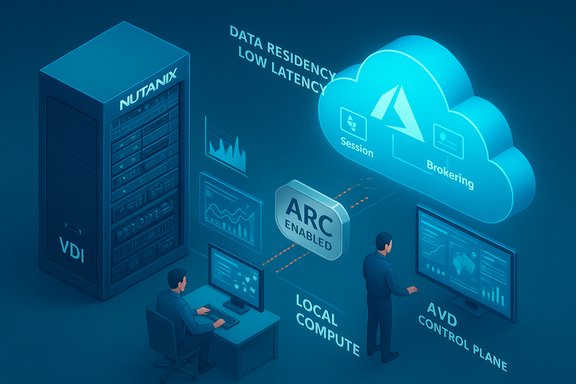
Isometric data center scene linking Nutanix VDI to cloud-based session brokering with ARC enabled.
Nutanix has announced that the Nutanix Cloud Platform will support Microsoft Azure Virtual Desktop (AVD) in hybrid environments — allowing organisations to host AVD session hosts on-premises on the Nutanix AHV hypervisor while using Azure’s control plane for brokering, management and security via Azure Arc‑enabled servers.

Background​

Microsoft’s Azure Virtual Desktop has long been a cloud‑native desktop-as-a-service offering, with established on‑premises options such as Azure Local (the evolution of Azure Stack HCI) for customers that require local session hosts. Recent work by Microsoft to broaden hybrid patterns — especially through Azure Arc and Azure Local concepts — opened the door to partner integrations that can register non‑Azure hosts as AVD session hosts. Nutanix used Microsoft Ignite 2025 to publicise its intent to integrate AVD with the Nutanix Cloud Platform so customers can run session hosts on AHV while retaining Azure’s brokering, identity and security services. This is a partner‑driven hybrid model: the AVD control plane (host pools, brokering, workspace management) continues to live in Azure, while session hosts live where organisations choose — on Nutanix AHV in customer datacentres or on alternative hosts that can be Arc‑enabled. Nutanix’s announcement describes the capability as “under development” rather than generally available today.

What exactly did Nutanix and Microsoft announce?​

  • Nutanix will enable Azure Virtual Desktop session hosts to run on the Nutanix AHV hypervisor in customer datacentres, integrating AHV into AVD’s hybrid model.
  • The solution relies on Azure Arc‑enabled servers (Arc agents and associated resource bridging) to register and connect on‑premises session hosts to the AVD control plane in Azure.
  • Nutanix emphasises use cases that require data residency, low latency, graphics acceleration and predictable TCO, and positions AHV as an option for regulated industries and latency‑sensitive workloads.
Multiple industry outlets republished the Nutanix press release and early reporting emphasised the preview‑style nature of the capability and the lack of a GA timeline. That outside coverage reinforces that this is a partner‑led expansion to Microsoft’s hybrid AVD story rather than a finished, supported Microsoft on‑prem formulation.

Why this matters: strategic and operational implications​

Hybrid choice without forced hypervisor migrations​

For organisations that have already standardised on Nutanix AHV, the ability to run AVD session hosts locally removes the need to migrate to Hyper‑V or move all session hosts into Azure simply to access AVD’s management and integrations. This is a significant operational lever for teams managing large on‑prem investments.

Compliance and data residency​

Sectors with strict residency or sovereignty rules — finance, healthcare, government — have historically favoured on‑prem solutions. Running AVD session hosts on AHV inside a local datacentre while using Azure’s brokering and Entra identity services can help organisations satisfy regulatory constraints while keeping a modern management plane in Azure.

Performance for latency‑sensitive and graphics workloads​

Local AHV compute can reduce round‑trip latency and keep GPU‑accelerated workloads closer to on‑prem datasets and peripherals. Nutanix highlights this advantage for CAD, trading floors and other interactive scenarios where latency and frame rates matter.

Operational consistency and hybrid bursting​

Combining AHV on‑prem session hosts with Azure control plane features enables operational patterns where steady‑state users run locally and cloud bursting or disaster recovery runs in Azure. Nutanix’s broader NC2 (Nutanix Cloud Clusters) story provides a technical path for migrating or bursting workloads into Azure when required.

The technical plumbing: Azure Arc, Azure Local and the limits you must know​

Azure Arc is the bridge that projects on‑premises servers into Azure for inventory, policy and management; those Arc‑enabled servers can be used to register session hosts with Azure Virtual Desktop’s control plane. Microsoft’s public documentation on Azure Virtual Desktop for hybrid/on‑premises scenarios explains that session‑host placement and the control plane are distinct responsibilities, and that Azure Local / Azure Stack HCI remains Microsoft’s validated on‑prem route for AVD. Azure Arc‑enabled servers are a supported mechanism to register non‑Azure servers, but Microsoft’s guidance also contains caveats: Arc is not recommended for short‑lived ephemeral VMs and there are feature differences compared to fully Azure‑native deployments. Key technical points to understand:
  • The AVD control plane continues to run in Azure; session hosts must register and report health/telemetry back to Azure. Azure Arc provides the agent and resource on‑boarding to make that possible.
  • Microsoft’s Azure Local documentation shows how Azure‑centric services can be deployed to local infrastructure if the environment conforms to Microsoft’s validated stacks; parity is not automatic across all features and host types.
  • Microsoft documentation cautions about using Azure Arc for VDI scenarios that create and delete many short‑lived VMs because Arc’s management model expects longer‑lived managed servers; organisations must validate whether their provisioning model fits Arc’s guidance.

Strengths: what Nutanix + AVD on AHV could deliver​

  • Real choice for VDI placement. Nutanix’s approach reduces migration friction and lets teams choose placement by workload.
  • Retention of Microsoft integrations. Customers keep access to Microsoft 365, Microsoft Teams optimisations, Microsoft Entra identity and Azure security tooling while using local compute.
  • Lower latency and local GPU support potential. Local session hosts on AHV can be tuned with local GPUs and networking for better interactive performance.
  • Cost predictability for customers with existing Nutanix investments. Reusing hardware avoids cloud spend that would otherwise be necessary for large user populations.

Risks, caveats and unanswered questions​

The announcement is promising, but the details that determine whether Nutanix + AVD on AHV is safe for production remain incomplete. The most important open items:
  • GA status, support matrices and vendor responsibilities. Nutanix publicly states the integration is under development; until Microsoft and Nutanix publish joint support guides, SLAs, and a compatibility matrix, production deployments carry risk. Organisations should not assume GA‑level single‑vendor support yet.
  • Licensing clarity for Windows and Microsoft 365 entitlements. Hybrid hosting models sometimes create non‑obvious licensing questions (Windows multi‑session entitlements, Microsoft 365 Apps for enterprise on Arc‑registered hosts, audit implications). Seek explicit, written licensing confirmation from Microsoft before committing large user bases.
  • Feature parity and technical gaps. Some cloud‑only AVD features (for example certain multi‑session density features) might not be available in hybrid Arc models. Validate Teams media quality, RDP Shortpath behaviour, FSLogix profile performance, USB redirection and vGPU/driver compatibility in representative workloads. Microsoft’s guidance already calls out feature differences for hybrid models and recommends testing.
  • Operational fragmentation and tooling responsibilities. Microsoft expects partner tooling to handle lifecycle tasks (provisioning, golden images, reprovisioning) on non‑Azure hypervisors. That places operational responsibility on Nutanix or third parties (Nerdio, ControlUp, LoginVSI etc., and organisations must vet those integrations and their SLAs.
  • Arc suitability for VDI models that create/destroy many short‑lived machines. Microsoft warns Azure Arc isn’t ideal for ephemeral VDI machines. Organisations that rely on ephemeral provisioning for cost efficiency must validate the fit or use provisioning patterns that keep session hosts longer‑lived.

Practical due‑diligence checklist (for IT teams and procurement)​

  1. Request a Microsoft–Nutanix joint compatibility matrix that explicitly lists supported AHV versions, required Nutanix software (Prism, AHV release), and any required agents.
  2. Secure written licensing guidance from Microsoft that maps Windows client or server entitlements and Microsoft 365 Apps licensing to Arc‑enabled, AHV‑hosted session hosts.
  3. Obtain a joint support playbook (SLA, escalation contacts, primary responder responsibilities) from Nutanix and Microsoft so operational ownership is clear.
  4. Pilot with a constrained user group that represents latency‑sensitive or regulated workloads. Measure FSLogix profile mounting, boot times, Teams audio/video quality and GPU performance.
  5. Validate backup/DR, patching and reprovision workflows for AHV‑hosted session hosts and ensure they meet your compliance and RTO/RPO requirements.
  6. Define acceptance criteria and rollback plans in procurement contracts (performance thresholds, profile latency, media quality, vGPU validation).

Deployment models to consider while the Nutanix path matures​

  • Azure Virtual Desktop on Azure Local / Azure Stack HCI: Microsoft’s validated on‑premises route for AVD if vendor‑level support is required today.
  • Run AVD in Azure and use Nutanix Cloud Clusters (NC2) on Azure to preserve Nutanix operational consistency while keeping session hosts in Microsoft‑backed compute.
  • Stay with mature AHV‑native EUC solutions (Citrix on AHV, Omnissa Horizon on AHV) until joint Microsoft–Nutanix documentation and GA support exists.

A technical roadmap for pilot projects​

  • Phase 1 — Discovery and gating: inventory workloads, tag sensitive data, and decide which user personas need on‑prem session hosts (graphics, low latency, regulatory). Use acceptance criteria aligned to your compliance, security and UX goals.
  • Phase 2 — Lab integration: deploy a small Arc‑enabled AHV host pool, onboard Azure Arc agents, and validate host registration with the AVD control plane. Measure telemetry, heartbeat stability and reprovision operations.
  • Phase 3 — Representative pilot: run 50–200 users across targeted personas. Benchmark FSLogix profile mount times, Teams media quality (jitter/packet loss), boot/reimage cycles and vGPU workloads if used. Ensure incident response runs smoothly across vendor teams.
  • Phase 4 — Compliance and licensing signoff: obtain written confirmation from Microsoft about licensing entitlements and from Nutanix about version compatibility and support responsibilities. Only then consider scaling to production.

What vendors need to publish next (and why it matters)​

For enterprises to adopt Nutanix + AVD on AHV with confidence, the following joint artifacts must appear:
  • A published compatibility matrix and deployment guide that documents AHV versions, required Prism/NC2 versions, Arc agent versions and validated guest OS images.
  • A joint Microsoft‑Nutanix support and escalation playbook with clear SLA handoffs.
  • Written licensing guidance from Microsoft covering Windows multi‑session entitlements, Microsoft 365 Apps and audit implications for Arc‑registered on‑prem hosts.
  • Real‑world performance and interoperability validation (Teams, FSLogix, vGPU) published as part of the documentation so purchasers can model user experience and TCO.
Until these artifacts are published, the announcement should be treated as a roadmap signal rather than a plug‑and‑play migration path for mission‑critical EUC.

Bottom line: what every Windows and VDI team should remember​

Nutanix’s announcement is a meaningful expansion of hybrid VDI choices: it signals a future where AHV can be a first‑class substrate for Azure Virtual Desktop session hosts, preserving local performance and data residency while retaining Azure management. That’s strategic progress for customers who want to avoid hypervisor lock‑in and keep sensitive workloads local. However, the engineering work, support agreements and licensing clarifications that turn a roadmap into a production‑grade service are still pending. Organisations should pilot, require written vendor commitments for licensing and support, and continue to use Microsoft‑validated on‑prem routes (Azure Local) or Azure‑hosted AVD for workloads that cannot tolerate uncertainty. The prudent course is staged evaluation: measure performance, secure contractual protections, and validate operational handoffs before any broad migration to a hybrid AVD on AHV model.
In short: the Nutanix + Azure Virtual Desktop combination promises flexibility, locality and performance — but the difference between promise and production will be decided by documentation, joint support commitments and licensing clarity that both vendors must publish next.

Source: SourceSecurity.com https://www.sourcesecurity.com/amp/...-co-14053-ga-co-1568897613-ga.1763630265.html
 

Nutanix’s announcement at Microsoft Ignite 2025 that the Nutanix Cloud Platform will support Microsoft Azure Virtual Desktop (AVD) in hybrid environments — enabling organizations to run AVD session hosts on Nutanix AHV in their own datacenters while using Azure’s control plane for brokering, identity, and management — is a strategically significant step for both vendors and a pragmatic answer to the enterprise demand for hybrid-first desktop services.

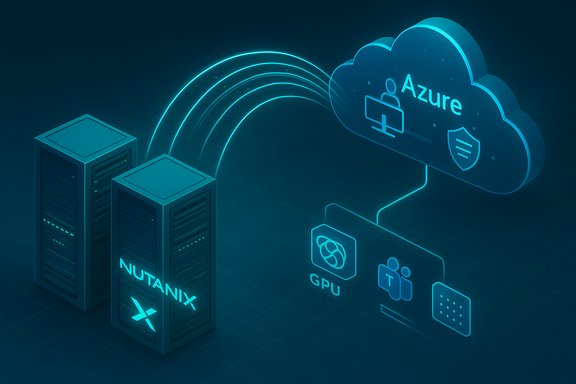
Nutanix servers connect to Azure cloud for GPU-enabled workloads.Background / Overview​

Nutanix used Microsoft Ignite 2025 to detail a partner-driven extension of Azure Virtual Desktop that allows Arc‑enabled on‑premises servers to register as AVD session hosts — and called out Nutanix AHV as a supported on‑prem substrate under development for this hybrid model. Microsoft’s hybrid AVD announcement formally frames this capability as a preview that relies on Azure Arc to project local servers into Azure’s management plane, while Nutanix positions AHV as a first‑class option for latency‑sensitive, regulated, or graphics‑intensive virtual desktop workloads. This announcement arrives alongside concrete enterprise traction for Nutanix’s hybrid strategy — for example, Finanz Informatik’s long‑term migration commitment to Nutanix‑hosted workloads underscores that regulated, large‑scale customers are taking hybrid architectural bets that favor on‑prem operational control.

What Nutanix and Microsoft Actually Announced​

The technical split: cloud control plane, local data plane​

Microsoft’s hybrid AVD model keeps the AVD control plane — brokering, workspace assignment, identity integration with Microsoft Entra, and centralized management — in Azure. Session hosts (the VMs that run user desktops and applications) can now be Arc‑enabled servers hosted on a variety of infrastructures, including Nutanix AHV, VMware vSphere, Hyper‑V or physical Windows Servers. The Arc agent projects those servers into Azure so they can participate in AVD host pools managed from the cloud. Nutanix’s message is that AHV will be able to host those Arc‑registered session hosts, enabling customers who standardized on AHV to adopt AVD without migrating hypervisors. Nutanix highlighted Microsoft 365 and Teams optimizations, Entra integration, and the ability to use Nutanix operational tooling (Prism, NC2) in mixed cloud/on‑prem topologies. The capability is being developed and has been publicly described as under development/preview rather than generally available today.

Partner tooling, lifecycle and provisioning responsibilities​

Microsoft’s published approach anticipates that lifecycle automation for non‑Azure hypervisors (golden image provisioning, scaling of host pools, reprovisioning) will come from partner tooling. Launch and early partner ecosystem activity already includes players such as Nerdio, ControlUp, and Login VSI — and Nutanix is explicitly cited as a partner for enabling lifecycle and operations workflows for AVD session hosts on AHV. That means operational responsibilities (image management, patching, vertical scaling, GPU drivers) will often sit with Nutanix or other ecosystem vendors rather than Microsoft directly.

Why this matters: practical and strategic benefits​

  • Data residency and compliance: For industries bound by strict data‑sovereignty and regulatory requirements (financial services, healthcare, government), the ability to keep session hosts and sensitive processing inside local datacenters while still leveraging Azure identity and brokering simplifies compliance posture. Nutanix explicitly pitched the integration for those use cases.
  • Latency and graphics performance: Running session hosts locally reduces round‑trip latency and is better suited for GPU‑accelerated or interactive workloads (CAD, trading desks, simulation), where user experience is critical. Nutanix emphasized AHV performance for latency‑sensitive workloads.
  • Preserve existing investments: Enterprises that standardized on AHV can avoid disruptive hypervisor migrations and reuse existing infrastructure and operational models while modernizing desktops with AVD’s management features. This reduces migration friction and total migration cost.
  • Single management plane for control vs compute: The hybrid split — Azure control plane and local compute — fits many organizations’ operational design: centralized policy and telemetry from Azure with local execution for compliance/performance. Azure Arc is the bridge that enables this architectural pattern.

What this does — and does not — deliver today​

It is important to be precise about what the announcement means in operational terms:
  • It signals partner‑enabled support rather than a Microsoft‑native, fully validated AHV host model. Public documentation frames hybrid AVD as a preview, and the Nutanix capability is described as under development; Microsoft’s formal on‑prem pathway historically centers on Azure Local/Azure Stack HCI as the validated route. Enterprises should treat the announcement as a roadmap signal and a partner integration build instead of an immediate drop‑in GA production model.
  • Several advanced cloud‑only features are not guaranteed in the hybrid preview (for example, Windows 11 Enterprise multi‑session density and other cloud‑native optimizations), and feature parity will be determined over time and through partner validation. This gap will affect density economics and licensing models for some customers.
  • Operationally, lifecycle automation often rests with partners (Nutanix, Nerdio, ControlUp, Login VSI), which provides flexibility but also introduces the need for integrated runbooks, single‑pane‑of‑glass tooling and clearly defined SLAs between vendors and customers.

Market and competitive implications​

For Nutanix: a play for hybrid leadership — and a bigger addressable market​

Nutanix has consistently bet on hybrid and multi‑cloud as the dominant enterprise architecture. Integrating AVD with AHV advances that narrative by opening a pathway for customers to adopt Microsoft’s desktop control plane without abandoning AHV. That expands Nutanix’s addressable market to include organizations that previously might have been forced to migrate away from AHV to consume AVD — a nontrivial commercial opportunity, especially in regulated markets where on‑prem presence is necessary. The Finanz Informatik deal illustrates that Nutanix is already winning complex, regulated customers that value on‑prem control.

For Microsoft: broader AVD adoption and Arc stickiness​

By enabling Arc‑based session hosts on multiple hypervisors, Microsoft gets a stronger strategic foothold: customers adopt the Azure control plane and Entra identity stack while keeping their compute where they need it. That increases dependency on Azure management services and makes migration to full Azure a smoother future path — without forcing immediate hypervisor changes. Azure Arc becomes a pivotal lock‑in mechanism for Microsoft’s management and security revenue.

For hyperscalers and virtualization incumbents​

The move slightly blunts the one‑way lock that some hyperscalers and hypervisor incumbents — particularly VMware/VMware Cloud on hyperscalers — seek by keeping AHV competitive for EUC workloads. However, it does not remove the fundamental competitive pressure Nutanix faces from public cloud economics, nor does it drastically change the large‑scale trend of workload migration to hyperscalers where convenient. The announcement is a tactical win for Nutanix’s EUC story, but not a strategic elimination of hyperscaler competition.

Financial and investment context — how this fits Nutanix’s narrative​

Nutanix has demonstrated improving financials in FY2025, with strong revenue growth, expanding non‑GAAP margins, and robust free cash flow — a performance backdrop that gives the company runway to invest in partner integrations and go‑to‑market initiatives. Fiscal 2025 revenue reached approximately $2.54 billion and management has been raising guidance in recent quarters. Those operational results provide a foundation for the company’s longer‑term growth expectations. Analyst and community valuations vary widely, reflecting differing judgments about Nutanix’s ability to defend and grow its hybrid software business against hyperscaler competition. Some models project materially higher revenue by 2028 under aggressive hybrid adoption scenarios; others discount growth due to competitive pressure and licensing complexities. The AVD/AHV announcement strengthens one part of the growth thesis (EUC‑driven hybrid demand) but does not eliminate risks tied to broader cloud migrations, price competition, or ARR conversion velocity.

Implementation risks and vendor due diligence (what every IT leader should require)​

This is where operational maturity matters. Companies considering Nutanix‑hosted hybrid AVD should proceed with disciplined steps:
  • Obtain Microsoft‑authored compatibility documentation that explicitly lists AHV and versions supported for AVD hybrid host pools. Require a published KB or compatibility matrix.
  • Secure written licensing clarifications from Microsoft that map Windows and Microsoft 365 entitlements (including multi‑session or other density models) to Arc‑enabled AHV session hosts to avoid surprises in audits.
  • Demand joint support playbooks and SLA commitments from Microsoft and Nutanix that describe first‑level responder responsibilities, escalation procedures, and operational runbooks.
  • Pilot with bounded user cohorts and representative workloads (Teams multimedia, FSLogix profile behavior, GPU workloads) and measure boot times, reprovision cycles, and user experience under realistic concurrency.
  • Model FinOps carefully: include amortized on‑prem hardware, Azure control plane costs, Arc operational costs, licensing deltas, and the cost of required partner services for lifecycle automation.
These steps reflect industry recommendations and the reality that the Nutanix + Microsoft approach is currently partner‑enabled rather than an immediate GA global support model. Treat the current offering as a controlled pilot pathway until Microsoft and Nutanix publish GA‑grade joint documentation and a formal validation matrix.

Ecosystem and channel implications​

  • Systems integrators and MSPs: The hybrid AVD model creates new managed‑service opportunities for MSPs to host and operate AVD session hosts on AHV for customers constrained by sovereignty or latency. Expect a wave of managed AVD offerings built on Nutanix infrastructure and partner toolchains.
  • Third‑party EUC tooling vendors (Nerdio, ControlUp, Login VSI): These vendors will compete to be the orchestration and observability layer for hybrid session hosts. Their integrations will determine the operational experience and could become decisive procurement factors.
  • Independent EUC stacks: Citrix and Omnissa (and similar AHV‑native solutions) remain practical alternatives for organizations that need GA‑backed on‑prem EUC today. Nutanix’s broader EUC partnerships indicate the company is not relying solely on AVD to win EUC workloads.

Strengths, caveats and the path to credibility​

Strengths​

  • Tactical removal of hypervisor‑migration friction for AHV customers considering AVD adoption.
  • Alignment with Microsoft’s broader Arc strategy — enabling choice while centralizing control in Azure.
  • Clear value proposition for regulated industries and latency‑sensitive workloads.

Caveats and unresolved issues​

  • The offering is in preview/under development; GA timing and formal Microsoft validation remain unannounced. Enterprises must not assume GA‑grade support until Microsoft and Nutanix produce joint documentation and a published compatibility matrix.
  • Licensing nuance remains a material commercial risk — Windows desktop entitlement, multi‑session density, and Microsoft 365 interactions require explicit, binding clarifications from Microsoft.
  • Operational complexity increases when two management planes (Prism/Prism Central + Azure control plane) must be reconciled; tooling and runbooks will be crucial to avoid friction and escalations.

What this means for Nutanix’s hybrid cloud leadership thesis​

The AVD/AHV integration is a meaningful tactical milestone: it extends Nutanix’s hybrid pitch into the high‑visibility, day‑to‑day EUC space and strengthens the company’s argument that AHV is a first‑class substrate for both traditional and modern enterprise workloads. That plays directly into Nutanix’s growth narrative by increasing the number of use cases and customers who can rationally choose AHV without losing access to cloud‑native operational models. However, the announcement does not by itself resolve the biggest strategic risk: the inexorable pull of hyperscaler economics and the long‑term shift of workloads into native cloud platforms. The Nutanix story benefits when enterprises require hybrid, sovereign, or latency‑bounded compute — but it remains exposed to scenarios where customers elect to move fully to public cloud for cost, agility, or strategic reasons. Investors should therefore view the AVD integration as a growth catalyst that reduces friction in a key vertical (EUC) and in regulated markets, but not as a panacea that eliminates hyperscaler competition or replaces the need for continued execution on ARR expansion, margin improvement, and operational scale.

Recommended adoption playbook for IT decision‑makers​

  • Treat the Nutanix + Microsoft hybrid AVD path as a pilot‑first initiative: begin with non‑mission‑critical, latency‑sensitive user groups where local compute delivers clear UX benefits.
  • Require joint documentation and SLAs before expanding beyond pilot: compatibility matrices, licensing letters, and support playbooks should be contractual prerequisites.
  • Standardize on a partner toolchain (Nutanix + one orchestration partner) to reduce operational fragmentation and keep a single pane for lifecycle operations.
  • Include exit and rollback paths in procurement contracts: ensure the ability to move users to Azure‑hosted AVD or to validated on‑prem Citrix/Omnissa stacks if the hybrid path does not reach GA support targets.

Conclusion​

Nutanix’s support for Azure Virtual Desktop on AHV is a strategically coherent, market‑sensible step that aligns with real enterprise needs: data residency, latency sensitivity, and pragmatic hybrid operations. It widens Nutanix’s commercial runway in EUC and regulated industries and plugs directly into Microsoft’s Arc‑first hybrid story — a two‑way benefit for partners and customers that want choice without wholesale replatforming. That said, the announcement is a preview‑era development. Critical operational questions — Microsoft validation, feature parity (Windows 11 multi‑session and similar), licensing clarity, and joint support playbooks — must be answered before enterprises should replatform production VDI estates onto AHV for AVD. Nutanix gains meaningful strategic leverage from the move, but the company still faces the broader competitive realities of hyperscaler economics and the need to keep execution tight across subscription growth and margin expansion. For IT leaders and investors, the right stance is disciplined optimism: recognize the added flexibility and addressable market expansion, but insist on verification, pilots, and contractual protections before treating the integration as a production‑grade migration path.

Source: simplywall.st Is Nutanix’s (NTNX) Azure Virtual Desktop Integration a Step Toward Broader Hybrid Cloud Leadership? - Simply Wall St News
 

Back
Top