

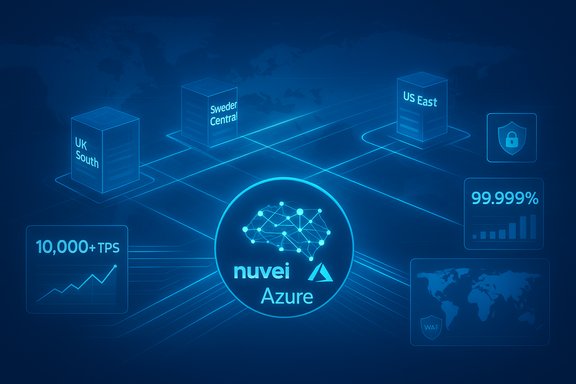
Nuvei’s payment engine will now run its core processing on Microsoft Azure, a strategic shift the companies say unlocks AI-driven transaction optimization, a global footprint capable of more than 10,000 transactions per second, and a target of 99.999% availability for large enterprise merchants — a move that reframes Nuvei’s scale ambitions and raises fresh questions about resilience, vendor lock‑in, and real‑world operational validation.
Background
Nuvei has publicly expanded its multi‑year strategic relationship with Microsoft to migrate core payment processing APIs and services onto Microsoft Azure. The announcement frames the work as a modernization and resilience play: moving critical components into a distributed, cloud‑native architecture built on Azure services such as Azure Kubernetes Service (AKS), Azure ExpressRoute, Azure Firewall, Azure Defender for Cloud, and Azure Application Gateway with Web Application Firewall (WAF) across several strategic regions.This is not Nuvei’s first collaboration with Microsoft — the companies have worked together on integrations and platform efforts before — but this step places Nuvei’s transaction core in Azure’s infrastructure and explicitly pairs it with Azure AI capabilities for real‑time transaction optimization. The vendor narrative emphasizes throughput (10,000+ TPS), availability objectives (five‑nines), and an aspirational runway to handle more than $1 trillion in annual payment volume as enterprise customers scale globally.
What the announcement actually says
- Nuvei’s core payment processing APIs are now running on Microsoft Azure and are designed to use Azure AI to optimize authorizations and routing in real time.
- The cloud deployment is described as capable of supporting more than 10,000 transactions per second and a platform foundation intended to support over $1 trillion in annual payment volume.
- Nuvei and Microsoft name UK South, Sweden Central, US West, and US East as four strategic Azure regions covering the initial distributed footprint.
- The architecture leverages Azure networking, container orchestration, security, and threat protection products (ExpressRoute, AKS, Firewall, Defender, Application Gateway + WAF).
- Nuvei frames the migration as a multi‑year investment to reduce reliance on third‑party legacy components, accelerate innovation, and improve performance and data‑residency compliance.
Why this matters: context for enterprise payments
Payments processing is an industry where latency, reliability, and authorization success directly translate into revenue capture or loss. A single millisecond of improved routing or a higher authorization acceptance rate can materially affect merchant conversion and chargeback exposure. Moving the transaction core into a globally distributed cloud with AI‑enabled decisioning therefore promises both operational and commercial upside.For merchants, the headline benefits Nuvei and Microsoft emphasize are:
- Improved authorization rates through smarter routing and AI‑driven decisioning.
- Lower latency in key regions through distributed compute and private connectivity.
- Higher resiliency during traffic spikes and global commerce peaks (holidays, promotions).
- Faster onboarding and feature delivery from a modernized API surface and cloud‑native toolchain.
Technical architecture: what was announced and why it matters
Azure services called out
Nuvei’s public description highlights a set of core Azure capabilities that map well to an enterprise payments platform:- Azure ExpressRoute — private network connectivity between Nuvei’s environments and customer or partner networks, reducing public‑internet exposure and often improving latency and consistency.
- Azure Kubernetes Service (AKS) — container orchestration for microservices and stateless/stateful workloads, enabling automated scaling and rolling upgrades.
- Azure Firewall and Azure Application Gateway + WAF — network and application‑layer defenses to protect transaction flows and API endpoints.
- Azure Defender for Cloud — advanced threat detection, posture management, and runtime protection.
Distributed footprint and data‑residency
Operating in multiple Azure regions (UK South, Sweden Central, US West, US East) lets Nuvei place processing closer to major merchant markets, reducing round‑trip times for authorization flows and providing regional data‑residency options. A multi‑region design also supports active/active failover and traffic absorption during regional incidents.However, four regions as an initial footprint is a pragmatic starting point — global commerce often requires presence in many more jurisdictions to meet latency and regulatory needs. Nuvei’s messaging suggests the architecture is extensible; the critical part is how orchestration, data replication, and compliance controls are implemented as regions expand.
Scalability claim: “more than 10,000 transactions per second”
The 10,000 TPS figure is a headline metric that signals enterprise throughput capability. From an engineering perspective, this level of scale is achievable with modern cloud infrastructure if the stack is stateless where possible, if databases and persistence layers are horizontally scalable, and if caching, queueing, and asynchronous compensation are used effectively.Key technical levers that enable such throughput include:
- Distributed API front ends behind global load balancers and WAFs.
- Kubernetes autoscaling for transaction microservices.
- High‑throughput, low‑latency data stores (in‑memory caches, purpose‑built key‑value stores).
- Private networking (ExpressRoute) and optimized peering to payment networks and acquirers.
- AI/ML models that run inference with minimal added latency to improve routing and authorization decisions.
Availability target: 99.999% — realistic or aspirational?
A target of 99.999% availability (five‑nines) is commonly cited for mission‑critical systems. That level equates to roughly 5 minutes of downtime per year and requires robust architecture, active‑active failover, and automated self‑healing across regions.Delivering five‑nines at global scale imposes several engineering and operational requirements:
- True multi‑region active‑active deployment with automatic failover and session continuity.
- Synchronous or carefully engineered asynchronous replication strategies for key data to avoid split‑brain or data loss during failovers.
- Extensive chaos testing, runbooks, and automation for rollback and traffic re‑routing.
- SLA alignment with downstream partners (card networks, acquirers, gateways) that often represent the weak link in end‑to‑end availability.
AI in payments: where Azure AI adds value — and where it needs caution
Nuvei says Azure AI will be used to optimize transactions in real time — for example, choosing the best routing path, making authorization decisions that balance fraud risk versus conversion, and adapting to regional acquirer performance.Potential benefits:
- Improved authorization rates by selecting the acquirer or route with the highest likelihood of success.
- Reduced false positives in fraud screening through contextually richer models.
- Adaptive throttling and routing during peaks to minimize latency and declines.
- AI models must be trained on high‑quality, diverse transaction data and continuously validated to avoid model drift.
- Real‑time inference must be engineered to add negligible latency; a slow ML call can reduce the transactional gains it aims to produce.
- Explainability and auditability matter for payments compliance and disputes; black‑box decisions create governance challenges.
- Data residency and privacy constraints can limit the centralization of training data, requiring federated or regionally partitioned models.
Security and compliance posture
Using Azure’s security tooling is an appropriate approach for a payments processor; the stack Nuvei cites addresses several layers:- Network isolation and private connectivity through ExpressRoute reduce exposure.
- Boundary protection using Azure Firewall and Application Gateway + WAF defends at network and application layers.
- Runtime and posture monitoring with Defender for Cloud provides threat detection and security score tracking.
Business implications: what enterprises gain and what to ask Nuvei
Moving core processing to Azure can make it easier for enterprise customers to scale across regions and to adopt new features faster. For partners, the migration can lower integration friction where customers also leverage Azure services.When evaluating the Nuvei Azure migration, enterprises should ask for:
- Performance validation — independent benchmarks and test reports that show sustained TPS under realistic loads and failure injection.
- SLA specifics — clear availability SLAs, definitions of downtime, and credits or remedies.
- Operational runbooks — failover, incident response, and rollback procedures.
- Security evidence — PCI DSS attestation, penetration testing, and audit logs access options.
- Data‑residency guarantees — where data is stored and how it’s replicated, encrypted, and purged.
- Cost transparency — how cloud costs are passed through or absorbed, and billing models for burst traffic.
Competitive landscape: how this positions Nuvei
Cloud migration plus AI capabilities are becoming standard differentiators in payments. Large processors and newer fintechs alike emphasize cloud agility and data‑driven routing. Nuvei’s announcement places it explicitly among “high‑volume processors” and signals intent to compete more directly for global enterprise workloads that demand scale and localization.Competitive impacts include:
- Increased pressure on legacy processors that remain dependent on on‑prem middleware and monolithic stacks.
- A push for tighter cloud‑native integrations between payments platforms and ERPs, e‑commerce platforms, and fraud vendors.
- Heightened focus on partnerships between hyperscalers and payments firms to co‑deliver compliance and regional edge presence.
Risks and cautionary notes
There are several material risks and open questions:- Vendor lock‑in: Deep dependency on Azure services can speed development but increases migration costs if a future pivot to another cloud is needed. Enterprises should verify exit strategies and portability of integrations.
- Operational opacity: AI decisioning in the critical transaction path can be difficult to audit externally. Merchants need transparency for chargeback disputes and regulatory requests.
- Downstream dependencies: End‑to‑end availability depends on acquirers, card networks, and banking partners — Azure availability does not automatically translate to payments availability unless the entire chain is resilient.
- Regulatory nuance: Cross‑border processing and data replication must comply with a mosaic of local laws; a multi‑region cloud presence reduces some friction but does not eliminate legal risk.
- Cost and unpredictability: Cloud egress, bursting, and autoscaling during peaks can produce unexpectedly large bills. Clear cost models and caps are vital.
- Proof vs. promise: Design targets like 10,000 TPS and five‑nines are meaningful but must be backed by third‑party validation, runbooks, and contractual SLAs to be operationally useful.
Implementation and migration challenges
Moving a payment core to cloud at enterprise scale is nontrivial. Typical technical and operational challenges include:- Data migration complexity for stateful transaction history and reconciliations.
- Ensuring transactional integrity across distributed systems and databases.
- Live migration with zero or minimal downtime for merchants.
- Rewriting or adapting legacy integrations and SDKs for new API patterns.
- Orchestration of multi‑region deployments with consistent configuration and secrets management.
- Extensive performance testing, including capacity planning, chaos engineering, and peak event simulation.
Practical guidance for merchants and partners
For organizations evaluating Nuvei’s Azure‑first platform, practical steps include:- Request a formal performance and resilience dossier that includes test plans, results, and third‑party audits.
- Negotiate SLAs that reflect meaningful financial remedies and clear definitions of downtime, latency thresholds, and support escalation paths.
- Validate security posture with independent penetration testing and review of Nuvei’s PCI DSS attestation.
- Confirm data‑residency options for each critical market and document data flow mappings for compliance teams.
- Run integration tests in mirrored staging environments and include real‑traffic replay tests for authorization and routing logic.
- Build a vendor exit plan and portability checklist covering data export, API compatibility, and integration teardown.
The larger trend: payments meet cloud + AI
Nuvei’s announcement exemplifies a broader industry trajectory: payments platforms embracing cloud‑native architectures and AI to deliver smarter routing, faster authorizations, and improved resilience. Hyperscalers are actively courting fintechs with regionally distributed infrastructure and AI tooling that promises to reduce latency and boost decision quality.This convergence accelerates innovation — but also raises operational governance imperatives. Payments are a critical infrastructure of commerce; the architectural choices vendors make affect merchants’ revenue, fraud exposure, and compliance posture. As cloud and AI become core to payment engines, the bar for transparency, independent validation, and regulation‑aware governance necessarily rises.
Conclusion
Nuvei’s migration of its core processing to Microsoft Azure and the positioning of Azure AI at the transaction level is a significant engineering and commercial step. The architecture choices — AKS, ExpressRoute, WAF, Defender, and a multi‑region footprint — reflect modern cloud best practices for high‑volume services. The claimed milestones (10,000+ TPS, five‑nines availability, support for $1 trillion in volume) are meaningful indicators of ambition and design intent.The practical value for merchants will hinge on verifiable performance, transparent AI governance, documented security and compliance evidence, and contractual SLAs that align operational reality with customer expectations. Enterprises should treat the announcement as the start of a procurement conversation: request benchmarks, insist on third‑party validation, and demand operational transparency before committing core revenue flows.
If executed as described and validated in production, Nuvei’s Azure‑native platform could deliver tangible uptime, throughput, and authorization benefits that matter to global merchants. If not, the risks — from vendor lock‑in to opaque AI decisioning and supply‑chain dependencies — could undercut some of the promised gains. The next step for buyers and partners is to move from press statements to performance proofs and to ensure that the new cloud foundation translates into measurable revenue and resilience improvements in real commerce events.
Source: TI INSIDE Online https://tiinside.com.br/en/02/12/20...port-more-than-10-000-transactions-per-second.
