

Nuvei’s decision to move its core payment-processing APIs onto Microsoft Azure and to pair that migration with Azure AI marks a decisive pivot toward cloud-native, AI-driven payments infrastructure designed to scale beyond 10,000 transactions per second while targeting five‑nines availability for enterprise merchants.
Nuvei, the Montreal‑based payments technology provider, has spent the last several years expanding from regional acquiring into a full‑stack global payments platform. The company serves merchants across hundreds of markets, supports local acquiring in dozens of countries, and provides a portfolio that spans acquiring, alternative payment methods, payouts, risk and fraud management, and issuing services. Nuvei’s expansion onto Azure is the next stage of a multi‑year modernization program intended to refresh legacy components, reduce reliance on disparate third‑party infrastructure, and create a single, scalable platform for high‑volume enterprise transactions. At the center of the announcement are three headline claims:
Moving the transaction core to a hyperscaler like Azure unlocks concrete technical levers:
Reality check:
Practical considerations:
Practical nuance:
From an industry perspective, hyperscalers are increasingly being positioned as infrastructure partners for payments because of their global backbones, private connectivity options, and growing AI toolsets. The story is not unique to Nuvei—other processors and fintech platforms have been testing cloud‑native approaches to trade off capital expenditure with operational agility. What differentiates Nuvei’s announcement is the explicit combination of throughput targets, five‑nines availability goals, and an AI‑native decisioning fabric. External coverage and industry press are already amplifying the message.
The announcement should be read as the opening of a new phase—one where evidence and operational transparency will determine whether five‑nines uptime and consistently higher authorization economics become measurable realities. The next milestones to watch are independent performance audits, contractual SLA terms, customer pilot outcomes during peak commerce events, and documentation of AI model governance. When those proofs appear, the industry will have firmer ground to judge whether this is a competitive repositioning or a transformative, verifiable capability.
Source: Fintech Finance Nuvei Expands Partnership With Microsoft to Scale Global Payments Infrastructure to Support More Than 10,000 Transactions Per Second
 Background
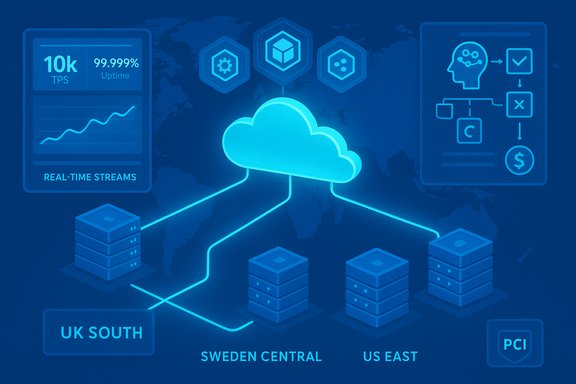
Nuvei, the Montreal‑based payments technology provider, has spent the last several years expanding from regional acquiring into a full‑stack global payments platform. The company serves merchants across hundreds of markets, supports local acquiring in dozens of countries, and provides a portfolio that spans acquiring, alternative payment methods, payouts, risk and fraud management, and issuing services. Nuvei’s expansion onto Azure is the next stage of a multi‑year modernization program intended to refresh legacy components, reduce reliance on disparate third‑party infrastructure, and create a single, scalable platform for high‑volume enterprise transactions. At the center of the announcement are three headline claims:- A processing capability in excess of 10,000 transactions per second (TPS).
- A design target of 99.999% availability for enterprise customers.
- A long‑term runway to support more than $1 trillion in annual payment volume as merchants scale globally.
Why this matters now
Payments infrastructure is revenue infrastructure. Authorization latency, routing efficiency, and availability have direct, measurable impacts on merchant conversion rates, customer experience, and overall revenue capture. A one‑millisecond latency reduction on an authorization path, or a single percentage point improvement in authorization acceptance, can translate into significant incremental revenue for global retailers and platforms.Moving the transaction core to a hyperscaler like Azure unlocks concrete technical levers:
- Elasticity and capacity bursting: Cloud compute and networking allow horizontal scaling to absorb traffic spikes during global commerce events.
- Geographic distribution: Placing compute closer to issuers and acquirers reduces round‑trip latency and improves authorization times.
- Platform‑native security and compliance: Built‑in services simplify continuous monitoring, threat detection, and regulatory controls.
- AI at decision point: Moving telemetry and decisioning logic nearer to transaction flows enables near‑real‑time routing, fraud scoring, and authorization optimization.
What Nuvei is running on Azure — architecture highlights
Nuvei lists a set of Azure platform components that form the backbone of its new architecture. These are standard enterprise building blocks for resilient, high‑throughput cloud workloads:- Azure ExpressRoute — private connectivity for predictable network performance and reduced exposure to public internet variability.
- Azure Kubernetes Service (AKS) — container orchestration to host stateless and stateful microservices with autoscaling and rolling deployments.
- Azure Firewall & Azure Application Gateway with WAF — perimeter and application‑layer protections to harden API endpoints.
- Azure Defender for Cloud — continuous threat detection and posture management.
- Multi‑region deployment across UK South, Sweden Central, US West, and US East for distribution, redundancy, and regional data residency options.
The claims — technical and commercial scrutiny
Claim: “More than 10,000 transactions per second”
This is a meaningful, class‑defining throughput figure for a payments processor targeting large global merchants and platforms. Achieving sustained TPS at this level requires careful design across compute, networking, state management, and downstream partners (acquirers, card networks, gateways).Reality check:
- Hyperscalers make it feasible to scale to high TPS through autoscaling, multi‑region distribution, and private interconnects. Nuvei’s stated use of ExpressRoute and AKS supports this approach.
- Measured TPS depends on definitions. Is the metric authorizations per second, end‑to‑end cleared transactions per second, or peak transient requests (including retries and idempotency)? Vendor statements typically reflect capabilities demonstrated under specific test conditions rather than an always‑on, globally uniform throughput guarantee.
Claim: “99.999% availability target”
Five‑nines availability is an ambitious operational target for payment rails. It represents less than six minutes of allowable downtime per year and implies near‑continuous global continuity even during regional outages.Practical considerations:
- Achieving five‑nines at the platform level requires not only multi‑region active‑active deployments, but also robust control‑plane redundancy, deterministic failover, routable circuit backups, and contractual SLAs with cloud providers and downstream partners.
- Cloud provider outages, network degradation, or third‑party acquirer disruptions can still affect availability. Architectural rigor and regular chaos testing are essential to make a five‑nines target credible.
Claim: “Support more than $1 trillion in annual payment volume”
This is a strategic positioning statement that shapes product roadmaps, sales narratives, and enterprise trust. It signals the company’s ambition to be a top‑tier processor for large merchant ecosystems.Practical nuance:
- Annualized volume capacity is a function of average ticket size, peak concurrency, settlement flows, and reconciliation tooling. The number is plausible as a long‑term target given a cloud‑native backbone and global acquiring footprint, but it remains a forward‑looking statement rather than a present‑verified throughput fact.
What Microsoft brings to the table
Microsoft’s value proposition in this partnership is twofold: infrastructure scale and AI tooling. Microsoft has positioned Azure as an “AI‑ready” cloud with a global backbone, private interconnects, and a growing portfolio of security and observability services — all attractive to payments platforms. The Microsoft quoted executive emphasized Azure’s suitability for resilient, responsive, and optimized payments experiences. For Nuvei, the advantages include:- Predictable networking via ExpressRoute for deterministic latency to partner banks and acquirers.
- Operational maturity in managed Kubernetes, observability, and security services that reduce undifferentiated operational burden.
- AI services that can be embedded into decisioning loops for authorization routing and fraud scoring.
Strengths of the approach
- Elasticity when it matters: Cloud autoscaling and AKS provide a credible mechanism to absorb sudden global spikes—Black Friday, product launches, or sudden regional demand surges—without degrading authorization performance.
- Data‑driven optimization: The AI‑native design lets Nuvei apply machine learning models to authorization outcomes and telemetry to dynamically route transactions toward higher‑probability authorizations, which can materially reduce false declines and improve yield over time.
- Standardized security posture: Native tooling (Defender for Cloud, WAF, Firewall) centralizes threat detection and compliance controls, which is important for PCI DSS and regional data‑residency regimes.
- Faster feature velocity: Containerization and cloud CI/CD reduce time to deploy new routing strategies, A/B experiments, and product features for merchants.
Risks and unknowns
- Vendor concentration and single‑provider risk: Consolidating core processing on one hyperscaler reduces architectural diversity. A major Azure outage or region incident could still ripple across Nuvei’s customer base unless multi‑cloud or additional fallback strategies are implemented. Historical hyperscaler incidents demonstrate that operational risk remains even with a robust multi‑region design.
- Verification gap on headline metrics: Claims about TPS, five‑nines availability, and $1 trillion volume are currently vendor‑stated; independent, reproducible performance tests and SLA commitments will be necessary for merchants to accept them as contractual guarantees.
- Model governance and explainability: AI‑driven authorization and fraud decisions need clear governance, audit trails, and human‑in‑the‑loop processes to manage false positives, regulatory scrutiny, and merchant disputes. Without robust model governance, optimization can create unpredictable customer experiences or regulatory friction.
- Operational complexity at boundaries: The real world dependence on local acquirers, national networks, and legacy rails introduces variability that cloud scale alone cannot remove. Improving authorization success requires both computation and deep commercial relationships with local acquiring ecosystems.
What enterprise merchants and architects should demand
Enterprise technology buyers evaluating Nuvei’s new Azure‑native offering should negotiate and validate carefully. Recommended steps:- Request a performance pack that includes load‑test reports, percentile latency curves, and conditions under which the 10k+ TPS figure was measured.
- Insist on contractual SLAs tied to availability targets, with clear remediation and credits for missed thresholds.
- Validate HSM and key‑management models for cryptographic controls—confirm whether keys are customer‑managed or cloud‑managed and verify certifications.
- Require model governance documentation for AI decisioning: versioning, explainability, drift monitoring, and a defined human escalation process.
- Run joint chaos and failover tests across the named Azure regions to validate operational runbooks and failover timelines.
- Confirm data‑residency and regulatory controls for the jurisdictions where the business operates.
- Pilot with low‑risk flows first before moving mission‑critical transactions onto the new platform.
Implementation and operational details that matter
Latency and tail percentiles
Authorization outcomes are highly sensitive to tail latency. It is not enough to report average response times; merchants should request 95th and 99th percentile figures for authorization latency under realistic load mixes.Retry and idempotency semantics
High TPS systems must have robust idempotency and retry policies to avoid duplicate authorizations or reconciliation mismatches. Clear documentation of idempotency keys and reconciliation tooling is essential.Observability and alerts
Real‑time dashboards for authorization success rates, acquirer latencies, error budgets, and fraud‑filter impact should be part of the commercial offering. Alerts with clear ownership and escalation paths are critical for enterprise operations.Change management and release cadence
Nuvei’s move to AKS and cloud CI/CD implies faster release cycles. Merchants should understand release windows, canarying practices, and rollback procedures to avoid surprises during upgrades.Competitive and industry context
10k+ TPS places Nuvei above many boutique and regional processors and into a competitive bracket with other enterprise processors that serve platform and marketplace workloads. Major card networks and national rails operate at larger absolute scales, but the market for enterprise payment processors is stratified: many merchants don’t need rail‑level peaks, but they do require predictable, highly available infrastructure during peak commerce events. Nuvei’s Azure strategy is a direct competitive play to position the company in that enterprise tier.From an industry perspective, hyperscalers are increasingly being positioned as infrastructure partners for payments because of their global backbones, private connectivity options, and growing AI toolsets. The story is not unique to Nuvei—other processors and fintech platforms have been testing cloud‑native approaches to trade off capital expenditure with operational agility. What differentiates Nuvei’s announcement is the explicit combination of throughput targets, five‑nines availability goals, and an AI‑native decisioning fabric. External coverage and industry press are already amplifying the message.
Short‑term impact and what to watch next
Expect the following near‑term developments:- Public release of technical performance packs or benchmark material from Nuvei or third parties clarifying TPS definitions and test conditions.
- Customer pilots with large merchants and platforms migrating high‑volume flows to the Azure‑native stack.
- Incremental region expansions beyond the initially named four Azure regions, driven by merchant demand and regulatory constraints.
- Continued productization of AI‑driven features such as dynamic routing, authorization probability scoring, and adaptive fraud controls.
Practical guidance for WindowsForum readers (payments, infrastructure, and IT operations)
- For platform operators and IT architects planning or evaluating payment provider migrations: treat vendor TPS claims as testable hypotheses. Make acceptance contingent on documented results.
- For security teams: insist on joint runbooks for incident response with clear escalation to both Nuvei and Azure support tiers.
- For engineering teams: require a sandbox environment with representative traffic patterns and the ability to instrument end‑to‑end observability.
- For procurement and legal: negotiate explicit SLAs and a roadmap for multi‑region continuity and proof of compliance with local data protection laws.
Verdict: a credible technical pivot that still needs third‑party proof
Nuvei’s migration of core processing onto Microsoft Azure represents a credible, modern architecture for enterprise payments: private connectivity, containerized microservices, layered security, and AI at the decisioning layer are exactly the design choices many processors need to meet global scale and latency goals. The partnership with Microsoft gives Nuvei access to deterministic networking (ExpressRoute), managed orchestration (AKS), and a suite of security and AI tools that materially reduce undifferentiated work and accelerate feature delivery. That said, the most important caveats are practical: the 10k+ TPS figure, five‑nines availability target, and $1 trillion annual volume runway are vendor declarations and should be validated through contractual SLAs, independent benchmarking, and real‑world uptime metrics. Vendors often announce aspirational capacity targets; turning those into consistent, global, production‑grade reality requires operational discipline, robust failover playbooks, and transparent metrics. Enterprise buyers should proceed with measured optimism and exacting diligence.Conclusion
Nuvei’s Azure migration is a substantive engineering and commercial statement: it signals a move from mixed infrastructure models toward a consolidated, cloud‑native platform that promises higher elasticity, lower latency, and AI‑driven optimization at the heart of payment decisioning. The architecture choices align with best practices for global, high‑throughput services and give Nuvei a credible path to serve large enterprise merchants and platforms.The announcement should be read as the opening of a new phase—one where evidence and operational transparency will determine whether five‑nines uptime and consistently higher authorization economics become measurable realities. The next milestones to watch are independent performance audits, contractual SLA terms, customer pilot outcomes during peak commerce events, and documentation of AI model governance. When those proofs appear, the industry will have firmer ground to judge whether this is a competitive repositioning or a transformative, verifiable capability.
Source: Fintech Finance Nuvei Expands Partnership With Microsoft to Scale Global Payments Infrastructure to Support More Than 10,000 Transactions Per Second
