Nuvei and Azure AI: Scaling Global Payments Beyond 10k TPS

  • Thread Author
Nuvei’s announcement that it will run core payment processing on Microsoft Azure and use Azure AI to optimize transactions marks a major inflection point in payments infrastructure: the company says the move expands its global capacity beyond 10,000 transactions per second, targets a 99.999% availability goal for enterprise merchants, and establishes an AI‑native foundation to support more than $1 trillion in annual payment volume.

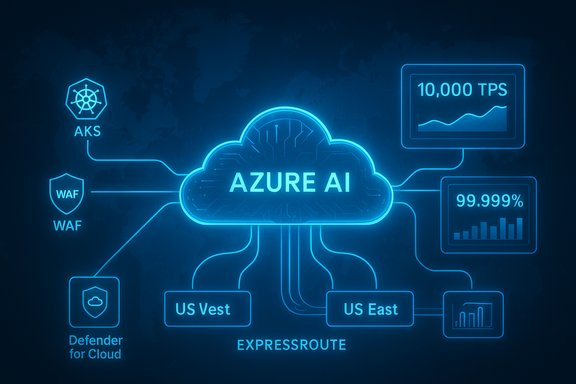
Glowing blue Azure AI cloud diagram showing network connections, security, and performance metrics.Background​

Nuvei has been steadily evolving from a regional acquirer to a full‑stack global payments provider, adding acquiring relationships, alternative payment methods, and enterprise APIs to its portfolio. The firm first publicized a strategic relationship with Microsoft in 2023; the new announcement describes a multi‑year migration of Nuvei’s core APIs and processing workload onto Azure with a view toward scale, resiliency, and real‑time AI optimization. This new phase of the relationship centers on shifting mission‑critical processing to a cloud environment that Nuvei describes as “AI‑native,” using a combination of Azure platform services—private connectivity via ExpressRoute, container orchestration on Azure Kubernetes Service (AKS), network protection with Azure Firewall, threat protections via Azure Defender for Cloud, and application security through Azure Application Gateway with Web Application Firewall. The architecture will span four strategic Azure regions: UK South, Sweden Central, US West, and US East.

What Nuvei says it is building (the claims, stated clearly)​

  • Throughput: Nuvei says the modernized platform enables processing beyond 10,000 transactions per second (TPS).
  • Availability target: Nuvei cites a target of 99.999% availability for enterprise merchants—what is commonly described as “five nines” uptime.
  • Scale ambition: The company positions the migration as foundational to support more than $1 trillion in annual payment volume as clients scale internationally.
  • Platform stack (examples): ExpressRoute, Azure Firewall, AKS, Azure Defender for Cloud, Azure Application Gateway with WAF.
These are vendor declarations about capabilities and targets. They indicate architecture and intent rather than independently measurable outcomes at the moment of announcement. Where numbers are operationally important—TPS, SLA targets, and annual volume expectations—these should be treated as company commitments that will require verification through published SLAs, third‑party tests, or customer reports over time.

Why Azure for payments processing: technical rationale​

Running core payments processing on Azure can deliver several concrete, technical benefits when executed correctly:
  • Elasticity and capacity bursting: Cloud compute and networking elasticity let a payment platform scale horizontally to absorb peaks—critical for high‑traffic events such as global sales, product launches, or tokenized payout surges. Azure’s global backbone and ExpressRoute private connectivity reduce exposure to public internet variability and improve predictability for latency‑sensitive authorization flows.
  • Containerization and portability: Using Azure Kubernetes Service (AKS) enables containerized workloads with autoscaling capabilities, which are well suited to stateless API request surfaces and microservice‑based payment pipelines. Containers reduce the friction of rolling updates and versioned deployments for transactional services.
  • Real‑time optimization with Azure AI: Nuvei frames one of the biggest payoffs as AI‑driven, real‑time transaction optimization—for example, dynamic routing, authorization optimization, and fraud scoring that learn from live telemetry across the global estate. In theory, ingesting authorization outcomes and latency telemetry globally enables models to adjust routing and acquirer selection to maximize authorization rates and minimize declines.
  • Security and compliance building blocks: Azure offers managed security services (Defender for Cloud, WAF, private connectivity) and regional compliance programs. For global merchants with stringent data‑residency and payments compliance needs, these native services help centralize controls and accelerate audits.

Architecture in practice: what the press release describes​

Nuvei’s public description of the architecture emphasizes a distributed, globally routed platform that uses Azure’s networking and security primitives to deliver consistent latency and high availability across regions. Key operational constructs cited include:
  • Private connectivity (ExpressRoute) to reduce latency variability and provide predictable routing for payment traffic.
  • AKS for container orchestration of API and processing workloads.
  • Network and application protection through Azure Firewall and Application Gateway with WAF, and threat detection with Azure Defender for Cloud.
  • Four strategic regions (UK South, Sweden Central, US West, US East) intended to provide geographic redundancy and regional performance points.
The combination of these services is consistent with modern cloud‑native design patterns for high‑volume, regulated applications. However, the press release does not include independent benchmark data, detailed SLA language, or proof points such as third‑party load tests or customer case studies demonstrating sustained TPS at stated levels; those are the next step for independent validation.

Strengths and opportunities​

  • Realistic engineering lever for scale. Moving core processing to a hyperscaler provides a clear path to elastic scale during spikes and predictable performance under load when the deployment is designed for horizontal scaling and service partitioning. Azure’s networking and private connectivity options give Nuvei tools to control latency variability more tightly than over the public internet.
  • AI as optimization multiplier. Applying AI to transaction routing and authorization has a high expected ROI: improved authorization rates directly translate to recovered revenue for merchants, and better fraud discrimination reduces false declines and chargeback risk. Nuvei’s claim that intelligence compounds value with each transaction is consistent with the economics of supervised learning on authoritative transaction labels.
  • Consolidation of stack and dependency control. Nuvei says the migration refreshes key components and reduces reliance on third‑party technologies. Owning more of the stack on Azure—while still integrating third‑party networks and acquirers—gives Nuvei tighter control over optimization and observability.
  • Geo‑resiliency and data residency posture. A multi‑region Azure deployment enables Nuvei to provide regionally proximal processing points and offer stronger arguments for data residency compliance where local processing is required. The specified regions (UK South, Sweden Central, US West, US East) are sensible high‑density locations for European and North American customers.

Risks, trade‑offs, and what to watch​

No architecture is risk‑free. The announcement outlines significant benefits but also raises operational and governance questions enterprises should weigh.
  • Vendor concentration / lock‑in risk. Moving core processing to a single hyperscaler increases concentration risk. If Nuvei’s business or its merchant clients must suddenly move workloads, portability and exit strategies will be costly. Contracts, data exit clauses, and multi‑cloud migration playbooks are essential mitigations.
  • Claims vs. demonstrated measurements. The press release states throughput and availability targets but does not publish third‑party load test results, continuous metering data, or contractual uptime guarantees visible to customers. Independent validation—either by audit, benchmark, or customer case studies—will be the metric for judging whether “beyond 10,000 TPS” is sustained in production. Treat the 10,000 TPS and $1 trillion annual volume claims as company targets until independently measured.
  • Operational complexity at hyperscale. Running payments at scale requires careful attention to consistency, idempotency, and transactional behavior across distributed regions. Cross‑region replication for reconciliation, state management for risk decisions, and latency‑sensitive dependencies (e.g., HSMs for tokenization) must be carefully engineered to avoid introducing new failure modes. Managed services reduce some operational burden but do not eliminate design complexity.
  • Regulatory and compliance scrutiny. Financial regulators and card networks require strong evidentiary controls for where and how cardholder data and payment tokens are processed. While Azure offers compliance artefacts, Nuvei and its merchant customers will still need documented attestations, encryption key management policies, and clarity on egress and data retention in each region.
  • Sovereignty and cryptography dependencies. For regulated markets, customers may require localized HSMs or cloud‑attested hardware. Nuvei’s design will need to support cryptographic boundary requirements and ensure keys and tokenization services meet the strictest local rules. This remains a live engineering and legal requirement for many enterprise merchants.

How Nuvei’s move compares to competitors​

Many high‑volume payment processors have adopted cloud strategies, but there is variation in approach:
  • Some processors retain on‑premises or co‑located HSMs and only lift other services to the cloud to maintain cryptographic and regulatory control.
  • Others have pursued multi‑cloud architectures to reduce single‑provider risk, at the cost of operational complexity.
  • Nuvei’s stated path—centralizing core processing on Azure and using Azure AI—favors deep integration with one hyperscaler, prioritizing speed to feature development and operational simplicity over multi‑cloud portability.
For merchants comparing providers, the difference will be in the contractual SLAs, transparency of observability, and the provider’s proof points for throughput and availability under real‑world loads.

Practical implications for enterprise merchants and platforms​

Merchants evaluating Nuvei’s Azure‑based offering should treat the announcement as an invitation to perform a pragmatic checklist:
  • Validate SLAs and penalties. Request written SLAs that align with the 99.999% availability target and clarify what financial remedies exist for downtime.
  • Ask for benchmark data and run pilots. Insist on reproducible load tests that reflect your traffic patterns and peak event scenarios.
  • Clarify data residency, key management, and audit evidence. Obtain attestation for where cardholder data and tokens are processed, how keys are protected, and what audit artifacts will be provided.
  • Review escape and portability plans. Ensure contractual terms include data export formats, timelines, and transition support in the event of termination.
  • Confirm fraud and dispute workflows. Understand how Nuvei’s AI models interact with human workflows, where false positives/false negatives are surfaced, and how reversals and dispute processes are managed.

Recommendations for IT leaders and payment architects​

  • Treat this announcement as a positive evolution in payments infrastructure, but require measurable proof. Insist on:
  • Representative load test reports or an independent benchmark demonstrating sustained TPS and tail‑latency characteristics.
  • Documented disaster recovery and failover exercises that include cross‑region failover timelines.
  • Clear compliance and audit artifacts (PCI DSS, region‑specific certification evidence).
  • Implement staged onboarding for mission‑critical services. Begin with low‑risk flows and gradually move high‑value, time‑sensitive transactions to the new infrastructure after validating authorization lift and latency improvements.
  • Negotiate contractual protections that explicitly address vendor concentration and portability, including escrow of configuration and deployment automation artifacts if possible.

Security and compliance considerations in depth​

Payments processing mixes high velocity with high sensitivity. Key security items to evaluate in a cloud migration:
  • Key and token sovereignty: Verify whether tokenization and cryptographic key operations occur inside Azure‑managed HSMs, customer‑managed HSMs, or a hybrid model. Ask for FIPS/equivalent attestations where required.
  • Network isolation and predictable connectivity: ExpressRoute provides private connectivity, but designs must consider redundancy, MACsec or link encryption, and failover modes to public internet paths where necessary for resilience.
  • WAF and runtime protections: Azure Application Gateway WAF and Azure Defender are helpful controls but require continuous tuning against payment‑specific threat vectors like skimming attempts, account takeover, and bots. Security posture must include runbooks for incident response and forensic evidence preservation.
  • Regulatory evidence: For regulated markets, ensure Nuvei provides region‑specific compliance documentation and that Azure region choices meet the legal requirements for data residency and processing.

What success looks like (measurable outcomes)​

Nuvei and its customers should expect the following measurable outcomes if the migration and AI optimizations deliver as claimed:
  • Higher authorization rates (measured as percent lift vs. baseline) leading to direct revenue increase.
  • Reduced tail latency for authorization requests (95th/99th percentile improvements).
  • Lower incidence of false declines through adaptive routing and merchant acquirer selection.
  • Demonstrable uptime consistent with published SLAs.
Each of these outcomes should be continuously monitored via dashboards, alerting, and periodic third‑party verification where possible.

Verdict: strategic step with due diligence necessary​

Nuvei’s decision to move core processing to Microsoft Azure and embed Azure AI for real‑time optimization is a credible and strategically coherent move that leverages cloud elasticity, managed security services, and AI‑driven optimization. It aligns with industry trends where hyperscalers and payments processors converge to meet global scale and regulatory requirements. The architecture described uses well‑accepted building blocks (ExpressRoute, AKS, Defender, WAF) and focuses on regions that matter for Western Europe and North America. However, the announcement is a company roadmap and commitment rather than a performance audit. The most important next steps for enterprise customers are contractual and operational: require measurable, reproducible benchmarks; secure explicit SLAs and compliance attestations; and insist on clear portability and incident response commitments. Treat the throughput and $1 trillion volume figures as targets that will need ongoing validation through audits and customer outcomes.

Practical checklist for procurement and technical teams​

  • Confirm the precise SLA wording and remediation mechanisms for availability and latency.
  • Require independent load and resilience testing or participate in a joint pilot that reproduces your peak workloads.
  • Obtain compliance attestations (PCI, local data residency, and any sector‑specific certifications).
  • Clarify HSM and tokenization designs and request cryptographic attestation.
  • Include exit and portability clauses with timelines and format specifications for data export.
  • Establish regular security tabletop exercises and incident response runbooks involving both Nuvei and Microsoft teams.

Conclusion​

This expanded partnership with Microsoft positions Nuvei to be a more formidable player among high‑volume payment processors by combining cloud‑native architecture with AI optimization. The technical choices—containerization on AKS, private connectivity via ExpressRoute, and a multi‑region footprint—are sound for a provider targeting high throughput and tight availability. The move should benefit merchants that demand global scale, lower declines, and improved uptime—provided Nuvei follows through with transparent benchmarks, strong contractual protections, and rigorous compliance evidence. For enterprises and payment architects, the practical takeaway is straightforward: treat the announcement as a promising architectural evolution, but require measurable proof and contractual safeguards before routing mission‑critical flows to the new environment. The balance of innovation and operational assurance will determine whether this becomes a defining capability for Nuvei’s customers or a technical promise that needs further validation.
Source: Morningstar https://www.morningstar.com/news/pr...port-more-than-10000-transactions-per-second/
 

Nuvei has announced a major expansion of its strategic partnership with Microsoft to migrate core payment processing onto Microsoft Azure, a move the company says will enable its global platform to scale beyond 10,000 transactions per second (TPS) while targeting 99.999% availability and an AI‑driven, regionally distributed architecture to support what Nuvei describes as more than $1 trillion in annual payment volume.

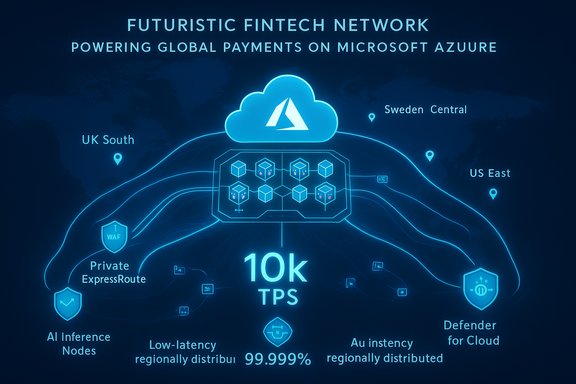
Futuristic fintech network on Microsoft Azure powering global payments with 10k TPS across global nodes.Background / Overview​

Nuvei, the Montreal‑based payments technology company, has spent recent years building a modular, global payments stack that combines local acquiring, alternative payment methods, fraud controls and transaction optimization. The company has previously partnered with Microsoft in select regions and integrated with Microsoft products such as Dynamics 365; the latest announcement formalizes and expands that relationship, moving Nuvei’s core processing APIs to Azure and explicitly citing the use of Azure AI and multiple Azure platform services to deliver improved resiliency, latency and throughput. This is being positioned as a multi‑year migration and modernization effort rather than a single ‘lift‑and‑shift’ event: Nuvei states the architecture will rely on Azure services such as Azure ExpressRoute, Azure Kubernetes Service (AKS), Azure Firewall, Azure Application Gateway with WAF, and Azure Defender for Cloud, deployed across multiple strategic regions (UK South, Sweden Central, US West and US East). The aim is a globally distributed, AI‑native transaction routing and optimization fabric that can absorb peaks, reduce latency for regional authorizations and apply analytics from every transaction.

What Nuvei is claiming — the technical headline​

  • Nuvei says its core payment processing APIs will run on Microsoft Azure and leverage Azure AI to optimize transactions in real time.
  • The company has stated the new architecture will scale beyond 10,000 transactions per second and aims for 99.999% availability for enterprise merchants.
  • The deployment footprint initially spans four strategic Azure regions (UK South, Sweden Central, US West and US East), with core platform components such as private connectivity (ExpressRoute), container orchestration (AKS), application WAFs and cloud native security in use.
These are explicit vendor claims and are framed as the outcome of a deliberate, multi‑year migration designed to reduce latency, increase elasticity and create a stronger runway for AI‑driven payments features.

Why the move matters: scalability, resilience and AI‑native payments​

Nuvei’s announcement touches three intersecting trends shaping modern payments infrastructure:
  • Scale and elasticity. Moving core processing to a hyperscaler enables horizontal scaling across regions, letting processors absorb large spikes (e.g., global commerce events) and shift capacity as demand moves. Nuvei positions Azure as the mechanism that will let it hit the 10k+ TPS mark while improving global latency and regional authorization success.
  • AI and real‑time optimization. Nuvei highlights the use of Azure AI to drive per‑transaction optimization—things like dynamic routing to local acquirers, authorization probability prediction, and adaptive fraud scoring in real time. The company frames this as a way to increase authorization rates and merchant revenue capture while reducing false declines.
  • Security and compliance at scale. By leveraging managed network connectivity (ExpressRoute), perimeter and application security (Firewall, WAF) and Azure Defender for Cloud, Nuvei is aiming to standardize security tooling across its distributed footprint while meeting regional data‑residency and compliance obligations.
Microsoft’s public comment in the release underscores its intent to position Azure as a preferred infrastructure for payments processors building AI‑enabled, always‑on systems. The vendor quote indicates Microsoft sees the work as part of the broader industry shift to cloud‑native payments architectures.

How credible are the performance claims?​

The headline 10,000 TPS figure is meaningful but should be read in context.
  • High single‑digit or low five‑figure TPS is a material capability for a payments processor servicing enterprise merchants. It signals that Nuvei aims to compete on the same class of throughput that regional and specialized processors require for peak events.
  • By comparison, major card networks and national rails operate at materially larger scales. Visa communicates capacity figures in the tens of thousands of TPS (Visa’s public materials reference capacity numbers often cited around 65,000 TPS as a theoretical or peak figure), while large national systems and super‑apps (Alipay, WeChat Pay) have reported hundreds of thousands of TPS during peak regional events. These comparisons show that 10,000 TPS places Nuvei well above many boutique processors but below the absolute peak capacity of the largest global card networks.
Caution: the 10,000 TPS and $1 trillion annual volume figures are company statements made in the press release; they are standard commercial targets and performance goals rather than independently audited throughput benchmarks. Independent validation—third‑party load tests, public throughput certificates, or independent monitoring over time—would be needed to treat them as proven, production‑sustained facts. Nuvei’s statement is credible within the context of a cloud migration roadmap, but it remains a vendor claim until external performance evidence is published.

Technical design choices and what they imply​

Nuvei lists a set of Azure technologies in the announcement that indicate conventional patterns for resilient, cloud‑native payments engines:
  • Azure ExpressRoute — private, high‑bandwidth connections for predictable network performance and separation from the public internet. This is typical where low latency and predictable routing to banking partners or acquiring banks are needed.
  • Azure Kubernetes Service (AKS) — container orchestration to scale microservices for authorization, routing, reconciliation and analytics. AKS enables rapid deployment, automated scaling and improved consistency across regions.
  • Azure Application Gateway + WAF and Azure Firewall — web application and network‑level protections to reduce attack surface and mitigate application‑layer threats, DDoS and attempted extrusions.
  • Azure Defender for Cloud — continuous threat detection and hardened posture management for regulated, always‑on environments.
Putting those pieces together suggests a layered model: private connectivity for settlement and partner links, containerized microservices for transaction processing, global edge and WAF protections for merchant traffic, and integrated cloud security tooling for continuous compliance. This architecture aligns with modern best practices for mission‑critical, low latency systems, provided the operational rigor (observability, chaos‑testing, configuration governance) matches the platform promises.

Strengths: what this partnership likely delivers​

  • Faster time to scale. Azure’s global regions, managed services and elastic compute make it faster for Nuvei to expand capacity and enter new markets without building and operating more physical datacenter layers. That lowers capital intensity for growth.
  • Operational consistency and observability. Standardizing on a single cloud provider allows centralized telemetry, standard security policies, and collective learning across regions—helpful when optimizing authorization routing and fraud models using global datasets.
  • AI‑driven transaction optimization. If Nuvei can successfully operationalize per‑transaction machine learning models at authorization time, merchants can see measurable increases in approval rates and revenue capture—high‑value outcomes. Azure’s ML and inference platforms provide a plausible path for low‑latency model serving.
  • Security posture and compliance. Using managed security services and private connectivity options helps address regulatory requirements and improves the company’s ability to demonstrate controls to acquirers, banks and enterprise clients.

Risks and trade‑offs — where to be cautious​

  • Vendor concentration and single‑provider risk. Moving core processing to one hyperscaler brings efficiency but also concentration risk. Major cloud outages show how an issue in a cloud control plane or global edge service can ripple through many dependent businesses. The October 29, 2025 Azure edge/DNS incident is a recent, high‑profile example of how configuration or global edge failures can produce broad customer impact. Nuvei and its customers must design for multicloud or robust failover if absolute independence is required.
  • Configuration and operational complexity. Kubernetes, multi‑region databases, low‑latency caches and AI inference at authorization speed introduce operational complexity. Without disciplined configuration governance, CI/CD gating, chaos engineering and rigorous observability, performance or correctness issues can appear at scale.
  • Security at scale remains a moving target. Hyperscale clouds provide many security tools, but they must be configured and monitored well. Supply chain and API abuse threats target high‑value payment flows; continuous pen‑testing, red teaming and model‑robustness checks are essential.
  • Regulatory and data‑residency nuances. Handling payments globally requires strict adherence to regional data residency, anti‑money‑laundering (AML) and local acquiring rules. Multi‑region cloud deployments ease policy enforcement, but legal and contractual work remains heavy and region‑specific. Vendors often under‑estimate compliance operationalization costs.
  • Claims vs. evidence gap. The press release sets an ambition (10k+ TPS, $1T/year volume) but lacks detailed, independently verifiable performance datapoints such as sustained throughput under multi‑vector loads, realtime SLAs under DDoS conditions, or public measurement over time. Observability metrics, third‑party load tests, or published post‑migration benchmarks would strengthen credibility.

Market context — how the numbers compare​

Transactions‑per‑second (TPS) is a headline metric, but its meaning varies by workload and business model. A few reference points:
  • Card networks and rails. Visa and other global card networks advertise peak capacity in the tens of thousands of TPS; Visa’s public materials often reference theoretical capacity numbers in the tens of thousands with sustained averages much lower. These networks and national instant payment systems handle enormous daily volumes and are architected for different failure and reconciliation models than a gateway or processor.
  • National rails and super‑apps. Systems such as Alipay or India’s UPI have demonstrated hundreds of thousands of TPS during national events—these are centralized national flows optimized for domestic scale.
  • What 10,000 TPS means. For a merchant processor or a platform that supports multiple enterprise merchants, sustained five‑figure TPS capability is a strong operational milestone. It signals readiness for large scale commerce and capacity to absorb spikes, provided latency and downstream clearing engines keep up. But it is not a direct replacement for the settlement networks or card schemes that operate at higher sustained global peaks.

Operational guidance: what merchants and partners should watch for​

  • SLA detail and maturity. Merchants should ask Nuvei for concrete SLAs, historical availability figures and runbooks for regional failover and incident response. Public claims of 99.999% availability are meaningful only when backed by contractual SLAs and penalty/remediation mechanisms.
  • Testing and certification. Request third‑party performance and security test results: load tests that simulate peak commerce events, DDoS resilience reports, and penetration test summaries. These provide greater assurance than aspirational headline numbers.
  • Onboarding and integration speed. Nuvei emphasizes faster onboarding and the compounding value of AI optimization; partners and integrators should scrutinize API docs, sandbox performance and integration timelines to ensure realistic go‑live schedules.
  • Failover and multicloud considerations. Where the business is intolerant of broad cloud provider incidents, require disaster recovery runbooks that include cross‑region failover or multicloud options, and verify those runbooks through tabletop exercises and periodic failover drills. The October 2025 Azure incident underscores the operational imperative.

Strategic implications for the payments landscape​

  • Nuvei’s move is consistent with an industry shift: payment processors are embracing cloud‑native architectures, AI inference at decision time and globally distributed microservices to reduce friction and lift authorization rates. For merchants, this trend promises faster innovation cycles, more localized payment options, and improved authorization economics.
  • Microsoft gains another high‑profile payments customer that helps validate Azure as a platform for mission‑critical fintech workloads. For Azure, every payments migration is both a technical proof point and a potential lead generator into adjacent enterprise payments workloads.
  • For competitors, the announcement raises the bar: other processors and gateways may accelerate cloud migrations or publish their own AI‑driven optimization roadmaps to avoid losing enterprise accounts sensitive to authorization performance.

What’s not yet public (and what to verify)​

  • Third‑party, sustained throughput benchmarks showing Nuvei’s platform handling sustained 10k+ TPS under realistic, multi‑vector loads (authorization/settlement/fraud checks) are not included in the announcement. That data, if published independently, would materially improve trust in the claim. Treat the headline TPS number as a corporate target until independent verification is available.
  • Full timelines and a roll‑out schedule for global migration beyond the four named Azure regions were not detailed. Customers in other regions should seek explicit timelines and transition support plans.
  • The announcement references the use of Azure AI for transaction optimization; the concrete models, inference latencies, and governance around model drift, bias and explainability were not disclosed. Those are crucial for regulated payments environments and merchant assurance.

Bottom line​

Nuvei’s expanded Microsoft partnership is a logical, well‑scoped step for a payments technology company aiming to scale globally while embedding AI into the transaction path. The architecture described—private connectivity, containerized microservices, managed security controls and Azure AI—aligns with modern best practices for an enterprise payments platform. If Nuvei achieves sustained >10,000 TPS with strong operational maturity, the industry will have a new example of cloud‑native payments at scale. However, the most important caveat is verification: the headline numbers are company claims and should be validated by independent performance data, published SLAs and third‑party testing. Additionally, the October 2025 Azure outage is a timely reminder that concentration on a single hyperscaler creates operational risk; architects and merchants must ensure redundancy, robust failover runbooks and clear contractual protection. For enterprise merchants, the announcement is positive news—an engineering investment that promises better authorization economics and scale—but it should prompt practical diligence: contractual SLAs, independent performance verification, clear migration and rollback plans, and an operational posture that anticipates and rehearses cloud provider incidents. Nuvei’s move to Azure signals the next chapter of cloud‑native payments; the proof will be in the sustained, independently measurable performance and the company’s record of managing incidents at hyperscale.

Source: The Globe and Mail Nuvei Expands Partnership with Microsoft to Scale Global Payments Infrastructure to Support More Than 10,000 transactions per second
 

Nuvei’s decision to run its core payment processing APIs on Microsoft Azure and to use Azure AI for real‑time transaction optimization is a decisive step toward cloud‑native, AI‑enabled payments — the company says this migration will push its platform beyond 10,000 transactions per second (TPS), target 99.999% availability, and create a foundation to support more than $1 trillion in annual payment volume for enterprise merchants worldwide.

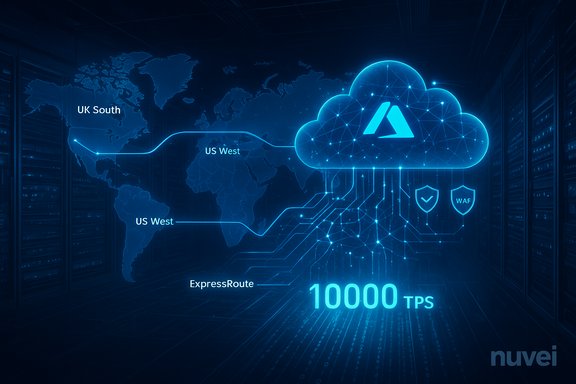
Blue neon cloud network linking global regions with 10,000 TPS.Background / Overview​

Nuvei has been evolving from a regional acquirer into a global, full‑stack payments platform, layering acquiring relationships, local payment methods, fraud controls, and per‑transaction intelligence into its enterprise APIs. The expanded collaboration with Microsoft formalizes a multi‑year migration of mission‑critical processing onto Azure and positions Nuvei to use Microsoft’s cloud networking, container orchestration, security tooling, and Azure AI capabilities to deliver resilient, low‑latency payments services at global scale. The new public announcement outlines a concrete technology stack and region footprint: Azure ExpressRoute for private connectivity, Azure Kubernetes Service (AKS) for containerized workloads, Azure Firewall, Azure Application Gateway with Web Application Firewall (WAF), and Azure Defender for Cloud for threat protection. Nuvei’s initial multi‑region architecture will span UK South, Sweden Central, US West, and US East. These are the building blocks Nuvei cites as the technical foundation of its AI‑native processing fabric.

What the announcement actually says — the hard claims​

  • Nuvei will run its core payment processing APIs on Microsoft Azure and use Azure AI to optimize transactions in real time.
  • Nuvei states the platform will scale beyond 10,000 TPS and that it is targeting 99.999% availability (commonly called “five nines”) for enterprise merchants.
  • The company positions the migration as foundational to support more than $1 trillion in annual payment volume as global merchants scale internationally.
  • Core Azure services explicitly named include ExpressRoute, AKS, Azure Firewall, Azure Defender for Cloud, and Azure Application Gateway + WAF; the footprint initially covers four strategic Azure regions: UK South, Sweden Central, US West and US East.
These are vendor declarations about architecture and targets rather than independently measured results published at time of announcement. Treat the throughput and availability numbers as stated business objectives pending external validation and contractually backed SLAs.

Why this move matters (technical rationale)​

Moving core payments processing into a hyperscaler like Azure enables a set of technical and operational levers that are important for enterprise payments:
  • Elastic scale and bursting capacity. Cloud compute and network elasticity let a payment platform horizontally scale across regions to absorb peaks — critical for global commerce events and flash traffic. Azure’s global backbone and ExpressRoute provide more predictable network performance than the public internet for latency‑sensitive authorization flows.
  • Containerized microservices for operational velocity. Deploying on AKS permits microservice partitioning, autoscaling, and faster deployment pipelines — useful for rolling updates, staged rollouts, and continuous delivery of authorization logic and AI optimizations.
  • AI at decision time. Nuvei emphasizes Azure AI to perform per‑transaction optimization: dynamic acquirer routing, authorization probability prediction, and adaptive fraud scoring. If executed at low latency, these models can materially increase authorization rates and reduce false declines, directly improving merchant revenue capture.
  • Standardized security and compliance tools. Using managed services such as Azure Defender for Cloud, Application Gateway + WAF, and private connectivity via ExpressRoute simplifies a unified security posture and helps gather compliance artifacts for PCI and regional regulatory regimes. However, management and configuration of those controls remain the customer’s responsibility.

Verifying the headline numbers — what independent data shows​

The most load‑bearing claims — 10,000+ TPS, 99.999% availability, and $1 trillion annual volume — are strong commercial headlines. The announcement published on major presswire services repeats those points. Independent context is important:
  • Payments networks and national rails operate at much larger absolute peaks: for example, Visa’s corporate materials reference processing capacity in the tens of thousands of TPS — commonly cited figures include a theoretical or peak capacity often reported around 65,000 TPS by Visa itself. This provides a benchmark to interpret Nuvei’s five‑figure TPS goal: 10k TPS is significant for gateway/processors but remains below the peak capacity of the largest card networks.
  • National instant payment systems and “super‑apps” can report very high single‑region TPS during peaks: India’s UPI platform has published figures in the low thousands of TPS (for example, ~3,700 TPS reported for 2023), which illustrates how TPS context varies by workload and regional design. These comparisons show that 10k TPS places Nuvei well above many boutique processors but not at the absolute scale of global rails.
Caveat: the press release is a milestone and roadmap statement. The critical next step for customers and auditors is to obtain measurable evidence: reproducible load tests, published sustained throughput curves, tail‑latency percentiles (p95/p99), and contractual uptime SLAs with remedies. Without those, the announced numbers remain corporate performance commitments rather than independently audited facts.

Architecture and security — what Nuvei is building in Azure​

Core platform components​

Nuvei identified a compact set of Azure primitives in its announcement, each carrying a clear operational role:
  • Azure ExpressRoute — private, high‑bandwidth network connectivity to reduce public internet variability and provide predictable routing to banks and acquirers.
  • Azure Kubernetes Service (AKS) — container orchestration for microservices and autoscaling of authorization, routing, and analytics workloads.
  • Azure Firewall & Application Gateway + WAF — network and application‑layer protections for merchant APIs and public endpoints.
  • Azure Defender for Cloud — runtime threat detection and posture management for a regulated, always‑on system.
These components, when combined with regional redundancy and strong observability, form a credible enterprise architecture for a high‑volume payments engine — provided the operational rigor (chaos testing, CI/CD gating, configuration governance) is rigorous and continuously exercised.

Regions and data sovereignty​

Initial regions named in the public announcement — UK South, Sweden Central, US West, and US East — are sensible for covering European and North American merchants while supporting data‑residency controls where needed. However, globally distributed enterprise customers will want explicit roll‑out timelines for other regions and region‑specific compliance attestations.

Strengths and opportunities​

  • Faster market expansion. Standardizing on Azure reduces time to open new markets (compared to building global data centres), accelerating Nuvei’s ability to service enterprise merchants with local payment rails.
  • Operational consistency. A single cloud vendor enables centralized telemetry and shared tooling for security, monitoring, and model governance — which is valuable when optimizing authorization routing across many merchants.
  • AI as a compounding advantage. Nuvei’s pitch that per‑transaction intelligence “compounds” with each authorization is valid in principle: supervised learning on labeled authorization outcomes can improve routing choices and fraud discrimination over time, producing measurable authorization lifts. If latency budgets are respected, this is high ROI for merchants.
  • Reduced third‑party surface. By migrating core services and refreshing legacy components, Nuvei claims it will reduce reliance on third‑party middleware and create a cleaner foundation for future features and faster rollouts.

Risks, trade‑offs, and what to watch​

  • Vendor concentration (single‑cloud) risk. Centralizing core processing on one hyperscaler improves velocity but introduces concentration risk. Large cloud incidents disproportionately affect customers that rely wholly on a single provider. Nuvei and enterprise customers should confirm failover and multicloud options if absolute independence is required. Recent Azure incidents underscore this operational reality.
  • Claims vs. evidence gap. The announcement frames TPS, availability, and $1T volume as targets. Enterprises should require independent load tests, published benchmarks, and contractually anchored SLAs before routing mission‑critical flows. Treat headline figures as vendor goals until validated.
  • Operational complexity at scale. Running low‑latency, stateful payment flows across regions with HSMs, tokenization, reconciliation, and cross‑region replication increases system complexity. Kubernetes, multi‑region caches, and low‑latency inference must be engineered for idempotency and consistency to avoid new failure modes.
  • Security, compliance, and cryptography posture. Managed Azure services provide tooling, but cryptographic key management (customer‑managed HSMs vs. cloud HSM), PCI artifacts, AML controls, and local regulator attestations remain non‑trivial deliverables. Customers must insist on documented evidence and testing regimes.
  • Model governance and explainability. If Azure AI is used in authorization/fraud decisions, merchants and regulators will expect controls: model versioning, explainability for declined transactions, and guardrails against drift and bias. The public announcement does not detail these governance mechanics.

Practical checklist for procurement and technical teams​

Enterprises evaluating Nuvei’s Azure‑based platform should treat the announcement as an invitation to a rigorous procurement process. Key items to demand and validate:
  • Written SLAs that explicitly define uptime targets, measurement windows, and remediation/financial penalties tied to the 99.999% availability claim.
  • Independent load‑test results or the right to run joint performance tests reproducing your peak event traffic; ask for p50/p95/p99 latency curves under load.
  • Detailed cryptographic design: where HSMs reside, whether keys are customer‑managed, and FIPS equivalents for regulated markets.
  • Compliance artifacts: PCI DSS attestation, region‑specific data residency evidence, and third‑party penetration test summaries.
  • Clear portability and exit terms: data export formats, timelines, and transition support (including escrow of deployment automation if feasible).
  • Model governance commitments: how Nuvei will handle model explainability, human review of declines, and remediation of false positives driven by AI decisions.

What success will look like (measurable outcomes)​

If Nuvei’s migration and AI optimizations deliver as claimed, customers should see measurable operational improvements:
  • Higher authorization rates and reduced false declines, measured as a percent uplift versus a baseline.
  • Reduced tail latency for authorization requests (p95/p99 improvements) and improved consistency across regions.
  • Demonstrable uptime consistent with contractual SLAs and evidence from independent monitoring.
  • Faster onboarding and improved integration velocity via standardized cloud tooling and APIs.
Each outcome should be tracked with dashboards, alerting, and periodic third‑party verification where possible.

Market implications and competitive context​

Nuvei’s announcement underscores a broader industry shift: payment processors are moving core decisioning and transaction flows closer to cloud platforms that offer elastic compute, global networking, and integrated AI services. For Microsoft, winning high‑profile payments workloads validates Azure as a candidate for mission‑critical fintech systems; for Nuvei, deepening the Azure integration accelerates product roadmaps for AI‑driven capabilities.
In comparative terms, Nuvei’s 10k+ TPS ambition positions the company above many boutique gateways but below the peak capacities of the largest payment rails (Visa’s corporate materials reference network capacities in the tens of thousands of TPS range). National systems such as India’s UPI operate at very high local scale but follow different architectural models and governance regimes. These comparisons illustrate that TPS is a useful but context‑sensitive metric: the right scale depends on the target market and workload.

Bottom line — opportunity tempered by due diligence​

Nuvei’s expanded partnership with Microsoft is a credible strategic move that aligns with modern cloud‑native architecture and the push to embed AI into authorization and fraud decisions. The technology choices it lists — ExpressRoute, AKS, Defender, WAF — are consistent with industry best practices for resilient payments infrastructure, and the initial multi‑region footprint is reasonable for Western Europe and North America. That said, the announcement is primarily a roadmap and set of vendor commitments. The headline numbers — 10,000+ TPS, 99.999% availability, and $1 trillion in annual throughput ambition — should be treated as corporate targets until accompanied by independent performance data, reproducible load tests, and solid contractual SLAs. Enterprises should insist on measurable proof, documented security and cryptographic designs, and exit/portability plans before routing mission‑critical flows to the new environment.

Recommended next steps for enterprise IT and payment architects​

  • Request a formal performance pack from Nuvei that includes published load tests, tail‑latency percentiles, and third‑party verification.
  • Negotiate SLA terms tied to the 99.999% availability target with explicit remediation and operational runbooks for failover.
  • Validate the cryptographic and key management model (customer‑managed HSM vs. cloud HSM) for regulatory compliance.
  • Pilot low‑risk flows first and run joint chaos and failover tests across the named Azure regions.
  • Require clear model governance and incident response procedures for AI‑driven declines and fraud decisions.

Nuvei’s Azure migration and AI ambitions are a meaningful evolution for the payments landscape: the combination of elastic cloud infrastructure, managed security, and real‑time AI creates a plausible path to improved authorization economics and global scale. The strategic gains are real — but the transformation’s value for merchants will ultimately depend on transparent, measurable evidence and the operational discipline that turns marketing targets into reproducible production outcomes.
Source: FX News Group Nuvei expands partnership with Microsoft
 

Nuvei’s decision to migrate its core payment processing services onto Microsoft Azure marks a significant inflection point for enterprise payments infrastructure, creating an AI‑native, globally distributed architecture Nuvei says can handle more than 10,000 transactions per second, target 99.999% availability, and scale to support over $1 trillion in annual payment volume — claims the company frames as capacity targets enabled by Azure’s distributed compute, private connectivity, container orchestration, and integrated security services.

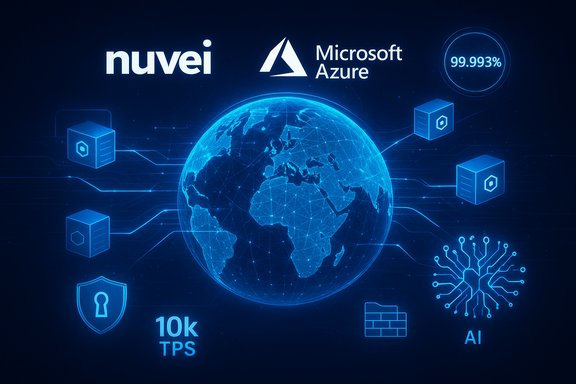
Blue digital globe with interconnected network lines, Azure and Nuvei logos, AI motif, and 10k TPS.Background​

Nuvei, a Montreal‑based global payments processor, has spent the last several years expanding its product stack — acquiring capabilities in local acquiring, alternative payment methods, payouts, and embedded finance — while serving merchants across hundreds of markets. The company’s latest move is a multi‑year migration of its core payment processing APIs and services from mixed on‑premises and third‑party hosted components into a cloud‑native architecture on Microsoft Azure.
The vendor narrative is straightforward: moving core services to Azure provides greater elasticity during peak demand, faster and more consistent global performance, tighter regional data residency controls, and a foundation to operationalize real‑time, AI‑driven transaction optimization. Technically, Nuvei has said it will use Azure building blocks such as Azure ExpressRoute (private connectivity), Azure Kubernetes Service (AKS) (container orchestration), Azure Firewall (network protection), Azure Defender for Cloud (threat detection and posture management), and Azure Application Gateway with Web Application Firewall (WAF) to harden application traffic and block common web threats.
This announcement extends a partnership trajectory between Nuvei and Microsoft that began several years ago and has already included integrations with Microsoft products and services. The new architecture is being positioned as both an immediate performance upgrade and a long‑term enabler for more advanced, AI‑powered capabilities across the payments lifecycle.

What Nuvei announced — the key facts​

  • Nuvei has migrated its core payment processing APIs to run on Microsoft Azure, using Azure’s AI capabilities to optimize transaction routing and authorization decisions in real time.
  • The new cloud architecture is described as capable of supporting 10,000+ transactions per second and a runway to handle more than $1 trillion in annual payment volume as clients scale globally.
  • Nuvei cites a target of 99.999% availability for enterprise merchants as a design objective of the Azure deployment.
  • The platform leverages Azure ExpressRoute, Azure Firewall, AKS, Azure Defender for Cloud, and Azure Application Gateway with WAF across multiple Azure regions (Nuvei identified UK South, Sweden Central, US West, and US East for initial strategic coverage).
  • Nuvei framed the migration as reducing reliance on third‑party legacy components and refreshing core components to accelerate innovation and resilience.
These are company‑reported technical and business targets. The figures represent capacity and design goals for the modernized platform rather than independent audit results of current, sustained throughput under live traffic.

Why cloud‑native architecture matters for payments​

Payments processing is a latency‑sensitive, availability‑critical workload with demanding operational, regulatory, and security constraints. For large merchants and platforms, even small improvements in authorization success and latency translate directly into revenue.
  • Elasticity: Cloud platforms let processors scale horizontally to absorb sudden global traffic spikes (for example, seasonal shopping peaks, gaming drops, or large promotional events).
  • Geographic distribution: Running services in multiple regions reduces round‑trip latency to regional acquirers and issuers, improving authorization time and success rates.
  • Security posture: Managed security services provide continuous threat intelligence and hardened controls that are expensive to replicate on‑premises.
  • Operational velocity: Containerization and orchestration (e.g., AKS) accelerate deployments, blue/green rollouts, and automated recovery, which improves both resilience and time to market for new features.
  • AI integration: Bringing AI models closer to transaction processing enables near‑real‑time decisioning — for authorization routing, fraud scoring, interchange optimization, and intelligent retries — which can materially improve approval rates and reduce decline leakage.
Nuvei’s narrative rests on these pillars: cloud scale, regional distribution, and AI‑native optimization. For enterprise merchants and ISVs integrating payment flows, these capabilities potentially reduce integration complexity and improve the economics of global expansion.

The architecture: what Nuvei is actually using​

Nuvei’s public outline names several Azure components that are industry‑standard for high‑throughput, secure workloads:
  • Azure ExpressRoute — a private, dedicated, and high‑bandwidth connection to Azure that bypasses the public internet for consistent latency and throughput. ExpressRoute supports very large bandwidths (10Gbps, 100Gbps options) and is commonly used for regulated or latency‑sensitive traffic.
  • Azure Kubernetes Service (AKS) — container orchestration for packaging and managing microservices and APIs, enabling rapid autoscaling and rolling updates.
  • Azure Firewall — managed, stateful cloud firewall with threat intelligence rule sets and centralized policy enforcement across virtual networks.
  • Azure Defender for Cloud — cloud workload protection, posture management, and integrated threat detection across workloads and services.
  • Azure Application Gateway + Web Application Firewall (WAF) — layer‑7 load balancing and WAF protections aimed at preventing OWASP top‑10 attacks, bot traffic mitigation, and integration with DDoS protection patterns.
Nuvei also described the deployment spanning multiple Azure regions (initially UK South, Sweden Central, US West, US East) to achieve geographic redundancy and reduce cross‑border latency for global merchant traffic.
These Azure services are well suited to payments workloads and are widely adopted in high‑security environments. The combination of ExpressRoute and AKS provides the predictable network performance and orchestration controls required for real‑time transaction processing.

AI in the critical path — real‑time optimization and the practicalities​

Nuvei emphasizes that Azure AI will be used to optimize transactions in real time. That phrase covers a range of plausible functions:
  • Authorization routing — choosing the best acquirer, route, or issuer path to maximize approval rates based on historical outcomes and current conditions.
  • Dynamic retry logic — applying intelligent retry patterns to transient failures or declines that might approve on a subsequent attempt.
  • Fraud and risk scoring — combining model outputs to flag high‑risk activity without introducing delay in the checkout flow.
  • Interchange and fee optimization — predicting interchange outcomes to select the most cost‑efficient processing path while balancing approval probability.
Putting models into the transaction path requires careful attention to inference latency, model explainability, and governance. At scale, even microsecond variance becomes material when tens of thousands of TPS are involved, and models must be resilient to adversarial inputs and distributional drift.
From a practical standpoint, Nuvei’s architecture on AKS and Azure AI tooling (Azure Machine Learning, real‑time inference endpoints, or edge‑proximate inference) can support low‑latency model serving if implemented with a focus on colocated compute, optimized model footprints, and fast IO. But the value of AI‑driven optimization depends heavily on the quality of training data, the model lifecycle process, and robust A/B testing infrastructure to avoid negative impacts on authorization rates or false declines.

What the performance claims mean — and what to watch out for​

Nuvei’s headline numbers — 10,000 transactions per second and a foundation to support more than $1 trillion in annual volume — are capacity and design milestones. They signal a scale ceiling rather than an immediate guarantee of universal performance under all conditions.
  • 10,000 TPS: This is a high water mark for simultaneous transaction throughput. It is credible as a capacity target for a horizontally scaled, cloud‑native payment engine, but throughput is a function of the entire stack (network, acquirer endpoints, downstream banks) and therefore can vary under real‑world routing complexity.
  • $1 trillion annual volume: This is framed as supportable capacity. Whether Nuvei currently processes anywhere near that volume is a separate question; the statement is best read as a statement of the architecture’s headroom rather than audited transaction totals.
  • 99.999% availability target: Five‑nines availability is a stringent SLA level (roughly 5.26 minutes of downtime per year). Achieving this across global regions and many third‑party endpoints requires not just cloud availability but resilient fallback strategies for acquirer outages, cross‑region failovers, and deterministic failover testing.
These claims are company‑stated objectives and align with modern cloud engineering practices; however, independent verification of sustained production behavior under diversified merchant traffic would be required to validate them fully. Merchants evaluating Nuvei should request performance benchmarks, SLA terms, incident response commitments, and audit reports that demonstrate measured uptime and throughput under representative loads.

Security, compliance, and data residency considerations​

Moving core processing to Azure brings both security benefits and additional audit points:
  • Improved baseline security: Managed services like Azure Firewall, WAF, and Defender for Cloud provide baseline protection and centralized visibility, reducing the operational burden on Nuvei to maintain always‑current security controls.
  • Shared responsibility: Cloud providers secure the infrastructure, but Nuvei remains responsible for application logic, cardholder data handling, encryption keys, and PCI DSS controls. Effective cloud security requires strict IAM, key management, and continuous compliance monitoring.
  • Data residency: Nuvei’s regional deployment footprint suggests an intent to meet data residency requirements, but compliance with local regulations (for example, EU data processing rules, UK regimes, or APAC regimes) depends on tenancy configuration, data flow maps, and contractual terms with merchants and acquirers.
  • Reduced third‑party tech dependence, but increased cloud dependency: While Nuvei says it reduced reliance on some legacy third‑party components, the migration increases dependency on Microsoft Azure for core infrastructure. That tradeoff centralizes risk: cloud provider outages or policy changes can have wide impact unless mitigations (multi‑cloud fallbacks, cross‑region resilience, and disaster recovery plans) are in place.
For enterprise customers, the important questions are concrete: how is encryption handled in transit and at rest, where are cryptographic keys stored and who controls them, does Nuvei maintain separate tenants or logically separated environments per region, and what attestations (SOC 2, PCI DSS, ISO 27001) and penetration test evidence can merchants review?

Operational risks and vendor lock‑in​

A major migration to Azure reduces operational friction and improves scalability, but it also introduces lock‑in risks:
  • Platform lock‑in: Optimizing services for AKS, Azure‑specific networking features, and ExpressRoute may increase the effort required to shift to another cloud provider in the future.
  • Cost dynamics: High throughput, private connectivity, and extensive regional presence carry significant operating costs. Cost predictability depends on workload patterns, reserved capacity commitments, and network egress characteristics.
  • Single‑provider dependency: Concentrating critical processing on one cloud provider raises concentration risk. Compensating controls include multi‑region redundancy, multi‑SIM approach for connectivity, and cross‑region backups.
  • Third‑party endpoint variability: Even with perfect internal performance, ultimate success rates rely on issuers, card networks, and acquirers — components outside Nuvei and Azure.
Nuvei and its customers will need clear contractual SLAs, regularly tested failover plans, and transparency into cost and performance metrics to manage these risks effectively.

Migration complexity and what it likely entailed​

Migrating payment core services to Azure at this scale is nontrivial. Typical migration tasks for a payments processor of Nuvei’s size include:
  • Refactoring monolithic services into containerized microservices for AKS.
  • Implementing stateful service patterns and persistent storage that meet PCI and regulatory requirements.
  • Designing cross‑region routing, session stickiness, and global load balancing to minimize latency and avoid split‑brain states.
  • Establishing ExpressRoute circuits and integrating with on‑premises or colocated legacy systems and banking partners.
  • Hardening security controls, rotating credentials, and migrating secrets into managed key vaults.
  • Replacing or integrating legacy third‑party components with cloud‑native equivalents or rebuilt services.
  • Running exhaustive functional, performance, chaos, and compliance testing before live traffic cutover.
The timeline for such a migration is typically measured in quarters or years, and it requires co‑ordination with banking partners and acquirers to avoid disruption. The company has characterized the work as a multi‑year effort; that aligns with expected complexity.

What this means for merchants and partners​

For merchants and integrators, Nuvei’s Azure migration promises several practical outcomes:
  • Faster onboarding and scale: If Nuvei’s AKS‑based APIs and AI integration improve onboarding velocity and transaction performance, merchants expanding into new regions may realize quicker time to revenue.
  • Better authorization economics: Intelligent routing and dynamic retries could improve approval rates and reduce revenue loss from false declines.
  • Stronger security baseline: Centralized cloud defenses and standardized deployments can simplify merchant audits and compliance evidence collection.
  • Potential cost and vendor considerations: Merchants should review how Nuvei’s cost model evolves post‑migration and seek contractual clarity around SLAs, failover behavior, and data residency guarantees.
Large merchants with heavy traffic should request performance and resilience reports, participate in joint load testing, and verify end‑to‑end compliance with their internal and regulatory auditors.

Strategic implications for Microsoft and the cloud payments landscape​

The Nuvei migration is another example of major payment processors choosing large public cloud providers to handle critical transactional workloads. For Microsoft, it demonstrates Azure’s suitability for real‑time, regulated, and high‑throughput workloads and reinforces Azure’s positioning as an AI‑first cloud, where integrated tooling for inference and data processing becomes a differentiator.
For the payments industry, cloud‑native payment stacks enable faster innovation cycles and advanced routing intelligence, but they also consolidate a significant portion of transaction plumbing on a few hyperscale clouds. That raises ecosystem questions about resilience, competition, and regulatory oversight going forward.

Strengths, tradeoffs, and key risks — an executive checklist​

  • Strengths
  • Elastic scale and global distribution reduce latency and improve capacity headroom.
  • AI‑driven optimization can materially improve approval rates when models are well‑trained and continuously validated.
  • Improved security posture through managed services and centralized controls.
  • Faster product velocity via containerization and modular APIs.
  • Tradeoffs
  • Increased dependency on Azure for critical infrastructure and networking.
  • Migration and run‑rate costs may increase, especially for high throughput and multiple ExpressRoute circuits.
  • Operational complexity in managing real‑time models in the critical path.
  • Key risks to monitor
  • Validation of capacity claims: Request independent performance benchmarks or third‑party audits.
  • Failover and incident response: Confirm cross‑region failover behavior and real incident timelines.
  • Regulatory compliance and data residency: Verify contractual commitments for regional processing and where primary cardholder data resides.
  • Model governance: Ensure A/B testing, rollback, and monitoring for AI decisioning to prevent unintended authorization impacts.

Practical guidance for IT and payments teams​

  • Evaluate SLA and auditability: Require documented SLAs and third‑party attestation reports (PCI DSS, SOC 2) for cloud environments and change controls.
  • Test with representative loads: Conduct joint performance and chaos testing to validate throughput and failover behavior under realistic patterns.
  • Clarify data residency pathways: Map transaction flows and confirm where data is transiently stored, processed, and logged; request data flow diagrams.
  • Review model governance: Ask for details on real‑time model training, drift detection, explainability, and rollback mechanisms.
  • Negotiate cost transparency: Understand how cloud egress, ExpressRoute, and regional replication affect merchant billing.
  • Plan for multi‑cloud contingencies: For mission‑critical platforms, evaluate mitigations for a cloud provider outage (cross‑region strategies, multi‑cloud fallbacks, or alternative routing).

The bottom line​

Nuvei’s migration of core processing to Microsoft Azure is a notable milestone in the evolution of modern payments infrastructure. The move promises greater elasticity, improved security controls, and the operational runway to bring AI into the transaction path — all capabilities that matter deeply to enterprise merchants seeking to optimize approval rates and expand globally.
However, the headline numbers (10,000 TPS, $1 trillion capacity, 99.999% target availability) should be read as company‑stated capacity and objectives rather than independently validated guarantees. Merchants and partners must demand transparency: performance benchmarks, compliance attestations, incident response guarantees, and clear technical documentation of failover behavior.
For organizations building on top of or integrating with Nuvei, the Azure migration can unlock faster time to market and better global performance — if they receive the operational evidence and contractual protections needed to manage the tradeoffs inherent in concentrating critical payments infrastructure on a single hyperscaler. The true test will be sustained, measured production performance under real transactional diversity and global scale.

Source: PYMNTS.com Nuvei Boosts Global Processing Capabilities by Migrating Core Services to Microsoft Azure | PYMNTS.com
 

Nuvei’s decision to move its core payment processing onto Microsoft Azure and to fold Azure AI into real‑time transaction optimization represents a defining moment for cloud‑native payments: the company says the migration will enable processing beyond 10,000 transactions per second (TPS), target 99.999% availability, and establish an AI‑native foundation to support more than $1 trillion in annual payment volume for enterprise customers worldwide.

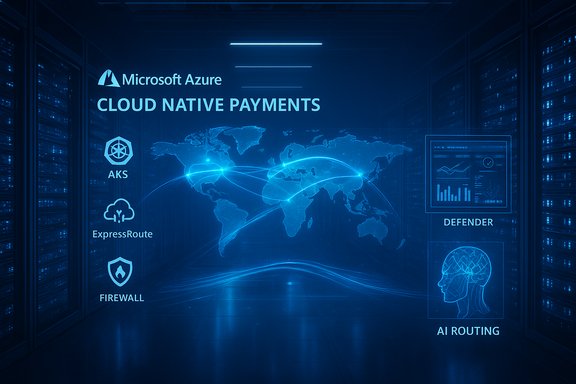
Azure Cloud Native Payments dashboard in a blue data center, with AI routing and Defender.Background​

Nuvei, the Montreal‑based payments technology firm, has steadily evolved from a regional acquirer into a full‑stack payments provider offering acquiring, alternative payment methods, payouts, card issuing, embedded banking, and fraud/risk services across hundreds of markets. The firm’s expanded partnership with Microsoft formalizes a multi‑year migration to run Nuvei’s core payment processing APIs and services on Microsoft Azure and to leverage Azure’s AI capabilities for per‑transaction routing and decisioning.
That public announcement frames three headline outcomes:
  • a throughput capability of more than 10,000 TPS,
  • a design objective of 99.999% availability for enterprise merchants, and
  • an architecture positioned to scale toward $1 trillion in annual transaction volume.
These are ambitious targets and, if realized in production under sustained traffic, place Nuvei in a different tier of high‑volume processors. The move combines standard cloud best practices—private connectivity, container orchestration, managed security—with the addition of AI in the decision path to improve authorization economics and reduce false declines.

Overview: what the Azure migration actually includes​

Nuvei’s public description calls out a concrete set of Azure building blocks and an initial regional footprint:
  • Azure ExpressRoute for private network connectivity and deterministic routing.
  • Azure Kubernetes Service (AKS) for container orchestration and autoscaling of microservices.
  • Azure Firewall and Azure Application Gateway with Web Application Firewall (WAF) for network and application‑layer defenses.
  • Azure Defender for Cloud for advanced threat detection and posture management.
Nuvei named four Azure regions in its initial rollout: UK South, Sweden Central, US West, and US East—a start that prioritizes Western Europe and North America while leaving room to expand regionally for latency and data‑residency needs.
Taken together, these components form a distributed, active/active architecture that Nuvei says will absorb peak global transaction volume, minimize latency to regional acquirers and issuers, and provide the controls needed for regulated, PCI‑scoped workloads.

Technical anatomy: why these building blocks matter for payments​

Azure ExpressRoute and deterministic networking​

Private interconnects like ExpressRoute are critical for payment processors because they reduce exposure to internet variability and provide more predictable latency to banking partners and acquiring endpoints. Private circuits help ensure that authorization windows remain stable during spikes and provide the deterministic behavior needed for tight SLAs.

Containerization and AKS for scale and velocity​

Using Azure Kubernetes Service (AKS) permits Nuvei to partition the transaction stack into microservices—stateless authorization tiers, routing engines, reconciliation jobs, and analytics—each horizontally scalable. Container orchestration simplifies rolling updates, blue/green deployments, and automated failure recovery, which are essential to sustaining high TPS while performing iterative changes.

Managed security and runtime protections​

Azure‑native security offerings—Firewall, Application Gateway + WAF, and Defender for Cloud—supply telemetry, attack surface reduction, and threat detection that would be costly to replicate on an all‑on‑prem architecture. For PCI environments, centralized logging, standardized WAF rules, and managed posture controls shorten audit cycles and support compliance evidence gathering. That said, configuration and runbook discipline remain the customer’s responsibility.

Multi‑region footprint and availability engineering​

An active/active multi‑region design reduces round‑trip latency for geographically distributed merchants and enables traffic absorption during regional incidents. Nuvei’s initial selection of four regions balances coverage with operational complexity, but global commerce and local data‑residency laws will likely require an expansion beyond those regions over time. Achieving a meaningful five‑nines availability target will depend on proven cross‑region failover, acquirer failback strategies, and extensive chaos testing.

The scale claims: reading “more than 10,000 TPS” and “99.999% availability”​

Nuvei’s headline metric—10,000+ TPS—is a clear signpost: it signals the company’s ambition to compete for very large enterprise accounts and global commerce events. That throughput figure is plausible for a well‑engineered cloud‑native stack with autoscaling, private network bandwidth, and tuned edge paths, but it must be understood as a capacity target rather than a universal, always‑on guarantee. Throughput depends on the entire end‑to‑end ecosystem: network, acquirer endpoints, issuer performance, downstream fraud checks, and the latency of external services.
The 99.999% availability target—commonly called “five nines”—equates to roughly 5.26 minutes of downtime per year. Achieving that level for global payments is difficult because outages are not only about cloud compute: they also involve dependent third parties (acquirers, issuing banks, card networks) and network transit variability. Nuvei’s ability to bind that target into a contractual SLA with explicit remediation will be the critical test for enterprise customers.
Contextual benchmarks help interpret the scale claim: the largest card networks publish capacity figures in the tens of thousands of TPS (Visa’s publicly reported capacity is often cited in that range), which shows that 10k TPS places Nuvei well above many niche processors but still below the absolute peaks of major global rails. Nuvei’s figure is meaningful for gateway and processor comparisons, but independent, reproducible load tests and third‑party verification will be needed to treat it as production‑sustained reality.

Azure AI in the transaction path: potential, pitfalls, and performance constraints​

Nuvei’s statement highlights Azure AI as a core enabler for real‑time transaction optimization: dynamic routing, authorization probability prediction, adaptive retries, and fraud scoring. In practice, these functions can improve authorization rates and reduce false declines—directly translating to merchant revenue—when models are accurate and inference latency is near‑zero.
That promise depends on three operational conditions:
  • High‑quality, labeled training data and continuous feedback loops to avoid model drift.
  • Low‑latency inference endpoints co‑located with the transaction path so they add negligible delay to authorizations.
  • Robust model governance: explainability, rollback paths, A/B tests, and safeguards against adversarial inputs that could degrade authorization outcomes.
AI in payments is not a panacea. Models can introduce subtle biases, and placing them in the critical authorization path requires operational discipline: feature validation, latency budgets, retraining cadence, and incident runbooks that include model rollback. Merchants must ask for model governance documentation, inference tail‑latency percentiles, and the safety nets for mistaken decisions.

Security, compliance, and data residency — what merchants must confirm​

Moving a PCI‑scoped core into a hyperscaler brings benefits—managed patching, centralized logs, and hardened perimeter controls—but also a set of contractual and architectural questions that merchant security teams should clarify before migrating mission‑critical flows:
  • PCI DSS scope and audit evidence: how Nuvei isolates cardholder data and the location(s) of primary and secondary data stores.
  • Cryptographic key management: whether HSMs are customer‑managed, cloud‑managed, or hybrid, and how key rotation and attestations are handled.
  • Data residency commitments and region expansion timelines for markets not covered by the initial four Azure regions.
  • Security operations and shared responsibility: how Nuvei integrates Defender telemetry, WAF rules, and runbooks with customer incident response plans.
These are not theoretical concerns: the joint architecture must provide auditable evidence for regulators and merchant security teams, and SLAs should include clearly defined remediation and forensic support.

Operational risks and hyperscaler dependence​

Relying heavily on a single hyperscaler creates concentration risk. Hyperscaler outages, regional network incidents, and cross‑region capacity pressures can all affect transaction flows. Nuvei’s public messaging emphasizes active/active distribution and private connectivity, but enterprise architects should still insist on robust failover playbooks, well‑tested cross‑region failbacks, and concrete commitments for timeliness of recovery. A recent high‑profile Azure outage in October 2025 is a reminder that cloud dependency requires compensating controls and rehearsed incident response.
Other operational tradeoffs include:
  • Cost variability as egress, ExpressRoute circuits, and replicated storage scale with higher TPS.
  • Increased complexity in debugging distributed transactions across regions and microservices.
  • Model governance overhead when AI decisions directly affect revenue‑critical authorization outcomes.
These risks are manageable, but they require explicit contractual protections and operational investment from both Nuvei and its merchant partners.

Practical checklist for IT, payments, and procurement teams​

  • Request a full performance pack from Nuvei that includes reproducible load test reports, tail‑latency percentiles, and independent third‑party verification of the 10k+ TPS claim.
  • Negotiate SLA language that ties uptime financial remedies to the 99.999% target, with clearly defined measurement windows and remediation timelines.
  • Test failover and chaos scenarios jointly across the named Azure regions (UK South, Sweden Central, US West, US East) and ask for runbooks and RTO/RPO metrics.
  • Validate cryptographic and key management architecture (cloud HSM vs. customer‑managed HSM) and require attestations for key custody.
  • Obtain model governance documentation for AI‑driven routing and fraud decisions: training data sources, retraining cadence, drift detection, explainability, and emergency rollback procedures.
  • Map data flows for regulatory compliance: confirm where cardholder data is stored, routed, and logged, and require contractual data‑residency guarantees for sensitive markets.
  • Clarify pricing impact of the new architecture (ExpressRoute circuits, egress, cross‑region replication) and request cost transparency for high‑volume scenarios.
Following this checklist helps turn vendor marketing targets into contractual, verifiable capabilities that can safely carry mission‑critical payments.

Market implications and competitive context​

Nuvei’s Azure migration is another data point in a broader industry shift toward hyperscaler‑hosted, AI‑enabled payments stacks. For Microsoft, winning Nuvei is a validation of Azure’s suitability for real‑time, regulated fintech workloads and reinforces Azure’s pitch as an AI‑first cloud. For Nuvei, the move accelerates product roadmaps and provides a technical runway to compete for large enterprise and cross‑border merchants.
Competitors will feel pressure to publish similar scale roadmaps or accelerate their own cloud migrations. The net effect is faster innovation for merchants—but it also consolidates critical transaction plumbing on a small set of hyperscalers, raising competitive and regulatory questions about resiliency and market concentration.

Strengths — what Nuvei gets right​

  • Clear engineering posture. The announced stack (ExpressRoute, AKS, Firewall, WAF, Defender) follows standard, proven patterns for high‑throughput, secure cloud architectures.
  • AI‑native ambition. Embedding Azure AI into routing and fraud decisioning can materially raise authorization rates when models are well governed and latency budgets are respected.
  • Elastic scale and multi‑region distribution. The architecture is designed to absorb bursts and reduce regional latency for global merchants.
  • Faster product velocity. Containerization and cloud tooling enable quicker rollouts and safer deployments for incremental innovation.

Weaknesses and open questions​

  • Verification gap. The 10k+ TPS and $1 trillion annual volume figures are company‑stated targets; independent, sustained benchmarks and third‑party audits are not included in the announcement. Treat these numbers as aspirational until proven in production.
  • Hyperscaler concentration risk. Relying on a single cloud provider requires strong contingency plans and cross‑region failovers to mitigate large‑scale outages.
  • AI governance complexity. Putting models in the critical path raises operational demands for drift detection, explainability, and immediate rollback mechanisms.
  • Regional expansion timeline. Four initial Azure regions are a pragmatic start, but many global merchants will require presence and data‑residency guarantees in additional jurisdictions. Timelines for that expansion are not detailed.

What success will look like — measurable indicators to watch​

  • Publication of independent performance test results showing sustained 10k+ TPS across multi‑region loads and realistic authorization workflows.
  • Contractual SLAs and year‑over‑year uptime reports that demonstrate approach to the five‑nines availability target.
  • Transparent model governance artifacts and monitoring dashboards proving low‑latency inference and measurable improvements to authorization rates.
  • Expansion of the regional footprint and clear migration plans for markets with stringent data‑residency requirements.
These signals will help distinguish marketing language from operational reality and give merchants the confidence to route mission‑critical flows through the new platform.

Conclusion​

Nuvei’s expanded partnership with Microsoft and its migration of core payment processing to Azure is a credible and strategically sensible evolution toward a cloud‑native, AI‑enabled payments infrastructure. The chosen Azure building blocks—ExpressRoute, AKS, Firewall, WAF, and Defender—match industry best practices for secure, high‑throughput workloads, and the addition of Azure AI promises tangible commercial upside when governed correctly.
That said, the headline claims—10,000+ transactions per second, 99.999% availability, and a platform positioned to underpin $1 trillion in annual payment volume—are company objectives that require independent validation, contractual SLAs, and rigorous operational proofs before enterprise merchants can treat them as guaranteed. The migration reduces certain operational burdens but concentrates critical dependency on a single hyperscaler, so careful procurement, joint testing, and clear governance will determine whether the platform delivers sustained, production‑grade resilience and improved authorization economics.
For payment architects and procurement teams, the pragmatic path forward is clear: demand measurable evidence, pilot representative flows under realistic peak loads, secure contractual protections for availability and data residency, and insist on detailed AI governance and cryptographic attestations. When those conditions are met, Nuvei’s Azure migration could become a credible example of cloud‑native payments at scale—but until then, the public numbers should be treated as ambitious targets to be validated in practice.

Source: Lelezard Nuvei Expands Partnership with Microsoft to Scale Global Payments Infrastructure to Support More Than 10,000 transactions per second
 

Back
Top