

Nvidia announced on July 9 that it is working with Hugging Face to develop open-source AI models for robots, pairing Nvidia’s GPU ecosystem with Hugging Face’s global developer community to lower the cost and complexity of robotics AI. The move is less about one model than about who controls the next development platform for physical machines. If language models turned cloud APIs into the default AI interface, Nvidia wants robotics to run through its hardware, simulation, model, and deployment stack. Hugging Face gives that strategy the missing ingredient: distribution through the open-source AI community.
The Nvidia-Hugging Face collaboration lands at a moment when robotics has become the most convincing answer to the question hanging over the AI industry: what comes after chatbots? As Bloomingbit reported, Nvidia said the joint effort is aimed at building open-source AI models tailored for robotics, with the explicit goal of reducing the technical and cost barriers involved in training and deploying models for robots. Finance.biggo described the same move more ambitiously, calling it a push to jointly develop an open-source AI foundation model specialized for robotics.
That difference in framing matters. “AI models for robots” sounds like a developer enablement story. “Foundation model specialized for robotics” sounds like a platform war. The first suggests Nvidia is helping builders move faster; the second suggests Nvidia is trying to define the common base layer for a future market in which humanoids, industrial arms, drones, smart cameras, and autonomous machines share more software DNA than they do today.
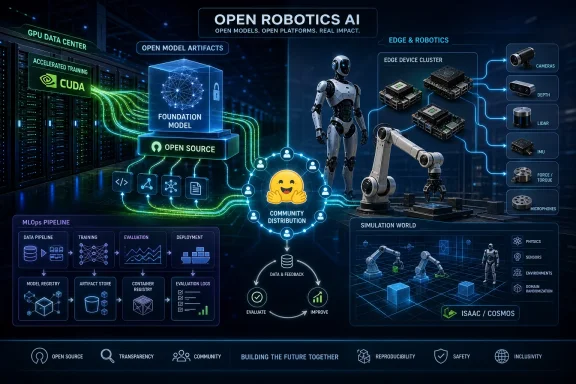
Nvidia’s own recent robotics messaging supports the larger interpretation. The company has been steadily talking less like a chip vendor and more like an operating-system company for physical AI: GPUs for training, Jetson for edge deployment, Isaac for simulation and robotics workflows, Cosmos for world models, GR00T-style robot models for reasoning and action, and Hugging Face as the distribution layer where developers already look for models and datasets. The July 9 coverage is therefore not an isolated partnership notice. It is another piece in Nvidia’s campaign to make robotics development look like modern AI development: download a model, fine-tune it, validate it, deploy it, iterate.
That is a radical simplification of a field that has historically resisted simplification. Robots do not merely answer text prompts. They have to perceive messy environments, plan motion, manipulate objects, recover from failure, respect physical constraints, and run reliably under power, latency, and safety limits. Training data is harder to collect, real-world testing can break equipment, and every deployment site adds new sources of failure. Nvidia’s bet is that open models plus GPU-accelerated simulation can turn that mess into a more standardized software pipeline.
For Windows users and IT pros, the story is not that a humanoid robot will suddenly appear in the office because a model landed on Hugging Face. The practical consequence is subtler: robotics AI is being pulled into the same developer and enterprise infrastructure pattern that already reshaped generative AI. Workstations, GPU drivers, containers, Python environments, source control, model registries, edge devices, and internal governance will become part of the robotics conversation much earlier than many IT departments expect.
Hugging Face is not just a place to host model files. It is where many developers discover models, compare capabilities, inspect licenses, reuse datasets, publish experiments, and build credibility. For language models, that made Hugging Face a kind of open AI commons. For robotics, it could become something even more important: a shared repository for models, policies, datasets, teleoperation traces, simulation environments, and evaluation workflows.
The reason this matters is that robotics has a data bottleneck that plain software does not. A web app can be tested with synthetic inputs and logs. A robot has to learn from demonstrations, simulation, sensor data, failures, and physical interaction. If each vendor keeps its own data formats, task definitions, and evaluation methods locked away, the field remains fragmented. If a shared open-source pipeline becomes credible, developers can build on one another’s work instead of rebuilding every training loop from scratch.
Nvidia’s official materials around LeRobot point in exactly that direction. The company has described work with Hugging Face to bring Nvidia robotics technologies into LeRobot, Hugging Face’s open-source robotics library, so developers can collect data, standardize it, fine-tune robot models, evaluate policies, and deploy through common workflows. That sounds dry until you translate it into operational terms: Nvidia is trying to make robotics development less like bespoke lab work and more like a reproducible MLOps pipeline.
For small and midsize companies, that is the real promise. Finance.biggo argued that robotics manufacturers have traditionally had to train specialized models from scratch for each application, leading to high costs and long development timelines. Open-source, pretrained robotics models could let those companies fine-tune rather than invent. The article suggested development cycles could potentially shrink from months to weeks, though that should be read as an aspiration rather than a guarantee.
The key word is potentially. Open-source models lower the starting cost, but they do not eliminate integration work. A warehouse robot, a surgical assistant, and a factory inspection arm operate under different safety, latency, sensor, and compliance requirements. A foundation model may provide the “brain,” but the nervous system still has to be wired to the body, the environment, and the business process.
Open-source models can expand a market by making experimentation cheap. Once experimentation turns into production, the gravity shifts toward the infrastructure that trains, accelerates, validates, monitors, and deploys those models. Nvidia is especially well positioned because its robotics stack spans both the data center and the edge. Finance.biggo specifically points to the Jetson series as representative of Nvidia’s edge AI platforms, already used in robots, drones, and smart cameras.
That gives Nvidia an end-to-end path: train on GPUs, simulate in Nvidia-backed environments, distribute models through Hugging Face, deploy on Jetson-class edge systems, and use Nvidia software layers to keep the workflow coherent. Even when the model is open, the easiest production route may still run through Nvidia’s hardware and tooling. Open source widens the funnel; the ecosystem captures the spend.
This is why the announcement should not be judged like a consumer product launch. There is no single feature for a Windows user to enable, no app to install, no immediate workplace robot upgrade. The strategic effect is cumulative. Nvidia is trying to ensure that when enterprises decide robotics AI is ready for serious pilots, the default answer to “what stack should we use?” is already Nvidia plus Hugging Face.
That has obvious parallels with CUDA. Nvidia did not win accelerated computing merely by shipping fast chips. It won by making developers organize their work around its software ecosystem. Robotics is more complicated, but the strategic goal is similar: make the developer’s first successful prototype depend on your stack, then make the production version safer, faster, and easier on the same stack.
Hugging Face changes the optics. A closed Nvidia robotics platform would invite resistance from academic labs, startups, and open-source developers. A Hugging Face-distributed model or framework can feel participatory, inspectable, and hackable. That matters in robotics, where credibility often comes from shared benchmarks, reproducible demos, and community experimentation rather than vendor claims alone.
Robotics and agents are two expressions of the same platform ambition. A software agent takes goals, calls tools, checks results, and acts inside digital systems. A robot does something similar in the physical world, except the tools are motors, sensors, cameras, grippers, and environment models. Both require planning, memory, tool use, evaluation, safety boundaries, and a runtime that enterprises can observe and govern.
That is why Nvidia’s use of Nemotron and LangChain is relevant to the robotics announcement. The company is not merely trying to provide isolated models. It is trying to provide the foundations for autonomous systems, whether those systems are moving files through enterprise workflows or moving objects through a warehouse.
The common thread is that Nvidia wants to own the scaffolding around intelligence. In the first wave of generative AI, the central question was “which model is smartest?” In the next wave, the question becomes “which environment lets a model do useful work safely and repeatedly?” That is a better question for Nvidia, because environments require compute, orchestration, deployment infrastructure, and developer loyalty.
This also explains the emphasis on open stacks. Enterprises are increasingly wary of black-box AI services that are difficult to customize, expensive to scale, or impossible to run under internal governance. An open model with an open harness and a deployable runtime is easier to sell to a CIO than a magical demo with unclear operating boundaries. Nvidia’s pitch is that companies can have openness without giving up performance or production tooling.
But the word “open” needs careful handling. Open-source availability does not automatically mean open economics. A model can be downloadable while still being optimized for one vendor’s accelerators, one deployment path, or one surrounding toolkit. The lock-in is not always in the license; sometimes it is in the convenience.
That matters because AI platform power is no longer measured only by revenue or benchmark charts. It is measured by what researchers build on by default. If graduate students, startup researchers, and enterprise labs use Nvidia GPUs, Nvidia datasets, Nvidia model families, and Nvidia tooling to produce their papers and prototypes, then Nvidia becomes part of the intellectual supply chain. By the time a technology is commercialized, the dependency is already baked in.
The company’s ICML narrative also reinforces the July 9 robotics story. Robotics AI is still research-heavy. Many of the hardest problems — generalizable manipulation, sim-to-real transfer, policy evaluation, world modeling, reliable edge inference — remain only partially solved. By presenting open models and datasets as research foundations, Nvidia is trying to pull academic experimentation and industrial deployment onto the same road.
This is a clever position. If Nvidia can make its open models useful enough for research and its hardware essential enough for scale, it wins twice. Research adoption creates legitimacy; production adoption creates revenue. Hugging Face helps bridge those worlds because it is both a research distribution platform and a practical developer hub.
For IT departments, the ICML numbers point to a future procurement problem. The more AI systems are assembled from open models, public datasets, shared benchmarks, and vendor-optimized components, the harder it becomes to draw a clean line between “software we bought,” “research we reused,” and “infrastructure we depend on.” That is already true for language models. Robotics will make it more physical, more operational, and potentially more dangerous when mistakes happen.
That does not mean open-source robotics models are inherently unsafe. In many ways, openness can improve safety because models, datasets, and evaluation methods can be inspected and challenged. But it does mean that enterprise adoption cannot treat a robotics foundation model like another Python package. The control plane matters as much as the model.
The most important missing piece in many robotics pilots is not intelligence; it is validation. A robot has to be tested against edge cases that developers did not imagine, in environments that change, with sensors that degrade, lighting that shifts, humans who behave unpredictably, and mechanical parts that wear down. Simulation helps, and Nvidia is right to emphasize it, but simulation is not reality. It is a filter that reduces risk before physical testing, not a substitute for operational validation.
This is where WindowsForum readers should pay attention. Many organizations will first encounter this wave not through humanoid robots, but through edge AI systems attached to ordinary operations: smart cameras, inspection devices, automated carts, robotic arms, drones, kiosks, and industrial PCs. Those systems still touch familiar IT concerns: identity, patching, drivers, network segmentation, logging, remote access, endpoint protection, and incident response.
A robotics AI model deployed at the edge is not just a model. It is a device fleet. It has firmware, operating-system images, GPU drivers, container runtimes, credentials, telemetry, and update channels. If the AI stack becomes more open and easier to prototype, the burden on IT increases because more teams can create pilots before the organization has a mature policy for running them.
That creates practical friction. Robotics AI workflows often assume Linux-native tooling, CUDA compatibility, containerized dependencies, Python environments, simulator integration, and GPU driver alignment. Windows users may run pieces through WSL, remote GPU servers, or cloud workstations, but the support matrix can become a quiet source of failure. A demo that works on one engineer’s machine can fail when IT tries to standardize it.
The same is true for security. Open-source robotics packages will bring dependencies, model artifacts, dataset files, and notebooks into corporate environments. Some will be benign research assets; others may be stale, poorly maintained, or licensed in ways that create compliance headaches. Hugging Face makes access easier, which is good for innovation, but easy access is exactly why enterprises need model intake policies.
There is also a cost-management lesson. Nvidia and Hugging Face are promising lower barriers, not zero-cost robotics. Training, fine-tuning, simulation, and evaluation can consume serious GPU time. Edge deployment may require Jetson-class hardware or other accelerators. If teams treat open models as free infrastructure, finance and IT will discover the bill later in cloud GPU invoices, workstation upgrades, storage growth, or device procurement.
The healthiest enterprise response is not to block experimentation. It is to channel it. Create approved GPU environments, maintain blessed container images, define where models can be downloaded from, log which datasets are used, and require clear handoff before a robot-adjacent model touches physical equipment. The companies that do this early will move faster because developers will not have to improvise around every control.
July 9 — Finance.biggo reported Nvidia and Hugging Face would jointly develop an open-source AI foundation model specialized for the robotics field.
July 9 — The same finance.biggo report said Nvidia also unveiled an open-stack initiative for AI agent development tied to Nemotron and LangChain.
ICML 2026 — Nvidia’s presented research track record included 74 accepted papers, approximately 2,000 accepted papers citing Nvidia GPUs, and 145 accepted papers citing Nemotron.
The broader thesis is sound: AI competition is moving from isolated model capability to operational completeness. OpenAI’s voice work, as described by finance.biggo, is about making human-AI interaction feel continuous rather than turn-based. Hitachi and NEC are framed as applying AI to industrial knowledge and corporate decision-making. Tesla and UBTECH are cited in the context of humanoid robots and downstream demand.
These examples should not be collapsed into one trend too casually. A real-time voice model, a corporate decision-support system, a humanoid robot, and an open-source robotics foundation model are different products with different risks. But they do share one direction: AI is being embedded into workflows where latency, reliability, context, and action matter more than a static benchmark score.
That is exactly the environment Nvidia wants. The more AI becomes infrastructure, the more valuable infrastructure suppliers become. The company’s historical identity as a graphics semiconductor firm is now almost inadequate. Nvidia is positioning itself as a provider of AI compute, model families, developer frameworks, robotics pipelines, agent stacks, and edge deployment hardware. In other words, it wants to be the company under the companies building the AI future.
There is a danger here for the industry. If the same vendor’s hardware, tooling, models, and reference workflows become the default at every layer, open-source development may still converge around a highly concentrated infrastructure base. That may be efficient, and it may accelerate robotics adoption, but it also makes ecosystem diversity harder. Open models reduce one form of lock-in while potentially strengthening another.
Robotics will inherit that lesson with sharper consequences. A flaky database can take down a service. A flaky robotics data pipeline can poison model evaluation. A stale dependency can break a deployment workflow. A rare bug in edge software can appear only after thousands of hours of operation. The “invisible infrastructure” becomes visible only when it fails.
This is where Nvidia’s stack strategy looks less like marketing and more like risk management. Enterprises do not simply need smarter models; they need repeatable toolchains. They need to know how training data was collected, how policies were evaluated, what hardware was used, which runtime executed the model, and how updates will be rolled back. Those questions are mundane until a robot behaves unpredictably.
Open source helps only if the surrounding process is disciplined. A model card is not a safety case. A GitHub repository is not a validation plan. A successful lab demo is not an operational deployment. Nvidia and Hugging Face can lower the barrier to entry, but the barrier to responsible production should remain high.
That distinction is likely to define the next phase of robotics AI. The winners will not be the organizations that download the most models. They will be the ones that build the best loop between simulation, real-world testing, monitoring, human oversight, and controlled deployment. Nvidia wants its tools to be the default loop.
But lowering the cost of entry changes who can create risk. In the old robotics world, expensive hardware and specialized expertise acted as natural gates. In the new one, a software team may be able to prototype robot behavior with open tools long before the organization has robotics-grade operational controls. That democratization is powerful, but it can also move experimentation ahead of governance.
This is not an argument against open-source robotics. It is an argument for treating open-source robotics as infrastructure rather than hobbyist software. The more accessible the stack becomes, the more organizations need internal rules for model provenance, dataset rights, simulation coverage, hardware compatibility, and incident response. “We found it on Hugging Face” is not a deployment strategy.
The same lesson applies to developers. The exciting part of an open foundation model is that it gives you a starting point. The dangerous part is believing the starting point understands your environment. Fine-tuning can adapt a model, but it can also overfit. Simulation can reveal failures, but it can also miss real-world messiness. Edge deployment can reduce latency, but it adds fleet-management problems.
Nvidia’s role here is both enabling and self-interested. The company benefits when more developers can build robotics AI. It also benefits when those developers need Nvidia-accelerated tools to train, simulate, and deploy. Hugging Face benefits by extending its open-source AI hub deeper into physical AI. Robotics developers benefit if the collaboration gives them reusable models and workflows. Enterprises benefit only if they pair that speed with controls.
That means familiar Windows-era problems will reappear in a new form. Driver mismatches will break AI workloads. Untracked downloads will become compliance risks. Shadow IT teams will spin up GPU experiments. Edge devices will need patching. Remote access will require controls. Logs will matter after incidents. Procurement will discover that “open source” and “cheap” are not synonyms.
The Nvidia-Hugging Face move is also a reminder that AI strategy cannot be separated from hardware strategy. Companies standardizing on Nvidia GPUs in the data center may find it easier to adopt Nvidia-flavored robotics workflows. Teams experimenting with Jetson devices may find Hugging Face-hosted models lowering the barrier to useful prototypes. Windows developers may increasingly work in hybrid setups where the desktop is Windows, the tooling is Linux-oriented, the runtime is containerized, and the deployment target is an edge AI module.
That hybridity is manageable, but only if IT treats it as a first-class platform. The old pattern — let researchers do whatever they need, then productionize later — becomes riskier when the software eventually controls physical systems. The productionization conversation needs to start before the first compelling demo, not after.
Nvidia’s July 9 Hugging Face announcement is therefore best understood as a bid to define the default rails for physical AI before the market hardens around anyone else’s. If the company succeeds, the next generation of robotics developers may begin not with a blank codebase or a proprietary lab stack, but with an open model, a Hugging Face workflow, Nvidia acceleration underneath, and an enterprise IT department suddenly responsible for making sure the robot’s brain is not just impressive, but dependable.
 Nvidia Wants the Robot Stack Before the Robot Boom Fully Arrives
The Nvidia-Hugging Face collaboration lands at a moment when robotics has become the most convincing answer to the question hanging over the AI industry: what comes after chatbots? As Bloomingbit reported, Nvidia said the joint effort is aimed at building open-source AI models tailored for robotics, with the explicit goal of reducing the technical and cost barriers involved in training and deploying models for robots. Finance.biggo described the same move more ambitiously, calling it a push to jointly develop an open-source AI foundation model specialized for robotics.That difference in framing matters. “AI models for robots” sounds like a developer enablement story. “Foundation model specialized for robotics” sounds like a platform war. The first suggests Nvidia is helping builders move faster; the second suggests Nvidia is trying to define the common base layer for a future market in which humanoids, industrial arms, drones, smart cameras, and autonomous machines share more software DNA than they do today.
Nvidia’s own recent robotics messaging supports the larger interpretation. The company has been steadily talking less like a chip vendor and more like an operating-system company for physical AI: GPUs for training, Jetson for edge deployment, Isaac for simulation and robotics workflows, Cosmos for world models, GR00T-style robot models for reasoning and action, and Hugging Face as the distribution layer where developers already look for models and datasets. The July 9 coverage is therefore not an isolated partnership notice. It is another piece in Nvidia’s campaign to make robotics development look like modern AI development: download a model, fine-tune it, validate it, deploy it, iterate.
That is a radical simplification of a field that has historically resisted simplification. Robots do not merely answer text prompts. They have to perceive messy environments, plan motion, manipulate objects, recover from failure, respect physical constraints, and run reliably under power, latency, and safety limits. Training data is harder to collect, real-world testing can break equipment, and every deployment site adds new sources of failure. Nvidia’s bet is that open models plus GPU-accelerated simulation can turn that mess into a more standardized software pipeline.
For Windows users and IT pros, the story is not that a humanoid robot will suddenly appear in the office because a model landed on Hugging Face. The practical consequence is subtler: robotics AI is being pulled into the same developer and enterprise infrastructure pattern that already reshaped generative AI. Workstations, GPU drivers, containers, Python environments, source control, model registries, edge devices, and internal governance will become part of the robotics conversation much earlier than many IT departments expect.
Hugging Face Supplies the Distribution Nvidia Cannot Manufacture Alone
Nvidia’s advantage is obvious: it owns the compute stack that much of the AI industry already depends on. The fact table’s wording is precise here: the partnership combines Nvidia’s graphics processing unit ecosystem with Hugging Face’s large developer community. That combination is the whole strategy.Hugging Face is not just a place to host model files. It is where many developers discover models, compare capabilities, inspect licenses, reuse datasets, publish experiments, and build credibility. For language models, that made Hugging Face a kind of open AI commons. For robotics, it could become something even more important: a shared repository for models, policies, datasets, teleoperation traces, simulation environments, and evaluation workflows.
The reason this matters is that robotics has a data bottleneck that plain software does not. A web app can be tested with synthetic inputs and logs. A robot has to learn from demonstrations, simulation, sensor data, failures, and physical interaction. If each vendor keeps its own data formats, task definitions, and evaluation methods locked away, the field remains fragmented. If a shared open-source pipeline becomes credible, developers can build on one another’s work instead of rebuilding every training loop from scratch.
Nvidia’s official materials around LeRobot point in exactly that direction. The company has described work with Hugging Face to bring Nvidia robotics technologies into LeRobot, Hugging Face’s open-source robotics library, so developers can collect data, standardize it, fine-tune robot models, evaluate policies, and deploy through common workflows. That sounds dry until you translate it into operational terms: Nvidia is trying to make robotics development less like bespoke lab work and more like a reproducible MLOps pipeline.
For small and midsize companies, that is the real promise. Finance.biggo argued that robotics manufacturers have traditionally had to train specialized models from scratch for each application, leading to high costs and long development timelines. Open-source, pretrained robotics models could let those companies fine-tune rather than invent. The article suggested development cycles could potentially shrink from months to weeks, though that should be read as an aspiration rather than a guarantee.
The key word is potentially. Open-source models lower the starting cost, but they do not eliminate integration work. A warehouse robot, a surgical assistant, and a factory inspection arm operate under different safety, latency, sensor, and compliance requirements. A foundation model may provide the “brain,” but the nervous system still has to be wired to the body, the environment, and the business process.
The Open Model Is the Hook; the Full Stack Is the Business
Nvidia’s public story is openness. Its business story is stack completeness. Those are not contradictions; they are the modern AI platform playbook.Open-source models can expand a market by making experimentation cheap. Once experimentation turns into production, the gravity shifts toward the infrastructure that trains, accelerates, validates, monitors, and deploys those models. Nvidia is especially well positioned because its robotics stack spans both the data center and the edge. Finance.biggo specifically points to the Jetson series as representative of Nvidia’s edge AI platforms, already used in robots, drones, and smart cameras.
That gives Nvidia an end-to-end path: train on GPUs, simulate in Nvidia-backed environments, distribute models through Hugging Face, deploy on Jetson-class edge systems, and use Nvidia software layers to keep the workflow coherent. Even when the model is open, the easiest production route may still run through Nvidia’s hardware and tooling. Open source widens the funnel; the ecosystem captures the spend.
This is why the announcement should not be judged like a consumer product launch. There is no single feature for a Windows user to enable, no app to install, no immediate workplace robot upgrade. The strategic effect is cumulative. Nvidia is trying to ensure that when enterprises decide robotics AI is ready for serious pilots, the default answer to “what stack should we use?” is already Nvidia plus Hugging Face.
That has obvious parallels with CUDA. Nvidia did not win accelerated computing merely by shipping fast chips. It won by making developers organize their work around its software ecosystem. Robotics is more complicated, but the strategic goal is similar: make the developer’s first successful prototype depend on your stack, then make the production version safer, faster, and easier on the same stack.
Hugging Face changes the optics. A closed Nvidia robotics platform would invite resistance from academic labs, startups, and open-source developers. A Hugging Face-distributed model or framework can feel participatory, inspectable, and hackable. That matters in robotics, where credibility often comes from shared benchmarks, reproducible demos, and community experimentation rather than vendor claims alone.
Two Nvidia AI Plays Are Converging on the Same Enterprise Buyer
Finance.biggo added an important parallel development: Nvidia simultaneously unveiled an open-stack initiative to support AI agent development, strengthening integration with its Nemotron models and LangChain. That might look like a separate enterprise AI story, but it belongs in the same strategic map.Robotics and agents are two expressions of the same platform ambition. A software agent takes goals, calls tools, checks results, and acts inside digital systems. A robot does something similar in the physical world, except the tools are motors, sensors, cameras, grippers, and environment models. Both require planning, memory, tool use, evaluation, safety boundaries, and a runtime that enterprises can observe and govern.
That is why Nvidia’s use of Nemotron and LangChain is relevant to the robotics announcement. The company is not merely trying to provide isolated models. It is trying to provide the foundations for autonomous systems, whether those systems are moving files through enterprise workflows or moving objects through a warehouse.
| Nvidia initiative | Primary domain | Named ecosystem pieces | Developer promise | Enterprise risk to manage |
|---|---|---|---|---|
| Hugging Face robotics collaboration | Physical AI and robots | GPU ecosystem, Hugging Face community, Jetson series | Lower technical and cost barriers for training and deploying robotics AI | Safety, hardware integration, validation, data quality |
| Open-stack agent initiative | Enterprise AI agents | Nemotron, LangChain | Easier development of autonomous agents that plan and use tools | Governance, permissions, auditability, tool misuse |
| ICML 2026 open-model push | AI research infrastructure | Nvidia GPUs, Nemotron, open datasets | Reusable foundations for research and industrial development | Reproducibility, dependency concentration, vendor gravity |
This also explains the emphasis on open stacks. Enterprises are increasingly wary of black-box AI services that are difficult to customize, expensive to scale, or impossible to run under internal governance. An open model with an open harness and a deployable runtime is easier to sell to a CIO than a magical demo with unclear operating boundaries. Nvidia’s pitch is that companies can have openness without giving up performance or production tooling.
But the word “open” needs careful handling. Open-source availability does not automatically mean open economics. A model can be downloadable while still being optimized for one vendor’s accelerators, one deployment path, or one surrounding toolkit. The lock-in is not always in the license; sometimes it is in the convenience.
ICML 2026 Shows Nvidia Selling Infrastructure as Research Gravity
The International Conference on Machine Learning detail in the source material is more than corporate bragging. Finance.biggo says Nvidia presented a track record at ICML 2026 that included 74 accepted papers, approximately 2,000 accepted papers citing Nvidia GPUs, and 145 accepted papers citing Nemotron. Those figures are meant to show that Nvidia’s influence extends beyond hardware shipments into the research substrate itself.That matters because AI platform power is no longer measured only by revenue or benchmark charts. It is measured by what researchers build on by default. If graduate students, startup researchers, and enterprise labs use Nvidia GPUs, Nvidia datasets, Nvidia model families, and Nvidia tooling to produce their papers and prototypes, then Nvidia becomes part of the intellectual supply chain. By the time a technology is commercialized, the dependency is already baked in.
The company’s ICML narrative also reinforces the July 9 robotics story. Robotics AI is still research-heavy. Many of the hardest problems — generalizable manipulation, sim-to-real transfer, policy evaluation, world modeling, reliable edge inference — remain only partially solved. By presenting open models and datasets as research foundations, Nvidia is trying to pull academic experimentation and industrial deployment onto the same road.
This is a clever position. If Nvidia can make its open models useful enough for research and its hardware essential enough for scale, it wins twice. Research adoption creates legitimacy; production adoption creates revenue. Hugging Face helps bridge those worlds because it is both a research distribution platform and a practical developer hub.
For IT departments, the ICML numbers point to a future procurement problem. The more AI systems are assembled from open models, public datasets, shared benchmarks, and vendor-optimized components, the harder it becomes to draw a clean line between “software we bought,” “research we reused,” and “infrastructure we depend on.” That is already true for language models. Robotics will make it more physical, more operational, and potentially more dangerous when mistakes happen.
Robots Turn Model Governance Into an Operational Safety Problem
Most enterprise AI governance today is still built around information risk: hallucinated answers, data leakage, copyright exposure, biased outputs, insecure code, and unauthorized tool calls. Robotics adds kinetic risk. A bad answer can mislead a user; a bad robot policy can damage equipment or injure someone.That does not mean open-source robotics models are inherently unsafe. In many ways, openness can improve safety because models, datasets, and evaluation methods can be inspected and challenged. But it does mean that enterprise adoption cannot treat a robotics foundation model like another Python package. The control plane matters as much as the model.
The most important missing piece in many robotics pilots is not intelligence; it is validation. A robot has to be tested against edge cases that developers did not imagine, in environments that change, with sensors that degrade, lighting that shifts, humans who behave unpredictably, and mechanical parts that wear down. Simulation helps, and Nvidia is right to emphasize it, but simulation is not reality. It is a filter that reduces risk before physical testing, not a substitute for operational validation.
This is where WindowsForum readers should pay attention. Many organizations will first encounter this wave not through humanoid robots, but through edge AI systems attached to ordinary operations: smart cameras, inspection devices, automated carts, robotic arms, drones, kiosks, and industrial PCs. Those systems still touch familiar IT concerns: identity, patching, drivers, network segmentation, logging, remote access, endpoint protection, and incident response.
A robotics AI model deployed at the edge is not just a model. It is a device fleet. It has firmware, operating-system images, GPU drivers, container runtimes, credentials, telemetry, and update channels. If the AI stack becomes more open and easier to prototype, the burden on IT increases because more teams can create pilots before the organization has a mature policy for running them.
Windows Developers Will Meet This Through Workstations, WSL, and Edge Pipelines
Nvidia’s robotics push is not a Windows feature story, but Windows users are still in the blast radius. A large share of developers, engineers, and enterprise users still begin AI experimentation on Windows workstations before moving workloads to Linux servers, containers, or cloud GPUs. The easier Nvidia and Hugging Face make robotics experimentation, the more likely those experiments are to start on mixed Windows-and-Linux developer setups.That creates practical friction. Robotics AI workflows often assume Linux-native tooling, CUDA compatibility, containerized dependencies, Python environments, simulator integration, and GPU driver alignment. Windows users may run pieces through WSL, remote GPU servers, or cloud workstations, but the support matrix can become a quiet source of failure. A demo that works on one engineer’s machine can fail when IT tries to standardize it.
The same is true for security. Open-source robotics packages will bring dependencies, model artifacts, dataset files, and notebooks into corporate environments. Some will be benign research assets; others may be stale, poorly maintained, or licensed in ways that create compliance headaches. Hugging Face makes access easier, which is good for innovation, but easy access is exactly why enterprises need model intake policies.
There is also a cost-management lesson. Nvidia and Hugging Face are promising lower barriers, not zero-cost robotics. Training, fine-tuning, simulation, and evaluation can consume serious GPU time. Edge deployment may require Jetson-class hardware or other accelerators. If teams treat open models as free infrastructure, finance and IT will discover the bill later in cloud GPU invoices, workstation upgrades, storage growth, or device procurement.
The healthiest enterprise response is not to block experimentation. It is to channel it. Create approved GPU environments, maintain blessed container images, define where models can be downloaded from, log which datasets are used, and require clear handoff before a robot-adjacent model touches physical equipment. The companies that do this early will move faster because developers will not have to improvise around every control.
Timeline
July 9 — Bloomingbit reported that Nvidia announced a joint effort with Hugging Face to develop open-source AI models tailored for robotics.July 9 — Finance.biggo reported Nvidia and Hugging Face would jointly develop an open-source AI foundation model specialized for the robotics field.
July 9 — The same finance.biggo report said Nvidia also unveiled an open-stack initiative for AI agent development tied to Nemotron and LangChain.
ICML 2026 — Nvidia’s presented research track record included 74 accepted papers, approximately 2,000 accepted papers citing Nvidia GPUs, and 145 accepted papers citing Nemotron.
The OpenAI, Hitachi, NEC, Tesla, and UBTECH Mentions Reveal the Bigger Frame
Finance.biggo’s article widened the lens beyond Nvidia and Hugging Face, and that is useful even if some of the examples sit outside the robotics-model announcement itself. It referenced OpenAI’s reported rollout of “GPT Live,” described as a real-time voice conversation model using a full-duplex architecture. It also pointed to Hitachi, NEC, Tesla, and UBTECH as examples of AI and robotics demand moving toward real industrial or consumer-facing systems.The broader thesis is sound: AI competition is moving from isolated model capability to operational completeness. OpenAI’s voice work, as described by finance.biggo, is about making human-AI interaction feel continuous rather than turn-based. Hitachi and NEC are framed as applying AI to industrial knowledge and corporate decision-making. Tesla and UBTECH are cited in the context of humanoid robots and downstream demand.
These examples should not be collapsed into one trend too casually. A real-time voice model, a corporate decision-support system, a humanoid robot, and an open-source robotics foundation model are different products with different risks. But they do share one direction: AI is being embedded into workflows where latency, reliability, context, and action matter more than a static benchmark score.
That is exactly the environment Nvidia wants. The more AI becomes infrastructure, the more valuable infrastructure suppliers become. The company’s historical identity as a graphics semiconductor firm is now almost inadequate. Nvidia is positioning itself as a provider of AI compute, model families, developer frameworks, robotics pipelines, agent stacks, and edge deployment hardware. In other words, it wants to be the company under the companies building the AI future.
There is a danger here for the industry. If the same vendor’s hardware, tooling, models, and reference workflows become the default at every layer, open-source development may still converge around a highly concentrated infrastructure base. That may be efficient, and it may accelerate robotics adoption, but it also makes ecosystem diversity harder. Open models reduce one form of lock-in while potentially strengthening another.
The Rockset Anecdote Is a Warning About Boring Infrastructure
One of the most revealing details in the finance.biggo source has nothing to do with robots. It describes an OpenAI case study involving Rockset, a high-speed data platform built with C++, where automated analysis using ChatGPT reportedly identified a bug that had been lurking in open-source code for 18 years. The point of including that anecdote is not that ChatGPT debugging will save robotics. It is that infrastructure failures become existential when AI services operate at massive scale.Robotics will inherit that lesson with sharper consequences. A flaky database can take down a service. A flaky robotics data pipeline can poison model evaluation. A stale dependency can break a deployment workflow. A rare bug in edge software can appear only after thousands of hours of operation. The “invisible infrastructure” becomes visible only when it fails.
This is where Nvidia’s stack strategy looks less like marketing and more like risk management. Enterprises do not simply need smarter models; they need repeatable toolchains. They need to know how training data was collected, how policies were evaluated, what hardware was used, which runtime executed the model, and how updates will be rolled back. Those questions are mundane until a robot behaves unpredictably.
Open source helps only if the surrounding process is disciplined. A model card is not a safety case. A GitHub repository is not a validation plan. A successful lab demo is not an operational deployment. Nvidia and Hugging Face can lower the barrier to entry, but the barrier to responsible production should remain high.
That distinction is likely to define the next phase of robotics AI. The winners will not be the organizations that download the most models. They will be the ones that build the best loop between simulation, real-world testing, monitoring, human oversight, and controlled deployment. Nvidia wants its tools to be the default loop.
Action checklist for admins
- Inventory any teams already using Hugging Face robotics models, Nvidia Isaac tools, Jetson devices, or GPU-backed simulation environments.
- Create an approved path for downloading and storing open AI models, including license review and artifact tracking.
- Standardize GPU driver, CUDA, container, and WSL configurations for developer workstations that touch robotics or edge AI projects.
- Require simulation, evaluation logs, rollback plans, and human-override procedures before any model controls physical equipment.
- Segment robotics and edge AI devices from core business networks, with explicit rules for telemetry, remote access, and update channels.
- Treat robotics datasets as sensitive operational assets, especially when they include video, facility layouts, human demonstrations, or proprietary process data.
The Cost Barrier Falls First; the Safety Barrier Should Not
The most commercially attractive claim in the July 9 reporting is that Nvidia and Hugging Face can lower the technical and cost barriers to robotics AI. That is plausible. Pretrained open models, shared datasets, simulation frameworks, and standardized workflows can reduce the amount of custom work needed to get started.But lowering the cost of entry changes who can create risk. In the old robotics world, expensive hardware and specialized expertise acted as natural gates. In the new one, a software team may be able to prototype robot behavior with open tools long before the organization has robotics-grade operational controls. That democratization is powerful, but it can also move experimentation ahead of governance.
This is not an argument against open-source robotics. It is an argument for treating open-source robotics as infrastructure rather than hobbyist software. The more accessible the stack becomes, the more organizations need internal rules for model provenance, dataset rights, simulation coverage, hardware compatibility, and incident response. “We found it on Hugging Face” is not a deployment strategy.
The same lesson applies to developers. The exciting part of an open foundation model is that it gives you a starting point. The dangerous part is believing the starting point understands your environment. Fine-tuning can adapt a model, but it can also overfit. Simulation can reveal failures, but it can also miss real-world messiness. Edge deployment can reduce latency, but it adds fleet-management problems.
Nvidia’s role here is both enabling and self-interested. The company benefits when more developers can build robotics AI. It also benefits when those developers need Nvidia-accelerated tools to train, simulate, and deploy. Hugging Face benefits by extending its open-source AI hub deeper into physical AI. Robotics developers benefit if the collaboration gives them reusable models and workflows. Enterprises benefit only if they pair that speed with controls.
The Concrete Meaning for WindowsForum Readers
For WindowsForum’s audience, the useful interpretation is not “robots are coming tomorrow.” It is that AI infrastructure is expanding from screens into machines, and the development habits formed around open models are coming with it.That means familiar Windows-era problems will reappear in a new form. Driver mismatches will break AI workloads. Untracked downloads will become compliance risks. Shadow IT teams will spin up GPU experiments. Edge devices will need patching. Remote access will require controls. Logs will matter after incidents. Procurement will discover that “open source” and “cheap” are not synonyms.
The Nvidia-Hugging Face move is also a reminder that AI strategy cannot be separated from hardware strategy. Companies standardizing on Nvidia GPUs in the data center may find it easier to adopt Nvidia-flavored robotics workflows. Teams experimenting with Jetson devices may find Hugging Face-hosted models lowering the barrier to useful prototypes. Windows developers may increasingly work in hybrid setups where the desktop is Windows, the tooling is Linux-oriented, the runtime is containerized, and the deployment target is an edge AI module.
That hybridity is manageable, but only if IT treats it as a first-class platform. The old pattern — let researchers do whatever they need, then productionize later — becomes riskier when the software eventually controls physical systems. The productionization conversation needs to start before the first compelling demo, not after.
What This Announcement Really Changes
The Nvidia-Hugging Face collaboration should be read as an ecosystem acceleration move, not a finished robotics revolution. The most concrete implications are near-term for developers and medium-term for enterprises.- Nvidia and Hugging Face are making robotics AI more accessible by combining Nvidia’s GPU-centered ecosystem with Hugging Face’s open-source developer reach.
- The effort is framed in the source coverage as open-source AI models for robots and, more ambitiously, as an open-source robotics foundation model.
- Nvidia’s simultaneous agent-stack work with Nemotron and LangChain shows the same strategy extending from digital agents to physical AI.
- The Jetson series remains strategically important because robotics models eventually have to run at the edge, not just in the cloud.
- ICML 2026 figures around Nvidia GPUs and Nemotron show Nvidia trying to turn open models into research infrastructure, not just product demos.
- Enterprises should welcome the lower barrier to experimentation while keeping a high bar for validation, safety, governance, and device management.
Nvidia’s July 9 Hugging Face announcement is therefore best understood as a bid to define the default rails for physical AI before the market hardens around anyone else’s. If the company succeeds, the next generation of robotics developers may begin not with a blank codebase or a proprietary lab stack, but with an open model, a Hugging Face workflow, Nvidia acceleration underneath, and an enterprise IT department suddenly responsible for making sure the robot’s brain is not just impressive, but dependable.
References
- Primary source: bloomingbit
Published: 2026-07-09T07:20:10.770544
Loading…
en.bloomingbit.io - Independent coverage: finance.biggo.com
Published: Thu, 09 Jul 2026 06:35:00 GMT
Loading…
finance.biggo.com - Related coverage: huggingface.co
Loading…
huggingface.co - Related coverage: cyberogz.com
Loading…
cyberogz.com - Related coverage: zglg.work
Loading…
zglg.work - Related coverage: nvidia.com
Loading…
www.nvidia.com
- Related coverage: nvidianews.nvidia.com
Loading…
nvidianews.nvidia.com - Related coverage: blogs.nvidia.com
Loading…
blogs.nvidia.com - Related coverage: storium.io
Loading…
www.storium.io - Related coverage: research.nvidia.com
Loading…
research.nvidia.com - Related coverage: tomshardware.com
Nvidia's Nemotron coalition brings eight AI labs together to build open frontier models | Tom's Hardware
Nemotron Coalition's first project is a base model co-developed with Mistral AI and open sourced on release.www.tomshardware.com - Related coverage: axios.com
Loading…
www.axios.com - Related coverage: tomsguide.com
Loading…
www.tomsguide.com - Related coverage: techradar.com